
The genetic code, algebraic codes and double numbers
Sergey V. Petoukhov1
1-Mechanical Engineering Research Institute of Russian Academy of Sciences. Russia, 101990, Moscow, M. Kharitonievskiy pereulok, 4,
http://eng.imash.ru/, [email protected]
Comment: Some elements of this article were presented by the author in his keynote speeches at the following conferences: the International Belgrade Bioinformatics Conference 2018 (Belgrade, Serbia, 18-22 June, 2018, http://belbi.bg.ac.rs/); the 2nd International Conference Artificial Intelligence, Medical Engineering, Education (Moscow, Russia, 6-8 October 2018); the 2nd International Conference on Computer Science, Engineering and Education Applications (Kiev, Ukraine, 27-28 January 2019,). Also an author's presentation with elements of this article was done at the 6th International Conference in Code Biology
(Friedrichsdorf, Germany, 3-7 June 2019,
http://www.codebiology.org/conferences/Friedrichsdorf2019/).
Abstract. The article shows materials to the question about algebraic features of the genetic code and about the dictatorial influence of the DNA and RNA molecules on the whole organism. Presented results testify in favor that the genetic code is an algebraic code related with a wide class of algebraic codes, which are a basis of noise-immune coding of information in communication technologies. Structural features of the genetic systems are associated with hypercomplex double (or hyperbolic) numbers and with bisymmetric doubly stochastic matrices. The received results confirm that represented matrix approaches are effective for modeling genetic phenomena and revealing the interconnections of structures of biological bodies at various levels of their organization. This allows one to think that living organisms are algebraically encoded entities where structures of genetic molecules have the dictatorial influence on inherited structures of the whole organism. New described algebraic approaches and results are discussed.
Keywords: genetic code, DNA, alphabet, amino acids, hypercomplex numbers, doubly stochastic matrix, binary numbers, dyadic groups, tensor product, palindrome.
CONTENTS
1. Introduction
2. The genetic code and genetic matrices
3. The genetic code, dyadic groups and the matrix of dyadic shifts 4. The genetic code and the matrix of Hamming distances
5. Double numbers and inherited macrobiological phenomena
6. Double numbers, bisymmetric doubly stochastic matrices and unitary matrices 7. Mendel's laws of heredity and their matrix modeling
8. Tensor families of genetic matrices and the conception of tensor-matrix memory 9. Genetic matrices of generating and replications of vectors of complementary palindromes
10. Some mathematical features of algebras of multiblock united-double numbers
Some concluding remarks Acknowledgments
References
1. Introduction.
What is the main difference between living cells and inanimate objects? One of the creators of quantum mechanics P. Jordan pointed out the following main difference [McFadden, Al-Khalili, 2018]. Inanimate objects are governed by the average random motion of millions of particles, such that the motion of a single molecule has no influence whatsoever on the whole object. By contrast, the few molecules control dynamics of living cells and have dictatorial influence through quantum-level events that govern their motion and are amplified to influence the entire organism. This insight is usually credited to Erwin Schrödinger, who later claimed that life was different from inorganic chemistry because of its dependence on the dynamics of a small number of molecules. P. Jordan, credited with the authoring the first work on quantum biology, postulated that the mechanisms of living organisms are associated with what he referred to as his ‘amplifier theory’, based on Bohr's notion of the ‘irreversible act of amplification’, required to bring the fuzzy quantum reality into sharp focus by ‘observing’ it [Jordan, 1932]. Jordan claimed that «life's missing laws were the rules of chance and probability (the indeterminism) of the quantum world that were somehow scaled up inside living organisms» [McFadden, Al-Khalili, 2018].
Living bodies are ensembles of a huge number of molecules interrelated by quantum-mechanical, resonant, stochastic and other principles. These ensembles have an amazing ability to inherit their biological traits to their descendants. G.Mendel in his experiments on the crossing of organisms discovered that the inheritance of these characters occurs according to algebraic rules, despite the colossal heterogeneity of the molecular structure of bodies. These algebraic rules of polyhybrid crossbreeding are presented in textbooks since 1906 in the form of Punnett squares, reminiscent of the structure of mathematical matrices. To explain the discovered statistical rules, Mendel proposed the remarkable idea of binary-opposition forms of existence of inheritance factors: dominant and recessive forms, combinations of which are shown in Punnett squares. In our days, many binary-oppositional features of the molecular-genetic systems and the dictatorial influence of genetic molecules on the whole organism are intensively studied [Petoukhov, 2008, 2011, 2016-2019; Petoukhov, He, 2010; Petoukhov, Petukhova, 2017a,b; Petoukhov, Petukhova, Svirin, 2019]. All inherited physiological systems, as parts of a whole organism, must be structurally coupled with a genetic code for transmission to descendants in encoded form. Therefore, inherited macrostructures can bear the imprint of structural features of the genetic code. Taking this into account, genetic biomechanics is developing as a new scientific direction in biomechanics, where symmetrologic approaches play an important role [Petoukhov, 2001, 2003-2006, 2008, 2012, 2015, 2016a,b, 2018a,b, 2019a,b; Petoukhov, He, 2010]. The presented article is devoted to some symmetrologic thematic researches related with DNA binary-opposition structures. The author notes that binary-oppositional structures in the genetic systems can be modeled by means of bisymmetric matrices representing 2-dimensional hypercomplex double (or hyperbolic) numbers and doubly stochastic matrices jointly with their tensor extensions.
authors in the field of mathematical biology. For example, the fine book about the history of mathematical biology "The Mathematics of Life: Numbers in biology and ecology" [Rafael Lahoz-Beltra, 2014] doesn't mention molecules DNA and RNA at all though they have algebraic features of key meaning for biological informatics.
The idea about special mathematical peculiarities of living matter exists long ago. For example V.I. Vernadsky [Vernadsky, 1965] put forward the hypothesis on a non-Euclidean geometry of living nature. Different branches of modern science use various kinds of multi-dimensional numbers – complex numbers, double numbers, dual numbers, quaternions and other hypercomplex numbers. These multi-dimensional numeric systems play the role of the magic tool for development of theories and calculations in problems of heat, light, sounds, fluctuations, elasticity, gravitation, magnetism, electricity, current of liquids, quantum-mechanical phenomena, special theory of relativity, nuclear physics, etc. It seems an important task to investigate what systems of multi-dimensional numbers are connected or can be connected with ensembles of parameters of the genetic code and inherited biological peculiarities. Some results of such investigation are presented in this article. They are connected with double numbers and their algebraic extensions, matrix forms of which give a new class of mathematical models in genetics and some other scientific fields.
The set of all two-dimensional double numbers (which are termed also as hyperbolic numbers, Lorentz numbers, split-complex numbers and perplex numbers) forms algebra over the field of real numbers [Harkin, Harkin, 2004; Kantor, Solodovnikov, 1989]. The algebra is not a division algebra or field since it contains zero divisors. Double numbers aj0+bj1 (where j0 is the real unit; j1 is the imaginary unit; a and b are real numbers) are well known in mathematics and theoretical physics and they have matrix form of their representations by the following bisymmetric matrices: G2 = [a, b; b, a], where a and b are real numbers (Fig. 1.1). Such matrix represetations of double numbers we will be termed simply and briefly as matrix double numbers. In such bisymmetric matrices, components a and b are located along two diagonals in the cruciform shape, which is met below in this article many times. Any bisymmetric matrix of any order with real entries a and b has an orthogonal set of eigenvectors with real eigenvalues.
a, b
b, a = a* 1, 0 0, 1 + b* 0, 1 1, 0 = a*j0 +b*j1;
Fig. 1.1. The decomposition of the bisymmetric matrix [a, b; b, a] into two sparse matrices, where the sparse matrices j0 and j1 are correspondingly matrix representations of the real unit and the imaginary unit of algebra of 2-dimensional double numbers. The multiplication table of these units are shown at right.
An important special case of double numbers and their matrix representations [a, b; b, a] are hyperbolic rotations, which satisfied the condition a2 – b2 =1. Hyperbolic rotations are represented in the special theory of relativity, in Minkowski geometry and in some other physical and mathematical fields. The algebra of double numbers can be extended to algebras of 2n-dimensional double numbers having also representations by bisymmetric (2n*2n )-matrices.
many others). These new results add previous author's results of matrix analysis of structures of genetic systems and also his publications on united-hypercomplex numbers [Petoukhov, 2008, 2011a,b, 2016b, 2017, 2018; Petoukhov, He, 2010; Petoukhov, Petukhova, Svirin, 2019 ].
2. The genetic code and genetic matrices
In DNA molecules genetic information is written in sequences of 4 kinds of nucleobases: adenine A, cytosine C, guanine G and thymine T. They form a DNA alphabet of 4 monoplets. In addition, DNA alphabets of 16 doublets and 64 triplets also exist. As known, the set of these 4 nucleobases A, C, G and T is endowed with binary-oppositional indicators:
- 1) in the double helix of DNA there are two complementary pairs of letters: the letters C and G are connected by three hydrogen bonds, and the letters A and T by two hydrogen bonds. Given these oppositional indicators, one can represent C = G = 1 and A = T = 0; - 2) the two letters are keto molecules (G and T), and the other two are amino molecules (A and C). Given these oppositional indicators, one can represent A = C = 1, G = T = 0.
Taking this into account, it is convenient to present DNA alphabets of 4 letters, 16 doublets and 64 triplets in the form of square tables, the columns of which are numbered in accordance with oppositional indicators “3 or 2 hydrogen bonds” (C = G = 1, A = T = 0), and the rows in accordance with oppositional indicators “amino or keto” (С = А = 1, G = T = 0). In such tables, all letters, doublets and triplets automatically occupy their strictly individual places (Fig. 2).
11 10 01 00
1 0 11 GG GT TG TT
1 G T 10 GC GA TC TA
0 C A 01 CG CT AG AT
00 CC CA AC AA
111 110 101 100 011 010 001 000 111 GGG GGT GTG GTT TGG TGT TTG TTT 110 GGC GGA GTC GTA TGC TGA TTC TTA 101 GCG GCT GAG GAT TCG TCT TAG TAT 100 GCC GCA GAC GAA TCC TCA TAC TAA 011 CGG CGT CTG CTT AGG AGT ATG ATT 010 CGC CGA CTC CTA AGC AGA ATC ATA 001 CCG CCT CAG CAT ACG ACT AAG AAT 000 CCC CCA CAC CAA ACC ACA AAC AAA
Fig. 2.1. The square tables of DNA-alphabets of 4 nucleotides, 16 doublets and 64 triplets with a strict arrangement of all components. Each of tables is constructed in line with the principle of binary numeration of its column and rows on the basis of binary-oppositional indicators of nucleobases A, C, G and T (see explanations in the text).
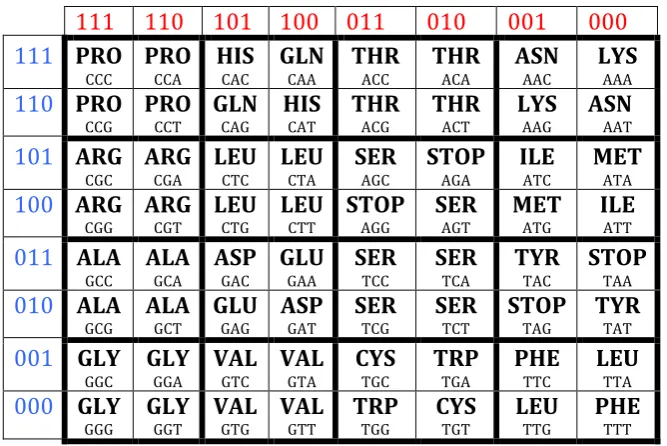
The genetic code is called a "degenerate code" because 64 triplets encode 20 amino acids and stop-codons so that several triplets can encode each amino acid at once and each triplet necessarily encodes only a single amino acid or a stop-codon. The (8x8)-matrix of 64 triplets (Fig. 2.1) was built formally without any mention of amino acids and stop-codons. Nothing data preliminary exist on a possible correspondence between triplets and amino acids. How can these 20 amino acids and stop-codons be located in this matrix of 64 triplets? There are a huge number of possible options for the location and repetition of separate amino acids and stop-codons in 64 cells of this matrix. More precisely, the number of these options is much more than 10100 (for comparison, the entire time of the Universe existance is estimated in modern physics at 1017 seconds). But Nature uses - from this huge number of options - only a very specific repetition and arrangement of separate amino acids and stop-codons, the analysis of which is important for revealing the structural organization of the informational foundations of living matter.
Fig. 2.2 shows the real repetition and location of amino acids and stop-codons in the Vertebrate Mitochondrial Code, which is the most symmetrical among known dialects on the genetic code. This genetic code is called the most ancient and "ideal" in genetics [Frank-Kamenetskii, 1988] (other dialects of the genetic code have small differences from this one, which is considered in the theory of symmetries as the basic from the structural standpoint).
111 110 101 100 011 010 001 000
111 PRO CCC PRO CCA HIS CAC GLN CAA THR ACC THR ACA ASN AAC LYS AAA 110 PRO
CCG PRO CCT GLN CAG HIS CAT THR ACG THR ACT LYS AAG ASN AAT 101 ARG
CGC ARG CGA LEU CTC LEU CTA SER AGC STOP AGA ILE ATC MET ATA 100 ARG
CGG ARG CGT LEU CTG LEU CTT STOP AGG SER AGT MET ATG ILE ATT 011 ALA
GCC ALA GCA ASP GAC GLU GAA SER TCC SER TCA TYR TAC STOP TAA 010 ALA
GCG ALA GCT GLU GAG ASP GAT SER TCG SER TCT STOP TAG TYR TAT 001 GLY
GGC GLY GGA VAL GTC VAL GTA CYS TGC TRP TGA PHE TTC LEU TTA 000 GLY
GGG GLY GGT VAL GTG VAL GTT TRP TGG CYS TGT LEU TTG PHE TTT
Fig. 2.2. The location and repetition of 20 amino acids and 4 stop-codons (denoted by bold) in the matrix of 64 triplets [C, A; G, T](3) (Fig. 2) for the Vertebrate Mitochondrial Code. The symbol “Stop” refers to stop-codons.
The location and repetition of all amino acids and stop-codons in the matrix of 64 triplets have the following feature (Fig. 2.2):
• Each of sixthteen (2*2)-subquadrants, forming this genetic matrix and denoted by bold frames, is bisymmerical: each of its both diagonals contains an identical kind of amino acids or stop-codon.
(Fig. 1.1). In other words, this phenomenologic arrangement of amino acids and stop-codons in the matrix of 64 triplets is associated to the multiblock union of matrix presentations of 16 two-dimensional double numbers.
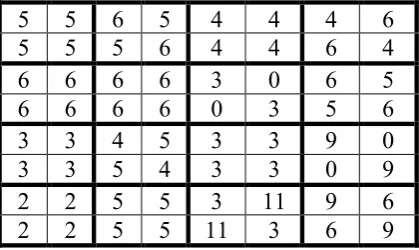
Fig. 2.3. The numeric analogue of the symbolic (8*8)-matrix of amino acids and stop-codons from Fig. 2.2 for the case of representing each of amino acids by numbers of its carbon atoms (stop-codons are conditionally represented by zero).
One should note an additional connection of genetic matrices in Fig. 2.1 with double numbers. Let us denote in these matrices purines A and G by the traditional symbol R, and pyrimidines C and T by the symbol Y. Then these matrices (Fig. 2.4) will represent 2-, 4- and 8-dimensional double numbers R + Yj1, RR + RYj1 + YRj2 + YYj3, RRR+RRYj1+RYRj2+ RYYj3+YRRj4+YRYj5+YYRj6+YYYj7 correspondingly.
RR RY YR YY R Y RY RR YY YR Y R YR YY RR RY YY YR RY RR
RRR RRY RYR RYY YRR YRY YYR YYY RRY RRR RYY RYR YRY YRR YYY YYR RYR RYY RRR RRY YYR YYY YRR YRY RYY RYR RRY RRR YYY YYR YRY YRR YRR YRY YYR YYY RRR RRY RYR RYY YRY YRR YYY YYR RRY RRR RYY RYR YYR YYY YRR YRY RYR RYY RRR RRY YYY YYR YRY YRR RYY RYR RRY RRR
Fig. 2.4. Transformations of the genetic matrices from Fig. 2.1 under denotations of their purines A and G by the symbol R, and pyrimidines C and T by the symbol Y.
The mentioned connection between the matrices in Fig. 2.4 correspondingly with 2-, 4- and 8-dimensional double numbers is revealed by the decompositions of these matrices on the basis of dyadic shifts described below. Fig. 2.5 shows an explanation example of the dyadic-shift dcomposition of the (4*4)-matrix of 16 doublets from Fig. 2.4 into the sum of 4 sparse matrices, which represent basis units j0, j1, j2, and j3 of 4-dimensional double numbers. This set of 4 sparse matrices is closed relative multiplication and it defines the multiplication table of the algebra of 4-dimensional double numbers.
RR RY YR YY RY RR YY YR YR YY RR RY
YY YR RY RR = RR
1 0 0 0 0 1 0 0 0 0 1 0 0 0 0 1 +RY
0 1 0 0 1 0 0 0 0 0 0 1
0 0 1 0 + YR
0 0 1 0 0 0 0 1 1 0 0 0 0 1 0 0 + YY
0 0 0 1 0 0 1 0 0 1 0 0 1 0 0 0
5 5 6 5 4 4 4 6
5 5 5 6 4 4 6 4
6 6 6 6 3 0 6 5
6 6 6 6 0 3 5 6
3 3 4 5 3 3 9 0
3 3 5 4 3 3 0 9
2 2 5 5 3 11 9 6
Fig. 2.5. The dyadic-shift decomposition of the genetic (4*4)-matrix from Fig. 2.4.
Demonstrated by the matrices in Figs. 2.2-2.5, the connection of the genetic code with double numbers supplements the following statement of the author, presented in a number of his publications [Petoukhov, 2008, 2016a,b, 2018; Petoukhov, He, 2010, etc.]. The genetic code is not just a mapping of one set of elements to other sets of elements by type, for example, of a phone book in which phone numbers encode names of people. But the genetic code is inherently an algebraic code, akin to those algebraic codes that are used in modern communication theory for noise-immune transmission of information. Algebraic features of the genetic code participate in noise-immune properties of this code and of the whole genetic system.
One can explain the meaning and possibilities of algebraic codes by the example of transmitting a photograph of the Marsian surface from Mars to Earth using electromagnetic signals. On the way to the Earth, these signals travel millions of kilometers of interference and arrive at the Earth in a very weakened and distorted form. But, in a magical way, based on these mutilated signals on Earth, a high-quality photograph of the surface of Mars is recreated. The secret of this magic lies in the fact that from Mars not the information signals about this photo are sent, but algebraically encoded versions of these signals that is quite other signals. At receivers on Earth, these algebraically encoded signals are algebraically decoded into signals, which recreate the original photographic image of the surface of Mars. It should be emphasized that algebraic coding of information in the theory of noise-immune communication actively uses the mathematical apparatus of matrices, which is also used in quantum informatics and quantum mechanics as matrix operators.
By analogy with this example from the theory of noise-immune communications, the author’s statement, that the genetic code of amino acids is algebraic one, entails the following author’s hypothesis: the molecular-genetic system is a system of certain algebraic codes, which serves to provide noise-immune transmission of genetic and - in addition - some important pra-genetic information along the chain of generations. The author’s works are aimed at studying algebraic properties of the genetic coding system for revealing hidden biological information algebraically encoded in the molecular genetic system.
What possible reasons of such character of the coding of amino acids and stop-codons, which is built in accordance with a matrix having 16 bisymmetric sub-quadrants? The author seeks an answer to this question in the relations of the genetic code with foundations of algebraic codes in the theory of noise-immune coding of information. The next Section describes some of the search results connected with notions of dyadic groups, Hamming distances and matrices of dyadic shifts.
3. The genetic code, dyadic groups and the matrix of dyadic shifts
Many structural features of genetic coding systems indicate the important role of dyadic groups of binary numbers [Petoukhov, 2008, 2016; Hu Z.B., Petoukhov S.V., Petukhova E.S. 2017]. Binary numbers and their dyadic groups occupy a very important place in modern science and technology including computers, digital noise-immune communication, systems of artificial intelligence, etc. DNA alphabets, having 4 monoplets, 16 doublets and 64 triplets, are connected namely with dyadic groups of binary n-bit numbers (n = 2,3,4, …), each of which contains 2n members [Harmuth, 1989]. For example, the dyadic group of 3-bit numbers contains 8 members:
The known operation of the bitwise modulo-2 addition serves as the group operation in dyadic groups. It is denoted by the symbol ⊕ and has the following rules: 0 ⊕ 0 = 0; 0 ⊕ 1 = 1; 1 ⊕ 0 = 1; 1 ⊕ 1 = 0. Modulo-2 addition is utilized broadly in the theory of discrete signal processing and algebraic coding as a fundamental operation for binary variables [Ahmed and Rao, 1975].
The modulo-2 addition of any two binary numbers from a dyadic group always results in a new number from the same group. For example, modulo-2 addition of two binary numbers 110 and 101 from (1), which are equal to 6 and 5 respectively in decimal notation, gives the result 110 ⊕ 101 = 011, which is equal to 3 in decimal notation. The number 000 serves as the unit element of this group: for example, 010 ⊕ 000 = 010. The reverse element for any number in this group is the number itself: for example, 010 ⊕ 010 = 000. Series (1) is transformed by modulo-2 addition of all its members with the binary number 001 into a new series of the same numbers: 001, 000, 011, 010, 101, 100, 111, 110. Such changes in the initial binary sequence, produced by modulo-2 addition of its members with any of binary numbers from (1), are termed dyadic shifts [Ahmed and Rao, 1975, Harmuth, 1989]. Fig. 5 shows an example of bisymmetric matrices of dyadic shifts where each of entries is received by modulo-2 addition of binary numerations of its column and row [Ahmed and Rao, 1975]. Such bisymmetric matrices are used in the theory of algebraic coding of noise-immune information transfering. To emphasize a close relation of the matrix of dyadic shifts with the genetic matrix of triplets in Figs. 2.1 and 4.1, appropriate triplets from Fig. 2.1 can be shown in Fig. 5 in all cells of the dyadic shift matrix.
111 110 101 100 011 010 001 000
111 000 (0) 001 (1) 010 (2) 011 (3) 100 (4) 101 (5) 110 (6) 111 (7)
110 001 (1) 000 (0) 011 (3) 010 (2) 101 (5) 100 (4) 111 (7) 110 (6)
101 010 (2) 011 (3) 000 (0) 001 (1) 110 (6) 111 (7) 100 (4) 101 (5)
100 011 (3) 010 (2) 001 (1) 000 (0) 111 (7) 110 (6) 101 (5) 100 (4)
011 100 (4) 101 (5) 110 (6) 111 (7) 000 (0) 001 (1) 010 (2) 011 (3)
010 101 (5) 100 (4) 111 (7) 110 (6) 001 (1) 000 (0) 011 (3) 010 (2)
001 110 (6) 111 (7) 100 (4) 101 (5) 010 (2) 011 (3) 000 (0) 001 (1)
000 111 (7) 110 (6) 101 (5) 100 (4) 011 (3) 010 (2) 001 (1) 000 (0)
Fig. 3.1. The bisymmetric (8*8)-matrix of dyadic shifts. In each matrix cell, there is shown a binary number and its decimal value (in brackets).
One can see from Fig. 3.1 that this matrix of dyadic shifts consists of 16 bisymmetrical (2*2)-subquadrants in some analogy with the genetic matrices in Fig. 2.2 and 2.3. Each of these subquadrants is a matrix representation of 2-dimensional double number. It is obvious that this matrix has analogies with the phenomenological distribution of amino acids and stop-codons in a matrix of 64 triplets, which also consists of 16 bisymmetrical (2*2)-subquadrants.
structures of interrelated and structured alphabets of DNA and RNA since these alphabets are key elements in the noise-immune transmission of genetic information.
4. The genetic code andthe matrix of Hamming distances
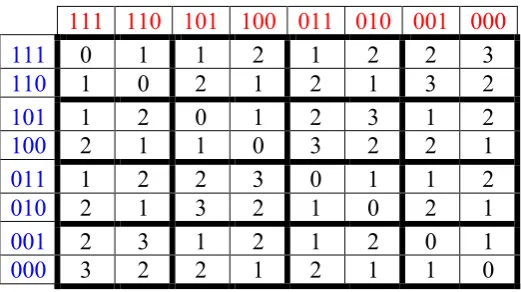
In the theory of algebraic coding of information in modern communication technologies, the concept of code distance plays an extremely important role, and code distance most often means the so-called Hamming distance [Sagalovich, 2011]. The Hamming distance between two symbol strings of equal length is the number of positions at which the corresponding symbols are different. In other words, it measures the minimum number of substitutions required to change one string into the other, or the minimum number of errors that could have transformed one string into the other. For example, let us consider the triplet AAC, which is represented in Fig. 2.1 by the binary sequence 001 (in relation to the binary indicators “3 or 2 hydrogen bonds”) and by the binary sequence 111 (in relation to the binary indicators “amino or keto”). It is obvious that the Hamming distance between these two representations of the triplet AAC is equal to 2. By analogy, calculations of Hamming distances between such two binary representations of each of triplets in the matrix in Fig. 2.1 lead to the bisymmetric matrix of Hamming distances for triplets in Fig. 4.1.
111 110 101 100 011 010 001 000
111 0 1 1 2 1 2 2 3
110 1 0 2 1 2 1 3 2
101 1 2 0 1 2 3 1 2
100 2 1 1 0 3 2 2 1
011 1 2 2 3 0 1 1 2
010 2 1 3 2 1 0 2 1
001 2 3 1 2 1 2 0 1
000 3 2 2 1 2 1 1 0
Fig. 4.1. The bisymmetric matrix of Hamming distances for two kinds of binary representations of 64 triplets in the genetic matrix in Fig. 2.1.
From Fig. 4.1 one can show that the bisymmetric (8*8)-matrix of Hamming distances consists of 16 bisymmetrical (2*2)-subquadrants, each of which is a matrix representation of 2-dimensional double number. It is obvious that this matrix has analogies with the phenomenological distribution of amino acids and stop-codons in a matrix of 64 triplets, which also consists of 16 bisymmetrical (2*2)-subquadrants.
5. Double numbers and inherited macrobiological phenomena
Fig. 5.1. Examples of phyllotaxis configurations in biological bodies.
For 150 years, in biology, inherited helical bio-lattices, associated with Fibonacci numbers, are studied under the title "phyllotaxis laws" [Jean, 2006]. (Fibonacci series: Fn = Fn-2+Fn-1: 0, 1, 1, 2, 3, 5, 8, 13, 21, …). For example, the numbers of left and right spirals in the heads of the sunflower are equal to the neighboring members of the Fibonacci series. Such phyllotaxis phenomena exist in plant and animal bodies at various levels and branches of biological evolution. The ratios Fn+1/Fn denote the order of symmetry of phyllotaxis lattices. In the process of growth of some organisms, their phyllotaxis lattices are transformed with the transition to other Fibonacci relations Fk+1/Fk.
Ukrainian Prof. O. Bodnar paid his attention that such growth transformations of phyllotaxis lattices correspond to hyperbolic rotations known in the special theory of relativity as Lorentz transformations [Bodnar, 1992, 1994]. On this basis, he declared that living matter is structurally related to Minkowski geometry.
Another example of the biological realization of structures associated with double numbers is given by the heritable organization of locomotion in animal organisms. As known, living bodies have innate abilities for locomotion. For example, newborn turtles and crocodiles, when they hatched from eggs, crawl by quite coordinated movements to water; millipedes manage the coordinated movement of dozens of their legs, using inherited algorithms, etc. One of the most respectable Russian journal “Uspekhi Fizicheskih nauk” published a large article by Prof. V. Smolyaninov “Spatio-temporal problems of locomotion control” with results of his 20 years of research on locomotion of a wide variety of animals and humans [Smolyaninov, 2000]. According to his results, spatio-temporal organization of locomotion control is related – by a special manner - with hyperbolic rotations and with Minkovsky geometry. On this basis, Smolyaninov put forward his “Locomotor theory of relativity” and wrote about a relativistic brain and relativistic biomechanics.
One more example of the structural connection of inherited biological phenomena with hyperbolic rotations (a special case of double numbers) is the basic psychophysical law of Weber-Fechner. Different types of inherited sensory perception are subordinated to this law: sight, hearing, smell, touch, taste, etc. The law states that the intensity of the perception is proportional to the logarithm of stimulus intensity; it is expressed by the equation:
p = k*ln(x/x0) = k*{ln(x) - ln(x0)} (2)
where p - the intensity of perception, x – stimulus intensity, x0 - threshold stimulus, ln – natural logarithm, k – a weight factor. Because of this law, for example, the power of sound in engineering technologies is measured on a logarithmic scale in decibels.
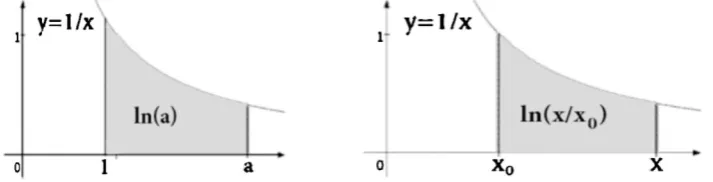
Let us explain a connection of hyperbolic rotations with the Veber-Fechner law (2). Hyperbolic rotations transform points of hyperbolas into points of the same hyperbolas (hyperbolas glide along themselves). It is known that for any real number a > 1 the natural logarithm is defined as the area under the hyperbola y = 1/x from 1 to a (Fig. 5.2, left). Accordingly, two points (x, 1/x) and (x0, 1/x0) of this hyperbola specify the value ln(x)-ln(x0) expressed the value of the perception intensity p in the Weber-Fechner law (Fig. 5.2, right). A change in the stimulus intensity x1 to a new value x2 corresponds to a hyperbolic rotation, which in this hyperbola transfers its point (x1, 1/x1) to its point (x2, 1/x2) and characterizes the magnitude of the change of perception intensity in this law: Δp = k * ln (x2/x1). Each of these points (x1, 1/x1) and (x2, 1/x2) of the hyperbola can be considered as double number.
Fig. 5.2. Illustration of the connection of hyperbolic rotations with the psychophysical law of Weber-Fechner (its explanation in the text).
It can be reminded here that when photons arrive at a single eye receptor from some luminous point of the observed image, then already coded signals in the form of sequences of nerve impulses run from the receptor along the nerve into the central nervous system. The author believes that all biological sensorics is based on the algebraic coding of information signals from the outside world. But the coding of information in sensory channels is only part of the overall picture of building the whole organism with all its genetically inherited subsystems as an algebraically encoded entity. From this point of view, the term "code biology" [Barbieri, 2015] can be interpreted as "algebraiс coded biology".
One should note also on using double numbers in effective modeling of percentages (or frequencies) in contents of long genetic and literary texts. In DNA double helixes, nitrogenous bases C-G and A-T form complementary pairs by means of 3 and 2 hydrogen bonds (it can be represented as C=G=3 and A=T=2). Correspondingly, any DNA sequence contains a long chain of numbers 2 and 3 of hydrogen bonds, for example, 33223223233…. Studying such binary “hydrogen texts” 33223223233… of a wide number of various genomes, the author discovered that in them percentages (or frequencies) of hydrogen monoplets (3, 2), doublets (33, 32, 23, 22), triplets (333, 332, 323, 322, 233, 232, 223, 222), tetraplets and pentaplets are subordinated to hidden rules: percentages of monoplets (values %3 and %2) are strongly interrelated with percentages of other hydrogen n-plets (n = 2, 3, 4, 5). These interrelations are effectively described by a tensor family [%3, %2; %2, %3](n) representing 2n-dimensional double numbers:
• %3 + %2*j (when n=1);
• %3*%3 +%3*%2*e1+%2*%3*e2+%2*%2*e3 (n=2); etc.
triplets 233. Knowing only percentages of monoplets %3 and %2, you can predict percentages of dozens of hydrogen n-plets in long DNA [Petoukhov, 2018, 2019a,b].
Leading experts on structural linguistics believe for a long time that human languages are a continuation of the genetic language using the principle of binary oppositions (see for example fundamental works by Roman Jakobson [Jakobson, 1985, 1987, 1999] who organized jointly with Niels Bohr a united seminar at the Massachusetts Institute of Technology to discuss connections among biology, linguistics and physics). Many researchers perceive a linguistic language as a living organism. The book “Linguistic genetics” [Makovsky, 1992] says: "The opinion about language as about a living organism, which is submitted to the laws of a nature, ascends to a deep antiquity … Research of a nature, of disposition and of reasons of isomorphism between genetic and linguistic regularities is one of the most important fundamental problems for linguistics of our time”.
The author’s studies of works by L.N. Tolstoy, F.M. Dostoevsky, A.S. Pushkin and others revealed new structural connections between long Russian literary texts and DNA texts [Petoukhov, 2018, 2019b]. Let us explain this.
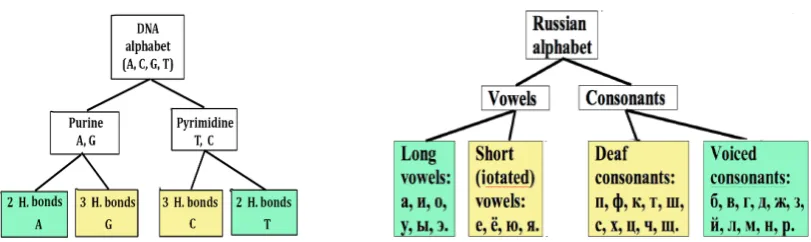
The DNA alphabet has a binary-oppositional structure: it contains two sub-alphabets of purines (A, G) and pyrimidines (T, C). Each sub-alphabet dichotomously divides into two subsub-alphabets according to indicators of 2 or 3 hydrogen bonds in its letters (Fig. 5.3, left).
Fig. 5.3. Binary-oppositional structures of the DNA alphabet and of the Russian alphabet.
The Russian alphabet, like the DNA alphabet, is phonetically based on binary oppositions, since it is divided into vowels and consonants. In turn, the set of vowels dichotomously divides into long and iotated vowels, and the set of consonants - into voiced and deaf consonants (Fig. 5.3, right).
To analyze long literary texts, the author introduced two equivalence classes: • the first class combines all the iotated vowels and the unvoiced consonants (yellow
boxes in Fig. 5.3) represented by the common symbol 0;
• the second class combines all the long vowels and voiced consonants (green boxes in Fig. 5.3) represented by the common symbol 1.
Leaving in an analysed literary text only these letters, and replacing each letter with the symbol of its equivalence class 0 or 1, we get the text representation as a binary sequence of the type 100101100 .... Denote by symbols %0 and %1 the percentages (frequencies) of characters 0 and 1 in this binary representation of the literary text.
texts - the percentages of these polyplets are effectively modeled by the tensor family of percent matrices [%0, %1; %1, %0](n) representing 2n-dimensional double numbers:
• %0 + %1*e1 (for n = 1; e1 is the imaginary unit of 2-dimensional double numbers); • %0*%0 +%0*%1*e1 + %1*%0*e2 + %1*%1*e3 (for n = 2; e1, e2 and e3 are imaginary
units of 4-dimensional double numbers); • etc …
The coordinates of these 2n-dimensional double numbers effectively model the percentages of the corresponding types of polyplets in these texts. For example, the coordinate %1*%0 models the percentage of the doublet 10. In any studied long literary text, knowing only the percentages of monoplets %0 and %1, one can predict the percentages of many types of polyplets in it with good accuracy [Petoukhov, 2018, 2019b].
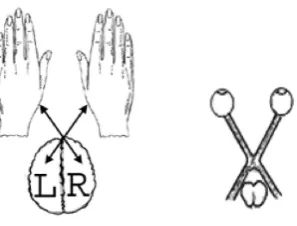
Now let us pay our attention to the bisymmetric (or cruciform) character, which is typical not only for matrix representations of 2-dimensional double numbers (and of 2n-dimensional double numbers) but also for genetic matrices of dyadic shifts (Fig. 3.1) and for genetic matrices of Hamming distances (Fig. 4.1). It is interesting that many genetic inherited constructions of physiological macrosystems including sensory-motion systems have a similar cruciform character. For example, the connection between the hemispheres of human brain and the halves of human body possesses the similar cruciform character: the left hemisphere serves the right half of the body and the right hemisphere serves the left half of the body (Fig. 5.4) [Annett, 1992; Gazzaniga, 1995; Hellige, 1993]. The system of optic cranial nerves from two eyes possesses the cruciform structures as well: the optic nerves transfer information about the right half of field of vision into the left hemisphere of brain, and information about the left half of field of vision into the right hemisphere. The same is held true for the hearing system [Penrose, 1989, Chapter 9]. It is naturally to think that these inherited physiological phenomena have relations with mentioned cruciform algebraic structures in the genetic code system.
Fig. 5.4. The cruciform organisation of some morpho-functional structures in a human body. On the left side: cruciform connections of brain hemispheres with the left and the right halves of a human body. On the right side: the cruciform structure of optic nerves from eyes in brain.
6. Double numbers, bisymmetric doubly stochastic matrices and unitary matrices
stochastic matrices. By definition, a square matrix is called doubly stochastic if all entries of the matrix are nonnegative and the sum of the elements in each row and each column is unity.
Such matrices have long been known and important for many problems of game theory and linear programming: optimizing access to resources, forming winning coalitions, logistics, growth models in oncology, etc. [Bapat, Raghavan, 1997; Prasolov, 1994]. This can allow you to transfer some already known mathematical results from game theory and from other fields into the field of models of algebraic biology. As far as the author knows, the first mention about a connection of some kinds of genetic matrices with doubly stochastic matrices was made by Prof. Matthew He in the book [Petoukhov, He, 2010].
The bisymmetric doubly stochastic matrices considered above are associated with unitary matrices that are important for quantum informatics, quantum mechanics, noise-immune coding of information, etc. and that are used in matrix genetics [Petoukhov, 2008, 2018; Petoukhov, He, 2010] The following known theorem states this connection [Prasolov, 1994]:
• if a square (n*n)-matrix M=∥mij∥ is unitary then a (n*n)-matrix B=∥bij∥, where bij =
|mij|2, is a doubly stochastic.
For example, the unitary matrix [0.6481, -0.7616; 0.7616, 0.6481] under squaring its components becomes the doubly stochastic matrix [0.64812, (-0.7616)2; 0.76162, 0.64812] = [0.42, 0.58; 0.58, 0.42]. Transformations based on unitary matrices are transformations of the rotation and reflection of vectors, preserving their lengths and angles.
Representations of DNA alphabets by genetic matrices like as in Fig. 2.1 show connections of the genetic system with unitary matrices, first of all, with Hadamard matrices. One of the types of binary oppositions in the DNA alphabet is the opposition of the letter T to the other three letters A, C, G:
-1) when switching from DNA to RNA, only this letter T replaced by another (uracil U); - 2) only this letter T has not the important amino group NH2.
Representing this opposition as A = C = G = +1, T = -1, we get the representation of the symbolic matrix [G, T; C, A] in the form of one of famous Hadamard matrices H2 (Fig. 6.1) satisfying the definition НnНnT = n*E, where n refers the order of the matrix and E is the
identity matrix. Under its normalization to the unit determinant by means of the factor 2-0.5, this Hadamard matrix H2 becomes one of unitary matrices M=2-0.5*H2. In accordance with the mentioned theorem, the unitary matrix M = [2-0.5, 2-0.5; -2-0.5, 2-0.5] - under squaring its components - becomes the doubly stochastic matrix [(2-0.5)2, (2-0.5)2; (-2-0.5)2, (2-0.5)2] = [0.5, 0.5; 0.5, 0.5]. Tensor powers of any unitary matrix always generate new unitary matrices of increased orders; each of these new unitary matrices under squaring its components becomes an appropriate doubly stochastic matrix.
The alphabetic systems of DNA and RNA with their binary-oppositional features have links with many families of Hadamard matrices. For example, any interchange of positions of letters inside the matrix [G, T; C, A] gives a new symbolic matrix, which becomes a new Hadamard matrix under replacing its symbols by the same numeric opposition A = C = G = +1, T = -1. Fig. 6.2 shows one of examples of these operations.
C A
è H2 = 1 1
T G -1 1
These relations DNA-alphabets with Hadamard matrices and with their normalized unitary versions are interesting because of the important role of Hadamard matrices in quantum mechanics (unitary Hadamard operators), quantum computers (Hadamard gates), spectral analysis, multichannel spectrometers, noise-immune coding of information, where a whole class of noise-immune codes are based on them, etc.
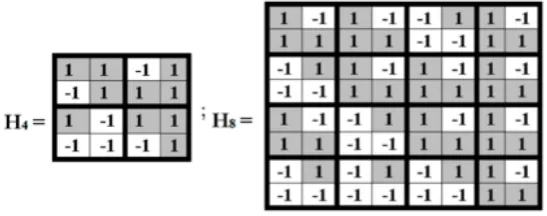
Unitary genetic matrices define transformations of rotation and reflection. When unitary matrices are raised to a power, they form cyclic groups with different periods for modeling cyclic biostructures. For example, when taking into account some binary-oppositional features of DNA-alphabets of 16 doublets and 64 triplets, Hadamard matrices H4 and H8 appear, which represent Hamilton quaternions and biquaternions with unit coordinates (Fig. 6.3).
Fig. 6.3. Hadamard matrices representing Hamilton quaternions and biquaternions with unit coordinates.
Under their normalisation to unit determinants, these matrices H4 and H8 are unitary matrices 0.5*H4 and 2-3/2*H8 . When these matrices are raised to a power, they form cyclic groups with periods 6 and 24 correspondingly: (0.5*H4)n+6 = (0.5*H4)n and (2-3/2*H8)n+24 = (2-3/2*H8)n. Due to their internal structures, these groups are used for modeling some cyclic biophenomena as it was described, for example, in works [Petoukhov, 2011b, 2016].
All calculations in quantum computers are built on unitary matrices, and each unitary matrix can be used as a logical gate in quantum computers. Our data on the relationship of the alphabetic system of DNA with unitary matrices suggests that inherited control of physiological processes is also largely based on unitary operators that represent rotation and reflection transformations. In particular, we note that the entire kinematic scheme of movements of our body and its parts is built on rotations in its joints and mirror reflections. Additional relations of DNA-alphabets with unitary matrices are described in [Petoukhov, 2018a; Petoukhov, Petukhova, 2020].
In addition to the mentioned theorem, one can also note another connection between bi-symmetric doubly stochastic (2n*2n)-matrices and unitary matrices: the set of 2n eigenvectors of these doubly stochastic matrices serve as columns of unitary (2n*2n)-matrices with real components. This relationship will be shown with a concrete example in the next paragraph.
7. Mendel's laws of heredity and their matrix modeling
This section is devoted to modeling the phenomenologic ratios based on the probabilities of individual gene combinations for the case of Mendel's laws of segregation and also an independent assortment of traits [Miko, 2008].
in the second generation differ in genotype and phenotype so that the characteristics of the grandparents regularly occur again. In a dominant-recessive inheritance, an average of 25 % are homozygous with the dominant trait, 50 % are heterozygous showing the dominant trait in the phenotype (genetic carriers), 25 % are homozygous with the recessive trait and therefore express the recessive trait in the phenotype. So, in this basic case, the phenotypic ratio is 3: 1 (or 3/4: 1/4).
Let us represent these phenomenologic data in the form of an appropriate bi-symmetric doubly stochastic (2*2)-matrix D, which is shown jointly with its set of 2 eigenvectors serving as columns of the matrix M2 in Fig. 7.1 (eigenvalues of these eigenvectors are equal to 0.5 and 1.0 correspondingly). It is easy to check that the matrix of eigenvectors M2 is unitary. Moreover, it is a normalized Hadamard matrix (the factor 2-0.5 normalized the Hadamard matrix [-1, 1; 1 1] to the unit determinant). This reveals one more connection of genetics with Hadamard matrices.
D = 3/4, 1/4 1/4, 3/4 ; M2 = 2-0.5 -1, 1 1, 1
Fig. 7.1. The bi-symmetric doubly stochastic matrix D, representing the phenotypic ratio 3/4: 1/4 in the considered basic case of mendelian genetics, and the unitary matrix M2 of its eigenvectors.
The matrix D from Fig. 7.1 is also a representation of 2-dimensional double number 3/4 + j1*1/4. The second tensor power of the matrix D gives a new bi-symmetric doubly stochastic matrix D(2) representing 4-dimensional double number 9/16 + j1*3/16 + j2*3/16 + j3*1/16. Ratios of coordinates of this double number 9:3:3:1 model well-known phenotypic ratios 9:3:3:1 in the case of dihybrid crosses in mendelian genetics. Fig. 7.2 shows the (4*4)-matrix D(2), whose 4 eigenvectors are columns of the unitary (4*4)-matrix M4. Using higher tensor powers n for the doubly stochastic matrix D, you automatically get phenotypic ratios for the cases of mendelian n-hybrid crosses in the form of coordinates of an appropriate 2n-dimensional double number D(n); the set of eigenvectors of the matrix D(n) will define a unitary (2n*2n)-matrix again.
D(2) =
0.5625 0.1875 0.1875 0.0625 0.1875 0.5625 0.0625 0.1875 0.1875 0.0625 0.5625 0.1875
0.0625 0.1875 0.1875 0.5625 ; M4 =
-0.5000 -0.5973 0.3785 0.5000 0.5000 -0.3785 -0.5973 0.5000 0.5000 0.3785 0.5973 0.5000 -0.5000 0.5973 -0.3785 0.5000
Fig. 7.2. On the right side: the second tensor power of the matrix D from Fig. 7.1. On the left side: the unitary matrix M4 formed by eigenvectors of the matrix D(2).
8. Tensor families of genetic matrices and the conception of tensor-matrix memory
Fig. 8.1. An example of fractal-like mosaics in the tensor family of Hadamard matrices H(n) = [1 1, -1 1](n). Here black cells mean entries +1 and white cells mean entries -1.
The fractal properties of tensor families of Hadamard matrices can be represented by graphs when in Hadamard matrices entries -1 are replaced by entries 0. Then the Hadamard matrices take the form of adjacency matrices known in graph theory. Tensor family of adjacency
matrices [1, 1; 0 1](n) , which corresponds to the tensor family of Hadamard matrices [1, 1; 0 1](n), has the same grafical representation shown in Fig. 8.1, only in this case white
cells mean entries 0. Fig. 8.2 shows examples of graphs corresponding to adjacency matrices [1, 1; 0 1](n).
Fig. 8.2. Graphs corresponding to initial members of the tensor family of adjacency matrices
[1, 1; 0, 1](n), where n = 2, 3, 4, related with the tensor family of Hadamard matrices [1, 1; -1, 1](n).
In the graphs on the basis of these matrices, groups of cooperative links of the graph of the previous matrix can be inherited into the graphs of matrices of higher tensor degrees as one can see in Fig. 8.2. This inheritance of groups of cooperative links in a tensor family of graphs the author conventionally termes "tensor-matrix memory."
Fig. 8.3. Upper row: the graphical representation of the tensor family of Hadamard matrices [1, 1; 1, -1](n), and corresponding tensor family of adjacency matrices [1, 1; 1, 0](n), where = 2, 3, 4. Bottom row: graphs corresponding to initial members of this tensor family of adjacency matrices [1, 1; 0, 1](n).
Properties of different tensor families of graphs related cyclic shifts in matrices representing DNA-alphabets, allow thinking about networks of cyclic tensor-matrix memory in genetic systems and studying such networks. Here it should be noted a lot of research that is being conducted in cognitive neurobiology regarding networks of cooperative link groups of neurons. The author believes that it makes sense to compare the networks of cooperative linking groups in genetics and neurobiology for mutual enrichment of genetics and cognitive neurobiology. Here one should remark that the nervous system appeared in biological evolution relatively recently. Billions of organisms perfectly existed and exist without nerve fibers at all, but with successfully solving the problems of food search, rescue from predators, etc. The nervous system in evolution did not appear at an empty place, but as a superstructure over the corresponding networks of protein and nuclein structures in relation with them on the basis of similar genetic algorithms.
9. Genetic matrices of generating and replications of vectors of complementary palindromes
One of important types of binary-oppositional features in the genetic coding system was noted by Yu.Rumer [Rumer, 1968; Fimmel, Strüngmann, 2016]. He described that the set of 64 triplets, according to their features of coding 20 amino acids, is divided into two subsets of 32 triplets in each:
- 32 triplets with “strong roots” (that is, with 8 doublets CC, CT, CG, AC, TC, GC, GT, GG at the beginning of triplets), whose code meanings do not depend on the letter in their third position;
- 32 triplets with “weak roots” (that is, with the remaining 8 doublets CA, AA, AT, AG, TA, TT, TG, GA at the beginning of triplets), whose code meanings depend on the letter in their third position.
Fig. 9.1. Symbolic matrices [C, A; T, G](2) and [C, A; T, G](3) for 16 doublets and 64 triplets. Black color denotes strong doublets and also triplets with strong roots.
Dispositions of “black” and “white” doublets and triplets in the matrices in Fig. 9.1 form the very symmetric black-and-white mosaics. For instance, left and right halves of each matrix are mirror-anti-symmetric to each other in its colors: any pair of cells, disposed by the mirror-symmetrical manner in these halves, has opposite colors (correspondingly a mosaic of each rows represents a complementary or inverse palindrom). Both quadrants along each of diagonals are identical in their mosaics and – by this reason – these mosaic matrices remind a figure of the cross (below special «cross-operators» are introduced on basis of such mosaic matrices with interesting algebraic properties). A sequence of black and white cells in each of
rows has a meander character and corresponds to one of Rademacher functions. In the matrix [C, A; T, G](3) rows 1-2, 3-4, 5-6, 7-8 are identical to each other from the viewpoint of the
mosaic, etc.
These symbolic matrices from Fig. 8.1 can be represented by appropriate numeric matrices (Fig. 9.2) under using the following numeric denotations in this binary opposition: black 8 doublets and 32 triplets are denoted by +1 and white 8 doublets and 32 triplets are denoted by -1. The author termes such matrices conditionally as «cross-matrices» taking into account their cross-like mosaics.
1 1 -1 -1 1 1 -1 -1 1 1 -1 -1 1 1 -1 -1
B12 =
1 -1 1 -1 1 1 1 1 -1 -1 -1 -1 1 1 -1 -1 1 1 1 1 -1 -1 -1 -1 1 -1 1 -1 B123 = 1 1 -1 -1 1 1 -1 -1 -1 -1 1 1 1 1 -1 -1 1 1 -1 -1 -1 -1 -1 -1 1 1 1 1 -1 -1 -1 -1 1 1 1 1
Fig. 9.2. Numeric representations of cross-matrices from Fig. 9.1 using denotations of all their black doublets and triplets by +1, and all other doublets and tripets – by -1.
Why is the genetic code structured in accordance with these matrices? Have they any interesting algebraic properties? Yes, they have! Let us first explain this on the cross-matrix B12 of doublets, which is a colony of 4 Hadamard matrices recorded in its quadrants (Fig. 9.2).
Consider the 4-dimensional state vector of some system X whose coordinates are arbitrary functions of time X = [a0(t), a1(t), a2(t), a3(t)]. The action of the cross-matrix B12 on X gives a state vector, which consists of pairs of coordinates opposite in sign and has the form of a complementary palindrome. Its left and right halves differ each other only by oppositte signs; figuratively speaking, they form a Yin-Yang system, represented by the symbol , which was the personal emblem of Niels Bohr:
X*B12 = [a0+a1+a2-a3, a1-a0-a2-a3, -(a1-a0-a2-a3), -(a0+a1+a2-a3)] = [b0, b1, -b1, -b0] (9.1)
refers that the sequence of its coordinates in the inverse direction (from its end to its beginnig) differs from the sequence of its direct direction only by opposite signs.
The second special feature of the cross-matrix operator B12 is the following: repeated action of the cross-matrix B12 to the initial vector X leads to the repeated dichotomous reproductions of the vector of the complementary palindrome [b0, b1, -b1, -b0] obtained under its first action: (X*B12)*B12n= 2n*[b0, b1, -b1, -b0]. These dichotomous reproductions of such
vectors resemble the dichotomous reproduction of somatic cells in mitosis with appropriate dichotomous reproduction of all genetic materials of each cell; it can be conditionally represented as repeated dichotomous reproduction of Yin-Yang systems (Fig. 9.3).
Fig. 9.3. The artistic image of repeated dichotomous reproductions of complementary palindromic vectors as Yin-Yang systems under repeated actions of the cross-matrix B12.
One can note that it is possible to get a complementary palindromic vector from voluntary vector [a0(t), a1(t), a2(t), a3(t)] by action of another kind of matrices: [1,1,-1,-1; 1,1,-1,-1; 1,1,-1,-1; 1,1,-1,-1]. But the second action of such matrix leads to vectors with zero coordinates without reproduction of the vector obtained under its first action.
It is not for nothing that the considered structures of the genetic coding system are coordinated precisely with cross-matrices, which provide both the generation of the indicated Yin-Yang systems and their reproduction according to the type observed during cell divisions.
One should remind here that in genetics, thousands of publications are devoted to the important topic of complementary palindromes since DNA sequencies of different genomes contain an abundance of such palindromes. In the human genome, they represent about a third of the DNA texts. In evolutionary biology, the abundance of such palindromes in genomes is regarded as evidence of not randomness of DNA texts, and their not reducibility to a set of random mutations. We are talking about sequences of letters that are read in both directions in the same way, if when reading in the opposite direction, replace each letter with a complementary one (А↔T, C↔G). An example of a complementary palindrome in DNA: AGACTGAGTCT. The initial work about complementary palindromes in matrix genetics was [Petoukhov, 2012].
Let us add briefly that action of the cross-matrix B12 on the (4*4)-matrix with voluntary entries generates a matrix, whose rows are complementary palindroms. Such generated matrices have interesting properties in their eigenvalues and form special closed sets regarding some algebraic operations.
Fig. 9.4. Cyclic changes of positions 1-2→2-1 in all doublets transform the mosaic matrix [C, A; T, G](2) of 16 doublets in Fig. 9.1 to the new symbolic matrix with its numeric representation B21.
But this new genetic matrix B21 also turns out to be the operator of generating and dichotomous reproduction of a vector of complementary palindromes when acting on an arbitrary vector X = [a0(t), a1(t), a2(t), a3(t)]:
X*B21 = [a0+a1+a2-a3, a0+a1-a2+a3, -(a0+a1-a2+a3), -(a0+a1+a2-a3)] = [c0, c1, -c1, -c0] (9.2)
(X*B21)*B21n= 2n*[c0, c1, -c1, -c0] (9.3)
In genetics, the topic of cyclic shifts and cyclic changes is very important since all organism is a huge chorus of coordinated cyclic processes. Since ancient times, chronomedicine claims that all our diseases are the result of violations in their coordination. The proteins of our body are also included in continuous cycles "life-death" of assembly and their disassembly into amino acids. For example, the half-life of the hormone insulin is 6-9 minutes, proteins of the intestinal mucosa - 10 days, proteins of the liver and blood plasma - 10 days, and on average for human proteins - 80 days.
Let us turn now to the mosaic cross-matrix [C, A; T, G](3) of 64 triplets and its numerical representation B123 (Figs. 9.1 and 9.2). The action of this cross-matrix B123 on an arbitrary 8-dimensional state vector of the system Y = [a0(t), a1(t), a2(t), a3(t), a4(t), a5(t), a6(t), a7(t)] also generates a vector with binary-oppositional sets of coordinates in a form of a complementary palindrome, whose left and right halves can be considered as a Yin-Yang pair:
Y *B123 = [b0, b0, b1, b1, -b1, -b1, -b0, -b0] (9.4)
The repeated action of the cross-matrix B123 leads to tetratomically reproductions of the complementary-palindromic vector obtained under its first action:
(Y*B123)*B123n = 4n*[b0, b0, b1, b1, -b1, -b1, -b0, -b0] (9.5)
Fig. 9.5. The artistic image of repeated tetratomous reproductions of complementary-palindromic vectors as Yin-Yang systems under repeated actions of the cross-matrix B123.
Cyclic shifts of positions (1-2-3→2-3-1→3-1-2→3-2-1→2-1-3→1-3-2) in all triplets of the mosaic matrix [C, A; T, G](3) (Fig. 9.1) transforms this matrix into 5 new mosaic matrices B231, B312, B321, B213, B132 whose indexes correspond to orders of transformed positions in triplets (Fig. 9.6).
B123 = B231 =
CCC CAC ACC AAC CCA CAA ACA AAA
CGC CTC AGC ATC CGA CTA AGA ATA
GCC GAC TCC TAC GCA GAA TC TAA
GGC GTC TGC TTC GGA GTA TGA TTA
CCG CAG ACG AAG CCT CAT ACT AAT
CGG CTG AGG ATG CGT CTT AGT ATT
GCG GAG TCG TAG GCT GAT TCT TAT
GGG GTG TGG TTG GGT GTT TGT TTT
B312 = B321 =
CCC ACC CCA ACA CAC AAC CAA AAA
GCC TCC GCA TCA GAC TAC GAA TAA
CCG ACG CCT ACT CAG AAG CAT AAT
GCG TCG GCT TCT GAG TAG GAT TAT
CGC AGC CGA AGA CTC ATC CTA ATA
GGC TGC GGA TGA GTC TTC GTA TTA
CGG AGG CGT AGT CTG ATG CTT ATT
GGG TGG GGT TGT GTG TTG GTT TTT
CCC ACC CAC AAC CCA ACA CAA AAA
GCC TCC GAC TAC GCA TCA GAA TAA
CGC AGC CTC ATC CGA AGA CTA ATA
GGC TGC GTC TTC GGA TGA GTA TTA
CCG ACG CAG AAG CCT ACT CAT AAT
GCG TCG GAG TAG GCT TCT GAT TAT
CGG AGG CTG ATG CGT AGT CTT ATT
GGG TGG GTG TTG GGT TGT GTT TTT
B213 = B132 =
CCC CCA ACC ACA CAC CAA AAC AAA
CCG CCT ACG ACT CAG CAT AAG AAT
GCC GCA TCC TCA GAC GAA TAC TAA
GCG GCT TCG TCT GAG GAT TAG TAT
CGC CGA AGC AGA CTC CTA ATC ATA
CGG CGT AGG AGT CTG CTT ATG ATT
GGC GGA TGC TGA GTC GTA TTC TTA
GGG GGT TGG TGT GTG GTT TTG TTT
CCC CAC CCA CAA ACC AAC ACA AAA
CGC CTC CGA CTA AGC ATC AGA ATA
CCG CAG CCT CAT ACG AAG ACT AAT
CGG CTG CGT CTT AGG ATG AGT ATT
GCC GAC GCA GAA TCC TAC TCA TAA
GGC GTC GGA GTA TGC TTC TGA TTA
GCG GAG GCT GAT TCG TAG TCT TAT
GGG GTG GGT GTT TGG TTG TGT TTT
Fig. 9.6. Transformations of the mosaic cross-matrix [C, A; T, G](3) (Fig. 9.1) under cyclic shifts of positions 1-2-3→2-3-1→3-1-2→3-2-1→2-1-3→1-3-2 in all its triplets.
Denoting 32 black triplets by +1 and 32 white triplets by -1 in each of these symbolic matrices, you get additionally five mosaic numeric (8*8)-matrices B231, B312, B321, B213, B132. Their actions regarding a voluntary 8-dimensional vector Y = [a0(t), a1(t), a2(t), a3(t), a4(t), a5(t), a6(t), a7(t)] give five new 8-dimensional complementary-palindromic vectors (8.6) and also tetratomic reproductions of these vectors under repeated actions of the matrices (by analogy with the above cases represented in expressions (9.4) and (9.5)):
Y*B231 = [c0 c1 -c1 -c0 c0 c1 -c1 -c0], (Y*B231)*B231n = 4n*[c0 c1 -c1 -c0 c0 c1 -c1 -c0], Y*B312 = [d0 d1 d0 d1-d1 -d0 -d1 -d0], (Y*B312)*B312n = 4n*[d0 d1 d0 d1-d1 -d0 -d1 -d0], Y*B132 = [e0 e1 e0 e1-e1 -e0 -e1 -e0], (Y*B132)*B132n = 4n*[e0 e1 e0 e1 -e1 -e0 -e1 -e0], Y*B213 = [f0 f0 f1 f1 -f1 -f1 -f0 -f0], (Y*B213)*B213n = 4n*[f0 f0 f1 f1 -f1 -f1 -f0 -f0], Y*B321 = [j0 j1-j1 -j0 j0 j1 -j1 -j0], (Y*B321)*B321n = 4n*[ j0 j1-j1 -j0 j0 j1 -j1 -j0] (9.6)
operators. The revealed relationship of the genetic coding system with binarization operators is consistent with many types of binary oppositions in it, as well as with the general physiological law "all or nothing" of binary responces holding true for different types of excitable cells of the body: excitable cells respond to external stimuli either “yes” or “no”. More precisely the cell does not respond to stimuli of a subthreshold value, but it responds to stimuli of any suprathreshold value by its full amplitude (it is true for neurons, muscle units, ...).
All this speaks of the fundamental importance of Boolean algebra of logic and Boolean functions for computer science and control in living bodies. On the basis of joint using Boolean algebra there is possible a mutual enrichment of algebraic biology and many other sciences: computer technologies, spectral logic, logical holography, etc. Boole dreamed of reproducing thinking logic through his algebra of human logic. His book was called "An investigation of the Laws of Thought". Our results show the importance of Boolean algebra of logic at the deepest biological level - genetic.
E.Schrodinger noted: “from all we have learnt about the structure of living matter, we must be prepared to find it working in a manner that cannot be reduced to the ordinary laws of physics… because the construction is different from an anything we have yet tested in the physical laboratory» [Schrödinger, 1944]. For comparison, the enzymes in biological organisms work in a million times more effectively than catalysts in the laboratory. What makes the enzyme in the body for 1 second, a catalyst in the laboratory can make only for 100 thousand years. We believe that such ultra-efficiency of enzymes in biological bodies is defined not only by laws of physics, but also by algebra-logical (computer-like) programs and algorithms of the geno-logic coding, and therefore - in line with Schrodinger - this ultra-efficiency cannot be reduced to the ordinary laws of physics.
10. Some mathematical features of algebras of multiblock united-double numbers
For possible understanding reasons of the construction of the genetic code in accordance with the genetic (8*8)-matrix in the form of the collection of bisymmetric (2*2)-matrices in Fig. 2.2, the author studies mathematical features of different unions of bisymmetric (2*2)-matrices into united square matrices of higher orders. This Section describes some initial results of such study. In particular, it turned out that the case of combining bisymmetric (2*2)-matrices with complex coefficients into a single square matrix turned out to be especially interesting. This case of the union leads to algebras of non-hypercomplex numeric systems over the field of complex numbers.
Let us construct for example a united (4*4)-matrix, whose (2*2)-quadrants are bisymmetric matrix representations of four different 2-dimensional double numbers aj0+bj1,
cj0+dj1, pj0+qj1 and sj0+rj1, where coefficients a, b, c, d, p, q, s, r are complex numbers (Fig. 10.1): a=a0+a1i, b=b0+b1i, c=c0+c1i, d=d0+d1i, p=p0+p1i, q=q0+q1i, s=s0+s1i, r=r0+r1i where i2 = -1 (the imagine unit of complex numbers).
a b c d b a d c p q s r q p r s
With such (4*4)-matrices, one can perform the same usual algebraic operations of their addition, multiplication, etc. as in algebra of 2-dimensional double numbers; in results of such operations, matrices of the same structure arise (if the determinant of the matrix is zero, then it is impossible to divide by it). In the general case, united matrices of this type are not bisymmetric. By a similar uniting sets of matrix representations of considered double numbers (having their complex numeric enries) into one united matrix (or one matrix colony), matrices with sizes (6*6), (8*8), ..., (2n*2n) can be constructed, which refer to appropriate algebras over the field of complex numbers.
One more remark regarding the (4*4)-matrix with complex entries in Fig. 10.1. Taking into account that complex numbers a=a0+a1i have their matrix representation by (2*2)-matrices [a0, a1; -a1, a0], the (4*4)-matrix in Fig. 10.1 can be rewriting into the (8*8)-matrix in Fig. 10.2 where all entries are real numbers. This (8*8)-matrix represents a special algebra over the field of real numbers.
a0 a1 b0 b1 c0 c1 d0 d1 -a1 a0 -b1 b0 -c1 c0 -d1 d0 b0 b1 a0 a1 d0 d1 c0 c1 -b1 b0 -a1 a0 -d1 d0 -c1 c0 p0 p1 q0 q1 s0 s1 r0 r1 -p1 p0 -q1 q0 -s1 s0 -r1 r0 q0 q1 p0 p1 r0 r1 s0 s1 -q1 q0 -p1 p0 -r1 r0 -s1 s0
Fig. 10.2. The matrix representation of 8-dimensional numbers of a special algebra (see explanation in the text).
In Fig. 10.2, the (8*8)-matrix consists of 16 (2*2)-subquadrants, each of which represents a complex numbers. In other words, this matrix is a colony of 16 matrix representations of complex numbers and it refers to the algebra of non-hyperbolic numbers. Similar types of numeric systems were termed as “united-hypercomplex numbers” (or briefly "U-numbers" by the first letter in the word "united") [Petoukhov, 2017].
Some concluding remarks
In the course of his structural researches of the genetic system, the author is increasingly convinced in the following:
• The genetic code is an algebraic code associated with the wide class of algebraic codes from theory of noise-immunity coding of information;
• The use of algebras of multidimensional numerical systems is effective both for revealing the interconnections of structures of biological bodies at various levels of their organization, and for understanding the noise-immune properties of genetic informatics. This allows one to think that living organisms are algebraically encoded entities (or, briefly, algebraic entities).

, where n = 2, 3, 4, related with the tensor family of Hadamard matrices [1, 1; -1, 1](n)](https://thumb-us.123doks.com/thumbv2/123dok_us/7985320.1324866/17.595.164.430.321.422/graphs-corresponding-initial-members-adjacency-matrices-hadamard-matrices.webp)
, and corresponding tensor family of adjacency matrices [1, 1; 1, 0](n), where = 2, 3, 4](https://thumb-us.123doks.com/thumbv2/123dok_us/7985320.1324866/18.595.173.425.72.160/graphical-representation-hadamard-matrices-corresponding-family-adjacency-matrices.webp)
