IJEDR1504049
International Journal of Engineering Development and Research (www.ijedr.org)327
Study on Behavior of Steel, Monel and Inconel at
Elevated Temperature
Neenu Joy1 ,Jobil Varghese2
1 PG Student, Civil Engineering, MBITS, Kerala, India 2 Assistant Proffesor, Civil Engineering, MBITS, Kerala, India
________________________________________________________________________________________________________ Abstract - In recent times, fire safety has become important in structural design due to increased fire damage to the properties and loss of lives. The analysis of structural members in a compartment in a steel framed structure subjected to fire attack is often difficult leading to the combined complexity of the material degradation and of the actions induced by thermal strains. The deformations of the steel structures will be caused due to many reasons and it mainly depends upon material properties and temperature conditions. Hence it is important to assess the behaviour of structures with different material properties under elevated temperature. This paper studies the behaviour of steel beam, which is a part of a thermal power plant structure subjected to elevated temperature on a framed compartment by finite element method. The study involves two –sided, three –sided and four –sided exposure conditions. A profound variation in responses is observed under the combination of thermal action and material properties. This paper also presents a review on responses of characteristic properties of structural steel and its alloys like Monel and Inconel at elevated temperature.
Keywords - Elevated temperature, Finite element analysis, Material degradation, Steel structures, Temperature conditions,
Thermal stain, Thermal expansion and Thermo-mechanic behavior.
________________________________________________________________________________________________________
1. INTRODUCTION
Structural steel has been widely used throughout the world. It is one of a designer’s best options in view of its advantages over other materials. Steel is available in a range of discrete size, and its ductile behavior allows plastic deformation upon yielding, therefore avoiding brittle failure. Inspite of its advantages ,steel on its own is vulnerable in fire. Elevated temperatures in the steel cause reduction in its strength and stiffness which eventually leads to failure due to excessive deformations. The structure will collapse when the deformation exceeds the permissible limit. The behavior of structural members can be analyzed using the numerical modeling tools that have been instrumental in developing inelastic response and collapse mechanism.
1.1 Properties of Mild Steel
The steel structural response under elevated temperature will depend upon the magnitude of temperature, thermal properties of steel and typical loading conditions. Due to incremental temperature regimes ,the standard material properties of steel such as modulus of elasticity, thermal conductivity, specific heat vary considerably. the thermal properties of steel could be affected by temperature and other factors including composition of steel. Mild steel contains 0.16-0.29 of carbon, 0.4-0.7 manganese, 0.1-0.5 of silicon and some traces of other elements such as phosphorus. It is neither brittle nor ductile and has a relatively low tensile strength, but it is cheap and malleable The density of mild steel is approximately 7850Kg/m3 and the Young’s modulus is 210,000 MPa. Mild steel is the cheapest and most versatile form of steel and serves every application which requires a bulk amount of steel and so it is also used in construction as structural steel. The physical properties of steel include high strength, low weight, durability, flexibility and offers great strength though it is light in weight. The dimensional stability of steel is a desired property, as the dimension of steel remains unchanged even after many years or being subjected to extreme environmental conditions. Mechanical properties of steel decide its utility. Some of the steel properties include tensile strength, hardness, toughness, elasticity and plasticity, brittleness, malleability and ductility.
1.2 Properties of Monel
MONEL nickel-copper alloy is a solid-solution alloy that can be hardened only by cold working. It has high strength and toughness over a wide temperature range and excellent resistance to many corrosive environments. Composition is shown in Table 2. Alloy 400 is widely used in many fields, especially marine and chemical processing. Typical applications are valves and pumps; pump and propeller shafts; marine fixtures and fasteners; electrical and electronic components; springs; chemical processing equipment; gasoline and fresh water tanks; crude petroleum stills, process vessels and piping; boiler feed water heaters and other heat exchangers; and deaerating heaters.
Physical and thermal properties of Monel
IJEDR1504049
International Journal of Engineering Development and Research (www.ijedr.org)328
Curie Temperature, °F ...70-120°C ...21-49 1.2 Properties of Inconel
INCONEL (nickel-chromium-iron) alloy 600 is a standard engineering material for applications which require resistance to corrosion and heat. The alloy also has excellent mechanical properties and presents the desirable combination of high strength and good workability. The limiting chemical composition of INCONEL alloy 600 is shown in Table 1. The high nickel content gives the alloy resistance to corrosion by many organic and inorganic compounds and also makes it virtually immune to chloride-ion stress-corrosion cracking The versatility of INCONEL alloy 600 has led to its use in a variety of applications involving temperatures from cryogenic to above 2000°F (1095°C). The alloy is used extensively in the chemical industry for its strength and corrosion resistance The alloy's strength and oxidation resistance at high temperatures make it useful for many applications in the heat-treating industry. It is used for retorts, muffles, roller hearths and other furnace components and for heat-treating baskets and trays. In the aeronautical field, INCONEL alloy 600 is used for a variety of engine and airframe components which must withstand high temperatures. The alloy is a standard material of construction for nuclear reactors.
Physical and thermal properties of Inconel Density, lb/in3 ...0.306 Melting Range, °F...2470-2575 °C ...1354-1413 Specific Heat, J/kg-°C...444 Curie Temperature, °F ...-192 °C...-124
2. STRUCTURAL ELEMENTS FROM THERMAL POWER PLANT 2.1Building details
A compartment of a 250kW thermal power plant is assumed to undergo fire attack. The beams and columns of the structure are made up of I- section. The behavior of a particular beam in that compartment exposed to fire is considered as the specimen. 2.2Modelling Approach
The advanced finite element software, ANSYS is used to simulate numerically the behavior of steel beam under elevated temperature. The beam is modeled as a thermo- structural element(SOLID 185 for structural analysis and SOLID 70 for thermal analysis) carried out the analysis. The study is conducted by varying the inside and outside temperature of the beam for the beam and the enormous deflection caused due to strength degradation at high temperature are studied.
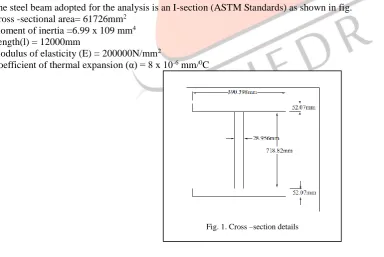
The steel beam adopted for the analysis is an I-section (ASTM Standards) as shown in fig. Cross -sectional area= 61726mm2
Moment of inertia =6.99 x 109 mm4
Length(l) = 12000mm
Modulus of elasticity (E) = 200000N/mm2
Coefficient of thermal expansion (α) = 8 x 10⁻⁶ mm/0C
IJEDR1504049
International Journal of Engineering Development and Research (www.ijedr.org)329
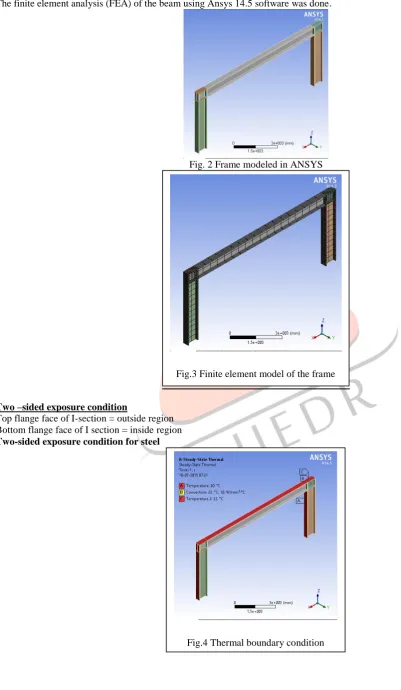
2.3 Finite Element ModellingThe finite element analysis (FEA) of the beam using Ansys 14.5 software was done.
Fig. 2 Frame modeled in ANSYS
Two –sided exposure condition
Top flange face of I-section = outside region Bottom flange face of I section = inside region Two-sided exposure condition for steel
Fig.3 Finite element model of the frame
IJEDR1504049
International Journal of Engineering Development and Research (www.ijedr.org)330
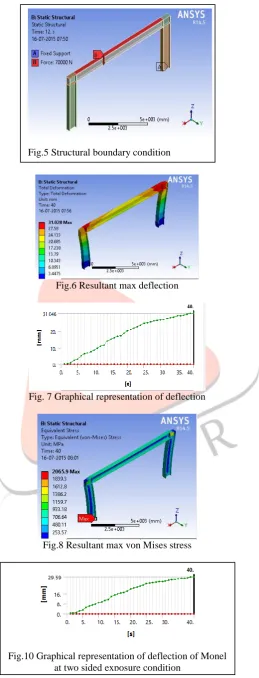
Fig.6 Resultant max deflectionFig. 7 Graphical representation of deflection
Fig.8 Resultant max von Mises stress Fig.5 Structural boundary condition
IJEDR1504049
International Journal of Engineering Development and Research (www.ijedr.org)331
Results and discussionThe analytical studies are directed towards considering the elevated temperature in response of a beam element ,which is a part of a framed compartment. In this study the member is subjected to set of incremental temperature inside and outside surface of element. The change in exposure of faces of steel section to elevated temperature leads to the change in the resultant displacement of the beam. The behavior of steel beam is analyzed and the maximum displacement during each case is observed.
Deflection in mm Exposure
condition
Steel Monel Inconel
Two-sided 31.04 29.59 91.6
3 CONCLUSIONS
This paper presents, numerical studies on the behavior of a steel beam, which is part of a thermal power plant structure subjected to elevated temperature in a framed compartment, by advanced finite element software ANSYS. The study involves, the application of nonlinear analysis to the thermo-mechanic behavior of materials and to the structures as a whole, together with the elevated temperature modeling is considered. All of this focuses on the importance of understanding the behavior of single elements while noting that the fundamental consideration in the structural collapse of a complex structure in the global behavior of the structure itself. The numerical results clearly show that a fully restrained I-section beam deflects considerably at its mid-span due to the effect of incremental temperature regimes apart from the effect of normal loading conditions.
ACKNOWLEDGEMENT
First of all, I would like to thank Almighty God and my family. I express my sincere thanks and regards to Mr. Jobil Varghese, Assistant Professor, Dept. of Civil Engineering, MBITS Nellimattom for his constant encouragement throughout my work. I would like to extend my heartfelt gratitude to all the staff members, Dept. of Civil Engineering, MBITS Nellimattom for their direct and indirect support during this work. I would also like to thanks my friends for their valuable co-operation and suggestions.
REFERENCES
[1]. Cinitha, P.K. Umesha and Nagesh R. Iyer (2013), “Numerical investigation on structural behaviour of steel beams under elevated Temperature” Journal of Structural Engineering Vol. 39, No. 5, December 2012 - January 2013 pp. 529-537
[2]. M. A. Bradford ,K. T. Luu ,A. Heidarpour(2007)” Numerical studies of a steel beam in a frame sub-assembly at elevated Temperatures”, Journal of structural engineering
[3]. Duong Xuan-Truong, Tran Minh-Duc (2010) effect of cutting condition on tool wear and surface roughness during machining of inconel 718”, International Journal of Advanced Engineering Technology
[4]. Sherif Yehia, Ghanim Kashwani (2013), Performance of Structures Exposed to Extreme High Temperature—An Overview” Journal of Civil Engineering, 2013, Vol.3,pp. 154-161