Schizosaccharomyces pombe: a promising biotechnology to modulate wine composition
Iris Loira, Antonio Morata, Felipe Palomero, Carmen González and José Antonio
Suárez-Lepe
Universidad Politécnica de Madrid. Departamento de Química y Tecnología de Alimentos.
Av. Puerta de Hierro, nº 2, 28040, Madrid
Abstract
There are numerous yeast species related to wine making, particularly non-Saccharomyces,
that deserve special attention due to the great potential they have when it comes to making
certain changes in the composition of the wine. Among them, Schizosaccharomyces pombe
stands out for its particular metabolism that gives it certain abilities such as regulating the
acidity of wine through maloalcoholic fermentation. In addition, this species is characterized
by favouring the formation of stable pigments in the wine and releasing large quantities of
polysaccharides during ageing on lees. Moreover, its urease activity and its competition for
malic acid with lactic acid bacteria make it a safety tool by limiting the formation of ethyl
carbamate and biogenic amines in wine. However, it also has certain disadvantages such as its
low fermentation speed or the development of undesirable flavours and aromas. In this
chapter, the main oenological uses of Schizosaccharomyces pombe that have been proposed in
the last years will be reviewed and discussed.
Keywords: Schizosaccharomyces pombe; oenological uses; maloalcoholic fermentation; stable pigments; wine safety
Origin and features of Schizosaccharomyces pombe
Schizosaccharomyces pombe, also known as fission yeast, was discovered by Lindner in 1983
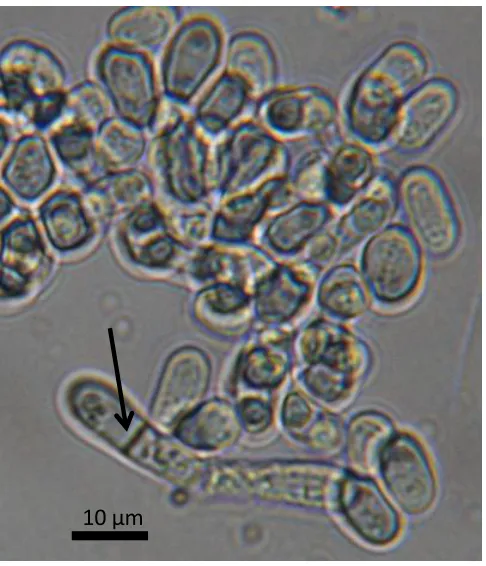
[1]. The cells of this species have a characteristic rod shape with sizes varying between 3-5 x
5-24 μm (Figure 1). However, immediately after cell division the new cells formed have a more rounded shape due to the turgor pressure [2]. It has a peculiar mode of vegetative
reproduction by fission (cross-wall formation) instead of budding, what is more common
among yeasts [3].Cells are separated by the formation of a transverse septum. The spores are
formed as a result of the sexual reproduction by conjugation of the cells when adverse
conditions occur, such as nutrient starvation, and, in the case of S. pombe, between two and
four (most often) haploid spores originate in the ascus [4].
Figure 1. Optical microscope image of S. pombe. The transverse septum formed during the asexual reproduction is indicated by an arrow.
Its growth rate is very slow with a long lag phase and a great vitamins requirement. However,
it has a low nitrogen requirement [5]. In normal minimal or complex media the generation
time is between 2 and 4 h [6]. Usually, S. pombe does not develop properly in most culture
media. A selective-differential media based on the resistance of S. pombe to actidione
(antibiotic) and to benzoic acid (inhibitory agent) has been recently proposed to isolate strains
of this genus from media with high sugar content [7]. S. pombe strains have been isolated
from grape juice, molasses and kombucha tea [1,8]. In addition to glucose, S. pombe can also
use glycerol, sucrose, raffinose, and maltose as carbon source [9].
Another peculiarity of S. pombe is that it can grow in environments with low water activity,
that is, it is an osmophilic yeast and therefore can be found in media with high sugar content
[1]. It also develops properly in very low pH environments and in a wide range of
temperatures [10]. Moreover, it is somewhat resistant to food preservatives, such as sulphur
dioxide, actidione, benzoic acid and dimethyl dicarbonate [10,11].
Regarding its fermentative performance, it is able to ferment glucose until an alcoholic degree
of around 10-15 % v/v ethanol, depending on the yeast strain and the aeration conditions [10].
As already mentioned, the genus Schizosaccharomyces is known for its slow growth rate and
excessive production of hydrogen sulphide during fermentation [12]. These two features,
together with high volatile acidity, are the main limitations for its use in winemaking. The
production of acetic acid is strain dependent, usually ranging between 0.8-1.4 g/L [13].
Nevertheless, through the selection of strains and their use in combination with yeasts of the
genus Saccharomyces, wines of differentiated quality can be obtained from unbalanced musts
with high total acidity.
Currently, thanks to recent research that opens new possibilities for using them,
yeasts encapsulated in alginate beads being marketed as an alternative to malolactic
fermentation or chemical deacidification [14]. An advantage of using these encapsulated
yeasts is that they can be removed from the medium at the desired time and, in addition, the
same capsules can be reused in several cycles (up to 5 times), although with a slight loss of
degrading activity [15,16]. Regarding sensory properties, the wines obtained by sequential
fermentation of S. pombe and S. cerevisiae resulted full-bodied, with better structure, balance,
and length than the controls made without using this deacidification technique [16].
Wine pH modulation
Wine acidity is the main responsible for freshness. After L-tartaric acid, L-malic acid is the
second organic acid in wine that contributes significantly to its total acidity. Its average
content in wine highly depends on the grape variety and the climate, varying widely between
1-10 g/L [17]. Reaching an appropriate balance between the sugar content and the total acidity
of the wine is fundamental to ensure its optimum quality. In addition, excessive amounts of
malic acid may cause a microbiological instability in wine. These are the two main reasons to
modulate wine pH.
The biological deacidification of wine through the use of Schizosaccharomyces pombe has
been studied thoroughly [18,19] since its ability to transform malic acid into ethanol and
carbon dioxide was discovered in the early 20th century [20]. Thanks to this ability of S.
pombe to develop the maloalcoholic fermentation (MAF) (Figure 2), it is possible to modulate the pH of the wine by the consumption of practically all the malic acid present in
the must with the corresponding stoichiometric production of ethanol. Unlike S. cerevisiae in
which the malic enzyme is located in the mitochondria (organelle in low numbers and
uptake of extracellular malic acid in addition to a malic enzyme located in the cytosol with a
very high substrate affinity [21]. The degree of degradation of malic acid is strain-dependent,
normally varying between 75-100 % [5,10]. Issatchenkia orientalis has been also proved to
have this strong malic acid degradative metabolism [22,23]. However, this yeast species is
only present in small quantities at the beginning of fermentation due to its sensitivity to
ethanol [24,25]. Kim, Hong, & Park, (2008) [26] have also reported the effectiveness of using
a mixed culture of Issatchenkia orientalis and Saccharomyces cerevisiae to reduce the malic
acid content during fermentation. Always when trying to improve the quality of the wine
through the combination in mixed or sequential fermentation of different non-Saccharomyces
and Saccharomyces yeast species, it is not only important to know the contribution of each
species or strain, but also to select the adequate inoculum ratio [27]. Other yeast species,
including some Saccharomyces spp. (commercially available strains are generally unable to
degrade L-malic acid effectively during fermentation), are able to consume malic acid, but to
a lesser extent (usually <25%). Another possibility is to use genetic engineering to improve
the ability of S. cerevisiae to degrade malic acid, for example, through the incorporation of
genes responsible for the transport of malic acid in S. pombe or the malolactic enzyme from
Oenococcus oeni [28].
L-malate L-malate
H+
1
CO2
NAD+
NADH Pyruvate
2 3
CO2
Acetaldehyde
Ethanol 4 NADH
NAD+
Figure 2. Schematic representation of the malic acid degradation by Schizosaccharomyces pombe: maloalcoholic fermentation (MAF) and alternative use of pyruvate in mitochondria
for cellular biosynthesis. The enzymes involved in the biochemical transformations of the
MAF are the following: 1: Malate permease (active transport); 2: Malic enzyme (malate
decarboxylase); 3: Pyruvate decarboxylase; 4: Alcohol dehydrogenase.
Although it has been mentioned on numerous occasions that the aroma produced by the
fermentative metabolism of S. pombe is not suitable for a quality wine, no particular
off-flavour has been described yet. In general, only atypical aroma [19] and a loss in the fruity
character [29] have been identified by some authors. This could be directly related to the fact
that it is a slow fermenting yeast [12]. Sometimes, more than 30 days are necessary to finish
the fermentation [29]. Moreover, immobilization techniques have been developed (e.g.
alginate beads) in order to avoid negative side effects such as high levels of acetic acid and
other off-flavours [30]. Following this technique, once the desired malic acid content is
reached in the wine thanks to the demalication activity of S. pombe, this yeast is removed and
the fermentation is finished by S. cerevisiae. Snow & Gallander (1979) [31] suggested that
one or two days of S. pombe fermentation is adequate to get a quality wine similar to that
obtained with S. cerevisiae, thus also avoiding excessive deacidification.
In addition to biological deacidification, either by yeast (MAF) or lactic acid bacteria (MLF),
there are also other methods to regulate wine acidity such as blending, carbonic maceration or
chemical deacidification using carbonate salts (usually calcium carbonate, CaCO3, potassium
carbonate, K2CO3, and potassium bicarbonate, KHCO3) [17].
The colour of the wine is one of the main sensory properties indicative of quality, especially
in red wines. It is highly dependent on the winemaking technology, especially influenced by
the maceration time and the mechanical processes performed during the same (e.g., punch
downs, pump overs, délestage...) [32], but the microorganisms used, both yeast and bacteria,
also play an important role in the development of the final colour of the wine and its stability.
First, the fermentative yeast may influence the colour by modifying the pH. In this sense,
oenological yeasts usually produce wines with pH between 3.2-3.8 and under this conditions
the anthocyanins tend to have a deep red colour, while the higher the pH, there is a
bathochromic shift from red to purple and later to blue [33]. In the case of pure fermentations
with S. pombe, pH control would be essential to avoid changes in colour to some extent,
because this yeast, as mentioned above, makes a high consumption of malic acid and
therefore the pH of the wine increases slightly.
Second, through the release of secondary metabolites of the fermentation that can react with
the grape anthocyanins and thus create more stable forms of colour such as
pyranoanthocyanins. The enzymatic activity of the yeast is also fundamental, especially
regarding the β-glucosidase and hydroxycinnamate decarboxylase activities. The first enzyme
leads to a colour loss because it catalyses the breakage of the bond between the glucose and
the anthocyanidin moieties, also known as anthocyanase activity [34]. These same authors
reported that no β-glucosidase activity was detected for the four strains of S. pombe evaluated.
The formation of pyranoanthocyanins is of great interest to preserve an intense colour in the
wine during aging processes, since these pigments originated during fermentation are much
more long-lasting due to its greater stability against pH changes and discoloration by SO2.
The strain effect is quite significant when several S. cerevisiae are used, so yeast selection is a
strains of S. pombe can lead to improvements in the colour stability of red wine thanks to its
high formation of vitisin A and derivatives thereof [36]. It is a direct consequence of its high
production of pyruvic acid during fermentation (ranging 150-350 mg/L). The higher values in
S. pombe compared to S. cerevisiae (<100 mg/L; [36]) are probably due to the specific
maloalcoholic fermentation pathway in which pyruvate is involved as metabolic intermediate
(Figure 2). The amount of pyruvate released by S. pombe can favour the formation of 2-4-folds more vitisin A and acetyl vitisin A than S. cerevisiae during the fermentation of red
wines (Figure 3). Concerning the production of Vitisin B derivatives, it is observed a lower formation of vitisin B with respect to S. cerevisiae fermentations [36]. However, the synthesis
of vitisin A is more interesting in wines than vitisin B because the latter is a red-brown
pigment (495 nm compared with 515 nm vitisin A; [35] and the hue is less suitable for wine
colour quality.
Figure 3. Formation of vitisin A and acetyl vitisin A during the fermentation with S. pombe (4 strains; dark grey bars) and S. cerevisiae (2 strains; light grey bars). Bars are average
concentrations, dots are single values for each strain (Adapted from [36]).
0 2 4 6 8 10 12
Vitisin A acetyl Vitisin A
m
g
Similarly, some strains of S. pombe have also shown the ability to transform the
hydroxycinnamic acids present in the must (e.g., p-coumaric, caffeic and ferulic acids) into
vinyl phenols that can condense with monomeric anthocyanins to form vinylphenolic
pyranoanthocyanins [37,38]. These pyranoanthocyanins display same enological properties
than vitisins concerning to their stability. Vinyl phenols are formed during fermentation by
yeasts with hydroxycinnamate decarboxylase activity (HCDA). It is possible to find this
activity in many non-Saccharomyces strains [39]. It has been observed that some strains of S.
pombe exhibit a strong HCDA that can increase the formation of
malvidin-3-O-glucoside-4-vinylphenol and malvidin-3-O-(6″-p-coumaroylglucoside)-4-vinylphenol by 10-30%
compared with S. cerevisiae strains selected for their performance in this activity [40].
Therefore, the selection and use of S. pombe in fermentation is a powerful tool to increase the
formation of stable pyranoanthocyanins both vitisin A derivatives and vinylphenolic
pyranoanthocyanins.
Polymeric pigments are formed by chemical condensation between grape anthocyanins and
other flavanols in a slow process during ageing that is affected by precursor contents, pH,
temperature and oxygen levels. Some of these pigments have red-orange colour but others can
absorb at 540 nm or higher wavelength showing red-bluish colours. It has been observed that
some yeasts are able to promote the formation of these pigment in a faster process during
fermentation [41,42]. S. pombe has shown high performance increasing the formation of
polymeric pigments derived from malvidin-3-O-glucoside and catechin or procyanidin B2
[41]. Yeast influence can be produced by the fermentative release of acetaldehyde which can
favour the formation of ethyl linked dimers [43]. Also some synergic effects were seen when
S. pombe is used in sequential fermentations with Lachancea thermotolerans [41].
And third, yeasts are able to trap significant amounts of pigments in their cell wall [44,45].
population is 108-109 CFU/mL [44], and cell wall adsorbed anthocyanins can represent
1.6-6% of wine content reaching 28% for some derivatives in some yeast strains [45]. The amount
of anthocyanins adsorbed to yeast cell walls can be evaluated by using plating media dossed
with grape anthocyanins [46]. Alternatively, and with higher precision, it is possible to
recover adsorbed anthocyanins from yeast cell walls and analyse the extracts by LC-DAD or
LC-DAD-MS [44]. When adsorption of anthocyanins was studied in non-Saccharomyces cell
walls, a differential adsorption was observed according to yeast species but also according to
strain. In a comparative view of adsorption in the plating system with anthocyanins added to
the agar formulation, it is possible to see a medium adsorption capacity for S. pombe (strain
938) compared with other species with high adsorption (L. thermotolerans, formerly
Kluyveromyces thermotolerans) or the low adsorption of Metschnikowia pulcherrima (Figure 4).
The protective effect of ageing on lees (AOL) on wine oxidation by the release of reductive
compounds from yeast structures such as glutathione can also produce some preservation on
wine anthocyanins. The high release of cell wall compounds from S. pombe during ageing on
lees [47] can favour and enhance this protective effect, thus better preserving wine colour.
Large release of polysaccharides during ageing on lees
As previously stated, Schizosaccharomyces yeast genus physiology and metabolism present
some peculiarities. S. pombe cell wall carbohydrate composition and distribution of
polysaccharides and other wall constituents is quite special; something which shouldn’t be
surprising bearing in mind we are dealing with an osmophilic yeast that reproduces
itself/asexually by binary fission thanks to the formation of a wall, from centre to centre of the
cell (Figure 1; [48,49]) Early in the seventies some authors far from food research, studied the structure and composition of their cell walls [50]. Indeed, the qualitative composition and
formation of cell wall polysaccharides can vary greatly among yeasts, and that differences are
useful for taxonomic classification purposes [51,52]. Later electron microscopy studies after
enzyme treatments,-aiming to deeply understand the molecular organization of S. pombe cell
walls-, highlighted the presence of galacto-manoproteins in the outer layer of the cell wall as
its main qualitative discriminating feature [53]. A comparative illustration of the cell walls of
Schizosaccharomyces pombe and Saccharomyces cerevisiae based on that study permits the
observation of those qualitative differences among these species, can be consulted in [47].
Besides those special features of S. pombe, a simple optical microscopy let us appreciate its
thickened cell walls. That big thickness and that previously mentioned particular molecular
organization of biopolymers in S. pombe cell walls give them structural strength enough to
Ageing over lees is relatively new to red wine production since this technique has been
traditionally used to produce white wines [54,55]. The autolytic release of yeast cell wall
polysaccharides in wine making and their contribution to aspects such as mouthfeel and tactile
properties, wine aroma, body and physicochemical stability has been widely studied,
discussed and demonstrated [56]. In particular, mannoproteins act as colloidal stabilizers,
having a positive effect on tartrate stability [57], decreasing tannin aggregation and
precipitation [58] and protecting wine form protein haze in white wines [59,60]. The
production and release of these macromolecules depends on the yeast strain, and according to
Vidal, Williams, Doco, Moutounet, & Pellerin, (2003) [61], they can reach up to 35 % of total
polysaccharides in wine.
Ageing over lees of red wines have been usually described as a technique that helps to
stabilize colour and modulate astringency. Several interactions between yeast lees and
phenols could take place simultaneously, and factors such as yeast lees reactivity towards
oxygen [62,63], the strain capacity to absorb anthocyanins [44,64,65] or the presence of
β-glucosidase activity explains why contradictory results and hypothesis can be easily found in
the literature.
The autolytic release of polysaccharides by Schizosaccharomyces pombe were studied for the
first time in synthetic media by Palomero et al., in 2009 [47]. From the first moment, results
showed a high quantity of cell wall polysaccharides. At 28 days both osmophilic yeasts
Schizosaccharomyces pombe and Saccharomycodes ludwigii released cell-wall fragments in
concentrations more than ten times greater than those produced by the Saccharomyces and
Pichia strains studied. Two months into the over lees ageing process, the polysaccharide
concentrations of the osmophilic yeast autolysates were those that would be reached at six or
seven months by Saccharomyces. This rapid release could entail an important competitive
peak were observed in the HPLC-RI chromatograms corresponding to biopolymers of over
788 kDa. These fragments are therefore larger than most of those observed from
Saccharomyces, and should be studied in order to understand its potential oenological interest
to modulate astringency, improve palatability and preserve colour [47]. Domizio, Liu, Bisson,
& Barile, (2017) [66] have recently found larger polysaccharide molecules in earlier peaks by
HPLC-RI when studying and characterizing S. pombe polysaccharides, but were not detected
in the chromatograms of the corresponding S. japonicus. These authors obtained similar
results when studying the release of polysaccharides during alcoholic fermentation. They
conclude all the Schizosaccharomyces strains studied released a quantity of polysaccharides
approximately 3 to 7 times higher than that released by a commercial Saccharomyces
cerevisiae. Subsequent studies have obtained similar results, underlining the polysaccharide
overproduction of yeast belonging to the Schizosaccharomyces genus [67].
Bio-tool for ensuring wine safety
The metabolic characteristics of S. pombe make it the ideal bio-tool to reduce the content of
certain unwanted compounds in musts and wines, either because they are responsible for
long-term microbiological instability, because they adversely affect the sensory quality of the
wine or because they can lead to toxic compounds [10]. Some examples of compounds that
can be controlled by S. pombe are malic acid, biogenic amines, gluconic acid and ethyl
carbamate.
The ability of S. pombe to metabolize malic acid was previously discussed (See section
Biogenic amines may pose health problems. An advantage of using S. pombe instead of lactic
acid bacteria (LAB) for the elimination of malic acid is that this yeast does not promote the
formation of biogenic amines, a health issue associated to the traditional malolactic
fermentation performed by LAB [68,69]. It is worth mentioning that, unlike wild malolactic
bacteria, the available commercial LABs have been selected according to the criterion of low
production of biogenic amines and ethyl carbamate. The combination of Lachancea
thermotolerans and S. pombe for the sequential fermentation of a red must with high pH has
shown to be effective in the control of the biogenic amines formation, with a reduction in the
concentration of histamine of up to four times with respect to the same grape must that
underwent a malolactic fermentation [68]. In addition, the organoleptic quality of the wine
was not compromised by the employment of two non-Saccharomyces yeasts for the
fermentation.
Gluconic acid decreases the microbiological stability of the wine, since LAB can metabolize
it increasing the acetic acid levels and, therefore, damaging the quality of the wine [70]. High
contents of this acid are related to the development of the fungal disease called gray rot. It has
been shown that S. pombe can metabolize gluconic acid and in this way favour the biological
aging of wines by preventing the development of LAB [71].
Despite belonging to the ascomycetes group, S. pombe exhibits a strong urease activity [72].
Urease catalyses the hydrolysis of urea into ammonia and carbamate, the latter product is
spontaneously hydrolysed to carbonic acid and ammonia under oenological conditions. Ethyl
carbamate is a well known carcinogen produced along the fermentation and ageing, and urea
is one of its precursors [73]. The safety limits established for ethyl carbamate in wines widely
varies between 15-60 μg/L depending on the country and the type of wine, being the dessert
wines those with upper limit. Therefore, fermenting with S. pombe may prevent ethyl
Sparkling wines and other fermented beverages (ice wines, beers)
In the winemaking of sparkling wines there is a second fermentation in bottle in which it is
necessary to use a yeast able to ferment in the presence of around 10 % v/v ethanol (base
wine). In addition to complying with this requirement, S. pombe can be an interesting species
for this process due to its high release rate of polysaccharides during ageing on lees [74]. The
higher the polysaccharide content in the wine, the better the mouth-feel sensations (reducing
astringency, enhancing sweetness and roundness) and the aromatic persistence and quality
[75]. It also has a protective effect on wine colour.
Moreover, the employment of S. pombe for the second fermentation and ageing on lees of
sparkling wines production was suggested as a way to obtain differentiation [76]. With the use
of S. pombe, red sparkling wines with higher pyranoanthocyanin concentrations and higher
colour intensity were obtained [76]. Concerning the sensory evaluation, both white and red
wines were rated as good quality without notable differences in relation to the control of S.
cerevisiae in taste characters, but with some differences at the aromatic and visual level. S.
pombe seems more suitable for winemaking in red than in white, losing partially in the latter
the fruity and floral character. The red sparkling wines made with S. pombe were the ones that
obtained the highest score for the colour intensity and aromatic intensity. Although the herbal,
buttery and yeasty notes stood out significantly, the wines had a good balance on the nose and
no aromatic defects were perceived. However, these results come from a single strain of S.
pombe (selected for its good fermentative behaviour), it would certainly be interesting to try
new strains.
S. pombe was also tested as yeast responsible for the bottle fermentation in brewing [13]. The
therefore, the amount of acetic acid synthesized by S. pombe should also be lower. S. pombe
also has potential application in the production of ice wines, especially when it comes to
obtaining wines with a better balance of acidity [77].
Conclusions
Schizosaccharomyces pombe is a useful tool for total or partial deacidification of grape musts,
achieving a good quality in the final wine when immobilization techniques are used. This
species has shown promising results regarding the production of stable colour forms,
therefore, ensuring the colour preservation in aged wines. Its use in winemaking can also
prevent potential health risks associated with the metabolism of the lactic acid bacteria
responsible for malolactic fermentation. As a general conclusion, due to its great resistance to
pH, temperature and preservatives, and its ability to ferment in media with high sugar content,
S. pombe is a strain of great versatility with potential utility not only in oenology, but also in
other sectors of the food industry.
Author Contributions: I.L. Literature review, writing and editing; A.M. Literature review, writing and images design; F.P. Literature review and writing; C.G. Critical reading; J.A.S.L.
Critical Reading.
Funding: This research received no external funding.
Conflicts of Interest: The authors declare no conflicts of interest.
1. Kurtzman, C. P.; Fell, J. W.; Boekhout, T. The yeasts: a taxonomic study; Elsevier, 2010; ISBN 9780080931272.
2. Atilgan, E.; Magidson, V.; Khodjakov, A.; Chang, F. Morphogenesis of the fission yeast cell through cell wall expansion. Curr. Biol. 2015, 25, 2150–2157, doi:10.1016/j.cub.2015.06.059.
3. Vaughan Martini, A. Evaluation of phylogenetic relationships among fission yeast by nDNA/nDNA reassociation and conventional taxonomic criteria. Yeast 1991, 7, 73–78, doi:10.1002/yea.320070108.
4. Krapp, A.; Del Rosario, E. C.; Simanis, V. The role of Schizosaccharomyces pombe dma1 in spore formation during meiosis. J. Cell Sci. 2010, 123, 3284–93, doi:10.1242/jcs.069112.
5. Benito, S.; Palomero, F.; Morata, A.; Calderón, F.; Suárez-Lepe, J. A. New applications for Schizosaccharomyces pombe in the alcoholic fermentation of red wines. Int. J. Food Sci. Technol. 2012, 47, 2101–2108, doi:10.1111/j.1365-2621.2012.03076.x.
6. Moreno, S.; Klar, A.; Nurse, P. Molecular genetic analysis of fission yeast Schizosaccharomyces pombe. Methods Enzymol. 1991, 194, 795–823, doi:10.1016/0076-6879(91)94059-L.
7. Benito, S.; Galvez, L.; Palomero, F.; Calderón, F.; Morata, A.; Palmero, D.; Suárez-Lepe, J. A. Schizosaccharomyces selective differential media. African J. Microbiol. Res. 2013, 7, 3026–3036, doi:10.5897/AJMR2013.5684.
8. Teoh, A. L.; Heard, G.; Cox, J. Yeast ecology of Kombucha fermentation. Int. J. Food Microbiol. 2004, 95, 119–126, doi:10.1016/J.IJFOODMICRO.2003.12.020.
9. Petersen, J.; Russell, P. Growth and the environment of Schizosaccharomyces pombe. Cold Spring Harb. Protoc. 2016, 2016, 210–226, doi:10.1101/pdb.top079764.
10. Suárez-Lepe, J. A.; Palomero, F.; Benito, S.; Calderón, F.; Morata, A. Oenological versatility of Schizosaccharomyces spp. Eur. Food Res. Technol. 2012, 235, 375–383, doi:10.1007/s00217-012-1785-9.
11. Escott, C.; Loira, I.; Morata, A.; Bañuelos, M. A.; Suárez-Lepe, J. A. Wine spoilage yeasts: Control strategy. In Yeast - Industrial Applications; InTech, 2017; pp. 89–116.
12. Rankine, B. C. The importance of yeasts in determining the composition and quality of wines. Vitis 1968, 7, 22–49.
13. Callejo, M. J.; González, C.; Morata, A. Use of non-Saccharomyces yeasts in bottle fermentation of aged beers. In Brewing Technology; InTech, 2017; pp. 101–119.
14. Proenol ProMalic. Biological deacidification of musts and wines Available online: https://www.proenol.com/web/produtos/leveduras-encapsuladas/promalic-detail.
15. Ramon-Portugal, F.; Silva, S.; Taillandier, P.; Strehaiano, P. Inmovilización de levaduras. Usos enológicos actuales. Vinidea.net. 2003, pp. 1–8.
Malic acid consumption by dry immobilized cells of Schizosaccharomyces pombe. Am. J. Enol. Vitic. 2003, 54, 50–55.
17. Su, J.; Wang, T.; Wang, Y.; Li, Y.-Y.; Li, H. The use of lactic acid-producing, malic acid-producing, or malic acid-degrading yeast strains for acidity adjustment in the wine industry. Appl. Microbiol. Biotechnol. 2014, 98, 2395–2413, doi:10.1007/s00253-014-5508-y.
18. Rankine, B. C. Decomposition of L-malic acid by wine yeasts. J. Sci. Food Agric.
1966, 17, 312–316, doi:10.1002/jsfa.2740170707.
19. Gallander, J. F. Deacidification of eastern table wines with Schizosaccharomyces pombe. Am. J. Enol. Vitic. 1977, 28.
20. Kluyver, A. J. Biochemische suikerbepalingen, Delft University of Technology, 1914.
21. Volschenk, H.; van Vuuren, H. J. J.; Viljoen–Bloom, M. Malo-ethanolic fermentation in Saccharomyces and Schizosaccharomyces. Curr. Genet. 2003, 43, 379–391, doi:10.1007/s00294-003-0411-6.
22. Seo, S.-H.; Rhee, C.-H.; Park, H.-D. Degradation of malic acid by Issatchenkia orientalis KMBL 5774, an acidophilic yeast strain isolated from Korean grape wine pomace. J. Microbiol. 2007, 45, 521–7.
23. Hong, S. K.; Lee, H. J.; Park, H. J.; Hong, Y. A.; Rhee, I. K.; Lee, W. H.; Choi, S. W.; Lee, O. S.; Park, H. D. Degradation of malic acid in wine by immobilized Issatchenkia orientalis cells with oriental oak charcoal and alginate. Lett. Appl. Microbiol. 2010, 50, 522–529, doi:10.1111/j.1472-765X.2010.02833.x.
24. ClementeJimenez, J. M.; MingoranceCazorla, L.; Martı́nez Rodrı́guez, S.; Heras -Vázquez, F. J. Las; Rodrı́guez -Vico, F. Molecular characterization and oenological properties of wine yeasts isolated during spontaneous fermentation of six varieties of grape must. Food Microbiol. 2004, 21, 149–155, doi:10.1016/S0740-0020(03)00063-7. 25. Zott, K.; Claisse, O.; Lucas, P.; Coulon, J.; Lonvaud-Funel, A.; Masneuf-Pomarede, I.
Characterization of the yeast ecosystem in grape must and wine using real-time PCR. Food Microbiol. 2010, 27, 559–567, doi:10.1016/J.FM.2010.01.006.
26. Kim, D.-H.; Hong, Y.-A.; Park, H.-D. Co-fermentation of grape must by Issatchenkia orientalis and Saccharomyces cerevisiae reduces the malic acid content in wine. Biotechnol. Lett. 2008, 30, 1633–1638, doi:10.1007/s10529-008-9726-1.
27. Comitini, F.; Gobbi, M.; Domizio, P.; Romani, C.; Lencioni, L.; Mannazzu, I.; Ciani, M. Selected non-Saccharomyces wine yeasts in controlled multistarter fermentations with Saccharomyces cerevisiae. Food Microbiol. 2011, 28, 873–882, doi:10.1016/J.FM.2010.12.001.
28. Volschenk, H.; van Vuuren, H. J. J.; Viljoen-Bloom, M. Malic acid in wine: Origin, function and metabolism during vinification. South African J. Enol. Vitic. 2006, 27, 123–136, doi:10.21548/27-2-1613.
doi:10.1016/S0168-1605(02)00320-3.
30. Yokotsuka, K.; Otaki, A.; Naitoh, A.; Tanaka, H. Controlled simultaneous deacidification and alcohol fermentation of a high-acid grape must using two immobilized yeasts, Schizosaccharomyces pombe and Saccharomyces cerevisiae. Am. J. Enol. Vitic. 1993, 44, 371–377.
31. Snow, P. G.; Gallander, J. F. Deacidification of white table wines through partial fermentation with Schizosaccharomyces pombe. Am. J. Enol. Vitic. 1979, 30, 45–48. 32. Morata, A.; González, C.; Tesfaye, W.; Loira, I.; Suárez-Lepe, J. A. Maceration and
fermentation. New technologies to increase extraction. In Red Wine Technology; Morata, A., Ed.; Elsevier-Academic Press, 2018 ISBN 9780128143995.
33. Khoo, H. E.; Azlan, A.; Tang, S. T.; Lim, S. M. Anthocyanidins and anthocyanins: colored pigments as food, pharmaceutical ingredients, and the potential health benefits. Food Nutr. Res. 2017, 61, 1361779, doi:10.1080/16546628.2017.1361779.
34. Manzanares, P.; Rojas, V.; Genovés, S.; Vallés, S. A preliminary search for anthocyanin-β-D-glucosidase activity in non- Saccharomyces wine yeasts. Int. J. Food Sci. Technol. 2000, 35, 95–103, doi:10.1046/j.1365-2621.2000.00364.x.
35. Morata, A.; Loira, I.; Suárez-Lepe, J. A. Influence of yeasts in wine colour. In Grape and Wine Biotechnology; Morata, A., Loira, I., Eds.; InTech, 2016; pp. 288–289 ISBN 9789537619343.
36. Morata, A.; Benito, S.; Loira, I.; Palomero, F.; González, M. C.; Suárez-Lepe, J. A. Formation of pyranoanthocyanins by Schizosaccharomyces pombe during the fermentation of red must. Int. J. Food Microbiol. 2012, 159, 47–53, doi:10.1016/j.ijfoodmicro.2012.08.007.
37. Morata, A.; Gómez-Cordovés, M. C.; Calderón, F.; Suárez, J. A. Effects of pH, temperature and SO2 on the formation of pyranoanthocyanins during red wine
fermentation with two species of Saccharomyces. Int. J. Food Microbiol. 2006, 106, 123–129, doi:10.1016/J.IJFOODMICRO.2005.05.019.
38. Morata, A.; González, C.; Suárez-Lepe, J. A. Formation of vinylphenolic pyranoanthocyanins by selected yeasts fermenting red grape musts supplemented with hydroxycinnamic acids. Int. J. Food Microbiol. 2007, 116, 144–152, doi:10.1016/j.ijfoodmicro.2006.12.032.
39. Suárez-Lepe, J. A.; Morata, A. Capítulo IV.- El atractivo visual del color del vino tinto: Implicaciones microbiológicas en nuevas formas estables y pérdidas de antocianos durante la fermentación. In Levaduras para vinificación en tinto. [Yeasts for red winemaking].; AMV Ediciones, 2015; p. 158 ISBN 9788494345197.
40. Morata, A.; Benito, S.; Loira, I.; Palomero, F.; González, M. C.; Suárez-Lepe, J. A. Formation of pyranoanthocyanins by Schizosaccharomyces pombe during the fermentation of red must. Int. J. Food Microbiol. 2012, 159, doi:10.1016/j.ijfoodmicro.2012.08.007.
2018, 239, doi:10.1016/j.foodchem.2017.07.037.
42. Escott, C.; Morata, A.; Loira, I.; Tesfaye, W.; Suarez-Lepe, J. A. Characterization of polymeric pigments and pyranoanthocyanins formed in microfermentations of non-Saccharomyces yeasts. J. Appl. Microbiol. 2016, 121, doi:10.1111/jam.13255.
43. Dallas, C.; Ricardo-da-Silva, J. M.; Laureano, O. Products formed in model wine solutions involving anthocyanins, procyanidin B2, and acetaldehyde. J. Agric. Food Chem. 1996, 44, 2402–2407, doi:10.1021/JF940433J.
44. Morata, A.; Gómez-Cordovés, M. C.; Suberviola, J.; Bartolomé, B.; Colomo, B.; Suárez, J. A. Adsorption of anthocyanins by yeast cell walls during the fermentation of red wines. J. Agric. Food Chem. 2003, 51, 4084–4088, doi:10.1021/jf021134u.
45. Morata, A.; Gómez-Cordovés, M. C.; Colomo, B.; Suárez, J. A. Cell wall anthocyanin adsorption by different Saccharomyces strains during the fermentation of Vitis vinifera L. cv Graciano grapes. Eur. Food Res. Technol. 2005, 220, 341–346, doi:10.1007/s00217-004-1053-8.
46. Caridi, A.; Sidari, R.; Kraková, L.; Kuchta, T.; Pangallo, D. Assessment of color adsorption by yeast using grape skin agar and impact on red wine color. OENO One
2015, 49, 195, doi:10.20870/oeno-one.2015.49.3.81.
47. Palomero, F.; Morata, A.; Benito, S.; Calderón, F.; Suárez-Lepe, J. A. New genera of yeasts for over-lees aging of red wine. Food Chem. 2009, 112, 432–441, doi:10.1016/J.FOODCHEM.2008.05.098.
48. Kreger-Van Rij, N. J. W. The Yeasts : a taxonomic study; Elsevier Science Publishers, 1984; ISBN 0444804218.
49. Lodder, J. The yeasts; a taxonomic study.; North-Holland Pub. Co: Amsterdam, 1970; ISBN 0720440548.
50. Manners, D. J.; Meyer, M. T. The molecular structures of some glucans from the cell walls of Schizosaccharomyces pombe. Carbohydr. Res. 1977, 57, 189–203, doi:10.1016/S0008-6215(00)81930-8.
51. Bartnicki-Garcia, S. Cell Wall Chemistry, Morphogenesis, and Taxonomy of Fungi. Annu. Rev. Microbiol. 1968, 22, 87–108, doi:10.1146/annurev.mi.22.100168.000511. 52. Weijman, A.C.M., & Golubev, W. I. Carbohydrate patterns and taxonomy of yeast and
yeast-like fungi. In The expanding realm of yeast-like fungi; Hoong, G. S., Smith, M. T., Weijman, A. C. M., Eds.; Elsevier: Amsterdam, 1987; pp. 361–371.
53. Kopecká, M.; Fleet, G. H.; Phaff, H. J. Ultrastructure of the Cell Wall of Schizosaccharomyces pombe Following Treatment with Various Glucanases. J. Struct. Biol. 1995, 114, 140–152, doi:10.1006/JSBI.1995.1013.
54. Vivas, N.; Vivas de Gaulejac, N.; Nonier, M. F.; Nedjma, M. Les phénomènes colloïdaux et l’interêt des lies dans l’élevage des vins rouges : Une nouvelle approche technologique et méthodologique. 2° partie- Méthodes destinés aux élevages en cuves de grande capacité. Rev. Fr. œnologie 2001, 190, 32–35.
colloïdaux et l’interêt des lies dans l’élevage des vins rouges: Une nouvelle approche technologique et méthodologique. 1°partie- Methodes traditionnelles d’élevage sur lie destinés aux vins en fûts. Rev. Fr. œnologie 2001, 189, 33–38.
56. Pérez-Serradilla, J. A.; de Castro, M. D. L. Role of lees in wine production: A review. Food Chem. 2008, 111, 447–56, doi:10.1016/j.foodchem.2008.04.019.
57. Lubbers, S.; Leger, B.; Charpentier, C.; Feuillat, M. Effet colloide-protecteur d’extraits de parois de levures sur la stabilité tartrique d’une solution hydro-alcoolique modele. J. Int. des Sci. la Vigne du Vin 1993, 27, 13–22.
58. Riou, V.; Vernhet, A.; Doco, T.; Moutounet, M. Aggregation of grape seed tannins in model wine - Effect of wine polysaccharides. Food Hydrocoll. 2002, 16, 17–23, doi:10.1016/S0268-005X(01)00034-0.
59. Moine-Ledoux, V.; Dubourdieu, D. An invertase fragment responsible for improving the protein stability of dry white wines. J. Sci. Food Agric. 1999, 79, 537–543, doi:10.1002/(SICI)1097-0010(19990315)79:4<537::AID-JSFA214>3.0.CO;2-B.
60. Waters, E. J.; Pellerin, P.; Brillouet, J.-M. A Saccharomyces mannoprotein that protects wine from protein haze. Carbohydr. Polym. 1994, 23, 185–191, doi:10.1016/0144-8617(94)90101-5.
61. Vidal, S.; Williams, P.; Doco, T.; Moutounet, M.; Pellerin, P. The polysaccharides of red wine: total fractionation and characterization. Carbohydr. Polym. 2003, 54, 439– 447, doi:10.1016/S0144-8617(03)00152-8.
62. Frankel, E. .; German, J. .; Kinsella, J. .; Parks, E.; Kanner, J. Inhibition of oxidation of human low-density lipoprotein by phenolic substances in red wine. Lancet 1993, 341, 454–457, doi:10.1016/0140-6736(93)90206-V.
63. Salmon, J. M.; Fornairon-Bonnefond, C.; Mazauric, J. P. Interactions Between Wine Lees and Polyphenols: Influence on Oxygen Consumption Capacity During Simulation of Wine Aging. J. Food Sci. 2002, 67, 1604–1609, doi:10.1111/j.1365-2621.2002.tb08691.x.
64. Mazauric, J.-P.; Salmon, J.-M. Interactions between Yeast Lees and Wine Polyphenols during Simulation of Wine Aging: I. Analysis of Remnant Polyphenolic Compounds in the Resulting Wines. 2005, doi:10.1021/JF050308F.
65. Mazauric, J.-P.; Salmon, J.-M. Interactions between Yeast Lees and Wine Polyphenols during Simulation of Wine Aging: II. Analysis of Desorbed Polyphenol Compounds from Yeast Lees. J. Agric. Food Chem. 2006, 54, 3876–3881, doi:10.1021/jf060037o. 66. Domizio, P.; Liu, Y.; Bisson, L. F.; Barile, D. Cell wall polysaccharides released
during the alcoholic fermentation by Schizosaccharomyces pombe and S. japonicus: quantification and characterization. Food Microbiol. 2017, 61, 136–149, doi:10.1016/j.fm.2016.08.010.
67. Romani, C.; Lencioni, L.; Gobbi, M.; Mannazzu, I.; Ciani, M.; Domizio, P. Schizosaccharomyces japonicus: A Polysaccharide-Overproducing Yeast to Be Used in Winemaking. Fermentation 2018, 4, 14, doi:10.3390/fermentation4010014.
Schizosaccharomyces pombe and Lachancea thermotolerans yeast strains as an alternative to the traditional malolactic fermentation in red wine production. Molecules
2015, 20, 9510–9523, doi:10.3390/molecules20069510.
69. De Fatima, M.; Centeno, F.; Palacios, A. Desacidificación biológica de mosto a través de la inoculación de levadura Schizosaccharomyces pombe encapsulada como alternativa a la no producción de aminas biógenas. In International Symposium of Microbiology and Food Safety in wine ‘“Microsafetywine”;’ 2007.
70. Peinado, R. A.; Moreno, J. J.; Maestre, O.; Ortega, J. M.; Medina, M.; Mauricio, J. C. Gluconic acid consumption in wines by Schizosaccharomyces pombe and its effect on the concentrations of major volatile compounds and polyols. J. Agric. Food Chem.
2004, 52, 493–497, doi:10.1021/jf035030a.
71. Peinado, R. A.; Mauricio, J. C.; Medina, M.; Moreno, J. J. Effect of Schizosaccharomyces pombe on aromatic compounds in dry sherry wines containing high levels of gluconic acid. J. Agric. Food Chem. 2004, 52, 4529–4534, doi:10.1021/JF049853R.
72. Lubbers, M. W.; Rodriguez, S. B.; Honey, N. K.; Thornton, R. J. Purification and characterization of urease from Schizosaccharomyces pombe. Can. J. Microbiol. 1996, 42, 132–140, doi:10.1139/m96-021.
73. Uthurry, C. A.; Suárez-Lepe, J. A.; Lombardero, J.; García Del Hierro, J. R. Ethyl carbamate production by selected yeasts and lactic acid bacteria in red wine. Food Chem. 2006, 94, 262–270, doi:10.1016/J.FOODCHEM.2004.11.017.
74. Kulkarni, P.; Loira, I.; Morata, A.; Tesfaye, W.; González, M. C.; Suárez-Lepe, J. A. Use of non-Saccharomyces yeast strains coupled with ultrasound treatment as a novel technique to accelerate ageing on lees of red wines and its repercussion in sensorial parameters. LWT - Food Sci. Technol. 2015, 64, doi:10.1016/j.lwt.2015.07.046.
75. Loira, I.; Vejarano, R.; Morata, A.; Ricardo-da-Silva, J. M.; Laureano, O.; González, M. C.; Suárez-Lepe, J. A. Effect of Saccharomyces strains on the quality of red wines
aged on lees. Food Chem. 2013, 139, 1044–1051,
doi:10.1016/J.FOODCHEM.2013.01.020.
76. Ivit, N. N.; Loira, I.; Morata, A.; Benito, S.; Palomero, F.; Suárez-Lepe, J. A. Making natural sparkling wines with non-Saccharomyces yeasts. Eur. Food Res. Technol. 2018, 244, 925–935, doi:10.1007/s00217-017-3015-y.