Mathematical Modelling of Human African Trypanosomiasis
using Control Measures
Hamenyimana Emanuel Gervas
1, Nicholas Opoku
1,2, Shamsuddeen Ibrahim
11African Institute for Mathematical Sciences, Ghana. 2University of Cape Coast, Ghana.
1To whom correspondence should be addressed; E-mail: [email protected]
Abstract
Human African Trypanosomiasis (HAT) commonly known as sleeping sickness, is a neglected tropical vector borne disease caused by trypanosome protozoa. It is transmitted by bites of infected tsetse fly. In this paper we first present the vector-host model which describes the general transmission dynamics of HAT. In the tsetse fly population, the HAT is modelled by three compartments while in the human population, the HAT is modelled by four compartments. The next generation matrix approach is used to derive the basic reproduction number,R0,
and also it is proved that ifR0 ≤1the disease free equilibrium is globally asymptotically stable, which means
the disease dies out. The disease persist in the population if the value ofR0>1. Furthermore, the optimal
con-trol model is determined by using the Pontryagin’s maximum principle with concon-trol measures such as education, treatment and insecticides used to optimize the objective function. The model simulations confirm that the use of the three control measures are very efficient and effective to eliminate HAT in Africa.
Keywords:Human African Trypanosomiasis (HAT), Mathematical modelling, optimal control, Control mea-sures.
1
Introduction
Human African trypanosomiasis (HAT), commonly known as sleeping sickness, is a vector-borne tropical disease which is caused by trypanosoma brucei protozoa species. It is one of the neglected tropical diseases which affects people in sub-Saharan Africa specifically those living in rural areas. HAT is caused by two species of protozoa which are Trypanosoma brucei gambiense (TBG), which causes the chronic form of HAT in central and western Africa and Trypanosoma brucei rhodesiense (TBR), which causes the acute form of the disease in Eastern and southern Africa [1]. The HAT disease has killed millions of people since the beginning of20thcentury and it is
transmitted from one individual to another by tsetse flies (genusGlossina); TBG is transmitted by riverine tsetse species while TBR is transmitted by savanna tsetse species [1]. Rhodesiense HAT is an acute disease that can lead to death if not treated within6months while Gambiense HAT is a slow chronic progressive disease which causes death with an average duration of3years [2]. The signs and symptoms for both forms of HAT are not specific and their appearances vary from one person to another; at the first stage of HAT, the disease is not severe and the signs and symptoms such as intermittent fever, headache, pruritus, lymphadenopathies, asthenia, anemia, cardiac disorders, endocrin disturbances, musculoskeletal pains and hepatosplenomegaly may be observed while in the second stage of HAT, sleep disorders and neuro-psychiatric disorders are likely to dominate. The HAT disease can be treated by using the drugs such as suramin, eflornithine, melarsoprol and pentamidine.
The disease is reported to affect about37sub-Saharan African Countries, it affects much rural areas where there are suitable environments for the tsetse flies to live and reproduce; the peri-urban areas can also be affected. The transmission of HAT can occur during the human activities such as hunting, farming as well as fishing [3]. The transmission of HAT needs the reservoir;reservoir is a species that can permanently maintain the pathogen and from which the pathogen can be transmitted to the target population [4]. Rhodesiense HAT is zoonotic which requires a non-human reservoir (animals) for maintaining its population, while in Gambiense HAT, humans act as key reservoir [4].
Mathematical models have been used to study the transmission and effective control of diseases simply and cheaply with no need of expensive and complicated experiments [5]. So far, different models have been developed and for-mulated by different researchers. One of the important modelling work on HAT, was done by [6]; the model explained the mathematical frame work on transmission of HAT in multiple host populations [6]. Rogers model was generalized by [7] and a new parameter which allows the tsetse flies to feed off multiple hosts was introduced. The model compared the effectiveness of two methods used to control HAT; insecticide treated cattle and the use of trypanocides drugs to treat cattle. They found out that treating cattle with insecticides is more effective and a cheaper approach to control HAT than using trypanocides drugs. [8] developed a model which was based on a constant population with a fixed number of domestic animals, human and tsetse flies in one of the Villages in West Africa. The major findings of their model estimated that the cattle population contribute to about92%of the total TBR transmission while the rest8%is the contribution of human population in transmission of the disease. The work in [8] which also formulated a multi-host model was used to study the control of tsetse flies and TBR in Southern Uganda. They found out that the effective application of insecticides brings about a cost-effective method of control and eliminating the disease, they realised that insecticides way for controlling HAT is more effective and efficient in the area where there are few wild hosts.
Due to low mortality rate of the disease and poverty of its sufferers, the efforts toward the control of HAT has re-duced. Most attention is given to popular diseases such as HIV/AIDS, Tuberculosis, Malaria and Ebola, although the disease is still a threat to the lives of sub-Saharan African people. Moreover, very few studies have been carried out on applying optimal control theory to HAT transmission models. In this paper, we use optimal control theory to study the transmission dynamics of HAT diseases by using education, treatment and insecticides as the control measures.
2
Model Formulation
In this section, the vector-host model as well as the necessary differential equations to describe the transmission of HAT from tsetse fly to human and vice versa is developed. The transmission of HAT in the human population is modelled using four subclasses; SusceptibleSH, ExposedEH, InfectiousIHand RecoveredRH. The total human
population,NH, is thus defined by:
NH =SH+EH+IH+RH.
The transmission of HAT in the vector (Tsetse flies) population, is also divided into Susceptible (SV), Exposed
(EV) and Infectious (IV). The total population of the tsetse flies,NV, is also defined by:
NV =SV +EV +IV.
We assume a constant population for both host and vector, it is also assumed that the tsetse fly cannot recover from the disease and the infected tsetse fly remains infectious throughout the rest of its life; there is no disease induced death rate for tsetse flies and the recruitment rates are assumed to be constant due to birth and immigration. In
Figure 1: Compartmental model for the transmission of Human African Trypanosomiasis.
our model, the recruitment rate of hosts and vectors are represented byπHandπV respectively. The susceptible
host gets the disease when bitten by infectious tsetse fly and susceptible tsetse fly gets the disease when it bites an infectious human at the ratea. The natural mortality rate for humans and vectors are represented byµH andµV
respectively. The parameterωrepresents the disease induced death rate for humans whileξHandξV are the force
of infection for humans and vectors respectively. The parameterσrepresents per capita rate of a vector becoming infectious, and the rest of the parameters are explained in Table1. Assuming that the transmission per bite from infectious tsetse-fly to human isa, then the rate of infection per susceptible human is given by
ξH=
apHIV
NV
and also if we further assume thatais the tsetse-fly biting rate, that is, the average number of bites per tsetse-fly per unit, then the rate of infection per susceptible tsetse-fly can be represented by
ξV =
apVIH
NH
.
From the model diagram in Figure(1), the following differential equations are derived: dSH
dt =πHNH+ρRH−
apHIV
NV
SH−µHSH
dEH
dt =
apHIV
NV
SH−εEH−µHEH
dIH
dt =εEH−µHIH−ωIH−τ IH dRH
dt =τ IH−ρRH−µHRH dSV
dt =πVNV −µVSV −
apVIH
NH
SV
dEV
dt =
apVIH
NH
SV −µVEV −σEV
dIV
dt =σEV −µVIV.
(1)
From system (1), the dimensionless technique is used to derive another equivalent differential equations; we denotesh=
SH
NH
,eh=
EH
NH
,ih=
IH
NH
,rh=
RH
NH
,sv =
SV
NV
,ev =
EV
NV
,iv =
IV
NV
and substitute into system (1), to obtain the following new equivalent equations:
dsh
dt =πh+ρrh−aphivsh−µhsh deh
dt =aphivsh−εeh−µheh dih
dt =εeh−µhih−ωih−τ ih drh
dt =τ ih−ρrh−µhrh dsv
dt =πv−µvsv−apvihsv dev
dt =apvihsv−µvev−σev div
dt =σev−µviv.
(2)
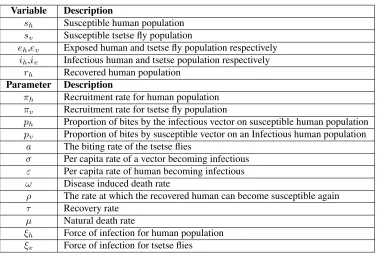
The following table shows the description of the model parameters and variables.
2.1
Positivity and Boundedness of the Solutions
In this subsection we show that system (2) is epidemiologically and mathematically well-defined in the positive invariant region;
D=
(sh, eh, ih, rh, sv, ev, iv)∈R7+:nh≤
πh
µh
;nv≤
πv
µv
. (3)
Theorem 1. There exist a domainDin which the solution(sh, eh, ih, rh, sv, ev, iv)is contained and bounded.
Proof. We provide the proof following the idea by [9]. Given the solution set(sh, eh, ih, rh, sv, ev, iv)with the
positive initial conditions(sh0, eh0, ih0, rh0, sv0, ev0, iv0), we define
nh(sh, eh, ih, rh) =sh(t) +eh(t) +ih(t) +rh(t) and
Table 1: The description of model variables and parameters
Variable Description
sh Susceptible human population
sv Susceptible tsetse fly population
eh,ev Exposed human and tsetse fly population respectively
ih,iv Infectious human and tsetse population respectively
rh Recovered human population
Parameter Description
πh Recruitment rate for human population
πv Recruitment rate for tsetse fly population
ph Proportion of bites by the infectious vector on susceptible human population
pv Proportion of bites by susceptible vector on an Infectious human population
a The biting rate of the tsetse flies
σ Per capita rate of a vector becoming infectious ε Per capita rate of human becoming infectious ω Disease induced death rate
ρ The rate at which the recovered human can become susceptible again τ Recovery rate
µ Natural death rate
ξh Force of infection for human population
ξv Force of infection for tsetse flies
The derivatives ofnh andnv with respect to time along the solution of system (2) for human and tsetse flies
respectively, are obtained by;
n0h=dsh
dt + deh
dt + dih
dt + drh
dt ,
=πh−(sh+eh+ih+rh)µh−ωih,
=πh−nhµh−ωih.
n0v =dsv
dt + dev
dt + div
dt,
=πv−(sv+ev+iv)µv,
=πv−nvµv.
From these differential equations it follows thatn0h≤πh−µhnhandn
0
v ≤πv−µvnv. We obtain the solutions
as follows;
nh≤
πh
µh
(1−exp(−µht)) +nh(sh0, eh0, ih0, rh0) exp(−µht),
nv≤
πv
µv
(1−exp(−µvt)) +nv(sv0, ev0, iv0) exp(−µvt).
By taking the limits of bothnhandnvabove ast−→ ∞we obtainnh≤ πµh
h andnv ≤
πv
µv, hence the solutions
given by;
D=
(sh, eh, ih, rh, sv, ev, iv)∈R7+:nh≤
πh
µh
;nv≤
πv
µv
.
3
Model Equilibria and Stability Analysis
In this section we give the model equilibria, the basic reproduction number,R0, and the stabilities at both disease
free and endemic equilibrium.
3.1
Disease-free Equilibrium(DFE)
The DFE in system (2) is when there are no HAT infections within the human and tsetse fly population. Thus the existence of the DFE is given by;E0=
π
h
µh
,0,0,0,πv µv
,0,0
.
3.2
Endemic Equilibrium(EE)
The EE is the non-trivial equilibrium point at which the HAT disease persist in both human and tsetse fly popula-tion. Thus the EE is obtained as follows;E∗= (s∗h, e
∗
h, i
∗
h, r
∗
h, s
∗
v, e∗v, i∗v),where,
s∗h = [πh(ρ+µh) +ρτ i
∗
h] [µv(σ+µv)(apvi∗h+µv)]
[a2σp
hpvπvi∗h+µvµh(σ+µv)(apvi∗h+µv)] (µh+ρ)
,
e∗h =(ω+τ+µh)i
∗
h
ε ,
r∗h = τ i
∗
h
µh+ρ
,
s∗v = πv
apvi∗h+µv
,
e∗v = apvπvi
∗
h
(σ+µv)(apvi∗h+µv)
,
i∗v = aσpvπvi
∗
h
(σ+µv)(apvi∗h+µv)µv
,
i∗h =(ρ+µh)
a2εphpvπhπvσ−µ2vµh(ε+µh)(σ+µv)(µh+τ+ω)
B ,
(4)
the term
B= (apv(aσphπv(ερω+µh(ρ(τ+ω)+ε(ρ+τ+ω)+µh(ε+ρ+τ+ω+µh)))+µh(ε+µh)(ρ+µh)(τ+ω+µh)µv(σ+µv))).
3.3
Basic Reproduction Number,
R
0The basic reproduction number,R0, is defined as the number of secondary infections caused by one infected host
or vector in a completely susceptible population [10]. Thenext generation matrixapproach as done byVan den DriesscheandWatmoughin [5, 11] is applied to derive
F=
aphivsh
0
apvihsv
0
andV=
µheh+εeh
−εeh+µhih+ωih+τ ih
µvev+δev
−δev+µviv
By denoting matrixF = ∂F
∂xi andV =
∂V
∂xi wherexi = eh, ih, ev, iv, the spectral radius of the next generation
matrixF V−1gives the value ofR 0. F=
0 0 0 aphsh
0 0 0 0
0 apvsv 0 0
0 0 0 0
andV =
ε+µh 0 0 0
−ε µh+ω+τ 0 0
0 0 µv+δ 0
0 0 −δ µv
,
F V−1=
0 0 aδph
µv(−δ+µv)
−aph
µv
0 apv
µh+τ+ω
0 0
0 0 0 0
0 0 0 0
.
The spectral radiusσ(F V−1)gives,
R0=σ(F V−1) =
s
a2εp
hpvπhπvσ
µ2
vµh(ε+µh)(σ+µv)(µh+τ+ω)
.
One infected human in a population of susceptible vectors will cause Rv infected vectors, like wise, one
infected vector in a population will causeRhinfected humans [5]. Therefore the basic reproduction number can
be rewritten asR0=
√
RhRv, whereRh=
aεphπh
µh(µh+ε)(µh+τ+ω)
andRv =
σapvπv
µ2
v(σ+µv)
. Thus,R0can also
be defined as the square root of the product of the number of infected humans in the susceptible population caused by one infected tsetse fly in its infectious lifetime and the number of infected tsetse flies caused by one infected human during the infectious period [12].
3.4
Local Stability of Disease-Free Equilibrium(DFE)
Theorem 2. IfR0≤1the DFE given byE0is locally asymptotically stable in the region defined by Equation (3),
it is unstable whenR0>1.
Proof. The DFE is locally stable if all eigenvalues of Jacobian matrixJE0are negative. The matrix has all eigen-values negative only if the trace ofJE0 <0and determinant ofJE0 >0. By linearising system (2) aroundE0, we obtain the following Jacobian matrix;
JE0 =
−µh 0 0 ρ 0 0 −aphsh
0 −(ε+µh) 0 0 0 0 aphsh
0 ε −(ω+τ+µh) 0 0 0 0
0 0 τ −(ρ+µh) 0 0 0
0 0 −apvsv 0 −µv 0 0
0 0 apvsv 0 0 −(σ+µv) 0
0 0 0 0 0 σ −µv
The trace of matrixJE0 is such that;
tr(JE0) =−(µh+ε+µh+µh+ω+τ+ρ+µh+µv+σ+µv+µv)
=−(4µh+ 3µv+ε+ω+τ+ρ+σ)<0.
Using the basic properties of matrix algebra as in [13], it is clear that the eigenvaluesλ1=−µhandλ2=−µvof
the matrixJE0have negative real parts. The reduced matrix is
JE1=
−(ε+µh) 0 0 0 aphsh
ε −(ω+τ+µh) 0 0 0
0 τ −(ρ+µh) 0 0
0 apvsv 0 −(σ+µv) 0
0 0 0 σ −µv
.
From matrixJE1 the eigenvalueλ3 =−(ρ+µh)has negative real part. The remaining matrix is further reduced by using the reduction techniques, we obtain;
JE2=
−(ε+µh) 0 0 aphsh
0 −(ω+τ+µh) 0
aphshε
ε+µh
0 apvsv −(σ+µv) 0
0 0 σ −µv
.
Using the properties of matrix algebra, the matrixJE2has eigenvalue−(ε+µh)which has negative real part. We further reduce to a2×2matrix by using the same reduction techniques. The matrix is
JE3=
−(ω+τ+µh)
aphshε
ε+µh
apvsvσ
σ+µv
−µv
.
From the reduced2×2matrix, the trace is negative and the determinant is,
Det(JE3) = (ω+τ+µh)µv− aphshε
ε+µh
×apvsvσ σ+µv
,
= (ω+τ+µh)µv
1− a
2εp
hpvπhπvσ
µ2
vµh(ε+µh)(σ+µv)(µh+τ+ω)
.
Since
R0=
s
a2εp
hpvπhπvσ
µ2
vµh(ε+µh)(σ+µv)(µh+τ+ω)
,
then, by lettingRT =
a2εphpvπhπvσ
µ2
vµh(ε+µh)(σ+µv)(µh+τ+ω)
, we find our determinant as,
Det(JE3) = (ω+τ+µh)µv[1−RT]. (5)
The value ofRT can be seen to be positive because all the parameters are positive. As a result, the determinant in
3.5
Global Stability of Disease-Free Equilibrium(DFE)
To show that the DFE is globally stable, we apply the Lypunov’s Theorem in [5].
Theorem 3. The DFE defined byE0 is globally asymptotically stable in the region defined by Equation (3) if
R0≤1. Otherwise unstable ifR0>1.
Proof. We define the Lypunov’s function as
V =k1
sh−sh0−sh0ln sh
sh0
+k2eh+k3ih+k4
sv−sv0−sv0ln sv
sv0
+k5ev+k6iv (6)
satisfying system (2), wherek1, k2, k3, k4, k5, k6>0are to be determined andsh0 = πh
µh
andsv0= πv
µv
. We first
show thatV >0for allE6=
π
h
µh
,0,0,0,πv µv
,0,0
. It is enough to check that,
k1sh0
sh
sh0
−1−ln sh
sh0
>0,
k4sv0 s
v
sv0
−1−ln sv
sv0
>0.
The functiong(m) =m−1−lnmsuch thatm= sh
sh0 =
sv
sv0 has minimum value equal to zero whenm= 1,
henceg(m) > 0for all m > 0. Thus the Lypunov’s function V > 0. The function V is radially unbounded because as|m|−→ ∞the functiong(m)−→ ∞. We now take the derivative ofV with respect to time and use system (2) to replace the derivatives in the right hand side such that;
V0 =k1
1−sh0 sh
ds
h
dt +k2 deh
dt +k3 dih
dt +k4
1−sv0 sv
ds
v
dt +k5 dev
dt +k6 div
dt,
=k1
1−sh0 sh
[πh+ρrh−aphivsh−µhsh] +k2[aphivsh−εeh−µheh]
+k3[εeh−µhih−ωih−τ ih] +k4
1−sv0 sv
[πv−µvsv−apvihsv]
+k5[apvihsv−µvev−σev] +k6[σev−µviv],
=2k1πh−aphshk1iv+ρrhk1−k1µhsh−k1
π2
h
µhsh
+aphπhiv
µh
k1−
πhρrh
µhsh
k1+k2aphshiv
−k2(ε+µh)eh+k3εeh−k3(τ+µh+ω)ih+ 2k4πv−k4apvsvih−µvsvk4−
πv2
µvsv
k4
+apvihπv
µv
k4−k5(µv+σ)ev+k5apvsvih+k6σev−k6µviv.
The terms withrhare ignored because ifsh, eh, ihare globally stable thenrh−→0at any timetand the DFE for
system(2)is globally stable. Takingk1=k2=µ1
h+ε,k4=k5= 1
µv+σ,k3= 1
εandk6=
1
σ, the derivative ofV
V0=− πh µh+ε
π
h
µhsh
+µhsh
πh
−2
−(τ+µh+ω) ε ih+
aphπh
(µh+ε)µh
iv−
πv
µv+σ
π
v
µvsv
+µvsv
πv
−2
−µv σ iv+
apvπv
µv(µv+σ)
ih,
=−
π
h
µh+ε
π
h
µhsh
+µhsh
πh
−2
+ πv
µv+σ
π
v
µvsv
+µvsv
πv
−2
+(τ+µh+ω)
ε
εap
vπv
µv(σ+µv)(µh+τ+ω)
−1
ih+
µv
σ
aσp
hπh
µvµh(µh+ε)
−1
iv,
=−
π
h
µh+ε
π
h
µhsh
+µhsh
πh
−2
+ πv
µv+σ
π
v
µvsv
+µvsv
πv
−2
+(τ+µh+ω)
ε (Rv−1)ih+ µv
σ(Rh−1)iv.
The terms πh
µhsh +
µhsh
πh −2
and πv
µvsv +
µvsv
πv −2
are positive because if we supposem= πh
µhsh =
πv
µvsv,
we havem+m1 −2 = m2−m2m+1 = (mm−1)2 >0for allm >1and sinceRv≤1andRh≤1thenV0is negative.
Thus we haveV0<0for allE06=
π
h
µh
,0,0,0,πv µv
,0,0
.
Thus, the largest compact invariant set inDis the singleton setE0. Hence, system(2)is globally
asymptoti-cally stable.
3.6
Local Stability of Endemic Equilibrium(EE)
Theorem 4. The unique endemic equilibrium defined byE∗is locally asymptotically stable in the region defined by Equation (3) ifR0>1, but is unstable ifR0≤1.
Proof. We give the proof of this theorem based on the approach used by [9, 14]. From theEEpoints defined in Equation(4), since all values are positive, we express the value ofi∗hin terms ofR0to obtain;
i∗h= µ
2
vµh(ε+µh)(ρ+µh)(σ+µv)(µh+τ+ω)
B
a2εp
hpvπhπvσ
µ2
vµh(ε+µh)(σ+µv)(µh+τ+ω)
−1
,
= µ
2
vµh(ε+µh)(ρ+µh)(σ+µv)(µh+τ+ω)
B
R20−1
,
where
B= (apv(aσphπv(ερω+µh(ρ(τ+ω)+ε(ρ+τ+ω)+µh(ε+ρ+τ+ω+µh)))+µh(ε+µh)(ρ+µh)(τ+ω+µh)µv(σ+µv))).
Since the basic reproduction number,R0=
s
a2εp
hpvπhπvσ
µ2
vµh(ε+µh)(σ+µv)(µh+τ+ω)
, if we let
RT =
a2εphpvπhπvσ
µ2
vµh(ε+µh)(σ+µv)(µh+τ+ω)
,
then we can findi∗has,
i∗h= µ
2
vµh(ε+µh)(ρ+µh)(σ+µv)(µh+τ+ω)
The value ofB is clearly positive because all parameters are positive. Hence, i∗h > 0if and only ifRT > 1,
implying that theEEis locally asymptotically stable ifRT >1.
3.7
Global Stability of Endemic Equilibrium(EE)
To show the global stability of theEEwe use Lyapunov’s Theorem together with the following Lemma.
Lemma 1. Suppose thaty1, y2,· · ·, ynarenpositive numbers, then their arithmetic mean is greater than or equal
to the geometric mean, that’sy1+y2+· · ·+yn
n ≥(y1y2· · ·yn) 1 n.
Theorem 5. The EE defined byE∗is globally asymptotically stable ifR0>1, otherwise is unstable.
Proof. The proof is based on the idea as explained by [5]. We define the Lyapunov function as
V =k1
sh−s∗h−s∗hln
sh
s∗h
+k2
eh−e∗h−e∗hln
eh
e∗h
+k3
ih−i∗h−i∗hln
ih
i∗h
+k4
sv−s∗v−s∗vln
sv
s∗
v
+k5
ev−e∗v−e∗vln
ev
e∗
v
+k6
iv−i∗v−i∗vln
iv
i∗
v
satisfying system (2) with k1, k2, k3, k4, k5, k6 > 0 to be determined. The function V is non negative for all
(sh, eh, ih, rh, sv, ev, iv)6= (sh∗, e∗h, i∗h, rh∗, s∗v, e∗v, i∗v)and radially unbounded.
We need to prove that V0 < 0 for all (sh, eh, ih, rh, sv, ev, iv) = (6 s∗h, e∗h, i∗h, rh∗, s∗v, e∗v, i∗v). We find the
derivative ofV with respect to time and replace the derivativess0h, e0h, i0h, r0h, s0v, e0v, i0vwith system (2). We also ignore therhterms because ifsh, eh, ihare globally stable thenrh−→0at any timetandEEis globally stable.
V0 =k1
1−s
∗
h
sh
[πh−aphivsh−µhsh] +k2
1−e
∗
h
eh
[aphivsh−(µh+ε)eh]
+k3
1−i
∗
h
ih
[εeh−(ω+τ+uh)ih] +k4
1−s
∗
v
sv
[πv−apvihsv−µvsv]
+k5
1−e
∗
v
ev
[apvihsv−(µv+σ)ev] +k6
1−i
∗
v
iv
[σev−uviv].
We now substituteπh=aphi∗vs∗h+µhs∗handπv=apvi∗hs∗v+µvs∗vat the endemic equilibrium then simplify and
put similar terms together to obtain;
V0 =−k1
(sh−s∗h)
2
µh
sh
+k1aphi∗vs∗h−k1aphivsh−k1aph
s∗h2i∗v sh
+k1aphivs∗h+k2aphshiv−k2(ε+µh)eh
−k2aphshiv
e∗h eh
+k2(ε+µh)e∗h+k3εeh−k3(ω+τ+µh)i∗h−k3εeh
i∗h ih
+k3(ω+τ+µh)i∗h
−k4
(sv−s∗v)
2
µv
sv
+k4apvi∗hs∗v−k4apvihsv−k4apv
s∗v2i∗h sv
+k4apvihs∗v+k5apvsvih−k5(σ+µv)ev
−k5apvsvih
e∗v ev
+k5(σ+µv)e∗v+k6σev−k6µvi∗v−k6σev
i∗v iv
We supposek1=k2andk4=k5, and multiply and divide the same equilibrium value to some of the fractions to
obtain;
V0=−k1
(sh−s∗h)
2
µh
sh
+k1aphi∗vs
∗
h−k1aph
s∗h2i∗v sh
+k1aphivs∗h−k2(ε+µh)eh
−k2aphshiv
e∗hs∗hi∗v s∗
hi∗veh
+k2(ε+µh)e∗h+k3εeh−k3(ω+τ+µh)ih−k3εeh
i∗he∗h ihe∗h
+k3(ω+τ+µh)i∗h
−k4
(sv−s∗v)
2
µv
sv
+k4apvi∗hs
∗
v−k4apv
s∗v2i∗h sv
+k4apvihs∗v−k5(σ+µv)ev
−k5apvsvih
e∗vs∗vi∗h s∗
vi∗hev
+k5(σ+µv)e∗v+k6σev−k6µvi∗v−k6σev
e∗vi∗v ive∗v
+k6µvi∗v.
We choose k3 = k2µhε+ε such that k3(ω +τ+µh)ih∗ = k2(ε+µh)eh∗ and choosek6 = k5µhσ+σ such that
k6µvi∗v =k5(σ+µv)e∗v. Nowaphs∗hi∗v= (µh+ε)e∗handapvs∗vi∗v = (µv+σ)e∗vbecausek1=k2andk4=k5
respectively. We now obtain;
V0 =−k1
(sh−s∗h)
2
µh
sh
+k1aphi∗vs
∗
h
3−s
∗
h
sh
−e
∗
hivsh
s∗
hehi∗v
−ehi
∗
h
ihe∗h
+k1aphivs∗h−k3(ω+τ+µh)ih
+ [k3ε−k2(ε+µh)]eh−k4
(sv−s∗v)
2
µv
sv
+k4apvi∗hs
∗
v
3−s
∗
v
sv
−e
∗
vihsv
s∗
vevi∗h
−evi
∗
v
ive∗v
+k4apvihs∗v−k6µviv+ [k6σ−k5(σ+µv)]ev.
Supposek6=k1aphs ∗ h
µv andk3=
k4apvs∗v
ω+τ+µh, we then substitute and simplify to get
V0=−k1
(sh−s∗h)
2
µh
sh
+k1aphi∗vs
∗
h
3−s
∗
h
sh
−e
∗
hivsh
s∗hehi∗v
−ehi
∗
h
ihe∗h
−k4
(sv−s∗v)
2
µv
sv
+k4apvi∗hs∗v
3−s
∗
v
sv
−e
∗
vihsv
s∗
vevi∗h
−evi
∗
v
ive∗v
.
From Lemma1above, the terms
k1aphi∗vs∗h
h
3−s∗h
sh −
e∗hivsh
s∗ hehi∗v −
ehi∗h
ihe∗h i
andk4apvi∗hs∗v
h
3−s∗v
sv −
e∗vihsv
s∗ vevi∗h
−evi∗v
ive∗v i
≤0.
Therefore,V0<0for all(sh, eh, ih, rh, sv, ev, iv)= (6 s∗h, e∗h, i∗h, rh∗, s∗v, e∗v, i∗v)implying that the endemic
equilib-rium is globally asymptotically stable ifR0>1.
4
Analysis of Optimal Control Model
In this section, we formulate the optimal control model by modifying system (2) to an optimal control problem. We thus define some linear functionsci(t) = 1, fori = 1,2,3. It is important to note that controls are fully
effective whenci(t) = 1and not effective whenci(t) = 0. The forces of infectionξhandxivwhich correspond to
the human and vector population respectively, are reduced by the factor(1−c1); wherec1measures the level of
success obtained due to the effort of educating people on the dangers of exposing their skin, and encouraging them to wear long sleeves and long pants during the day to minimize tsetsefly-human contacts. The factorc2represents
the effort of treatment to control the disease and the factorc3also represent the effort of using insecticides to ensure
made, we try to find the most effective strategy that reduces the HAT infection in the population at a very minimum cost. With the use of bounded Lebesgue measurable control, we define the objective function to be minimized as
J(c1, c2, c3) =
Z tF
0
M1eh+M2ih+M3ev+M4iv+
1 2k1c
2 1+
1 2k2c
2 2+
1 2k3c
2 3
dt. (7)
Thus, the dynamics of the controls that minimizes the objective function is given by dsh
dt =πh+ρrh−(1−c1)aphivsh−µhsh deh
dt = (1−c1)aphivsh−εeh−µheh dih
dt =εeh−µhih−ωih−c2τ ih drh
dt =c2τ ih−ρrh−µhrh dsv
dt =πv−c3µvsv−(1−c1)apvihsv dev
dt = (1−c1)apvihsv−c3µvev−σev div
dt =σev−c3µviv,
(8)
subject to the initial conditionssh ≥0, eh ≥0, ih ≥0, rh ≥0, sv ≥0, ev ≥0, iv ≥0. The associated effective
reproduction number for Equation(8)denoted byREis obtained as
RE=
s
a2ε(1−c
1)2phπhπvσ
c3µh(ε+µh)µ2v(σ+c3µv)(µh+c2τ+ω)
=pRc. (9)
The goal is to minimize the exposed and infectious human populations(eh, ih), the exposed and infectious vector
populations(ev, iv)and the cost of implementing the control by the use of possibleci, i= 1,2,3. The functional
objective includes the social cost which relates to the resources that is needed for educating people on personal protection 12k1c21, the application of treatment
1 2k2c
2
2and spraying of tsetsefly operations 1 2k3c
2
3. The quantities
M1 andM2 respectively represent the associated cost with minimizing the exposed and infected human
pop-ulation, whileM3 andM4 also represent the cost associated with minimizing the exposed and infected vector
respectively. The quantitytF is the time period of intervention. As explained in [17], the costs corresponding
toM1eh, M2ih, M3evandM4iv are linear while the cost control functions 12k1c21, 1 2k2c
2 2,and
1 2k3c
2
3should be
nonlinear and take a quadratic form. Therefore, we seek to minimize the objective function over the given time interval[0, tF]. Pontryagin’s Maximum Principle is used to solve this optimal control problem and the derivation
of the necessary conditions. The Lagrangian of the optimal control problem is given by
L=
M1eh+M2ih+M3ev+M4iv+
1 2k1c
2 1+
1 2k2c
2 2+
1 2k3c
2 3
. (10)
To determine the Lagrangian minimum value, we define the Hamiltonian,H, for the control problem as
H =M1eh+M2ih+M3ev+M4iv+
1 2k1c
2 1+
1 2k2c
2 2+
1 2k3c
2 3+λsh
dsh
dt +λeh
deh
dt +λih
dih
dt
+λrh
drh
dt +λsv
dsv
dt +λev
dev
dt +λiv
div
dt,
whereλsh, λeh, λih, λrh, λsv, λev, λiv are adjoint variables or co-state variables. The differential equations of
dλsh
dt =λshµh+ (λsh−λeh)(1−c1)aphiv
dλeh
dt =−M1+ (λeh−λih)ε+λehµh
dλih
dt =−M2+ (λih−λrh)c2τ+λih(ω+µh) + (λsv −λev)(1−c1)apvsv
dλrh
dt = (λrh−λsh)ρ+λrhµh
dλsv
dt = (λsv−λev)(1−c1)apvih+λsvµvc3
dλev
dt =−M3+ (λev−λiv)σ+λevµvc3
dλiv
dt =−M4+ (λsh−λeh)(1−c1)aphsh+λivµvc3.
(11)
Theorem 6. Given the optimal controlsc∗1, c∗2, c∗3 and the solutionssh, eh, ih, rh, sv, ev, iv of the corresponding
state Equations (8) and (7) which minimizeJ(c1, c2, c3)over the region Ω, then there exist adjoint variables
λsh, λeh, λih, λrh, λsv, λev, λiv satisfying
−dλi dt =
∂H
∂i i∈ {sh, eh, ih, rh, sv, ev, iv},
and the optimal solutionc∗1, c∗2, c∗3is given by
c∗1= min{1,max(0,cb1)},
c∗2= min{1,max(0,cb2)},
c∗3= min{1,max(0,cb3)}.
Proof. The Pontryagin’s Maximum principle described in [15, 16] is applied. The Corollary4.1 in [16] shows the existence of an optimal control due to the convexity of the integrandJ with respect toc1, c2, c3, and Lipschitz
property of the state system with respect to the state variables. By using the optimal conditions, ∂H
∂c1
= 0, ∂H ∂c2
= 0, ∂H ∂c3
= 0,
we obtain,
∂H
∂c1 =k1c1+ (λsh−λeh)aphivsh+ (λsv −λev)apvihsv = 0,
∂H
∂c2 =k2c2+ (λrh−λih)τ ih= 0,
∂H
∂c3 =k3c3−(λsvµvsv+λevµvev+λivµviv) = 0.
(12)
Solving Equation (12) we have,
b c1=
(λeh−λsh)aphivsh+ (λev−λsv)apvihsv
k1
,
b c2=
(λih−λrh)τ ih
k2
,
b c3=
λsvµvsv+λevµvev+λivµviv
k3
.
As stated earlier, the lower and upper boundaries for the control parameters are 0 and 1 respectively. If
b
c1,cb2,cb3<1thenc1=c2=c3= 0and ifcb1,cb2,cb3>1thenc1=c2=c3= 1otherwisec1=cb1, c2=cb2, c3=
b
4.1
Optimal Control Simulations
The Octave programming language is used to simulate the optimal control model using the set of parameters obtained from previously reported studies and datasets, which have been cited. Some of these parameters are assumed for the sake of illustrations. Table2represents the values of the model parameters used for simulations. The following initial conditions were considered,
sh(0) = 30, eh(0) = 7, ih(0) = 2, rh(0) = 0, sv(0) = 40, ev(0) = 10, iv(0) = 3,
and the weight constants were assumed to be
M1= 1, M2= 2, M3= 2, M4= 2, k1= 2, k2= 10, k3= 5.
Table 2: Parameters values used for simulations
Parameter Value Reference
πh 0.000215/day [14]
πv 0.07/day [14]
ph 0.62 [6]
pv 0.065 [6], [17]
a varying Assumed
σ 0.001 Assumed
ε 0.083 [18]
ω 0.004 [3]
ρ 0.02 [6]
τ 0.125 [3]
µh 0.00044 Assumed
µv 0.034 [17]
The Figures2 and3 represent the control profiles at different values ofc1, c2 andc3 while the rest of the
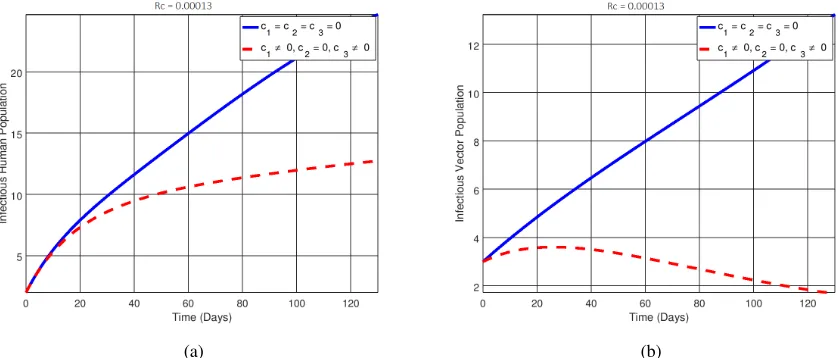
plots are the graphs of infectious human and vector population plotted against time in days and they represent the effect of optimal controlsc1, c2andc3in reducing the number of individuals infected. From Figure4we observe
(a) (b)
Figure 2: (a) Control Profile whenc1= 0,c26= 0andc36= 0. (b) Control profile whenc16= 0, c2= 0andc36= 0.
(a) (b)
Figure 3: (a) Control Profiles whenc1 6= 0, c2 6= 0andc3 = 0. (b) Control profile whenc1 6= 0, c2 6= 0,and
c36= 0.
(a) (b)
(a) (b)
Figure 4: Simulations of the model showing the efforts of treatment and insecticides only on infectious individuals.
(a) (b)
Figure 6: Simulations of the model showing the efforts of education and treatment only on infectious individuals.
(a) (b)
In epidemiology, a reproduction number less than unity implies that the disease can be eradicated in the long run. Hence, choosing suitable parameters for the controlsc1, c2 andc3, it was observed that the effective
repro-duction number obtained for Figures2(a),2(b),3(a),3(b),4,5,6, and7were0.0075,0.00013,0.044,0.000075,
0.0075,0.00013,0.044and0.000075respectively. This shows that by incorporating all the control measures that is educating individuals, giving treatment and applying insecticides is an effective method to help reduce the number secondary infections in the population which corresponds with eradicating the disease in the long run.
5
Conclusion
In this paper, we studied and analysed the model for transmission of HAT, and determined the basic reproduction number. The local and global stabilities of disease free equilibrium and endemic equilibrium were also proved. For the optimal control model, education, treatment and insecticides as control measures were used to optimize the objective function defined by Equation (7). The numerical simulations of the optimal control model shows that the best strategy to reduce the number of infected individuals is through the use of both education, treatment and insecticides. This is the effective and efficient method to eliminate the disease. Furthermore, the national authorities, Non-Governmental Organizations (NGOs), and stakeholders must not lose their interest in controlling the disease because neglecting this disease may cause the rapid re-occurrence and much effect to the people who are at risk.
6
Conflicts of Interest
The authors declare that they have no conflicts of interest.
7
Acknowledgements
The first author’s work (thesis) was partly supported by the Next Einstein Initiative of the African Institute for Mathematical Sciences, Ghana, Annual Grant for Graduate Studies.
8
Data Availability Statement
References
[1] Rock, K.S., Torr, S.J., Lumbala, C., Keeling, M.J.: Quantitative evaluation of the strategy to eliminate human african trypanosomiasis in the democratic republic of congo. Parasites & vectors8(1), 532 (2015)
[2] Franco, J.R., Simarro, P.P., Diarra, A., Jannin, J.G.: Epidemiology of human african trypanosomiasis. Clinical epidemiology6, 257 (2014)
[3] Brun, R., Blum, J., Chappuis, F., Burri, C.: Human african trypanosomiasis. The Lancet375(9709), 148–159 (2010)
[4] Organization, W.H.,et al.: Control and Surveillance of Human African Trypanosomiasis: Report of a WHO Expert Committee. World Health Organization, ??? (2013)
[5] Martcheva, M.: An Introduction to Mathematical Epidemiology vol. 61. Springer, ??? (2015)
[6] Rogers, D.J.: A general model for the african trypanosomiases. Parasitology97(1), 193–212 (1988)
[7] Hargrove, J.W., Ouifki, R., Kajunguri, D., Vale, G.A., Torr, S.J.: Modeling the control of trypanosomiasis using trypanocides or insecticide-treated livestock. PLoS neglected tropical diseases6(5), 1615 (2012)
[8] Kajunguri, D.: Modelling the control of tsetse and african trypanosomiasis through application of insecticides on cattle in southeastern uganda. PhD thesis, Stellenbosch: Stellenbosch University (2013)
[9] Olaniyi, S., Obabiyi, O.S.: Mathematical model for malaria transmission dynamics in human and mosquito populations with nonlinear forces of infection. International Journal of Pure and Applied Mathematics88(1), 125–156 (2013)
[10] Chisholm, R.H., Campbell, P.T., Wu, Y., Tong, S.Y.C., McVernon, J., Geard, N.: Implications of asymp-tomatic carriers for infectious disease transmission and control. Open Science5(2), 172341 (2018)
[11] Yan, P., Liu, S.: Seir epidemic model with delay. The ANZIAM Journal48(1), 119–134 (2006)
[12] Azu-Tungmah, G.T.: A mathematical model to control the spread of malaria in ghana. PhD thesis (2012)
[13] Pedro, S.A., Abelman, S., Ndjomatchoua, F.T., Sang, R., Tonnang, H.E.Z.: Stability, bifurcation and chaos analysis of vector-borne disease model with application to rift valley fever. PloS one9(10), 108172 (2014)
[14] Olaniyi, S., Obabiyi, O.S.: Qualitative analysis of malaria dynamics with nonlinear incidence function. Ap-plied Mathematical Sciences8(78), 3889–3904 (2014)
[16] Heimann, B.: Fleming, wh/rishel, rw, deterministic and stochastic optimal control. new york-heidelberg-berlin. springer-verlag. 1975. xiii, 222 s, dm 60, 60. ZAMM-Journal of Applied Mathematics and Mechan-ics/Zeitschrift für Angewandte Mathematik und Mechanik59(9), 494–494 (1979)
[17] Davis, S., Aksoy, S., Galvani, A.: A global sensitivity analysis for african sleeping sickness. Parasitology
138(4), 516–526 (2011)