Analysis of Multi Resolution Weber in
Detecting Images Forgery
Abstract:
These days the computerized picture assumes a vital part in human life. Because of huge
development in the picture preparing strategies, with the accessibility of picture adjustment devices
any change in the pictures should be possible. These adjustments can't be perceived by human eyes.
So Identification of the picture uprightness is essential in today's life. The proposed strategy utilizes
three principle systems to distinguish the phony of the picture; we used two detail
of-the-workmanship neighborhood surface descriptors: multi-scale Weber's law descriptor
(multi-WLD) and multi-scale local binary pattern (multi-LBP) for plicing and copy move
manufacture area. As the adjust takes after are not unmistakable to open eyes, so the chrominance
parts of a photo encode these takes after and were used for exhibiting modify takes after with the
surface descriptors. To decrease the estimation of the segment space and discard overabundance
components, we used locally learning based (LLB) count. For recognizing a photo as true blue or adjusted, Support vector machine (SVM) was used This paper displays the careful examination for
the approval of this phony identification method. The examinations were coordinated on three
benchmark picture data sets, to be particular, CASIA v1.0, CASIA v2.0, and Columbia shading. The
trial occurs showed that the exactness rate of multi-WLD develop method was 94.19% in light of
CASIA v1.0, 96.52% on CASIA v2.0, and 94.17% on Columbia data set. It is not simply out and out
better than multi-LBP based procedure; furthermore it outmaneuvers other best in class near fraud
recognizable proof methodologies.
Keywords: Digital Image Processing, Locally Learning Based (LLB) Algorithm, Multi-Scale Local
Binary Pattern (Multi-LBP), Weber's Law.
INTRODUCTION
In the present time, computerized picture
plays a vital component in human life
additionally this pictures can utilized as official
record like as a part of military, every day daily
papers, magazines, and in the medicinal analyze
field or might be utilized as verification picture
Akram Hatem Saber
M.E., ECE Department
College Of Engineering, Osmania University, India
Md. Misbahuddin Ph.d., Dr., Assistant Professor,
ECE Department,
College Of Engineering, Osmania University,
at court. Be that as it may, these pictures can be
fashioned effectively utilizing accessible
adjustment apparatuses like Photoshop and so
on, so any change in the picture tends to fraud.
The picture imitations can expel an essential
question from a proof picture which can be an
explanation behind loss of imperative
verification in court. Additionally here and there
these adjustments in the pictures can't be
effortlessly distinguished by human eyes and it
will change the picture respectability. Hence
recognition of the picture imitation is
particularly essential in today's life. There are
numerous systems have been created with the
end goal of credibility of the advanced pictures.
These methods are partitioned into two sections
one is dynamic and other is detached. The
dynamic methods are likewise called as nosy
which is further arranged into two classes. The first needs to install a watermark in the picture,
and second is a computerized signature-based
procedure.
The basically utilized fraud procedures are
copy–move falsification and joining. Duplicate
move fraud implies locale of a picture is
replicated and moved to another district in a
similar picture so as to make area duplication
keeping in mind the end goal to conceal
essential question from unique picture and these replicated square is changed by any sort of
pre-handling technique, for example, scaling,
added substance clamor, revolution and so forth
which is suits the replicated put with the whole
picture. Another fabrication procedure is
grafting in this one a player in a picture is
duplicated and stuck it in another picture. In this
paper three strategies for phony discovery
technique is characterized i.e Histogram
Oriented Gradient, Multi-Resolution Weber
Local Descriptors and Discrete Cosine
Transformer. This will distinguish the phony in
the picture proficiently.
Computerized picture accept a basic part in
different headways and fields. The usage of
cutting edge cameras, PCs, and advanced
picture taking care of programming open for
adjustment and for control of picture. These
mechanical assemblies are versatile and gives
UI highlights. A photo can be controlled easily
through picture planning gadgets and use for
hiding some imperative or significant
information to make fabricated pictures. The
essential purpose of picture wrongdoing scene
examination to address picture reliability and validity. Picture cutting, cloning, solidifying has
been done to make created pictures and
uprightness of picture is lost. These mechanized
designed pictures are not unmistakable in this
way certifiable and validity is lost. In this way,
reliability and validness check of cutting edge
picture has been get pro thought in picture
taking care of field.
The distinctive sorts of contraptions
comprehensively used for change and
poisonously control electronic pictures, for
instance, Freehand and Photoshop et cetera. Therefore, making strategies to affirm these
modernized pictures ended up being basic
especially when pictures are used for any law
methodology as a piece of court, for therapeutic
purposes and money related record,
extortion recognizable proof frameworks have
been proposed to oversee different sorts of
changing pictures and choose the photo realness
and dependability. Starting late, a couple of
makers worked and analyzed the issues of
recognizing picture frauds; and presumption the
tempered pictures and can't reveal
idiosyncrasies and any visual, the pivotal
information of solidifying pictures difference
and special pictures.
Related Work
H. Huang, W. Guo, and Y. Zhang proposed a
SIFT. Scale-invariant element change (SIFT) is
the one of the calculation in PC vision with a
specific end goal to distinguish and portray
neighborhood highlights in pictures. To start
with the question is separated from an
arrangement of given picture and later it put away in a database and a protest is recognized in
another picture by looking at every components
exclusively from the new picture to this
database and finding coordinating elements in
view of Euclidean separation. The proposed a
Run Length Run number which is utilized as
highlight extraction strategy. This calculation
was for the most part created to remove the
surface component which is fundamentally in
view of a multilevel overwhelming eigenvector
estimation strategy. Likewise it enhances the
order precision. The picture which having a long run length is smoother than that the picture with
a short run length on the grounds that the last has
diverse areas alongside various structures.
Muhammad et al. proposed a photo creation
area system that relies on upon bustle outline. In
this method, first disturbance case is gained by
subtracting the denoised picture from the
information picture. By then, histograms of fuss
from different segments of the photo are stood
out from find the mutilation achieved by picture
extortion. Peng et al. used sensor upheaval plan
for recognizing picture extortion. Instead of using the histogram, they used four genuine
measures to be particular, change, entropy,
banner to-clatter extent, and typical
essentialness incline figured from the bustle
outline. He et al. proposed a system that relies
on upon Approximate run length (ARL) to
distinguish CMF. In the first place, the
edge-edge show of a given picture is figured,
and after that ARL is prepared along edge-slant
presentations. Zhao et al. used chrominance
spaces with RLRN (run-length run-number) for
CMF area. To begin with, the data shading picture is changed into YCbCr shading space.
By then RLRN is used to isolate the components
from the de-relationship of chrominance
sections. SVM is used for portrayal reason. This
procedure gives favored execution with JPEG
pictures over TIFF pictures.
Undecimated wavelet change (UWT) based
picture misrepresentation acknowledgment
procedure was proposed. Figure and point by
point coefficients from UWT deteriorations of covering bits of a photo are used to find the
closeness between the squares. The system is
energetic against JPEG weight and a particular
level of turn and scaling. Scale invariant
component change (SIFT) based impersonation
altogether intense against turn and scaling
post-taking care of.
Shi et al. proposed quantifiable segments in
light of 1D and 2D minutes, and move
probability highlights in perspective of Markov
chain in DCT range for picture joining area. On the CASIA v2.0 database, the strategy finished
84.86% accuracy. Later, He et al. upgraded the
system by joining move probability incorporates
into DCT and DWT ranges. For request, they
used SVM together with recursive highlight
transfer (RFE). Their system procured 89.76%
accuracy on the CASIA v2.0 database.
Most of the non-intruding procedures, which
have been proposed along these lines, stand up
to various troubles, for instance, achieving more
incredible totally customized adulteration
distinguishing proof, reducing the rate of false
positives/negatives, quality for change
acknowledgment in any kind of picture
arrangement, et cetera. In this examination, our
consideration is on diminishing the amount of
false positives/negatives and power against any
kind of picture course of action.
PROPOSED METHOD FOR IMAGE
FORGERY
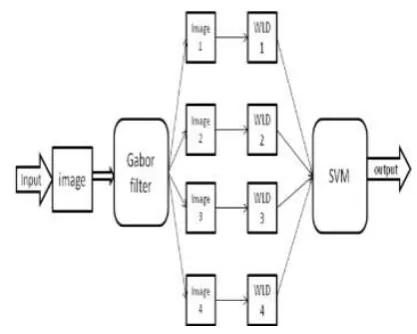
The proposed framework designing for picture
misrepresentation area. In introductory stride
input shading picture is passed to a Gabor channel, where Gabor channel is used for
changing over a lone picture into number of
assurance and number of presentation. In send
step a Weber close-by descriptor which relies on
upon Weber's law is used to think highlight from
data picture. The multi-assurance WLD can give
preferable partition over the single assurance. In
the last walk support vector machine (SVM) is
classifier which is used for describe the photo
into special or created.
Figure 1: Proposed Architecture
Passing Input Image to a Gabor Filter:
In beginning stride we pass the data picture to a
Gabor channel for treatment of picture. Here,
Gabor channel is used to change over the
information picture into number of different
assurance and number of different presentation.
Additionally these channels have been seemed to gatherings perfect confinement properties in
both spatial and repeat space. Gabor stations
have been used as a part of various applications,
for instance, surface division, target area, fractal
estimation organization, file examination, edge
revelation, retina recognizing verification,
picture coding and picture representation. A2D
Gabor channel is a Gaussian bit work changed
by a sinusoidal plane wave. A channel bank
involving Gabor channels with various scales
and turns is made. The channels are convolved with the banner, realizing a claimed Gabor
Gabor channel is characterized as,
Figure 2: Output of Gabor filter bank in
different resolution
let g(x,y,θ,φ) be the capacity characterizing a Gabor channel focused at the inception with as the spatial recurrence and φ as the orientation.A set of Gabor channel with various recurrence
and introduction is Helped to concentrate more
element from picture.
Preprocessing (Conversion from RGB to
YCbCr Space)
Picture Forgers all things considered do picture
changing in RGB space and attempt to wrap
controlled takes after. As human eyes are less sensitive to chrominance parts of YCbCr space,
so the diminishing takes after are filtered into
chrominance portions. In that limit with respect
to perceiving copy move or joining manufacture
in a mechanized picture, chrominance parts are
more reasonable. Keeping in view this
discernment, first the data shading picture is
changed into YCbCr space. The chrominance
portions are figured by subtracting luminance
fragment from red (Cr = R-Y) and blue (Cb =
B-Y). The change from RGB to YCbCr space is
given underneath:
Y= 0.299 R+0.587 G+0.1114B (1)
Cr= 0.701R - 0.587 G - 0.1114B (2)
Cb= - 0.299R - 0.587 G+0.8886B (3)
Highlight extraction
For an effective powerful fabrication
identification framework, it is basic how the
altering are shaped. The accuracy of the
framework is develop generally in light of this
illustrating. We expect that modifying maddens
the surface cases in a photo, and this change can
be shown using surface descriptors. Therefore,
we use two detail of-the - workmanship surface
descriptors: multi-scale WLD and multi-scale
LBP. In the going with subsections, we give an audit of these descriptors
Multi-scale WLD (multi-WLD)
WLD is a vigorous neighborhood descriptor,
which relies on upon Weber's law, which
measures the way that human affectability of a
case relies on upon the change of the first jolt
power. WLD is a close-by surface descriptor. It
has various captivating properties, for instance,
edge acknowledgment and power against light
and hullabaloo changes. It has two fragments: differential excitation (D) and presentation (Φ). As showed by Weber's law, the extent of the
establishment is a steady, which is characterized
as takes after:
Where x is the foundation force, Δx is the
addition limit (perceptible refinement), and C is
a constant. This equation is utilized to figure
differential excitation (D). The D(pc) of a pixel pc is computed utilizing the channel f00 as
Follows :
Where pi is the ith neighbor of pixel pc and N is
the aggregate number of neighbors
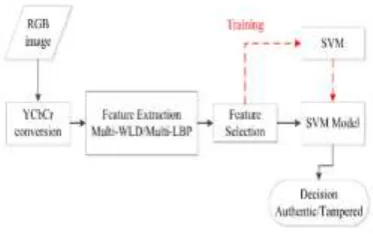
Figure 3: Image forgery detection method based
on texture descriptors
WLD introduction part is the angle introduction.
For pixel Pc, it is computed as takes after:
Where, ks11 and ks10 are the yields of the channels f11 and f10 (appeared in Figure 3), respectively.The extent of Φ is [-π, π], first it is mapped to Φ' whose range is [0, 2π] and after that it is quantized into T winning presentations.
In the wake of finding out differential excitation
and incline presentation, WLD histogram is processed using D and Φ', the detail can be found. The estimation of WLD histogram
incorporates three parameters: the amount of
overpowering presentations (T), the amount of differential excitation parts (M), and the amount
of canisters in each differential excitation divide.
Fundamental WLD descriptor uses 3x3
neighborhood about the central pixel. It is not fit
for getting the detail of all adjacent surface
scaled down scale plans, which exist with
different scales. Multi-WLD can get the detail
of surface little scale outlines with different scales and it is figured using symmetric square
neighborhoods (P, R) with evolving P (the
amount of neighboring pixels) and R (the range
that addresses scale). The histograms enrolled
with three neighborhoods are connected to
convey the multi-WLD that structures the
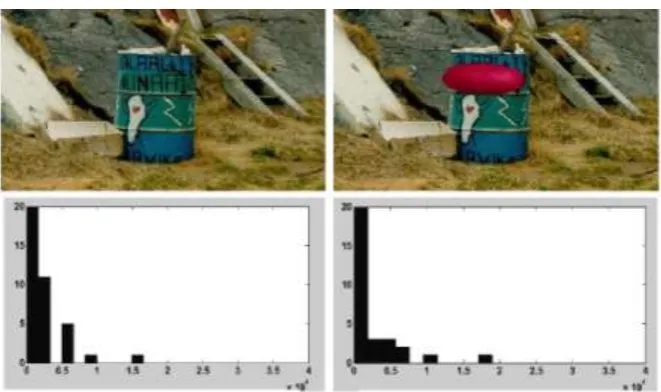
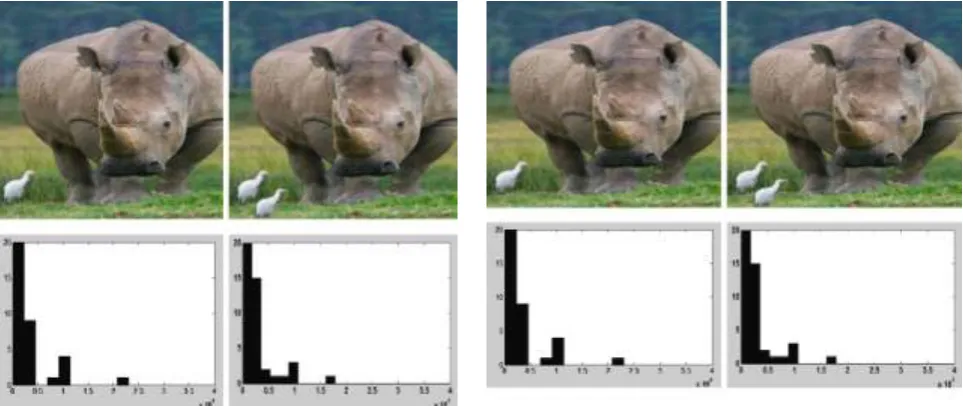
representation of the photo. The multi-WLD
histograms of Cr fragment of genuine picture
and the relating copy move designed picture
without doing any preprocessing on the
recreated range are sketched out in Figure 7.
Multi-WLD histograms of Cr section of a real picture and the contrasting copy move picture
molded and playing out a transformation on the
repeated region are showed up in Figure 8.
Multi-scale LBP (Multi-LBP)
LBP has been attested to be a to a great degree
effective adjacent surface descriptor. It encodes
neighborhood surface scaled down scale plans
and has been productive in various fields. LBP
offers a bound together portrayal including both
fundamental and quantifiable qualities of
surface cases, in this way it is solid for surface
examination. LBP descriptor has low
computational cost and is intense against
monotonic illumination changes. A LBP head
relates a twofold code with each pixel p
on a float of range R. Formally, it is described as
takes after:
Figure4: f00 filters for (16,2) and (24,3) scales
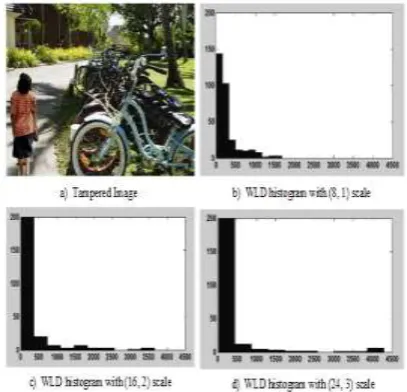
Figure 5: WLD histograms of a tampered image
with three scales.
where the thre-shoulding function s(x) is
specified as follows:
Here pc is the grayscale value of pixel pc and pn (n= 0,1, …, N-1) are the gray-scale values of its neighbors.There are three variants of LBP
operator: (1) rotation invariant LBP denoted by
(1) rotation invariant LBP denoted by
(2) uniform LBP denoted by and (3)
uniform rotation -invariant LBP denoted by
The rotation invariant LBP is
Imple LBP operator considers only 3×3 neighborhood of a pixel for computing its LBP code.
Similarly to WLD, LBP cannot encode texture micro-patterns at multiple scales. Like multi-WLD,
multi-LBP is defined using multiple neighborhoods (P, R) of varying P (the number of neighboring
pixels) and R (the radius that defines scale). In our experiments, we employed three scales: P = 8, 12,
16 and R = 1, 1.5, 2.
Figure 6: Multi-WLD histograms of Cr chrominance component of an authentic image (left) and a
spliced image (right).
Include Subset Selection
Each of multi-WLD and multi-LBP descriptor contains an impressive measure of abundance
components, which not simply inspirations the scourge of the dimensionality issue also tends to
decrease the execution exactness of a classifier. Neighborhood learning based (LLB) incorporate
subset decision methodology is computationally capable and is not delicate to the generous number of irrelevant segments. The essential framework of this figuring is to separate erratically an ensnared
non-straight issue into a social occasion of locally direct issues by using neighborhood learning, and a while later to learn incorporate significance universally in the most extraordinary edge framework.
Notwithstanding the way that LLB is a channel methodology for highlight subset assurance, in any
case we use it as a rapper procedure with SVM.
In the wake of performing trial on picture it will clearly show that GWLD system give the correct
planning dataset to the model, it will arranged precisely and in testing stage it find whether given
picture is novel or not. It obviously made refinement on these photos. Favored outlook of this
methodology over past strategy is time required for planning and testing the model is less as
differentiated and other procedure. This procedure will give correct outcome for copy move sorts of
extortion. This procedure finds any sorts of modification done on novel picture, it can without a lot of
an extend find up to 90 degree turn and half changed picture.
Table 1 spoke to the result of GWLD method for copy move sorts of misrepresentation revelation. There are four sorts of changes: (a) curve the recreated range (b) resize the copied area (c) rotate the
reproduced region, and (d) no change. Portion 2 in two different procedure for misrepresentation
distinguishing proof first system is Gabor Weber close-by descriptor and send strategy is Weber
precision of both system and it doubtlessly show the accuracy of GWLD procedure is beated over
methodology. The outcome of copy move adulteration area in light of progress and most bewildering
precision of 88.21% is expert with no change.
CONCLUSION
A Gabor Weber adjacent descriptor procedure is
proposed. Gabor channel is used to address
picture into different presentation and upset. WLD will isolate component from these photo.
SVM is used for gathering proposed. A propose
methodology fulfilled exactness 88.21% for
copy move sorts of misrepresentation area.
Proposed method moreover puts aside less
chance to set up the model. A part work will be
find uniting sort of misrepresentation in picture.
We have talked about a picture falsification
identification technique that depends on entropy
channel and nearby stage quantization (LPQ)
surface administrator. The entropy channel
highlights the irregular changes in the pictures that aides in finding manufactured part. The
LPQ administrator gives the data about the
inside insights of this entropy separated picture
that aides in group produced and nonforged
pictures. Our strategy work similarly well for
both sort of produced pictures i.e. duplicate
move and joined pictures. Our strategy gives
95.41%, 98.33% and 91.14% recognition
exactnesses on CASIA v1.0, CASIA v2.0 and
Columbia databases separately.
REFERENCE:
[1] Hussain, M., Muhammad, G., Saleh, S. Q.,
Mirza, A. M., & Bebis, G. (2013, July). Image
forgery detection using multi-resolution Weber
local descriptors. In EUROCON, 2013 IEEE
(pp. 1570-1577). IEEE.
[2] Schölkopf, B., Smola, A., & Müller, K. R.
(1998). Nonlinear component analysis as a
kernel eigenvalue problem. Neural
computation, 10(5), 1299-1319.
[3] Gragnaniello, D., Poggi, G., Sansone, C., &
Verdoliva, L. (2013, September). Fingerprint
liveness detection based on weber local image
descriptor. In Biometric Measurements and
Systems for Security and Medical Applications
(BIOMS), 2013 IEEE Workshop on (pp. 46-50).
IEEE.
[4] Hussain, M., Muhammad, G., Saleh, S. Q.,
Mirza, A. M., & Bebis, G. (2012, November).
Copy-move image forgery detection using
multi-resolution Weber descriptors. In Signal
Image Technology and Internet Based Systems
(SITIS), 2012 Eighth International Conference
on (pp. 395-401). IEEE.
[5] Hussain, M., Saleh, S. Q., Aboalsamh, H.,
Muhammad, G., & Bebis, G. (2014, June).
Comparison between WLD and LBP descriptors
for non-intrusive image forgery detection. In
Innovations in Intelligent Systems and Applications (INISTA) Proceedings, 2014 IEEE
International Symposium on (pp. 197-204). IEEE.
[6] Alahmadi, A. A., Hussain, M., Aboalsamh,
H., Muhammad, G., & Bebis, G. (2013,
December). Splicing image forgery detection
Global Conference on Signal and Information
Processing (GlobalSIP), 2013 IEEE (pp.
253-256). IEEE.
[7] Lu, D., Hetrick, S., Moran, E., & Li, G.
(2010). Detection of urban expansion in an
urban-rural landscape with multitemporal
QuickBird images. Journal of applied remote
sensing, 4(1), 041880-041880.
[8] Hussain, M., Qasem, S., Bebis, G.,
Muhammad, G., Aboalsamh, H., & Mathkour,
H. (2015). Evaluation of image forgery
detection using multi-scale weber local
descriptors. International Journal on Artificial
Intelligence Tools, 24(4), 1540016.
[9] Gragnaniello, D., Poggi, G., Sansone, C., &
Verdoliva, L. (2015). An investigation of local
descriptors for biometric spoofing detection.
IEEE Transactions on Information Forensics
and Security, 10(4), 849-863.
[10]Cozzolino, D., Gragnaniello, D., &
Verdoliva, L. (2014, October). Image forgery
detection through residual-based local
descriptors and block-matching. In 2014 IEEE
International Conference on Image Processing
(ICIP) (pp. 5297-5301). IEEE.
[11]Muhammad, G., Dewan, M. S.,
Moniruzzaman, M., Hussain, M., & Huda, M.
N. (2014, April). Image forgery detection using
Gabor filters and DCT. In Electrical
Engineering and Information & Communication
Technology (ICEEICT), 2014 International