Medical Video Compression Using Integer
Wavelet Transform Systems in H.264/SVC
Standard
Mohanraj.R, B.Karthik
Assistant Professor, Dept of ECE, Bharath University, Chennai, Tamil Nadu, India
Assistant Professor, Dept of ECE, Bharath University, Chennai, Tamil Nadu, India
ABSTRACT: The Rate distortion performance and computational complexity is higher in H.264/AVC (Advanced Video Coding). H.264 /SVC (Scalable Video Coding) is the latest standard in medical video compression. This paper provides evaluation and performance analysis of SVC. It uses Integer Wavelet transform to compress the medical video frames. Temporal, Spatial, Fidelity are three scalability properties in SVC. The standard performance metrics like Compression Ratio, PSNR and MSE are evaluated. H.264/SVC provides better compression than AVC.
KEYWORDS: H.264/AVC,PSNR, H.264/SVC, compression, medical video.
I. INTRODUCTION
Due to large size of medical videos, enormous disk storage is required. In addition to this, transmission of high resolution medical videos at a faster rate poses a problem and during the time of emergency, it is pivotal to make diagnoise as quickly as possible. The telemedicine allow medical amenities to make diagnosis without the need of medical doctor to be physically present (Ref[5][6]. Pedersen et al., 2009). CT scan (Computerized Tomography),Ultrasound, Magnetic resonance imaging (MRI) echocardiography, and so on, are tools for the aid of doctors to diagnose and treat patients with incredible precision and swiftness. Telemedicine can be used considerably in disaster ridden areas where there is a problem of accessibility like flood and earthquake struck areas. The technician can take video and send it online to medical panel which can diagnose and results can be sent back.Furthermore, telemedicine applications provide the path to take advice from specialists all over the world over complex medical issues. As a result, compression of medical video is required to address the above stated issues.Moreover,it is crucial that compression produces no noteworthy loss of detail and does not generate any perceptible artifacts that could lead to wrong diagnosis. The H.264/SVC is the recent state of- the-art video compression standard (Ref[5]. Schwarz et al.,2007). The video produced has reduced temporal (framerate), spatial resolution and/or lower quality, which makes SVC to provide significant compression without compromising the subjective quality of video.It also renders the receiving devices, versatility of having variable display and computational needs from high definition equipments to low power battery operated machines, providing scalability to be a useful tool in medical video compression.Very little work has been done on the evaluation of medical videos using H.264/AVC (Ref[5]. Yu et al., 2005). Performance analysis of the SVC is good achieve high compression ratios (Ref[5]. Wien et al., 2007). However, analysis is done on commercial (non-medical) videos. To the best of our knowledge, until now no effort has been made in applying H.264/SVC for medical video and there is a need to evaluate this standard with respect to medical videos. This is the key inspiration for this research.
II. H.264/SVC OVERVIEW
H.264/AVC (Advanced Video Coding) standard in fidelity (Ref[5][6]. Schwarz and Wien, 2008) SVC is beneficial than simulcast, that permits concurrent transmission of single-layer bit streams with dissimilar bit rates and picture sizes, depending upon the application. SVC, as an extension of H.264/AVC, ideally needs to fulfill the following requirements, each crucial if SVC is to become widely adopted:
1) Minimal increase in computational complexity compared to H.264/AVC.
2) Minimal loss in coding efficiency relative to single layer coding, namely, H.264/AVC non-scalable video coding. 3) Support of multilevel scalability, namely, the provision of increased temporal and spatial resolution, and image quality.
4) Easy extraction of subsets of the scalable bit stream.
The basic block diagram of an SVC encoder with two spatial layers is demonstrated in Fig.1. Input medical video can be converted to different resolutions for encoding using the spatial decimation block. Scalability is supported at the cost of increase in bit rate required for symbolizing a specific fidelity and the tradeoff among the desired level of scalability and the coding efficiency depend upon the particular application. Original or the spatially decimated video is presented for motion compensation, intra prediction and base layer coding using H.264/AVC compatible encoderto generate a bit stream with spatial and temporal scalability. Quality scalability can be added to this bit stream using fidelity scalable coding block. Consequently each of them represents the source contents with a specific fidelity and spatial resolution that is a part of the overall SVC bit stream and is denoted as a layer.
Fig.1: Block Diagram of H.264/SVC Encoder.
the H.264/AVC standard and can be accomplished by division of the access units into multiple layers (temporal base and one or more enhancement layers). Each access unit of a specific layer is encoded using only the access units of the same or a lower temporal layer for inter picture prediction. SVC introduced the features of spatial and fidelity scalability. Spatial scalability is the case when subset bit stream supplies more than one picture size(spatial resolution) (Ref[5]. Andrew et. al., 2007) while the fidelity scalability describes the situation when the subset bit stream delivers the source content at the original spatio-temporal resolution but with variable reconstruction quality.
III. INTEGER WAVELET TRANSFORM
The wavelet transform has received much attention in the field of image and video compression. It provides great potential of achieving better rate-distortion performance than conventional DCT-based approach (e.g., JPEG). One problem associated with the wavelet image compression technology is the high computational complexity. Although floating-point arithmetic is nearly as fast as integer arithmetic when their operands have the same data length, the integer wavelet transform can be implemented much faster than the floating point wavelet transform in almost all general purpose computers because the floating point wavelet transform demands for longer data length than the integer wavelet transform does. Another benefit of using integer wavelets is the reversibility. That is, the image can be reconstructed lossless because all the coefficients are integers and can be stored without rounding-off errors.
.
The lifting scheme is a new method for constructing integer wavelet transform. Bi-orthogonal wavelets constructed by the lifting scheme have been identified as very promising filters for lossless/lossy image compression applications. By making use of similarities between the high- and low-pass filters, the lifting scheme reduces the computation complexity by a factor of two compared with traditional wavelet transform algorithms. With certain modifications, the corresponding wavelet transform can even be calculated with only integer addition and shift operations which make the computation even faster. Besides, the transform is reversible which means that it can be used for both lossless and lossy image compression. Furthermore, the inverse wavelet transform can be immediately found by undoing the operations of the forward transform.
Modern wavelet-based image compression systems contain three building elements:
wavelet transform
successive quantization and adaptive entropy coding.
Typically, more than 60% of the time used in image compression is consumed by the wavelet transform. It is very crucial to speed up the computation of the wavelet transform for real-time image and video-compression applications, especially for large-scale and color images. While integer wavelets using the lifting scheme significantly reduce the computation time, we propose a new approach to further speed up the computation of the wavelet transform. The method is based on the fact that the 16-bit integer arithmetic has the same speed as the 32-bit integer arithmetic in contemporary computers while a 16-bit data unit is sufficient for most integer wavelets. We can therefore pack multiple pixels (wavelet coefficients) in a single long word during the computation of the reversible wavelet transform. As a result, operations on multiple pixels (wavelet coefficients) can be performed at once. Thus, the computation time as well as the working memory space can be dramatically reduced.
Fig.2 Basic Filter Bank For Bi-Orthogonal Wavelet Transform
Sub-band coding (SBC) is any form of transform coding that breaks a signal into a number of different frequency bands and encodes each one independently. This decomposition is often the first step in data compression for audio and video signals.
The wavelet transform can be considered as a subband transform and implemented with a filter bank Fig.2 describes the general block scheme of a one-dimensional bi orthogonal wavelet transform. The forward transform uses two analysis filters ĥ(low pass) and ĝ(high pass) followed by sub sampling, while the inverse transform first up samples and then uses two synthesis filters ĥ(low pass) and ĝ (high pass). SVC can present diversity in combinations of the above mentioned three fundamental scalability types. They are Temporal, spatial, fidelity. The synthesis filters are added together to reconstruct the original signal.
IV. RESULTS AND DISCUSSION
INPUT:
The medical CT scan video applying at input in H.264/SVC for performing compression. So medical data sets for CT scan video frames following below.
Fig.3 CT scan input video frames
OUTPUT:
Compressed video: 15
Fig.4 CT scan output video frames.
The above medical video compression output shows lossless approaches and efficient compression done by using integer wavelet transform.
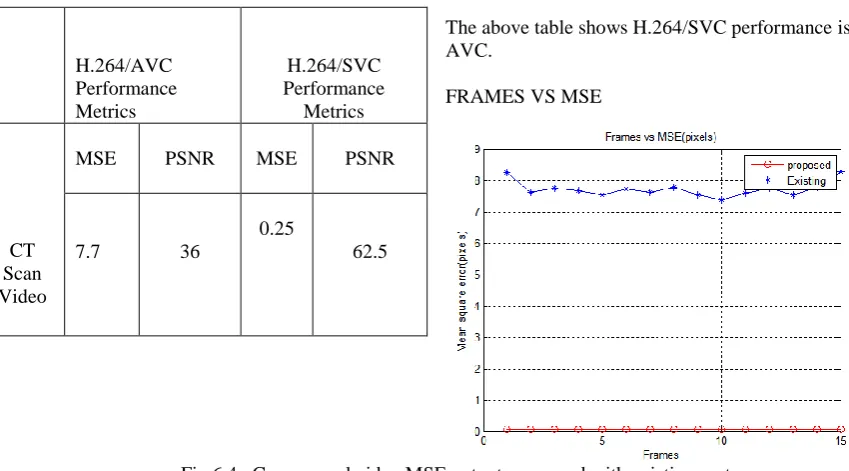
COMPARISON OF PERFORMANCE METRICS FOR H.264/AVC & SVC:
TABLE 1:
Performance metrics are following below
The above table shows H.264/SVC performance is better than AVC.
FRAMES VS MSE
Fig.6.4 Compressed video MSE output compared with existing system.
The output of medical video compression has MSE value is below 0.5 pixels. So there is no possible for error occurred during compression.
H.264/AVC Performance Metrics
H.264/SVC Performance
Metrics
CT Scan Video
MSE PSNR MSE PSNR
7.7 36
0.25
FRAMES VS PSNR
PSNR is defined as the ratio between the maximum possible power of a signal and the power of noise that affects the fidelity of its representation.
Compute the PSNR using the following equation (2)
PSNR=10log10 [R 2
/MSE]
In the previous equation, R is the maximum fluctuation in the input image data type. For example, if the input image has a double-precision floating-point data type, then R is1. If it has an 8-bit unsigned integer data type, R is 255, etc.
Fig.6.3 Compressed video PSNR output compared with existing system
The above fig 6.3 shows clearly, that PSNR value of this proposed system is above 60 compared to the existing system.
COMPRESSION RATIO:
Compression ratio is defined as the ratio between the uncompressed size and compressed size. The result of Compression ratio for medical video is 3.143178
V. CONCLUSION
In comparison to the scalable profiles of prior video coding standards, the H.264/AVC extension for SVC provides various tools for reducing the loss in coding efficiency relative to single layer coding. Experimental results shows efficient compression by using integer wavelet transform and evaluated compression ratio, PSNR (Peak signal to noise ratio) and MSE (mean square error value) for compressed medical videos.
VI. FUTURE WORK
The output of compressed medical videos is encoded block by block and apply into fidelity scalable coding in H.264/SVC for improve the compressed medical video quality and reconstruction the Temporal, Spatial, Fidelity scalability from base layer into enhancement layer.
REFERENCES
[1] Iraide Unanue, Inigo Urteaga, Ronaldo Husemann, Javier Del Ser, Valter Roesler, Aitor Rodríguez and Pedro Sánchez, A Tutorial on H.264/SVC Scalable Video Coding and its Tradeoff between Quality, Coding Efficiency and Performance, Tecnalia research & innovation, P. Tecnológico,
Zamudio, UFRGS - Instituto de Informática. Av. Bento Gonçalves, Porto Alegre, IKUSI-Ángel Iglesias, S. A., Paseo Miramón, Donostia-San Sebastian Spain, Brazil
[2] Rajasulochana P., Krishnamoorthy P., Dhamotharan R., "An Investigation on the evaluation of heavy metals in Kappaphycus alvarezii", Journal of Chemical and Pharmaceutical Research, ISSN : 0975 – 7384, 4(6) (2012) pp. 3224-3228.
[3] Xin Lu and Graham R. Martin, Fast Mode Decision Algorithm for the H.264/SVC, Vol. 23, No. 5, May 2013.
[4] Jasmine M.I.F., Yezdani A.A., Tajir F., Venu R.M., "Analysis of stress in bone and microimplants during en-masse retraction of maxillary and mandibular anterior teeth with different insertion angulations: A 3-dimensional finite element analysis study", American Journal of Orthodontics and Dentofacial Orthopedics, ISSN : 0889-5406, 141(1) (2012) pp. 71-80.
[5] Gary J. Sullivan, Jens-Rainer Ohm, Woo-Jin Han and Thomas Wiegand, “Overview of the High Efficiency Video Coding (HEVC) Standard” IEEE transactions on circuits and systems for video technology, vol. 22, no. 12, December 2012.
[6] Raj M.S., Saravanan T., Srinivasan V., "A modified direct torque control of induction motor using space vector modulation technique", Middle - East Journal of Scientific Research, ISSN : 1990-9233, 20(11) (2014) pp.1572-1574
[7] Jung-Hwan Lee and Chuck Yoo, “Scalable ROI Algorithm for H.264/SVC-based Video Streaming”, Vol. 57, No. 2, May 2011.
[8] Bharatwaj R.S., Vijaya K., Rajaram P., "A descriptive study of knowledge, attitude and practice with regard to voluntary blood donation among medical undergraduate students in Pondicherry, India", Journal of Clinical and Diagnostic Research, ISSN : 0973 - 709X, 6(S4) (2012) pp.602-604. [9] F.Nazir and G. Raja,”H.264/SVC for Medical Video Compression”, Pakistan Journal of Science (Vol. 63 No. 4 Dec, 2011)
[10] Anbuselvi S., Rebecca J., "A comparative study on the biodegradation of coir waste by three different species of Marine cyanobacteria", Journal of Applied Sciences Research, ISSN : 1815-932x, 5(12) (2009) pp.2369-2374.
[11] J.Mohanalin Rajarathnam, “A novel Fuzzy based Medical video compression using H.264”.Georgian Electronic Scientific Journal Computer Science and Telecommunications 2008.
[12] Yu-Ming Lee and Yinyi Lin, Zero-Block Mode Decision Algorithm for H.264/AVC IEEE transactions on image processing, vol. 18, no. 3, march 2009.
[13] Hongtao Yu, Zhiping Lin and Feng Pan, Applications and Improvement of H.264 in Medical Video Compression, vol. 52, no. 12 on December 2005.
[14] Chengjiang Lin, Bo Zhang, and Yuan F. Zheng, “Packed Integer Wavelet Transform Constructed by Lifting Scheme”,IEEE transactions on circuits and systems for video technology, vol. 10, no. 8, December 2000.
[15] A.R. Calderbank, Ingrid Daubechies, Wim Sweldens, and Boon-Lock Yeo, “Wavelet transforms that map integers to integers”, August1996. [16] Computed tomography medical videos taken from www.medipix.com.
[17] B Karthik, TVUK Kumar, EMI Developed Test Methodologies for Short Duration Noises, Indian Journal of Science and Technology 6 (5S), PP 4615-4619, 2013.
[18] S.Rajeswari, Blurred Image Recognition by Legendre Moment Invariants, International Journal of Advanced Research in Electrical, Electronics and Instrumentation Engineering, ISSN 2278 – 8875,pp 83-86, Vol. 1, Issue 2, August 2012
[19] G.Tamizharasi, S.Kathiresan, K.S.Sreenivasan, Energy Forecasting using Artificial Neural Networks , International Journal of Advanced Research in Electrical, Electronics and Instrumentation Engineering,ISSN: 2249-2615,pp 7-13, Volume2 issue-6 No1 Nov 2012
[20] K. Subbulakshmi,An Embedded Based Web Server Using
ARM 9 with SMS Alert System,International Journal of Advanced Research in Electrical, Electronics and Instrumentation Engineering, ISSN (Print) : 2320 – 3765, pp 6485-6490,Vol. 2, Issue 12, December 2013.
[21] K. Subbulakshmi,VLSI Implementation of Evolvable PID
Controller,International Journal of Advanced Research in Electrical, Electronics and Instrumentation Engineering,ISSN (Print) : 2320 – 3765 , pp 6572-6579,Vol. 3, Issue 1, January 2014.