Fuzzy Based Control of TCPS-SMES Co-Ordination
In two Area Thermal System with Automatic
Generation Control
D. HARISH VARMA
M-tech Student Scholar
Department of Electrical & Electronics Engineering, Avanthi’s St. Theressa Institute of Engineering and Technology,
Garividi;
Vizianagaram(Dt); Andhra pradesh, India.
B.SANKARA PRASAD, M.Tech. Associate Professor
Department of Electrical & Electronics Engineering, Avanthi’s St. Theressa Institute of Engineering and Technology,
Garividi;
Vizianagaram (Dt); Andhra Pradesh, India.
ABSTRACT: Automatic generation control has been used for several years to meet the objective of maintaining the system frequency at nominal value and the net tie line power interchange from different areas at their scheduled values. The concept of conventional AGC is discussed. Controlling the frequency has always been a major subject in electrical power system operation and is becoming much more significant recently with increasing size, changing structure and complexity in interconnected power systems.The power systems are widely interconnected for its applicapability all over the globe. Interconnection not only enhances system reliability but also improves the system efficiency. Since the system is wide and complex, for the faithful operation, the analysis of the system is of greater importance. The proposed TCPS-SMES combination can improve the dynamic system performance of Automatic Generation Control of an interconnected system after the sudden load perturbation. The integral gains of AGC are obtained by tuning the quadratic performance index using Integral Squared Error (ISE) technique. The system is modeled using MATLAB SIMULINK. The proposed concept is implemented to fuzzy logic controller application by using Mat lab\Simulink software
Keywords— Automatic Generation Control (AGC), Integral Squared Error (ISE), Superconducting Magnetic Energy Storage (SMES), Thyristor Controlled Phase Shifter (TCPS)
I. INTRODUCTION
The ultimate objective of automatic generation control (AGC) is to maintain the balance between power output of the electrical generator and load demand so as to keep the frequency within the acceptable limits, in response to the changes in the
system and tie-line loading. This function is normally termed as load frequency control (LFC) [1]. The power systems are widely interconnected for its applicapability all over the globe. Interconnection not only enhances system reliability but also improves the system efficiency. Since the syste m is wide and complex, for the faithful operation, the analysis of the system is of greater importance. Currently system became too complex with addition of more utilities, which may leads to a condition where supply and demand has got a wide gap [2]. Due to heavy load condition in tie-lines by electric power exchange results in poor damping which may leads to inter-area oscillation. Since the loading conditions are unpredictable, this makes the operation more complex. It has been a topic of concern, right from the beginning of interconnected power system operation. In this context, Automatic Generation Control plays a vital role in the power system operation. Several works have been carried out for the AGC of interconnected power systems for last few decades [3]-[6]. Earlier works in this field proposed many ideas to enhance to syste m stability when there is sudden drift in the demand.
However these proble ms can also occurs from the generation side thermal power plants has got its own associated operational constraints, but the scenario changes considering the Distributed Generation (DG) especially Photo Voltaic cells, most of the proposed solutions so far for AGC have not been implemented for Distributed Generations [7].
independent adjustment of certain system variables such as power flows, which are not normally controllable [7]. Automatic Generation Control (AGC) that allows dispatchers to change the relative phase angle between two system voltages, thereby helping them to control real power transfers between the two interconnected power systems. It attenuates the frequency of oscillations of power flow following a load disturbance in either of the areas, as well. Phase shifters also provide series compensation to augment stability. The high-speed responses of phase shifters make them attractive for use in improving stability. The AGC is expected to be an effective control for the tie-line power flow control of an interconnected power system. Usually sudden changes in power requirement are met by kinetic energy of generator rotor, which effectively damp electromechanical oscillations in power system [2]. Use of fast acting storage devices in the syste m also improves the transient performance by supplying stored energy after the sudden load perturbation. [8] Has proposed a control strategy AGC to providing active control of system frequency and thereby to damp the system frequency and tie power oscillations. Considering these viewpoints, the proposed system can be a good tool for LFC of multi-area power system.
II. THYRISTOR CONTROLLED PHASE SHIFTER (TCPS)
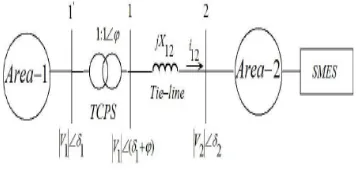
Fig 1. Schematic diagram of two area system with TCPS & SMES
TCPS is a device that changes the relative phase angle between the system voltages. Therefore the real power flow can be regulated to mitigate the frequency oscillations and enhance power system stability [7]. In this study, a two-area multi-unit ther mal power system interconnected by a tie-line is considered. Fig. 1 shows the sche matic representation of the two-area interconnected power system considering a TCPS in series with the tie-line. TCPS
interconnected power syste m, the reactance to-resistance ratio of a tie-line is quite high and the effect of resistance on the dynamic performance is not that significant. Because of this, the resistance of the tie-line is neglected.
Superconducting Magnetic Ene rgy Storage (SMES)
The SMES unit contains a DC superconducting coil and a 12-pulse converter, which are connected to grid through a Y-Δ/Y-Y transfor mer. The superconducting coil can be charged to a set value from the utility grid during steady state operation of the power system. The DC magnetic coil is connected to grid via inverter/ rectifier arrangement. The charged superconducting coil conducts current which is immersed in a tank containing helium. The energy exchange between the superconducting coil and the electric power system is controlled by a line commutated converter. When there is a sudden rise in the load demand, the stored energy is almost released through the converter to the power system as alternating current. As the governor and other control mechanisms start working to set the power system to the new equilibrium condition, the coil current changes back to its initial value and are similar for sudden release of load [12].
III. SYSTEM INVESTIGATED
Fig.2 Linearized model of an interconnected thermal-thermal system
control areas. Area 1 consists of two reheat thermal power generation units and Area 2 comprises two non reheat thermal generation units. The frequency in the power syste m is being maintained by controlling the driving torques of the thermal turbine. The reheat turbine gives a fast response component due to the High Pressure (HP) stage and a much slower Low Pressure (LP) due to reheat delay. A Generation Rate Constraint (GRC) of 10 % p.u. MW/min and 3% p.u. MW/min for non-reheat and reheat thermal systems respectively [9,13]. GRCs are taken into account since the rapid power increase would draw out excessive stea m from boiler system to cause steam condensation due to adiabatic expansion. k11and k22 are the integral gain settings in area 1 and area 2 respectively. The nominal parameters of the system are given in Appendix-1.
IV.FUZZY LOGIC CONTROLLER
L. A. Zadeh presented the first paper on fuzzy set theory in 1965. Since then, a new language was developed to describe the fuzzy properties of reality, which are very difficult and sometime even impossible to be described using conventional methods. Fuzzy set theory has been widely used in the control area with some application to dc-to-dc converter system. A simple fuzzy logic control is built up by a group of rules based on the human knowledge of system behavior. Matlab/Simulink simulation model is built to study the dynamic behavior of dc-to-dc converter and performance of proposed controllers. Furthermore, design of fuzzy logic controller can provide desirable both small signal and large signal dynamic perfor mance at same time, which is not possible with linear control technique. Thus, fuzzy logic controller has been potential ability to improve the robustness of dc-to-dc converters. The basic scheme of a fuzzy logic controller is shown in Fig 5 and consists of four principal components such as: a fuzzification interface, which converts input data into suitable linguistic values; a knowledge base, which consists of a data base with the necessary linguistic definitions and the control rule set; a decision-making logic which, simulating a human decision process, infer the fuzzy control action from the knowledge of the control rules and linguistic variable definitions; a de-fuzzification interface which yields non fuzzy control action from an inferred fuzzy control action [10].
Fig.3. General Structure of the fuzzy logic controller on closed-loop system
The fuzzy control systems are based on expert knowledge that converts the human linguistic concepts into an automatic control strategy without any complicated mathematical model [10]. Simulation is performed in buck converter to verify the proposed fuzzy logic controllers.
Fig.4. Block diagram of the Fuzzy Logic Controller (FLC) for dc-dc converters
A. Fuzzy Logic Membership Functions:
system. The single output variable (u) is duty cycle of PWM output.
Fig. 5.The Membership Function plots of error
Fig.6. The Membership Function plots of change error
Fig.7. the Membership Function plots of duty ratio
B. Fuzzy Logic Rules:
The objective of this dissertation is to control the output voltage of the boost converter. The error and
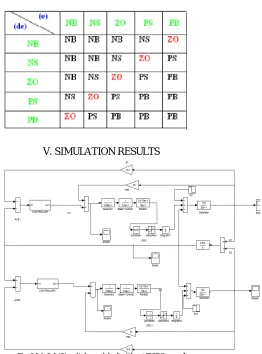
inputs of fuzzy logic controller. These 2 inputs are divided into five groups; NB: Negative Big, NS: Negative Small, ZO: Zero Area, PS: Positive small and PB: Positive Big and its parameter [10]. These fuzzy control rules for error and change of error can be referred in the table that is shown in Table I as per below:
Table I
Table rules for error and change of error
V. SIMULATION RESULTS
Fig.9 shows the deviation of frequency in area-1
Fig.9 shows the deviation of frequency in area-2
Fig.10 shows the deviation in tie-line power flow
Fig.11 Matlab/Simulink model of without TCPS area-2
Fig.12 shows the deviation of frequency in area-1
Fig.14 shows the deviation of frequency in area-1 using fuzzy logic controller
Fig.15 shows the deviation of frequency in area-2 using fuzzy logic controller
VI. CONCLUSION
In this paper, a coordinated control of SMES and TCPS has been proposed for a two-area multi-unit interconnected thermal power system. Gain settings of the integral controllers without and with SMES-TCPS combinations are optimized using ISE technique in the presence of GRCs by minimizing a quadratic performance index. A fuzzy control strategy has been proposed to control the SMES-TCPS combination which in turn controls the frequency deviation in the control areas and inter-area tie-line power flow. From the simulation studies it is revealed that the SMES-TCPS combination can effectively control phase angle (TCPS action) and
supply or absorb power when there is change in system power levels (SMES action).
REFERENCES
[1] P. Kundur, Power System Stability and Control, McGraw- Hill Inc., New York, 1994.
[2] Olle. L.Elegerd, Electric Energy systems Theory-An introduction Second Edition Tata McGraw-Hill Education Private Ltd. New Delhi, 1983.
[3] Elgerd, O.I., and Fosha, C.: Optimum megawatt frequency control of multi-area electric energy systems,
IEEE Trans. Power Appar. Syst., , pp. 556-563,1970. [4] Cohn, N.: Techniques for improving the control of bulk power transfers on interconnected systems, IEEE Trans. Power Appar. Syst., pp. 2409- 2419,1971.
[5] Miniesy, S.M., and Bohn, E.V.: Two level control of interconnected power plants, IEEE Trans. Power Appar. Syst.,, pp. 2742 -2748,1971, 90, (6)
[6] Hiyama, T.: Design of decentralized load frequency regulators for interconnected power systems, IEE Proc., Gener. Transm. Distrib.,1982.
[7] Rajesh Joseph Abraham, D Das, Amit Patra, ”
Automatic generation control of an interconnected hydrothermal power system considering superconducting magnetic energy storage”, Electrical Power and Energy systems, Vo l. 29, pp-571-579, 2007
[8] Des ire Championship, Somali Anwar, “Interaction between phase shifting transformers installed in the tie-lines
of interconnected power systems and automatic frequency controllers”, Electrical Power Systems, Vol.33, pp-1351-1360, 2001.
[9] R J Abraham, D Das, A Patra. ” Effect of TCPS on oscillations in tie-power and area frequencies in an interconnected hydrothermal power system.”, IET Generation,Transmission & Distribution, Vol. 1, pp. 632-639, 2007.
[10] Rajesh Joseph Abraham, D Das, Amit Patra, “AGC study of a hydrothermal system with SMES and TCPS”, European Transactions on Electrical Power, Vol.19, pp. 487-498, 2009.
[11] K.R.Sudha, R. Vijaya Santhi, “ Load Frequency Control of an interconnected Re heater thermal system using Type-2 fuzzy system including SMES
units”,Electrical Power