ISSN (Print) : 2320 – 3765 ISSN (Online): 2278 – 8875
I
nternational
J
ournal of
A
dvanced
R
esearch in
E
lectrical,
E
lectronics and
I
nstrumentation
E
ngineering
(An ISO 3297: 2007 Certified Organization)
Vol. 3, Issue 8, August 2014
Integrated Approach for Speech Compression
Using DWT & DCT
Hemant Amhia
1, Ratish Kumar
2Prof. at Jabalpur Engineering College, Jabalpur engineering college, Jabalpur, M.P, India1 PG stud [control system], Jabalpur Engineering College, Jabalpur, M.P, India2
ABSTRACT: With the growth of multimedia technology over past decades, the demand for digital information increase dramatically. The enormous demand poses difficulties in handling speech compression. Speech compression is a mature technology with many applications. To overcome this problem is to compress the information by removing redundancies present in it. Lossy compression scheme that is often used to compress information such as speech signals. This paper presents a method of transformation for the compression of speech signal. In this paper a new lossy algorithm to compress speech signal using discrete wavelet transform (DWT) and then again compressed by discrete cosine transform (DCT) then decompressed it by discrete cosine transform afterward decompressed by discrete wavelet transform to retrieve the original signal in compressed form. To measure the performance of speech signal on the basis of signal to noise ratio (SNR) and mean square error (MSE) by using different filter of wavelet families.
KEYWORDS: DWT, DCT, SPEECH COMPRESSION & DECOMPRESSION, PSNR, MSE.
I. INTRODUCTION
Speech is a very basic way for humans to convey information to one another. With a bandwidth of 400Hz to 4kHz, speech can carry information with different colour of emotion of a human voice. Now a day’s people are able to hear someone’s voice from anywhere in the world-as if the person would be in the same location and they are talking in face to face. Speech can be defined such as the response of the vocal tract to one or more excitation signals.Compression of signals is based on removing the redundancy between neighbouring samples and/or between the adjacent cycles. In data compression, it is desired to represent data by as small as possible number of coefficient within an acceptable loss of visual quality. Compression techniques can be classified into one of two main categories: lossy and lossless.
Compression methods can be classified into three functional categories: Direct Methods: The samples of the signal are directly handled to provide compression.
In transformation method the signal is transformed into frequency domain. In transform method we use Discrete wavelet transform and Discrete cosine transform. Transformation techniques don’t compress the signal, they provide information they provide information about the signal and using various encoding technique compression of signal.
ISSN (Print) : 2320 – 3765 ISSN (Online): 2278 – 8875
I
nternational
J
ournal of
A
dvanced
R
esearch in
E
lectrical,
E
lectronics and
I
nstrumentation
E
ngineering
(An ISO 3297: 2007 Certified Organization)
Vol. 3, Issue 8, August 2014
Transformation Methods: Such as Fourier Transform (FT). Wavelet Transform (WT), and Discrete Cosine Transform (DCT).Parameter Extraction Methods: A pre-processor is employed to extract some features that are later used to reconstruct the signal.
A discrete wavelet transform is defined as a “small wave” that has its energy concentrated in time to provide a tool for the analysis of transient, non-stationary or time-varying phenomena. It has the oscillating wave like properties but also has the ability to allow simultaneous time and frequency analysis. Wavelet Transform has emerges as a powerful mathematical tool in many areas of science and engineering more so in the field of audio compression.
Wavelet transform decomposes a signal into a set of basic functions these basis functions are called wavelets. Wavelet are obtained from a single prototype wavelet y (t) called mother wavelet by dilation and shifting.
𝛹a,b(t) =
1
𝑎Ψ( 𝑡−𝑏
𝑎 )
Where “a” is the scaling parameter and “b” is the shifting parameter.
The wavelet transform is computed separately for different segment of the time-domain signal at different frequencies giving different frequencies. Multi-resolution analyzes (MRA): analysis of signal at different resolution. MRA is designed to give good time’s resolution and poor frequency resolution at high frequencies and good frequency resolution and poor time resolution at low frequencies. Good for signal having high frequency components for short duration and low frequency components for long duration e.g. images, video frames, speech signal.
Discrete Cosine Transform (DCT) is very common when encoding video and audio tracks on computers. The DCT can also be used to analysis the spectral components of images as well. To DCT is very similar to the DFT, except the output values are all real numbers and the output vector is approximately twice as long DFT output. It expresses a sequence of finite data points in terms of sum of cosine functions.
The 1-D Discrete Cosine Transforms
𝑦 𝑘 =ω(k) x(n) cos 2𝑛+1 𝑘𝜋
2𝑁 𝑁
𝑛=1
n= 1,2,3 ... N
Where
ω(k) = 1
𝑁 For k = 1 and ω k = 2
𝑁 for 2≤ k ≤ N
Where N is the length of x, and x and y are of same size. If x is a matrix, DCT transform its columns. The series is indexed from n = 1 and k = 1 instead of the usual n=0 and k=0 because MATLAB vectors run from 1 to N instead of 0 to N-1.
It often reconstructs a sequence very accurately from only few DCT coefficients, a useful property for application requiring data reduction. But our effort is to store the compressed signal to smaller bit size for better compression as well as implementation.
II. IMPLEMENTATION
In this paper hybrid model of compression and decompression by using DWT and DCT technique is used for the recorded signal. A different approach is being used for better compressed signal as well as less degraded signal is being recovered.
First set the compression and decompression at zero level flag. Then set the compression ratio i.e. up to what level of compression is required. By using the frame size of the signal we can estimate the size (length) of the signal to be compressed. After the transformation of the signal, we arrange the coefficient so that higher value of frequency of the signal is not eliminated. Whereas we are move the unnecessary zeros to other location. This provides a great help in
ISSN (Print) : 2320 – 3765 ISSN (Online): 2278 – 8875
I
nternational
J
ournal of
A
dvanced
R
esearch in
E
lectrical,
E
lectronics and
I
nstrumentation
E
ngineering
(An ISO 3297: 2007 Certified Organization)
Vol. 3, Issue 8, August 2014
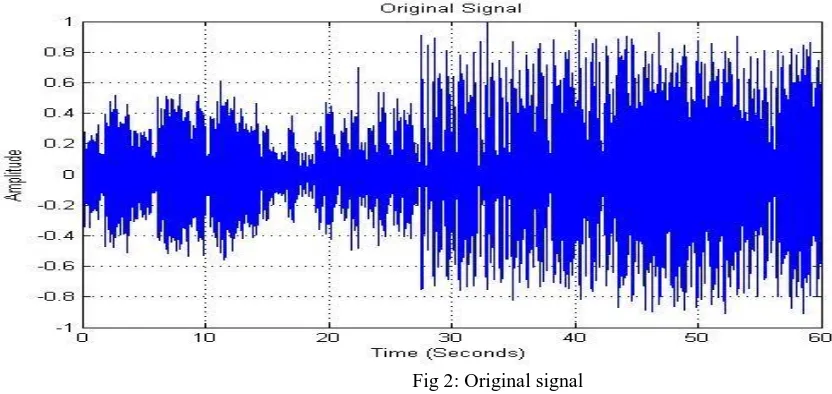
Fig 2: Original signal
In the above figure the signal which is used to compress using DWT then by DCT with different compression ratio generating the compressed signal. After the compression by removing the distortion or unnecessary coefficient the signal is reconstructed to the original form by taking inverse transform after adding the zeros which were generated in DWT & DCT. In method of compression the signal doesn’t lose any of its information.
In this paper DB4 filter of wavelet transform is used to compress the signal. Now take the frame size of the signal to be 10 sec to analysis the different compression ratio in order to attain compressed signal with better result.
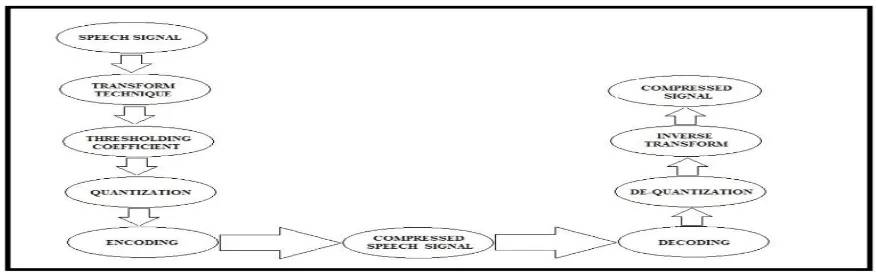
Fig 3: Flowchart of the compressed signal
Table I OBSERVATION
COMPRESSION RATIO 2 4 6 8 10
MSE 4.1441e-05 0.00026461 0.00054662 0.00083422 0.0011368
SNR 24.3325 16.2808 13.1299 11.294 9.95
COPMRESSION TIME(sec) 0.24139 0.14476 0.1565 0.15816 0.18526
ISSN (Print) : 2320 – 3765 ISSN (Online): 2278 – 8875
I
nternational
J
ournal of
A
dvanced
R
esearch in
E
lectrical,
E
lectronics and
I
nstrumentation
E
ngineering
(An ISO 3297: 2007 Certified Organization)
Vol. 3, Issue 8, August 2014
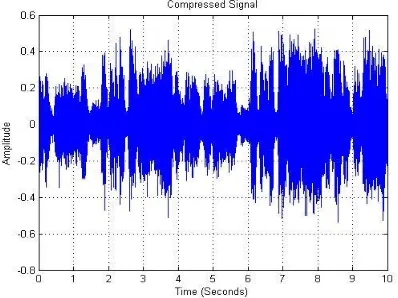
Fig 4: compressed signal of compressed ratio 2
Fig 5: compressed signal of compressed ratio 4
Fig 6: compressed signal of compressed ratio 6
Fig 7: compressed signal of compressed ratio 8
Fig 8: compressed signal of compressed ratio 10
III. CONCLUSION
ISSN (Print) : 2320 – 3765 ISSN (Online): 2278 – 8875
I
nternational
J
ournal of
A
dvanced
R
esearch in
E
lectrical,
E
lectronics and
I
nstrumentation
E
ngineering
(An ISO 3297: 2007 Certified Organization)
Vol. 3, Issue 8, August 2014
fidelity assessments of the compressed speech signal. The SNR and MSE of signal show the high efficiency of the compression it is concluded that it can be very effectively used for the speech signal compression.
IV. RESULT
Speech compression is achieved by using DB4 filter of DWT and DCT transform. In table 1 shows the MSE, SNR, compression time, decompression time of the given speech signal of frame size as10sec. Figure 4 to 7 shows the compressed signal with compression ratio varying from 2 to 10 gives us the better result in terms of reconstructed speech signal.
REFERENCES
1. Graps, A. “An Introduction to Wavelets”, 1997.
http://www.amara.com/current/wavelet.html
2. H. Elaydi “speech compression using wavelet”
3. Jean-Marc Luneau, J´erˆome Lebrun, and Søren Holdt Jensen
“Complex Wavelet Modulation Subbands for Speech Compression” in data compression conference in 2009.
4. Polikar, R. “The Wavelet Tutorial” 1996. http://engineering.rowan.edu/~polikar/WAVELETS/WTpa rt4.html
5. ZHAO Dan,MA Sheng-qian “Speech Compression with Best Wavelet Packet Transform and SPIHT Algorithm” Second International Conference on Computer Modeling and Simulation in 2010.
6. Joebert S. Jacaba “AUDIO COMPRESSION USING MODIFIED DISCRETE COSINE TRANSFORM: THE MP3 CODING STANDARD” in October 2001.
7. Mathworks Wavelet Toolbox. In;http://mathworks.com/access/helpdesk/help/toolbox/ wavelet. 8. Russel Lloyd Lim “Speech Compression using the Discrete Wavelet Transform”
9. Othman O. Khalifa, Sering Habib Harding & Aisha-Hassan A. Hashim “Compression using Wavelet Transform” in Signal Processing: An International Journal, Volume (2): Issue (5).
10. Chun-Lin, Liu “A Tutorial of the Wavelet Transform” in February 23, 2010.