Automatic Control for Storage and Retrieval
System Based On PLC
AsaadMusaab Ali Yousif
1, Jiang Dening
2Masters student, Dept. of Electronics, Tianjin University of Technology and Education, Tianjin, China1 Ass. Professor, Dept. of Electronics, Tianjin University of Technology and Education, Tianjin, China 2
ABSTRACT: This paper is based upon use of PLCs (Programmable Logic Controllers) and 3-ph motor for the purpose of
transport, store and retrieve package (automatic warehouse). A PLC system provides many benefits to control solutions, from reliability and repeatability to programmability. Currently many researches works have been done on the subject of Automatic warehouse using PLC. However their approaches seems to be more complex and cost higher. This because they always employ complex logic components which are expensive. In this research we proposed an automatic warehouse which is easy to implement and cost effective. The implementation of this system improves the efficiency of labor and the quality of manufactured products and to create conditions for the optimum utilization of all production resources. Warehouse automation is the next logical step to stay ahead of your competition and reduce your costs.
KEYWORDS: warehouse, PLC, 3-ph motor, sensors and movable rod.
I. INTRODUCTION
Automation is the use of control systems (such as numerical control, programmable logic control, and other industrial control systems), to control industrial machinery and processes, reducing the need for human intervention [1]. In the scope of industrialization, automation is a step beyond mechanization [1].
Automation greatly reduces the need for human sensory and mental requirements as well [1]. Processes and Systems can also be automated. Specialized industrial computers, referred to as programmable logic controllers (PLCs), are frequently used to synchronize the flow of inputs from (physical) sensors and events with the flow of outputs to actuators and events [1]. This leads to precisely controlled actions that permit a tight control of almost any industrial process [1].
II. RELATED WORK
There are various AS/RS systems (automated storage and retrieval systems) including pallet stacker cranes, miniload cranes a n d s h u t t l e s f o r t h e a u t o m a t i c i n f e e d a n d o u t f e e d o f g o o d s i n h i g h - b a y w a r e h o u s e s . For example Stefano, Albeto,Jens and Juan proposed a multidimensional modelling and non-OLTP workloads which require specialized design techniques. They addressed, respectively, conceptual models, logical models, methods for design, i n t e r o p e r a b i l i t y , a n d d e s i g n f o r n e w a r c h i t e c t u r e s a n d a p p l i c a t i o n s [ 4 ] . Jinxiang, Marc and Leon presented a detailed survey of the research on warehouse design, performance evaluation, practical case studies, and computational support tools. After investigating 100 papers on thewarehouse systems they came into conclusion that conclusion is that warehouse design related research has focused on analysis, primarily of storage systems rather than synthesis. While this is somewhat surprising, an even more surprising observation is that only 10% of papers directly addressing warehouse design decisions have a publication date of 2000 or later. Given the rapid development of computing hardware and solvers for optimization, simulation, and general mathematical problems, one might reasonably expect a more robust design-centric research literature [5].
Cost of labor is high.
The system More complexity. Man power requirement is high.
III. PROPOSED SYSTEM
The main objective of this system is to transport, store and retrieve packagewhich can be achieved using PLC. All the manual operations are replaced by sending signals from the PLC to the respective devices. The work of storing and retrieval of goods from various places is automatically done by a three axis movable rod setup that is controlled by the PLC.
IV. PLC HARDWARE SPECIFICATIONS
We have chosen PLC_200 Series Programmable Logic Controllers with the following features.
Table (1) S7-200 CPU Model features [2].
Feature CPU 226
Physical size (mm) 190 x 80 x 62 Program memory:
with run mode edit without run mode edit
16384 bytes 24576 bytes
Data memory 10240 bytes
Memory backup 100 hours
typical Local on-board I/O
Digital Analog
24 In/16 Out
--Expansion modules 7 modules1
High-speed counters Single phase Two phase
6 at 30 kHz 4 at 20 kHz Pulse outputs (DC) 2 at 20 kHz
Analog adjustments 2
Real-time clock Built-in
Communications ports 2 RS--485
Floating-point math Yes
Digital I/O image size 256 (128 in, 128 out) Boolean execution
speed
0.22
microseconds/instruction Picture
V. PLC-SOFTWARE SPECIFICATIONS
7--Micro/WIN provides an extensive online help system and a documentation CD that contains an electronic version of this manual, application tips, and other useful information [2].
VI. BASIC DESIGN OF THE SYSTEM
Firstly we design a rack, the rack is subdivided into 120 cells, which are identified by the number for storage of goods. Secondly we construct a three axis movable rod setup placed between a two racks that can move along x-axis, y-axis and z-axis the 3-ph motor it can provoke this movement. Thirdly I construct an automatic monorail one for delivering of packages and the other for retrieval of the packages. The entire process of storing and retrieval of goods is automated by connecting all sensors, actuators and the other units of the system to the PLC located in the control room.
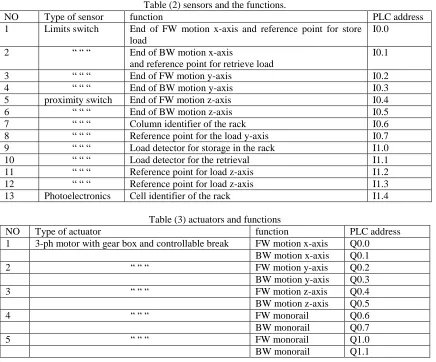
Table (2) sensors and the functions.
NO Type of sensor function PLC address
1 Limits switch End of FW motion x-axis and reference point for store load
I0.0
2 ― ― ― End of BW motion x-axis
and reference point for retrieve load
I0.1
3 ― ― ― End of FW motion y-axis I0.2
4 ― ― ― End of BW motion y-axis I0.3
5 proximity switch End of FW motion z-axis I0.4
6 ― ― ― End of BW motion z-axis I0.5
7 ― ― ― Column identifier of the rack I0.6
8 ― ― ― Reference point for the load y-axis I0.7
9 ― ― ― Load detector for storage in the rack I1.0
10 ― ― ― Load detector for the retrieval I1.1
11 ― ― ― Reference point for load z-axis I1.2
12 ― ― ― Reference point for load z-axis I1.3
13 Photoelectronics Cell identifier of the rack I1.4
Table (3) actuators and functions
NO Type of actuator function PLC address
1 3-ph motor with gear box and controllable break FW motion x-axis Q0.0 BW motion x-axis Q0.1
2 ― ― ― FW motion y-axis Q0.2
BW motion y-axis Q0.3
3 ― ― ― FW motion z-axis Q0.4
BW motion z-axis Q0.5
4 ― ― ― FW monorail Q0.6
BW monorail Q0.7
5 ― ― ― FW monorail Q1.0
BW monorail Q1.1
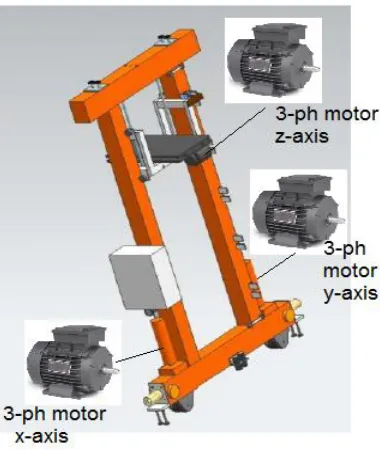
Figure 1: Three axis movable rod with actuators
Figure 2: Three axis movable rod with sensors
Figure 3: Three axis movable rod with sensors
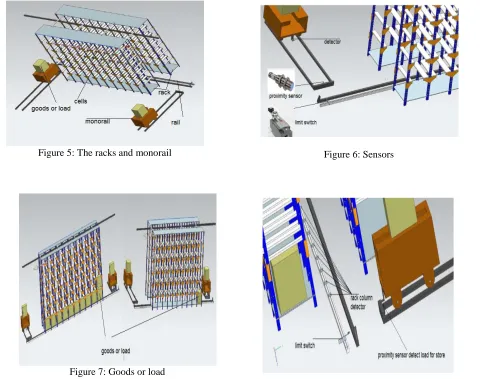
Figure 5 shows the final destination is divided into two racks and the rack is subdivided into 60 cells between the two racks there is a rail to allow the rod move in between it ,to storage and retrieve the goods. Figures 6-7-8 shows that the sensors control the moving of monorail and determine the end of motion for the three axis moveable rod
VII. WORKING
The working of the design can be classifiedinto two phases:
[A]. STORAGE PHASE
In storage phase, the automatic monorail delivers the package to the three axis movable rod, when it reaches to storage reference point the load detector (proximity sensor) will sense the proximity of the monorail and the sensor will go into on state. The PLC will receive the signal from the sensor and send the control signal to the movable rod alerting it to move to the storage reference point. In the storage reference point the movable rod is commanded to take the package to the final destination which is one of the cells of the rack. All this activities are performed automatically by the PLC itself.
Figure 5: The racks and monorail Figure 6: Sensors
Figure 7: Goods or load
[B]. RETRIEVAL PHASE
The retrieval phase is the reverse process of the storage phase. In this phase another automatic monorail will arrive at the retrieval reference point without any load (package) on it. The proximity sensor will sense it, the sensor will change to on state which sends the signal to PLC alerting it about the request of retrieval. PLC will crosscheck the warehouse if there is any load enough to be retrieved. Then PLC will send signal to the movable rod to move and take the load according to first request first cell and take the load out for retrieval. Then the movable rod should move back to the retrieval reference point and release the load to automatic monorail.
VIII.SIMULATION & RESULTS
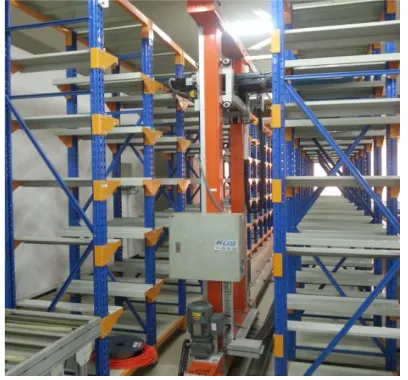
First we finish the ladder code for the control system we install it in the PLC after that we did all connection and configuration for the actuators, sensors and PLC. The system is work normally and stably without any fault figures 9-10 shows the whole system and there connections.
Figure 9: General storage system. Figure 10: PLC and its connections
IX. CONCLUSION
Complexity of system has been simplified, by this proposal. Man power has been reduced and labor cost has been eliminated.
REFERENCES
1. AUTOMATION & CONTROL - Theory and Practice, Edited by A. D. Rodić p. cm. ISBN 978-953-307-039-1
2. S7-200 Programmable Controller System Manual Edition 09/2007 A5E00307987—03
3. .PLC-SCADA Based Automated Logistics Warehouse Management System V. Ramanan&Sach
4. Stefano Rizzi, Alberto Abell´o, Jens Lechtenb¨orger and Juan Trujillo,‖ Research in Data Warehouse Modeling and Design Dead or Alive?‖
DOLAP’06, November 10, 2006, Arlington, Virginia, USA.
5. JinxiangGua, Marc Goetschalckx b,*, Leon F. McGinnis ,‖ Research on warehouse design and performance evaluation: A comprehensive review‖
BIOGRAPHY
AsaadMusaab Ali Yousif, He is master students (3rd Year) in the Dept. of ElectronicsEngineering, Tianjin University of Technology and Education. His areas of interest are PLC, microcontroller, automation and Programming. Currently heis working in the field of automation Design.
![Table (1) S7-200 CPU Model features [2]. CPU 226 190 x 80 x 62](https://thumb-us.123doks.com/thumbv2/123dok_us/7791693.1291265/2.612.187.426.332.660/table-s-cpu-model-features-cpu-x-x.webp)