Western University Western University
Scholarship@Western
Scholarship@Western
Electronic Thesis and Dissertation Repository
8-23-2013 12:00 AM
Policy-Based Immunization Framework for MANET
Policy-Based Immunization Framework for MANET
Arash Tajalli-Yazdi
The University of Western Ontario Supervisor
Professor Hanan Lutfiyya
The University of Western Ontario
Graduate Program in Computer Science
A thesis submitted in partial fulfillment of the requirements for the degree in Master of Science © Arash Tajalli-Yazdi 2013
Follow this and additional works at: https://ir.lib.uwo.ca/etd
Part of the Digital Communications and Networking Commons
Recommended Citation Recommended Citation
Tajalli-Yazdi, Arash, "Policy-Based Immunization Framework for MANET" (2013). Electronic Thesis and Dissertation Repository. 1537.
https://ir.lib.uwo.ca/etd/1537
This Dissertation/Thesis is brought to you for free and open access by Scholarship@Western. It has been accepted for inclusion in Electronic Thesis and Dissertation Repository by an authorized administrator of
Policy-Based Immunization Framework for
MANET
(Thesis format: Monograph)
Arash Tajalli-Yazdi
Graduate Program in Computer Science
A thesis submitted in partial fulfillment
of the requirements for the degree of
Master of Science
The School of Graduate and Postdoctoral Studies
The Western University
London, Ontario, Canada
c
Abstract
Mobility is one of the most important driving forces of the hyper-interconnected world that
we are living in. Mobile computing devices are becoming smaller, more ubiquitous and
si-multaneously providing more computing power. Various mobile devices in different sizes
with high computing power cause the emergence of new type of networks’ applications.
Researchers in conferences, soldiers in battlefields, medics in rescue missions, and drivers
in busy highways can perform more efficiently if they can be connected to each other and
aware of the environment they are interacting with. In all mentioned scenarios, the major
barrier to have an interconnected collaborative environment is the lack of infrastructure.
Mobile Ad hoc Networks (MANETs) are very promising to be able to handle this challenge.
In recent years, extensive research has been done on MANETs in order to deliver secure
and reliable network services in an infrastructure-less environment. MANETs usually deal
with dynamic network topologies and utilize wireless technologies, they are very
suscepti-ble to different security attacks targeting different network layers. Combining policy-based
management concepts and trust evaluation techniques in more granular level than current
trust management frameworks can lead to interesting results toward more secure and reliable
MANETs.
Contents
Abstract ii
List of Figures vii
1 Introduction 1
1.1 MANET characteristics and applications . . . 3
1.2 Security challenges in MANET . . . 4
1.3 Thesis focus . . . 6
1.4 Thesis organization . . . 6
2 Background and Related Works 8 2.1 Security in Mobile Ad hoc Networks . . . 8
2.1.1 Internal vs. External attacks . . . 8
2.1.2 Passive vs. Active attacks . . . 8
2.1.3 Security attacks in mobile ad hoc networks . . . 9
2.1.3.1 Physical layer attacks . . . 9
2.1.3.2 Link layer attacks . . . 9
2.1.3.3 Network layer attacks . . . 10
2.1.3.4 Transport layer attacks . . . 11
2.1.3.5 Application layer attacks . . . 11
2.2 Routing . . . 12
2.2.1 Distance Vector routing protocols . . . 13
2.2.2 Link-State routing protocols . . . 13
2.3 Routing in mobile ad hoc networks . . . 14
2.3.1 MANET routing protocols from different perspectives . . . 15
2.3.1.1 Flat, Hierarchical, and Geographical routing protocols . . . 15
2.3.1.3 Proactive, Reactive, and Hybrid routing protocols . . . 16
2.3.2 MANET routing protocols descriptions . . . 17
2.3.2.1 AODV Ad-hoc On-Demand Distance Vector . . . 17
2.3.2.2 OLSR - Optimized Link State Routing . . . 18
2.4 Policy-based management . . . 19
2.4.1 Policy-based network management architecture . . . 20
2.5 Wormhole attack . . . 22
2.5.1 How wormhole attack works . . . 22
2.5.2 Wormhole attack launching techniques . . . 23
2.5.2.1 Out-of-Band Channel technique . . . 23
2.5.2.2 High Power Transmission technique . . . 23
2.5.2.3 Encapsulation technique . . . 23
2.5.2.4 Packet relay technique . . . 24
2.5.2.5 Using Protocol Deviations . . . 24
2.5.3 Wormhole attack classification . . . 24
2.5.4 Wormhole Attack Impacts . . . 24
2.5.5 Wormhole attack countermeasures . . . 25
2.5.5.1 Location and time based solutions . . . 25
2.5.5.2 Recent approaches . . . 26
2.6 Research Gap . . . 30
3 Proposed Framework 31 3.1 How the framework works . . . 32
3.2 Toward Defining Policies . . . 34
3.2.1 From Environment Characteristics to Policies . . . 35
3.2.2 Defining Policies . . . 35
3.2.2.1 Studying the Network Behaviours . . . 35
3.2.3 Defining policies for the case study . . . 36
3.3 Framework components . . . 40
3.3.1 Evidence Gatherer . . . 41
3.3.2 Opinion manager . . . 42
3.3.2.1 Assumption maker . . . 42
3.3.2.2 Assumption/Opinion transceiver . . . 43
3.3.2.3 Opinion maker . . . 43
3.4 The Framework in Action . . . 43
3.5 Summary . . . 45
4 Implementation and Simulation 46 4.1 OPNET . . . 46
4.2 Implementation considerations (prerequisites) . . . 47
4.3 Implementation of framework components . . . 48
4.3.1 Evidence gatherer class . . . 49
4.3.2 Assumption maker class . . . 51
4.3.3 Opinion/Assumption transceiver class . . . 51
4.3.4 Opinion maker class . . . 51
4.3.5 Executive . . . 52
4.3.6 Attacks.XML . . . 52
4.3.7 Evidences.XML . . . 54
4.3.8 InvestigationPolicies.XML . . . 55
4.3.9 InternalAssumptionsExternalOpinions.XML . . . 55
4.3.10 Opinions.XML . . . 56
4.3.11 ExecutivePolicies.XML . . . 56
5 Experimental Results 60 5.1 Simulation Environment Setup . . . 60
5.2 Benchmarks . . . 61
5.2.1 Healthy environment . . . 62
5.2.2 Unhealthy environment . . . 62
5.3 Framework settings . . . 64
5.3.1 Experimental results . . . 66
5.4 Impact of using the proposed framework . . . 66
6 Conclusions and Future works 70 6.1 Conclusion . . . 70
6.2 Contribution . . . 71
6.3 Future work . . . 71
Appendix A 72
List of Figures
1.1 Infrastructure based wireless network . . . 2
1.2 Infrastructure less wireless network . . . 3
2.1 Policy-based Network Management . . . 20
2.2 Policy-based Network Management Architecture . . . 21
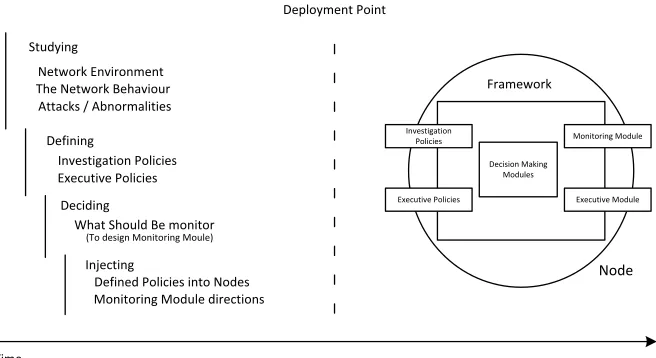
3.1 Framework before and after deployment . . . 33
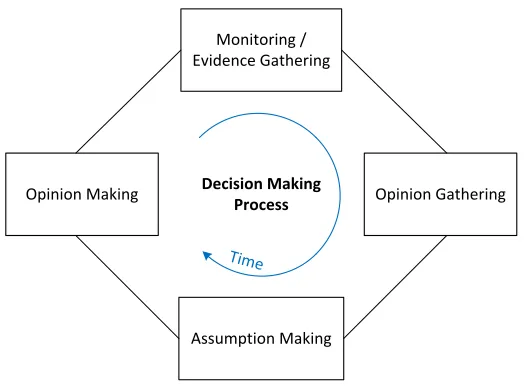
3.2 Decision making process . . . 34
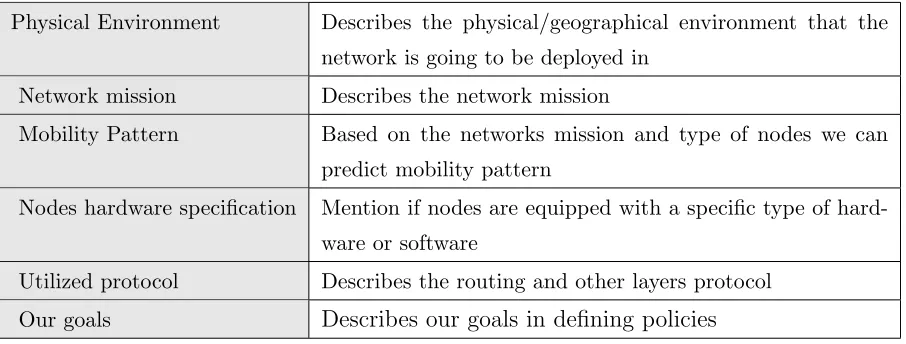
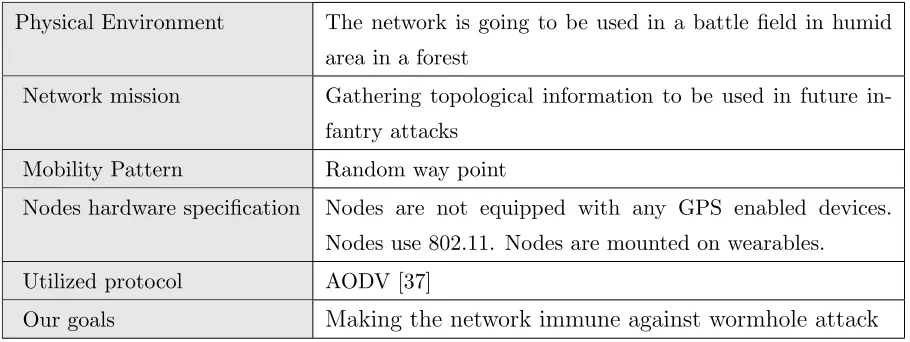
3.3 From Environment characteristics to policies. . . 36
3.4 The Least Attached Neighbour . . . 38
3.5 The Most Traffic Absorbent Neighbour . . . 38
3.6 The Furthest Neighbour . . . 39
3.7 Two Very Friendly Nodes . . . 39
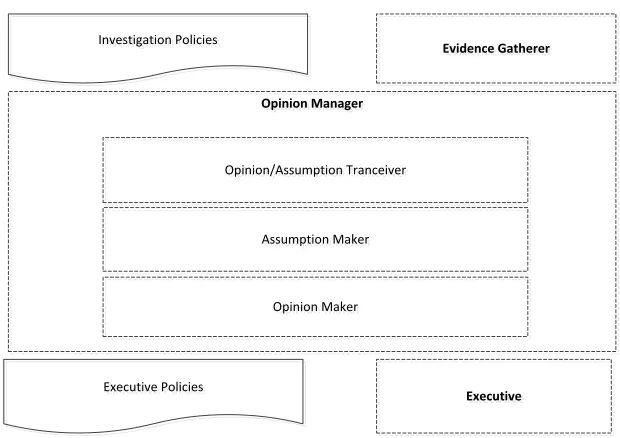
3.8 Framework (To be implemented in each node) . . . 41
3.9 Framework interacting with environment. . . 42
3.10 Example Topology . . . 44
4.1 Manet Station Advanced With Wormhole node model . . . 48
4.2 Framework From Implementation Perspective . . . 49
4.3 attacks.xml . . . 53
4.4 evidences.xml . . . 57
4.5 investigationPolicies.xml . . . 58
4.6 internalAssumptionsExternalOpinions.xml . . . 58
4.7 Opinions.xml . . . 59
4.8 ExecutivePolicies.xml. . . 59
5.1 Manet Simulation setup 40 nodes in 1000*1000 m . . . 61
5.3 Average MANET delay in healthy environment . . . 62
5.4 Average hop count per route 40 node scenario . . . 63
5.5 Average hop count per route 60 node scenario . . . 63
5.6 MANET delay of Malicious and benign nodes in 40 node scenario . . . 64
5.7 MANET delay of Malicious and benign nodes in 60 node scenario . . . 64
5.8 Average Hop count per route in MANET equipped with the framework . . . 69
Chapter 1
Introduction
I
n 2011, for the first time, the global unit shipment of smartphones and tablets surpasseddesktop and notebook PCs [36]. Today, mobile smart devices can be seen everywhere and
terms like Internet of Things and service oriented architecture are commonly used. Users
desire access to their information wherever they are and whenever they want. To move
toward this goal, advanced wireless communication standards have been developed, and
different types of connected devices have been introduced.
For many applications, these devices need to be connected to an existing network to
access data and perform their assigned tasks. Today, a fixed and robust network
infras-tructure is in place and millions computers are using different types of protocols to make
connections between themselves in order to provide a framework for developing and
deploy-ing new distributed computdeploy-ing systems. New smart mobile devices have been introduced,
and new operating systems and protocols have been developed. These devices can form
wire-less networks, which are connected to the pre-existing infrastructures. This type of wirewire-less
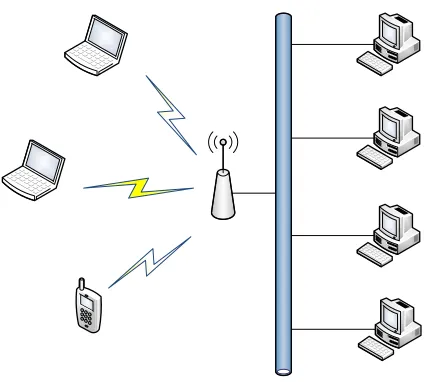
network is called infrastructure-based wireless network and can be seen as an extension to
the fixed wired network. In infrastructure-based wireless network [20], wireless devices are
all connected to an access point, which acts as a bridge between wired and wireless
net-works. Infrastructure-based wireless networks form wireless LANs, which are used in offices,
airports, and train stations. Deploying this type of network can cut the cost of wiring and
maintenance of the network [20]. Figure 1.1 demonstrates the infrastructure-based wireless
network.
In some scenarios, smart mobile devices do not have access to any fixed network
infras-tructures. In order to accomplish an assigned task the devices should be connected to each
Figure 1.1: Infrastructure based wireless network
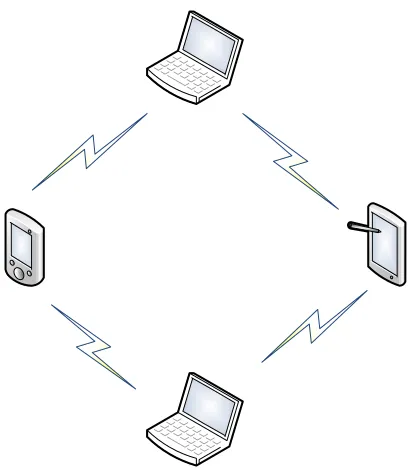
to rely on. Responsibility for providing network connectivity is shared by all the mobile
de-vices. For example, in military battle fields, there is no pre-existing network infrastructure;
If troops or military equipment need to be connected to each other to conduct a mission,
they need to form an ad hoc network. These types of ad hoc networks are infrastructure-less
wireless networks. An infrastructure-less wireless network is illustrated in Figure 1.2.
Ad hoc networks are decentralized types of wireless networks. In this type of network,
nodes should cooperatively form the network and manage all the connectivity issues. In most
cases, it is desirable that the network can operate and accomplish its mission without any
central entity. Trying to have a network managing mechanism without any central entity is
a step toward having a truly distributed system.
In the majority of ad hoc networks’ applications, nodes are not stationary. Nodes
change their positions in the network. While they are moving, they need to stay connected
to the network. This type of mobile ad hoc networks are categorized as MANET [20]. Lack
of centralized management entity, mobility, and wireless communication makes MANET
susceptible to a variety of security attacks. With advances in wireless communication and
proliferation of mobile devices, researchers try to investigate the different security solutions
Figure 1.2: Infrastructure less wireless network
1.1
MANET characteristics and applications
Mobile ad hoc networks are a collection of mobile devices, equipped with wireless technologies
that form a network without any central administrative entity [20]. In this type of network,
nodes can communicate with each other directly or through other nodes without using any
central entity to manage the connections. In a MANET, nodes acts as hosts and routers.
Node mobility causes frequent network topology changes and routing protocols should be
capable of maintaining connectivity in such a dynamic environment. Some of the most
important characteristics of MANET are as follows [20]:
• As a result of wireless communication links, MANETs have lower bandwidth capacity
in comparison to wired networks; they are subject to jamming, signal fading and
interference [49];
• In MANETs, nodes usually depend on battery power. Thus nodes should perform
their tasks in the most energy efficient manner;
• Because of wireless links and absence of central entities, security in MANETs can
easily be compromised. Wireless nodes are vulnerable to eavesdropping and jamming.
• Mobility of nodes lead to frequent topology changes. Routing protocols in MANETs
should be agile in responding in order to frequent changes to maintain a current route
between nodes [2];
• Because of lacking a fixed-infrastructure, MANETs are easy and fast to deploy.
There-fore, they can provide an instant network formation, and reduce the cost of deployment
and maintenance of the network;
These characteristics make MANET an ideal option for the following applications
• MANET can be used in military battlefields, where there is no fixed infrastructure and
nodes (troops or military equipments) need to be connected to each other;
• MANET can be used in rescue operations, where network infrastructures are damaged
due to natural catastrophes;
• MANET can be used in classrooms, conferences, and meetings in order to allow
par-ticipants to share their information without the need of connecting to a central server;
• MANET can be used to form personal area networks [47], where a person wants to
form a network between his/her PDA, laptop, and a printer without having to plug
anything in;
1.2
Security challenges in MANET
Securing MANETs, because of salient characteristics of mobile ad hoc networks such as
vulnerability of channel, vulnerability of nodes, absence of infrastructure, and dynamically
changing topology is a challenging task [19]. Moreover, every application has its own security
requirements. A robust and reliable security solution should provide security services such
as authentication, confidentiality, integrity, anonymity, and availability. Here we briefly
describe these services
Availability means that a node should provide all promised services regardless of security
state of it [30]. Sometimes nodes in a MANET become malicious or selfish and hesitate to
collaborate with other nodes to deliver the designed service of the network. This is the main
Integrity of messages should be kept during transmission. Either malicious activities or
transmission disturbance can corrupt a message. Integrity guarantees that a transmitted
message is not corrupted [19].
Confidentiality means that information can be accessed by those who have been
au-thorized to access it [30]. It guarantees that sensitive information like military, routing or
personal information is never disclosed to unauthorized entities [19].
Authenticity ensures that claims of identity from participants in a communication are
authentic [30]. If there is no such a service in place, a malicious node can impersonate a
benign node and start a communication with another node.
Non-repudiation ensures that a sender or receiver of a message can not deny that they
have ever sent or received such a message [30].
Authorization is the process of issuing credentials which specify the privileges and
per-missions of accessing a resource. Authorization is used to assign different access rights to
users from different user levels [49].
Anonymity means that a node should privately keep all the information that can be used
to identify the owner or the current user of the node and should not distribute this
informa-tion in the network [30].
Several attacks have been designed to violate these security services [49]. Attacks target
different network protocols and attempt to disrupt the proper functionality of the network.
In order to design a security solution for MANETs, as noted by V. Balakrishnan et al. [6],
maybe the fundamental question to be addressed is “how to enable a mobile node to enlist
trusted intermediate mobile nodes so that they can cooperate in forwarding the information
to a target without modifying the information or obstructing the operation of other mobile
nodes.” This shows that security of MANETs heavily depends on security of communication
layer.
In order to deliver security services in MANETs, several secure routing protocols like
SAODV [32] have been suggested. However because of the absence of centralized authority,
key management which is the key function of secure routing could not be done properly. Also,
genuinely broken links from maliciously reported ones [6]. Hence, incentive-based systems
have been proposed. Incentive-based systems such as SIP try to stimulate cooperation in
packet forwarding among nodes by introducing concepts like credit [50]. Incentive-based
systems to some extent could motivate selfish nodes, which do not collaborate with other
nodes in order to save their battery power, CPU cycle, or available bandwidth, to cooperate
in forwarding the network traffic with other nodes. In contrast, malicious nodes which
deliberately want to disturb the functionality of the network can still ignore all the incentives
and harm the network. Shortcomings of secure routing and incentive-based protocols led
to emergence of trust-based management systems [6] . Trust-based management solutions
introduced the concept of trust among nodes in MANETs. These systems usually consist
of three main modules: monitor, reputation manager, and trust manager. By utilizing
these modules, they can proactively detect and reactively isolate malicious or selfish nodes
[6]. Several trust-management systems have been introduced [13][18] but few of these use
their acquired information from network monitoring and knowledge of an attack’s behaviour
toward defining policies for detection of a specific type of attack. Doing that, more effective
policies will be defined and attacks will be detected with higher rates.
1.3
Thesis focus
The thesis focus is to introduce a new trust management system that can be deployed on
nodes in mobile ad hoc networks and make them resistant to security attacks. The
computa-tion power and network bandwidth of nodes are limited in MANET, thus we plan to develop
a computationally light-weighted mechanism to turn each node into a autonomous
abnor-mality detector. We will show how our framework utilizes policies and a simple collaboration
scheme among neighbours to prevent potential abnormalities.
1.4
Thesis organization
The remainder of this thesis is organized as follows: Chapter 2 covers background and related
work, including key definitions, concepts and a review of the current research relevant to
security issues in Mobile ad hoc networks, policy-based management systems, and trust
management in MANET. Chapter 3 describes the architecture of our proposed policy based
trust management system to be deployed in each node in Manet. Chapter 4 describes the
study and shows how the framework can handle abnormality detection in Manet. Finally,
Chapter 6, Conclusion, provides some final conclusions and presents ideas and thoughts for
Chapter 2
Background and Related Works
This chapter presents key definitions and concepts, and reviews the current research which
is relevant to MANETs’ security vulnerabilities and attacks. Section 2.1 presents security
issues in MANET and discusses possible security attacks in different network layers. Section
2.2 presents different types of routing which are being used as the bases of mobile routing
algorithms. Section 2.3 describes common routing protocols in MANET. Section 2.4 explains
the notion of policy in managing a MANET. Finally, in section 2.5, a wormhole attack and
its countermeasures are studied.
2.1
Security in Mobile Ad hoc Networks
Attacks in mobile ad hoc networks can be classified from different perspectives. Each attack
can be classified as Internal orExternal and Passive orActive [19].
2.1.1
Internal vs. External attacks
External attacks are carried out by outsiders. These types of attacks are launched by nodes
that do not belong to the domain of the network. On the other hand, internal attacks are
performed by compromised insiders that are network members and have some privileged
access rights that make them more disruptive and hard-to-detect.
2.1.2
Passive vs. Active attacks
Passive attacks obtain information from communications in the networks without disrupting
[49] are examples of passive attacks. On the other hand, active attacks not only obtain
information from the network, they also modify, fabricate, drop, or replay packets in the
network. Thus, they interrupt the normal behaviour of the networks. Jamming, spoofing,
modification, replaying are examples of active attacks [49].
Wu, Bing, et. all in [49] further categorized MANET attacks based on different
lay-ers, stealthy versus non-stealthy attacks, and cryptography versus non-cryptography related
attacks.
2.1.3
Security attacks in mobile ad hoc networks
2.1.3.1 Physical layer attacks
The broadcast wireless nature of MANETs’ communications means thatsignal jamming and
eavesdropping can be easily done by an adversary.
• Eavesdropping: Wireless links are broadcast in nature. Some mobile hosts share a
wireless medium in ad hoc networks. Thus, wireless signals, which are usually in
radio frequency spectrum, can be intercepted and heard by unauthorized third parties.
Eavesdropping is the capturing of a message by an unauthorized receiver who is looking
for confidential information such as location, public key, private key, or passwords [30].
• Interference and jamming: Radio signals can be jammed and interfered with some
stronger signals emitted from outsider or compromised insider nodes. These strong
signals can corrupt the messages and prevent messages from being delivered to their
destination. The attacker can transmit random noises and pulses into the network
which can in turn overwhelm the network signals.
2.1.3.2 Link layer attacks
Link layer protocols are responsible for ensuring the connectivity between 1-hop neighbours.
Wireless medium access control (MAC) protocol has to coordinate the transmission of nodes
on transmission medium. Since token-passing bus, which is used in wired network can not
be used in wireless environment, IEEE 802.11 protocols are dedicated to dealing with
con-trolling the wireless medium [49]. The 802.11 MAC working group suggested two contention
resolution mechanisms: distributed coordination function and point coordination function
scheme which is based on carrier sense multiple access with collision avoidance (CSMA/CA)
protocol. DCF uses handshake scheme called RTS-CTS along with binary exponential back
off rules to avoid possible collisions in wireless environments [7]. An attacker can deviate
from CSMA/CA rules in a way it can disrupt the network operations toward its own benefits.
2.1.3.3 Network layer attacks
Network layer protocols are responsible for extending the one-hop neighbouring connectivity
to all other nodes in the network. There are a large number of attacks targeting this layer in
the network. An attacker tries to inject itself to the network in order to disrupt the routing
process in different phases of routing such as route discovery, route maintenance, or data
forwarding [25]. Network layer attacks take the control of the network traffic flow and cause
severe damage such as preventing a node from finding the optimum path to the destination,
partitioning the network, forwarding packets to a nonexistent path, and creating routing
loops. Sometimes two or more colluding nodes collaborate to perform sophisticated attacks
in order to take control of the network traffic flow. Some of the network layer attacks are as
follows [49].
• Routing table overflow attack: In this attack, attacker advertises routes to non-existent
nodes and causes other nodes to become incapable of finding new routes while having
their routing tables overwhelmed by false routes. This attack targets proactive routing
protocols because proactive routing protocols rely on periodic route advertisements. In
order to attack on-demand routing protocols two or more colluding nodes are needed
in a way that one node request a route to nonexistence destination and the other node
replies with a false route [16].
• Routing cache poisoning attack: In ad hoc networks, sometimes when a node senses a
packet, it updates its routing table using information contained in that packet. This
operation is called promiscuous routing table updating. A malicious node can
broad-cast a packet with false routing information and cause some nodes to update their
routing table information with this incorrect information. Doing this, the malicious
node can direct the network traffic to pass through it [49].
• Replay attack: Due to node mobility, network topology frequently changes. In this
attack, a node records routing control messages of another node and replay them later.
Doing this, the node deceives other nodes about routing information that may be stale
• Wormhole attack: A wormhole attack is a severe network layer attack which can disrupt
a high percentage of communication across the network. It is easy to implement and
challenging to detect. In this attack, a malicious node records packets in one location
of a network and tunnels them to another malicious node at a distant point in the
network. The second malicious node replays the received packets. Wormhole attacks
are discussed in detail in 2.5.
2.1.3.4 Transport layer attacks
The transport layer in MANET is responsible for reliable delivery of packets, congestion
control, flow control, and clearing of connections [49] between communicating entities.
TCP-like protocols in MANET should handle higher channel error rate in comparison to TCP in
weired networks. Like the TCP protocol in fixed networks, MANET protocols are vulnerable
toSYN flooding and session hijacking attacks.
• Session hijacking: In this attack, attacker spoofs the victim’s IP address and finds the
expected sequence number in a TCP session between the victim and a third entity
with an active session with the victim. Using this information, an attacker can hijack
the established session and gain the control over the session. Usually by launching a
DoS against the victim, the attacker keeps victim busy and uses the hijacked session to
communicate with the third entity. The fact that most communications are protected
only at session setup not thereafter is used by attacker to launch this attack.
• SYN flooding: In order to establish a TCP connection, two communicating nodes have
to do a three-way hand shake [28]. During the hand shake process three messages of
typeSYN andSYN-ACK are exchanged. Upon completion of the hand shake process,
a fully-opened TCP connection is created.
An attacker sends a large number of SYN packets with spoofed return addresses to a
victim. The victim replies to SYN packets withACK packets and waits for the response
of ACK from the attacker to complete the three-way hand shake. The attacker does
not send a final ACK to the victim which leads to many half-open connections and
waste of resources of the victim [24].
2.1.3.5 Application layer attacks
The application layer is where all user data, which are an attacker’s highest interest, reside.
can provide many vulnerabilities that attackers could have a stake in.
• Malicious code attacks: Malicious code can appear in the form ofviruses, worms, and
Trojan horses and disrupt the proper functionality of the network. Viruses are
self-replicating code segments that are attached to other host executables. As soon as the
host is executed the virus code is activated. Viruses usually replicate themselves and
attach to different executables. Worms are also self-replicating programs but they do
not need any other executable to play role of a host for them. They can run and
replicate themselves without any other intervention. Worms usually exploit network
services to propagate themselves through the network [38]. Trojan horses are malicious
codes masquerading as a legitimate application. Trojan horses do not replicate and
they try to deceive their victims that they are providing benign services and then start
to capture information.
• Repudiation attacks: Repudiation is the denial of participation in a communication. A
secure system has to provide non-repudiation as one of its security services. It means
the system should ensure that entities could not deny what they have done in the
different states of the system. Repudiation attacks take advantage of lack of a proper
logging system and launch repudiation attacks.
2.2
Routing
Routing is the process of selecting a path through which network traffic can be forwarded
from one host to another. Routing is the responsibility of the network layer in the
net-work protocol stack. When a node joins a netnet-work, it is completely unaware of the netnet-work
topology. Therefore, it starts a process, called neighborhood discovery, in which the node
constructs its routing table and starts to learn about the network topology. After the
dis-covery phase a node starts another process called routing table update in order to maintain
its connectivity to the network. In this phase, nodes have their knowledge of topology
up-dated by exchanging their routing tables. There are two broad classes of routing algorithms:
decentralized and global [28]. In a decentralized routing algorithm, routing nodes do not
have the knowledge of all the links in the network. Each node, through collaboration with
its neighbors will eventually have a routing table which is complete and up-to-date. On
the other hand, in global routing algorithms, each node has the complete overview of the
network’s links and it broadcasts all its routing table changes not only to its neighbors, but
2.2.1
Distance Vector routing protocols
Distance-vector protocols are decentralized. In these protocols, nodes are not aware of the
whole path to destination, and nodes only maintain a vector (table) of destinations and
minimum distance to destination nodes in their routing tables. In this approach, nodes
periodically, upon expiration of a counter or updates in routing table, send their routing
tables to their neighbors. By receiving routing tables from its neighbours, a node can
recal-culate its routing table and forward the new routing table to its neighbors and so on. Since
nodes usually deal only with the routing tables received from their neighbors, the topology
control traffic does not use a large chunk of network bandwidth. Also, nodes do not need
to consume high processing power and memory in order to have an updated routing table.
These type of routing protocols use Bellman-Ford [45] algorithm to calculate paths between
communicating nodes, and they are not loop-free. These routing algorithms are susceptible
to count-to-infinity problem [31] and suffer from scalability issues. Distance vector routing
protocols, in comparison to link-state routing protocols, have less computational complexity
and message overhead. RIPv1, RIPv2, and IGRP are examples of distance vector routing
protocols [28].
2.2.2
Link-State routing protocols
Link-state routing protocols are global. In link-state routing protocols, routing algorithms
need to have a complete knowledge of the network topology. These types of routing
al-gorithms take a complete and global knowledge of connectivity between all nodes in order
to compute the least-cost path between source and destination. To do so, nodes need to
broadcast the identities and costs of their links to all other nodes. Besides routing table,
each node has a topological database to store all the links’ information in the network. This
information is broadcasted using a specific message called link-state advertisement [3]. This
data propagation through the network is called flooding. Initially, a node does not know
about all other nodes in the network, but after a while, by receiving other nodes’ broadcasts,
it eventually learns the topology of the network, and starts the path calculation process. In
link-state algorithms, usually Dijkstra’s algorithm is used in path-calculation process and
count-to-infinity problem does not arise. In comparison with distance-vector algorithms,
link-state routing algorithms need more computational power and storage. OSPF, IS-IS are
2.3
Routing in mobile ad hoc networks
In ad hoc networks, nodes perform as hosts and routers. Initially, a node does not have
any knowledge about other nodes in the network. Nodes need to disseminate information
about their existence, and listen to the network in order to find the current topology. Based
on the nature of the ad hoc networks, ad hoc routing protocols should deal with an ad
hoc network’s limitations, such as limited bandwidth, high power consumption, and high
error rate. In order to better understand routing protocols for MANETs, the reason we
cannot use conventional routing protocols in mobile ad hoc networks should be investigated.
The following is a summarized list of MANET characteristics which shows why designing a
routing protocol for MANET is a challenging task.
• In MANET rate of topology changes is very high, and it causes difficulty in convergence
of conventional routing algorithms into steady state [41];
• Wireless links are less reliable that wired ones, and their performance will fluctuate
based on environmental conditions;
• Wireless links can be unidirectional which prevents the proper handshake between
sender and receiver;
• Wireless links, lack of centralized entity, dynamic topology changes, and delay in
prop-agation of new routing information makes the design of stable routing protocol for
MANETs challenging;
• Wireless devices usually rely on batteries as their source of power. Sometimes a lack of
power can force a node to act selfishly and prevent its participation with other nodes
to form updated routes.
Thus, routing protocols in ad hoc networks should be capable of dealing with all these
characteristics of MANETs and provide a service that can ensure scalability and security.
This is why classic routing protocols are inadequate for MANETs. An ideal routing protocol
for wireless ad hoc network should have the following characteristics:
• cope with frequent topology changes
• deal with possible unidirectional links
• scale well in different network parameters such as network size, mobility, and traffic
• perform in a distributed manner
• handle multiple routes for a specific destination in order to reduce the topology control
messages
• be loop free
• prevent network partitioning
2.3.1
MANET routing protocols from different perspectives
MANET routing protocols can be classified based on the way they envision the network,
which conventional routing approach they use, and how they act upon topology changes.
2.3.1.1 Flat, Hierarchical, and Geographical routing protocols
Flat routing protocols consider every node to be equal. In this type of routing, when a node
wants to find a route to another node, it considers all other nodes equal and it assumes
no preferences between nodes. There is no effort to organize nodes or traffic in different
categories and the network is assumed, by routing protocol, to be seated on a flat geometric
plane. Hierarchical routing protocols give different roles to nodes. Some nodes are assigned
special duties such as being a gateway. The notion of clustering comes to play. When a
node wants to forward a packet to a destination and the the destination node is not in
its neighborhood, it sends the packet to a special node called gateway. The gateway then
sends the packet to other gateways until it reaches the gateway with a direct connection to
the destination. In geographical routing, routing is based on the geographical positions of
nodes. This means that a source node uses geographical address of the destination node to
forward a packet instead of using its network address. Each node should be aware of its
own geographical location and the destination’s geographical location. Thus, in this type
of protocol, routing can be done without the knowledge of the network topology and route
discovery process.
2.3.1.2 Link-state, Distance-Vector routing protocols
In MANETs, there are families of routing protocols which inherit the characteristics of
consider all the characteristics and limitations of MANETs and propose some novel
tech-niques to deliver reliable services.
2.3.1.3 Proactive, Reactive, and Hybrid routing protocols
In proactive routing protocols, each node (router) proactively maintains a fresh list of routes
to all other nodes in the network. These routes will be used by each node whenever they
are needed. Because routes already have been found and reside in the routing table, no
latency is imposed on the network prior to forwarding a packet to find the needed route.
Routes are computed periodically through the dissemination of control messages throughout
the network, which impose heavy traffic to the network. Examples of this kind of protocol
are OLSR, DSDV, and TBRPF [41]. On the other hand, in reactive routing approach, the
routing protocol does not take the initiative for finding a route to the destination until it is
required, and there is no topology table in nodes. This type of protocol, which are also called
on-demand, do not flood the network with periodically disseminated control traffic in order
to maintain fresh route to all other nodes. On-demand protocols start the route discovery
process whenever it is needed, and the route is maintained through the route maintenance
procedure until the route is no longer required. Therefore, they experience the route discovery
delay prior to forwarding a message to a new destination. When node S wants to transmit
data to node D, and it has no valid route to D, it starts a route discovery process. In route
discovery S starts broadcasting to all nodes searching for node D. The process is completed
when the route is found or all possible route permutations have been examined. After the
route has been found, the route maintenance procedure maintains the route until either the
destination become inaccessible, or the route is no longer needed. The main advantage of
this type of protocol is that the wireless channel does not need to carry a large amount of
routing overhead for routes that are no longer used. AODV, DSR, and TORA are reactive
routing protocols [41]. Hybrid routing protocols try to combine the advantages of reactive
and proactive routing protocols. For example, the Zone routing protocol defines a zone
around each node. Inside the zone, routing is done in a proactive manner and outside the
zone routing is done reactively. Doing this, nodes inside the defined zone are immediately
available, and to access further nodes the protocol will use reactive approach in an optimized
way. It should be mentioned that hybrid routing inevitably combines the disadvantages of
2.3.2
MANET routing protocols descriptions
This section describes two commonly used MANET routing protocols.
2.3.2.1 AODV Ad-hoc On-Demand Distance Vector
AODV is a reactive (On-Demand) distance vector routing protocol which can be used in large
wireless ad-hoc networks [37]. AODV is a distance vector routing protocol and it inherits
the concept of destination sequence number from DSDV to become loop-free. In on-demand
routing protocols there is no need for periodic broadcasts of route advertisements, however
on-demand acquiring of a route introduces the route acquisition latency to the network.
In AODV, which uses symmetric links between neighboring nodes [37], nodes that are not
involved in any data communication process, neither maintain any routing information nor
exchange routing tables with their neighbors. In AODV, routing process is done in four
phases: path discovery, route table management, path maintenance, and local connectivity
management. When a node wants to communicate with another node and it does not have
any route information to destination, it starts the route discovery process. In this phase
the source node sends the special packet called Route Request (RREQ) to all its neighbors.
If a neighbor can provide the route, it sends back a Route Reply (RREP) message to the
source node. Otherwise, it forwards the RREQ to its neighbors. The RREQ is propagated
through the network until it reaches the destination node. All intermediate nodes on the
path from source to destination maintain some information in order to build forwarding and
reversing path from the source to the destination node. Thus, in path discovery process,
with help of intermediary nodes, the forwarding and reversing paths between source and
destination node are setup. In route management phase, each node has some information
associated with each route table entry, such as destination sequence number of that entry,
request expiration time, active route timeout, and route caching timeout. Also, each entry in
the routing table contains destination address, next hop, number of hops, sequence number
for destination, active neighbor for this route, and expiration time for this entry. Using this
information, each node maintains up-to-date active routes to different destinations. Broken
links can be detected using periodichello messages, link-layer acknowledgments, or detecting
failing attempts to forward a packet to the next hop. If a link breaks, the node notifies all
other nodes that were using that link by sending a special RREP message with hop count
of ∞ and sequence number that is one greater than previously known sequence number.
Upon receiving a broken link notification, if the link is still needed, the node starts the route
known sequence number. These are all being done in the path maintenance phase. In local
connectivity management phase, if a node does not send any packets to its active neighbors
during a time named hello interval, it broadcasts a special RREP called hello messages.
A hello message contains the time to live of one and a list of all nodes that the sending
node heard their hello messages; therefore, a receiving node does not rebroadcast it and can
be sure of existence of bidirectional link between sender and itself. These phases are not
necessarily sequential, as each node tries to create new route if it is needed and it tries to
maintain its active route while it maintains its local connectivity to its neighbors.
2.3.2.2 OLSR - Optimized Link State Routing
OLSR is a proactive routing protocol [15] where each node proactively maintains a list of
routes to all other nodes in the network. These routes are used by each node whenever
needed. There is no latency prior to forwarding the message since the routes have already
been found and reside in the routing table. OLSR is an optimized version of conventional
link state routing for mobile ad hoc networks. OLSR enhances the inherited characteristics
of link state routing by reducing the size and number of broadcast control messages in the
network. OLSR does this by introducing theMulti-point Relays (MPRs). Each node selects
a subset of its neighbors as multi-point relays. Multi-point relays are selected based on the
fact that all the two-hop neighbors are accessible through them. Each node in the network
maintains a list of nodes, which have been selected as a multi-point relay in a table called
MPR selectors. Each node periodically broadcasts its MPR selector table and all the
avail-able routes to other nodes. Therefore, inOLSR, the route is a sequence of hops through the
multi-point relays from source to destination. OLSR functions in four phases. Each node
periodically disseminateshello messages which contain the list of all one hop neighbors and
their connection status, that can be directional, bidirectional, orMPR. Thesehello messages
will be received by all one-hop neighbors, and these neighbors will not broadcast hello
mes-sages any further. By receiving a hello message, a node determines if it has been selected
by its neighbors as MPR. Each node maintains a list of MPR selectors, and periodically
broadcast this table using a special type of message called topology control message (TC).
TC messages will be broadcasted throughout the networks, and all the nodes in the
net-work will build their routing tables based on their one-hop neighbors table, MPR selector
table, and TC messages they have received. OLSR uses the concept of sequence number,
which identifies the most recent information, to get rid of controlling in-order delivery of
is designed to work in a completely distributed manner and there is no dependency on any
central entity.
2.4
Policy-based management
Nowadays, systems in general are becoming more complex and decentralized. Social,
fi-nancial, political, and information systems are getting larger and comprise a great number
of entities. Managing this type of system is time consuming and tedious. Managers have
to spend a lot of time trying to govern different entities, monitor their behaviours, detect
abnormalities, and make important decisions to act upon them. Large systems need a huge
amount of expensive administrative tasks which are critical to maintain the system in a
healthy state. A large body of research has been dedicated to system management and
finding ways to automating administrative tasks.
In complex distributed computer networks, different types of entities are involved and
collaborate to deliver the main service of the networks. In these types of networks human,
computers, and peripherals are all bounded to each other to deliver resources to the
net-works’ users. Due to this entity diversity and different requested services from users, network
management is a complex and arduous task. Network management tasks include fault
man-agement, performance management, and security management [3]. In order to automate
these facets of networks management, researchers have proposed different solutions. One of
these solutions is policy-based network management (PBNM).
In PBNM systems, administrators do not deal with the detailed configuration of
en-tities in the network. Instead they define high-level requirements of the expected network
behaviour. PBNM systems then configure all the settings in a way to be compliant to the
requirements of the system. High-level requirements are injected to the PBNM in the form of
a policy. Policies are building blocks of PBNM systems. Policy is information which can
di-rect or modify the behaviour of a system [34]. D. Agrawal et al. define policy as externalized
logic which can drive the behaviour of a system [1]. In order to have a secure manageable
system Matt Bishop inComputer Security Art and Science [8] considers a computer system
as a finite-state automaton with a set of transition functions that change states. He defined
policy as a statement that divides states into secure and nonsecure groups. A secure system
is a system which can neither start, nor enter in a nonsecure state.
Policies define either long-term requirements of a network, such as supported traffic
malicious user. PBNM systems have a automated feed back loop which is used to make a
network responsive to changes without requiring any human action. The general concept of
policy-based management systems is depicted in 2.1.
Policy management
Figure 2.1: Policy-based Network Management
2.4.1
Policy-based network management architecture
In order to standardize the PBNM system concepts several working groups such as IETF [23]
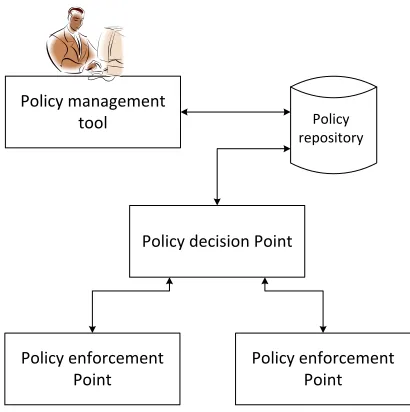
and DMTF [17] tried to propose an architecture for a PBNM system. A PBNM system as
illustrated in 2.2 consists of policy management tool, policy repository,policy decision point,
and policy enforcement point.
The policy management tool is used by administrators for defining and modifying
policies that the system should implement in the network in order to keep the network’s
performance compliant to the requirements.
The policy repository is used to as a storage for the defined policy which can be accessed
by other modules of the system.
The policy decision point (PDP) is responsible for interpreting the defined policies
and instructing the network to take the proper action in different states of the system. The
PDP ensures that the system is compliant to the policies all the time. The PDP receives
Policy management tool
Policy decision Point
Policy enforcement Point
Policy enforcement Point
Policy repository
Figure 2.2: Policy-based Network Management Architecture
the system by either instructing an entity to take a specific action, or changing the system’s
configuration.
The policy enforcement point (PEP) is responsible for implementing and enforcing
the PDP’s decisions across the network.
There are two main challenges in designing and implementing policy-based management
systems. The first one is how to translate the high-level policies, which are stemmed from
requirements into a form which is interpretable with system components, and the second is
how to extend the PBNM system to operate in a fully distribute environment.
To address the first challenge, different policy languages have been defined such as
Pon-der, Ismene, Rei, andPolicy Description Language (PDL) [3]. Each of these languages take
a different approaches to define policies. Some of these languages use structured programs
developed specifically for expressing policies, some use formal logic languages, and others
use set of simple structured rules in form of if ... then ... else [3].
To address the second challenge, Moris Sloman introduced networked resources as
managed entities and placed them in domains [42]. The main promise of a domain was to
group managed entities (objects) in order to apply management decision to them. Domains
can include otherdomainsand build a hierarchy. They then defined policies as objects which
managed environment, two approaches can be used to govern the policies in distributed
fashion: peer-to-peer, hierarchical. In the former, each domain has its own fully independent
network management system, and the coordination between network management system
only happens if both participating parties benefit form this collaboration. In the latter, each
domain has its own network management system but it is not independent of other network
management systems, and they form a hierarchy which governs all the network entities [3].
Policy management has been extensively used in different aspect of network
manage-ment, especially in security management areas such as Role-based access control and Trust
management.
Notion of trust has been used in different areas such as sociology, economics,
philos-ophy, and psychology. In computer science, concept of trust is used in different fields like
autonomic computing and communication and networking. In communication and
network-ing, Aivaloglou et al. defines trust as the quantified belief of a trustor regarding honesty,
competence, security, and dependability of a trustee in a specific context. Also, trust can be
define as the degree of a belief about the behaviour of other entities [13].
2.5
Wormhole attack
We are going to use the proposed framework of the thesis in a case study to detect wormhole
attack in a AODV-powered MANET. In this section the wormhole attack is studied in more
details.
2.5.1
How wormhole attack works
In this attack, attackers capture packets at one location in the network and forwards (tunnels)
them to a distant location to be replayed in order to prevent benign nodes from having a
valid image of the network’s topology. The main goal of wormhole attack is to deceive benign
nodes in a way that attackers can absorb high volume of network traffic to be passed through
them. This attack can be done by one, two or more colluding nodes. Wormhole attacks can
be launched using different techniques [4]. Sadeghi et al [39] has claimed that AODV is
more vulnerable to a wormhole attack thanOLSR. Sadeghi et al. [39] presents an analysis of
the performance ofAODV andOLSR powered MANET with and without wormhole attack.
They have done their simulation in 1000m * 1000m area with 80 random waypoint mobile
nodes. As AODV and OLSR are two dominant routing protocols MANET, there are lots
attacks [4].
2.5.2
Wormhole attack launching techniques
Azer et al. [4] categorized the launching techniques of wormhole attack into five groups.
2.5.2.1 Out-of-Band Channel technique
In this technique, attacker nodes are directly connected, either by using long range directional
wireless links or by direct wired link. As this technique needs special hardware, it is more
expensive to launch and maintain. In this technique a colluding node tunnels received
packets to the other colluding node residing in a distant part of the network using a direct
link. Therefore, the packets will reach that part of the network faster and with fewer numbers
of hops in comparison to packets which took the benign paths. Therefore, nodes residing
close to wormhole ends choose the wormhole path to communicate with other nodes.
2.5.2.2 High Power Transmission technique
In this technique, any node can launch a wormhole attack. The malicious node uses high
power transmission to broadcast received RREQs. Thus, its forwarded RREQs can reach
other nodes faster compared to RREQs which are forwarded by benign nodes. This process
increases the chance of malicious node to be on the routes established between a source and
a destination.
2.5.2.3 Encapsulation technique
In this technique, when a colluding node hears a RREQ, it encapsulates it in a packet and
sends this packet to another colluding node. The receiving colluding node will extract the
encapsulated packet and replay it. In this way, all the nodes resided on the path between
colluding nodes will be ignored in hop-count calculation process. Thus, the destination node
will see the packet with very small hop count that will affect its path selection process. In
this technique there is no need for any special equipment, such as high speed wire link or a
high power source to create the wormhole. One way to prevent this type of wormhole attack
is in the use of a routing protocol, which does not rely on the shortest path (minimum
number of hops) like protocols which select fastest path. Motivation for this type of routing
2.5.2.4 Packet relay technique
In this technique, one or two malicious nodes can just play a role of an invisible bridge
between two not-in-range benign nodes. The attacker just relays packets among two nodes,
which are not in communication range of each other, without doing the mandated changes to
the packet header and it deceives these two nodes that they are neighbours. After exchanging
enoughhello messages the wormhole will be established and the malicious node can take the
control of the traffic among attacked nodes.
2.5.2.5 Using Protocol Deviations
Sometimes malicious nodes use protocol specification in order to disrupt the normal
be-haviour of the network. For example, a malicious node can ignore the back-off time enforced
byMAC layer in order to win the competition of being the first to reach the destination.
2.5.3
Wormhole attack classification
Khabazizan et al. mention two modes of operation for wormhole attacks: hidden and
par-ticipation mode [43]. In hidden mode colluding nodes do not use their identities to forward
packets. Thus, they remain hidden to legitimate nodes. Basically in this mode, attacking
nodes provide a virtual tunnel between two far-off legitimate nodes. Azer et al. named this
type of wormhole as closed wormhole attack [4]. Well known wormhole detection schemes,
such as packet leashes, directed antenna and SECTOR, deal with wormhole attack in this
mode of operation. In participation mode, colluding nodes do not create a virtual link and
they actively participate in routing as legitimate nodes and by sending packets through the
wormhole they attract more traffic. Azer et al. divided these types of wormholes into open
and half-open wormhole that respectively got their names based on the fact that both or
only one of the colluding nodes reveal their identity to the routing protocol. After launching
the wormhole and absorbing traffic, colluding nodes can launch DoS attacks by randomly
dropping packets.
2.5.4
Wormhole Attack Impacts
We can see wormhole attack as a two-phase process. First, attacker should establish the
wormhole tunnel and absorb network traffic. At this time - end of phase one - we can see
the wormhole as a fast packet delivery service to network which cause the other nodes to not
used by other nodes to forward a significant amount of network traffic and attacker can
monitor, edit, or selectively drop packets. Having control of the network traffic, the attacker
has the opportunity to launch other type of attacks, like DoS. Periodically an attacker can
switch an active wormhole off and impose a huge route rediscovery burden to the network. If
a attacker decides to drop the network traffic, nodes close to a wormhole tunnel ends become
sinkholes.
2.5.5
Wormhole attack countermeasures
There are two different approaches to deal with wormhole attacks: proactive (preventive)
and reactive (detective). In proactive countermeasures usually special hardware is added to
nodes. On the other hand, reactive approaches try to investigate some evidence that can
prove existence of a wormhole attack. These two approaches define two lines of defence. In
the literature, there are different categories of defence against wormhole attacks.
2.5.5.1 Location and time based solutions
In these solutions, nodes’ locations and the time they send and receive packets are used
in order to avoid using a wormhole to route packets. In these solutions, nodes are usually
equipped by extra equipment, such as GPS, or they have tightly synchronized clocks.
Packet leashes: Hu et al. introduced the notion of leash where extra information is added
to a packet in order to defend against wormhole attacks [22]. A leash is any information
added to a packet in order to limit the distance a packet can be transmitted. Two types
of leashes have been introduced: geographical and temporal. A geographical leash ensures
that the distance between sender and receiver of a packet does not exceed a certain limit. A
temporal leash ensures that a packet has an upper lifetime limit, and it can not be alive for
more than a specific limit. In geographical leashes, nodes use loosely synchronized clocks in
order to calculate the traveled distance of packet, and in temporal leashes, nodes use tightly
synchronized clocks in order to calculate a precise life time for each packet and prevent a
wormhole attack. Common authentication scheme or signature scheme like MAC and RSA
can be used to ensure the authenticity of timestaps and location information in leashes. The
main drawback of this method is the dependence on clock synchronization and need for extra
Directional Antenna: Hu et al. [21] introduced directional neighbor discovery, verified
neighbour discovery, and strict neighbor discovery protocols which use directional antenna
to detect the existence of a wormhole attack in MANET. In these protocols directional
information are shared between source and destination. Nodes use specific sectors of their
antennas to communicate with each other. Therefore, a node receiving a message from its
neighbour can calculate the orientation of the neighbour with respect to itself. This extra
bit of information, makes wormhole discovery much easier than in networks with exclusively
omni-directional antennas. This approach requires neither clock synchronization nor location
information, and is energy efficient.
SECTOR: In secure tracking of node encounters (SECTOR) introduced by S. Capkun et
al. [10], like packet leashes, the same principal of measuring distance between nodes has
been followed. However, it only measures single hop distance using Mutual Authentication
with Distance-bounding (MAD) protocol and a special hardware which is appended to nodes
in order to make them able to rapidly exchange challenge nodes with each other. Using these
bidirectional fast- challenge bit exchange, nodes estimate distance between themselves and
their neighbours which lead to wormhole attack detection.
2.5.5.2 Recent approaches
Following we discuss some innovative methods to detect and prevent wormhole attack that
they do not need any extra hardware.
Diffusion of innovations: Azer et al. [5] have suggested a preventive detective scheme
based on a social science theory called diffusion of innovations. This mechanism can help
nodes to detect or prevent wormhole attack even before any interaction with malicious nodes.
They claimed that their scheme is totally decentralized and does not impose any
computa-tional complexity to the nodes. Diffusion is the process that innovation is communicated
between entities in a social network. Diffusion of innovation theory tries to show how an
innovation is adopted or rejected by members of a social network. The spread of a new idea
is explained in this theory by defining five phasesknowledge,persuasion,decision,
implemen-tation, andconfirmationwhich members of the social network who can have different defined
roles, should pass through. Members of network can belong to one of the five defined roles
in the network, a set of thresholds are defined and nodes compare their observations with
these thresholds. If they find strong variations they become early adopters of the idea that a
specific node is launching a wormhole attack. Otherwise, they just listen to their neighbours’
opinions (roles) and adopt a role based on the rule which the adopted role will be less than
neighbours’ role by a degree [5]. Superimposing this actor’s network on the network, authors
claimed they can detect and prevent wormhole attacks in wireless networks.
Is detective? Yes Is preventive? Yes
Used routing protocol AODV Is simulated? OPNET
Needs routing
proto-col modification
Yes Is mobility considered No
Disadvantages introduce end-to-end
delay to the network
Advantages distributed and does
not add
computa-tional complexity to
the nodes
Table 2.1: Diffusion of innovation summary
Path tracing algorithm: The path tracing algorithm is another wormhole detection
mech-anism dealing with networks which are using DSR, another on-demand routing protocol in
which the routed packets contain the address of each device the packet will traverse [46],
as their routing protocol. In this approach, neighbours communication has to be
bidirec-tional. T. Sakthil et al. [40] introduced a two-phase process which can detect and prevent
wormhole attacks. In the first phase, they calculateprior per hop distance,per hop distance,
and timstamp which are placed in the DSR packet header during the route discovery
pro-cess. In this approach, no tight clock synchronization is needed and each node uses its own
clock. On a route, the distance between adjacent nodes is computed and then compared
with consecutive neighbours distances on the same route, and if the difference exceeds a
threshold the link becomes suspicious that there is a wormhole. Another parameter which is
calculated is frequent appearance of a link in a path. Frequent appearance can be computed
by dividing the number of times a link appears in a path by the number of all created links.
Thus, if the difference of a link’s hop distance field and the prior hop distance field is more
is assumed to be a wormhole. In the second phase, if a wormhole has been detected, this
information would be propagated through the network and the malicious node information
will be added in wormhole lists in other nodes. Thus, a wormhole attack can be detected
using information resided in DSR packets’ header. In this paper, authors do not mention
how they calculated the thresholds.
Is detective? Yes Is preventive? Yes- it starts
indetec-tive mode
Used routing protocol DSR Is simulated? NS-2
Needs routing
proto-col modification
Yes Is mobility considered Yes - Random way
point
Disadvantages Does not mention
how to calculate the
thresholds
Table 2.2: Path tracing algorithm summary
WAP: Wormhole attack prevention algorithm [14], proposed a mechanism to detect the
wormhole in a mobile ad hoc networks without utilizing any special hardware. Sun Choi et
al. [14] suggest neighbour nodes monitoring method using a local timer calledWPT
(worm-hole prevention timer). This method is deployed to networks with DSR routing algorithm
with disabled DSR optimization because it performs end-to-end signature authentication of
routing packet and verification of sending RREP right . When a node sends a RREQ to the
network, it starts a WPT and waits to overhear the rebroadcasted RREQ from its
neigh-bours. Using these over-hearings, the node builds up a neighbour node table which records
the sending and overhearing time of a specific RREQ from each neighbour. Assuming the
speed of light for packet propagation, by calculating the round trip distance between the
node and its neighbours, a node can useWPT to find out if one of its neighbours is located
on the other side of a wormhole. In order to detect exposed wormhole attacks, thewormhole
route detection mechanism is proposed, which calculates the delay per hop on each route,
and compares it to WPT, and it should be smaller. Using this method, WAP can detect
hidden exposed wormhole attacks. WAP places detected nodes related to a wormhole in a
Is detective? Yes Is preventive? No
Used routing protocol DSR Is simulated? Qualnet
Needs routing
proto-col modification
Yes Is mobility considered Yes - Random way
point
Table 2.3: Wormhole attack prevention
Multi path routing protocols: Ning Song et.al tried to detect and locate wormhole attack
in MANET with multi path routing protocols [43]. They suggested Statistical Analysis
approach (SAM) for multi path routing networks. Multi path routing protocols such as
SMR [29] detect multi paths to a destination and preserve them in a node. In case of route
failure, nodes do not need to execute the route recovery process and they just use next
available route. Multi-path routing protocols are claimed to have less management overhead
than single-path routing algorithms such AODV.
In this paper, the authors tried to use local data gathered by each node to spot the
wormhole attack. They calculated some statistics in normal environment, referred to as
training environment, and use these statistics in the real scenarios where the network is
under wormhole attack. They completely ignored mobility, and they discussed two types of
topologies: clustered, and uniform. At the end, they claimed that their method, which does
not need any extra hardware such as synchronized clock or GPS, can be used in intrusion
detection systems.
Is detective? Yes Is preventive? No
Used routing protocol MR - derivative of
SMR
Is simulated? Not mentioned
Needs routing
proto-col modification
It needs multi-path
routing protocol
Is mobility considered No
Disadvantages It depends on
topol-ogy of the network
and completely ignore
mobility
Advantages It brings vulnerability
of multi-path routing
algorithms into
atten-tion
2.6
Research Gap
Mobile ad hoc networks are infrastructureless networks with no central management entity
and frequently changing topology. These characteristics make them vulnerable to security
attacks. Wormhole attack is a complex network layer attack, which tries to gain the control
over the traffic flow in the network. In this chapter, several countermeasure against it have
been studied. It maybe feasible to have a framework which requires neither extra hardware
nor high computational power to detect and react upon the wormhole attack. Policies can be
used to empower the framework toward detecting not only wormhole attack but also other