International Journal of Research (IJR)
e-ISSN: 2348-6848, p- ISSN: 2348-795X Volume 2, Issue 05, May 2015Available at http://internationaljournalofresearch.org
A Study on Traffic Adaptive MAC Protocols for Wireless
Body Area Network
Bhawana Singh
(Asstt.Prof.) Department Of Computer Science And Engineering (M.Tech) Indus Institute Of Technology & Management, Kanpur
U.P. (209202)
email: [email protected]
Abstract.
A wireless Body Area Network (WBAN) is expected to be a very useful technology with potential to offer a wide range of benefits to patients, medical personnel and society through continuous monitoring and early detection of possible problems .An energy-efficient Medium Access Control (MAC) protocol is required to satisfy the stringent WBAN requirements. It is still in progressing stage and implementation of the standard is not yet finalized. In this study, I discussed various MAC protocols proposed by research peers specifically addressed the needs of WBAN and finally considered that by adopting the cognitive approach through traffic consideration the MAC Protocol in WBAN can reduce the energy wastages in WBAN sensors. I have considered here single hop master slave star topology for the network. The IEEE 802.15.4 standard provides the widely accepted solution for low-cost and low-power wireless communications. Despite its design, the fixed superframe size in Beacon-enabled mode limits its capabilities due to two contrasting goals; energy efficiency and higher data throughput. In this paper, I outlined that an enhancement of IEEE 802.15.4 Beacon-enabled mode which adaptively adjusts the active period based on the traffic-load resulting in energy saving of devices.
Keywords:
MAC; WBAN; BSN; low-power
I. INTRODUCTION
A Wireless Body Area Network (WBAN) [1] consists of small, intelligent devices attached on or implanted in the body which are capable of establishing a wireless communication link. These devices provide continuous health monitoring and real-time feedback to the user or medical personnel. One of the crucial areas in implanting sensors is the battery lifetime. Batteries cannot be replaced or recharged without employing a serious medical procedure so it is expected that battery powered medical devices placed inside the body should last for ten to fifteen years according to specific application. Networking places an extra demand on the transceiver and processing
operations of the sensor resulting in increased power consumption. A network placed under a hard energy constraint must therefore ensure that all sensors are powered down or in sleep mode when not in active use, yet still provide communications without significant latency when required. Using wireless communication, instead of traditional wired connections, in healthcare systems not only reduces the maintenance cost, and gives the patients more freedom and comfort, but also makes pervasive and mobile healthcare possible. It can help physicians to perform early diagnosis and treatment, and develop and verify new therapies through continuously monitoring and analyzing human vital signs . As shown in Fig. 1, a BSN usually consists of implantable or wearable biosensors, and measure the temperature, blood pressure, heart rate, ECG, EEG, respiration rate, SpO2-levels etc. It includes even ingestible camera pills. These sensors continuously monitor vital signs and report data to a powerful external device, such as a personal digital assistant (PDA), a cell phone, or a wrist-worn smart watch.
International Journal of Research (IJR)
e-ISSN: 2348-6848, p- ISSN: 2348-795X Volume 2, Issue 05, May 2015Available at http://internationaljournalofresearch.org
Our era is witnessing an increasing pressure on quality and quantity of healthcare due to the increase of aging population, chronic diseases, and health consciousness of people. BAN soon will be in great demand.
The number of MAC-protocols specifically developed for WBANs is limited. Two major categories of MAC-protocols are contention-based and schedule-based. For the former, CSMA/CA is a typical example, while TDMA is a typical scheme for the latter. The advantages of contention-based approaches are the simplicity, its infrastructure-free adhoc feature and good adaptability to traffic fluctuation, especially for low load. Schedule-based approaches on the other hand are free of idle listening, overhearing and packet collisions because of the lack of medium competition, but require tight time synchronization.
In specifying this MAC Protocol, the following attributes can be inferred about the wireless body area sensor network. 1. All wireless sensor nodes are attached to the body. 2. The data being monitored is of low frequency.
3. Sensors monitor a range of vital signs which are typically at a low data rate (<1kB) .
4. Sensor nodes are resource constrained, i.e., they have low processing power and limited memory.
5. Data from the wireless sensor nodes is forwarded to a central master node for processing; this central node is significantly less resource and power constrained relative to the wireless sensor nodes.
II. RELATED WORK
This term was first coined by Van Dam in 2001 [1] and received the interest of several researchers . Some implementations of WBANs use Bluetooth (IEEE 802.15.1). This was developed as a cable replacement and does not support multi-hop communication. It has a complex protocol stack and a high energy consumption compared to IEEE 802.15.4. It is therefore not suited to be used in a WBAN. Most current implementations of WBANs use IEEE 802.15.4 or ZigBee as enabling technology. As most of the radios used in a WBAN are based on an IEEE 802.15.4 compliant chip set, some researchers have adapted the IEEE 802.15.4 MAC-protocol to make it more suitable for WBANs.
For the first time, Nicholas F. Timmons and William G. Scanlon [2] presented an analysis of the performance of the IEEE 802.15.4 low power, low data rate wireless standard in relation to medical sensor body area networks. The main consideration in this work was the long-term power consumption of devices, since for practical reasons, implanted medical devices and sensors must function for at least 10 to 15 years without battery replacement. The results show that when properly configured, 802.15.4 can
be used for medical sensor networking when configured in non-beacon mode with low data rate asymmetric traffic.
This paper focused on an analysis of the 802.15.4 standard configured as a star network where the coordinating device is external to the body, e.g., incorporated in a PDA, mobile telephone or in bedside monitoring station.
Description of the network was star network consisted of the coordinator and 10 body implanted sensors.
In IEEE 802.15.4, each node can employ a CSMA/CA protocol to avoid power-consuming collisions when multiple simultaneous transmissions may occur. The CSMA/CA protocol used in 802.15.4 can be slotted or unslotted. If a beacon is being used the slotted CSMA/CA is employed in the CAP part of the superframe. If a non-beacon network is used, or if the beacon is not detected, then unslotted CSMA/CA is employed. In slotted CSMA/CA the start of the first back-off period of each node is aligned with the start of the beacon. In unslotted CSMA/CA there is no link in time between the backoff periods of any node. There are three variables maintained by each node for each transmission attempt: NB, CW and
BE.
In the first study of its kind, the low power performance of three modes of the IEEE 802.15.4 standard were evaluated in relation to a body area network of implanted medical sensors.
The modes evaluated were beacon, beacon plus guaranteed timeslots and non-beacon, all at 2.4 GHz. In a non-beacon
enabled network data frames are transmitted using unslotted CSMA/CA.
When communication is from the node to the
coordinator, the coordinator acknowledges
successful reception of the data frame by sending back an acknowledgement frame.
When the coordinator wishes to send a data frame to a node, it must wait until it receives a data request from the sensor.
In a Beacon enabled network with GTS
When communication is from the node to the coordinator, if GTS was assigned, it will send the data frame within appropriate time slot. If no GTS is assigned the sensor transmits its data in CAP using CSMA/CA.
International Journal of Research (IJR)
e-ISSN: 2348-6848, p- ISSN: 2348-795X Volume 2, Issue 05, May 2015Available at http://internationaljournalofresearch.org
solution to the challenge of the body area network. The IEEE 802.15.4 standard would provide a limited answer in its non-beacon form. Sensors that do not have large amounts of data to transfer could be used, i.e., small packets of data several times per hour.
Another an Ultra-low-power Medium Access Control Protocol for Body Sensor Network proposed by Huaming Li and Jindong Tan [3]. BSN-MAC is an adaptive, feedback-based and IEEE 802.15.4-compatible MAC protocol. BSN-MAC exploits the feedback information from the deployed sensors to form a closed-loop control of the MAC parameters. This paper proposed BSN-MAC (Body sensor network MAC), which is a dedicated ultra-low-power MAC protocol designed for star topology BSNs. BSN-MAC has good compatibility with IEEE 802.15.4 as well as accommodates unique requirements of the biosensors in BSNs.
BSN-MAC is designed to be an adaptive MAC protocol. By exploiting feedback information from distributed sensors in the network, BSN-MAC adjusts protocol parameters dynamically to achieve best energy conservation on energy critical sensors. They introduced two tradeoffs in BSN-MAC design. The first is between the energy of coordinator (unconstrained) and the life of energy-critical sensors nodes. The second is between the sensor data report delay and the life time of energy-critical sensors nodes.Once the node powers up its radio and gets synchronized, depending on the beacon information and buffered data size, it either sends out a data transmission request (REQ) packet followed by part of the sensory data or sends out the sensory data directly. After the node synchronizes with the coordinator, by decoding the beacon frame, the node learns the length of the beacon interval and understands whether it can transmit its data during a single beacon interval. If yes, it will start transmitting its data directly. Otherwise, the node sends out a REQ packet first to ask the coordinator to change the beacon interval. The REQ packet includes the PMAC of the sensor, which is used by the network coordinator to determine the priority when multiple REQs are received.
Here EL is the energy constraint level. 0 to 3 are assigned to energy unconstrained, constrained, high constrained and extremely constrained sensors respectively. TC is the criticality index of the sensory data. ER represents the energy remaining level and is chosen from 1 to 3. BR represents the remaining buffer level of a sensor and is assigned from 1 to 3.The sensor cannot always change the MAC parameters as their will since when the MAC parameters are changed to favor a certain
node, other nodes may suffer from it. PMAC (medium access priority) is determined by the energy constraint level, data time criticality and the remaining energy and buffer level .We notice that all the information needed to calculate PMAC is available on the sensors’ side.
Category of sensor in BSN based on energy critical level
Unconstrained Constrained Highly Extremely
(PDA) (Wearable constrained
constrain ed
Sensors) (Ingestible (Implanted
sensors) sensors)
Therefore, only the nodes with the highest medium access priority can request the coordinator to change the beacon interval freely. All the other sensors may change the beacon intervals, but not that significantly. RBN is used by the sensors to describe how many such requested beacon intervals they need to transmit the current data.
A cross layer design strategy is adopted in BSN-MAC. The network coordinator and the sensors interact to achieve efficient power management. The coordinator controls the communication by varying the superframe structure. The sensors provide real-time feedback to BSN coordinator with application-specific and sensor-specific information. Hence, the BSN coordinator can make dynamic adjustment based on the feedback to achieve better performance in energy efficiency and latency.
One of the few MAC-protocols for WBANs was proposed by Lamprinos [4]. It incorporates master-slave architecture, with all medical sensor nodes being designated as slaves, while the administrating node acts as the master of the patient PAN. The application software of the master node normally initiates data exchange, by transmitting set up information to the slave nodes. Each sensor is assigned a unique address, and the system has a globally unique address.
Transmission from slaves to master is based on a Request to send – Allow to send scheme. The exchange of data is supported
by optional acknowledgement,
International Journal of Research (IJR)
e-ISSN: 2348-6848, p- ISSN: 2348-795X Volume 2, Issue 05, May 2015Available at http://internationaljournalofresearch.org
avoid collisions and channel overhearing and administrate the exchange of data in the communication channel, the timeline was break in
four types of timeslots, namely Transmit Slot
(TX Slot), Receive Slot (RX Slot), Receive to Synchronize Slot (RXS Slot) and Stand By Slot
(SB Slot).
In particular, if a node has data to transmit, it can execute the respective procedure only at the fade- in of a TX Slot.
Accordingly, reception of data can occur only during RX Slot or RXS Slot.
The RXS Slot is a type of RX Slot implemented only in the slave nodes. It differs in the sense that it endures longer and is used for the
synchronization of the slave with the master.
Finally, both master and slave nodes switch off their transceiver during Stand By Slot. During this period, no transmission or reception activity takes
place.
The main drawback of this protocol is that some slaves will have a low duty cycle whereas the nodes that are serviced later have a higher duty cycle.
Fig.2. Timeslot alteration and data exchange between master and slave nodes
According to the author of this proposed scheme, the sequence and duration of timeslots is predefined. Initially, the slave node alternates between SB Slot and RXS Slot. During RXS Slot, it listens to the communication channel and if it tracks down a packet designated for it, it calculates an offset time, combining the length of the received packet, the predefined duration of timeslots and the transmission bit rate in order to accommodate its transition from RXS Slot to TX Slot to the master’s transition from TX Slot to RX Slot.
The general idea of the proposed synchronization procedure is that after the reception of the first packet, the slave adapts an alteration of timeslots which results in being in TX Slot whenever the master is in RX Slot and inversely. All the nodes of the network are in SB Slot simultaneously. These features are depicted in Fig. 2, where timeslot alteration and data exchange between the master and two slave nodes are presented.
The main drawback of this protocol is that some slaves will have a low duty cycle whereas the nodes that are serviced later
have a higher duty cycle.
0.C.Omeni, 0.Eljamaly, A.J.Burdett [5]propose a MAC protocol for a star-networked WBAN that supports TDMA to reduce the probability of collision and idle listening. Each slave node is assigned a slot by the central node. When an alarm occurs at one of the nodes, the node can be assigned an extra slot for direct communication. The protocol has been evaluated on a Sensium platform. The proposed MAC protocol operations are based on three main communication processes.
The first is when a wireless sensor node wants to join a cluster. This is called the Link establishment process.
The second is when a slave and master wake-up after an assigned sleep period. This is called the wakeup service process.
The last process is an exception process which occurs when a slave urgently wants to send information to the cluster master. This is called an Alarm process.
In all 3 processes, communication can only be initiated by the master. In addition only one slave can join the network at a time as the network is non- ad hoc.
The H-MAC protocol [6] uses the human heartbeat rhythm information to perform time synchronization for TDMA. The biosensors can thus achieve time synchronization without having to turn on their radio. The algorithm is verified with real world data but assumes a certain buffer. As a TDMA protocol, H-MAC assigns dedicated time slots to each biosensor to guarantee collision-free transmission. On the other hand, by taking advantage of heartbeat rhythm that is inherent in every human body, H-MAC achieves TDMA time synchronization without distributing periodic timing information, which reduces the energy cost. In H-MAC, biosensors extract the necessary synchronization information from their own sensory biosignals, which are correlated with or directly driven by the heartbeat pulsation, in a distributed way.
H-MAC considers time slot scheduling for one hop star topology BSNs. Since the traffic pattern in BSNs is data logging and the network coordinator is the common receiver of the transmissions, only one sensor node is allowed to transmit in a time slot to avoid collisions. In H-MAC, we use the peaks as synchronization beacons and use peak intervals as time slots for data transmission. By introducing a peak counter in each biosensor, we can assign dedicated time slots to each biosensor for collision-free network transmission.
III. Standard of WBAN MAC Protocol
International Journal of Research (IJR)
e-ISSN: 2348-6848, p- ISSN: 2348-795X Volume 2, Issue 05, May 2015Available at http://internationaljournalofresearch.org
fundamental lower network layers of a type of wireless personal area network (WPAN) which focuses on low-cost, low-speed ubiquitous communication between devices, intending to exploit this to lower power consumption even more.
The basic framework conceives a 10-meter communications range with a transfer rate of 250 kbit/s. Lower transfer rates of 20 and 40 kbit/s were initially defined, with the 100 kbit/s rate being added in the current revision. As already mentioned, the main identifying feature of IEEE 802.15.4 among WPANs is the importance of achieving extremely low manufacturing and operation costs and technological simplicity, without sacrificing flexibility or generality. Important features include real-time suitability by reservation of guaranteed time slots, collision avoidance through CSMA/CA and integrated support for secure communications. Devices also include power management functions such as link quality and energy detection. IEEE 802.15.4-conformant devices may use one of three possible frequency bands for operation.
Fig. 3. IEEE 802.15.4 Superframe structure
IV. PROTOCOL ARCHITECTURE
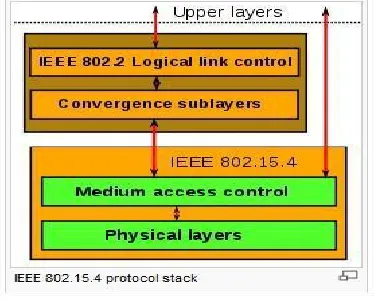
Fig.4. IEEE 802.15.4 protocol stack
A. The physical layer
There are two physical layer variants in 802.15.4: 868/915MHz and 2.4 GHz (TABLE I). The standard defines the 868 MHz band as a single channel with a data rate of 20 kbps, the 915 MHz band as a single 40 kbps channel, while the 2.4 GHz band is divided into 16 channels each with a data rate of 250 kbps. For convenience, this work considers only 2.4 GHz.
TABLE I
802.15.4 PHYSICAL PARAMETERS
B . The MAC layer
The medium access control (MAC) [1] enables the transmission of MAC frames through the use of the physical channel. Two topologies are supported by 802.15.4: star and peer-topeer, but here only star networks is considered. The main advantage of using a star network for medical sensor applications is that an external coordinator can be used with access to rechargeable power supply. With the star topology there are two communication methods: beacon mode and nonbeacon mode.
In beacon mode, communication is controlled by the network coordinator, which transmits regular beacons for device synchronization and network association control. The network coordinator defines the start and end of a superframe by transmitting a periodic beacon. The length of the beacon period and hence the duty cycle of the system can be defined by the user between certain limits as specified in the standard. The advantage of this mode is that the coordinator can communicate at will with the nodes. The disadvantage is that the nodes must wake up to receive the beacon.
International Journal of Research (IJR)
e-ISSN: 2348-6848, p- ISSN: 2348-795X Volume 2, Issue 05, May 2015Available at http://internationaljournalofresearch.org
must wait to be invited by the node to communicate.
In beacon mode, the superframe may consist of both an active and inactive period (Figure 3). The active portion of the superframe, which contains 16 equally spaced slots, is composed of three parts: a beacon, a contention access period (CAP), and a contention free period (CFP). The beacon is transmitted without the use of CSMA at the start of slot 0 and the CAP commences immediately after the beacon. The coordinator only interacts with nodes during the active period and may sleep during the inactive period. There is a guaranteed timeslot (GTS) option in 802.15.4 to allow lower latency operation. There are a maximum of 7 of the 16 available timeslots that can be allocated to nodes, singly or combined. When a node is allocated a timeslot it may only transmit data during that timeslot. GTS nodes must listen to the beacon to synchronize prior to communication within its allocated timeslot(s). The relative size of each of the active and inactive periods is determined by the values of the macBeaconOrder
(BO) and the macSuperframeOrder (SO) and the overall superframe length (or Beacon Interval, BI) and active superframe duration (ASD) are calculated as follows:
BI=(aBaseSlotDuration×aNumSuperframeSlots×2BO
)symb-ols
where 0≤BO≤14, aBaseSlotDuration=60 symbols and aNumSuperframeSlots(slots in a frame)=16
ASD=(aBaseSlotDuration×aNumSuperframeSlots×2SO
)sy-mbols
where 0≤SO≤BO≤14
C. Higher layers
Other higher-level layers and interoperability sublayers are not defined in the standard. There exist specifications, such as 6LoWPAN and ZigBee, which build on this standard to propose integral solutions. TinyOS, Unison RTOS, DSPnano RTOS and Contiki stacks also use a few items of IEEE 802.15.4 hardware.
V. ADAPTING OF DATA TRAFFIC IN IEEE 802.15.4
IEEE 802.15.4 WPAN (Wireless Personal Area Networks) standard [8] supports for low-cost and low-power wireless connectivity among resource-limited devices. Especially, IEEE 802.15.4 MAC achieves a low-duty cycle operation by means of its Beacon-enabled mode. In this mode, a PAN coordinator periodically disseminates a superframe structure bounded by a beacon frame into the network and manages its active/inactive period. Any associated devices are allowed to communicate in the active period and conserve energy by turning off their transceivers during the inactive period. However, a fixed duration of the active period limits its overall performance by two means: idle listening and lower data throughput. In this paper, I studied a novel scheme for mitigating the idle listening problem and improving data throughput in the current IEEE
802.15.4 Beacon enabled mode. In this scheme, a coordinator can adaptively adjust the active period based on the data traffic information of associated devices. When a data traffic load is low, the active period is reduced to conserve energy consumption regardless of a superframe duration. However, with a higher traffic load the active period becomes lengthen up to a total beacon interval to improve data throughput.
VI.The Scheme Studied
To reduce energy consumption but still improve data throughput, the presented scheme adaptively adjusts the active period based on the data traffic information. This description, uses the term sentinel duration to refer to a special epoch for detecting the traffic information.
Fig.5. Performing sentinel durations in a beacon interval
A. Adaptive Active Duration
In this scheme, devices having no data traffic are not required to continuously maintain an active state even when they are in their superframe duration part. The sentinel duration is periodically performed with a length equivalent to a superframe duration in a single beacon interval as shown in Fig. 5. In this scheme, the value for Superframe Order (SO) is set to be smaller than the Beacon Order (BO). Therefore, several occurrences of sentinel duration can be performed in one beacon interval. At the start of a sentinel duration, if a node finds pending data traffic in its queue buffer, it tries to convey the traffic information to its coordinator. On detecting traffic presence from devices at some sentinel duration, the coordinator maintains an active RF state to receive data frames until the next sentinel duration. If there is no data traffic at any sentinel duration, the coordinator and devices can enter or continuously maintain the sleep state accordingly. Devices can continuously carry out the sentinel duration so that the pending data traffics can be transmitted to the coordinator even after the superframe duration is over. In this way, data throughput can be increased while decreasing latency when the data traffic load is high.
B. Traffic Indication Technique
International Journal of Research (IJR)
e-ISSN: 2348-6848, p- ISSN: 2348-795X Volume 2, Issue 05, May 2015Available at http://internationaljournalofresearch.org
T SD = (2BE − 1) × aUintBackoffPeriod (1)
where BE means a back-off exponent value and its maximum value is 5 in the IEEE 802.15.4 standard,
TABLE II
therefore T SD is calculated as 620 symbols. As a transmitted packet should appear within the maximum 620 symbols, traffic indication technique can detect existence of the traffic information within this duration. If one of the CCA becomes busy during T SD, traffic indication technique decides that there is data traffic. However, if no data is generated during T SD, nodes decide that there is no traffic in this active period and enter into the sleep mode. Since our traffic indication technique transmit no additional traffic indicator frames, it is consistent with the original IEEE802.15.4 MAC without any conflict and control packet transmission overheads.
SCHEMATIC OVERVIEW OF MAC PROTOCOLS IN A WBAN.
MAC- IEEE802.15.4 TDMA CSMA Star Time Factor improved
Protocol based based based topology synchronization
Timmons Power
consumption
BSN-MAC mixed Energy efficiency
,low latency
Lamprinos Energy efficiency
Omeni Energy
consumption
H-MAC Network Lifetime
Traffic Reducing energy
adaptive wastage
International Journal of Research (IJR)
e-ISSN: 2348-6848, p- ISSN: 2348-795X Volume 2, Issue 05, May 2015Available at http://internationaljournalofresearch.org
Recently, researchers from academia and industry have focused their interest on the development of the IEEE 802.15.6 [9] specification as the future standard for BANs for both medical and non-medical applications, with priority given to medical application data. One of the main technical issues in BAN is the reliable and efficient transfer of vital life signs using wireless communication near the human body, which is a very lossy medium. A key technical requirement is to meet the reliability requirement as set out by the IEEE 802.15.6 draft standard, which states that “the packet error rate (PER) shall be less than or equal to 10% for a 256 octet payload with a link success probability of 95% over all channel conditions”. Most research adopts a Star Topology (ST) as the default topology for BANs for simplicity of the communication protocols and to reduce the power consumption associated with multi-hop or Tree Topologies. Project Authorization Request (PAR) presents an extended description of the task group . It stresses the fact that current WPANs do not meet medical communication guidelines, because of the proximity to human tissue.
The combined effect of high propagation loss, the limited energy source, and the issue of tissue overheating, justify the deployment of more than one transmission hop for BANs.
Started as a Study Group in 2006 and motivated by the increasing research and industry interest in WBANs, the IEEE Standards Association decided to form the IEEE 802.15 Task Group 6 in November 2007. It describes itself as follows: The IEEE 802.15 Task Group 6 (BAN) is developing a communication standard optimized for low power devices and operation on, in or around the human body (but not limited to humans) to serve a variety of applications including medical, consumer electronics and In 2008, a Call for Proposals on physical layer and MAC layer protocols was issued . The large number of responses, 64 in total, confirmed the industry interest. Currently, the responses are being evaluated at monthly meetings, while some proposals are merged. The creation of the IEEE 802.15 Task Group 6 and the work on an IEEE 802.15.6 standard stresses the importance of the research with
respect to WBANs.
VII. CONCLUSION
A WBAN is expected to be a very useful technology with potential to offer a wide range of benefits to patients, medical personnel and society through continuous monitoring and early detection of possible problems. In this paper it has been shown that by adopting the Traffic Adaptive MAC Protocol in WBAN can result in the reduction of the energy consumption of WBAN sensors
.With this protocol consideration the wastage of energy can be reduced. Future work can be extended to multihop network scenario.
IX. REFERENCES
[1] Bart Braem , Ingrid Moerman . Chris Blondia ,Piet Demeester “A Survey on Wireless Body Area Networks”.
[2] N. F. Timmons and W. G. Scanlon, “Analysis of the performance of IEEE 802.15.4 for medical sensor body area networking” in First Annual IEEE Communications Society Conference on Sensor and Ad Hoc Communications and Networks, 2004. IEEE SECON, Oct. 2004, pp. 16-24.
[3]H. Li and J. Tan, “An ultra-low-power medium access control protocol for body sensor network” in 27th Annual International Conference of the Engineering in Medicine and Biology Society, 2005. IEEE-EMBS, Shanghai,, 2005, pp. 2451-2454.
[4]I. E. Lamprinos, A. Prentza, E. Sakka, and D. Koutsouris,“Energy-efficient MAC protocol for patient personal area networks” in 27th Annual International Conference of the Engineering in Medicine and Biology Society, 2005. IEEE- EMBS, Shanghai,, 2005, pp. 3799-3802.
[5]O. C. Omeni, O. Eljamaly, and A. J. Burdett, “Energy efficient medium access protocol for wireless medical body area sensor networks” in Medical Devices and Biosensors, 2007. ISSS-MDBS 2007. 4th IEEE/EMBS International Summer School and Symposium on, Cambridge, UK,, Aug. 2007, pp. 29-32.
[6]H. Li and J. Tan, “Heartbeat driven medium access control for body sensor networks” in HealthNet '07: Proceedings of the 1st ACM SIGMOBILE international workshop on Systems and networking support for healthcare and assisted living environments. Puerto Rico, USA: ACM, 11 June 2007, pp. 25-30.
[7]Anis Koubaa, André Cunha, Mário Alves “A Time Division Beacon
Scheduling Mechanism for IEEE 802.15.4/Zigbee Cluster-Tree Wireless Sensor Networks”in Technical Report HURRAY-TR-070401 version 1.0.
[8]Zeeshan Hameed Mir, Changsu Suh and Young-Bae Ko“Performance Improvement of IEEE 802.15.4 Beacon-enabled WPAN with Superframe Adaptation via Traffic Indication ” in part supported by the MIC (Ministry of Information and Communication),korea,under the ITRC support program supervised by IITA,(IITA – 2006-C1090-0602-0011) and (IITA-2006-C1090-0603-0015)
[9]Hind Chebbo, Saied Abedi, Tharaka A. Lamahewa, David B. Smith, Dino Miniutti and Leif Hanlen “Reliable Body Area Networks Using