University of Toronto
Master’s Thesis
Comparing Different Definitions of
Secure Session
Author:
Can
Zhang
Supervisor:
Charles
Rackoff
1
Introduction
One of the strong goals of cryptography is to ensure secure exchange of information between two parties in the presence of an adversary who has full control over the channel. This means that the adversary decides what should be delivered to either of the parties, regardless what the two
parties wish to deliver. In particular, we are interested in the following scenario, which we term
as a “session”:
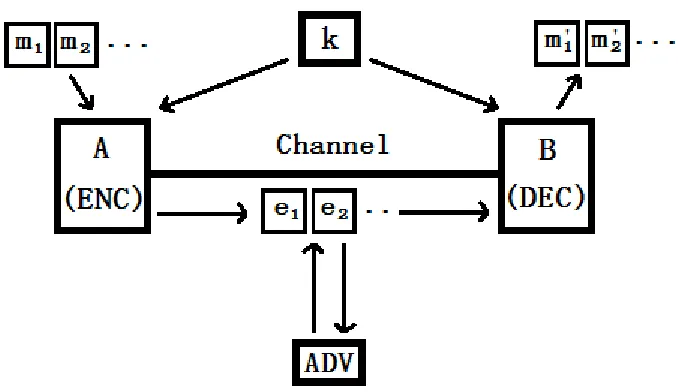
Figure 1: The Session Model
Alice (A) has a stream of message pieces of a fixed sizem1, m2, . . . that she would like to share
with Bob (B), and A encrypts each piece and sends the encrypted pieces to B. In our session
model, we allow the two parties to share a random secret key for encryption and decryption. The secret key can be agreed upon in various ways: two parties can decide on a key via a trusted carrier, or they can use some public key infrastucture and a key exchange protocol where a random key can be established securely. In our discussion of sessions, we assume that the two parties start with a shared key and do not consider the distribution of the key as a part of the session. Technically,
an “encrypted piece” merely refers to the text that Adecides to put on the channel for a message
piece. During the transmission of the encrypted pieces, the adversary has access to all the bits
that Aputs on the channel and decides whatB receives. OnceBreceives (supposedly) encrypted
pieces from the adversary, if the adversary did not change the encrypted pieces, B should be able
to extract the original message pieces from the encrypted pieces using his decrypting algorithm. For a session to be secure, two types of security properties need to be satisfied: privacy and integrity. Essentially, privacy ensures the message pieces that are embedded in the encrypted
pieces remain unknown to the adversary. Integrity asserts that whenever B outputs a message
piece, it must be the same message piece appearing at the corresponding position in the list of A’s
input message pieces. Since the adversary decides what B receives, it can always send garbage to
B. In order to detect invalid encrypted pieces, Bhas the option to output a special FAIL symbol.
WheneverBoutputs FAIL, we say thatB“rejects” an encrypted piece. This is crucial to integrity
because if B decrypts everything it sees, an adversary would be able to send anything to B and
message pieces that A originally has. There are notions of privacy and integrity defined in the literature for encryption primitives [5], which deal with encryption for one fixed message (in one piece), but these notions are not sufficient for session encryption. If we handle each message piece independently during a session, the adversary would be able to alter the meaning of the message pieces by simply reordering the pieces.
The first goal of this paper is to present a formal definition of “session protocol”. This means that we will state the components of a session protocol and the conditions that a session protocol needs to satisfy in order to operate correctly in the absence of an adversary. Rackoff [8] proposes a
simpler definition of session where Brejects all the subsequent (supposedly) encrypted pieces once
B sees an invalid encrypted piece. In our definition, B continues normally afterB sees an invalid
encrypted piece. We define session protocol this way so that session protocols are more robust and closer to the behaviours of popular Internet protocols, which are practical implementations of sessions. With this richer definition of session protocol, we consider a number of different definitions of integrity and privacy.
The main goal of this paper is to study the notion of security of session protocols, i.e. “secure sessions”. In practice, the adversary may have more power than just controlling the channel. In
particular, we are interested in what information that the adversary is allowed to obtain from B
for each (supposedly) encrypted piece, which is a form of chosen-ciphertext attack. Furthermore, in order to construct a session protocol that is most secure, we need to construct an adversary that can perform as many types of attack as possible. We will present a sequence of the definitions of integrity and a sequence of definitions of privacy, and we will show that each definition in the sequences is more powerful than the previous one.
1.1
History & Related Work
Shared-key cryptography has a long history that dates back at least to 50 BC when Julius Caesar used a cipher to send messages of military significance. Since then, various encryption techniques have been invented, but the notion of security was not rigorously discussed until late 1900s. The seminal work by Goldwasser and Micali [4] proposes definitions of security for public-key encryption primitives, and this paper had a lot of influence on future work on the definition of security. Several alternative definitions of security for shared-key encryption primitives have been proposed [1, 6], and Katz and Young [5] give a systematic analysis of those definitions and catagorize privacy and integrity (termed as indistinguishability and non-malleability by the authors) as two types of security for shared-key encryption primitives.
In constrast to substantial discussion on security for encryption primitives, there is little work on the definition of secure session, where a stream of message pieces are sent rather than a single message piece. Canetti and Krawczyk [2, 3] introduced the notion of “secure channel” as
a combination of a network authentication protocol and a network encryption protocol. Both of
security experiment.
1.2
The Definition of Session Protocol
A session protocol specifies how A encrypts message pieces and how B decrypts encrypted pieces
in order to extract the message pieces that A originally has. As a basic requirement, a session
protocol must ensure that the session works correctly in the absence of an adversary. The purpose
of a session is to ensure secure delivery of A’s message pieces to B, and one can imagine a session
protocol in which other information can be exchanged between A and B (in particular, B is able
to send things to A) in order to successfully deliver the message pieces. However, we do not allow
B to send information to A in our definition of session protocol, and therefore it is considered to
be unidirectional in this sense. In the lower levels of the implementation of a session protocol,
it might be allowed to send bits back and forth between A and B, which may be carried out
insecurely, but we will ignore such lower-level interactions.
Both encryption and decryption are algorithms which operate on one message piece during each invocation, and they keep state information needed for future invocations. The reason why the protocol operates in such a stateful manner is that if session protocols are stateless, the adversary would be able to arbitrarily rearrange the message pieces without being noticed and therefore integrity could never be achieved.
In our definition of session protocol, onceBreceives an invalid encrypted piece (whichBrejects
by outputting FAIL), B continues to decrypt the subsequent (supposedly) encrypted pieces. This
is an extension to Rackoff’s original definition of session protocol [8] where B rejects all future
(supposedly) encrypted pieces in the case of an invalid encrypted piece, which makes it easier to define the notion of security. The original definition effectively results in a more restricted adversary because the adversary does not have more opportunities to break the protocol after it
sends an invalid encrypted piece to B. However, by allowing protocols to continue after seeing an
invalid encrypted piece, sessions will not be terminated by a single invalid encrypted piece and hence become more resilient to common disruptions such as noise in the channel.
1.3
The Notion of Security of Session Protocol
As mentioned above, privacy and integrity are the two properties which session protocols must satisfy to achieve security. Technically, we need both properties to claim a session protocol secure, which means one can be sure that every message delivered by the system remains secret and unchanged. However, privacy is not always an essential property in practice if the conversation does not need to be confidential, whereas usually one will not tolerate any alteration to delivered message pieces. Therefore we construct our definition of privacy in such a way that it is most interesting and intuitively correct when the session protocol also satisfies integrity. Readers may not agree with our view on the relation between privacy and integrity, but it does not affect the notion of security, which includes integrity and privacy, because a session protocol is useful in practice only if it achieves integrity.
Our definition of integrity captures the intuitive idea that the adversary cannot trick B into
decrypting into something different from the message pieces thatAoriginally has. Recall that the
for B and for each such encrypted piece sees if B outputs FAIL. The adversary wins if B outputs a different message piece at some position in the stream of (supposedly) encrypted pieces from
the piece at the same position in the stream of A’s messages pieces. Since the adversary wins as
soon as B outputs a bad decryption, the adversary may safely assume thatB outputs the correct
message piece if it does not output a FAIL symbol. We allow the adversary to choose message
pieces for A because it is hard to otherwise model how the messages are generated. Moreover, we
allow the adversary to seeB’s responses to the (supposedly) encrypted pieces because an attacker
may be able to gain access to the local output of B in practice and we require session protocols
to be capable of defending against such attackers as well.
The notion of privacy states that the adversary cannot distinguish the encrypted pieces of two different message pieces. As with integrity, the security experiment for privacy starts with both
parties sharing a secret key. The adversary chooses message pieces forA and sees their encrypted
pieces. For exactly once in the experiment the adversary chooses two message pieces and sees the encrypted piece of a random one of them, and the adversary needs to guess which piece of the two
was encrypted. Similarly, the adversary is allowed to see for each piece whether or not B outputs
FAIL; in a session protocol that already satisfies integrity, the adversary knows that B outputs
the correct piece if it does not output FAIL.
Note that even if we claim a session protocol is “secure”, there is a way in which an adversary
can cause any session to be completely useless: whatever the adversary sees from A, it just sends
garbage to B (or does not send anything at all) so that B does not decrypt into anything other
than FAIL. This type of attack is beyond the scope of our discussion since defeating it requires a richer setting of the internet where the adversary only has control over parts of it. For the purposes of this paper, the property of integrity only ensures that all successfully decrypted message pieces
must be the ones composed by A.
Ideally, we want session protocols to be as secure as possible, and thus we allow the adversary maximum control over the channel in our defintion. However, it is not obvious that all of the power we grant the adversary may be useful in breaking the security of a session protocol. Therefore we come up with three versions of the adversary. All three adversaries are allowed to see encrypted pieces of any message piece throughout the experiment, but the difference appears in the way in
which each adversary gains information from B. The first and weakest adversary is only allowed
to send one group of (supposedly) encrypted pieces to B at the end of the experiment (which
means that it is not allowed to choose more message pieces for A) and see which ones B rejects;
the second adversary is allowed to send any number of (supposedly) encrypted pieces to B one
at a time, but it is still only allowed to do so after it finishes choosing message pieces for A; the
strongest adversary is allowed to not only get information from B for an unlimited amount of
time, but also choose message pieces for A and see encrypted pieces of them between rounds of
(supposedly) encrypted pieces sent to B. Although each adversary is semantically stronger than
the previous one, it is not obvious that the differences in the power of the adversary is essential in enabling it to break a session protocol. In order to show this, we will show that there are protocols which are secure under one version of the definition but insecure under a stronger one.
1.4
Pseudo-Random Function Generators
Our session protocols are constructed based on the existence of pseudo-random function
gener-ators. A function generator F maps a string s ∈ {0,1}n to a function F
s : {0,1}n −→ {0,1}n
for each integer n. Intuitively, a pseudo-random function generator produces functions that are
pseudo-randomness of a function generator F, we need to define an adversary for function generators. An
adversary D={Dn} is a probabilistic polynomial time algorithm with an oracle for a function f
as input. D outputs a bit indicating whether or notf is accepted.
We say a function generatorF is pseudo-random if for every adversaryD, define the following:
(1) pD(n) = the probability that if s is randomly chosen from {0,1}n and D is given n and an
oracle for Fs, then Daccepts;
(2) rD(n) = the probability that ifD is given n and an oracle for a randomly chosen
f :{0,1}n −→ {0,1}n, then D accepts;
Then |pD(n)−rD(n)| ≤ n1c for every c and sufficiently large n.
2
The Definition of Session Protocol
We now give our formal definition of session protocols. During a session between two parties A
and B, Asends encrypted message pieces to Busing ENC, andBdecypts them using DEC, and
we assert that B correctly receives everything that A sends with probability 1.
Definition. Asession protocol consists of algorithmsENC and DEC, and length functions z(n),
z0(n) and z00(n). The length functions are computable in time polynomial inn.
ENC has the following bit strings as input: the key k of lengthn, a message piece mof length
z(n), a “history” h of length z00(n), and a string of random bits rand if ENC is probablistic.
ENC is computable in time polynomial in n, outputs a bit string of lengthz0(n) representing the
encrypted piece of m, together with a bit string of length z00(n) representing the new “history”
that has to be remembered in order to encrypt the subsequent pieces.
DEC has the following bit strings as input: the keykof lengthn, a supposedly encrypted piece
eof lengthz0(n) and a “history”hof lengthz00(n). DEC(k, e, h) is computable in time polynomial
in n; it outputs either the special symbol FAIL, or of a bit string of length z(n) representing the
decrypted piece together with a bit string of length z00(n) representing the new history that has
to be remembered in order to decrypt the subsequent pieces.
In the absence of an adversary, the cryptosystem must work correctly. Specifically, the following condition must be satisfied:
Letm0, m1, . . .be a sequence of pieces each of length z(n). Define the sequencese0, e1, . . . and
h0, h1, . . .and m00, m
0
1, . . .and h
0
0, h
0
1, . . . as follows, wherek is ann-bit string and rand0, rand1, . . .
are bit strings of appropriate length depending on ENC:
h0 =h00 = the all 0 string;
(ei, hi+1) = ENC(k, mi, hi, randi);
(m0i, h0i+1) = DEC(k, ei, h0i).
Then for all i, m0i =mi.
The length of each message piece z(n) specifies the “granularity” of a session protocol. Since
3
The Definitions of Integrity
In the experiment for the definition of integrity, the adversary accesses ENC by choosing message
pieces and seeing their encrypted pieces, and it accesses DEC by sending (supposedly) encrypted
pieces to B and sees whether or not B outputs FAIL symbols. The adversary “wins” as soon as
it causes B to output a different message piece from the message piece at the same position in
the stream of input message pieces chosen for A. We say that a session protocol satisfies integrity
if every adversary wins with negligible probability (probability that diminishes as the security
parameter of the session protocol grows).
Recall that we will propose three versions of definition of integrity characterized by how much
and when interaction with both A and B is allowed for the adversary. In the first version, the
adversary is allowed to choose message pieces for A and then send one batch of (supposedly)
encrypted pieces toBat the end of the experiment; in the second version, the adversary is allowed
to choose message pieces for Aand then send (supposedly) encrypted pieces toB one at a time at
the end of the experiment; in the last version, the adversary is allowed to choose message pieces
for A or send (supposedly) encrypted pieces to B in arbitrary order at any moment during the
experiment.
3.1
Definition of Integrity
#1
Let (ENC,DEC, z(n), z0(n), z00(n)) be a session protocol. The adversary D is a polynomial size
family of circuits {D1, D2, . . .}, where Dn is the adversary for security parameter n. Consider the
following experiment:
A randomn-bit k is chosen, but Dn doesn’t see it.
Dn chooses piecem0 and sees e0, an encrypted piece of m0 byENC using key k;
then Dn chooses piecem1 and sees an encrypted piece e1;
this continues for a polynomial amount of timel =l(n).
Then Dn chooses a string σ and sends it to B.
B runsDEC on keykand encrypted-piece-streamσto obtain a sequence of piecesm00, m01, . . . , m0l0,
where eachm0i can be a string of lengthz(n) (in which case it is a decrypted piece) or FAIL symbol.
DefinepD(n) to be the probability that there exists ani, 0 ≤i≤l0 such that either of the two
statements is true: (1) i > l; (2) i≤l and mi 6=m0i and m
0
i 6= FAIL.
Definition. We say a session protocol satisfiesintegrity #1 if for every adversaryD as described
above, pD(n)≤ n1c for each cand sufficiently large n.
We state that the adversary “wins” if one of the following happens: 1) the adversary causes
B to output more pieces than what is sent; 2) the adversary causesB to output a different piece
from the piece which is in the same position in the sequence of messages which A encrypts. In
fact, the definition would not become weaker if we insisted that the adversary can never cause B
to output more pieces than what is sent. Suppose that there exists an adversary D that causes
B to output extra pieces — after outputting pieces m01, m02, . . . , m0l, B continues to output pieces
m0l+1, . . . , m0l0. Then we can build a new adversary D0 who chooses mi+1, . . . , ml0 arbitrarily (as
long as they are not equal to m0l+1, . . . , m0l0 respectively) after choosing the first l message pieces,
3.2
Definition of Integrity
#2
Let (ENC,DEC, z(n), z0(n), z00(n)) be a session protocol. The adversary D is a polynomial size
family of circuits {D1, D2, . . .}, where Dn is the adversary for security parameter n. Consider the
following experiment:
A randomn-bit k is chosen, but Dn doesn’t see it.
Dn chooses piecem0 and sees e0, an encrypted piece of m0 byENC using key k;
then Dn chooses piecem1 and sees an encrypted piece e1;
this continues for a polynomial amount of timel =l(n).
Then Dn chooses a string e00 (of length z0(n)), sends it to B; B runs DEC on key k and e00 to
obtain its decryption m00 (a string of length z(n) or FAIL symbol); thenB lets Dn know whether
the decryption is a FAIL symbol;
then Dn chooses e01, sends it to B; B runs DEC on key k and e01 to obtain its decryption m01
(a string of length z(n) or FAIL symbol); then B lets Dn know whether the decryption is a FAIL
symbol;
this continues for a polynomial amount of timel0(n).
DefinepD(n) to be the probability that there exists ani, 0 ≤i≤l0 such that either of the two
statements is true: (1) i > l; (2) i≤l and mi 6=m0i and m
0
i 6= FAIL.
Definition. We say a session protocol satisfiesintegrity #2 if for every adversaryD as described
above, pD(n)≤ n1c for each cand sufficiently large n.
This definition is the same as the previous version except that the adversary now can view the
FAIL/“NOT FAIL” results which B outputs before deciding what to send to B next. Intuitively
the responses from B might provide information related to the secret key and hence help the
adversary break the system. While this is true under our definition of session protocol, if we
let the protocol terminate once B outputs a FAIL symbol as in the original definition of session
protocol [8], then the responses from B would not help the adversary at all: the adversary should
assume that the i-th piece is decrypted correctly because the adversary has already won if it is
decrypted incorrectly, and the adversary has no more chances of breaking the system if Boutputs
FAIL.
3.3
Definition of Integrity
#3
Let (ENC,DEC, z(n), z0(n), z00(n)) be a session protocol. The adversary D is a polynomial size
family of circuits {D1, D2, . . .}, where Dn is the adversary for security parameter n. Consider the
following experiment:
A randomn-bit k is chosen, but Dn doesn’t see it.
Dn chooses to perform one of the following actions:
(1) Dn chooses a message piece and sees its encrypted piece;
(2) Dn chooses a string of length z0(n), sends it to B; B runs DEC on key k and the string to
obtain its decryption (a string of lengthz(n) or FAIL symbol); thenBlets Dnknow whether
the decryption is a FAIL symbol.
this continues for a polynomial amount of time. We name the message stream and
encrypted-piece stream in (1) m0, m1, . . . and e0, e1, . . ., respectively; also, we name the string pieces and
their decryptions in (2) e00, e01, . . . and m00, m01, . . ., respectively.
DefinepD(n) to be the probability that there exists an i, such thatmi 6=m0i and m0i 6= FAIL.
Definition. We say a session protocol satisfiesintegrity #3 if for every adversaryD as described
above, pD(n)≤ n1c for each cand sufficiently large n.
This version of integrity allows maximum interaction withAandBfor the adversary since now
there is no restriction on how and when the adversary could access ENC and DEC. In particular,
the adversary may choose more message pieces after seeing some responses from B. It is worth
pointing out that in this experiment, the adversary can ask for the decryption of message pieces
even before it chooses any message piece for A. However, an adversary should never be able to
construct the encrypted piece of a certain message piece without seeing its encrypted piece (i.e. “forging a message piece”), and therefore a secure session should be able to defend against this kind of attack.
3.4
Relations Between Different Definitions of Integrity
We will show that all three versions of the definition of integrity are different from each other. Specifically, we will show that the the Definition of Integrity #2 is stronger than the Definition of Integrity #1, and the Definition of Integrity #3 is stronger than the Definition of Integrity #2. Recall that each of our session protocols is constructed based on a pseudo-random function generator. In the proof of each theorem, we construct a session protocol, and show: 1) if there exists an adversary that breaks the integrity of this session protocol under the weaker definition of integrity, then there is an adversary which breaks the pseudo-randomness of the underlying function generator; 2) there is an adversary which breaks the integrity of this session protocol under the stronger definition of integrity. In the proof of 1), an adversary that breaks the “pseudo-randomness” of a function generator is essentially an adversary that distinguishes functions that are generated by pseudo-random function generators from functions that are generated by truly random ones, and it outputs a bit about whether or not the function is generated by a pseudo-random function generator.
Theorem 3.1. There exists a session protocol that satisfies the Definition of Integrity#1 but does not satisfy the Definition of Integrity #2.
Proof. To show that the responses from B may be useful to the adversary, we construct a session
protocol in which DEC reveals one bit of the secret key each timeDEC is called using encrypted
pieces of a special format, and therefore the adversary can learn the key and encrypt anything of
its choice. Essentially, the adversary only needs one additional round of access to DEC to send
a different message piece encrypted with the key after sending a batch of (supposedly) encrypted
pieces to B (as in the Definition of Integrity #1) in order to break this session protocol under the
Definition of Integrity #2.
Consider the following session protocol Π = (ENC,DEC):
LetF be a pseudo-random function generator whereFi :{0,1}2n−→ {0,1}n for any integer i.
For ann-bit keyk =k0k1. . . kn−1 andz(n)-bit message piecesm0, m1, . . .,ENC encrypts each
For a sequence of stringse00, e01, . . ., each of length 2n+ 1, DEC decrypts each e0i as follows:
Let e0i = [m0i, βi0, b], where B is a single bit and controls the “mode” of DEC. When b = 1,
DEC indicates if thei-th bit of the secret keyk is 0 or 1 by outputting FAIL or not. Whenb= 0,
DEC decrypts normally. More formally:
(1) If i < n, b= 1 and ki = 0, output FAIL.
(2) Otherwise, check if βi0 =Fk(¯imi). If so, output m0i; if not, output FAIL.
Claim 3.1.1. Session protocol Π = (ENC,DEC) satisfies the Definition of Integrity #1.
Proof. Suppose that an adversaryCbreaks the integrity of Π under the Definition of Integrity #1.
We will construct an adversary D that breaks the pseudo-randomness of the underlying function
generator F. LetpC be the probability defined in the Definition of Integrity #1, and assume that
there exists a constant c such that for infinitely many n, pC(n)> n1c; fix such an n.
Suppose we are given a function f :{0,1}2n −→ {0,1}n. D
n simulates Cn as follows:
WheneverCn choosesmi, we seef(¯imi) and give [mi, f(¯imi),0] to Cn. Suppose this continues
for l times. ThenCn outputs a sequence of strings [m00, β00, b0],[m01, β10, b1], . . . ,[ml00, βl00, bl0].
Dn will accept if there is an i, 0 ≤ i ≤ l0, such that βi0 = f(¯im
0
i), and either of the two
statements is true: (1) i > l; (2) i≤l and mi 6=m0i and m
0
i 6= FAIL.
Therefore a pseudo-randomly generated f will be accepted with probability > n1c.
Iff is randomly generated, it will only be accepted if Cn guesses the value of f on an input it
did not query. Specifically, Cn has l0 guesses, and therefore its probability of success is
1−(1− 1
2n)
l0
< l0· 1 2n.
Claim 3.1.2. Session protocol Π = (ENC,DEC) does not satisfy the Definition of Integrity #2, i.e. there exists an adversary that breaks the integrity of Π under the Definition of Integrity #2.
Proof. We will show how to construct such an adversary D. Specifically, we will construct Dn for
any n.
Dn chooses arbitrary message piecesm0, m1, . . . , mn, mn+1 and sees their respective encrypted
pieces e0, e1, . . . , en, en+1. Let k =k0k1. . . kn−1.
For each ei = [mi, βi,0], let e0i = [mi, βi,1]. (That is, set the last bit of ei to 1). Dn sends
e00, e01, . . . , e0n to B one at a time; if B outputs FAIL on e0i, the adversary knows that ki = 0;
otherwise ki = 1. ThereforeDn learns k by repeating this n times.
With key k, the adversary simply encrypts any different message other than mn+1 and sends
its encrypted piece to B to make B output something different.
We simply combine both claims to conclude the proof of the theorem.
Theorem 3.2. There exists a session protocol that satisfies the Definition of Integrity#2 but does not satisfy the Definition of Integrity #3.
needs to access ENC at least once after sending (supposedly) encrypted pieces to B in order to reveal the secret key and hence break the protocol.
Consider the following session protocol Π = (ENC,DEC):
LetF be a pseudo-random function generator whereFi :{0,1}2n−→ {0,1}n for any integer i.
For an n-bit key k and z(n)-bit message pieces m0, m1, . . ., ENC sees if any message piece is
the “special” message piece predetermined by the protocol; if so, ENC reveals the secret key in
its output, and encrypts normally otherwise. Specifically, ENC encrypts each mi as follows:
(1) ei = [mi, Fk(i+ 1·mi),0,¯0], if mi 6=Fk(¯0·¯0);
(2) ei = [mi, Fk(i+ 1·mi),0,k¯], if mi =Fk(¯0·¯0).
For a sequence of stringse00, e01, . . ., each of length 3n+ 1, DEC decrypts each e0i as follows:
Let e0i = [m0i, βi0, bi, si] and Fk(¯0·¯0) = m∗ = m∗0m
∗
1. . .. bi controls the “mode” of DEC and
when bi is 1, it reveals thei-th bit of m∗, which is the “special” message piece.
(1) If i < n, bi = 1 and m∗i = 0, output FAIL;
(2) otherwise, check if Fk(i+ 1·mi0) = βi0. If so, output m0i; otherwise output FAIL.
Claim 3.2.1. Session protocol Π = (ENC,DEC) satisfies the Definition of Integrity #2.
Proof. Suppose that an adversaryCbreaks the integrity of Π under the Definition of Integrity #1.
We will construct an adversary D that breaks the pseudo-randomness of the underlying function
generator F. LetpC be the probability defined in the Definition of Integrity #2, and assume that
there exists a constant c such that for infinitely many n, pC(n)> n1c; fix such an n.
Suppose we are given a function f :{0,1}2n −→ {0,1}n. D
n simulates Cn as follows:
WheneverCn chooses mi, Dn simulatesENC as follows:
(1) Dn checks if mi =f(¯0·¯0); if so, it accepts f.
(2) Otherwise, Dn gives [mi, f(i+ 1mi),0,¯0] to Cn.
Whenever Cn chooses to see the decryption of a string e0i = [m
0
i, β
0
i, bi, si], Dn simulates DEC
as follows:
(1) Dn checks if bi = 1. If so, it checks if the ith bit of f(¯0·¯0) is 0; it gives FAIL to Cn if so.
(2) In cases where either of the two checks in (1) fails, Dn checks if βi0 = f(i+ 1m
0
i). If so, it
gives “NOT FAIL” to Cn; it gives FAIL toCn otherwise.
(3) At any point during the experiment, let l be the number of message pieces Cn has chosen
and l0 be the number of (supposedly) encrypted piecesCn has chosen to see. Dn will accept
if there is an i, 0≤ i ≤l0, such that either one of the following statments is true: 1) i > l;
Therefore a pseudo-randomly generatedf will be accepted in two cases: 1)CnchoosesF(¯0·¯0);
2)Cnnever choosesF(¯0·¯0) and tries to break the system normally. f is accepted with probability
1 in 1), and is accepted with probability > n1c in 2) because Dn runs a perfect simulation of Cn.
Therefore Cn accepts a pseudo-randomly generated f with a probability higher than n1c.
Iff is randomly generated, it will be accepted if one of the two things happens: 1)Cn chooses
F(¯0·¯0); 2)Cnguesses the value off on an input it did not query. Case 1) happens with probability
< 2ln and case 2) happens with probability<
l0
2n. Therefore, the overall probability that a randomly
generated f is accepted is< l+2nl0 which is a negligible function of n.
Claim 3.2.2. Session protocol Π = (ENC,DEC) does not satisfy the Definition of Integrity #3, i.e. there exists an adversary that breaks the integrity of Π under the Definition of Integrity #3.
Proof. We will show how to construct such an adversary D. Specifically, we will construct Dn for
any n.
Dn chooses arbitrary message piecesm0, m1, . . . , mn, mn+1 and sees their respective encrypted
pieces e0, e1, . . . , en, en+1. Let Fk(¯0·¯0) =m∗ =m∗0m
∗
1. . . m
∗
n.
For each ei = [mi, βi,0,¯0], let e0i = [mi, βi,1,¯0]. Dn sends e00, e
0
1, . . . , e
0
n to B one at a time; if
B outputs FAIL one0i, the adversary knows thatmi∗ = 0; otherwisem∗i = 1. Therefore Dn learns
Fk(¯0·¯0) by repeating this n times.
ThenDnsendsFk(¯0·¯0) toENC and learnskas the last tuple of the encrypted piece. With key
k, the adversary simply encrypts any different message other than mn+1 and sends its encrypted
piece to B to make B output something different.
We simply combine both claims to conclude the proof of the theorem.
4
The Definitions of Privacy
In the experiment for the definition of privacy, the adversary first chooses a piece index for which it will later choose two message pieces and see the encrypted piece of a random one of them. Then
the adversary accesses ENC by choosing message pieces and seeing their encrypted pieces, and it
accessesDEC by sending (supposedly) encrypted pieces toBand sees if B outputs FAIL. Finally,
the adversary outputs a guess at which one of the two pieces was encrypted. The adversary “wins” if its guess is correct. We say that a session protocol satisfies privacy if every adversary wins with
1
2 + negligible probability.
Similar to integrity, we propose three versions of the definition of privacy characterized by how
much and when interaction with both A and B is allowed for the adversary, and the differences
between these versions are analogous to the definitions of integrity.
4.1
Definition of Privacy
#1
Let (ENC,DEC, z(n), z0(n), z00(n)) be a session protocol. The adversary D is a polynomial size
family of circuits {D1, D2, . . .}, where Dn is the adversary for security parameter n. Consider the
following experiment:
A randomn-bit k is chosen, but Dn doesn’t see it.
Dn chooses piecem0 and sees e0, an encrypted piece of m0 byENC using key k;
then Dn chooses piecem1 and sees an encrypted piece e1;
this continues through piecemr−1 and er−1.
Then Dn chooses two pieces m0 and m1.
A random bit B is chosen but Dn doesn’t see it, and then Dn sees an encrypted piece er of
mch. We call mch the “challenge encryped piece”.
Then Dn chooses piece mr+1 and sees an encrypted piece er+1;
then Dn chooses piecemr+2 and sees an encrypted piece er+2;
this continues for a polynomial amount of time.
Then Dn outputs a string σ and sends it to B. B runs DEC on key k and each piece in the
encrypted-piece-stream σ, and then Dn learns if and for which pieces B outputs FAIL.
Then Dn outputs ch0, a guess at ch.
DefineqD(n) = probability(ch=ch0).
Definition. We say a session protocol satisfies privacy #1 if for every adversary D = {Dn} as
described above, qD(n)≤ 12 +n1c for each cand sufficiently large n.
We ask the adversary to choose the piece on which it will make a guess rather than choose after seeing some (supposedly) encrypted pieces (and decryptions for stronger definitions described below). It seems that we provide less information to the adversary, but in fact the definition would not be weakened if we let the adversary choose the piece whenever it wishes. Suppose there exists
an adversary D which breaks a session protocol by choosing the piece to guess after interacting
with A and B, we can construct an adversary D0 that breaks the same protocol by choosing the
piece beforehand: D0 simply randomly picks a message piece to guess and imitates D until D
decides on which piece it is going to guess. If Dhappens to choose the one on whichD0 randomly
“decides”, D0 keeps imitating D and will perform equally well as D; otherwise, D0 flips a coin to
make a guess. Suppose D chooses at most m message pieces, and then the advantage which D0
has over a half is reduced by a factor of m, which is still non-negligible.
If we let the adversary see the decryption of the challenge encrypted piece, the adversary would be able to trivially break any protocol. However, the adversary obtains the same amount of information from a “FAIL/NOT FAIL” response as it from the actual decryption for any other (supposedly) encrypted pieces. As mentioned earlier, our notion of privacy is most interesting and intuitive when the session protocol also achieves integrity. Therefore if the session protocol
satisfies integrity, the adversary could safely assume that B decrypts correctly when B responds
with “NOT FAIL”.
4.2
Definition of Privacy
#2
Let (ENC,DEC, z(n), z0(n), z00(n)) be a session protocol. The adversary D is a polynomial size
family of circuits {D1, D2, . . .}, where Dn is the adversary for security parameter n. Consider the
following experiment:
Dn chooses an integer r; Dn will be trying to learn what ther-th piece of the message is.
A randomn-bit k is chosen, but Dn doesn’t see it.
Dn chooses piecem0 and sees e0, an encrypted piece of m0 byENC using key k;
then Dn chooses piecem1 and sees an encrypted piece e1;
Then Dn chooses two pieces m0 and m1.
A random bit ch is chosen but Dn doesn’t see it, and then Dn sees an encrypted piece er of
mch.
Then Dn chooses piece mr+1 and sees an encrypted piece er+1;
then Dn chooses piecemr+2 and sees an encrypted piece er+2;
this continues for a polynomial amount of time.
Then Dn chooses a string e00 (of lengthz0(n)), sends it toB, and sees if B outputs FAIL.
then Dn choosese01, sends it to B, and sees if B outputs FAIL;
this continues for a polynomial amount of time.
Then Dn outputs ch0, a guess at B.
DefineqD(n) = probability(ch=ch0).
Definition. We say a shared-private-key encryption scheme satisfies privacy #2 if for every
ad-versary D ={Dn} as described above, qD(n)≤ 12 + n1c for each cand sufficiently large n.
Similarly to integrity, Privacy #2 allows the adversary to send (supposedly) encrypted pieces
to B one at a time so that it may choose subsequent (supposedly) encrypted pieces according to
B’s responses.
4.3
Definition of Privacy
#3
Let (ENC,DEC, z(n), z0(n), z00(n)) be a session protocol. The adversary D is a polynomial size
family of circuits {D1, D2, . . .}, where Dn is the adversary for security parameter n. Consider the
following experiment:
Dn chooses an integer r; Dn will be trying to learn what ther-th piece of the message is.
A randomn-bit k is chosen, but Dn doesn’t see it.
Dn chooses to perform one of the following actions:
(1) Dn chooses a message piece and sees its encrypted piece. If this is the r-th time Dn has
chosen to perform this action, Dnchooses two pieces m0 andm1 instead; a random bit ch is
chosen but Dn doesn’t see it, and then Dn sees an encrypted piece er of mch.
(2) Dn chooses a string of length z0(n), sends it to B, and sees if B outputs FAIL;
then Dn again chooses to perform one of the actions;
this continues for a polynomial amount of time. We name the message stream and
encrypted-piece stream in (1) m0, m1, . . . and e0, e1, . . ., respectively; also, we name the string pieces in (2)
e00, e01, . . ..
Then Dn outputs ch0, a guess at ch.
DefineqD(n) = probability(ch=ch0).
Definition. We say a session protocol satisfies privacy #3 if for every adversary D = {Dn} as
described above, qD(n)≤ 12 +n1c for each cand sufficiently large n.
Similarly to integrity, this is the case where the adversary can access DEC before and while
4.4
Relations Between Different Definitions of Privacy
Since our definition of privacy is most interesting where session protocols already satisfy integrity, it makes little sense to discuss protocols which satisfy privacy but not integrity. We adopt the strongest notion of integrity, i.e. the Definition of Integrity #3. In general, integrity can be achieved by attaching a “signature” to each message piece, and therefore we can achieve both privacy and integrity by attaching signatures to encrypted pieces that satisfy privacy.
Similarly to integrity, we will show that the Definition of Privacy #2 is stronger than the Definition of Privacy #1, and the Definition of Privacy #3 is stronger than the Definition of Privacy #2. In the proof of each theorem, we construct a session protocol and show: 1) if there exists an adversary that breaks the privacy of this session protocol under the weaker definition of privacy, then there exists an adversary that also breaks the pseudo-randomness of one of the underlying function generators; 2) if there exists an adversary that breaks the integrity of this session protocol under the Definition of Integrity #3, then there exists an adversary that breaks the pseudo-randomness of the other one of the underlying function generators; 3) there is an adversary that breaks the integrity of this session protocol under the stronger definition of integrity.
Theorem 4.1. There exists a session protocol that satisfies the Definition of Privacy #1 and the Definition of Integrity #3, but does not satisfy the Definition of Privacy #2.
Proof. As in the session protocol Theorem 3.2, we construct a session protocol that reveals one
bit of a “password” in each output of DEC, and by later providing the “password” to DEC it
reveals whether ¯0 or ¯1 was encrypted into the challenge encrypted piece.
Consider the following session protocol Π = (ENC,DEC):
LetF, Gbe pseudo-random function generators, where Fk :{0,1}n−→ {0,1}n, and
Gk0 :{0,1}2n−→ {0,1}n for any n-bit stringk, k0. Let kk0 be the session key, where k and k0 are
the n-bit keys for F and G, respectively.
For z(n)-bit message pieces m0, m1, . . ., ENC encrypts each mi by ei = [αi,¯0,00, Gk0(¯iαi)],
where αi =mi⊕Fk(i+ 1). Here αi is an encrypted piece that satisfies privacy #1, and we sign
αi to satisfy integrity. Notice that we are not signing the two middle fields because it is crucial
to be able to change those bits in order to trigger the special modes where DEC reveals critical
information. Also, this still satisfies integrity since those bits are indepedent of the content of the message pieces and changing them will not result in a different message when decrypted.
For a sequence of stringse00, e01, . . ., each of length 3n+ 1, DEC decrypts each e0i as follows:
Lete0i = [α0i,pwdi, bi, βi0], where pwdi isn-bit long and bi is two-bit long. If bi = 01, we call e0i
a guess query, which indicates that DEC should reveal the next bit in the password. (When
bi = 10, the adversary can use pwdi to cause B to reveal whether or not the message piece is all
zeros.)
(1) (Integrity Check) Check ifβi0 =Gk(¯iα0i); if not, output FAIL;
(2) otherwise, perform the following action:
(a) (Password) if bi = 01, then let j be the number of guess queries that DEC has seen
so far; ifj < n and thejth bit of Fk(¯0) is 0, output FAIL;
(b) (Answer to the Challenge) if bi = 10 and pwdi = Fk(¯0) and α0i ⊕Fk(i+ 1) = ¯0,
output FAIL;
Claim 4.1.1. Session protocol Π = (ENC,DEC) satisfies the Definition of Privacy #1.
Proof. Suppose that an adversary C = {Cn} breaks the privacy of Π under the Definition of
Privacy #1. We will construct an adversary D which breaks the pseudo-randomness of the
un-derlying function generator F. Let qC be the probability defined in the Definition of Privacy #1,
and assume that there exists a constant csuch that for infinitely manyn, qC(n)> 12+n1c; fix such
an n. We will construct an adversary Dn that breaks the pseudo-randomness of F on key length
n.
We constructDn as follows, given a function f :{0,1}n −→ {0,1}n:
Dn chooses a randomk0 for G. Dn simulates both A and Cn:
When Cn asks for the encrypted piece of mi, Dn computes αi =mi⊕f(i+ 1) and gives the
encrypted piece ei = [αi,¯0,00, Gk0(¯iαi)] to Cn.
When Cn chooses two pieces m0 and m1, Dn randomly chooses one, remembers its choice ch
and gives Cn the encrypted piece of mch.
When Cn sends a sequence of strings e00e
0
1. . . e
0
i. . . to B, for each of the pieces Dn simulates
DEC as follows (lete0i = [α0i,pwdi, bi, βi0]):
(1) If βi0 6=Gk0(¯iα0i), Dn gives FAIL to Cn;
(2) otherwise, perform the following:
(a) Ifbi = 01, letj be the number of guess queriesDn has seen so far and it checks ifj < n
and the jth bit off(¯0) is 0; if so,D
n gives FAIL toCn; otherwise it gives “NOT FAIL”
toCn.
(b) Ifbi = 10 and pwdi =f(¯0), Dn checks if αi0 ⊕f(i+ 1) = ¯0; if so, it gives FAIL to Cn.
(c) In all other cases,Dn gives “NOT FAIL” to Cn.
Finally, when Cn outputs a guess atch, Dn accepts if it is equal toch, otherwise Dn rejects.
When f is a truly random function, if Cn correctly guesses the value of f(¯0) before it sends a
string toB, it can usef(¯0) to learn which piece was encrypted and therefore its success at guessing
chis 1. Suppose thatl is the number of message piecesCn chooses in total, and the adversary has
at most l chances to guess f(¯0) by choosing a message to be ¯0 for A. Therefore the probability
that the adversary guesses f(¯0) correctly is < l· 1
2n. In all other cases, the only information Cn
sees about ch is mch⊕f(i+ 1) and no other encrypted piece uses f(i+ 1). Hence the adversary
learns no information about ch. Also note that no information about f is revealed in step (1),
and so receiving a FAIL due to step (1) will not help Cn. Therefore the overall probability that
ch0 =chis < 12 +l· 1 2n ·
1 2.
When f is Fk for a random k, the probability that Dn accepts is p(n)> 12 + n1c; and when f
is a truly random function, the probability is < 12 +l· 1
2n ·
1
2. Therefore the difference is at least
1
nc −
l
2n+1 >
1
nc0, for some integerc
0.
Claim 4.1.2. Session protocol Π = (ENC,DEC) satisfies the Definition of Integrity #3.
Proof. Suppose that an adversary C breaks the integrity of Π under the Definition of Integrity
#3. We will construct an adversary D which breaks the pseudo-randomness of the underlying
function generator G. Let pC be the probability defined in the Definition of Integrity #3, and
Suppose we are given a function g : {0,1}2n −→ {0,1}n. D
n chooses a random key k for F.
Then Dn simulates A and Cn as follows:
When Cn choosesmi, Dn computes αi =mi⊕Fk(i+ 1) gives the encrypted piece
ei = [αi,¯0,00, g(¯iαi)] to Cn.
When Cn sends a sequence of strings e00e01. . . e0i. . . to B, for each of the pieces Dn simulates
DEC as follows (lete0i = [α0i,pwdi, bi, βi0]):
(1) If βi0 6=g(¯iα0i),Dn gives FAIL to Cn;
(2) otherwise, perform the following:
(a) Ifbi = 01, letj be the number of guess queriesDn has seen so far and it checks ifj < n
and thejth bit of Fk(¯0) is 0; if so, Dn gives FAIL to Cn.
(b) Ifbi = 10 andpwdi =Fk(¯0), Dn checks ifα0i⊕Fk(i+ 1) = ¯0; if so, it gives FAIL to Cn.
(c) In all other cases,Dn computes m0i =α
0
i⊕Fk(i+ 1) and gives “NOT FAIL” to Cn.
Letl be the number of message pieces Cn chooses for A and l0 be the number of (supposedly)
encrypted pieces Cn sends to B. Dn will accept g if there is an i, 0≤i≤l0, such that one of the
following statment is true: 1)i > l; 2) i≤l, βi0 =g(¯iα0i), mi 6=m0i and m
0
i 6= FAIL.
Since Dn runs a perfect simulation of the security experiment for Cn, a pseudo-randomly
generated g will be accepted with probability > n1c.
Since step (2) does not reveal any information about g, any responses produced in step (2)
will not help the adversary. Therefore if g is randomly generated, it will only be accepted if Cn
guesses the value of g on an input it did not query. Since Cn has l0 chances to guess the value of
g, its probability of success is < l0· 1
2n.
Claim 4.1.3. Session protocol Π = (ENC,DEC) does not satisfy the Definition of Privacy #2, i.e. there exists an adversary that breaks the privacy of Π under the Definition of Privacy #2.
Proof. We will show how to construct such an adversary D. Specifically, we will construct Dn for
any n.
Dn choosesr =n+ 1; that is, it will try to guess the (n+ 1)-th message piece.
Dnchoosesm0, m1, . . . , mn−1 arbitrarily and sees their encrypted pieces of the form [αi,¯0,¯0, βi].
Then Dn chooses ¯0 and ¯1 and sees the encrypted piece of one of them er = [αr,¯0,¯0, βr].
Then Dn sends e00, e
0
1, . . . , e
0
n−1 where e
0
j = [αj,¯0,¯1, βj] for j = 0,1, . . . , n−1, and learns each
bit of Fk(¯0) from outputs ofDEC.
ThenDnsends [αi, Fk(¯0),0¯, βi] toB; ifBoutput FAIL,Doutputsch0 = 0; otherwise it outputs
1.
SinceDnalways sends a correct message-signature pair to DEC,DEC will never output FAIL
due to invalid β’s. Therefore probability(ch0 =ch) = 1 and Dn breaks the privacy of Π.
We simply combine all three claims to conclude the proof.
Proof. The difference between Privacy #2 and #3 is that the adversary in Privacy #3 is allowed
to choose more message pieces for A after it sends (supposedly) encrypted pieces toB. Therefore
we need to construct a session protocol that can be broken if we let ENC reveal some secret
information. In order to force the adversary to access ENC at least one more time after seeing
some responses from B, we make a particular message piece into aspecial message piece. Similarly
to the session protocol in Theorem 4.1, the adversary first send some (supposedly) encrypted pieces
and learn thespecial message piece from the responses of B one bit at a time. Then the adversary
chooses thespecial message piece forA, andENC reveals a password in the encrypted piece of the
special message piece. Finally, the adversary inserts the password in an encrypted piece and learn some information about the message piece that is encrypted, which helps with guessing whether ¯
0 or ¯1 was encrypted as the challenge encrypted piece.
Consider the following session protocol Π = (ENC,DEC):
LetF, Gbe pseudo-random function generators, where Fk :{0,1}n−→ {0,1}n, and
Gk0 :{0,1}2n −→ {0,1}n for any integer k,k0. Let kk0 be the session key, where k and k0 are the
n-bit keys for F and G, respectively.
Forz(n)-bit message pieces m0, m1, . . ., ENC encrypts each mi as follows:
(1) (Password) If mi =Fk(¯0), ei = [αi, Fk(¯1,00, Gk0(¯iαi)], where αi =mi⊕Fk(i+ 2));
(2) otherwise, ei = [αi,¯0,00, Gk0(¯iαi)], where αi =mi⊕Fk(i+ 2) and βi =Gk0(¯iαi).
For a sequence of strings of length 3n+ 1 e00, e10, . . ., DEC decrypts each e0i as follows:
Lete0i = [α0i,pwdi, bi, βi0], where pwdi is n-bit long and bi is two-bit long. If bi = 01, we call e0i
a guess query, which indicates that DEC should reveal the next bit in the password. (When
bi = 10, the adversary can use pwdi to cause B to reveal whether or not the message piece is all
zeros.)
(1) (Integrity Check) Ifβi0 6=Gk0(¯iαi0), output FAIL;
(2) otherwise, perform the following:
(a) (Special Message Piece) if bi = 01, then let j be the number of guess queries that
DEC has seen so far; if j < n and the jth bit of F
k(¯0) is 0, output FAIL;
(b) (Answer to the Challenge) if bi = 10 and pwdi = Fk(¯1) and α0i ⊕Fk(i+ 2) = ¯0,
output FAIL;
(c) otherwisem0i =α0i⊕Fk(i+ 2).
Claim 4.2.1. Session protocol Π = (ENC,DEC) satisfies the Definition of Privacy #2.
Proof. Suppose that an adversary C = {Cn} breaks the privacy of Π under the Definition of
Privacy #2. We will construct an adversary D which breaks the pseudo-randomness of the
un-derlying function generator F. Let qC be the probability defined in the Definition of Privacy #2,
and assume that there exists a constant csuch that for infinitely manyn, qC(n)> 12+n1c; fix such
an n. We will construct an adversary Dn that breaks the pseudo-randomness of F on key length
n.
We constructDn as follows, given a function f :{0,1}n −→ {0,1}n:
Dn chooses a random k0 for G. When Cn asks for the encrypted piece of mi, Dn simulates
(1) Dn checks ifmi =f(¯0); if so, it gives [αi, f(¯1),00, Gk0(¯iαi)] toCn, where αi =mi⊕f(i+ 2);
(2) otherwise it gives [αi,¯0,00, βi] to Cn, where αi =mi⊕f(i+ 2) and βi =Gk0(¯iαi).
When Cn chooses two pieces, Dn randomly chooses one, remembers its choice chand gives Cn
its encrypted piece (by simulating ENC in the same way as in the previous step).
When Cn sends a stringe0i to B, Dn simulates DEC as follows: (Let e0i = [α
0
i,pwdi, bi, βi0].)
(1) If βi0 6=Gk(¯iα0i), Dn gives FAIL to Dn;
(2) otherwise, perform the following:
(a) if bi = 01, then let j be the number of guess queries that DEC has seen so far; if the
jth bit of f(¯0) is 0, D
n gives FAIL to Cn;
(b) if bi = 10 and pwdi =f(¯1) and αi0 ⊕f(i+ 2) = ¯0, Dn gives FAIL to Cn;
(c) in all other cases, Dn gives “NOT FAIL” to Cn.
Finally, when Cn outputs a guess atch, Dn accepts if it is equal toch, otherwise Dn rejects.
Whenf is a truly random function, if the adversary correctly guesses the value off(¯0) (before it
is allowed to send stuff to B) or f(¯1), its success at guessingchis 1. This happens with probability
<2l· 1
2n where l is the number of message pieces and (supposedly) encrypted pieces Cn chooses for
both Aand B in total and is a polynomial of n. (the exact probability is lower than this because
there are fewer chances of guessing the value of f(¯0).) In all other cases, the only information the
adversary sees about ch is mch⊕f(i+ 2) and no other encrypted piece uses f(i+ 2). Hence the
adversary learns no information about ch. Also note that no information about f is revealed in
step (1), and so receiving a FAIL due to step (1) will not helpCn. Therefore the overall probability
that ch0 =chis < 12 +22nl ·
1 2.
When f is Fk for a random k, the probability that Dn accepts is p(n) > 12 + n1c; and when
f is a truly random function, the probability is < 12 + 22nl ·
1
2. Therefore the difference is at least
1
nc −
1 2n −
2l
2n+1 >
1
nc0, for some integer c
0.
Claim 4.2.2. Session protocol Π = (ENC,DEC) satisfies the Definition of Integrity #3.
Proof. Suppose that an adversary C = {Cn} breaks the integrity of Π under the Definition of
Integrity #3. We will construct an adversary D break the pseudo-randomness of the underlying
function generator G. Let pC be the probability defined in the Definition of Integrity #3, and
assume that there exists a constant csuch that for infinitely many n,pC(n)> n1c; fix such ann.
Suppose we are given a function g : {0,1}2n −→ {0,1}n. D
n chooses key k for F. Then Dn
simulates A and Cn as follows:
When Cn asks for the encrypted piece of mi, Dn simulates ENC as follows:
(1) Dnchecks ifmi =Fk(¯0); if so, it gives [αi, Fk(¯1),00, g(¯iαi)] toCn, whereαi =mi⊕Fk(i+ 2);
(2) otherwise it gives [αi,¯0,00, βi] to Cn, where αi =mi⊕Fk(i+ 2) and βi =Gk0(¯iαi).
When Cn sends a stringe0i to B, Dn simulates DEC as follows: (Let e0i = [α0i,pwdi, bi, βi0].)
(2) otherwise, perform the following:
(a) if bi = 01, then let j be the number of guess queries that DEC has seen so far; ifj < n
and thejth bit of Fk(¯0) is 0, Dn gives FAIL to Cn;
(b) if bi = 10 and pwdi =Fk(¯1) andαi0 ⊕Fk(i+ 2) = ¯0, Dn gives FAIL to Cn;
(c) in all other cases, Dn computes m0i =α
0
i⊕Fk(i+ 2) and gives “NOT FAIL” toCn.
At any point during the experiment, letlbe the number of message piecesCnhas chosen forA
and l0 be the number of (supposedly) encrypted piecesCn has sent toB. Dn will acceptg if there
is an i, 0 ≤ i ≤l0, such that one of the following statment is true: 1)i > l; 2) i ≤ l, βi0 = g(¯iα0i),
mi 6=m0i and m
0
i 6= FAIL.
Since Dn runs a perfect simulation of the security experiment for Cn, a pseudo-randomly
generated g will be accepted with probability > n1c.
Since step (2) does not reveal any information about g, any responses produced in step (2)
will not help the adversary. Therefore if g is randomly generated, it will only be accepted if Cn
guesses the value of g on an input it did not query. Therefore its probability of success is < l· 1
2n.
Claim 4.2.3. Session protocol Π = (ENC,DEC) does not satisfy the Definition of Privacy #3, i.e. there exists an adversary that breaks the privacy of Π under the Definition of Privacy #3.
Proof. We will show how to construct such an adversary D. Specifically, we will construct Dn for
any n.
Dn choosesr =n+ 1; that is, it will try to guess the (n+ 1)-th message piece.
Dnchoosesm0, m1, . . . , mn−1arbitrarily and sees their encrypted pieces of the form [αi,¯0,00, βi].
Then Dn chooses ¯0 and ¯1 and sees the encrypted piece of one of them er = [αr,¯0,00, βr].
ThenDn sends e00, e
0
1, . . . , e
0
n−1 where e
0
j = [α
0
j,¯0,01, βj] forj = 0,1, . . . , n−1, and learns each
bit of Fk(¯0) from outputs ofDEC.
Then Dn sends Fk(¯0) to ENC and learns Fk(¯1);
Then Dn sends [αi, Fk(¯1),10, βi] to B; if B outputs FAIL, D outputs ch0 = 0; otherwise it
outputs 1.
SinceDnalways sends a correct message-signature pair to DEC,DEC will never output FAIL
due to invalid β’s. Therefore probability(ch0 =ch) = 1 and Dn breaks the privacy of Π.
We simply combine both claims to conclude the proof of the theorem.
5
More Robust Notions of Session Protocol
There are various ways in which an error may occur during a session, and it would be ideal to reduce the loss of message pieces from those errors as much as possible. In a session protocol that is secure under our definition of security, if a (supposedly) encrypted piece is altered during
transmission, which causes B to output a FAIL symbol, the subsequent (supposedly) encrypted
pieces are still decrypted normally. Therefore our definition of session protocol has some resilience against this type of error. However, if two (supposedly) encrypted pieces swap positions when
encrypted piece is dropped or a new encrypted piece is inserted, the subsequent encrypted pieces
would arrive out of their original positions, which would cause B to output FAIL on all of them.
Nonetheless, there are alternative definitions of session protocol that offer the ability to recover from those types of error.
We can grant session protocols the ability to recover from out-of-order pieces by asking the decrypting algorithm to output the indices of the decrypted pieces. Upon successful decryption of
a (supposedly) encrypted piece, DEC outputs a pair (i, m) where i is the index of the decrypted
piece. In the case of an unsuccessful decryption (i.e. DEC rejects),DEC outputs a special symbol
FAIL as in our previous definition. The adversary is considered to have broken the integrity if an encrypted piece is decrypted into something different from the message piece with the same index in the input stream of message pieces. Under this definition of session protocols, if a message is out-of-order, duplicated or missing, the indices of the output would reflect the errors immediately. This definition also results in different definitions of integrity and privacy. In particular, the adversary now should be able to see the index of a message piece as a part of the response from
B.
These definitions of session protocol provide protection for message pieces that arrive out of
order, but it is still impossible to recover encrypted pieces on which B outputs FAIL symbols.
Another change that we can make is to allow B to send responses toA so that A is able to learn
whether message pieces have been delivered successfully. Again, the definition of session security would need to be modified appropriately because the adversary may be able to gain information
from this additional phase of interaction between A and B. However, the information B sends to
A is also controlled by the adversary. As a result, the information exchanged in this phase is also
subject to the adversary to the same degree as in our previous definition. It would be interesting to propose a formal definition of session protocol in this setting, but we will omit it from this paper.
References
[1] M. Bellare, A. Desai, E. Jokipii, and P. Rogaway. A concrete security treatment of
symmet-ric encryption: Analysis of the DES modes of operation. In In Proceedings of 38th Annual
Symposium on Foundations of Computer Sci ence (FOCS 97, 1997.
[2] Ran Canetti and Hugo Krawczyk. Analysis of key-exchange protocols and their use for building
secure channels. InAdvances in Cryptology EUROCRYPT 2001, volume 2045, pages 453–474,
2001.
[3] Ran Canetti and Hugo Krawczyk. Universally composable notions of key exchange and secure
channels. InAdvances in Cryptology EUROCRYPT 2002, volume 2332, pages 337–351, 2002.
[4] Shafi Goldwasser and Silvio Micali. Probabilistic encryption. J. Comput. Syst. Sci., 28(2):270–
299, 1984.
[5] Jonathan Katz and Moti Yung. Complete characterization of security notions for probabilistic
private-key encryption. InJournal of Cryptology, pages 245–254. ACM Press, 2000.
[6] Michael Luby. Pseudorandomness and Cryptographic Applications. Princeton University Press,
[7] Chanathip Namprempre. Secure channels based on authenticated encryption schemes: A
simple characterization. In Advances in Cryptology ASIACRYPT 2002, volume 2501, pages
111–118, 2002.
[8] Charles Rackoff. Lecture notes for introduction to cryptography. http://www.cs.toronto.