Information Theoretic Evaluation of
Side-Channel Resistant Logic Styles
Fran¸cois Mac´e⋆, Fran¸cois-Xavier Standaert⋆⋆, Jean-Jacques Quisquater
UCL Crypto Group, Universit´e Catholique de Louvain.
e-mails:mace,fstandae,[email protected]
Abstract. We propose to apply an information theoretic metric to the evaluation of side-channel resistant logic styles. Due to the long design and development time required for the physical evaluation of such hard-ware countermeasures, our analysis is based on simulations. Although they do not aim to replace the need of actual measurements, we show that simulations can be used as a meaningful first step in the validation chain of a cryptographic product. For illustration purposes, we apply our methodology to gate-level simulations of different logic styles and stress that it allows a significant improvement of the previously consid-ered evaluation methods. In particular, our results allow putting forward the respective strengths and weaknesses of actual countermeasures and determining to which extent they can practically lead to secure imple-mentations (with respect to a noise parameter), if adversaries were pro-vided with simulation-based side-channel traces. Most importantly, the proposed methodology can be straightforwardly adapted to adversaries provided with any other kind of leakage traces (including physical ones).
1
Introduction
In modern cryptography, a side-channel attack is generally defined as an attack based on information gained from the physical implementation of a cryptosys-tem, rather than theoretical weaknesses in the algorithms. As typical exam-ples, timing information [12], power consumption [13] or electromagnetic em-anations [1] provide a source of information that can be exploited to break a particular system. Since their introduction in the 1990s, such attacks have been demonstrated extremely powerful to defeat a variety of algorithms (e.g.secret or public key) implemented on different platforms (e.g.smart cards, ASICs, FP-GAs). Following these findings, a significant research effort has been devoted to the development of countermeasures against these physical leakages. Such pro-tections are usually classified between software and hardware countermeasures. Software countermeasures typically rely on time or data randomization tech-niques in order to decorrelate the physical leakages from the target data. Because of their fast development time, such countermeasures have been intensively stud-ied in the open literature. Although none of them is sufficient to completely pre-vent side-channel attacks, it is generally admitted that they increase the difficulty of performing a key recovery. Hardware countermeasures rely on modifications
⋆Fran¸cois Mac´e is a PhD student funded by the FRIA, Belgium.
of an implementation’s physical structure. As a typical example, asynchronous designs have been investigated in order to evaluate the extent to which they decrease the side-channel leakages,e.g.in [8]. Similarly, the use of dynamic and differential logic styles for which the power consumption is (ideally) independent of the data handled,e.g.in [11, 15, 21, 22], the use of masked logic gates,e.g.in [9], or the combination of both,e.g.in [17] have been proposed as solutions to in-crease to security of an implementation against side-channel adversaries. But al-though side-channel attacks have been intensively investigated in the recent years [6], the fair evaluation of these different countermeasures has been a long stand-ing open question. In [18], a theoretical framework was consequently introduced and suggests analyzing side-channel attacks with a combination of information theoretic and security metrics. These metrics respectively aim to evaluate the amount of information provided by a leaking implementation and the possibility to turn this information into a successful key recovery. They allow considering the quality of an implementation and the strength of an adversary separately.
This paper has three distinct goals. First, we aim toanalyze different
hard-ware countermeasuresagainst side-channel attackswith the information theoretic
metricintroduced in [18]. We also justify this evaluation criteria with respect to
previous attempts to quantify the effectiveness of side-channel countermeasures. Unfortunately, due to the length and cost of their design process, only a few realizations of hardware countermeasures have been publicly detailed, evaluated and compared. As a consequence, an alternative goal of the paper is toimprove
the previously proposed simulation-based security evaluations for side-channel resistant logic styles. We note that such simulation-based investigations are not intended to replace the need of actual measurements in side-channel attacks but to serve as a meaningful first step in their evaluation. As intuitively pictured in Figure 1, a target implementation can be viewed at different levels of com-plexity, ranging from an abstract logic level to the actual physical level. As a matter of fact, side-channel attacks are performed at the physical level. The aim of a simulation-based security evaluation is to get some insights on a phys-ical attack without performing measurements, by carefully investigating higher abstraction levels. The figure immediately suggests the limitations of such an approach. Namely, each time the abstraction level decreases, new imperfections may appear in the design process, possibly increasing the amount of information provided to the adversary. For example, certain masking schemes work fine at the logic level but fall under attacks if the circuits glitching activity is taken into account [16]. Similarly, dual-rail circuits are highly dependent on how perfectly balanced the routing process is [10, 23]. Otherwise said, the best security evalu-ation is (obviously) performed at the physical level, using actual measurements. Hopefully, this does not mean that the simulation-based approach is meaningless, but that it only pictures a part of the physical reality that has to be confirmed by subsequent analyzes at lower abstraction levels. This latter point relates to the third objective of the paper. Namely, we aim to illustrate how the evaluation methodology introduced in [18] can be turned into abottom-up approach for the
logic
transistor
layout
physical
L
L
L
L e.g. Hamming weight assumption
e.g. post synthesis simulation
e.g.post place and route simulations
e.g. actual measurements
implementation protocol
algorithm
Fig. 1.Circuit abstraction levels and side-channel leakages.
Otherwise said, the transistor-level simulated traces we analyze in this re-port only provide the bottom of a complete evaluation process for side-channel resistant logic styles. Lower level (e.g. post-layout) simulations are intermedi-ate steps and physical measurements constitute the final goal. But contrary to most previous (ad hoc) solutions for the analysis of side-channel attacks and countermeasures, the proposed methodology and metrics are expected to remain meaningful against any implementation, at any abstraction level.
2
Brief description of the investigated logic styles
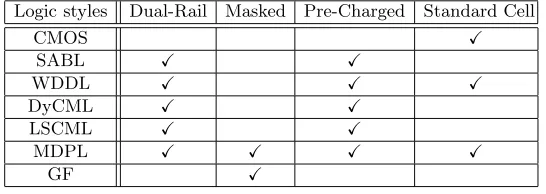
In this section, we briefly present the different logic styles we considered for our security investigations. Among the various proposals that have been proposed in the open literature (that could be similarly investigated), they were selected in order to obtain a representative panel of countermeasures acting at the gate level. Namely, we analyzed standard CMOS gates for reference, dual-rail pre-charged logic styles and masked logic styles. We also selected countermeasures requiring full custom designvs.countermeasures that can be implemented using CMOS standard cell libraries. These features are summarized in Table 1.
– Sense Amplifier Based Logic (SABL):is a full custom logic style pro-posed in [21]. SABL uses dual-rails and pre-charges with an internal structure allowing the full discharge of all the internal capacitances.
– Wave Dynamic Differential Logic (WDDL): is a dual-rail pre-charge like logic style based on standard cell libraries [22]. It uses a combination of complementary logic gates in order to balance the activity in the circuit. – Dynamic Current Mode Logic (DyCML):is a dual-rail pre-charge logic
style using current mode behavior. It was originally proposed in [2] and the first investigations of its security features have been proposed in [15]. – Low-Swing Current Mode Logic (LSCML): is a dual-rail pre-charge
logic style presented in [11] using current mode logic behavior as DyCML. In LSCML, the value of the swing is independent of the value of the load capacitances and of the size of a particular transistor.
– Gammel-Fischer Logic (GF): relates to the work presented in [9], in which the authors formalize the problem of information leakage due to glitches for masked logic and propose a combination of operations that do not reveal information about the data handled, even in the presence of glitches.
Logic styles Dual-Rail Masked Pre-Charged Standard Cell
CMOS X
SABL X X
WDDL X X X
DyCML X X
LSCML X X
MDPL X X X X
GF X
Table 1.Summary of logic styles.
3
Evaluation criteria & methodology
3.1 Old proposals and limitations
Since the first logic styles were proposed in order to improve the security against side-channel attacks, several evaluation criteria have been introduced to quantify their effectiveness. The aim of this section is to detail some of the most frequently used criteria and to point out their limitations.
Among the first ones, the Normalized Energy Deviation (NED) and Normal-ized Standard Deviation (NSD) were introduced in [21] and used in a number of works. They both categorize the quality of a logic style according to the vari-ance of the power consumption over different keys. The main limitation of this approach is that it does not allow a fair comparison of masked and dual-rail logic styles. Dual rails typically reduce the variances while masking does not. NED and NSD are therefore heuristic metrics rather than sound criteria. An im-provement of the variance-only approach is to consider a particular side-channel adversary and see how good it behaves against various logic styles. For example, [17] suggested comparing the difference-of-mean-energies of different logic styles which directly relates to Kocher’s DPA [13]. Tiri and Verbauwhede similarly used a correlation attack [25]. The limitation is then that the security evalu-ation relates to one particular adversary. In theory, it would be interesting to discriminate the logic styles, independently of a particular attack.
adversary that is usually assumed to be the strongest one for side-channel at-tacks, if a perfect noise model is available to the adversary [5]. Since the mu-tual information measures the extent to which the side-channel information al-lows discriminating different keys, it is a particularly convenient method for the evaluation of different countermeasures. In the following, we will consequently compute this information for various logic styles. In addition, and contrary to previous approaches for the evaluation of side-channel countermeasures, we will evaluate the information available with respect to the amount of noise in the side-channel measurements in order to determine the noise thresholds for which a given countermeasure becomes a better (or worse) solution than another one.
3.2 Information theoretic approach
In this section, we define the mutual information as it will be used to evaluate different side-channel resistant logic styles. For this purpose, we define S as a variable denoting the target signal (e.g. typically, a part of a secret key) in a side-channel attack andsas a realization of this variable. LetLq be a random vector containing the side-channel observations generated withq queries to the target cryptographic implementation and lq be a realization of this random vector. In practice, we have:lq = [l1, l2, . . . , lq], where eachli is the side-channel trace cor-responding to one given query. Let finally Pr[s|lq] be the conditional probability of a key classsgiven a leakagelq. We evaluate the amount of information in the side-channel leakages with the conditional entropy:
H[S|Lq] =E
s lEq|s −log2Pr[S=s|Lq =lq] From which we derive the mutual information:
I(S;Lq) = H[S]−H[S|Lq],
where H[S] = Es−log2Pr[S =s] is the entropy of the key classS before any
side-channel attack has been applied. In the following, we typically investigate the security of 2-input or 3-input logic gates for which H[S] = 2 or H[S] = 3.
In order to include the various types of noise that affect the side-channel leakages in our analysis, we assumed that the overall effect of all the noise sources in an attack can be modelled by a Gaussian distribution. That is, we considered leakages of the form:lq =dq+ nq, wheredq is the leakage deterministic part (typically provided by the simulations in the next sections) andnq is a random noise following a normal distribution with varianceσn2. These definitions can be straightforwardly applied to our different logic styles as follows.
Pre-charged/not masked logic styles: SABL, WDDL, DyCML, LSCML. This is the easiest situation since there is one single leakage trace per secrets:
H[S|Lq] =− X
s Pr[s]
Z
where Pr[s|lq] = Pr[lq| s]·Pr[s]
P
s∗Pr[lq|s∗]·Pr[s∗] =
Pr[lq|s]
P
s∗Pr[lq|s∗]. Note that due to the particular
structure of our leakages, i.e. lq = dq + nq, the integral over the leakages is equivalent to an integral over the noise values.
Not pre-charged/not masked logic styles: CMOS. The situation is now slightly more complex. Since there is no systematic pre-charge, each secret s
can give rise to different leakage traces, corresponding to the different input transitions. If we denote the possible input transitions by a variable T and a particular transition byt, we find:
H[S|Lq] =−X s
Pr[s]X t
Pr[t] Z
Pr[lq|s, t]·log2Pr[s|lq]dl,
where Pr[s|lq] = Pr[lq| s]
P
s∗Pr[lq|s∗]. Since the input transitions t are known by the
adversary, the probability Pr[lq|s] can be directly computed as Pr[lq|s, t].
Pre-charged/masked logic styles (MDPL). The situation is similar to the previous ones: one single secretscan again give rise to different leakage traces, corresponding to the different mask valuesm. It yields:
H[S|Lq] =− X
s
Pr[s]X m
Pr[m] Z
Pr[lq|s, m]·log2Pr[s|lq]dl,
where Pr[s|lq] = Pr[lq| s]
P
s∗Pr[lq|s∗]. However, contrary to the case of known input
transitions, the mask values arenotknown by the adversary. Therefore, we have to compute Pr[lq|s] =PmPr[lq|s, m]·Pr[m].
Not pre-charged/masked logic styles (GF). This context finally combines a non pre-charged type of gate with known input transitions and unknown masks:
H[S|Lq] =− X
s
Pr[s]X t
Pr[t]X m
Pr[m] Z
Pr[lq|s, t, m]·log2Pr[s|lq]dl,
where Pr[s|lq] =
Pr[lq|s]
P
s∗Pr[lq|s∗],
and Pr[lq|s] = Pr[lq|s, t] =PmPr[lq|s, t, m]·Pr[m].
Mutual information vs. security metric. Before moving to the practical aspects of our analysis, let us finally mention that this paper only considers the information leaked by different logic styles. This is motivated by the fact that the mutual information allows comparing different implementations, independently of the adversary’s algorithmic details. Nevertheless, as will be underlined later in the paper, a security metric such as the adversary’s success rate would be required if the security of an implementation had to be measured in terms of,e.g.
3.3 Side-channel leakage source and simulation environment
As stated in the introduction, one purpose of the present work is to improve the simulation-based security evaluations of side-channel resistant logic styles by the use of good metrics. In order to do so, we investigated transistor level descriptions of different logic styles and extracted the necessary leakages from single gate simulations. Since this level of complexity allows relatively simple descriptions while still giving good insights on the behavior of the different pro-posed countermeasures, it was a good starting point for the application of our bottom-up security evaluations. The simulations were run on ELDO c [7], an electrical circuit simulator. We used a 0.13µmBulk CMOS process thoroughly described in the BSIM3 [4] notice. We simulated the current driven from the power supply during different events of the gates. According to the logic style, the actual part of the power consumption curve was either the one relative to the transition between two different inputs or the one relative to a transition be-tween the evaluation phase and the pre-charge phase. Simulations were run with a 1.2 V power supply and using a time resolution of 10−4ns1. Single gates under
investigation were driven and loaded by gates in a similar logic style connected to another power node. Finally and as far as possible, our circuit configuration respects the descriptions given in the original papers describing the logic styles (e.g.in terms of matched output loads, input rise/fall or arrival time). For each countermeasure, the following functions were simulated, in order to represent a panel of the basic logic blocks needed to build a complete circuit:
- AN2: 2 inputs AND gate - AN3: 3 inputs AND gate - OR2: 2 inputs OR gate - OR3: 3 inputs OR gate
- EO2: 2 inputs XOR gate - MAJ: majority gateZ = (B+C)A+BC
We note that, as also mentioned in the introduction, considering lower abstrac-tion levels (and possibly real measurements) would increase the quality of our analysis. For example, the power consumption behavior of a complex circuit (rather than simple gates) and/or the use of conditions that do not respect the description made in the original papers could be considered. This was done in several papers like in [20], where the influence of unmatched output loads and input arrival time was detailed on WDDL and MDPL. Refinements of the simulation models could be similarly developed, including the study of the inter-connect, diffusion, routing and/or cross-talk capacitances, as proposed in [25]. Finally, for dynamic and differential logic styles, the influence of transition be-tween data states should also be analyzed as some history effect can be the source of additional information leakages. Importantly, the evaluation method-ology described in this paper could be similarly applied atall abstraction levels (e.g.post place-and-route or physical), by just changing the leakage source. This is the main advantage of our proposal compared to previous ad hoc approaches for such evaluations. As already mentioned, simulated gate-level evaluations are only aimed to be the first step in the complete analysis of a logic style.
1
3.4 Information extraction: template attacks in principal subspaces
Assuming that our evaluations are provided with simulation-based leakage traces lq, a practical question remains to properly evaluate the probability distributions Pr[Lq|S] necessary to compute the mutual information. Due to the large dimen-sionality of the leakage traces, a number of heuristics have been proposed in the open literature in order to reduce the number of leakage samples to tractable values. In this paper, we consider the Principal Component Analysis (PCA) described in [3], of which we now recall the necessary background. For more details, we refer to the original paper. PCA is a standard statistical tool for di-mensionality reduction. It looks for a linear transformationRthat projects high dimensional data into a low-dimensional subspace while preserving the data vari-ance. PCA usually works in two steps. First, it rotates the original axes in such a way that the new coordinate system indicates the successive directions in which the data have maximal variance. Second, it only retains theD most important directions in order to reduce the dimensionality. Note that for practical reasons, a maximum of (|S| −1) directions can be efficiently computed, where|S|is the number of key classes targeted in the side-channel attack.
Let us assume single query leakage tracesli withN samples, obtained from our simulation environment. In the following and for each logic style/gate inves-tigated, we first compute theN ×(|S| −1) PCA linear transformRthat maps the high-dimensional tracesli to (|S| −1)-dimension vectors ˜li = T(li). Then, we keep theD highest dimensions of the transformed leakage traces. Note that if each sample of the original trace is affected by an independent Gaussian noise with varianceσ2n, then each principal direction also is. Consequently, in practice,
the main parameters in our security evaluations are:
1. The number of dimensionsD kept in the transformed leakages2. 2. The noise varianceσ2n in the leakage samples.
We note that all our following results are meaningful to the extent that the PCA properly extracts and compresses the information from the original leak-age traces. On the one hand, this was verified in [3] for practical measurements. On the other hand, the proposed PCA optimizes the inter-classes variance with-out considering the intra-classes variances. As a consequence, other statistical tools could possibly improve the quality of our conclusions. Again and most im-portantly, the methodology would be exactly the same (only the evaluation of the probabilities Pr[lq|s] would have to be changed). But using the PCA already allows improving the previous (e.g. variance-based) evaluation criteria. Other-wise said, we require the main hypothesis of [18] to hold to a sufficient degree and expect that the leakage probability distributions approximated with the PCA provide a reasonable approximation of the actual ones.
2
4
Single gates evaluation results
In this section, we first provide the average and standard deviation of the currents supplied to our logic gates, as preliminary results of our simulations. Then, we selected a number of illustrations of our systematic analysis in order to put forward meaningful intuitions on different logic styles and gates.
4.1 Preliminary results
The average and standard deviation of the currents flowing from the power supply node (for the parts of the leakage traces that were used in our analysis) are given in Tables 2 and 3. We first mention that these currents in individual gates barely give an image of the power consumption for complex circuits. For example, DyCML and LSCML have to generate a completion signal to indicate to the next gate stage of the circuit that the inputs are stable and ready. The current generated by this completion signal generation is included in our simulations. By contrast, the currents produced by the clocktree network required for other logic styles was not considered. In general, it is hard to extrapolate the behavior of a complex circuit from its component gates. This is true both in terms of average power consumption and security. Still, we can analyze logic styles at the gate level to put forward theoretical strengths/weaknesses in their design.
Table 2.Average power supply current [µA].
AN2 OR2 EO2 AN3 OR3 MAJ
CMOS 1.1964 5.7654 6.5587 0.1744 6.5332 2.8254
WDDL 9.6736 9.6736 26.6118 12.5295 12.5295 17.5892 MDPL 17.5892 17.5892 52.6239 35.7938 35.7938 70.4666 DyCML 11.9831 11.9831 11.8661 12.0787 12.0787 11.9373 LSCML 9.3266 9.3266 9.0547 9.3971 9.3971 9.0531
SABL 6.0025 6.0025 6.0033 6.4585 6.4585 7.3581
GF 31.0162 24.4751 5.8440 N.A. N.A. N.A.
Table 3.Power supply current standard deviation [µA].
AN2 OR2 EO2 AN3 OR3 MAJ
CMOS 4.1049 3.9061 5.7183 3.1113 2.9890 5.5226
WDDL 0.7933 0.7933 6.7263 1.5183 1.5183 1.1398
MDPL 1.2311 1.2311 1.1257 1.6451 1.6451 2.4790
DyCML 0.1222 0.1222 8.30 10−14 0.1525 0.1525 0.1928
LSCML 0.1271 0.1271 6.56 10−10 0.1713 0.1713 0.2061
SABL 9.64 10−4 9.64 10−4 0 2.68 10−2 2.68 10−2 1.97 10−3
GF 21.9866 17.7882 5.0805 N.A. N.A. N.A.
on the number of gate inputs, mask bits, use of a pre-charge, . . . ). Additionally, the existence of non-consuming events (see below) artificially increases the leak-age variances. More generally, and as already stated, variance-based criteria are not sufficient for the fair evaluation of side-channel attacks.
4.2 Analysis Results
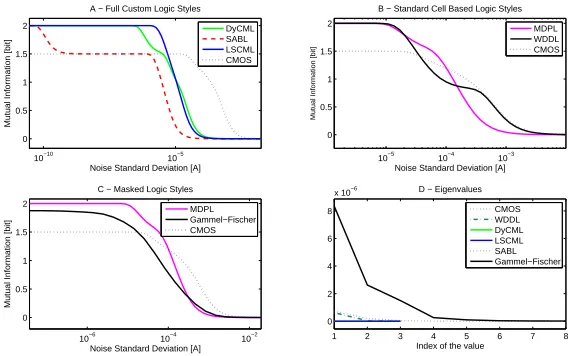
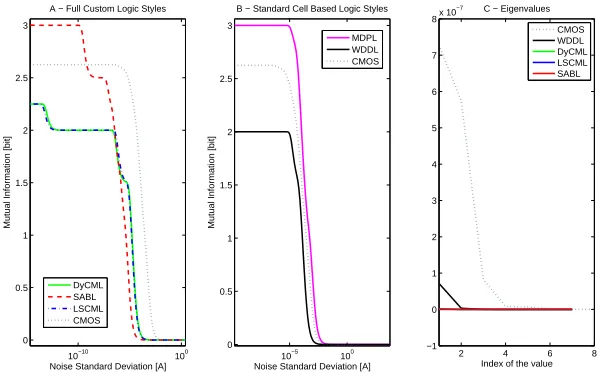
Figures 2, 4, 5 and 6 (the last ones in Appendix) illustrate the amount of in-formation in the side-channel leakagesvs.the noise standard deviation, respec-tively for the AN2, EO2, OR3 and MAJ logic functions. We limited ourselves to these gates since the shapes of the information curves are similar for the couples (AN2-OR2), (AN3-OR3) in all the logic styles (besides CMOS). Indeed, the gate structures are identical (for SABL, DyCML, LSCML and Gammel-Fischer), or use complementary gates (for WDDL and MDPL) and thus generate the same current curves. In the remainder of the section, we pointed out a number of interesting (and intuitive) facts that can be observed from the different figures.
1. Existence of close and undistinguishable leakages. Undistinguishable leakages typically cause initial values for the information curves below the the-oretical expectations. As a typical example, the CMOS AN2 and EO2 gates do not have an initial mutual information of 2 bits. This is caused by the exis-tence of events with identical leakages, namely, the 0 →0, 1 →1, 2 →2 and 3 → 3 input transitions. The same phenomenon occurs for the GF gates, the SABL EO2 gate and for DyCML and LSCML EO2 and MAJ gates. In these examples, certain different inputs lead to identical simulated leakages. Similarly, certain inputs give rise to close leakages. As a result, an increase in the noise level may cause certain inputs to become undistinguishable, which is observed in the figures with the stepped shape of certain information curves.
10−10 10−5 0 0.5 1 1.5 2
A − Full Custom Logic Styles
Noise Standard Deviation [A]
Mutual Information [bit]
DyCML SABL LSCML CMOS
10−5 10−4 10−3 0
0.5 1 1.5 2
B − Standard Cell Based Logic Styles
Noise Standard Deviation [A]
Mutual Information [bit]
MDPL WDDL CMOS 10−6 10−4 10−2 0 0.5 1 1.5 2
C − Masked Logic Styles
Noise Standard Deviation [A]
Mutual Information [bit]
MDPL Gammel−Fischer CMOS
1 2 3 4 5 6 7 8
0 2 4 6 8
x 10−6 D − Eigenvalues
Index of the value CMOS WDDL DyCML LSCML SABL Gammel−Fischer
Fig. 2.Information extraction results for the AN2 gate.
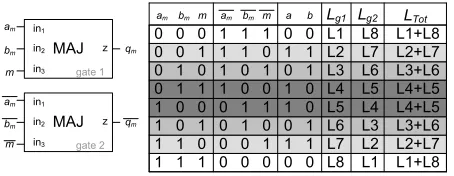
3. Number of masking bits. Our analysis also allows putting forward the different behaviors of masked logic styles, depending on the number of mask bits used in their implementation. Informally, the presence of mask bit(s) in a circuit ideally generates confusion since the same input value to the gates can leak different shapes of power curves depending on the mask values. The more mask bits are used, the more confusion can be expected. For example, MDPL uses a single mask bit to protect the AN2 gate while GF uses two ones. As a result, we could theoretically expect a better resistance of the GF logic style. In fact, looking carefully at the MDPL gates additionally suggests that at this
abstraction level, the mask does not actually improve the confusion at all.
The cause of this phenomenon is illustrated in figure 3. In this figure,am, bm,
am, bmrepresent the masked inputs and their complementary values,mand m the mask value and its complementary,a andb the unmasked values. Let LG1
andLG2stand for the power consumption events relative to the inputs occurring
1 1 1 0 0 0 0 0 L8 L1 L1+L8 1 1 0 0 0 1 1 1 L7 L2 L2+L7 1 0 1 0 1 0 0 1 L6 L3 L3+L6 1 0 0 0 1 1 1 0 L5 L4 L4+L5 0 1 1 1 0 0 1 0 L4 L5 L4+L5 0 1 0 1 0 1 0 1 L3 L6 L3+L6 0 0 1 1 1 0 1 1 L2 L7 L2+L7 0 0 0 1 1 1 0 0 L1 L8 L1+L8 MAJ
in1 in2 in3
z
gate 1
MAJ
in1 in2 in3
z
gate 2
bm
bm
am
am
m
m
qm
qm
am bm m am bm m a b Lg1 Lg2 LTot
Fig. 3.MDPL gate structure for the AN2 function and corresponding event table.
simulation curves: they have access to a perfect leakage model which may not be the case in practice. Additionally, when low noise variances are considered, the simulations allow discriminating most events, which makes the masking a relatively inefficient method, from a theoretical point of view.
4. Differences between logic gates and size dependencies. These are simple statements. First, the inner structure of certain logic gates (e.g. EO2) makes them inherently easier to protect against side-channel attacks, because of a better balanced internal structure. Second, one can observe that our con-clusions do not significantly differ when we increase the gate sizes (e.g. AN2
vs.OR3). On the other hand, moving towards higher circuit complexities is ex-pected to illustrate other facts about the logic styles, as detailed in Section 3.3.
Interpretation of the results. The information plots in this section allow
com-paring different logic styles in function of the noise level in the observations. For example, Figure 2.B shows that beyond a certain noise threshold, MDPL becomes a better countermeasure than WDDL at the gate level (i.e.it provides less information to the adversary). But information plotsdo not tell how much better a countermeasure is in terms of, e.g. number of measurements required to perform a successful attack. For these purposes, a security metric such as the adversary’s success rate needs to be computed. As detailed in [18], there is no straightforward way to turn the information theoretic metric into a security metric: they quantify different aspects of a side-channel attack. Otherwise said, since the present paper aims to compare different logic styles, the information theoretic evaluation is sufficient. But the security of these logic styles against any given adversary could be similarly investigated, as in [19].
Importantly, these experiments confirm the limitations of the variance-based (and other ad hoc) evaluations of logic styles. In particular, our different figures show that the respective effectiveness of different countermeasures depends on the amount of noise in the observations and therefore cannot be properly ex-plained from simple tables as in Section 4.1. By contrast, it is expected that our information theoretic approach allows analyzing any countermeasure in a unified evaluation methodology. For example, both masked and dual-rail logic styles can be fairly compared thanks to the information theoretic metric3, although they
have opposite impacts on the leakage variances.
3
5
Conclusions and open problems
This paper describes an information theoretic evaluation methodology to ana-lyze the effectiveness of side-channel resistant logic styles. It allowed us to put forward a number of meaningful observations about recently proposed counter-measures against such physical attacks. Among the advantages of the proposed approach is the possibility to apply the same metrics and methodology at all
design stages of a cryptographic device. We considered gate-level simulations as a first step in such evaluations. A practically interesting scope for further re-search is therefore to extend our analysis to more complex simulation models and to actual measurements. Moving from theory to practice will allow exhibiting additional strengths and weaknesses of the various logic styles and is therefore necessary for their better evaluation and understanding.
Our results exhibit (once again) that no perfect logic style exists to prevent side-channel leakages. They also show that different categories of solutions (e.g. full custom vs. standard cells) allow reaching different security levels. From a practical point of view, this security has to be traded with the implementation cost of the countermeasures. A central objective of this paper is therefore to allow a good evaluation of this securityvs. efficiency tradeoff, with fair metrics. We finally suggest the development of a full custom logic style, combining dual-rails, pre-charges and masking as an interesting research direction.
Acknowledgements: The authors would like to thank anonymous CHES re-viewers for their interesting comments. Since we could hardly address all of them in the present paper, we refer to [26] for further details on this line of research.
References
1. D. Agrawal, B. Archambeault, J. Rao, P. Rohatgi,The EM Side-Channel(s), in
the proceedings of CHES 2002, Lecture Notes in Computer Science, vol 2523, pp 29-45, Redwood City, California, USA, August 2002.
2. M.W. Allam and M.I. Elmasry,Dynamic Current Mode Logic (DyCML): A New
Low-Power High-Performances Logic Styles, IEEE Journal of Solid State Circuits, vol 36, num 3, pp 550-558, March 2001.
3. C. Archambeau, E. Peeters, F.-X. Standaert, J.-J. Quisquater,Template Attacks
in Principal Subspaces, in the proceedings of CHES 2006, Lecture Notes in Com-puter Science, vol 4249, pp. 1–14, Yokohama, Japan, October 2006.
4. Berkley MOSFET Simulation Model, Device Research Group, Department of of Electrical Engineering and Computer Science, University of California, Berkeley, http://www-device.eecs.berkeley.edu/ bsim3/
5. S. Chari, J. Rao, P. Rohatgi,Template Attacks, in the proceedings of CHES 2002,
Lecture Notes in Computer Science, vol 2523, pp 13-28, CA, USA, August 2002.
6. ECRYPT Network of Excellence in Cryptology,The Side-Channel Cryptanalysis
Lounge, http://www.crypto.ruhr-uni-bochum.de/en sclounge.html. 7. http://www.mentor.com/products/eldo
8. J.A. Fournier, S. Moore, H. Li, R.D. Mullins, G.S. Taylor, Security Evaluation
9. W. Fischer, B. M. Gammel, Masking at the Gate Level in The Presence of Glitches, in the proceedings of CHES 2005, Lecture Notes in Computer Science, vol 3659, pp 187-200, Edinburgh, Scotland, August 2005.
10. S. Guilley, P. Hoogvorst, Y. Mathieu, R. Pacalet, The Backend Duplication
Method: A Leakage-Proof Place-and-Route Strategy for ASICs, in the proceed-ings of CHES 2005, LNCS, vol 3659, pp 383-397, Edinburgh, UK, Sept. 2005.
11. I. Hassoune, F. Mac´e, D. Flandre, J.-D. Legat, Low-swing current mode logic
(LSCML): a new logic style for secure smart cards against power analysis attacks, in Microelectronics Journal, vol 37, num 9, pp 997-1006, Elsevier, September 2006.
12. P. Kocher,Timing Attacks on Implementations of Diffie-Hellman, RSA, DSS and
Other Systems, in the proceedings of Crypto 1996, Lecture Notes in Computer Science, vol 1109, pp 104-113, Santa Barbara, California, USA, August 1996.
13. P. Kocher, J. Jaffe, B. Jun, Differential Power Analysis, in the proceedings of
Crypto 1999, LNCS, vol 1666, pp 398-412, Santa-Barbara, USA, August 1999.
14. H. Li, T. Markettos, S. Moore,Security Evaluation Against Electromagnetic
Anal-ysis at Design Time, in the proceedings of CHES 2005, Lecture Notes in Computer Science, vol 3659, pp 280-292, Edinburgh, Scotland, August 2005.
15. F. Mac´e, F.-X. Standaert, I. Hassoune, J.-D. Legat, J.-J. Quisquater,A Dynamic
Current Mode Logic to Counteract Power Analysis Attacks, in the Proceedings DCIS 2004, pp 186-191, Bordeaux France, November 2004.
16. S. Mangard, T. Popp, B. Gammel,Side-Channel Leakage of Masked CMOS Gates,
in the proceedings of CT-RSA 2005, Lecture Notes in Computer Science, vol 3376, pp 351-365, San Fransisco, USA, 2005.
17. T. Popp, S. Mangard,Masked Dual-Rail Pre-Charge Logic: DPA-Resistance
With-out RWith-outing Constraints, in the proceedings of CHES 2005, Lecture Notes in Computer Science, vol 3659, pp 172-186, Edinburgh, Scotland, August 2005.
18. F.-X. Standaert, T.G. Malkin, M. Yung, A Unified Framework for the
Analy-sis of Side-Channel Key Recovery Attacks, Cryptology ePrint Archive, Report 2006/139, 2006, http://eprint.iacr.org.
19. F.-X. Standaert, E. Peeters, C. Archambeau, J.-J. Quisquater,Towards Security
Limits in Side-Channel Attacks, in the proceedings of CHES 2006, Lecture Notes in Computer Science, vol 4249, pp. 30–45, Yokohama, Japan, October 2006.
20. D. Suzuki, M. Seaki, Security Evaluation of DPA Countermeasures Using
Dual-Rail Pre-Charge Logic Style, in the proceedings of CHES 2006, Lecture Notes in Computer Sciences, vol. 4249, pp 255-269, Yokohama, Japan, October 2006
21. K. Tiri, M. Akmal, I. Verbauwhede,Dynamic and Differential CMOS Logic with
Signal Independent Power Consumption to Withstand DPA on Smart Cards, in the proceedings of ESSCIRC 2002, pp 403-406, Florence, Italy, September 2002.
22. K. Tiri, I. Verbauwhede, A Logic Level Design Methodology for a Secure DPA
Resistant ASIC or FPGA Implementation, in the proceedings of DATE 04, vol 1, pp 10246 - 10251, Paris, France, February 2004.
23. K. Tiri, I. Verbauwhede,Place and Route for Secure Standard Cell Design, in the
proceedings of CARDIS 2004, pp 143-158, Kluwer, August 2004.
24. K. Tiri, I. Verbauwhede, Design Method for Constant Power Consumption of
Differential Logic Circuits, in the proceedings of DATE 2005, pp 628-633.
25. K. Tiri, I. Verbauwhede,Simulation Models for Side-Channel Information Leaks,
in the proceedings of DAC 05, pp 228-233, San Diego, CA, USA, June 2005.
26. UCL Crypto Group, Theoretical Models for Side-Channel Attacks home page,
A
Figures
10−15 10−10 10−5
0 0.5 1 1.5
A − Full Custom Logic Styles
Noise Standard Deviation [A]
Mutual Information [bit]
DyCML SABL LSCML CMOS
10−5 10−4 10−3 10−2
0 0.5 1 1.5 2
B − Standard Cell Based Logic Styles
Noise Standard Deviation [A]
Mutual Information [bit]
MDPL WDDL CMOS 10−10 10−5 0 0.5 1 1.5 2
C − Masked Logic Styles
Noise Standard Deviation [A]
Mutual Information [bit]
MDPL Gammel−Fischer CMOS
2 4 6 8 10 12
0 0.5 1 1.5
2x 10
−6 D − Eigenvalues
Index of the value CMOS WDDL DyCML LSCML SABL Gammel−Fischer
Fig. 4.Information extraction results for the XOR2 gate.
10−10 10−5 0 0.5 1 1.5 2 2.5 3
A − Full Custom Logic Styles
Noise Standard Deviation [A]
Mutual Information [bit]
DyCML SABL LSCML CMOS
10−5 100 0 0.5 1 1.5 2 2.5 3
B − Standard Cell Based Logic Styles
Noise Standard Deviation [A]
Mutual Information [bit]
MDPL WDDL CMOS
1 2 3 4 5 6
0 1 2 3 4 5
x 10−7 C − Eigenvalues
Index of the value CMOS WDDL DyCML LSCML SABL
10−10 100 0
0.5 1 1.5 2 2.5 3
A − Full Custom Logic Styles
Noise Standard Deviation [A]
Mutual Information [bit]
DyCML SABL LSCML CMOS
10−5 100 0
0.5 1 1.5 2 2.5 3
B − Standard Cell Based Logic Styles
Noise Standard Deviation [A]
Mutual Information [bit]
MDPL WDDL CMOS
2 4 6 8
−1 0 1 2 3 4 5 6 7 8x 10
−7 C − Eigenvalues
Index of the value CMOS WDDL DyCML LSCML SABL

![Table 3. Power supply current standard deviation [µA].](https://thumb-us.123doks.com/thumbv2/123dok_us/1863067.1242146/10.612.148.470.83.178/table-power-supply-current-standard-deviation-ua.webp)