Available Online atwww.ijcsmc.com
International Journal of Computer Science and Mobile Computing
A Monthly Journal of Computer Science and Information Technology
ISSN 2320–088X
IMPACT FACTOR: 5.258
IJCSMC, Vol. 5, Issue. 9, September 2016, pg.16 – 22
An Efficient Preprocessing Method to
Detect User Access Patterns from Weblogs
V.Pushpa
1
, V. Vidyapriya
2
1
Research Scholar, Quaid-E-Millath Govt College for women (Autonomous), Anna Salai, Chennai-02
2
Associate Professor, Quaid-E-Millath Govt College for women (Autonomous), Anna Salai, Chennai-02
1 [email protected], 2 [email protected]
Abstract ---The World Wide Web contains immense information, which is rapidly growing. It has the complex task to discover the exact data from web pages. Web mining technique is helpful for mining the information from the web pages, which is known as application techniques of data mining. It is used to determine the exotic patterns from the world wide web, in which there are three categories, namely web content, web structure and web usage mining. This paper concentrates on data preprocessing of web usage mining, which is performed to eliminate the inconsistence, irrelevant data and extract the interesting knowledge patterns from the weblogs, which assists to know about the user behaviour. The main objectives of this paper is to clean the server logs and acquiring the user session identification through a weblog explorer tool which are used to recognize the user activity and the pre-processed weblogs are used in the further stages of web usage mining.
Keywords--- web usage mining, data pre-processing, weblogs, data cleaning, user identification, session identification, web log explorer tool.
I. INTRODUCTION
II. WEB USAGE MINING
This paper discusses about web usage mining, which is the one of the phases of web mining. It primarily deals with the identifying of user behavioural patterns from web log files that is merely known as web log mining. Usually web usage mining has four methods such as Data collection, Data preprocessing, Pattern discovery, Pattern analysis.
A. Data Collection
The web usage mining uses the primary data source that holds the browser behaviour of user log data, which is gathered from different data sources like web server, client server and proxy server etc.
B. Data Preprocessing
Data preprocessing is the primary stage of web usage mining, which is used to remove the noisy, irrelevant, and inconsistent data from web logs. The data preprocessing techniques are data cleaning, user identification, session identification and path completion [1] [3].
C. Pattern Discovery
Pattern discovery is the major key component of web usage mining, which is used to detect the stimulating patterns or knowledge of the web user behaviour from the preprocessed weblogs. Pattern discovery uses different kinds of machine learning techniques such as association, sequential pattern, clustering, classification and so on. [2]
D. Pattern Analysis
Pattern analysis is the finishing phase of web usage mining, which is used to eradicate the uninteresting patterns and extract the useful patterns from the mined information of pattern discovery phase. The pattern analysis has some common methods of query mechanism such as SQL (structured Query Language) and OLAP operation [2].
III. WEB LOG FILES
A web log is the main source to be used in the web usage mining process. When the user requests the particular web page on any website that entry will be created as a record on the server automatically, which is maintaining a history of user browser behaviour [3]. Typically, the web log contains some fields such as IP address, date & time, request method, status, bytes, referrer, user agent etc.
A. Different Data Sources
Web logs are collected from different data sources like web server, proxy server, and client server.
1) Web server logs:
The log files are mostly collected from web server, which is containing the user log records. Server log maintains the relationship between the web server and the users. Generally, a server log file has four types, namely access log, error log, referrer log and agent log [2] [3].
Access logs : access log files stores all incoming requests of the user access Error log: error log is used to store all the failed http error files
Referrer logs: the referrer logs maintain the records, how the user has linked to each site and each page.
Agent logs: it indicates information about browser, operating system that is used by the user.
2)Proxy server logs:
The proxy server log files are stored in the proxy server, which is used to handle the user request page when the main server is unable to respond to the user access [4].
3)Client server logs:
The client server log is also called as browser log, which consist of client browser itself. Client server logs helps to handle the web page caching and session reconstruction problems with the use of HTTP cookies [4].
B. Web Log File Format
There are different types of weblog format available in the various web servers such as
NCSA common format – this is regularizes text file format used by the server, which format is fixed ASCII text so the user unable to customize it.
IIS log format- this is also having a fixed ASCII text format. But it contains more information than the NCSA log format.
These three are common web log file format on the web server [1][3].
IV. DATA PREPROCESSING
The weblogs usually contains the adequate information about the click stream data of user requests it may be incomplete, noisy and unstructured data. Data preprocessing is the one of the phases of web usage mining, which is used to remove the inconsistent, irrelevant and redundant data. The main intention of data preprocessing is to transform raw logs into the cleaned logs that can be given for further processing of web usage mining [5] [6].
Fig 1. Data preprocessing steps
The data preprocessing has some techniques such as data cleaning, user identification, session identification and path completion, which can be used to clean the weblogs effectively. The above figure shows steps of data preprocessing.
A. Data Cleaning
Data cleaning is the essential step of data preprocessing which is used to remove the unwanted information from the web logs. The log files obtain very large data and it takes 80% process work in the data cleaning step, then only the further processes of pattern discovery are performed effectively. During data cleaning, we have to remove the irrelevant information, which is followed below:
Remove Image File: The log file entries contain different extension format. But we need only relevant extension data other than the extension files of image file, graphics or multimedia and style sheet pages will be eliminated which is with the extension .gif, .jpg, .jpeg, .css to be removed from log files [8].
Remove Failed Status Code: The log entries with failed status code which is to be removed from the weblogs. There are different failed status codes available it may be like this,
400 - Invalid request page 403 - Forbidden page 404 - Page not found
Data cleaning
User identification
Session identification
Path completion Raw logs
206 - Partial content 304 –Not modified 412 - Condition failed
These are the some of the failed status code, but we need only the log entries with success that is 200 status codes and rest of others will be removed from the weblogs.
Remove Spider/ Robots Files: The weblogs also entries with automated search engine such as robots, spider and crawler files removed from web logs. The robot file extension with robots.txt that is has to be removed.
B. User Identification
After the data cleaning process is over then the next step is user identification, which is used to identify which pages are accessed by whom. Each user obtains an individual IP address, which could be representing different user. The main task of user identification is to find the unique user to use of IP address, user agent and referrer URL. There are some following methods, which are used to identify the unique user [7].
If an IP address is new then it represents a new user.
If an IP address is same but agent logs (browser and operating system) are different then it represents distinguish user.
If an IP address and agent log is same then check browsing path using referrer log if it is a mismatch then it represents a one more user in same IP address.
C. Session Identification
Session identification is the one of the stages of data preprocessing which is used to identify the user session that is the sequence of web pages are accessed by a single user in the particular time. The default session time out is 30 minutes, but when the user requests for page, the user session is accessed until time out. In case of the same user, spend time more than 30 minutes on the same web page then the next session is started.
There are some condition which can be followed during session identification that are, If the IP address is new then the session is considered, has a new session. If the time exceeds 30 minutes, then the new session is started.
D. Path Completion
Path completion is the final step of preprocessing which are acquiring the entire path of the user access. The user page request is could not recorded in the log entries during the caching problems, POST method and during the use of “forward” or “back” button of a browser. If the user page request is not directly linked to the last page requested, then check the recent history, in case entries are not available in recent history then have to check the referrer URL in which the page request closest to the unknown page request that source is filled in this path and the pages is added to the user session.
V. TOOLS FOR PREPROCESSING
There are many log file analyser tools are available on the internet like log miner, deep log analyser, awstats, web log expert, logstash, log cruncher, weblizer and so on. But these types of tools provide only statistical analysis of log files and it is unable to perform the data preprocessing method of data cleaning. In this paper, use weblog explorer tool, which is used to analyse web server log and generate reports. It is the flexible system of filters, which give information about visitor who accessed the specific web page and this tool is used to remove the irrelative entries and generate useful log report. So the preprocessing steps of web usage mining will be done effectively.
VI. EXPERIMENTS AND RESULTS
Fig 2 . Raw web log files
This weblog contains below type of irrelative file extension, and error code such as Image files - .jpg, .jpeg, .png
Error code - 404, 206, 304, Other files - .js, .css,.log,
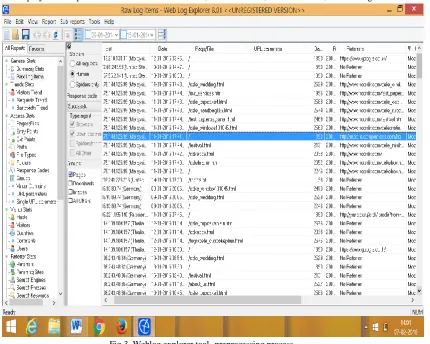
These unwanted log files will be eliminated from weblogs and only capture the useful files through web log explorer from which the required options will be chosen in the tool. The below figure shows that the log files which displays the respective fields such as IP address, date and time, status method, the user agent.
Fig 3. Weblog explorer tool- preprocessing process
human or spider. In those logs, only human request is needed and to select the success response code which displays as the 200 status code entries. There are totally 4193 log entries are recorded in the web log file from 995 spider logs are presented. After removing the spider from the weblog, the number of entries becomes 3198. Then remove error code files such as 404, 206, 304, which has 799 entries in log files. Then to remove the image files and other files, which have totalled 2145 entries, are recorded in the web log files. Finally, the web log is cleaned effectively now the log files have only 254 useful page file entries. This is the useful exact pattern detected from the data preprocessing step. The below table summarizes the number of weblogs entries in the cleaning process
Raw logs
After removing spider files
After removing error files
After removing image files
After removing other files
Cleaned logs
4193 3198 2399 1414 254 254
Table1. Entries of log file
This table shows that the number of entries after removing the irrelative files where the entries are shows in graphical representation in the below Fig 4.
Fig 4. Number of weblog entries
The below Fig 5 shows that the result of final preprocessed weblog that contains the total raw log entries has 4193 after data cleaning the weblogs become 254. In cleaned logs individual has a unique IP address, user agent, and URL to represent as a unique user.
Fig 5. Result of preprocessed weblogs
0 1000 2000 3000 4000 5000
Weblogs
Raw logs
Cleaned logs 0
500 1000 1500 2000 2500 3000 3500 4000 4500
WEBLOGS
VII. CONCLUSION
The World Wide Web is a vast collection of web document such as text, images, and multimedia data too, which is not an easy task to retrieve the exact data from the web. Web mining technique is one of the data mining techniques, which is used to mine the data from the web. This paper described the data preprocessing of web usage mining from which the weblogs are cleaned effectively using the web log explorer tool. This tool has the flexible system of filters, which gives information about visitors who accessed the specific web page. It is used to remove the irrelative entries and generate useful log report. Now these preprocessed weblogs can be used for further stages of pattern discovery and pattern analysis of web usage mining.
REFERENCES
[1]. Mugali, Chaitra L., AyeshaAzeema Maniyar, and Asst Prof Padma Dandannavar. "Pre-Processing and Analysis of Web Server Logs." (2014).
[2]. ERRITALI, Mohammed, and Hanane EZZIKOURI. "Pretreatment of web log files." Journal of Information Sciences and Computing Technologies 2.1 (2015): 108-121.
[3]. Chitraa, V., and A. Selvadoss Thanamani. "A novel technique for sessions identification in web usage mining preprocessing." International Journal of Computer Applications 34.9 (2011): 23-27.
[4]. Khosla, Mr Shivkumar, and Mrs Varunakshi Bhojane. "Capturing Web Log and Performing Preprocessing of the User’s Accessing Distance Education System." Int. J. Mod. Eng. Res.(IJMER) 2.5 (2012): 3128-3130. [5]. Sait, Abdul Rahaman Wahab, and Dr T. Meyappan. "Data Preprocessing and Transformation Technique to Generate Pattern from the Web Log." International conference on Computer Science and Information Systems (ICSIS’2014) Oct. 2014.
[6]. Chitraa, V., Dr Davamani, and Antony Selvdoss. "A survey on preprocessing methods for web usage data."
arXiv preprint arXiv:1004.1257 (2010).
[7]. Raiyani, Sheetal A. "Efficient Preprocessing technique using Web log mining." International Journal of Advancements in Research & Technology 1.6 (2012): 59-63.