Security on Prime Order Groups
Xiaoyi Li, Kaitai Liang, Zhen Liu, and Duncan S. Wong
Security and Data Sciences, Hong Kong Applied Science and Technology Research Institute, Hong Kong SAR, China School of Computing, Mathematics and Digital Technology, Manchester Metropolitan University, Manchester, U.K.
[email protected],[email protected],[email protected],[email protected]
Abstract. A Ciphertext-Policy Attribute-Based Encryption (CP-ABE) allows users to specify the access policies without having to know the identities of users. In this paper, we contribute by proposing an ABE scheme which enables revoking corrupted users. Given a key-like blackbox, our system can identify at least one of the users whose key must have been used to construct the blackbox and can revoke the key from the system. This paper extends the work of Liu and Wong to achieve traitor revocability. We construct an Augmented Revocable CP-ABE (AugR-CP-ABE) scheme, and describe its security by message-hiding and hiding games. Then we prove that an AugR-CP-ABE scheme with message-hiding and index-hiding properties can be transferred to a secure Revocable CP-ABE with fully collusion-resistant blackbox traceability. In the proof for index-hiding, we divide the adversary’s behaviors in two ways and build direct reductions that use adversary to solve the D3DH problem. Our scheme achieves the sub-linear overhead ofO(√N), where N is the number of users in the system. This scheme is highly expressive and can take any monotonic access structures as ciphertext policies.
Keywords: Traitor Tracing, Revocation, Ciphertext-policy Attribute Based Encryption, Prime Order Groups
1
Introduction
Attribute-Based Encryption (ABE) system is first introduced by Sahai and Waters [22], which is based on users’ roles and does not have to know their identities in the system. In an Attribute-Based Encryption (CP-ABE) system, each user possesses a set of attributes and a private key generated based on his/her attributes. The encrypting party will define anaccess policyover role-based/descriptiveattributes to encrypt a message without having to know the identities of the targeted receivers. As a result, only the user who owns the appropriate attributes which satisfy the access policy are able to decrypt the ciphertext. Intuitively, Alice, for example, is to encrypt a message under “(Development DepartmentAND(ManagerOREngineer))”, which is anaccess policy defined over descriptiveattributes, so that only those receivers who have their decryption keys associated with the attributes which satisfy this policy can decrypt it correctly.
Among the CP-ABE schemes recently proposed, [3,4,7,23,10,19,8,11,20], progress has been made with regard to the schemes’ security, access policy expressivity, and efficiency. While the schemes with practical security and expressivity (i.e. full security against adaptive adversaries in the standard model and high expressivity of supporting any monotone access structures) have been proposed in [10,19,11], the traceability of traitors which intentionally expose their decryption keys has been becoming an important concern related to the applicability of CP-ABE. Assume in a communication system, the sender wants to assure that only those users who have paid for the service can access the content. This concern can be solved by encrypting the content and only receivers who own the legitimate keys can decrypt the content correctly. If we build such a system with ABE, however, due to the nature of CP-ABE, the attributes (and the corresponding decryption privilege) are generallyshared by multiple users. As a result, a malicious user, with his attributes shared with multiple other users, might have an intention to leak the corresponding decryption key or some decryption privilege in the form of a decryption blackbox/device in which the decryption key is embedded, for example, for financial gain or for some other incentives, as he only has little risk of getting caught.
Ciphertext Private Key Public Key Pairing Computation On Prime Revocation Order of the
Size Size Size in Decryption Order Groups Groups
[13] 2l+ 17√N |S|+ 4 |U |+ 3 + 4√N 2|I|+ 10 × × p1p2p3
[16] 6l+ 3 + 46√N 6|S|+ 12 24|U |+ 22 + 14√N 6|I|+ 30 √ × p
this paper 6l+ 3 + 46√N 6|S|+ 9 + 3√N 24|U |+ 22 + 23√N 6|I|+ 30 √ √ p 1Letlbe the size of an access policy,|S|the size of the attribute set of a private key,|U |the size of the attribute universe,
and|I|the number of attributes in a decryption key that satisfies a ciphertext’s access policy. Table 1.Features and Efficiency Comparison
blackbox/device which keeps the embedded decrypt keys and algorithms hidden, Liu et al.[13] proved that the blackbox traceable CP-ABE scheme supports fully collusion-resistant blackbox traceable in the standard model, where fully collusion-resistant blackbox traceability means that the number of colluding users in constructing a decryption blackbox/device is not limited and can be arbitrary. This scheme is fully secure in the standard model and highly expressive (i.e. supporting any monotonic access structures).
It should be observed that a tracing system is not designed to protect the encrypted content. It is used to distinguish the compromised users from other legitimate users, which means the corrupted user/key is still remained in the system and an effective blackbox is likely to be produced with these corrupted keys in the wild market. The exposed compromised users need to leave or be removed from the system to avoid incurring more losses. When any of these happens, the corresponding user keys should be revoked. We added the revocability in the scheme so that we can remove the compromised keys as needed. We focus on achieving direct revocation in traceable CP-ABE system. In a direct revocation mechanism, it does not need any periodic key updates and it does not affect any non-revoked users either. A system-wide revocation list could be made public and revocation could be taken into effect promptly as the revocation list could be updated immediately once a key is revoked. Specifically, we generateQ0
i, which is a part of ciphertext, with a non-revoked index list ¯R. When decrypting,
we first recoverK¯i,j which has a common item hQj0∈R¯
ihj
0 with Q0i if they share a consistent revocation list
R. Then K¯i,j is used in the following decryption process. To avoid a further loss, the revocation list should
be updated timely once corrupted users are found. For the security proof for message-hiding, we re-construct the Semi-functional Keys by replacinghwithhhj, which can realize revocability, and adding the random item
¯
Ki,j,j0 accordingly. As a contrast, the random items for Semi-functional Ciphertexts remain the same, which is
irrelevant to the revocability. For the security proof for index-hiding, we have two ways for adversary to take and add more sub-cases inCase IIwhich make the security proof a non-trivial work. In this paper, We continue our work on prime order groups as an extension for [16].
1.1 Our results
It has been shown (e.g. in [6,9]) that the constructions on composite order groups will result in significant loss of efficiency and the security will rely on some non-standard assumptions (e.g. the Subgroup Decision Assumptions) and an additional assumption that the group order is hard to factor. The previous work in [16] achieves better security than the scheme in [13], which is constructed on composite order groups. In this paper, we add the revocability in [16] and prove it highly expressive and fully secure in the standard model. On the efficiency aspect, this new scheme achieves the same efficient level as in [16], i.e. the overhead for the fully collusion-resistant blackbox traceability is inO(√N), whereN is the number of users in a system.
Table 1 compares this new scheme with the previous work on blackbox traceable CP-ABE [13] and the traceable CP-ABE on prime order group but without revocability [16]. We only change the size of keypair as we need add revocation items in the key. Both the ciphertext and the pairing computation in decryption are kept unchanged. This implies both this new scheme and [16] have better security than the scheme in [13], although all of them are fully secure in the standard model and have overhead inO(√N).
by any decryption key which is in the revocation list even though the associated attribute set of the key satisfies the ciphertext policy. For ABE scheme, in [13] Liu et al. defined a ‘functional’ CP-ABE that has the same functionality as the conventional ABE (i.e. having all the appealing properties of the conventional CP-ABE), except that each user is assigned and identified by a unique index, which will enable the traceability of traitors. Liu et al. also defined the security and the fully collusion-resistant blackbox traceability for such a ‘functional’ CP-ABE. Furthermore, Liu et al. defined a new primitive called Augmented CP-ABE (AugCP-ABE) and formalized its security using message-hiding and index-hiding games. Then Liu et al. proved that an AugCP-ABE scheme with message-hiding and index-hiding properties can be directly transferred to a secure CP-ABE with fully collusion-resistant blackbox traceability. With such a framework, Liu et al. obtained a fully secure and fully collusion-resistant blackbox traceable CP-ABE scheme by constructing an AugCP-ABE scheme with message-hiding and index-hiding properties. In [16], Liu et al. obtain a prime order construction and it will be tempting to bring the revocation into [16] as a practical enhancement and implementation. In this paper, we leverage the revocation idea from [15].
Outline.In this paper, we follow the same framework in [16]. In particular, in Section 2, we propose a definition for CP-ABE supporting key-like blackbox traceability and direct revocation. the definition is ‘functional’, namely each decryption key is uniquely indexed byk∈ {1, . . . , N}and given a key-like decryption blackbox, the tracing algorithm Trace can return the index k of a decryption key which has been used for building the decryption blackbox. In our direct revocation definition, theEncrypt algorithm takes a revocation listR⊆ {1, . . . , N} as an additional input so that a message encrypted under the (revocation list, access policy) pair (R,A) would only allow users whose (index, attribute set) pair (k, S) satisfies (k∈[N]\R)AND(SsatisfiesA) to decrypt. In Section 3, we revisit the definitions and security models of Augmented Revocable CP-ABE (AugR-CP-ABE for short) from [15]. We refer to the ‘functional’ CP-ABE in Section 2 as Revocable CP-ABE (R-CP-ABE for short), then extend the R-CP-ABE to AugR-CP-ABE, which will lastly be transformed to a key-like blackboxtraceable R-CP-ABE. More specifically, we define the encryption algorithm of AugR-CP-ABE asEncryptA(PP, M, R,A,k)¯ which takes one more parameter ¯k ∈ {1, . . . , N + 1} than the original one in R-CP-ABE. This also changes the decryption criteria in AugR-CP-ABE in such a way that an encrypted message can be recovered using a decryption key SKk,S, which is identified by index k ∈ {1, . . . , N} and associated with an attribute set S,
only if (k∈[N]\R)∧(S satisfies A)∧(k≥¯k). In Section 4 we propose our AugR-CP-ABE construction on prime order groups and prove that our AugR-CP-ABE construction is message-hiding and index-hiding in the standard model. As a result, we obtain a fully secure and fully collusion-resistant blackbox traceable R-CP-ABE scheme on prime order groups.
To construct the AugR-CP-ABE, we continue our work in [16] and leverage the revocation idea from [15]. In particular, besides achieving the important features for practicality, such as revocation, high expressivity and efficiency, the construction is proved secure and traceable in the standard model.
2
Revocable CP-ABE and Blackbox Traceability
We follow the definition in [15]. Given a positive integern, our Revocable Ciphertext-Policy Attribute-Based Encryption (R-CP-ABE) system consists of four algorithms:
Setup(λ,U, N) → (PP,MSK). The algorithm takes as input a security parameter λ, the attribute universe U, and the number of users N in the system, then runs in polynomial time in λ, and outputs the public parameterPPand a master secret keyMSK.
KeyGen(PP,MSK, S)→SKk,S. The algorithm takes as input the public parameterPP, the master secret key
MSK, and an attribute setS, and outputs a private decryption key SKk,S, which is assigned and identified
by a unique indexk∈[N].
Encrypt(PP, M, R,A) → CTR,A. The algorithm takes as input the public parameter PP, a message M, a revocation list R ⊆[N], and an access policy A over U, and outputs a ciphertext CTR,A such that only users whose indices are not revoked by R and attributes satisfyA can recoverM. R and Aare implicitly included inCTR,A.
Decrypt(PP, CTR,A,SKk,S) → M or ⊥. The algorithm takes as input the public parameter PP, a ciphertext
Correctness.For any attribute setS⊆ U, indexk∈[N], revocation listR⊆[N], access policyAoverU, and messageM, suppose (PP,MSK)←Setup(λ,U, N),SKk,S ←KeyGen(PP,MSK, S),CTR,A←Encrypt(PP, M, R,A). If (k∈[N]\R)∧(S satisfiesA), thenDecrypt(PP, CTR,A,SKk,S) =M.
Security. Now we define the security of a R-CP-ABE system using amessage-hiding game. GameMH. TheMessage-hiding game is defined between a challenger and an adversaryAas follows:
Setup.The challenger runsSetup(λ,U, N) and gives the public parameterPPtoA.
Phase 1. For i = 1 to Q1, A adaptively submits (index, attribute set) pair (ki, Ski), and the challenger
responds withSKki,Ski.
Challenge.Asubmits two equal-length messagesM0, M1and a (revocation list, access policy) pair (R∗,A∗). The challenger flips a random coinb∈ {0,1}, and sendsCTR∗,
A∗←Encrypt(PP, Mb, R∗,A∗) toA. Phase 2.Fori=Q1+1 toQ,Aadaptively submits (ki, Ski), and the challenger responds withSKki,Ski.
Guess.Aoutputs a guessb0 ∈ {0,1}forb.
A wins the game if b0 = b under the restriction that none of the queried {(kt, Skt)}
Q
i=1 can satisfy (kt ∈
[N]\R∗)AND(Skt satisfiesA
∗). The advantage ofAis defined asMHA
AdvA=|Pr[b0=b]−12|.
Definition 1. AnN-user R-CP-ABE system is secure if for all polynomial-time adversariesA the advantage MHAdvA is negligible inλ.
Themessage-hiding gameis a typical semantic security game and is based on that for conventional CP-ABE [10,11], where the revocation list R is always empty. It is clear that such a CP-ABE system [10,11] has the following properties: fully collusion-resistant security, meaning that several users should not be able to decrypt a message that none of them are individually granted to access, fine-grained access control on encrypted data, and efficient one-to-many encryption.
It is worth noticing that, as pointed in [13], in the definition of the game: (1) the adversary is allowed to specify the index of the private key when it makes key queries for the attribute sets of its choice, i.e., fort= 1 to Q, the adversary submits (index, attribute set) pair (kt, Skt) to query a private key for attribute set Skt,
whereQ≤N,kt∈[N], andkt6=kt0 ∀1≤t6=t0≤Q(this is to guarantee that each user/key can be uniquely
identified by an index); and (2) forkt6=kt0 we do not requireSk
t 6=Skt0, i.e., different users/keys may have the
same attribute set. We remark that these two points apply to the rest of the paper.
2.1 Blackbox Traceability
Now we define the traceability against key-like decryption blackbox. A key-like decryption blackboxDcan be viewed as a probabilistic circuit that takes as input a ciphertextCTR,A and outputs a message M or ⊥, and such a decryption blackbox does not need to be perfect, namely, we only require it to be able to decrypt with non-negligible success probability. In particular, a key-like decryption blackboxDis described by a (revocation list, attribute set) pair (RD, SD) and a non-negligible probability value(i.e. 0≤≤1 is polynomially related
toλ), and advertised that for any ciphertext generated under the (revocation list, access policy) pair (R,A), if ((SD satisfiesA) AND ([N]\R)∩([N]\RD)6=∅) can be satisfied bySD andRD, this blackboxDcan decrypt
the corresponding ciphertext with probability at least. Specifically, once a blackbox is found being able to decrypt ciphertext, we can regard it as a key-like decryption blackbox with the corresponding (revocation list, attribute set) pair (RD, SD), and the ciphertext is related to the pair (R, A) which satisfies ((SD satisfies A) AND ([N]\R)∩([N]\RD)6=∅). If we set the revocation listRandRDas empty, we can get the same definition
for key-like decryption blackbox as shown in [13].
TraceD(PP, RD, SD, )→KT ⊆[N]. This is an oracle algorithm that interacts with a key-like decryption blackbox
D. Given the public parameterPP, a revocation listRD, a non-empty attribute setSD, and a probability value
(lower-bound), the algorithm runs in time polynomial inλand1/, and outputs an index setKT ⊆[N]which
identifies the set of malicious users. Note thathas to be polynomially related toλ.
The following Tracing Game captures the notion offully collusion-resistant traceability. In the game, the adversary targets to build a decryption blackbox D that functions as a private decryption key with the pair (RD, SD) (as the name of key-like decryption blackbox implies) which can decrypt ciphertexts under some
(revocation list, access policy) pairs (R,A). The tracing algorithm, on the other side, is designed to extract the index of at least one of the malicious users whose decryption keys have been used for constructingD.
Setup.The challenger runsSetup(λ,U, N) and gives the public parameterPPtoA.
Key Query.Fori= 1 toQ, Aadaptively submits (ki, Ski), and the challenger responds withSKki,Ski.
(Key-like) Decryption Blackbox Generation. A outputs a decryption blackbox D associated with a (revocation list, attribute set) pair (RD, SD), SD ⊆ U, RD ⊆[N] and a non-negligible probability
(lower-bound) value.
Tracing.The challenger runs TraceD(PP, RD, SD, ) to obtain an index setKT ⊆[N].
LetKD ={ki|1≤i≤Q}be the index set of keys corrupted by the adversary. We say that the adversary A
wins the game if the following conditions hold:
1. For any (revocation list, access policy) pair (R,A) which satisfied ((SD satisfiesA) AND ([N]\R)∩([N]\ RD)6=∅), we have
Pr[D(Encrypt(PP, M, R,A)) =M]≥,
where the probability is taken over the random choices of message M and the random coins of D. A decryption blackbox satisfying this condition is said to be auseful key-like decryption blackbox.
2. KT =∅, or KT 6⊆KD, or (kt∈RD)OR(SD 6⊆Skt)∀kt∈KT
. We denote byTRAdvAthe probability that adversary Awins this game.
Definition 2. AnN-user Blackbox Traceable CP-ABE system is traceable if for all polynomial-time adversaries Athe advantage TRAdvA is negligible inλ.
3
Augmented R-CP-ABE Definitions
3.1 Definitions and Security Models
An Augmented R-CP-ABE (AugR-CP-ABE) system consists of the following four algorithms:
SetupA(λ,U, N) → (PP,MSK). The algorithm takes as input a security parameter λ, the attribute universe U, and the number of users N in the system, then runs in polynomial time in λ, and outputs the public parameterPPand a master secret keyMSK.
KeyGenA(PP,MSK, S)→SKk,S. The algorithm takes as inputPP,MSK, and an attribute set S, and outputs
a private keySKk,S, which is assigned and identified by a unique index k∈[N].
EncryptA(PP, M, R,A,¯k)→CTR,A. The algorithm takes as inputPP, a messageM, a revocation listR⊆[N], an access policy AoverU, and an index ¯k∈[N+ 1], and outputs a ciphertextCTR,A. A is included in CTR,A, but the value of k¯ is not.
DecryptA(PP, CTR,A,SKk,S)→M or⊥. The algorithm takes as inputPP, a ciphertext CTR,A, and a private keySKk,S. If (k∈[N]\R)AND (S satisfiesA), the algorithm outputs a messageM, otherwise it outputs ⊥indicating the failure of decryption.
Correctness.For any attribute setS⊆ U, indexk∈[N], revocation listR⊆[N], access policyAoverU, en-cryption index ¯k∈[N+1], and messageM, suppose (PP,MSK)←SetupA(λ,U, N),SKk,S ←KeyGenA(PP,MSK, S), CTR,A←EncryptA(PP, M, R,A,¯k). If (k∈[N]\R)∧(SsatisfiesA)∧(k≥¯k) thenDecryptA(PP, CTR,A,SKk,S) =
M.
Security.The security of AugR-CP-ABE is defined by the following three games, where the first two are for message-hiding, and the third one is for the index-hiding property.
In the first twomessage-hiding gamesbetween a challenger and an adversary A, ¯k= 1 (the first game, GameAMH1) or ¯k=N+ 1 (the second game,GameAMHN+1).
Setup.The challenger runsSetupA(λ,U, N) and gives the public parameterPPtoA.
Phase 1. For t = 1 to Q1, A adaptively submits (index, attribute set) pair (kt, Skt), and the challenger
responds withSKkt,Skt, which corresponds to attribute setSkt and is assigned indexkt.
Challenge.Asubmits two equal-length messagesM0, M1and a (revocation list, access policy) pair (R∗,A∗). The challenger flips a random coinb∈ {0,1}, and sendsCTR∗,
Phase 2.Fort=Q1+ 1 toQ,Aadaptively submits (index, attribute set) pair (kt, Skt), and the challenger
responds withSKkt,Skt, which corresponds to attribute setSkt and is assigned indexkt.
Guess.Aoutputs a guessb0 ∈ {0,1}forb.
GameAMH1. In the Challenge phase the challenger sendsCTR∗,A∗ ←EncryptA(PP, Mb, R∗,A∗,1) toA.Awins the
game ifb0 =bunder therestrictionthat none of the queried{(kt, Skt)}
Q
i=1can satisfy (k∈[N]\R∗)AND(Skt
satisfiesA∗). The advantage of Ais defined asMHA1AdvA=|Pr[b0 =b]−12|.
GameAMHN+1. In the Challenge phase the challenger sendsCTR∗,A∗←EncryptA(PP, Mb, R∗,A∗, N+ 1) toA. A
wins the game ifb0=b. The advantage of Ais defined asMHAN+1AdvA=|Pr[b0=b]−12|.
Definition 3. A N-user Augmented R-CP-ABE system is message-hiding if for all probabilistic polynomial time (PPT) adversariesA the advantages MHA1AdvA andMHAN+1AdvAare negligible inλ.
GameAIH. In the third game, index-hiding game, for any non-empty attribute set S∗ ⊆ U, we define the
strictest access policy as AS∗ = V
x∈S∗x, and require that an adversary cannot distinguish between an
encryption using (AS∗, R∗,¯k) and (AS∗, R∗,k¯+ 1) without a private decryption key SKk,S¯ ¯
k such that (¯k ∈
[N]\R∗)∧(Sk¯⊇S∗). The game takes as input a parameter ¯k∈[N] which is given to both the challenger and
the adversaryA. The game proceeds as follows:
Setup.The challenger runsSetupA(λ,U, N) and gives the public parameterPPtoA.
Key Query. For t = 1 to Q, A adaptively submits (index, attribute set) pair (kt, Skt), and the challenger
responds withSKkt,Skt, which corresponds to attribute setSkt and is assigned indexkt.
Challenge.Asubmits a messageM and a (revocation list, access policy) pair (R∗,A∗). The challenger flips a random coinb∈ {0,1}, and sendsCTR∗,
A∗←EncryptA(PP, M, R∗,A∗,¯k+b) toA. Guess.Aoutputs a guessb0 ∈ {0,1}forb.
A wins the game if b0 = b under the restriction that none of the queried pairs {(kt, Skt)}
Q
i=1 can satisfy
(kt= ¯k)∧(kt∈[N]\R∗)∧(Skt satisfiesAS∗), i.e. (kt= ¯k)∧(kt∈[N]\R
∗)∧(S
kt ⊇S
∗). The advantage ofA
is defined asIHAAdvA[¯k] =|Pr[b0 =b]−12|.
Definition 4. A N-user Augmented R-CP-ABE system is index-hiding if for all PPT adversariesA the ad-vantagesIHAAdvA[¯k]fork¯= 1, . . . , N are negligible inλ.
3.2 The Reduction of Traceable R-CP-ABE to Augmented R-CP-ABE
We now show that an AugR-CP-ABE with message-hiding and index-hiding implies a secure and traceable R-CP-ABE. Let ΣA = (SetupA,KeyGenA,EncryptA,DecryptA) be an AugR-CP-ABE with message-hiding and index-hiding, defineEncrypt(PP, M,A) =EncryptA(PP, M,A,1), thenΣ= (SetupA,KeyGenA,Encrypt,DecryptA) is a R-CP-ABE derived fromΣA. In the following, we show that ifΣA is message-hiding and index-hiding, then Σ is secure. Furthermore, we propose a tracing algorithm TraceforΣ and show that if ΣA is message-hiding and index-hiding, thenΣ(equipped withTrace) is traceable.
3.2.1 R-CP-ABE Security
Theorem 1. If ΣA is an AugR-CP-ABE with message-hiding and index-hiding properties, thenΣ is a secure and traceable R-CP-ABE.
Proof. Note thatΣ is a special case ofΣA where the encryption algorithm always sets ¯k= 1. Hence,GameMH forΣis identical toGameAMH1 forΣA, which implies thatMHAdvA forΣin GameMHis equal toMHA1AdvA for
ΣA in GameAMH1, i.e., ifΣA is message-hiding (in Game A
3.2.2 R-CP-ABE Traceability
Now we show that ifΣA is message-hiding (inGameAMHN+1) and index-hiding,Σ is traceable. As shown in [13],
with the followingTracealgorithm [13],Σachieves fully collusion-resistant blackbox traceability against key-like decryption blackbox.
TraceD(PP, RD, SD, ) → KT ⊆ [N]: Given a key-like decryption blackbox D associated with a non-empty
attribute setSD and probability >0, the tracing algorithm works as follows:
1. For ¯k= 1 toN+ 1, do the following:
(a) The algorithm repeats the following 8λ(N/)2 times:
i. SampleM from the message space at random. ii. LetCTR,ASD ←EncryptA(PP, M, R,ASD,
¯
k), whereASD is the strictest access policy ofSD.
iii. Query oracleDon inputCTR,ASD, and compare the output ofDwithM.
(b) Let ˆp¯k be the fraction of times thatDdecrypted the ciphertexts correctly.
2. Let KT be the set of all ¯k ∈[N] for which ˆp¯k−pˆ¯k+1 ≥/(4N). Then output KT as the index set of the
private keys of malicious users.
Theorem 2. If ΣA is message-hiding and index-hiding, then Σ is traceable using the Tracealgorithm against key-like decryption blackbox.
Proof. In the proof sketch below, we show that if the key-like decryption blackbox output by the adversary is a useful one then the tracedKT will satisfy (KT 6=∅)∧(KT ⊆KD)∧ ∃kt∈KT s.t.(kkt ∈[N]\RD)∧(SD ⊆Skt)
with overwhelming probability, which implies that the adversary can win the gameGameTRonly with negligible probability, i.e.,TRAdvAis negligible.
LetD be the key-like decryption blackbox output by the adversary, and (RD, SD) be the (revocation list,
attribute set) pair which can be used to describeD. Define
p¯k= Pr[D(EncryptA(PP, M, R,ASD,¯k)) =M],
where the probability is taken over the random choice of messageM and the random coins ofD. We have that p1≥andpN+1 is negligible. The former follows the fact that Dis a useful key-like decryption blackbox, and
the later follows that ΣA is message-hiding (in GameAMHN+1). Then there must exist some ¯k ∈ [N] such that
p¯k−pk¯+1≥/(2N). By the Chernoff bound it follows that with overwhelming probability, ˆpk¯−pˆ¯k+1≥/(4N).
Hence, we haveKT 6=∅.
For any kt ∈ KT (i.e., ˆpkt −pˆkt+1 ≥
4N), we know, by Chernoff, that with overwhelming probability
pkt−pkt+1≥/(8N). Clearly (kt∈KD)∧(kt∈[N]\RD)∧(SD ⊆Skt) since otherwise,Dcan be directly used
to win the index-hiding game forΣA. Hence, we have (KT ⊆KD)∧ (kt∈[N]\RD)∧(SD⊆Skt)∀kt∈KT
.
4
An Augmented R-CP-ABE Construction on Prime Order Groups
Now we construct an AugR-CP-ABE scheme on prime order groups, and prove that this AugR-CP-ABE scheme is message-hiding and index-hiding in the standard model. Combined with the results in Section 3.2, we obtain a R-CP-ABE scheme that is fully collusion-resistant blackbox traceable in the standard model, fully secure in the standard model, and on prime order groups.
4.1 Preliminaries
Before proposing our AugR-CP-ABE construction , we first review some preliminaries.
Bilinear Groups.LetG be a group generator, which takes a security parameter λand outputs (p,G,GT, e)
wherepis a prime,GandGT are cyclic groups of orderp, ande:G×G→GT is a map such that: (1) (Bilinear)
∀g, h∈G, a, b∈Zp, e(ga, hb) =e(g, h)ab, (2) (Non-Degenerate)∃g∈Gsuch thate(g, g) has orderpin GT. We
refer toGas the source group and GT as the target group. We assume that group operations inGand GT as
well as the bilinear mapeare efficiently computable, and the description ofGandGT includes a generator of
Complexity Assumptions.We will base the message-hiding property of our AugR-CP-ABE scheme on the Decisional Linear Assumption (DLIN), the Decisional 3-Party Diffie-Hellman Assumption (D3DH) and the Source Group q-Parallel BDHE Assumption, and will base the index-hiding property of our AugR-CP-ABE scheme on the DLIN assumption and the D3DH assumption. Note that the DLIN assumption and the D3DH assumption are standard and generally accepted assumptions, and the Source Groupq-Parallel BDHE Assump-tion is introduced and proved by Lewko and Waters in [12]. Please refer to Appendix A for the details of the three assumptions.
Dual Pairing Vector Spaces. Our construction will use dual pairing vector spaces, a tool introduced by Okamoto and Takashima [17,18,19] and developed by Lewko [9] and Lewko and Waters [12]. Letv = (v1, . . . , vn)
be a vector overZp, the notationgvdenotes a tuple of group elements asgv:= (gv1, . . . , gvn).Furthermore, for
anya∈Zp andv= (v1, . . . , vn),w= (w1, . . . , wn)∈Znp, define
(gv)a :=gav= (gav1, . . . , gavn), gvgw:=gv+w= (gv1+w1, . . . , gvn+wn),
and define a bilinear mapen onn-tuples ofGasen(gv, gw) := n
Y
i=1
e(gvi, gwi) =e(g, g)(v·w),where the dot/inner
productv·wis computed modulo p.
For a fixed (constant) dimension n, we say two bases B := (b1, . . . ,bn) and B∗ := (b∗1, . . . ,b∗n) of Z n p are
“dual orthonormal” when
bi·b∗j ≡0(modp)∀1≤i6=j≤n, bi·b∗i ≡ψ(modp)∀1≤i≤n,
whereψ is a non-zero element of Zp. (This is a slight abuse of the terminology “orthonormal”, since ψis not
constrained to be 1.) For a generatorg∈G, we note thaten(gbi, gb
∗
j) = 1 wheneveri6=j, where 1 here denotes
the identity element inGT. Let Dual(Znp, ψ) denote the set of pairs of dual orthonormal bases of dimensionn
with dot productsbi·b∗i =ψ, and (B,B∗) R
←−Dual(Zn
p, ψ) denote choosing a random pair of bases from this
set. As our AugR-CP-ABE construction will use dual pairing vector spaces, the security proof will use a lemma and a Subspace Assumption, which are introduced and proved by Lewko and Waters [12], in the setting of dual pairing vector spaces. Please refer to Appendix A.1 for the details of this lemma and the Subspace Assumption. Here we would like to stress thatthe Subspace Assumption is implied by DLIN assumption.
To construct our AugR-CP-ABE scheme, we further define a new notation. In particular, for any v = (v1, . . . , vn)∈Znp,v0= (v10, . . . , vn00)∈Zn
0
p , we define
(gv)v0:= ((gv)v10, . . . ,(gv)v
0
n0) = (gv
0
1v1, . . . , gv01vn, . . . , gvn00v1, . . . , gvn00vn)∈
Gnn
0
.
Note that for anyv,w∈Znp,v0,w0∈Z n0
p , we have
enn0((gv)v
0
,(gw)w0) =
n0
Y
j=1
n
Y
i=1
e(gv0jvi, gw0jwi) =
n0
Y
j=1
(
n
Y
i=1
e(gvi, gwi))v0jw
0
j
= en(gv, gw)
(v0·w0)
= e(g, g)(v·w)(v 0·w0)
=e(g, g)(v·w)(v0·w0)=enn0((gv
0
)v,(gw0)w).
Linear Secret-Sharing Schemes (LSSS).As in previous work, we use linear secret-sharing schemes (LSSS) to express the access policies. An LSSS is a share-generating matrixAwhose rows are labeled by attributes via a functionρ. An attribute set S satisfies the LSSS access matrix (A, ρ) if the rows labeled by the attributes in S have thelinear reconstruction property, namely, there exist constants{ωi|ρ(i)∈S} such that, for any valid
shares{λi} of a secrets, we have Pρ(i)∈Sωiλi =s. The formal definitions of access structures and LSSS can
be found in Appendix C.
Notations. Suppose the number of users N in the system equals n2 for some n 1, so we use [n, n] instead
of [N] in the following content. We arrange the users in a n×n matrix and uniquely assign a tuple (i, j) where 1 ≤ i, j ≤ n, to each user. A user at position (i, j) of the matrix has index k = (i−1)∗n+j. For
simplicity, we directly use (i, j) as the index where (i, j) ≥(¯i,¯j) means that ((i >¯i)∨(i = ¯i∧j ≥¯j)). The use of pairwise notation (i, j) is purely a notational convenience, as k = (i−1)∗n+j defines a bijection between{(i, j)|1≤i, j≤n}and{1, . . . , N}. We conflate the notation and consider the attribute universe to be [U] ={1,2. . . ,U }, soU serves both as a description of the attribute universe and as a count of the total number of attributes. Given a bilinear group orderp, one can randomly chooserx, ry, rz∈Zp, and setχ1= (rx,0, rz),
χ2= (0, ry, rz),χ3=χ1×χ2= (−ryrz,−rxrz, rxry). Letspan{χ1,χ2}be the subspace spanned byχ1andχ2,
i.e.span{χ1,χ2}={ν1χ1+ν2χ2|ν1, ν2∈Zp}. We can see thatχ3 is orthogonal to the subspacespan{χ1,χ2}
and thatZ3p =span{χ1,χ2,χ3} ={ν1χ1+ν2χ2+ν3χ3|ν1, ν2, ν3 ∈Zp}. For any v ∈span{χ1,χ2}, we have
(χ3·v) = 0, and for randomv∈Z3p, (χ3·v)6= 0 happens with overwhelming probability.
4.2 AugR-CP-ABE Construction
SetupA(λ,U, N =n2)→(PP,MSK). The algorithm chooses a bilinear groupGof orderpand two generators g, h∈G. It randomly chooses {hj ∈Zp}j∈[n],(B,B∗),(B0,B∗0)∈Dual(Z3p, ψ) and (B1,B∗1), . . . ,(BU,B∗U)∈
Dual(Z6
p, ψ). We letbj,b∗j(1≤j ≤3) denote the basis vectors belonging to (B,B∗), b0,j,b∗0,j(1 ≤j ≤3)
denote the basis vectors belonging to (B0,B∗0), andbx,j,b∗x,j(1≤j ≤6) denote the basis vectors belonging
to (Bx,B∗x) for eachx∈[U]. The algorithm also chooses random exponents
α1, α2∈Zp, {ri, zi, αi,1, αi,2∈Zp}i∈[n], {cj,1, cj,2, yj, hj∈Zp}j∈[n].
The public parameterPPand the master secret keyMSKare set to PP=(p,G,GT, e), g, h, gb1, gb2, {hj}j∈[n], hb1, hb2, {hbj1, h
b2
j }j∈[n],
hb0,1, hb0,2, {hbx,1, hbx,2, hbx,3, hbx,4}
x∈[U],
F1=e(g, h)ψα1, F2=e(g, h)ψα2, {F1,j =e(g, hj)ψα1, F2,j =e(g, hj)ψα2}j∈[n],
{Ei,1=e(g, g)ψαi,1, Ei,2=e(g, g)ψαi,2}i∈[n],
{Gi=gri(b1+b2), Zi =gzi(b1+b2)}i∈[n], {Hj =gcj,1b
∗
1+cj,2b∗2, Yj =Hyj
j }j∈[n]
.
MSK=b∗1,b2∗, b∗0,1,b0∗,2, {b∗x,1,b∗x,2,b∗x,3,b∗x,4}x∈[U], α1, α2, {ri, zi, αi,1, αi,2}i∈[n], {cj,1, cj,2}j∈[n]
.
In addition, a counterctr= 0 is implicitly included inMSK.
KeyGenA(PP,MSK, S) → SK(i,j),S. The algorithm first sets ctr = ctr+ 1 and computes the corresponding
index in the form of (i, j) where 1 ≤ i, j ≤ n and (i−1)∗ n+j = ctr. Then it randomly chooses σi,j,1, σi,j,2, δi,j,1, δi,j,2∈Zp, and outputs a private key
SK(i,j),S=h(i, j), S, Ki,j=g(αi,1+ricj,1)b
∗
1+(αi,2+ricj,2)b∗2(hhj)(σi,j,1+δi,j,1)b∗1+(σi,j,2+δi,j,2)b∗2, K0i,j=g(α1+σi,j,1+δi,j,1)b1∗+(α2+σi,j,2+δi,j,2)b∗2, K00
i,j= (K
0
i,j) zi,
{K¯i,j,j0=h(σi,j,1+δi,j,1)b ∗
1+(σi,j,2+δi,j,2)b∗2
j0 }j0∈[n]\{j},
Ki,j,0=gδi,j,1b
∗
0,1+δi,j,2b∗0,2, {K
i,j,x=gσi,j,1(b
∗
x,1+b∗x,2)+σi,j,2(b∗x,3+b∗x,4)}
x∈S i.
EncryptA(PP, M, R,A= (A, ρ),(¯i,¯j))→CTR,(A,ρ). R⊆[n, n] is a revocation list.A is anl×mLSSS matrix
and ρ maps each row Ak of A to an attribute ρ(k) ∈ [U]. The encryption is for recipients whose (index,
attributes set) pair (i, j), S(i,j)
satisfy (i, j)∈[n, n]\R
∧ S(i,j) satisf ies(A, ρ)
∧ (i, j)≥(¯i,¯j) . Let ¯
R= [n, n]\Rand fori∈[n],R¯i={j0|(i, j0)∈R}, that is, ¯¯ Ris the non-revoked index list, and ¯Riis the set
of non-revoked column index on thei-th row. The algorithm first chooses random κ, τ, s1, . . . , sn, t1, . . . , tn∈Zp, vc, w1, . . . ,wn∈Z3p,
ξ1,1, ξ1,2, . . . , ξl,1, ξl,2∈Zp, u1,u2∈Zmp.
It also chooses random rx, ry, rz ∈ Zp, and sets χ1 = (rx,0, rz),χ2 = (0, ry, rz),χ3 = χ1 ×χ2 =
(−ryrz,−rxrz, rxry). Then it randomly chooses
vi ∈Z3p f or i= 1, . . . ,¯i, vi ∈span{χ1,χ2}f or i= ¯i+ 1, . . . , n.
Letπ1andπ2be the first entries ofu1andu2respectively. The algorithm creates a ciphertexthR,(A, ρ), (Ri,
1. For each row i∈[n]:
– ifi <¯i: choose random ˆsi∈Zp, then set
Ri = (gb1+b2)vi, R0i=R κ i,
Qi=gsi(b1+b2), Q0i= (h
Y
j0∈R¯i
hj0)si(b1+b2)Ztiihπ1b1+π2b2, Q00i =gti(b1+b2), Ti=e(g, g)ˆsi.
– ifi≥¯i: set
Ri= (Gi)sivi, R0i=R κ i,
Qi=gτ si(vi·vc)(b1+b2), Q0i= (h
Y
j0∈R¯i
hj0)τ si(vi·vc)(b1+b2)Ztiihπ1b1+π2b2, Q00i =gti(b1+b2),
Ti=M
(Ei,1Ei,2)τ si(vi·vc)
(F10F20)τ si(vi·vc)F1π1F
π2 2
,
whereF10 =F1
Y
j0∈R¯i
F1,j0 andF20=F2
Y
j0∈R¯i
F2,j0 respectively.
2. For each columnj∈[n]:
– ifj <¯j: choose random µj∈Zp, then setCj= (Hj)τ(vc+µjχ3)(Yj)κwj, C0j = (Yj)wj.
– ifj≥¯j: set Cj = (Hj)τvc(Yj)κwj, C0j= (Yj)wj.
3. P0=hπ1b0,1+π2b0,2, {Pk=h(Ak·u1+ξk,1)bρ(k),1−ξk,1bρ(k),2+(Ak·u2+ξk,2)bρ(k),3−ξk,2bρ(k),4}k∈[l].
DecryptA(PP, CTR,(A,ρ),SK(i,j),S) → M or ⊥. The algorithm parses CTR,(A,ρ) and SK(i,j),S to hR,(A, ρ),
(Ri,R0i,Qi,Q0i,Q00i, Ti)ni=1, (Cj,C0j)nj=1, (Pk)lk=0iandh(i, j), S,Ki,j,K0i,j,K00i,j,{K¯i,j,j0}j0∈[n]\{j},Ki,j,0,
{Ki,j,x}x∈S irespectively. If (i, j)∈RorS does not satisfy (A, ρ), the algorithm outputs⊥, otherwise it
1. Computes constants{ωk ∈Zp|ρ(k)∈S}such thatPρ(k)∈SωkAk = (1,0, . . . ,0), then computes
DP =e3(Ki,j,0,P0)
Y
ρ(k)∈S
e6(Ki,j,ρ(k),Pk)ωk.
2. Since (i, j)∈R(= [n, n]¯ \R) impliesj∈R¯i, the algorithm can compute
¯
Ki,j =Ki,j·(
Y
j0∈R¯i\{j}
¯ Ki,j,j0)
=g(αi,1+ricj,1)b∗1+(αi,2+ricj,2)b∗2(hhj)(σi,j,1+δi,j,1)b∗1+(σi,j,2+δi,j,2)b∗2
·( Y
j0∈R¯i\{j}
h(σi,j,1+δi,j,1)b1∗+(σi,j,2+δi,j,2)b∗2
j0 )
=g(αi,1+ricj,1)b∗1+(αi,2+ricj,2)b∗2(h Y
j0∈R¯
i
hj0)(σi,j,1+δi,j,1)b ∗
1+(σi,j,2+δi,j,2)b∗2.
Note that if (i, j) ∈ R (implyingj /∈ R¯i), the algorithm cannot produce such a ¯Ki,j. The algorithm
then computes
DI =
e3(K¯i,j,Qi)·e3(K00i,j,Q00i)·e9(R0i,C0j)
e3(K0i,j,Q0i)·e9(Ri,Cj)
.
3. ComputesM =Ti/(DP·DI) as the output message. Assume the ciphertext is generated from message
M0 and index (¯i,¯j), it can be verified that only when (i >¯i) or (i= ¯i∧j≥¯j),M =M0 will hold. This follows from the facts that for i >¯i, we have (vi·χ3) = 0 (sincevi∈span{χ1,χ2}), and for i= ¯i, we
Correctness.Assume the ciphertext is generated from revocation listR, messageM0 and index (¯i,¯j). For i≥¯iwe have
e3(K¯i,j,Qi)·e3(K00i,j,Q00i)
e3(K0i,j,Q0i)
=
e(g, g)ψ(αi,1+ricj,1+αi,2+ricj,2)τ si(vi·vc)e(h Y
j0∈R¯
hj0, g)ψ(σi,j,1+δi,j,1+σi,j,2+δi,j,2)τ si(vi·vc)
e(g, h Y
j0∈R¯
hj0)ψ(α1+σi,j,1+δi,j,1+α2+σi,j,2+δi,j,2)τ si(vi·vc)e(g, h)(α1+σi,j,1+δi,j,1)π1ψ+(α2+σi,j,2+δi,j,2)π2ψ
= e(g, g)
ψ(αi,1+ricj,1+αi,2+ricj,2)τ si(vi·vc)
e(g, h Y
j0∈R¯
hj0)ψ(α1+α2)τ si(vi·vc)e(g, h)ψ(α1+σi,j,1+δi,j,1)π1+ψ(α2+σi,j,2+δi,j,2)π2
= (Ei,1Ei,2)
τ si(vi·vc)·e(g, g)ψri(cj,1+cj,2)τ si(vi·vc)
(F0
1F20)τ si(vi·vc)F
π1 1 F
π2
2 ·e(g, h)ψ(σi,j,1+δi,j,1)π1+ψ(σi,j,2+δi,j,2)π2
,
whereF10=F1
Y
j0∈R¯
i
F1,j0 andF20=F2
Y
j0∈R¯
i
F2,j0 respectively.
Ifi≥¯i∧j≥¯j: we have e9(R0i,C0j)
e9(Ri,Cj)
= e9((Gi)
κsivi,(Y
j)wj)
e9((Gi)sivi,(Hj)τvc(Yj)κwj)
= 1
e3(Gi,Hj)τ si(vi·vc)
= 1
e(g, g)ψri(cj,1+cj,2)τ si(vi·vc).
Ifi >¯i∧j <¯j: note that fori >¯i, we have (vi·χ3) = 0 (sincevi∈span{χ1,χ2}), then we have
e9(R0i,C0j)
e9(Ri,Cj)
= e9((Gi)
κsivi,(Y
j)wj)
e9((Gi)sivi,(Hj)τ(vc+µjχ3)(Yj)κwj)
= 1
e3(Gi,Hj)τ si(vi·vc)+τ siµj(vi·χ3)
= 1
e(g, g)ψri(cj,1+cj,2)τ si(vi·vc).
Ifi= ¯i∧j <¯j: note that fori= ¯i, we have that (vi·χ3)6= 0 happens with overwhelming probability (since
vi is randomly chosen fromZ3p), then we have
e9(R0i,C0j)
e9(Ri,Cj)
= e9((Gi)
κsivi,(Y
j)wj)
e9((Gi)sivi,(Hj)τ(vc+µjχ3)(Yj)κwj)
= 1
e3(Gi,Hj)τ si(vi·vc)+τ siµj(vi·χ3)
= 1
e(g, g)ψri(cj,1+cj,2)τ si(vi·vc)·e(g, g)ψri(cj,1+cj,2)τ siµj(vi·χ3).
Note that
DP =e3(Ki,j,0,P0)
Y
ρ(k)∈S
e6(Ki,j,ρ(k),Pk)ωk
=e3(Ki,j,0,P0)
Y
ρ(k)∈S
e(gσi,j,1, hAk·u1)e(gσi,j,2, hAk·u2)ψωk
=e(g, h)ψ(δi,j,1π1+δi,j,2π2)e(g, h)ψ(σi,j,1π1+σi,j,2π2).
Thus from the values ofTi, DP andDI, forM =Ti/(DP·DI) we have that: (1) if (i >¯i)∨(i= ¯i∧j≥¯j),
thenM =M0; (2) ifi= ¯i∧j <¯j, thenM =M0·e(g, g)ψri(cj,1+cj,2)τ siµj(vi·χ3); (3) ifi <¯i, thenM has no
4.3 Security of The AugR-CP-ABE Construction
The following Theorem 3 and Theorem 4 show that our AugR-CP-ABE construction is message-hiding, and Theorem 5 shows that our AugR-CP-ABE construction is index-hiding.
Theorem 3. Suppose the DLIN assumption, the D3DH assumption, and the source group q-parallel BDHE assumption hold. Then no PPT adversary can winGameAMH1 with non-negligible advantage.
Proof. We begin by defining our various types of semi-functional keys and ciphertexts. The semi-functional space in the exponent will correspond to the span ofb3,b∗3, the span ofb0,3,b∗0,3and the span of eachbx,5,bx,6,b∗x,5,b∗x,6.
Semi-functional Keys. To produce a semi-functional key for an attribute setS, one first calls the normal key generation algorithm to produce a normal key consisting ofKi,j,K0i,j,K00i,j,{K¯i,j,j0}j0∈[n]\{j},Ki,j,0,{Ki,j,x}x∈S
with index (i, j). One then chooses random valueγ. The semi-functional key is Ki,j(hhj)γb
∗
3, K0
i,jgγb
∗
3, K00
i,jgziγb
∗
3,{K¯i,j,j0hγb ∗
3
j0 }j0∈[n]\{j}, Ki,j,0, {Ki,j,x}x∈S.
Semi-functional Ciphertexts. To produce a semi-functional ciphertext for an LSSS matrix (A, ρ) of sizel×m, one first calls the normal encryption algorithm to produce a normal ciphertext consisting ofhR,(A, ρ), (Ri,R0i,Qi,
Q0i,Q00i, Ti)in=1,(Cj,C0j) n
j=1,(Pk)lk=0i. One then chooses random valuesπ3, ξk,3(1≤k≤l)∈Zp and a random
vectoru3∈Zmp with first entry equal toπ3. The semi-functional ciphertext is:
hR,(A, ρ), (Ri,R0i,Qi,Q0ihπ3b3,Q00i, Ti)ni=1,(Cj,C0j)nj=1, P0hπ3b0,3,(Pkh(Ak·u3+ξk,3)bρ(k),5−ξk,3bρ(k),6)lk=1i.
Our proof is obtained via a hybrid argument over a sequence of games:
Gamereal: The real message-hiding game (i.e.GameAMH1) as defined in the Section 3.1.
Gamet(0≤t≤Q): LetQdenote the total number of key queries that the attacker makes. For each t from 0
to Q, we defineGametas follows: In Gamet, the ciphertext given to the attacker is semi-functional, as are
the firsttkeys. The remaining keys are normal.
Gamef inal: In this game, all of the keys given to the attacker are semi-functional, and the ciphertext given to
the attacker is a semi-functional encryption of arandom message.
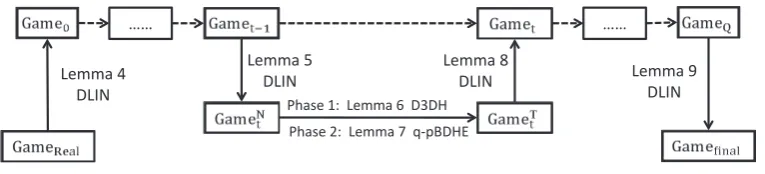
The outer structure of our hybrid argument will progress as shown in Fig. 1. First, we transition from Gamereal to Game0, then to Game1, next to Game2, and so on. We ultimately arrive at GameQ, where the
ciphertext and all of the keys given to the attacker are semi-functional. We then transition toGamef inal, which
is defined to be likeGameQ, except that the ciphertext given to the attacker is a semi-functional encryption of
a random message. This will complete our proof, since any attacker has a zero advantage in this final game. The transitions from Gamereal to Game0 and from GameQ to Gamef inal are relatively easy, and can be
accomplished directly via computational assumptions. The transitions from Gamet−1 to Gamet require more
intricate arguments. For these steps, we will need to treatPhase 1key requests (before the challenge ciphertext) andPhase 2key requests (after the challenge ciphertext) differently. We will also need to define two additional types of semi-functional keys:
Nominal Semi-functional Keys. To produce a nominal semi-functional key for an attribute set S, one first calls the normal key generation algorithm to produce a normal key consisting of Ki,j,K0i,j,K00i,j,
{K¯i,j,j0}j0∈[n]\{j},Ki,j,0,{Ki,j,x}x∈S with index (i, j). One then chooses random values σi,j,3, δi,j,3 ∈Zp.
The nominal semi-functional key is: Ki,j(hhj)(σi,j,3+δi,j,3)b
∗
3, K0
i,jg(σi,j,3+δi,j,3)b
∗
3, K00
i,jgzi(σi,j,3+δi,j,3)b
∗
3,
{K¯i,j,j0hj0(σi,j,3+δi,j,3)b ∗
3}
j0∈[n]\{j},Ki,j,0gδi,j,3b ∗
0,3, {K
i,j,xgσi,j,3(b
∗
x,5+b∗x,6)}
x∈S.We note that a nominal
semi-functional key still correctly decrypts a semi-semi-functional ciphertext.
Temporary Semi-functional Keys.A temporary semi-functional key is similar to a nominal semi-functional key, except that the semi-functional component attached toK0i,j will now be randomized (this will prevent correct decryption of a semi-functional ciphertext) andKi,j,K00i,jand{K¯i,j,j0}j0∈[n]\{j}change accordingly.
More formally, to produce a temporary semi-functional key for an attribute setS, one first calls the normal key generation algorithm to produce a normal key consisting of Ki,j,K0i,j,K00i,j,{K¯i,j,j0}j0∈[n]\{j},Ki,j,0,
{Ki,j,x}x∈S with index (i, j). One then chooses random values σi,j,3, δi,j,3, γ ∈ Zp. The temporary
semi-functional key is formed as: Ki,j(hhj)γb
∗
3, K0
i,jg
γb∗3, K00
i,jg
ziγb∗3, {K¯
i,j,j0hγb ∗
3
j0 }j0∈[n]\{j}, Ki,j,0gδi,j,3b ∗
0,3, {K
i,j,xgσi,j,3(b
∗
x,5+b
∗
x,6)}
For eacht from 1 toQ, we define the following additional games:
GameNt : This is likeGamet, except that thetthkey given to the attacker is a nominal semi-functional key. The
firstt−1 keys are still semi-functional in the original sense, while the remaining keys are normal.
GameTt: This is like Gamet, except that thetth key given to the attacker is a temporary semi-functional key.
The firstt−1 keys are still semi-functional in the original sense, while the remaining keys are normal. In order to transfer fromGamet−1 toGamet in our hybrid argument, we will transition first fromGamet−1
to GameNt , then toGameTt, and finally to Gamet. The transition fromGameNt to Game T
t will require different
computational assumptions for Phase 1 and Phase 2 queries (As shown in Fig. 1, we use two lemmas based on different assumptions to obtain the transition).
As shown in Fig. 1, we use a series of lemmas, i.e. Lemmas 4, 5, 6, 7, 8, and 9, to prove the transitions. The details of these lemmas and their proofs can be found in Appendix B.1.
Lemma 4 DLIN
…… ……
Lemma 5 DLIN
Lemma 8
DLIN Lemma 9
DLIN Phase 1: Lemma 6 D3DH
Phase 2: Lemma 7 q-pBDHE
Fig. 1.Lemmas 4, 5, 8, and 9 rely on the subspace assumption (w.r.t. Definition 5), which is implied by DLIN assumption, Lemma 6 relies on the D3DH assumption, and Lemma 7 relies on the source groupq-parallel BDHE assumption.
Theorem 4. No PPT adversary can win GameAMHN+1 with non-negligible advantage.
Proof. The argument for security of GameAMH
N+1 is very straightforward since an encryption to indexN+ 1 =
(n+ 1,1) contains no information about the message. The simulator simply runs actualSetupA and KeyGenA algorithms and encrypts the messageMb by the challenge access policy A and index (n+ 1,1). Since for all i = 1 to n, the values of Ti contain no information about the message, the bit b is perfectly hidden and
MHAN+1AdvA= 0.
Theorem 5. Suppose that the D3DH assumption and the DLIN assumption hold. Then no PPT adversary can winGameAIH with non-negligible advantage.
Proof. Theorem 5 follows Lemma 1 and Lemma 2 below.
Lemma 1. Suppose that the D3DH assumption holds. Then for ¯j < n no PPT adversary can distinguish between an encryption to(¯i,¯j) and(¯i,¯j+ 1)inGameAIH with non-negligible advantage.
Proof. InGameAIH, the adversaryAwill eventually behave in one of two different ways:
Case I: In Key Query phase, A will not submit ((¯i,¯j), S(¯i,j¯)) for some attribute set S(¯i,¯j) to query the
corresponding private key. In Challenge phase,Asubmits a messageM and a non-empty attribute setS∗. There is not any restriction onS∗.
Case II: In Key Query phase, A will submit ((¯i,¯j), S(¯i,j¯)) for some attribute set S(¯i,¯j) to query the
corre-sponding private key. In Challenge phase,Asubmits a messageM and a non-empty attribute setS∗ with the restriction that the corresponding strictest access policyAS∗ is not satisfied byS(¯i,¯j).Case IIhas the
following sub-cases:
1. (¯i,¯j)∈/[n, n]\R∗, S(¯i,¯j)satisfiesA∗.
2. (¯i,¯j)∈/[n, n]\R∗, S(¯i,¯j)does not satisfyA∗.
We flip a random coin c∈ {0,1} as our guess on which case thatA is in. In particular, if c= 0, we guess thatA is inCase I,Case II.1 or Case II.2. In this case, it follows the restriction in the index-hiding game for Augmented Broadcast Encryption (AugBE) in [6], where the adversay does not query the key with index (¯i,¯j) or (¯i,¯j) is not in the receiver list [n, n]\R∗. If c = 1, we guess thatAis inCase I, Case II.2or Case II.3, which means that the adversary does not query the key with index (¯i,¯j) or the attributes set S(¯i,¯j) does
not satisfyA∗. As of the fully secure CP-ABE schemes in [10,19,11,12,13], we assume that the size of attribute universe (i.e.|U |) is polynomial in the security parameter λ, so that a degradation ofO(1/|U |) in the security reduction is acceptable. The proof details of Lemma 1 can be found in Appendix B.2.
Lemma 2. Suppose the D3DH assumption and the DLIN assumption hold. Then for any 1 ≤¯i≤n no PPT adversary can distinguish between an encryption to(¯i, n)and(¯i+ 1,1)inGameAIHwith non-negligible advantage. Proof. The proof of this lemma follows from a series of lemmas that establish the indistinguishability of the following games, where “less-than row” implies the corresponding vi is randomly chosen from Z3p and Ti is a
random element (i.e.Ti=e(g, g)sˆi), “target row” implies the correspondingviis randomly chosen fromZ3pand
Ti is well-formed, and “greater-than row” implies the corresponding vi is randomly chosen from span{χ1,χ2}
andTi is well-formed.
– H1: Encrypt to columnn, row ¯iis the target row, row ¯i+ 1 is the greater-than row.
– H2: Encrypt to columnn+ 1, row ¯iis the target row, row ¯i+ 1 is the greater-than row.
– H3: Encrypt to column n+ 1, row ¯iis the less-than row, row ¯i+ 1 is the greater-than row (no target row).
– H4: Encrypt to column 1, row ¯iis the less-than row, row ¯i+ 1 is the greater-than row (no target row).
– H5: Encrypt to column 1, row ¯iis the less-than row, row ¯i+ 1 is the target row.
It can be observed that gameH1 corresponds to the encryption being done to (¯i, n) and gameH5corresponds
to encryption to (¯i+ 1,1). As shown in Fig. 2, we use a series of lemmas, i.e. Lemmas 10, 11, 12, and 13, to prove the indistinguishability of the games H1 and H5. The details of these lemmas and their proofs can be
found in Appendix B.3.
H
1Lemma 10
D3DH
H
2Lemma 11
D3DH
H
3Lemma 12
D3DH
H
4Lemma 13
DLIN
H
5Fig. 2.Lemmas 10, 11, and 12 rely on the D3DH assumption, and Lemma 13 relies on the DLIN assumption.
5
Conclusion
In this paper, we proposed a new Augmented R-CP-ABE construction on prime order groups, and proved its message-hiding and index-hiding properties in the standard model. This CP-ABE achieves full security in the standard model on prime order groups. Our contributions are (1)adding the revocation list, and (2)proving its full security with revocability. We follow the proof method in [16] for message-hiding, and build two direct reductions for the proof for index-hiding. The scheme is a fully collusion-resistant blackbox traceable R-CP-ABE scheme. It achieves the most efficient level to date, with the overhead inO(√N) only.
References
1. N. Attrapadung and H. Imai. Conjunctive broadcast and attribute-based encryption. InPairing, pages 248–265, 2009.
2. A. Beimel. Secure Schemes for Secret Sharing and Key Distribution. PhD thesis, Israel Institute of Technology, Technion, Haifa, Israel, 1996.
4. L. Cheung and C. C. Newport. Provably secure ciphertext policy ABE. In ACM Conference on Computer and Communications Security, pages 456–465, 2007.
5. H. Deng, Q. Wu, B. Qin, J. Mao, X. Liu, L. Zhang, and W. Shi. Who is touching my cloud. InESORICS, Part I, pages 362–379, 2014.
6. S. Garg, A. Kumarasubramanian, A. Sahai, and B. Waters. Building efficient fully collusion-resilient traitor tracing and revocation schemes. InACM Conference on Computer and Communications Security, pages 121–130, 2010. 7. V. Goyal, A. Jain, O. Pandey, and A. Sahai. Bounded ciphertext policy attribute based encryption. InICALP (2),
pages 579–591, 2008.
8. J. Herranz, F. Laguillaumie, and C. R`afols. Constant size ciphertexts in threshold attribute-based encryption. In
Public Key Cryptography, pages 19–34, 2010.
9. A. B. Lewko. Tools for simulating features of composite order bilinear groups in the prime order setting. In
EUROCRYPT, pages 318–335, 2012.
10. A. B. Lewko, T. Okamoto, A. Sahai, K. Takashima, and B. Waters. Fully secure functional encryption: Attribute-based encryption and (hierarchical) inner product encryption. InEUROCRYPT, pages 62–91, 2010.
11. A. B. Lewko and B. Waters. New proof methods for attribute-based encryption: Achieving full security through selective techniques. InCRYPTO, pages 180–198, 2012.
12. A. B. Lewko and B. Waters. New proof methods for attribute-based encryption: Achieving full security through selective techniques.IACR Cryptology ePrint Archive, 2012:326, 2012.
13. Z. Liu, Z. Cao, and D. S. Wong. Blackbox traceable CP-ABE: how to catch people leaking their keys by selling decryption devices on ebay. InACM Conference on Computer and Communications Security, pages 475–486, 2013. 14. Z. Liu, Z. Cao, and D. S. Wong. White-box traceable ciphertext-policy attribute-based encryption supporting any
monotone access structures.IEEE Transactions on Information Forensics and Security, 8(1):76–88, 2013.
15. Z. Liu and D. S. Wong. Practical ciphertext-policy attribute-based encryption: Traitor tracing, revocation, and large universe. In T. Malkin, V. Kolesnikov, A. B. Lewko, and M. Polychronakis, editors, Applied Cryptography and Network Security - 13th International Conference, ACNS 2015, New York, NY, USA, June 2-5, 2015, Revised Selected Papers, volume 9092 ofLecture Notes in Computer Science, pages 127–146. Springer, 2015.
16. Z. Liu and D. S. Wong. Traceable CP-ABE on prime order groups: Fully secure and fully collusion-resistant blackbox traceable. In S. Qing, E. Okamoto, K. Kim, and D. Liu, editors,Information and Communications Security - 17th International Conference, ICICS 2015, Beijing, China, December 9-11, 2015, Revised Selected Papers, volume 9543 ofLecture Notes in Computer Science, pages 109–124. Springer, 2015.
17. T. Okamoto and K. Takashima. Homomorphic encryption and signatures from vector decomposition. InPairing, pages 57–74, 2008.
18. T. Okamoto and K. Takashima. Hierarchical predicate encryption for inner-products. InASIACRYPT, pages 214– 231, 2009.
19. T. Okamoto and K. Takashima. Fully secure functional encryption with general relations from the decisional linear assumption. InCRYPTO, pages 191–208, 2010.
20. Y. Rouselakis and B. Waters. Practical constructions and new proof methods for large universe attribute-based encryption. InACM Conference on Computer and Communications Security, pages 463–474, 2013.
21. A. Sahai, H. Seyalioglu, and B. Waters. Dynamic credentials and ciphertext delegation for attribute-based encryption. InCRYPTO, pages 199–217, 2012.
22. A. Sahai and B. Waters. Fuzzy identity-based encryption. InEUROCRYPT, pages 457–473, 2005.
23. B. Waters. Ciphertext-policy attribute-based encryption: An expressive, efficient, and provably secure realization. InPublic Key Cryptography, pages 53–70, 2011.
A
Assumptions
The Decisional Linear Assumption (DLIN)Given a group generatorG, define the following distribution: (p,G,GT, e)
R
←− G, g, f, v←−R G, c1, c2
R
←−Zp,
D:= ((p,G,GT, e), g, f, v, fc1, vc2),
T0=gc1+c2, T1
R
←−G.
We define the advantage of an algorithmAin breaking this assumption to be: AdvDLG,A:=|Pr[A(D, T0) = 1]−Pr[A(D, T1)] = 1|.
We say thatG satisfies the DLIN Assumption ifAdvDL
G,A is a negligible function of the security parameterλfor
The Decisional 3-Party Diffie-Hellman Assumption (D3DH) Given a group generator G, define the following distribution:
(p,G,GT, e) R
←− G, g←−R G, x, y, z←−R Zp,
D:= ((p,G,GT, e), g, gx, gy, gz),
T0=gxyz, T1
R
←−G.
We define the advantage of an algorithmAin breaking this assumption to be: AdvGD,3ADH :=|Pr[A(D, T0) = 1]−Pr[A(D, T1)] = 1|.
We say thatGsatisfies the D3DH Assumption ifAdvGD,3ADH is a negligible function of the security parameter λ for any PPT algorithmA.
The Source Groupq-Parallel BDHE Assumption [12]Given a group generatorG and a positive integer q, define the following distribution:
(p,G,GT, e) R
←− G, g←−R G, c, d, f, b1, . . . , bq R
←−Zp,
D= (p,G,GT, e), g, gf, gdf, gc, gc
2
, . . . , gcq, , gcq+2, . . . , gc2q, gci/bj ∀i∈ {1, . . . ,2q} \ {q+ 1}, j∈ {1, . . . , q},
gdf bj ∀j∈ {1, . . . , q},
gdf cibj0/bj ∀i∈ {1, . . . , q}, j, j0∈ {1, . . . , q}s.t. j6=j0 ,
T0=gdc
q+1
, T1
R
←−G.
We define the advantage of an algorithmAin breaking this assumption to be: AdvGqP B,A :=|Pr[A(D, T0) = 1]−Pr[A(D, T1)] = 1|.
We say thatGsatisfies the Source Groupq-Parallel BDHE Assumption ifAdvqP BG,A is a negligible function of the security parameterλfor any PPT algorithmA.
A.1 Assumptions for Dual Pairing Vector Spaces
Let (B,B∗) denote a pair of dual orthonormal bases overZn
p,A∈Zmp×mbe an invertible matrix for somem≤n,
andSm⊆ {1, . . . , n} be a subset of sizem. Then new dual orthonormal bases (BA,B∗A) are defined as follows.
LetBmdenote the n×mmatrix overZp whose columns are the vectorsbi∈Bsuch thati∈Sm. Then BmA
is also ann×mmatrix.BA is formed by retaining all of the vectorsbi ∈Bfor i /∈Sm and exchanging thebi
fori∈Smwith the columns ofBmA. To define B∗A, similarly letB∗mdenote the n×m matrix overZp whose
columns are the vectors b∗i ∈ B∗ such that i ∈ Sm. Then Bm∗(A−1)t is also an n×m matrix, where (A−1)t
denotes the transpose ofA−1.B∗A is formed by retaining all of the vectors bi∗∈B∗ fori /∈Sm and exchanging
theb∗i fori∈Sm with the columns ofB∗m(A−1)t. We have
Lemma 3. [9] For any fixed positive integers m≤n, any fixed invertibleA∈Zmp×m and set Sm⊆ {1, . . . , n}
of sizem, if(B,B∗)←−R Dual(Znp, ψ), then(BA,B∗A)is also distributed as a random sample fromDual(Znp, ψ).
In particular, the distribution of(BA,B∗A)is independent of A.
The “Subspace Assumption” is introduced by Lewko [9], and is generalized by Lewko and Waters [12]. In particular, let the parametermdenote the number of bases, and each basis pair has its own dimensionni and
its own parameterki whereki is a positive integer such thatki≤ n3i. The following statement of the subspace
assumption is implied by DLIN assumption, and is proved by Lewko and Waters [12, Appendix A]. Note that this reduction (i.e.,the Subspace Assumption is implied by DLIN assumption) holds for any valid choices of the parametersm, ni, ki. We refer to [12] for more details of the following statement of the subspace assumption.
Themdual orthonormal bases pairs will be denoted by (B1,B∗1), . . . ,(Bm,B∗m). For eachifrom 1 tom, the
basis vectors comprising (Bi,B∗i) will be denoted bybi,1, . . . ,bi,ni andb
∗
Definition 5. (The Subspace Assumption [12]) Given a group generatorG, define the following distribution:
(p,G,GT, e) R
←− G, g←−R G, ψ, η, β, τ1, τ2, τ3, µ1, µ2, µ3
R
←−Zp,
(B1,B∗1)
R
←−Dual(Znp1, ψ), . . . ,(Bm,B∗m) R
←−Dual(Znpm, ψ),
∀i∈ {1, . . . , m}:
Ui,1:=gµ1bi,1+µ2bi,ki+1+µ3bi,2ki+1,Ui,2:=gµ1bi,2+µ2bi,ki+2+µ3bi,2ki+2,
. . . ,Ui,ki:=g
µ1bi,ki+µ2bi,2ki+µ3bi,3ki,
Vi,1:=gτ1ηb
∗
i,1+τ2βb∗i,ki+1,V
i,2:=gτ1ηb
∗
i,2+τ2βb∗i,ki+2,
. . . ,Vi,ki :=g
τ1ηb∗i,ki+τ2βb∗i,2ki,
Wi,1:=gτ1ηb
∗
i,1+τ2βb∗i,ki+1+τ3b∗i,2ki+1,W
i,2:=gτ1ηb
∗
i,2+τ2βb∗i,ki+2+τ3b∗i,2ki+2,
. . . ,Wi,ki :=g
τ1ηb∗i,ki+τ2βbi,∗2ki+τ3b∗i,3ki,
D:= (p,G,GT, e), g, {gbi,1, gbi,2, . . . , gbi,2ki, gbi,3ki+1, . . . , gbi,ni,
gηb∗i,1, . . . , gηb
∗
i,ki, gβb
∗
i,ki+1, . . . , gβb
∗
i,2ki, gb
∗
i,2ki+1, . . . , gb
∗
i,ni,
Ui,1,Ui,2, . . . ,Ui,ki}
m i=1, µ3.
We assume that for any PPT adversaryA (with output in{0,1}), AdvG,A:=|Pr[A(D,{Vi,1, . . . ,Vi,ki}
m
i=1) = 1]−Pr[A(D,{Wi,1, . . . ,Wi,ki}
m i=1) = 1]|
is negligible in the security parameterλ.
B
Proofs
B.1 Proof of Theorem 3
Lemma 4. Under the subspace assumption, no PPT attacker can achieve a non-negligible difference in advan-tage betweenGamereal andGame0.
Proof. Given a PPT attackerAachieving a non-negligible difference in advantage betweenGamerealandGame0,
we will create a PPT algorithmBto break the subspace assumption. We will employ the subspace assumption with parameters m = U + 2, ni = 3, ki = 1 for two values of i, and ni = 6, ki = 2 for the rest of the
values of i. In order to reconcile the notation of the assumption with the notation of our construction as conveniently as possible, we will denote the bases involved in the assumption by (D,D∗),(D0,D∗0)∈Dual(Zp3, ψ)
and (D1,D∗1), . . . ,(DU,DU∗)∈Dual(Zp6, ψ).Bis given (we will ignore theU terms andµ3because they will not
be needed):
G, p, g, gd1, gd2, gd0,1, gd0,2, {gdx,1, gdx,2, gdx,3, gdx,4}x∈[U],
gηd∗1, gβd
∗
2, gd
∗
3, gηd
∗
0,1, gβd
∗
0,2, gd
∗
0,3, {gηd
∗
x,1, gηd
∗
x,2, gβd
∗
x,3, gβd
∗
x,4, gd
∗
x,5, gd
∗
x,6}x ∈[U],
T1, T0,1, {Tx,1,Tx,2}x∈[U].
The exponents of the unknown terms T1,T0,1 are distributed either asτ1ηd∗1+τ2βd∗2 and τ1ηd∗0,1+τ2βd∗0,2
respectively, or asτ1ηd∗1+τ2βd∗2+τ3d∗3 andτ1ηd∗0,1+τ2βd0∗,2+τ3d∗0,3 respectively. Similarly, the exponents of
the unknown termsTx,1,Tx,2are distributed either asτ1ηd∗x,1+τ2βd∗x,3andτ1ηd∗x,2+τ2βd∗x,4respectively, or
asτ1ηd∗x,1+τ2βd∗x,3+τ3d∗x,5andτ1ηd∗x,2+τ2βd∗x,4+τ3d∗x,6 respectively. It isB’s task to determine if theseτ3
contributions are present or not.
Setup.B implicitly sets the bases for the construction as:
b1=ηd∗1, b2=βd∗2, b3=d∗3, b∗1=η−1d1, b∗2=β−1d2, b∗3=d3,
bx,1=ηd∗x,1, bx,2=ηd∗x,2, bx,3=βd∗x,3, bx,4=βd∗x,4, b5=d∗5,b6=d∗6 ∀x∈[U],
b∗x,1=η−1dx,1,b∗x,2=η−1dx,2,b∗x,3=β−1dx,3,b∗x,4=β−1dx,4,b∗5=d5,b∗6=d6∀x∈[U].
We note that these are properly distributed because (D,D∗),(D0,D∗0), etc. are randomly chosen (up to
sharing the sameψvalue). Bchooses random exponents
θ, α01, α02∈Zp, {ri, zi, αi,01, α 0
i,2 ∈Zp}i∈[n], {c0j,1, c 0
j,2, yj, υj ∈Zp}j∈[n].
ThenBgives toAthe following public parameter:
g, h=gθ, {hj}j∈[n], gb1, gb2, hb1 = (gb1)θ, hb2 = (gb2)θ,
{hb1
j = (g
b1)υj, hb2
j = (g
b2)υj}
j∈[n], hb0,1 = (gb0,1)θ, hb0,2= (gb0,2)θ,
{hbx,1 = (gbx,1)θ, . . . , hbx,4 = (gbx,4)θ}
x∈U, F1=e3(gd1, gηd
∗
1)θα
0
1, F2=e3(gd2, gβd∗2)θα
0
2,
{F1,j =e3(gd1, gηd
∗
1)υjα01, F
2,j =e3(gd2, gηd
∗
2)υjα02}
j∈[n],
{Gi=gri(b1+b2), Zi=gzi(b1+b2), Ei,1=e3(gd1, gηd
∗
1)α0i,1, E
i,2=e3(gd2, gβd
∗
2)α0i,2}
i∈[n],
{Hj= (gd1)c
0
j,1(gd2)c0j,2, Yj = (Hj)yj}
j∈[n]
.
Note thatBimplicitly sets
α1=ηα01, α2=βα02, {αi,1=ηα0i,1, αi,2=βα0i,2}i∈[n], {cj,1=ηc0j,1, cj,2=βc0j,2}j∈[n].
Phase 1. To respond to a query for ((i, j), S(i,j)),B produces a normal key as follows. It randomly chooses
σ0i,j,1, σ0i,j,2, δ0i,j,1, δi,j,0 2∈Zp, and outputs a private keySK(i,j),S(i,j)=h(i, j), S(i,j),Ki,j,K 0
i,j,K00i,j,{K¯i,j,j0}j0∈[n]\{j},
Ki,j,0,{Ki,j,x}x∈S(i,j)ias:
Ki,j=g(αi,1+ricj,1)b
∗
1+(αi,2+ricj,2)b∗2(hh
j)(σi,j,1+δi,j,1)b
∗
1+(σi,j,2+δi,j,2)b∗2
=(gd1)α0i,1+ric0j,1+(θ+υj)(σi,j,0 1+δ0i,j,1)(gd2)α0i,2+ric0j,2+(θ+υj)(σi,j,0 2+δ0i,j,2), K0i,j=(gd1)α
0
1+σ
0
i,j,1+δ
0
i,j,1(gd2)α02+σ
0
i,j,2+δ
0
i,j,2, K00
i,j= (K0i,j)zi,
{K¯i,j,j0}j0∈[n]\{j}={h
(σi,j,1+δi,j,1)b∗1+(σi,j,2+δi,j,2)b∗2
j0 }j0∈[n]\{j},
={gd1υj0(σi,j,0 1+δ0i,j,1)gd2υj0(σi,j,0 2+δi,j,0 2)}
j0∈[n]\{j}.
Ki,j,0=(gd0,1)δ
0
i,j,1(gd0,2)δi,j,0 2, Ki,j,x=(gdx,1)σ
0
i,j,1(gdx,2)σ0i,j,1(gdx,3)σ0i,j,2(gdx,4)σ0i,j,2 ∀x∈S (i,j).
Note thatBimplicitly sets
σi,j,1=ησi,j,0 1, σi,j,2=βσi,j,0 2, δi,j,1=ηδ0i,j,1, δi,j,2=βδ0i,j,2.
Challenge. A submits to B a revocation list R, an LSSS matrix (A, ρ) of size l×m and two equal length messagesM0, M1, Bproduces the challenge ciphertext for index (¯i= 1,¯j= 1) as follows.
Bfirst chooses random
κ, τ, s1, . . . , sn, t1, . . . , tn ∈Zp,
vc ∈Z3p, w1, . . . ,wn ∈Z3p,
ξ10,1, ξ01,2, . . . , ξ0l,1, ξl,02 ∈Zp, u01,u 0 2 ∈Z
m p ,
where the first entries ofu01 andu02are equal to 0. It also chooses a random vectoru∈Zp with first entry
equal to 1, and chooses random exponentsξ10,3, . . . , ξl,03∈Zp. Bimplicitly sets
π1=τ1, π2=τ2,
u1=τ1u+u01, u2=τ2u+u02,