A Monthly Journal of Computer Science and Information Technology
ISSN 2320–088X
IJCSMC, Vol. 2, Issue. 2, February 2013, pg.6 – 11
RESEARCH ARTICLE
© 2013, IJCSMC All Rights Reserved
6
A New Fuzzy Logic Rule Based Power
Management Technique for Cognitive Radio
Partha Pratim Bhattacharya1, Subhajit Chatterjee2 1
Department of Electronics and Communication Engineering, Faculty of Engineering and Technology,
Mody Institute of Technology & Science (Deemed University), Rajasthan - 332311, India
2
Department of Electronics and Communication Engineering, Regent Education & Research Foundation, Barrackpore, West Bengal
Abstract— The limited available spectrum and the ineffiffiffifficient use of spectrum necessitate a new communication paradigm to exploit the existing wireless spectrum opportunistically. Cognitive radio is a wireless communication system in which either a network or a wireless node changes its transmission or reception parameters to communicate efficiently avoiding interference with licensed or unlicensed users. In our work, a fuzzy logic rule based control system is proposed where the cognitive radio can change its transmission power depending on distance between transmitter and receiver, node density and interference. The proposed system is simulated and found to give satisfactory results.
Indexed Terms: - Cognitive radio, fuzzy logic, dynamic spectrum access.
I. INTRODUCTION
Cognitive radio is a kind of wireless communication system in which either a network or a wireless node changes its transmission or reception parameters to communicate efficiently avoiding interference with licensed or unlicensed users. It was thought of as an ideal goal towards which a software-defined radio platform should evolve to a fully reconfigurable wireless black-box that automatically changes its communication variables in response to network and user demand. It is considered to be an intelligent wireless communication system that is aware of its surrounding environment (i.e., outside world), and uses the methodology of understanding-by-building to learn from the environment and adapt its internal states to statistical variations in the incoming RF stimuli by making corresponding changes in certain operating parameters (e.g., transmit-power, carrier frequency, and modulation strategy) in real-time, with two primary objectives in mind:
· Highly reliable communications whenever and wherever needed; · Efficient utilization of the radio spectrum.
© 2013, IJCSMC All Rights Reserved
7
Regulatory bodies in various countries (including the Federal Communications Commission in the United States, and Ofcom in the United Kingdom) found that most of the radio frequency spectrum was inefficiently utilized [2]. For example, cellular network bands are overloaded in most parts of the world, but amateur radio and paging frequencies are not. Independent studies performed in some countries confirmed that observation [3-6], and concluded that spectrum utilization depends strongly on time and place. Moreover, fixed spectrum allocation prevents rarely used frequencies (those assigned to specific services) from being used by unlicensed users, even when their transmissions would not interfere at all with the assigned service. This was the reason for allowing unlicensed users to utilize licensed bands whenever it would not cause any interference. This paradigm for wireless communication is known as cognitive radio.
More specifically, the cognitive radio technology will enable the users to determine which portions of the spectrum is available and detect the presence of licensed users when a user operates in a licensed band (spectrum sensing), (2) select the best available channel (spectrum management), (3) coordinate access to this channel with other users (spectrum sharing), and (4) vacate the channel when a licensed user is detected (spectrum mobility)..
Applications of Spectrum Sensing Cognitive Radio include emergency networks and WLAN higher throughput and transmission distance extensions. The main functions of Cognitive Radios are [7-9]:
i) Spectrum Sensing: It refers to detect the unused spectrum and sharing it without harmful interference with other users. It is an important requirement of the Cognitive Radio network to sense spectrum holes, detecting primary users is the most efficient way to detect spectrum holes. Spectrum sensing techniques can be classified into three categories:
o Transmitter detection: Cognitive radios must have the capability to determine if a signal from a primary transmitter is locally present in a certain spectrum, there are several approaches proposed:
matched filter detection
energy detection
o Cooperative detection: It refers to spectrum sensing methods where information from multiple Cognitive radio users are incorporated for primary user detection.
o Interference based detection.
ii) Spectrum Management: It is the task of capturing the best available spectrum to meet user communication requirements. Cognitive radios should decide on the best spectrum band to meet the Quality of Service requirements over all available spectrum bands, therefore spectrum management functions are required for Cognitive radios, these management functions can be classified as:
o spectrum analysis o spectrum decision
iii) Spectrum Mobility: It is defined as the process when a cognitive radio user exchanges its frequency of operation. Cognitive radio networks target to use the spectrum in a dynamic manner by allowing the radio terminals to operate in the best available frequency band, maintaining seamless communication requirements during the transition to better spectrum.
iv) Spectrum Sharing: It refers to providing the fair spectrum scheduling method, one of the major challenges in open spectrum usage is the spectrum sharing.
II. PROPOSED SYSTEM FOR TRANSMISSION POWER CONTROL
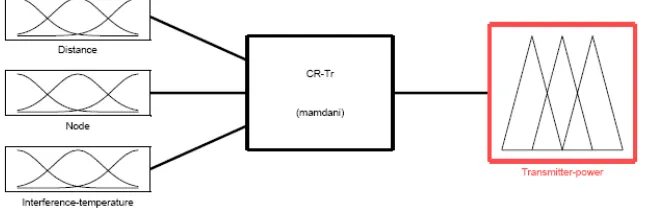
Energy management is one of the key issues in CR because of limited resources and longer lifetime expectation. Moreover, interference between licensed and unlicensed users also needs to be minimized. The model of the fuzzy controlled energy management system is shown in Figure 1.
© 2013, IJCSMC All Rights Reserved
8
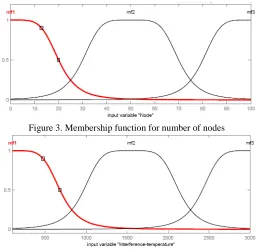
The distance between the transmitter and receiver has been considered to be one determining parameter because for larger distance more transmission power is required. The node density is also one input parameter here. Interference temperature has been kept to be the third determining parameter because more is the interference more is the requirement of high transmitted power. The linguistic variables are kept to be LOW, MEDIUM and HIGH and the membership functions are shown in Figures 2, 3 and 4 respectively. Trapezoidal membership functions are used here. Based on the knowledge on the linguistic variable 27 IF THEN ELSE fuzzy rules are used to take decision for transmitter power selection.
Mamdani rule is used here because this type of fuzzy rule based system (FRBS) provides a natural framework to include expert knowledge in the form of linguistic rules. This knowledge can be easily combined with rules that describe the relation between system input and output. Moreover, Mamdani type FRBS possesses a high degree of freedom to select the most suitable fuzzification and defuzzification interface components as well as the interface method itself. Mamdani type FRBSs also provide a highly flexible means to formulate knowledge, while at the same they remain interpretable. The selection of power at a particular location is calculated as
Power selection = weight х min value of the membership functions.
A decision value close to 1 is considered to take decision in favor of increasing transmission power to its maximum possible value. Matlab 7.0 is used for the simulation. The proposed FRBS thus takes decision based on three key parameters according to a predefined rule base, as in Figure 5.
Figure 2. Membership function for distance between the transmitter and receiver (meter)
Figure 3. Membership function for number of nodes
© 2013, IJCSMC All Rights Reserved
9
Distance Number of nodes
Interference-temperature
Transmission power
Low Low Low Low
Low Low Medium Low
Low Low High Low
Low Medium Low Low
Low Medium Medium Low
Low Medium High Medium
Low High Low Medium
Low High Medium Medium
Low High High Medium
Medium Low Low Low
Medium Low Medium Medium
Medium Low High Medium
Medium Medium Low Low
Medium Medium Medium Medium
Medium Medium High High
Medium High Low Medium
Medium High Medium High
Medium High High High
High Low Low Medium
High Low Medium Medium
High Low High Medium
High Medium Low High
High Medium Medium High
High Medium High High
High High Low High
High High Medium High
High High High High
Figure 5. Fuzzy IF-THEN-ELSE rules
III.RESULTS AND DISCUSSION
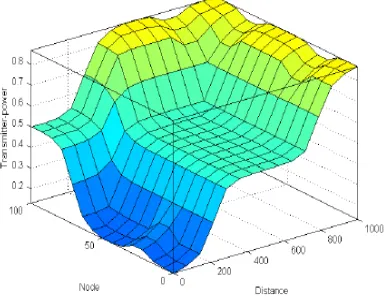
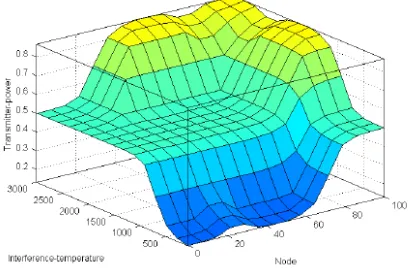
The results are shown in Figures 6, 7 and 8. It may be observed from Figure 6 that the chance of increasing transmission power increases as the distance between nodes and number of nodes increase. The result is desirable because more transmission power is required if the distance increases and node density increases. Similarly, the chance increases as the interference temperature increases (Figures 7 and 8) because if interference increases more transmission power is required.
© 2013, IJCSMC All Rights Reserved
10
Figure 7. Decision for using maximum transmission power
Figure 8. Decision for using maximum transmission power
IV.CONCLUSION
Researchers throughout the World are trying to develop a radio communications system that would be able to fulfill the requirements for a Cognitive radio system. In this paper, fuzzy logic based power control method is proposed which work satisfactorily. The simulation software programs for the proposed system are not complex and do not consume much time to respond. Hence, it can be easily implemented in real systems.
REFERENCES
[1] Mitola, J., III; Maguire, G.Q.Jr, Cognitive radio: making software radios more personal, Personal Communications, IEEE Volume 6, Issue 4, Aug 1999, pp 13 – 18.
[2] Gregory Staple and Kevin Werbach, The End of Spectrum Scarcity, IEEE Spectrum Online, March 2004. [3] Cabric, D.; Mishra, S.M.; Brodersen, R.W, Implementation issues in spectrum sensing for cognitive radios,
Proc. Thirty-Eighth Asilomar Conference on Signals, Systems and Computers, Volume 1, Issue , 7-10, Nov. 2004, pp 772 – 776.
[4] Paul Leaves, David Grandblaise, Ralf Tönjes, Klaus Moessner, Michele Breveglieri, Didier Bourse, Rahim Tafazolli, “Dynamic Spectrum Allocation in Composite Reconfigurable Wireless Networks”, IEEE
Communications Magazine, Vol. 42, No. 5, May 2004
[5] P. Leaves and al, “Dynamic Spectrum Allocation and Coexistence – Functional Specification and Algorithm”, March 2003, IST-2001-35125/OverDRiVE/WP1/D06.
[6] Ghasemi, A. and Sousa, E.S., Spectrum Sensing in Cognitive Radio Networks: Requirements, Challenges and Design Trade-offs, IEEE Communications Magazine, pp. 32-39, April 2008.
© 2013, IJCSMC All Rights Reserved
11
Journal, Vol. 24, no.2, pp. 111-116, Apr. 2006.