THE IMPACT OF FOREIGN DIRECT INVESTMENT
ON TURKISH MANUFACTURING
E. Esra Karadeniz
A thesis submitted for the degree of Doctor of Philosophy
University of London
Department of Economics University College
ABSTRACT
In the course of the 1980s, Turkey came to recognize the
need to change its attitude towards foreign investment,
assigning a significant role to direct foreign investment.
Hence, after the 1980s, there was a significant increase in
the number of foreign firms operating in Turkey and the inf low
of foreign capital to Turkey. Although the importance of
foreign direct investment in the Turkish economy has been
increasing, a variety of questions are far from being
resolved. The important obstacle is that the available data do
not let us analyze the extent and performance of foreign
firms. In this study a considerable effort was made in
collecting new data from foreign firms operating in the
Turkish manufacturing industry.
The main purpose of this study is to analyze and evaluate
the economic effects of direct foreign investment on Turkish
manufacturing. At the centre of our analysis has been the role
of foreign firms in industrial concentration, technological
choice and trade behaviour.
In the first chapter we outline the main issues to be
analyzed in this study and explain the method of collecting
and processii)g data from foreign firms operating in the
Turkish manufacturing industry. The second chapter discusses
determinants of foreign direct investment. We also analyse the
industrial distribution of direct foreign investment in
Turkish manufacturing. In the third chapter we undertake an
overview to the historical background of foreign firms and the
legislation covering foreign investment in Turkey. At the
beginning of the following three main chapters we analyze the
performance of foreign firms in terms of those basic issues in
the literature, according to the market imperfection approach,
and later on we investigate the performance of foreign firms
in Turkish manufacturing using our own data, supplemented by
To ny father,
ACKNOWLEDGEMENTS
I am intellectually indebted to: my supervisors, Prof.
Chris Heady and Dr. Steve Machin, who discussed substantial
matters relating to my dissertation, providing useful comments
and reading through various drafts. I would also like to thank
Dr. Richard Vaughan to provide insightful comments.
My gratitude extends also to the following persons who
provided me with valuable data for this study: former Minister
of the State Planning Organization (SPO), Dr. Ali Tigrel; head
of the Foreign Investment Department (FID), Dr. All Cakir.
I am also grateful to my friend, Albert Benbasat, for his
assistance in data processing. I am indebted to Amy Bankier,
who spent hours going through the manuscript and, proofreading
its contents.
My appreciation goes to Prof. Victoria Chick, Dr. Kirtida
Pari]th, Pat Fairbrother, Dr. Tomris Yilivaz, Nural Yegenoglu,
Tainami Uochi, Dr. Rogerio Studart, and all friends who
consistently provided moral support during my studying.
I am extremely grateful to Cuneyt Karadeniz for his
helpful advice, cooperation, and understanding which were
TABLE OF CONTENTS
LISTOF
TABLES.... ... ... ... .. . . .. . . .. .
9LISTOF
ABBREVIATIONS. . . ... . . . .
12CHAPTER 1. INTRODUCTION
1.1. Objective of the Study
... . . . .
14
1.2. Major Areas in the Study
... . . . ... . . . . .
16
1.3. Data Base. ... . . . ... . . . ...
.
21
CHAPTER
2• THE DETERMINANTS OF FOREIGN DIRECT INVESTMENT
2.1. Introduction... ... ...26
2.2. The Industrial Organization Approach..
... . ... . . .
27
2 • 3. Internalization versus Externalization... ... . . . ... . . .32
2.4. DirectForeign Investmentversus Export ...36
2 • 4 • 1 . Locational Factors . . . ... 37
2 .4 • 2. The Product Cycle Model. .. . . ...•
•
43
2.4.3. Oligopolistic Reaction... ...46
2.5. Eclectic Approach... • . . . ... . ... ...49
2.6. Dynamic and Development Prospect of Eclectic
Approach: The Investment Development Cycle. . . .. . ... .50
2.7. The Determinants of Foreign Direct Investment
in Turkish Manuf acturing Industry. . . • . . ... .. .52
2.8. Conclusion... . . . • ... . . . .63
CHAPTER 3. HISTORICAL BACKGROUND OF FOREIGN FIRMS IN TURKEY
3.1. Introduction...65
3.2. Historical Background and Legal Basis of Foreign
Invest.ient. • . . . • ...• . . . ... . . . .65
3.3. A Profile of Foreign Investment in Turkey... .. . . .76
CHAPTER 4. FOREIGN FIRMS AND MARKET STRUCTURE
4 . 1 . Introduction. . .
. . .
. . . 85
4.2. Industrial Concentration, Competition and
F
orei Firm. . . S • • • S S • S S • • ... . . . 864.3. Elupirica]. Evidence.
... . ... . . . ...
98
4 • 4. Structure of the Turkish Manufacturing Industry...102
4.5. Determination of Concentration on the Turkish
Manufacturing Sector... . . . ... . . ...115
4.5.1. Hypothesis and Variables. ...120
4.5.2. Statistical Results... ...124
4.6.ProfitabilityandMarketStructure... ...128
4.6.1. HypothesisandVariables. . ... .129
4.6.2. Statistical Results.
...•..••• ...
136
4 .7. Conclusion... ... • . . . ...• . . ... 140
CHAPTER 5. TECHNOLOGICAL CHOICE OF FOREIGN FIRMS
5.1. Introduction... ... .
144
5.2. Theoretical Considerations
...146
5 • 3 . Empirical Evidence. . . • . • . . . ... . 149
5.4. Indigenous Technological Developments ...158
5.5. The Transfer of Technology by Foreign Firms in the
Turkish Manufacturing Industry... ... . . . .166
5.6. Determinants of the Choice of Technique... . . . . .172
CHAPTER 6. TRADE PERFORMANCE OF FOREIGN FIRMS
6 .1. Introduction... . . . •...•... . ... . . . .183
6.2. Trade Performance of Multinational Firms ...185
6 .3 . The Empirical Evidence ... . . . . ... . . . 190
6.4. The Trade Performance of Turkish
Manufacturing Industry. . . . ... ... . . ... 194
6 . 4 . 1 . Expor-t Performance. . . . ... . . 195
6.4.2. The Development of Imports... ... . . . .199
6.5. Foreign Firms and Trade Performance..
... .... . .201
6 . 5 • 1 • Export Performance. . . . ... . • . . . . ... . • . . . 201
6.5.2. A Comparison of Export Performance Between
DomesticandForeignFirms... ...210
6.5.3. Foreign Firms and the Changing Patterns of
Comparative Advantage. . ... ... . .213
6 .5 .4 . Import Performance . • . . . • . . . ... . . . 218
6.6. Determinants of Export Performance of Foreign Firms...225
6 .7. Conclusion... ... ... . •....233
cIlAP'I'ER. 7. cONcLtJSION... ...236
APPENDIX .I. ... . . • . . . • ... . . . • ...255
A.PPEN1IX.II. . . ... . • . . . ... . ...260
A.PPENDIX.III. ... . .
• • . . . • . . . ... . . . • . .264
APPENDIX .]\T... ... . . . . • ... . ... .268
LIST OF TABLES
Table 2.1.
Simple Correlation Coefficient for
Independent Variables... ... . .59
Table 2.2.
Regression Equations for the Determinants
of Foreign Firms... . ... . . . .60
Table 3.1.
Authorized Foreign Capital in Turkey,
(1954-1989)... . . . ... . . . .77
Table 3.2.
Realized Foreign Capital and Profit
Remittance (1954 - 1989)... . . . ... .. .. .79
Table 3.3.
The Sectoral Distribution of Operating
Foreign Capital, (%) ... ...
Table 3.4.
Sectoral Distribution of Foreign Firms
Operatingunder 1aw6224 ... ...8].
Table 3.5.
The Breakdown of Foreign Capital by
Countries at the end of 1989 ... .. . . ...83
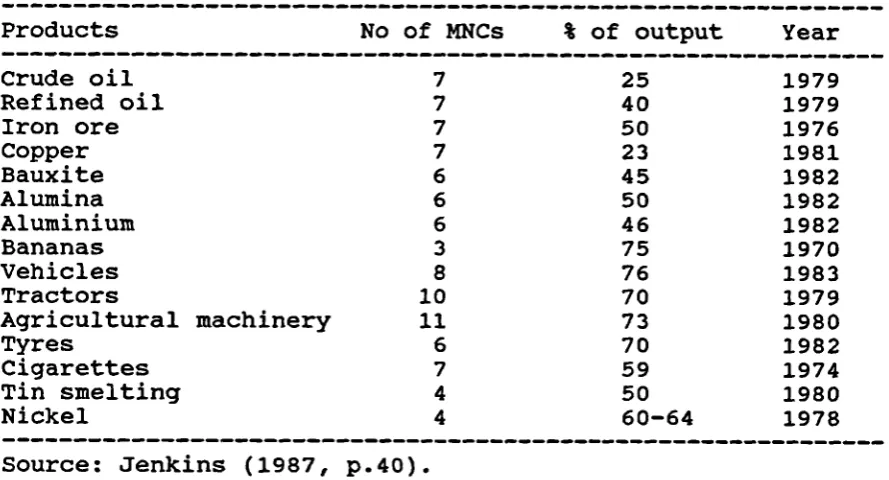
Table 4.1.
Major MNCs Share of Western World
Output of Selected Products... .. .. .. .93
Table 4.2.
Table 4.3.
Table 4.4.
Table 4.5.
Table 4.6.
Table 4.7.
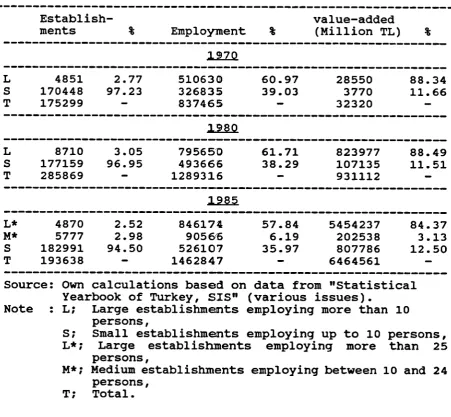
Large and Small Establishments in
Manufacturing Industry: 1970,1980,1985... .103
Value Added in the Manufacturing Sector,
(private and public), (%) ... .... . . ... .106
Participation of foreign Firms in
Sales and Employment in 1987, (%) ...108
Distribution of Foreign Firms by Size of
Sales, Paid-up capital, and Employment... .109
Sectoral Distribution of Sales, and
Employment for all and Foreign Firms... .112
5 Firm Concentration Ratios of Turkish
Manufacturing Industry in 1987 . ...116
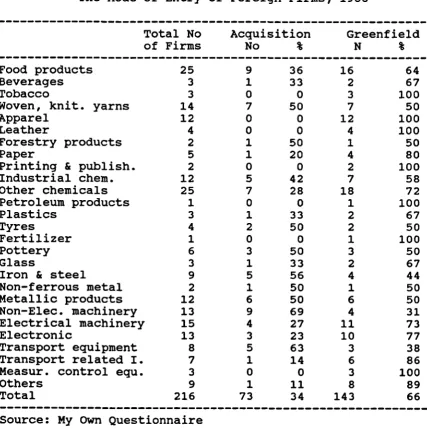
Table 4.8.
The Mode of Entry of Foreign Firms, (1988). .119
Table 4.9.
Estimated Correlation Matrix of Variables
Table 4.10.
Regression Equations for the
Determination of Concentration ... . . .126
Table 4.11.
Estimated Correlation Matrix of Variables. . . 138
Table 4.12.
Regression Equations Explaining
Price-Cost Margin . . . ... ... . . 138
Table 5.1.
Distribution of Technological Activities....168
Table 5.2.
Percentage of Imported Inputs Used by
Foreign Firms Operating in Turkish
Manufacturing Industry (1988).. ...]71
Table 5.3.
Availability of Foreign Firms's Inputs
Table 5.4.
Table 5.5.
Table 5.6.
Table 5.7.
Local].y. . . . ... . . . ...171
Factors Influencing the Purchasing of
Inputs Locally... . . . .171
Determinants of the Choice of Technique. .. . .173
Estimated Correlation Matrix of Variables
for Double Logarithmic
Regression Equations for the
Determination of Concentration... ... 179
Table 6.1.
Growth Rate of Exports and the Share of
of Exports in GNP, (1980-1988)... ...196
Table 6.2.
Growth Rate of Total Imports and
Composition of Imports by Type of Goods,
(1979-1988), (%)... ... ...200
Table 6.3. Exports Values of Foreign Firms, Foreign
Firms' Share of Manufactured Exports and
Exports/Sales Ratios, (1973-1988)... .. . . . .202
Table 6.4.
Export by Foreign Firms by Sector of
Origin, (1987)... . . . .205
Table 6.5.
Table 6.6.
Table 6.7.
Export by Foreign Firms by Sector of
Origin, (1988).... . . .. . . . ... . . . .206
Exports of Foreign Firms as percentage
of Their Sales in 1987... . .. .. .. ... . .208
Distribution of Foreign Firms by size
Table 6.8.
Distribution of Foreign Firms by
Size of Exports in 1988... ... .. . ... . . 209
Table 6.9.
Comparison of Domestics Firms and
Foreign Firms' Export Performance.. . .. .... . .212
Table 6.10.
Revealed Comparative Advantage Indices...216
Table 6.11.
Share of Foreign Firms in Turkish
Manufacturing Imports and
Coefficients of Imports, (1987) ...220
Table 6.12.
Share of Foreign Firms in Turkish
Manufacturing Imports and
Coefficients of Imports, (1988).. ...221
Table 6.13.
Concentration of Foreign Firms
According to Import Values, (1987)... . . . .222
Table 6.14.
Trade Balance of Foreign Firms, (Mill.$). . . .224
Table 6.15.
Estimated Correlation Matrix of Variables.. .231
Table 6.16.
Table A.I.l.
Table A.I.2.
Explaining Export Performance of
Foreign Firms. . . ... . . . . - ... . . . 231
Number of Firms and Total Capital
Covered by This Study, (1987) ... . . . . .256
Number of Firms and Total Capital
Covered by This Study, (1988).. .
...257
Table A.I.3. New Foreign Firms Distribution
According to Sectors, (1987-1988) ... .258
Table A.I.4. The Ratio of Equity of Foreign Firms,
(1987-1988).... ...
... ....
..258
Table A.I.5. Years of Establishment of Foreign Firms,
(1940-1988)... . . . .258
Table A.I.6. The Breakdown of Foreign Firms by
Countries, (1988).
... . ... . . . . .
259
Table A.II.1. Capital/Labour Ratios of Foreign Firms
and All Firms in Manufacturinci
Industries in Turkey, (1987) ...262
Table
A.III.1.Composition of Turkish Exports,
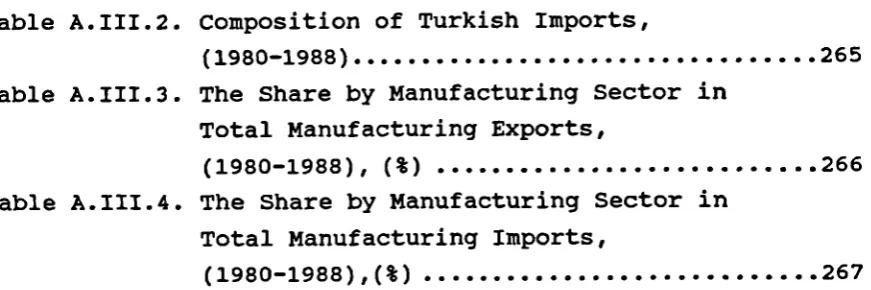
Table A.III.2. Composition of Turkish Imports,
(1980-1988)... ... . ... . . . .265
Table A.III.3. The Share by Manufacturing Sector in
Total Manufacturing Exports,
(1980-1988), (%) .. ... ... ...266
Table A.III.4. The Share by Manufacturing Sector in
Total Manufacturing Imports,
ASEAN
DC FDI GDP GNP )!NC LDC ILO OECD OLI RCA R&D SEE S'S SKE
SPO TNC UN UNCTAD
UNCTC
LIST OF ABBREVIATIONS
Association of Southeast Asian Nations
Developing Countries
Foreign Direct Investment Gross Domestic Product Gross National Product Multinational Corporation Less Developed Countries International Labour Office
Organization for Economic Cooperation Ownership/Location/Interriali zation Revealed Comparative Advantages Research and Development
State Economic Enterprises
Statistical Year Book of Turkey Small-and medium-size Enterprises and Development
State Planning Organization Transnational Corporation United Nation
United Nations Centre for Trade and Development
CHAPTER 1
INTRODUCTION
1.1. Objective of the Study
Over the past decade there has been a significant
increase in the number of foreign firms operating in Turkey
and the inflow of foreign capital to Turkey. In the 1954-1979
period, only $97.1 million of foreign capital came to Turkey.
By the end of 1979, there were only 91 foreign firms operating
in Turkey. The number of foreign firms and the inflow of
foreign capital increased enormously through the 1980s. (It is
interesting to compare this figure with the post-1980
picture.) In the 1980-1989 period, the cumulative total
realized foreign capital was estimated as $2136.0 million. By
the end of 1989, there were 1545 foreign firms operating in
Turkey.
Over the past decade, the importance of foreign direct
investment in the Turkish economy has been constantly
disputed. The views range from a very optimistic line of
thought, which strongly contends that the contribution of
direct foreign investment is positive; to an extremely
pessimistic view, which sees only the adverse effect of
investment.
as different interest groups bring different economic and
noneconomic views to the field. Although some research has
been done in this area for Turkey, there have been very few
systematic studies. A variety of questions concerning direct
foreign investment are still far from being resolved. The
important obstacle is that the available data do not let us
analyze the extent and performance of foreign firms. Without
any systematic analytical evidence, to discuss the effects of
foreign firms might be misleading or inappropriate and may
effect adversely the Turkish economy. Therefore, a
comprehensive study that includes data is needed to explain
the issues and provide a basis for sound policies.
The main purpose of this study is to analyze and evaluate
the economic effects of direct foreign investment on Turkish
manufacturing industry. This will be assessed by concentrating
on the three major issues: market structure, technology and
trade. The analysis is based on a survey with questionnaires
of 182 foreign firms in 1987 and 23.6 foreign firms in 1988
operating in Turkey.
In this chapter, we introduce the main issues which are
going to be analyzed in this study and explain the method of
collecting and processing data from foreign firms operating in
the Turkish manufacturing industry. In the second chapter, we
will discuss the theories and empirical evidence concerning
the determinants of foreign direct investment in order to get
chapter is to use this review to analyse the industrial
distribution of direct foreign investment in Turkish
manufacturing industry. In the third chapter, we undertake an
overview of the historical background of foreign firms and the
legislation covering foreign investment in Turkey. In the
following chapters, the effects of foreign firms on market
structure (chapter 4), on the choice of technology (chapter
5), and on trade (chapter 6), will be analyzed. In the last
chapter, a summary and main conclusions will be presented.
1.2. Major Areas in the Study
This study intends to evaluate the market imperfection
approach, through the case study of the Turkish manufacturing
industry. The crucial method that will be used is the
comparison of proposed alternative hypotheses regarding direct
foreign investment. The analysis is carried out over three
major areas. These are
(i) the market structure and Multinational Companies
(MNCs)
(ii) the technology choice of MNCs
(iii) the trade strategy (exports and imports) of
MNC5.
Every chapter includes theoretical background, a literature
survey and empirical study of the related issues.
influences the existing Turkish manufacturing industry
structure. In a study of foreign investment in Turkey, one can
hardly ignore the effect of foreign firms on the domestic
industrial structure. On the one hand, since 1980 the Turkish
economy has entered a liberalization process with the prime
objective of changing the roles of different economic agents.
In this respect the domestic industrial structure, which was
characterized by high concentration due to the dominance of a
limited number of public sector producers in each industry,
has been expected to change in the direction of more
competition, and to be replaced by foreign and domestic firms
that undertake industrial activities. In this sense, the
market imperfection approach provides a testable hypothesis.
The market imperfection approach assumes that foreign
firms face certain disadvantages over local competitors. For
foreign firms to be able to effectively compete in foreign
markets they ought to have some specific advantages that can
only arise in cases of market imperfections either in the good
or factor markets, or in both. On the one hand, foreign firms
might have oligopolistic or monopolistic control over their
products through the use of the patent system, trade marks,
and product differentiation. On the other hand, foreign firms
might have some ownership advantages (e.g. technology, cheap
sources of capital, and managerial skill) which enable them to
maintain their oligopolistic position in foreign markets. Two
imperfection approach, concern the effects of foreign
investment by MNCS on concentration in host countries.
The first view argues that MNC entry into an industry
means that one additional firm in the market indicates
decreasing concentration and results in a more competitive
market structure. The other view is that, MNCs are responsible
for an increase in industrial concentration, barriers to entry
in the host country market, and the elimination of
competition, limiting any potential benefit that might be
expected from the foreign firm's operation.
The aim of this chapter is to empirically analyze the
influence of foreign firms on concentration and the process of
competition in the Turkish manufacturing industry. Hence, it
is concerned with industrial concentration and the foreign
investment model which takes into account not only the
effects of foreign ownership on industrial structure.
The second major issue in this study is which types of
technology have been transferred under the aegis of foreign
firms to developing countries and, and whether foreign firms
adapt the technologies they transfer in Turkish manufacturing.
In general, the market imperfection approach argues that
MNCs use relatively capital intensive production technologies
in less developed countries. The capital-intensive technology
is one of the main source of the specific advantages of MNCS
which make them unique. It is the possession of advanced
organisational, financial and marketing factors, which can be
applied elsewhere at little extra cost (Lall, 1980, p.48). As
Lal]. argued that "Minor on-the-spot adaptation may be made to
suit local conditions, to meet official requirements, or to
save foreign exchange, but by their nature TNCs do not
specialise in the simple, labour-intensive products which can
be adapted to LDC factor endowments" (ibid).
Secondly, factors which influence the technology choices
made by MNCs will be examined. These factors might be internal
to MNCs, such as the quality of the product and the
relationship between the parent company and foreign
subsidiaries, or factors external to MNCs, e.g., country
location-specific advantages such as labour costs, skilled
labour and capital availability.
In the last section, the effect of foreign firms and
other industrial factors affecting the capital intensity of
Turkish manufacturing will analyzed.
The third major issue of this study is about the impact
of multinational firms on Turkish manufacturing, the export
and import performance of MNCs, and a comparison with domestic
firms.
Recent years have seen a rapid growth in manufacturing
exports from developing countries which has led scholars
working in this area to become increasingly aware of the role
of multinational firms in world trade.
countries have played a vital role in the rapid growth of
their manufactured exports. Because foreign firms have
ownership-specific advantages, such as having marketing
channels in place, having better knowledge of foreign markets,
producing products with internationally well known brand names
and trade marks. Therefore, subsidiaries of multinational
groups have comparative advantages over domestic firms, and
they enjoy the benefits of monopolistic advantages come over
the marketing barriers which are usually faced by many
domestic firms in developing countries.
Critics emphasize that the import content of foreign
firm' exports should be analyzed in order to see the
importance of the growth of exports by multinational
corporations. It has been stated that these exports have a
high import content, which would offset the export earnings
and foreign exchange generated by exports.
Critics also argue that since multinationals are located
in the oligopolistic industries, their operations in
developing countries may constrain the benefits of comparative
advantages. Because an increasing part of trade is not
determined by the comparative advantage of countries, but is
largely based on the product or process specialization within
the companies.
In 1980, Turkey introduced a new economic program aimed
at shifting Turkey away from inward-oriented industrial
Since then the value of exports has grown rapidly. Hence, the
aim of this chapter is to examine these issues applied to the
Turkish manufacturing industry.
Firstly, the importance of foreign firms in Turkish
manufacturing and their participation in the export of
manufactures will be analyzed. Secondly, the export
propensities of foreign subsidiaries and domestic firms will
be compared. Thirdly, how foreign firms have affected Turkey's
comparative advantages in world trade will be analyzed.
Fourthly, import propensity of foreign firms will be examined
and a comparison with domestic firms will be made. Finally, we
will examine the factors which determine the export
performance of foreign firms in the manufacturing sector.
We hope that our study will provide important economic
information to assist in answering questions concerning direct
foreign investment in the Turkish manufacturing industry.
1.3. Data Base
The Turkish government's foreign investment department'
does not publish comprehensive and systematic information on
foreign firms operating in Turkey. From the available data,
' The main function of the Foreign Investment Department is: I. to help foreign firms to find out investment
opportunities,
II. to examine investment applications and allow foreign firms to operate in Turkey,
some general characteristics of foreign firms (origin of
country, capital flows and profit remittance) can be seen in
Chapter 2. Therefore, the available data do not let us analyse
the extent and performance of foreign firms. Because of the
very limited data on foreign firms, in this study a
considerable effort was made in collecting new data from
foreign firms operating in the Turkish manufacturing industry.
Therefore, the statistical data in this thesis is drawn
largely from a questionnaire, and has been supplemented by
public sources of information. The first step was to prepare
a questionnaire. It covered the general characteristics of
foreign firms and the three major topics noted earlier. It is
based on the statistical data and a set of questions.
I sent my questionnaire to all the firms operating in the
Turkish manufacturing sector in May 1989. Unfortunately, only
25 replied. As a last resort, I explained my project to the
Foreign Investment Department. They thought it was a good
study, they sent the questionnaire under their name, for which
I am grateful. It was mailed for a second time in September
1989 to 326 firms operating in Turkish manufacturing. We
required the firms to fill up the statistical part of the
questionnaires for 1987 and 1988.
The 182 firms from 1987 and 216 in 1988 which form the
heart of this thesis, account for something like 69.2 percent
in 1987 and 66.9 percent in 1988, of all foreign firms in the
A.I.2). In terms of the value of capital invested, our sample
accounted for 81.8 percent and 83.4 percent of the total
capital respectively, in 1987 and 1988.
The Table A.I.3 shows new firms' distribution according
to sectors. There were 36 new foreign firms in 1987. Out of
this, 23 started production in 1987 and 5 started production
in 1988. There were 34 new firms in 1988. Out of this, 14
started production.
A foreign firm is defined by the Foreign Investment
Department as one in which foreign corporations of individuals
from one country have some equity shares. In this study, Table
A.I.4 shows the ratio of the equity of firms. 19 firms were
wholly-owned foreign firms (e.g., the ratio of equity of
foreign firms is 100 percent), 79 firms are majority-owned
foreign firms (e.g., the ratio of equity of foreign firm is
more than 50 percent), 119 firms are minority-owned firms
(e.g., the ratio of equity of foreign firm is less than 50
percent).
As for the age distribution of the firms in this study,
about two-thirds of firms were established after 1980, about
one-third did so between 1940-1980 (Table A.I.5). As we
mentioned in the beginning of
introduction,
the number offoreign firms increased enormously after 1980. This may show
that our sample is a reasonably representative one according
to the trend of foreign firms.
our sample, we considered the nationality which controlled the
largest share as its national identification. For example, if
German investors had 45 percent of the share, Switzerland 35
percent, and Turkey the remaining 20 percent, we considered it
as a German-controlled firm. In a few cases this rule has been
broken. The investors of different nationality owned had an
equal level of shares same shares i.e., 50-50. In this case,
we chose the company which comes from the more developed
country. We assumed that the company could have more
initiative to set up the joint venture. The Table A.I.6 shows
the distribution of foreign firms according to country of
origin. Germany had first place with 54 firms in 1988,
followed by Switzerland, the United States, and the United
Kingdom. More than 50 percent of foreign firms come from these
countries.
It should be noted that just because firms responded to
the questionnaire does not mean that they has answered every
question. Quite often, a few questions have been left out.
Hence, the response rate for each question is given when it is
analyzed in the following chapters.
We used three digit Standard Industrial Classification in
order to compare our data with the other source of
information, mainly Turkey's State Statistical Institutes.
It should also be noted that the data from questionnaires
were collected on a confidential basis. It was agreed that the
The quality of the replies to the questionnaire must be
considered at various levels. Every question on every
questionnaire has been checked carefully to ensure that there
is internal consistency. This involved not only checking the
arithmetic but also ensuring that the replies closely related
to the questions. Where necessary, the replies were clarified
by telephoning the finns.
The questionnaire data were processed and all the
CHAPTER 2
THE DETERMINANTS OF FOREIGN DIRECT INVESTMENT
2.1. Introduction
This chapter has two objectives. The first one is to
review literature on the determinants of foreign direct
investment. The second objective is to use this review to
analyse the industrial distribution of direct foreign
investment in Turkish manufacturing. Hence our review will be
based on theories with special reference to developing
countries.
The theories we will discuss are based on some type of
market imperfection and suggest that Multinational Companies
(MNC5) exist because of market imperfections; without market
imperfections, there would be no foreign direct investment as
no advantage would accrue from it to the prospective MNC.
These theories of foreign direct investment, which may
broadly be called the market imperfection approach, explain
the determinants of a firms's decision to invest and produce
abroad, and the reason why it chooses foreign direct
investment rather than alternatives such as exporting or
licensing; and in which location foreign direct investment
2.2. The Industrial Organization Approach
A major contribution to the explanation of foreign direct
investment is the industrial organization approach, originally made by Hymer (1976) 1 . He made it clear that foreign direct
investment involved the transfer of other resources than
capital, e.g technology, marketing skills, management etc,. It
was the expected return on these rather than on capital per se
which induced firms to invest abroad. He emphasizes that the
structure of markets and specific future of the firms are
crucial elements to explain foreign direct investment. He adds
that the existence of multinational firms rests on market
imperfections which help them to increase their market power.
This arises as a result of scale economies, knowledge
advantages, distribution networks, product diversification,
and credit advantages. These are the firm-specific advantages
with respect to domestic firms. When a foreign firm sets up a
subsidiary abroad, it encounters some disadvantages when
competing with domestic firms. These disadvantages arise
because of the costs of operating at a distance, and include
travel, communication, time loss as well as differences in the
institutional and legal frame work, culture, language and so
on. Despite these disadvantages, foreign firms do invest
abroad. Hymer therefore proposed that they must have some
firm-specific advantages over existing or potential domestic
firms which offset the disadvantages. Hence he explains the
process of foreign direct investment as an international
expansion of industrial organization Dunning and Rugman
1985).
Hymer's ideas were refined by Kindleberger (1969) who
distinguished four general sources of monopolistic advantages
of MNCs. First, there may be imperfect competition in the
final goods markets through the introduction of a new or
differentiated product; second, imperfections in the factor
markets may arise from patented technology, access to
financial capital, or special management skills; third,
internal or external economies, the latter conferring
advantages to MNCS in the production process where vertical
integration is economic; and fourth, government limitation on
output or entry.
Kindleberger placed the analysis of foreign direct
investment more firmly in the structure-conduct-performance
paradigm of the industrial organization. MNC was a function of
market structure characterized by monopolistic competition
between differentiated products rather than as a means
involved in oligopolistic/monopoly collusion. Thus unlike
Hymer, he stated that market structure determines conduct of
firms, not vice versa.
A number of economists, following the Hymer-Kinleberger
NNCs. A major contribution was made by Caves, who suggested
that the ability to differentiate a product was the major
advantage of firms making horizontal investments (Caves 1971,
1974). Further studies: Caves et.al (1979), Saunders (1982),
Gupta (1983), and Kuluar (1987), supported the idea of the
ability of product differentiation as an ownership advantage
determined foreign direct investment.
Another characteristic of MNCs is the possession of
superior technology over local firms. The most important form
of superior production technology is the skills in product
innovation (Shepherd et.al 1985), development and
differentiation (Caves 1974) and superior production and
marketing know-how. The sources of the technological advantage
of MNCs over other firms can be distinguished as follows (Lall
and Streeten 1977, p.24); first, the very high cost of resarch
and development (R&D) required for successful innovation and
a very large threshold size of market required before the
technology can fruitfully be put into use, means only a very
large firm like an !4NC can undertake it successfully. Second,
even if such costs and thresholds are not the problem, it is
still the large firm with its other monopolistic advantages,
especially marketing, which make its innovation into
commercial use more efficient than a small firm. Third, where
continuing R&D need outside financial support, it is the very
large firms which are better able to attract government and
maintain production secrecy or defend patents internationally,
it is MNCs which are large enough to shoulder the heavy burden
of expenses, and are most protected by the patent system.
Fifth, if the international patent system is not enough, the
large firms are in a better position to use restrictive
practices, such as pricing conventions, cartels, information
swaps and market allocations.
In foreign direct investment (FDI) literature, the
intensity of R&D activities is often used as a proxy variable
for the intensity of production of technology It has been
found that MNC5 do undertake a substantial amount of R&D
activities (Lall 1980), and they are important innovators
(Mansfield 1974). Furturemore, there is a significant
correlation between multinational propensity and research
intensity (Saunders 1982, Gupta 1983, and Buckley and Casson
1991).
Another ownership advantage explaining foreign production
was the size of the firm (Horst 1972, Owen 1982, Lall and
Mohammed 1983a, Grubaugh 1987, and Pearce 1989). However,
Dunning (1977) mentioned that firm size is not a variable per
se, it is the combined measure of the firm's ownership
advantages: the availability of tangible assets such as cash
resources as well as intangible assets such as superior
management skills and production technology.
With regard to skill intensity, it is often claimed that
bring this to their foreign investment. This superiority takes
one of two forms: generally greater efficiency of operation,
or specifically, greater entrepreneurial ability compared with
their local competitors. Further research showed that skill
intensity was significantly correlated with foreign direct
investment (Caves et.al 1979, Buckley and Dunning 1976, Lall
1980, Saunders 1982, Lall and Mohammad 1983a, and Kumar 1987).
The advantage of MNC5 concerning capital can be described
as a possession of, or access to, a larger and/or cheaper
source of capital than their local competitors, because of the
financial strength of the parent company. The parent company
of some MNCs may have such abundant internal funds that the
opportunity cost of using them is low. Also, its established
credit rating, size and its worldwide renown may help its
foreign subsidiaries to obtain priority or favourable terms in
rasing capital locally and abroad. However, the advantage of
access to large and/or cheaper financial capital usually
serves mainly as a permissive factor in foreign direct
investment (Lall and Streeten 1977, p.20). Without other
ownership advantages, it is unlikely that mere access to cheap
and large financial capital would be a motivation for direct
foreign investment.
Another type of advantage which foreign firms possess
over their local counterparts, particularly those in
developing countries, is that which arises specifically from
different economic environments in which a firm operates and
the greater the differences between them, the better placed it
is to take advantage of different factor endowments and market
situations (Dunning 1981, p.27). An international involvement
provides the opportunity for a MNC to exploit differential
imperfections in national or international markets and/or
currency areas through transfer-price manipulation; the
acquisition and monitoring of information; and the extension
of benefits enjoyed by multi-plant national firms at an
international level (ibid., p.36). Consequently, the
multinationality status reinforces the ownership advantages
which foreign firms possess over their local competitors.
Ownership-specific advantages explain why a foreign firm
can compete successfully over domestic firms in the host
country, such advantages do not explain why this competition
might take the form of foreign direct investment rather than
other forms such as: exporting, licensing or selling the
technical, managerial or marketing skill to the foreign
market. The next section will answer this question.
2.3. Internalization versus Externalization
The firms have an alternative between utilising their
ownership advantages to exploit the foreign market, or selling
or leasing these advantages to domestic firms in that foreign
advantages (technology, skill
intensity,
capital, etc) toproduce in the host country in order to externalize the use of
these advantages by engaging in portfolio investment and
licensing.
They do this because they can benefit byinternalizing rather than externalizing their ownership
advantages.
The essence of internalization is based on imperfection
in intermediate product, which prevents the efficient
operation of international trade and investment. When markets
are perfectly competitive, the transaction between different
parties would be at arm's length, and once imperfection
occurs, the gains could be possible when controlling and
co-ordinating independent activities through internalization
(Dunning 1981, p.31).
Buckley and Casson (1991) emphasized imperfections
particularly in intermediate-product markets rather than
final-product markets. They argue that particularly the
marketing, R&D, the training of labour, the building of a
management team, the procurement of finance and the management
of financial assets, are important activities of the modern
business sector apart from the usual production of goods and
services. All these activates are related through flows of
intermediate products which include not only semi-processed
materials but also knowledge and expertise included in patents
and human capital. When the market of intermediate goods are
efficiently. Therefore, efficient co-ordination of business
activities requires a complete set of markets in the
intermediate products. There will be an incentive for the
firms to avoid these markets by creating their own internal
markets. The internalization of these markets across national
boundaries leads to MNCs (Buckley and Casson 1991, p.33).
Buckley and Casson list five main types of market
imperfection which give rise to potential benefits from
internalization (ibid., Chapter 2);
1 - the avoiding of time lags, because linking different
activities through these markets involves
significant time lags between initiation and
completion,
2 - the ability to exercise price discrimination which
is not practical in external markets,
3 - the elimination of uncertainty where a bilateral
concentration of market power causes an unstable
bargaining situation.
4 - the elimination of buyer uncertainty when buyer and
seller are not informed about the value and nature
of the product equally,
5 - the minimization of the impact of government
intervention via transfer pricing.
Buckley & Casson stressed that a market in an
intermediate good will be internalised if the benefits
costs arising through internalization;
1 - the resource cost of fragmentation of the market
which depends on the relation between the optimal
scales of the activities linked by the market,
2 - the additional communication costs in an internal
market compared to the external market,
3 - the costs of political discrimination against
foreign-owned firms,
4 - the administrative costs of the internal market
which rely on the professionals of the management.
Buckley and Casson concluded that the incentive to
internalise depends on the relationship between four groups of
factors (ibid., p.45);
1 - Industry-specif
IC
factors, such as the nature of theproduct, the structure of the external market and
economies of scale,
2 - Region-Specific factors, eg., geographical and
social distance between regions,
3 - Nation-Specific factors, being the political and
fiscal policies between the countries,
4 - Firms-Specific factors, like the ability of
organizing an internal market and dealing with
multi-plant and multi-currency corporate accounting
problems effectively.
Hence profit-maximising firms will internalise markets up
private cost. MNC5 are created whenever markets are
internalized across national boundaries.
So far, it has been shown that the possession of
ownership advantages enables MNCs to compete with local
competitors in foreign countries, and the net benefits from
internalization induces them to choose FDI as the form of
international investment because of market imperfection,
particularly in the intermediate products market.
Nevertheless, in addition to the firms-ownership advantages,
location factors (region-specific and nation-specific
factors), were accepted to be an integral part of the firms'
decision to engage in multinational operations.
2.4. Direct Foreign Investment versus Export
In this section, we will discuss why firms choose to
supply foreign markets through direct investment rather than
exporting. The major strand of the argument is based on
location and international trade theories
concerning
thefactors determining the location of production. The idea
behind locational-specific advantages is that the host
country should have some locational advantages over the home
country of the firm. Thus, it should be more profitable to use
ownership advantages in combination with at least some factor
inputs located in the host country, otherwise, foreign markets
We classified factors influencing a firm's decision to
invest abroad rather than to export into three groups:
locational factors, oligopolistic reaction, and the product
cycle theory.
2.4.1. Locational Factors
Unlike ownership advantages which are internal to the
firms that posses them and can be transferred across
countries, locational factors are external to the firms and
specific to the country in which they originated.
Cost Consideration
Among the locational factors which may influence foreign
direct investment, the difference in wage costs is considered.
Relative wage costs are particularly important in sourcing
activities2 and export oriented industries (Lall and Streeten
1977, p.30). The supply of cheap labour is generally expected
to be one of developing countries' comparative advantages in
international trade which enable firms to gain an advantage
in the home and world market. Moreover, when the product
becomes standardized, the firm looks for the place where the
supply of cheap labour is abundant in order to keep its
2 Sourcing activities refers to the transfer of certain stages
international competitiveness.
The results of statistical evidence is mixed. Caves
(1974), Riedel (1975), Saunders (1982), and Schneider and Frey
(1985), found wage costs to have a significant influence on
foreign direct investment. However, Papanastassiou and Pearce
(1990), Gupta (1983), and Owen (1982), reported wage costs as
never being significant.
Transport costs are another consideration for foreign
firms affecting the initial decision to invest abroad. If
transportation costs such as packing, shifting,
insurance,..etc. are too high, firms may decide to invest in
the host country rather than exporting from the home country.
Moreover, producing in the host country provides the firms
with better production and marketing adaptation to meet the
requirements of host countries. Firms usually prefer to export
to the foreign market first; then if the market is
sufficiently large enough, they decide on local production
for lower transport costs and better serving of the local
market.
Market Size and Characteristics
The size of host country markets and certain of their
characteristics, for example average income levels and growth
rates, are important locational factors influencing foreign
absolute size of host country GNP or GDP and inward foreign
direct investment, was found by Horst (1974), Maclayton et.al
(1980), Shepher et.al (1985), and Papanastassiou and Pearce
(1990).
However, Root and Ahinet (1979) found the rate of growth
is more important than the market size in developing countries
to atract foreign direct investment. Caves and Rueber (1971),
and Goldberg (1972) found that foreign direct investment is a
function of market growth.
Government Policies
Government policies relating to tariffs and other
barriers to trade are likely to have a positive effect on
foreign firms's decision, particularly in market-seeking
investment, while they are likely to have a negative effect on
efficiency-seeking foreign production (Dunning 1993, p. 164-5).
Empirical studies find the existence of tariff and non-tariff
barriers which encourage firms to carry out foreign direct
investment. These studies include Horst (1972), Lall and
Siddharthan (1982), and Shepherd et.al (1985). All found
protection to be a significant determinant of industry,
However, Caves (1974), Caves et.al (1979), Owen (1982),
Saunders (1982), and Gupta (1983), could not find significant
results.
disincentive upon foreign direct investment. Incentive
policies might be tax exemption, grants and subsidized loans,
special credit privileges, and permission to profit
remittance. Disincentives to foreign direct investment include
restriction on foreign ownership, profit remittance and size,
location, entry into some industries, and requiring foreign
firms to use domestic input and export some part of their
output. The slow processing of authorization of foreign
investment projects and bureaucratic obstacles are more
disincentives to foreign direct investment. The empirical
evidence shows that the incentives and disincentives policies
(those studies are documented in Agarwal 1980 and OECD 1989)
have small affects on MNCs' decisions. These policies have had
greater impact on smaller firms which have limited experience
in foreign markets than on larger firms (Reuber et.al 1973).
In addition to the locational factors mentioned above,
the political and social environment and government attitude
towards FDI factors effect the foreign firms' decision.
Nevertheless, once the firms have decided to undertake FDI,
the host government policies may become an important factor in
determining the location of FDI among several alternative
Differential Rates of Return
This approach argues that foreign direct investment is
the result of international differences in rates of return on
capital investment. FDI flows from countries with low rates of
returns to countries with high rates of return, under the
assumption that investors are concerned about maximizing the
rate of return on their investment, by using the marginalist
approach that firms equate expected marginal returns with the
marginal cost of capital. The differences in rates of return
exist because of differences in factor production and prices.
Hence capital moves from where it is abundant and cheap to
where it is scarce and expensive.
This approach became popular during the 1950s when
American FDI in Europe increased sharply. During that time,
the rates of return of US firms in Europe were significantly
above the rate of return on American firms j US. However, in
the 1960s FDI continued to rise although the rates of returns
of American firms operating in Europe become less than the
rates of return on domestic manufacturing (Hufbauer 1975).
Although this approach restricted applicability to
investment in Europe, it stays popular in the studies of the
flow of foreign direct investment in developing countries.
Stevens (1969) found there was a positive relationship between
flow of US investment and the rate of return on capital
individual countries except in Brazil. Rueber et.al (1973),
found similar results in Argentina, Brazil, Chile, India,
Indonesia, Mexico and the Philippines.
Hufbauer explained the inconclusiveness of the emprical
results as being due to methodological problems (ibid.,
p.261). First, reported profits might be different than actual
profits because of intra-firm pricing, in order to reduce
their overall tax burden, to avoid exchange control etc.
Second, profit-rate differential was partly due to risk
differentials, i.e., exchange-rate variations, political
instability, the treat of expropriation, and business
fluctuations. Third, in oligopolistic industries, earnings on
new projects can differ substantially from return on existing
plants, something which the published data do not take in
account.
While the difficulties of measuring expected profits may
be partly the reason for failing to provide strong supporting
evidence, this theory can not explain certain aspects of
foreign direct investment; firstly, this theory can not show
how two-way flow of foreign investment can occur at the same
time, because countries with similar factor proportions invest
in each other; secondly, how there is an increase in the
number of MNCs from developing countries investing in other
developing countries and even in developed countries.
Therefore, although the differential rates of return on
not the only factor which causes foreign direct investment.
2.4.2. The Product Cycle Model
The product cycle model, developed by Vernon
(1966,
1971,1974,
and1979),
and Hirsch(1967),
is based on the changes in location specific factors over time as the productitself moves through its life cycle. This model is generally
considered to be an extension of the industrial organization
approach (Casson
1980,
Dunning1981).
According to the product cycle model, the life cycle of
a product has three stages. The first stage is producing the
new product. The new product is usually first developed,
produced, and marketed in country with high income and skills
like the U.S. The reason might be that the price elasticity of
demand for the product is comparatively low because of a high
degree of product differentiation, or the existence of
monopoly in the early stages. Hence it may help the firm to
regard cost considerations as being less important. Another
reason might be the uncertainties at the initial stage. The
firm prefers to have a close contact with customers and
suppliers, so that response to changes in demand is made
quickly. The firm prefers to increase production and export
initially to other rich countries rather than foreign
investment, because of its monopoly position, and less
The second stage is the "maturing product stage", in
which a certain degree of standardization starts to take
place but the innovator still has technological advantages. At
that stage the cost consideration becomes more important,
because the product can now be produced by its competitors.
The price elasticity of demand becomes more elastic, because
of better knowledge of consumers on the product. At that
stage an expansion of production becomes so important. Growing
competition and expansion of demand leads the firm to decide
to invest abroad. Also, it may be concerned about its market
share. Consequently, production in some foreign countries
begins to replace the export of this product. The location of
investment is preferred in developed countries where income
elasticity of demand is higher nd has similar consumption
pattern.
In the third stage, the product becomes standardized and
the innovator has no technological advantage any more. The
market is competitive on a price basis, and the innovating
firm producing in developed countries faces competition from
the domestic firms; who may even export some of their products
to the innovating country. The cost consideration becomes very
important at this stage. The innovating firm then prefers to
invest in the cheaper locations so as to protect its profit
and market share. In this case, the developing countries are
being attracted to invest in order to obtain some cost
In the final stage, when the product becomes
standardised, and when mass production combines economies of
scale with the application of relatively unskilled labour,
developing countries gain a competitive advantage over the
innovating country, and may even export to the innovating
country.
The product cycle theory was mainly aimed to explain the
expansion of U.S multinational firms after World War II,
particularly in Western Europe. However, since the early
1970s, the product life cycle theory has failed to explain
foreign investment as a result of changes in the international
environment. Specifically, the rise of U.S direct investment
in Western European countries, and subsequently in the
developing countries, is no longer defensible.
Vernon (1971) admitted the limitations of the initial
Product Cycle model and reformulated it through incorporating
and emphasising the oligopolistic behaviour of MNCS. The model
now contained "innovation-based oligopoly", "mature oligopoly"
and senescent oligopoly". The first stage was very smiler to
first version of the Product Cycle model. In the second stage,
scale economies in research, production and marketing
constituted an effective entry barrier to an industry, and
oligopolist rivals match each other's moves in order to
strengthen their bargaining power. In the final stages, scale
economies weaken and lose their significance as effective
such as product differentiation via advertising, so that
eventually they are in a competitive environment. In the final
stage, the location of production is determined by cost
differences.
Vernon (1979) explained the reasons for his theory
failing to explain the pattern of foreign direct investment
even though he made modifications to his model. First, U.S
firms now have a better knowledge of market demands all over
the world and they are part of an established world-wide
network of subsidiaries. In this situation, a new product can
be developed in any part of the world, not just in U.S.
Secondly, the technological gap and the income differences
between the United States and the other developed countries
has been narrowing. Hence, it is hard to defend the assertion
that U.S firms are subject to a very different home
environment than firms in other countries. However, Vernon
(1979) still asserts that the hypothesis is likely to explain
the innovating activities of smaller firms investing abroad.
and the development of foreign direct investment in developing
countries, where income levels and labour cost are still far
below those of developed countries.
2.4.3. Oligopolistic Reaction
The oligopolistic reaction approach is also an attempt to
other alternatives. This reaction approach was first put
forward by Knickerbocker (1973). It is based on the
interaction among mutually interdependent firms within
oligopolies. He has hypothesized that FDI undertaken by one
firm in a particular market will immediately be followed by
similar investment in the same market by its rivals, in order
to keep their market share. His hypothesis showed that the
initial investment of foreign firms in a given industry will
tend to be "bunched" in time and that the more oligopolistic
the industry, the greater the bunching will be. He tested his
theory on data for 107 US MNCs, and the bunching of American
firms into foreign markets was positively correlated with the
four-firm concentration ratio which is used as an index of the
presence of oligopoly. He also found that the bunching was
strongly correlated with profitability of foreign investment
in the particular industry and with an index of the stability
in the MI4C's domestic market. Hufbauer (1975) indicated that
increased industrial concentration induced the reaction of
rivals in order to minimize the possibility of one rival
gaining a significant cost or marketing advantage over others.
He also found that the bunching of investment was positively
correlated with market size, showing that the reaction tends
to be stronger in a larger market. Moreover, the bunching of
investment in a foreign market was also negatively correlated
with product diversity and with their research and development
less when firms had a variety of investment opportunities, or
when they had some technological advantages.
To examine the factors motivating the initial investment
of multinational firms, Yu and Ito (1988) studied one
oligopolistic and one competitive industry. Their results
suggest that in an oligopolistic industry, foreign direct
investment is motivated by the behaviour of rivals, as well as
host country-related and firm-related factors; by contrast, in
more competitive industries, besides considering their
competitors' activities, firms do not generally match their
competitors' foreign direct investments. As a result, the
authors argued that firms in oligopolistic industries, besides
considering their competitors' activities, make their foreign
direct investment decisions on the basis of the same economic
factors as firms in competitive industries.
What we have discussed so far is that foreign
firm-ownership advantages over their domestic rivals enable them to
compete in an unknown market, while the theory of market
failure or property rights applies to explaining the costs and
benefits of internalizing the firm-ownership advantages.
Finally, the theory of location and trade is adopted to
explain the reasons why foreign firms choose foreign
2.5. Eclectic Approach
Dunning (1977, 1981, and 1988) formulated an eclectic
approach by integrating ownership, internationalization and
locational advantages, in order to explain why direct foreign
investment takes place, since no single economic theory can
provide a satisfactory explanation. He argued that FDI is a
function of all three elements, and he puts them in the form
of three conditions which a firm has to satisfy in order to
undertake FDI. First, the firm should have some ownership
advantages with respect to other firms in the host country,
and these advantages should outweigh the firms's disadvantages
because of operating in a foreign country. These ownership
advantages largely take the form of the possession of
intantgiable assets. Second, assuming condition one is
satisfied, it should be more beneficial for the firm to
internalize the advantages through foreign investment rather
than any other method of exploiting them (e.g., licensing).
Third, assuming conditions 1 and 2 are satisfied, it should be
more profitable for the firms to use these advantages in
combination with at least some factor input (e.g., lower wage
costs, cheaper energy or raw materials, and investment
incentives) outside its home country, otherwise direct export
to the host country may result.
In conclusion Dunning (1988) defends the eclectic
theory of international production. Its applicability relies
on identifying and evaluating the specific OLI
(Ownership/Location/Internalization) variables likely to
affect the different types of foreign direct investment.
2.6. Dynamic and Development Prospect of Eclectic Approach:
The Investment Development Cycle
Dunning (1981, 1988, and 1993) has extended his basic OLI
approach to develop the idea of an investment development
cycle, in order to explain the dynamics of international
production.
According to the investment development cycle, a
country's propensity to engage in FDI (both inward and
outward) will depend on (i) its stage of economic development;
(ii) the structure of its factor endowments and market; (iii)
its political and economic system, and (iv) the degree of
market failure in the transaction of intermediate products
across national boundaries (Dunning 1988). This suggests that,
as a country's level of development grows, its international
direct investment role will pass through a number of stages.
In the first stage the location advantages of the country are
insufficient to attract either market seeking or resource
based investments. The country's political, commercial and
technological infrastructure is also inadequate to back
services required by foreign direct investors and the growth
likely to occur in the second stage of the investment
development cycle where the overall infrastructure improves
and incomes rise, subject to economic structure and government
policy. The third stage is where the country's firms can
develop their ownership advantages, which will initially be
based on the structure of the country's factor endowments. The
level of outward investment will rely on the nature of these
advantages, the relative attractions of production abroad, and
of internalizing production. The point at which a country
reaches the third stage of the investment development cycle
depends on its resource endowments and government policy
towards international economic involvement, including inward
and outward foreign direct investment. The fourth stage of the
cycle occurs when a country becomes a net outward investor.
Here the expenditure to exploit indigenous ownership
advantages abroad must exceed the expenditure by foreigners on
the exploitation of their ownership advantages in the
particular country in question. The fifth stage of the
investment development cycle occurs when the ownership
specific advantages of the country's MNCS become more firm
specific and less country specific, and locational decisions
of firms depend on extending regional or global markets,
exploiting economies of scale in production, avoiding
uncertainty and market instabilities, rather than comparative
advantages. This is reflected by the fact that most