Effects of Different Types of Curing on
Strength of Concrete
Gokul. T1, Arun. M2, Arunachalam. N3
PG Student, Department of Civil Engineering, Bannari Amman Institute of Technology, Sathyamangalam, India1 Assistant Professor – Senior Grade, Department of Civil Engineering, Bannari Amman Institute of Technology,
Sathyamangalam, India2
Professor and Dean, Department of Civil Engineering, Bannari Amman Institute of Technology, Sathyamangalam, India3
ABSTRACT: This experimental work was carried out to investigate the effect of concrete strength in terms of compressive and split tensile strength for M20 grade of normal strength concrete and M40 grade of medium strength concrete as per 10262:1999 by adopting Immersion curing, Wet gunny bags curing and Accelerated warm water curing as per IS 9013:1978. Traditionally, quality of concrete in construction works is calculated in terms of its 28 days compressive strength . This procedur e requires 28 days of moist curing before testing, which is too long a period to be of any value for either concrete construction control or applying timely corrective measures. What is essentially needed for assessing quality of controlled concrete is an acceptance test which can supply results, within about 24 hours after casting. With the assistance of reliable test methods employing accelerated curing techniques, it is now possible to test the compressive strength of concrete within a short period and thereby the test results of compressive strength and split tensile strength having good agreement with the specified strength at 28 days. The results of the investigations demonstrate that superior strength is achieved by Immersion curing than the other two types of curing. But the strength achieved in Accelerated curing within 24 hours is nearby to Immersion curing. So, Accelerated curing can be used for curing , also it is very much useful in prefabrication industry.
KEYWORDS: Accelerated warm water curing, Normal strength concrete, Medium strength concrete, Split tensile strength, Compressive Strength and Wet gunny bags
I. INTRODUCTION
Concrete is a construction material which has been widely used in construction industry. Curing is the process in which the concrete is protected from loss of moisture and kept within a reasonable temperature range. This process results in concrete with increased strength and decreased permeability. Curing is also a key player in mitigating cracks.
II. MATERIAL TEST RESULTS
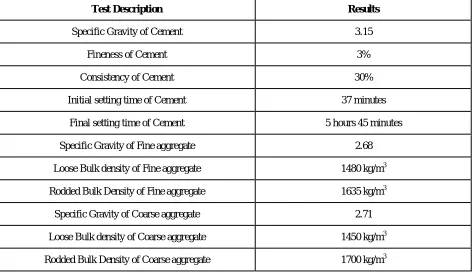
Table 1: Material test results
Test Description Results
Specific Gravity of Cement 3.15 Fineness of Cement 3% Consistency of Cement 30% Initial setting time of Cement 37 minutes
Final setting time of Cement 5 hours 45 minutes Specific Gravity of Fine aggregate 2.68 Loose Bulk density of Fine aggregate 1480 kg/m3 Rodded Bulk Density of Fine aggregate 1635 kg/m3
Specific Gravity of Coarse aggregate 2.71 Loose Bulk density of Coarse aggregate 1450 kg/m3 Rodded Bulk Density of Coarse aggregate 1700 kg/m3
III.MIX PROPORTION
Silica fume, also known as microsilica is an amorphous polymorph of silicon dioxide, silica. It is an ultrafine powder collected as a by-product of the silicon and ferrosilicon alloy production and consists of spherical particles with an average particle diameter of 150 nm. The bulk density of silica fume depends on the degree of densification in the silo and varies from 130 (undensified) to 600 kg/m3. The specific gravity of silica fume is generally in the range of 2.2 to 2.3.
Table 2:Mix Proportion
Mix Cement Silica fume Fine
aggregate
Coarse
aggregate Water
Super plasticizer
M20 1 - 1.58 2.51 0.45 -
M40 1 0.1 1.9 3.16 0.36 0.02
IV. EXPERIMENTAL SETUP
After the specimens have been made, they shall be left to stand undisturbed in their moulds in a place free from vibration at a temperature of 27+ 2oC for at least one hour, prior to immersion in the curing tank. The time between the addition of water to the ingredients and immersion of the test specimens in the curing tank shall be at least 1hour 30 minutes but shall not exceed 3hour and 30 minutes.
The specimen in their moulds shall be gently lowered into the curing tank and shall remain totally immersed at 55+ 2oC for a period of not less than 19 hours 50 minutes. The specimens shall be removed from the water, marked for identification, removed from the moulds and immersed in the cooling tank at 27+ 2oC before the completion of 20 hours 10 minutes from the start of immersion in the curing tank. They shall remain in the cooling tank for a period of not less than 1 hour. After that the specimens shall be tested while still wet, not more than 2 hours from the time of immersion in the cooling tank.
V. RESULT AND DISCUSSION
In this experimental work a total number of 42 cubes and 42 cylinders were cast and tested. Out of these, 36 cubes and 36 cylinders were tested for Immersion curing and wet gunny bags curing respectively. Out of which,18 cubes and 18 cylinders were cast and tested for normal strength of concrete(M20) and medium strength of concrete(M40) through Immersion and wet gunny bags curing method. Remaining 6 cubes and 6 cylinders were tested for Accelerated warm water curing method.
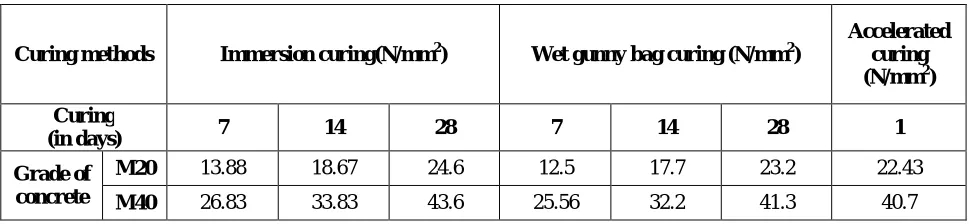
Table 3: Test Result for Compressive Strength
Curing methods Immersion curing(N/mm2) Wet gunny bag curing (N/mm2)
Accelerated curing (N/mm2)
Curing
(in days) 7 14 28 7 14 28 1
Grade of concrete
M20 13.88 18.67 24.6 12.5 17.7 23.2 22.43
Fig 1:Effect of three types of curing on compressive strength of concrete for M20 grade of concrete
From Figure 1, it can be concluded that the compressive strength of concrete cubes by Immersion curing method was achieved that 56.42% and 74.8% of 28 days strength at 7 days and 14 days respectively for M20 grade of concrete. The compressive strength of concrete cubes by wet gunny bags curing method wa s achieved that 53.8% and 76.2% of 28 days strength at 7 days and 14 days respectively for M20 grade of concrete.
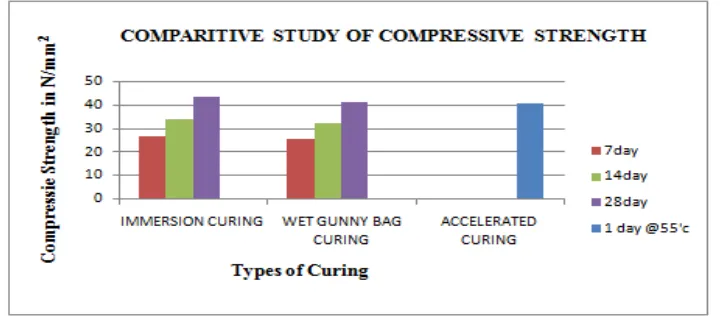
Fig 2:Effect of three types of curing on compressive strength of concrete for M40 grade of concrete
From Figure 2, it can be concluded that the compressive strength of concrete cubes by immersion curing method was achieved that 61.5% and 77.5% of 28 days strength at 7 days and 14 days respectively for M40 grade of concrete. The compressive strength of concrete cubes by Wet gunny bags curing method was achieved that 61.8% and 77.8% of 28 days strength at 7 days and 14 days respectively for M40 grade of concrete.
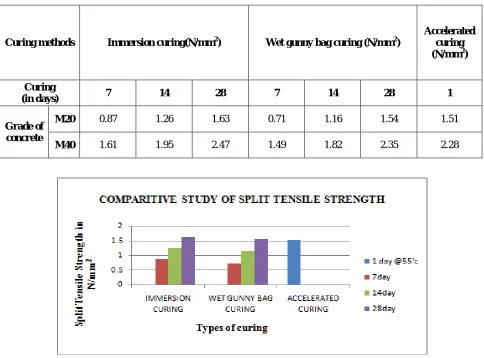
Table 4: Test Result for Split Tensile Strength
Curing methods Immersion curing(N/mm2) Wet gunny bag curing (N/mm2)
Accelerated curing (N/mm2)
Curing
(in days) 7 14 28 7 14 28 1
Grade of concrete
M20 0.87 1.26 1.63 0.71 1.16 1.54 1.51
M40 1.61 1.95 2.47 1.49 1.82 2.35 2.28
Fig 3: Effect of three types of curing on split tensile strength of concrete for M20 grade of concrete
Fig 4: Effect of three types of curing on split tensile strength of concrete for M40 grade of concrete
From Figure 4, it can be concluded that the split tensile strength of concrete cylinders by Immersion curing method was achieved that 65.2% and 78.9% of 28 days strength at 7 days and 14 days respectively for M20 grade of concrete. The compressive strength of concrete cubes by wet gunny bags curing method wa s achieved that 63.4% and 77.4% of 28 days strength at 7 days and 14 days respectively .After 28 days it was seen that the strength achieved by Immersion curing and Accelerated curing was 1.05% higher and 0.97% lesser than Wet gunny bag curing respectively for M40 grade of concrete.
VI. CONCLUSION
In this experimental work a total number of 42 cubes and 42 cylinders were cast and tested. Out of these, 36 cubes and 36 cylinders were tested for Immersion curing and wet gunny bags curing respectively. Out of which,18 cubes and 18 cylinders were cast and tested for normal strength of concrete(M20) and medium strength of concrete(M40) through Immersion and wet gunny bags curing method. Remaining 6 cubes and 6 cylinders were tested for Accelerated warm water curing method
a. From the experimental test results the following conclusions were made,
II. The Immersion curing and Wet gunny bag curing attained an average compressive strength of 24.6 N/mm2 and 23.2 N/mm2 respectively for M20 grade of concrete at the age of 28 days. At same age, the Immersion curing and Wet gunny bag curing attained an average compressive strength of 43.6 N/mm2 and 41.3 N/mm2 respectively for M40 grade of concrete.
III. At the age of 28 days by Immersion curing and Wet gunny bag curing attained an average split tensile strength of 1.63 N/mm2 and 1.54 N/mm2 respectively for M20 grade of concrete. In case of M40 grade the average split tensile strength of 2.47N/mm2 by Immersion curing and 2.35 N/mm2 by Wet gunny bags curing respectively.
IV. The average compressive strength of concrete cubes with Accelerated warm water curing method equivalent to 28 days was found to be 22.43 N/mm2 for M20 grade
V. The average compressive strength of concrete cubes with Accelerated warm water curing method was 40.7 N/mm2 for M40 grade of concrete.
VIII. From the experimental values it can be concluded that the optimum strength of concrete for compressive and split tensile strength was achieved by adopting immersion curing method for both normal and medium strength concrete.
IX. But as immersion curing is not practically possible the strength is being compared with Wet gunny bags curing which is practically done in the site.
X. The variation in average compressive strength of concrete for a normal strength of M20 grade by Immersion curing was observed to be 1.06% higher than Wet gunny bags curing. The results of Accelerated curing was found to be 0.96% lesser than Wet gunny bags curing. The variations in average split tensile strength by Immersion curing was observed to be 1.06% higher and by Accelerated curing 0.98% lesser when compared with Wet gunny bags curing method.
XI. The variation in average compressive strength of concrete for a medium strength of concrete of M40 by Immersion curing was observed to be 1.06% higher than Wet gunny bags curing and by Accelerated curing it was 0.98% lesser than Wet gunny bags curing. The variations in average split tensile strength by Immersion curing was observed to be 1.05% higher and by Accelerated curing 0.97% lesser when compared with Wet gunny bags curing method.
XII. Though M20 and M40 grade of concrete results in lesser percentage by Accelerated warm water method of curing compared to Wet gunny bag curing method, the results obtained by this Accelerated warm water method was higher than 1.12% and 1.02% of required value for both M20 and M40 grade of concrete.
XIII. Since the variation in results, while compared to all three methods of curing are very close to the actual value and also the result of Accelerated warm water method of curing can be obtained within 24 hours, it is strongly recommended to use in prefabrication industry to obtain quick results and reduce the expenses.
REFERENCES
[1] Ajay Goel, JyotiNarwal, VivekVerma, Devender Sharma and Bhupinder Singh , “A Comparative Study on the Effect of Curing on the Strength of Concrete ”,International Journal of Engineering and Advanced Technology (IJEAT), Volume-2, Issue-6, ISSN: 2249 – 8958, August 2013.
[2] Akeem Ayinde Raheem , Aliu Adebayo Soyingbe and Amaka John Emenike,, “Effect of Curing Methods on Density and Compressive Strength of Concrete”,International Journal of Applied Science and Technology, Vol. 3 Issue - 4, 2013.
[3] Denny Meyer, “A Statistical Comparison Of Accelerated Concrete Testing Methods”,Journal of Applied Mathematics & Decision Sciences, vol. 1, Issue-.2, pp 89-100 ,1997.
[4 ]Reliability of accelerated curing techniques for speedy design of concrete mixes – An appraisal of IS 9013:1978 code.
[5] Krishna Rao, M..V, Rathish Kumar, P, and Azhar Khan, M, “A study on the influence of curing on the strength of a standard grade concrete mix”, Architecture and Civil Engineering, Vol. 8, Issue- 1, pp. 23 – 34, 2010.
[6] Abalaka,A.E,, and Okoli,O .G, “Influence of curing regime on strength development of grade C60 concrete” , International Journal of Modern Engineering Research (IJMER), Vol.3, Issue.2, , pp-709-714. March-April.2013.
[7] Safiuddin , Raman S. N, and. Zain, M , “Effect of Different Curing Methods on the Properties of Microsilica Concrete”,,Australian Journal of Basic and Applied Sciences, vol.1, Issue-.2, pp 87-95, 2007.
[8] Ali H. Hameed , “The effect of curing condition on compressive strength in high strength concrete”, ISSN 1999-8716 Vol. 02 ,pp. 35-42,2009. [9] Krishna Reddy,K.V., “A comparative study on methods of curing concrete influence of humidity”, International Journal of Engineering Research and Applications (IJERA) ISSN: 2248-9622 Vol. 3, Issue 3, pp.1161-1165, May-Jun 2013.
[10] IS 10262:2009 Concrete mix proportioning – guidelines.