Multiuser Detection for
CDMA Systems
A.
Duel-Hallen
J.
Holtzman
Z. Zvonar
.~
-Center for Communications
and
Signal Processing
Department of Electrical
and
Computer Engineering
North Carolina State University
y/l0
c
o
n
AJLo
MULTIUSER DETECTION FOR CDMA SYSTEMS
Alexandra Duel-Hallen*, Jack Holtzman**, Zoran Zvonar***
*CCSP, North Carolina State University, **WINLAB, Rutgers University, ***Woods Hole
OceanographicInstitute
Abstract
Present day direct sequence code division multiple access (DS/CDMA) systems treat each user separately as a signal, with all ofthe other users representing interference or noise. Potentially significant capacity improvements can be achieved
if
the negative effect that each user has on the others is cancelled. In other words, joint detection (multiuser detection), rather than separate detection, is beneficial. Optimal multiuser detection is, however, too complex. Thus, suboptimal approaches have been investigated. The basic principles of optimal and suboptimal multiuser detection are well understood now and effortis underway on investigating practical and economic feasibility.1.
Introduction
Spread spectrum has been very successfully used by the military for decades. Recently, spread spectrum based code division multiple access (CDMA), has taken on a significant role in cellular and personal communications. Multiple access allows multiple users to share limited resources such as frequency (bandwidth) and time. There are a number of multiple access schemes including more than one type of CDMA. We shall concentrate on one type, Direct Sequence CDMA (DS/CDMA). CDMA has been found to be attractive because of such characteristics as potential capacity increases over competing multiple access methods, anti-multipath capabilities, soft capacity and soft handoff.
We shall not here cover all the background of DS/CDMA since that has been well explained in recent literature (see e.g., [VI94]). In fact, the present article may be viewed as a supplement to that literature with an update on some potential enhancements to the versions of DS/CDMA currently being developed (see [GI91], [PI9!])·. We will show that there is a natural modification of the present systems, multiuser
detection, that is potentially capable of significant capacity increases.
By
"natural modification" we mean amodification that can be made conceptually clear, not that it is easy to implement. Indeed, the optimal multiuser detector is much too complex and most of the present research addresses the problem of simplifying multiuser detection for implementation. The objective of this article is to make the basic idea
intuitive and then show how investigators are trying to reduce the idea to practice. As a result of these
investigations, an answer is expected to the following question: Is there a suboptimal multiuser detector that is cost effective to build with significant enough performance advantage over present day systems? We will first review some salient features of CD MA systems needed for the discussion following.
1. 1 Limitations of a conventional cDMA System
A conventionalDSteDMAsystem treats each user separately as a signal, with the other users considered
as interference (multiple access interference,MAl), or noise. The detection of the desired signal is
protected against the interference due to the other users by the inherent interference suppression capability of CDMA, measured by the processing gain. The interference suppression capability is, however, not unlimited and as the number of interfering users increases, the equivalent noise results in degradation of
performance, i.e., increasing bit error rate (BER). Even ifthe number of users is not too large, some
users may be received at such high signal levels that the desired user may be swamped out. This is the
nearlfar effect:users near the receiver are received at higher powers than those far away, and those further
away suffer a degradationin performance. Even if users are at the same distance, there can be an effective
near/far effect because some users may be received during a deep fade. DS/CDMA systems are very
sensitive to the near/far effect and the recent success of DS/CDMA has, in large part, been due to the
successful implementation of relatively tight power control, with attendant added complexity.
There are thus two key limits to present DS/CDMA systems:
• All users interfere with all other users and the interferences add to cause performance degradation.
• The near/far problem is serious and tight power control, with attendant complexity, is needed to
combatit
1 . 2 Multipath Propai:ation
One other aspect of CDMA that we need to review is the ability to combat multipath reception of signals [TU84]. Due to multiple reflections, the received signal contains delayed, distorted replicas of the original
transmitted signal. First, consider what happens in a non-spread spectrum system. When the multiple
reflections, called multipath signals or simply multipaths, from one transmitted bitare received within the
time duration of one bit, the received signal consists of the superposition of the several signal replicas, each with its own amplitude and phase. It is important to recognize that this superposition is the addition
of complex quantities. Due to the motion of the mobile (or, even of the base stationinsome systems), the
relative phases of the received signals are continually changing. This results in successive reinforcement
and interference of the superposed multipath signals, resultinginvery large time variations in the received
signal. Such variations are referred to as Rayleigh fading (or Rician fading, if there is a direct component in addition to the reflections). The variations due to Rayleigh fading are a serious cause of performance degradation and a communication system must be designed carefully, taking that into account.
CDMA systems are inherently wideband when the chip duration, as opposed to the longer bit duration, is compared to the time between multipath receptions. One can then combat multipath interference by multipath reception, whereby the different multipath arrivals are considered as independent receptions of the signal and are used to give a beneficial time diversity. This is usually done with a RAKE receiver, the name apparently from the operation of a RAKE with a number of teeth pulling in a number of items simultaneously. So, instead of multipath being just a source of performance degradation, the multipaths are used to provide the benefit of diversity [PR89].
1. 3 Interference cancellation and Multiuser Detection
In a conventional CDMA system, all users interfere with each other. Potentially significant capacity
increases and near/far resistance can theoretically be achieved if the negative effect that each user has on
others can be canceled. A more fundamental view of this is multiuser detection in which all users are
considered as signals for each other. Then, instead of users interfering with each other, they are all being
used for their mutual benefit by joint detection. The drawback of optimal multiuser detection is one of
complexity so that suboptimal approaches are being sought. There is a wide range of possible
performance/complexity combinations possible. Much of the present research is aimed at finding an appropriate tradeoff between complexity and performance.
1. 4 Multiuser Detection in cellular Systems
In a cellular system, a number of mobiles communicate with one base station (BS). Each mobile is concerned only with its own signal while the BS must detect all the signals. Thus, the mobile has the
information only about its own chip sequence while the base stationhas the knowledge ofall the chip
sequences. For this reason, as well as less complexity being tolerated at the mobile (where size and weight are critical), mulituser detection is currently being envisioned mainly for the BS, or in the reverse link (mobile to BS). It is important to realize, however, that the BS maintains information only on those mobiles in its own cell. This plays a role in the limitations on improvements to be expected in a multiuser detection system, to be discussed next
1.5 Limitations to Improvements
Before we discuss multiuser improvements to the conventional DS/CDMA detector, it is important to define factors that limit such improvement [H094]. One factor is intercell interference in a system that
cancels only the intracell interference" I. For intercell interference which is a fraction f of the the
intracell interference, the bound of capacity increase (all of the intracell interference is cancelled) is
(1+/)/
f .
For /=0.55, this factor is 2.8 [VI94]. Observe that with a sectorized antenna, it isconceivable to cancel users from another sector and thus improve the bound.
Another limiting factor is the fraction,
t..
of energy captured by a RAKE receiver. That is, a RAKEreceiver with L branches or "fmgers" will try to capture the power in the L strongest multipath rays but
there will be additional received power in additional rays. For the conventional detector, this is self-interference. Ref. [CH92] gives examples of the fraction of captured power. The fraction of captured
power is a function of chip rate and delay spread as well as the number of RAKE branches. So,
combining the two effects (measured by
I
andIe)'
the total interference before cancellation is(1 +
1)1
(neglecting the smaller self-interference due to uncaptured multipath power of the desired user).
Cancellation removes at most
leI
so the bound on improvement is(I-+:-
I) /
(1+
f -
Ie).
ForIe
= 1, theabove bound of 2.8 on capacity improvement remains. For
Ie
=
0.5, the bound is reduced to 1.5.It should be recognized that multiuser detection is used not only to increase capacity but also to alleviate the near/far problem, and the preceding bound does not account for that benefit. Relaxing the power control
requirement actually translates into a capacity benefit whichis, however, more difficult to quantify than by
the above simple signal/interference argument. A multiuser detector could recapture part ofthisreduction
by reducing variability (or relax the requirements on power control).
To put these constraints on improvements into further perspective, we are assuming here that multiuser
detection is a candidate primarily for the reverse link:for reasons given earlier. Since the reverselink:is
usually more limiting than the forward link, increasing the reverse link capacity will improve the overall system capacity. But increasing it beyond the forward link capacity will not further increase the overall system capacity. Thus,
(i) The potential capacity improvementsincellular systems are not enormous (order of magnitude) but
certainly non-trivial
(ii) Enormous capacity improvements only on the reverse link (the candidate for multiuser detection)
would onlybepartly used anyway in determining overall system capacity
(iii) Hence, the cost of doing multiuser detection must be as low as possible so that there is a performance/cost tradeoff advantage to multiuser detection.
The bottom lineisthat there are significant advantages to multiuser detection which are, however, bounded
and a simple implementationisneeded.
1.
6
Historical BackeroundThe idea of interference cancellation arises in many contexts, e.g., noise cancellation in speech [LI83] and adaptive interference canceling as in Chapter 12 of [W18S]. There 'are thus a number of non-CDMA references with ideas similar to those being currently studied for CDMA. We should distinguish between
canceling noise which has no useful purpose (as in [LI83], Chap. 12 of [WI8S]) from canceling
type of cancellation also is of importance in CDMA systems, e.g., in suppressing narrowband interference
(this is not discussed in this article, but is discussed in Section 5 of [PI91]). Both types of interference
cancellation have in common the goal of removing from a desired signal a noise-like interference. Butin
the second type (the type considered here), the fact that the signals being removed are themselves
information carrying leads to a new viewpoint, one of simultaneously detectingall the information carrying
signals.
The first CDMA interference cancellation references we are aware of are [SC79] and [K083]. Both of these papers delineate a number of ideas that are present in much of the 'ongoing research. Estimates based on mean square error and maximum likelihood are discussed in [SC79]. Reference [K083] shows how cancellation is implemented by solving simultaneous equations, in essence, by inverting a key matrix. There were subsequently a number of papers with variants of the ideas of [SC79] and [KG83].
Significant theoretical steps forward were taken in [VE86], [VE86a] (withearlier references),in analyzing
the structure and complexity of optimal receivers. This work triggered a new research effort on
suboptimal algorithms. The strong connection between MAl and intersymbol interference (ISn was also made in [VE86]. There are aspects of MAl, however, that are not shared by lSI:
• The near/far problem, and
• MAl is affected by the relationship among user chip sequences (codes) as well as by the
imperfections of the radio channel, while lSI is due only to the channel.
Thus while equalization (used to combat lSI) will playa role in the multiuser detectors to be discussed, it should not be expected that it can be used without modification.
Recent survey papers include [VE94], [H094]. We shall let the rest of the references be brought up as
neededin the discussion.
K
Y
ny2
n
codeK
xK
ncode 1
xl
net)
n
matched
yet)
filter
code 2
bank
x
2n2.
Multiuser Detection: Concept and Techniques.
Cl
2 · 1 The cDMA Channel Model and Approaches to Detection.
ACDMAchannel with K users sharing the same bandwidth is shown in Figure2-1. The signaling interval
of each user is T seconds, and the input alphabet is antipodal binary: {+1, -I}. The objective is to detect
those polarities, which contain the transmitted information. During the n-th signaling interval, the input
vector is xn=(xn1 , ... , xnK)T, where xnk is the input symbol of the k-th user. User k (ke l , ... , K) is
assigned a signature waveform (or code, or spreading chip sequence) Sk(t) which is zero outside[O,T] and
is normalized
T
J
Sk(t)2 dt=1o
Pulse amplitude modulationisemployed at the transmitter. The baseband signal of the k-th useris
00
Uk(t) =
L
XikCik sk(t-iT-"Ck),i=O
(2-1)
where'tkis the transmission delay, and Cik is the complex channel attenuation. According to (2-1), each
user's signal travels along a single path, so this model does not illustrate multipath propagation. The effect
of multipath is discussed in sections 1 and 3. For synchronous CDMA, the delay 'tk= 0 for all users. For
asynchronous CDMA, the delays can be different. The channel attenuation is a complex number
whereWik and 8ik are the received power and phase of the k-th user, respectively. The received signal (at
baseband) is the noisy sum of all the users' signals:
K
yet)
=
L
Uk(t)+Z(t),k=l
(2-2)
where z(t) is the complex additive white gaussian noise (AWON). The first step inthe detection process is
to pass the received signaly(t)through a matched [titer bank (or a set of correlators). It consists ofK filters
matched to individual signature waveforms followed by samplers at instances Tn+'tk, k=l, ... ,K, n=I,2,
.... The outputs of the matched filter bank form a set of sufficient statistics about the input sequence Xn given yet) [VE86]. Thus, we will consider the equivalent discrete-time channel model which arises at the output of the matched filter bank.
simplification will represent another factor to consider for the multiuser detection system.) We will consider a synchronous CDMA system with real channel attenuation. The synchronous assumption simplifies analysis and often permits the derivation of closed-form expressions for the desired performance
measures. These are useful since similar trends are found in th'e analysis of the more complex
asynchronous case. The real model is convenient for analyzing coherent methods, and can be easily
generalized to the complex case. For synchronous CDMA, the output signal yet) (2-2) for nT~t
<
(n+ l)Tdoes not depend on the inputs of other users sent during past or future time intervals. Consequently, it is
sufficient to consider a one-shot system with input vector xn=(x l , ... , xK)T, real positive channel
attenuations (amplitudes)
cl=~
, ... ,cK=....J
wK and real additive white Gaussian noise z(t) with powerspectral density NO. The sampled output of the k-th matched filter (matched to the signature waveform of user k) is
(2-3)
T T K
s.
= f y(t)sk(t)dt=f Sk (t)[LS/t)ci xi+
z(t)]dto 0 j=l
K T T
=CkXk
+
Lxici f Sk(t)s/t)dt+f Sk(t)z(t)dtj~k 0 0
Note that Yk consists of three terms. The first is the desired information which gives the sign of the
information bit ~ (which is exactly what is sought). The second term is the result of the multiple access
interference (MAl), and the last is due to the noise. The second term typically dominates the noise so that one would like to remove its influence. Its influence is felt through the cross-correlations between the chip
sequences and the powers of users. Ifone knew the cross-correlations and the powers, then one could
attempt to cancel the effect of one user upon another. This is, in fact, the intuitive motivation for interference cancellation schemes.
Suppose there are only two users in the system. Let r be the cross correlation between the signature
T
waveforms of the two users r = f S\ (t )S2(t)dt. In this case, the outputs of the matched filters are
o
yl
=
c l xl+
r c2x2+
zl and y2=c2x2+
r cl xl + z2. (2-4)The MAl terms for users 1 and 2 are r c2x2 and r c l xl, respectively. If these terms were not present, the
single user system would result. The bit error rate of the optimal detector for the single user system serves as a lower bound on the performance of any other detector. This single user bound is
PIeCE)
=
Q (
~
}
(2-5)where the Q-function
00
1
f
:i!:.
Q(x) = _
r.:::-
exp( 2 )dy.The conventionalDS/CDMAuses the same approach as the optimal receiver for the single user system. It
detects the bitfrom userk by correlating the received signal with the chip sequence of userk. Thus, the
conventional detector makes its decision at the output of the matched filter bank:
(2-6)
When MAl terms are significant (see (2-3)), the bit error rate of this detector is high. Note that MAl
depends both on the cross-correlations and the powers of users. In the 2-user example above, if user 1is
much strongerthan user 2 (the near-far problem), the MAl term r c l xl present in the signal of the second
user is very large, and can significantly degrade performance of the conventional detector for that user. A
multiuser detector called a successive interference canceller (decision-directed) can remedy this problem as
follows. First, a decision ~lis made for the stronger user I using the conventional detector. Since user 2
is much weaker then user 1, this decision is reliable from the point of view of user 2. So, this decision can
be used to subtract the estimate of MAl from the signal of the weakeruser, The decision for user 2 is given
by
~2=sgn (y 2 -r cl ~l) =sgn (c2x2
+
r c1(x! -~l)+z2). (2-7)Provided the decision of the first user is correct, all MAl can be subtracted from the signal of user 2. The performance of this successive interference canceller for the weaker user is the same as the performance of
the multistage detector proposed in [VA9I]. (However, for the stronger user, the canceller can be more
reliable.) Ifwe fix the energy of the second user, andlet the energy of the first user grow, the error rate of
the successive interference canceller for the second user will approach the single-user bound. Thus, this detector is successful in combating the near-far problem. This simple example motivates the use of multiuser detectors for CDMA channels. Below, we will discuss several previously proposed multiuser detectors.
2.2. The Decorrelatine Detector
As a step towards the most general formulation, consider the matrix version of the of the equivalent
discrete time model
(2-3).
The output vectory
= [ /,l,...
,yKf
(seeC2-3»
can be expressed asy
=
R W x+z, (2-8)where Rand Ware KxK matrices, and z is a colored Gaussian noise vector. The components of the
matrix R are givenbycross-correlations between signature waveforms
T
Rk,j
=
J
Sk(t) Sj(t) dto
The second matrix, W, is diagonal with Wk,k given by the channel attenuation ck of the k-th user. For example, in a two-user system, the matrix
where r is the cross-correlation between the signature waveforms of the users (2-9) (with k= 1, j=2).
Inspection of (2-8) immediately suggests a method to solve for x, whose components xk contain the bit
information sought. If z was identically zero, we have a linear system of equations,y = R W x, the
solution of which can be obtained by inverting R (it is invertiblein most cases of interest [LU89]). With a
non-zero noise vector z, inverting R is still an effective procedure and actually optimal in certain
circumstances, to be discussed later. This resultsin
(2-10)
where it is seen that the information vector, x, is recovered but contaminated by a new noise term (Figure
2-2). From (2-10), the signal of the k-th useris
(2-11)
The decision is ~k=sgn (
yk ).
f'l
1
y
r
=:f=
I
I
I
y 2 ~2
matrix
1I
I
=:f=
I
I
•
filter R-
•• •
•
•yK
£,K
I
=:f=
I
I
I
Fieure 2-2. The Decorrelator for Synchronous cDMA
Note that the decorrelating detector completely eliminates MAl However, the power of the noise
zk
is NOfor the 2-user system with the cross-correlation r, the noise power at the output of the decorrelating filteris
No'(1-r2). The error rate of the decorrelator is given by
Pk(E) =Q
(~
(NO:-\k'k)I
The performance of the decorrelating detector degrades as the cross-correlations between users increase. The decorrelating detector also reduces to matrix inversion for the asynchronous case, although the derivation is more involved in that case [LU90]. The decorrelator has several desirable features. It does not require the knowledge of the users' powers, and its performance is independent of the powers of the
interfering users. This can be seen from (2-11). Observe that neither signal nor noise terms depend on the
powers of interferers. In addition, when users' energies are not known, and the objective is to optimize performance for the worst case MAl scenario, the decorrelator is the optimal approach [LU89]. In addition, the differentially coherent version of the decorrelator has been developed (see section 3). These properties of the decorrelator make it very well suited for the near-far environment.
Multiuser detection is closely related to equalization for intersymbol interference(lSI)channels [PR89]. For
example, the decorrelating detector is analogous to the zero-forcing equalizer. Similarly, the MMSE linear
multiuser detector [XI90] (also given by a matrix inverse) is the multidimensional version of the MMSE
linear equalizer for the single-user lSI channel. The linear structure of these detectors often limits their
performance. In the following section, we will describe several non-linear approaches to multiuser
detection.
2. 3 The Optimal Detector
The objective of maximum-likelihood sequence estimation (MLSE) is to find the input sequence which maximizes the conditional probability, or likelihood of the given output sequence [PR89]. For the simplified synchronous CDMA problem discussed above, the maximum likelihood decision for the vector
of bits,
x,
is given by~
= arg{ max A2yTWx- bTWRWb]}xe{-l,+l}
This equation dictates a search over the 2K possible combinations of the components of the bit vector x.
For asynchronous CDMA, the MLSE detector can be implemented using the Viterbi algorithm [VE86].
The path metrics of this algorithm were derived by identifying the asynchronous CDMA channel with a single-user channel with periodically time-varying lSI. The memory of this equivalent channel is K-l (the
updates per transmission interval. Although the optimal detector has excellent performance, it is too complex for practical implementation, and we will not discuss it in greater detail.
2. 4 Non-Linear Suboptimal Multiuser Detectors
In this section, we will consider several interference cancellation methods which utilize feedback to reduce
MAlinthe received signal. These algorithms can be broken into three classes:
(1)
(2)
(3)
the multistage detectors [e.g., VA90,GI93,VA91,XI90]; the decision-feedback detectors [DU92, DU93, DU94];
successive interference cancellers (this idea is explicit or implicitina number of papers)
Remark: or (3).
Particular realizations of suboptimal multiuser detectors may use combinations of(1), (2),
The first two classes of algorithms are decision-directed. They utilize previously made decisions of other users to cancel interference present in the signal of the desired user. These algorithms require estimation of channel parameters and coherent detection. The algorithms in the third class use estimates of transmitted signals (e.g., outputs of the correlation receivers in [PA94]) to remove MAl components. They lend themselves to differentially coherent implementation. The algorithms of the second and third classes employ successive interference cancellation (also proposed in [VI90]), which requires ordering of users according to their powers. The signals of stronger users are demodulated first and cancelled from the signals of weaker users. This technique provides an efficient and practical solution to the near-far problem.
Several representatives from the three classes of non-linear detectors are described below.
n)
stage
stage
1
X(1 )
2
x(2)
stage
.
-" - - -
.
n
x(
.
-y
2.4.1 Multista~eDetectors
A diagram of the multistage detector proposed in [VA90, VA91] is shown in fig. 2-3. The n-th stage of
this detector uses decisions of the (n-l)-st stage to cancel MAl presentin the received signal. Due to delay
constraints, it is desirable to limit the number of stages to two. For example, consider a two-stage detector
with the conventional first stage for the synchronous 2-user system with the cross-correlation r (2-4). The
decisions produced by the first stage (conventional) detector are
i
1(1) and ~2(1) computed as in (2-6 ).The decisions of the second stage are
i
1(2)= sgn [y 1 -r c2 ~2(1)] and~2(2)=sgn [y2 -r c1 ~1(1)]. Theperformance of this two-stage detector depends on the relative energies of the users. Clearly, if the first
user is stronger than the second, the decisions of the second stage for user 2 agree with those of the
decision-directed successive interference canceller describedin the last paragraph of section 2.1. Thus, for
the weaker user, the second stage produces more reliable decisions than the first stage. However, for the
stronger user, feedback might not be beneficial since the decision produced by the conventional detector for
the weaker user is poor. More reliable two-stage detector results if the conventional detector in the first
stage is replaced by the decorrelator [VA9I]. This example illustrates the issues which playa role the
design of multistage detectors. Insummary, the two important questiorts are:
• How to choose the initial stage.
• How to choose the subsequent stages of processing.
A discussion of different options for the initial and subsequent stages is given, along with further
references, in [GI93].
2.4.2 Decision-Feedback Detectors
Sorter
A
bl
C2fK2
cir
«
-yK
-y2
CK*
~-=
The detectors proposed in [OU92, DU93, DU94] are multiuser decision-feedback equalizers, characterized by two matrix transformations: a forward filter and a feedback filter. These detectors are analogous to the
decision-feedback equalizers employed in single user lSI channels [PR89]. However, in addition to
equalization, the decision-feedback multiuser detectors employ successive cancellation. In each time frame,
decisions are made in the order of decreasing user's strength, i.e. the stronger users make decisions first, allowing the weaker users to utilize these decisions. The sorting is performed by any multiuser detector with successive MAl cancellation. We will explain the rationale for using this particular order in section
2-4-3.
A diagram of the decorrelating (zero-forcing) decision-feedback detector for synchronous CDMA [DU93] is shown in Fig. 2-4. At the output of the sorter, users are ranked according to their powers, so that the strongest user is ranked first, and the weakest - last. Following the sorter, the noise whitening filter is applied. This filter is obtained by Cholesky factorization of the autocorrelation matrix, which yields a resulting MAl matrix which is lower triangular. Consequently, at the output of the whitening filter, the
signal of the k-th strongest user
Yk
is given by :Yk
=
desired signal+
MAl due to stronger users (1, ... .k-I)+
noise.In particular, the signal of the strongest user
Yl
is not corrupted by MAl, and can be demodulated firstThis decision is then used to subtract MAl from the signal of the' second user, and so on. For the
asynchronousCDMA several decision-feedback detectors were derived in [DU92, DU94].
The performance of the decision-feedback detector is similar to that of the decorrelator for the strongest user, and gradually approaches the single user bound as user's power decreases relative to powers of
interferers. Thus, for the decision-feedback detector, performance advantages with respect to the
conventional or the decorrelating detectors are greater for relatively weaker users. This is also the case for multistage detectors with the decorrelating first stage. Figure 2-5 depicts typical performance of several
detectors for the weakest user in a bandwidth efficient system. The signature waveforms for this
asynchronous 4-user CDMA system were derived from Gold sequences of length 7 [DU94]. (see also
[DU93, VA9I].) In Figure 2-5, the conventional, decorrelating, decision-feedback and multistage
detectors are compared for the weakest user (user 4). The powers of all users grow, but the differences
between the powers remains the same. Note that the two-stage detector with the conventional first stageis
interference-limited. Both the decision-feedback and the two-stage detector with the decorrelating first
100
conventional
10-1
+ + +
'"""' 10-2
0
--t::
eu
0 .. decorrelator
~
0 ...
0
10-3 ":.::: ...
.,,0
~ " "
.,,0
"
0
'""'" 10-4
c,
10-5
10-6- - - . . . L . . - - - L . - -_ _----L ----L.----.J
13 12
10
9 11
SNR(4)
Figure 2-5. Error rates for user 4 in the four-user system of [DU94].
SNR(3)=SNR(4)+3 dB, SNR(2)=SNR(4)+4 dB, SNR(I)=SNR(4)+5 dB.
· · · . · . · .· . . dfand ideal df
+ +
2-stage df, 1st stage - conventionalo 0 2-stageelf, 1st stage - decorrelator
2.4.3 Successive Interference cancelers
One approach to successive interference cancellation is to consider what would be the simplest augmentation to the conventional detector which would achieve some of the benefits of multiuser detection. This can be explained most simply by referring back to (2-3). In order to cancel the MAl, the factors
xici
are needed, in addition to the cross-correlations. These can be obtained either with estimates of eachof the factors
xi
and ciseparately, i.e., separation of the bit estimate and power estimates. Alternately, onecan estimate the product
xic
i directly by using the correlator output. We shall focus on the latter methodbecause that requires the simplest augmentation to the conventional detector. It is found that using the correlator output to estimate xici is sufficiently accurate to obtain improvement over the conventional detector.
As
mentioned previously, it is most important to cancel the strongest signal before detection of the otherhas the minimum MAl since the strongest signal is excluded from its own MAl. This is the twofold rationale for doing successive cancellation in order of signal strength:
(i) Canceling the strongest signal has the most benefit.
(ii) Canceling the strongest signal is the most reliable cancellation.
30
15 20 25
Number of ActiveUsers
_..._-_...-. .-. ---..._...- -- .- ·t·_-- --- --_..._-
_._---_
..._- ._.-_._.-....~
---t----·---t·
._..__.-...-..._._.__.__
.~-..
IC;)nventi~na1· ---'.
._-:=-.
§§§=
~ ~.§§§~
.-I . I
i L i
·1···--SuccessiV~Cane?"! ~.
¥~:~:-~~~~~~~~~?~I~~?J.~r:1~~~~~~~~~~T
'Y"Il I - , - - . , , - , , , . .I ...:--·1.-J;ououlel·€tane=-!...
i ...-
Parall~iC 2j . / .•••••• • anc.
~~~~~~~~~~~~~~~~lf:~~~~~~~~~~~~~\I~[~~~~J~~~\~~·
_._....-....-._..._.-..._-_..._._.."-._..._.-
...-._..._._..._._..._._~.._._..._._..._._...._._...-_..-.~...-_._..._..._...-...; i i
! ! !
Ie-OS
10 0.01
et:
UJ aJ
0.001
oil
>
-e
0.0001
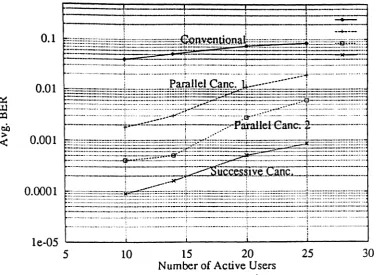
In a number of studies (e.g., [DE92]··· [PA94], [PA94a]), it has been shown that this method of cancellation yields significant improvements over the conventional detector (but substantially less than the optimum multiuser detector).
0.1
Figure 2.6 - BER vs # of Active Users under Ideal Power Control (Asynchronous)
Successive cancellation works by successively subtracting off the strongest remaining signal. An
alternative (the parallel method) is to simultaneously subtract off all of the users' signals from all of the others. It is found [PA94a] that when all of the users are received with equal strength, the parallel method outperforms the successive scheme (Figure 2.6). When the receivedsignals are of distinctly different strengths (the more important case), the successive method is superior in performance (Figure 2.7). The important thing to note is that in both cases, both outperform the conventional detector and the unequal power case is the more important case.
30 25
15 20
Number of Active Users
10
r---t·----+----4---===:::r=-=-::.-.---.-
i-+::::--I , .
-T
! ~:::-:·-Pntallet·€anc:..~-·_···_·-·..-·-···-·-....11\1~~~~~~~rJ~1~~~~~§~~~~~1~;~i~i~~~~1~1~~~1~1~~~1~~~~1~~i~r
__._.__.
l_.
._.__
._._~uc~:e~~Siv~~Canc:·--·l--·--.-.-..._.-...---....
1~.~[~·[.~.~:1.~.~~1~~~~~'~~i·!~j~~:::~~~~~~~\!.~~:j::~~~~.~~i:ili:i~iiii~iii:~i·iiii:-i : ~
i
0.1
Ie-05
5
0.0001 0.01
IX
UJ
to
oil
>
0.001
«
Figure 2.7 · BER vs # of Active Users under' Rayleigh Fading
(Asynchronous)
The successive cancellation must operate fast enough to keep up with the bit rate and not introduce
intolerable delay. For this reason, it will presumably be necessary to limit the number of cancellations. The
ability to limit the number of cancellations is consistent with the objective of controlling complexity by
choosing an appropriate performance/complexity tradeoff. For more information and references on
successive interference cancellation, see [H094].
3.
Noncoherent Multiuser Detection and Multipath Fading Channels
For the sake of simplicity of exposition, most of the discussion in Section 2 concentrated on coherent
multiuser reception. The underlying assumption there is that the multiuser receiver is able to estimate and
track the phase of each active user in COMA scenario. However, as stated earlier, a reverse link. of a
cellular COMA system employs noncoherent reception since the pilot signal which provides a coherent
reference is not available. We willbriefly address the concept of noncoherent multiuser detection and also
analyze the multiuser receiver performance in multipath fading channels.
All noncoherent multiuser techniques perform in-phase and quadrature (I & Q) demodulation before the
detection. The noncoherent multiuser detection was first considered for differentially phase-shift keying
(OPSK) [VA93]. The concept can be easily described as presented in Fig. 3.1. The decorrelating
operation is performed both on in-phase and quadrature signal branches (afterI &
Q
demodulation), sothe decorrelating filter eliminates MAl, differentially coherent demodulation and the same decision logic
can be applied as in single-user receiver. Moreover, this type of detector was shown to be optimally
near-far resistant
Decision User 1
Decision UserK Decorrelating
Filter
Decorrelating
Filter r(t)
Figure 3.1 - Differentially coherent decorrelating multiuser detector.
The resulting expression for the error probability in a synchronous case, given by
(3-1)
indicates that the performance loss compared to coherent reception is the same as in a single-user channel. The realization and performance of noncoherent decorrelating receiver do not depend on signal amplitudes and phases, and the only requirement for the described receiver to be near-far resistant is that chip sequences among the users are linearly independent.
Another noncoherent scheme is based on the idea of successive interference cancellation previously
describedin Section 2. A noncoherent version of successive interference cancellation uses a combination
ofM-ary orthogonal signaling and CDMA on the reverse link [PA94b]. After the I & Qdemodulation at
the receiver front-end, the received signal is correlated with respectiveI &
Q
chip sequences, the user'sspreading code and with all
M-ary
symbols obtained from Walsh functions. The interference cancellationalgorithm starts
by
decoding the strongest user first. The amplitude of the decoded user is estimated fromcorresponding chip sequence, and cancelled from the received signal. The cancellationisrepeated until all
users are decoded or until a limited number of cancellations are done. As in the case of differentially coherent multiuser reception, this concept can be extended to CDMA multipath fading channels as described in the next section.
3. 1 Multiuser Detection in Multipath Fadine Channels
As discussed in Section 1.2, multipath fading presents a major limitation to the performance of wireless
CDMA systems. Examples include cellular mobile radio, indoor wireless communications, personal
communication services and underwater acoustic local area networks. In these systems MAl is enhanced
by multipath propagation, and near-far effects are produced not only by the difference in the distance between the transmitter and receiver but also by the fading on the propagation paths. While multipath
propagation, usually encountered in an urban scenario, offers inher~nt diversity, certain scenarios in
suburban areas result in a single-path propagation [TU84] , [LE9!]. This depends on whether the
individual multipaths can be resolved which in turn depends on whether the chip duration is small enough relative to the separation between multipaths. In the case of single-path propagation small but nonzero cross-correlations among chip sequences can cause severe near-far problem in the presence of fading. When there is only a single fading path for each active user and interference is relatively strong, there are no means of diversity to overcome fading of the desired signal below the level of MAl, unless the explicit diversity using distributed antennas is introduced. Since multiuser receivers are near-far resistant, they
significantly improve the CDMA system performance in the single-path scenario [ZV94], [DU93a],
[PA94b], [WU94].
When the chip duration issmall enough to resolve the different multipath receptions, multipath diversityis
exploited to improve the performance in the presence of MAl. The conventional receiver in the case of
multipath fading channel consists of a bank of RAKE receivers, one for each active user, at the base
station and one for the desired user in a mobile. A summary of the research efforts on conventional
reception techniques is given in [KC93]. Consequently, having in mind the multipath combining
property ofRAKE receiver, all multiuser techniques in multipath fading channels utilize some form of
RAKE structure at the receiver front-end. With multipath resolution available, multiuser detection and
multipath diversity reception are combined to provide the reliable receiver performance.
The optimal MLSE receiver for multipath fading CDMA channel consists of the same front-end of RAKE
filters, followeed by a dynamic programming algorithm of the Viterbi type. This optimal structure
provides the same order of diversity and asymptotically has the same error probability as RAKE receiver in
the single-user case [ZV92], at the expense ofhighcomplexity.
Both linear and nonlinear suboptimal noncoherent multiuser receivers for multipath fading channels have
combining method depends on the modulation type. To eliminate the effects of MAl prior to the combining process, linear multipath decorrelating receivers [ZV92a], [WI93] perform the decorrelating
operation on KL correlator outputs, where L is the number of resolvable fading paths and K is the
number of active users as depicted in Fig. 3.2. Consequently, the equal-gain diversity combining for
DPSK signaling is performed on signals which suffer from less interference. The performance loss due the noise enhancement in the presence of other active users is modest, for the typical mobile radio scenarios it is on the order of 3dB compared to single-user RAKE performance over the whole range of SNRs [ZV93]. Similar performance degradations are observed for the 'coherent linear multiuser receivers [KL93]. When a fraction of the multipath power is captured due to limited number of RAKE correlators, only a portion of MAl is eliminated by decorrelating operation and residual MAl may cause the
performance degradation (recall Section 1). In that case additional antenna diversity was shown to be
effective in reducing the effects of the residual MAl [ZV93]. Another combination of multiuser detection and antenna diversity is given in [K090].
Multlpath Processing
.,(t)
MulUpath Dec::orrelatlng
To Diversity Combiner
user 1
r(t)
• ...(1)
:
FIlter P
To
t-~ Diversity
Combiner
I-~ userK
Figure 3.2 - Differentially coherent multipath decorrelatinglmuItipath combining linear multiuser receiver.
Nonlinear techniques for multipath fading channels rely on interference cancellation and inherently employ the regeneration of the interfering signals. The major difference among numerous interference cancellation
techniquesis in the methods for the channel parametersestimation and interfering signal reconstruction. A
· · terf nee cancellation receiver for noncoherentM-aryorthogonal modulation which uses the
successive m
llere
·
channel estimates is given in [PA94]. Since RAKE receivers are used in a front-end, each multipath
arrival tracked by RAKEiscancelled from the received signal using the appropriate correlator output as
shown in Fig. 3.3.
For any of the multipath multiuser detectors, the residual MAl problem of Section 1.5 couldarisewhen the
number of cancelled paths is smaller than the total number of multipathsinthe channel.
Figure 3.3 - Noncoherent receiver with interference cancellation and mnltipath combining.
4.
Issues in Practical Implementations
4.1 complexity
Major obstacles to the application of the multiuser detectors in practical wireless systems are processing complexity and possible processing delay. The optimal multiuser MLSE receiver is clearly too complex for any application in a system with a large user population, and most of the efforts are focused on implementation of suboptimal structures. Two promising techniques regarding receiver complexity are the linear sliding window decorrelating receiver [WI93] and the successive interference canceller using correlator outputs for amplitude estimates already discussed.
The sliding window decorrelating algorithm allows what may be practical implementation of the decorrelating detector, both for infinite and [mite data block lengths in asynchronous CDMA systems, by solving the linear system of equations described in [WI93]. The major cost in each iteration is due to
multipath and voice activity exploration. The computationally efficient algorithm for updating the
coefficients of the decorrelating filter is proposed by exploiting the parallelismin the linear system solution
[WI93a]. The number of operations for the correction of the matrix filter coefficients is on the order of
K x N whereK is the number of active users in CDMA system and N is the length of the sliding
window. The readily available technology for high-speed zero-forcing equalizers makes the decorrelator one of the simplest interference cancellation technique to implement [WI93a].
The successive interference cancellation scheme of Section 2.4.3 may be the simplest augmentation to the conventional detector. The major complexity in the multipath environment comes from tracking each
multipath at the RAKE receiver, which involves for each path M coefficients corresponding to the
possible M orthogonal symbols [PA94]. These coefficients are generated by a Walsh-Hadamard
Transform (WHT) and the speed of performing the transform determines the processing delay of the
canceller. To ensure the real-time implementation the speed ofWHT must be at least I x RwhereI is the
number of possible cancellations and R is the targeted symbol rate in the CDMA system. The complexity
of the successive interference cancellation scheme can be controlled by limiting the number of cancellations. That is, one can achieve a compromise between performance and complexity. Observe that
there is decreasing improvement with subsequent cancellations because cancellations are doneinorder of
strength of the different users' signals.
4.2 Sensitivity and Robustness
Almost all of the discussions and analyses of multiuser detection have assumed a number of idealizations.
For example,incancelling out a chip sequence, it has been assumed that there is a perfect synchronization
of each user. Clearly, ifthere are tracking errors, the chip sequences being cancelled will be offset and
imperfect cancellation willbe performed. The pertinent question is whether the tracking error tolerable for
the conventional detector is tolerable for the cancellation receiver, o~ how much tighter it must be for
multiuser detection. For the conventional detector, the synchronization must be within a fraction of a chip duration. The impact of tracking errors on the performance of successive interference cancellation receiver
is analyzed in [CH94]. For numerical results presented here, the interference cancellation scheme was
subject to pessimistic conditions:
• Did not use averaging of the correlator outputs for amplitude estimates which significantly im proves cancellation performance.
• Assumed equal received powers (perfect power control). The improvement over the
con-ventional detectorismuch greater in the more realistic case of unequal received powers.
Figure 4.1 shows results for a processing gain (number of chipslbit)
N
=31 and the total number of usersis varied from 5 to 20. There are 3 curves each for the interference cancellation scheme and the
with respect to chip duration (e =0 iszero tracking error). The interference cancellation scheme retains superiority over the conventional detector. Similar types of results were found in [LE94] from simulation of the scheme of [DE92]. While it is premature to draw any general conclusions about robustness of the interference cancellation receivers at this point, these results are promising.
24 22
20 18
16 14
12
... ···....·r··.. ·....····....···..···....··..··;···....···..
T..···..···..
T..···..··..····..···..···....:::::::::::::::::::::~::::::::::::::::::::::~:::::::::::::::::::::::;:::::::::::::::::::::::~::::::::::::::::::::::~::::::::::::::::::::::.;.:::::::::::::::::::::
::::::::::::::::::~;:Q~:~:~i:::::::::::::::::::::i:::::::::::::::::::::+:::::::::::::::::::::I::::::::::::::::::::::1:::::::::::::::::::::
···:~··.;·:···::·1··~····.... _~~._ : :... . : ,... . .
·:~::~:;.::~:~.:~.~:;;:~~~;:~~~:~::t~:~~::::~:::::::::t:::::::::::··:::::::I::::::::::::::::::::E··:::·:::::::::::::1:···::::::::::::·:
.' i
~ j ~10-1r---~---,..---.,...---...----...----r---'
10-4 \ -_ _...I.-_ _- - I - ~_ _- " " -_ _----t. ~_ _---'
10
NUMBER OF ACI1VE USERS
Figure 4.1.- BER Performance Degradation with Tracking Errors
s.
Concluding Remarks
The theoretical bases of optimal multiuser detection are well understood. Given the prohibitive complexity of optimum multiuser detectors, attention has been focused on suboptimal detectors, and properties of these
detectors are well understood by now. The next stages of investigation, involving implementation and
robustness issues, are accelerating now and will lead to determination of the practical and economic feasibility of the multiuser detector. Initial studies of robustness show that robustness does not appear to
bea fatal flaw. Further investigations into practicality will include actual hardware implementations.
References
[CA87]
[CH92]
James
w.
Carlin, Yeheskel Bar-Ness, Stephen Gross, Michael I. Steinberger and WilliamE. Studdiford, "An IFCross-Pol Canceller for Microwave Radio Systems," IEEE Journal
on Selected Areas in Communications, Vol. SAC-5, No.3, pp.502-514, April 1987.
L.F. Chang, "Dispersive Fading Effects in CDMA Radio Systems," Proc. of [CUPC '92
[CH94] [DE92] [DU92] [DU93] [DU93a] [DU94] [GI91 } [GI93] [H094] [Ke93] [KL93] [K083] [K090] [LE91]
Fang C: Cheng and Jack M. Holtzman, "Effect of Tracking Errors on DS/CDMA
Successive Interference Cancellation," To appear inProc. of Third Communication Theory
Mini Conference in Conjunction with Globecom '94 , San Francisco, CA, November 1994. P. Dent, B. Gudmundson and M. Ewerbring, "CDMA-IC: A Novel Code Division Multiple
Access Scheme Based on Interference Cancellation," Proc. of PIMRC '92,Boston, MA,
October 1992, pp. 98-102.
A. Duel-Hallen, "On Suboptimal Detection for Asynchronous Code-Division Multiple
Access Channels," Proc. of the Twenty-Sixth Annual Conference on Information Sciences
and Systems, Princeton University, Princeton, NJ, March 1992, pp. 838-843.
A. Duel-Hallen, "Decorrelating Decision-Feedback Multiuser Detector for Synchronous
Code-Division Multiple Access Channel," IEEE Transactions on Communications, Vol.
COM-41, No.2, pp. 285-290, February 1993.
A. Duel-Hallen, "Performance of Multiuser Zero-Forcing and MMSE Decision Feedback
Detectors for CDMA Channels," Conference Record of the Second Communication Theory
Mini-Conference in conjunction with Globecom '93,Houston, TX, December 1993, pp. 82-86.
A. Duel-Hallen, "A Family of Multiuser Decision-Feedback Detectors for Asynchronous
Code-Division Multiple Access Channels," IEEE Transactions on Communications, to
appear.
K.S. Gilhousen, I.M. Jacobs, R. Padovani, A.J.Viterbi, L.A. Weaver,Jr. and C.E.
Wheatley III, "On the capacity of a Cellular CDMA System," IEEE Transactions on
Vehicular Technology, Vol. VT-40, No.2, pp. 303-312, May 1991.
T.
R. Giallorenzi and S. G. Wilson, "Decision Feedback Multiuser Receivers forAsynchronous CDMA Systems," Proc. of Globecom'93, Houston, TX, Nov.- Dec. 1993,
pp. 1677-1681.
J. M. Holtzman, "DS/CDMA Successive Interference Cancellation," Proc. of ISSSTA '94 ,
Oulu, Finland, July 1994.
C. Kchao and G. Stuber, "Performance Analysis of a Single Cell Direct Sequence Mobile
Radio System,"IEEE Transactions on Communications, Vol. COM-41,No. 10, pp.
1507-1516, October 1993.
A. Klein and P. Baier, "Linear Unbiased Data Estimation in Mobile Radio System
ApplyingCDMA,"./EEE Journal ofSelected Areas in Communications,Vol. SAC-H, No.
7,
pp. 1058-1066, September 1993.R. Kohno, M. Hatori and H. Imai, "Cancellation Techniques of Co-Channel Interferencein
Asynchronous Spread Spectrum Multiple Access Systems," Electronics and
Communications, Vol. 66-A, No.5, pp. 20-29, 1983.
R. Kohno, H. Imai, M. Hatori and S. Pasupathy, "Combination of an Adaptive A;ray Antenna and a Canceller of Interference for Direct-Sequence Spread- Spectrum
Multiple-Access System,"IEEE Journal on SelectdAreas in Communications, Vol. SAC-8, No.4,
pp. 675-682, May 1990.
W. Lee, "Overview of Cellular CDMA,"IEEE Transaction on Vehicular Technology,Vol.
[LE94] [LI83] [LU89] [LU90] [PI91] [PA94] [pA94a] [PA94b] [PR89] [SA85] [SC79] [SI85] [TU84] [VA90] [VA91] [VA93]
L.Levi, F. Muratore and G. Romano, "Simulation Results for a CDMA Interference
Cancellation Technique in a Rayleigh Fading Channel," Proc. of 1994 International Zurich
Seminar on Digital Communications, Zurich, Switzerland, March 1994, pp.
J. S. Lim, Ed.,Speech Enhancement, Prentice-Hall, Englewood Cliffs, NJ, 1983.
R. L~pas and S. Verdu, "Linear Multiuser Detectors for Synchronous Code-Division
Multiple-Access Channel," IEEE Transactions on Information Theory, Vol. IT-35, No.1, ,
pp. 123-136, January 1989.
R. Lupas and S. Verdu, "Near-Far Resistance of Multiuser Detectors in Asynchronous
Channel," IEEE Transactions on Communications, Vol. COM-38, No.4 pp.496-508
April 1990. '
R.L. Pickholtz, L.B. Milstein and D.L.Schilling, "Spread Spectrum for Mobile
Communications" IEEE Transactions on Vehicular Technology, Vol. VT-40, No.2, pp.
313-322, May 1991.
P. Patel and J. Holtzman, "Analysis of a Simple Successive Interference Cancellation
Schemein DS/CDMA System,"to appear in JSAC - Special Issue on CDMA, First Quarter
1994.
P. Patel, and J. Holtzman, "Performance Comparison of a DS/CDMA System using a
Successive Interference Cancellation (lC) Scheme and
a
Parallel IC Scheme under Fading,"Proc. of ICC'94, New Orleans, LA , May 1994, pp. 510-515.
P.R. Patel and J.M. Holtzman, "Analysis of Successive Interference Cancellationin M-ary
Orthogonal DS-CDMA System with Single Path Rayleigh Fading," Proc. of 1994
International Zurich Seminar on Digital Communications, Zurich, Switzerland, March 1994,
pp. 150-161.
John G. Proakis, "Digital Communications," McGraw-Hill, 1989.
J. Salz, "Digital Transmission Over Cross-Coupled Linear Channels," AT&T Tech,
Journal, Vol. 64, No.6, pp. 1147-..., July-Aug. 1985.
K. S. Schneider, "Optimum Detection of Code Division Signals," IEEE Trans. on
Aerospace and Electronic Systems, Vol. AES-15, No.1, p. 181-185, Jan. 1979.
M.K. Simon, J.K. Omura, R.A. Scholtz and B.K. Levitt, "Spread Spectrum
Communications, Vols. J-Ill, Computer Science Press, Rockville, MD 1985.
G. Turin, "The Effects of Multipath and Fading on the Performance of Direct Sequence
CDMA Systems," IEEE Journal on Selected Areas in Communications, Vol. SAC-2,
No.4, pp 597-603, July 1984.
M. K. Varanasi and B. Aazhang, "Multistage Detection in Asynchronous Code Division
Multiple-Access Communications," IEEE Transactions on Communications., Vol.
COM-38, No.4, pp. 509-519, April 1990.
M. K. Varanasi and B. Aazhang, "Near-Optimum Detection in Synchronous Code-Division
Multiple Access Systems," IEEE Transactions on Communications, Vol. COM-39, pp.
725-736, May 1991.
M. Varanasi, "Noncoherent Detection in Asynchronous Multiuser Channels," IEEE
[VE86]
[VE86a]
[VE94]
[VI90]
[VI94]
[WI85]
[WI93]
[WI93a]
[WU94]
[XI90]
[ZV92]
[ZV92a]
[ZV93]
[ZV94]
s.
Verdu, "Minimum Probability of Error for Asynchronous Gaussian Multiple AccessChannels," IEEE Trans. on Info. Theory, Vol. IT-32, No.1, January 1986.
S. Verdu, "Optimum Multiuser Asymptotic Efficiency," IEEE Transactions on
Communications, Vol. Com-34, No.9, pp. 890-897, September 1986.
S. Verdu, "Adaptive Multiuser Detection," Proc. 0+ISSSTA '94 , Oulu Finland July
1994. ' J , ,
A. Viterbi, "Very Low Rate Convolutional Codes for Maximum Theoretical Performance of
Spread-Spectrum Multiple-Access Channels," IEEE Journal on Selected Areas in
Communications, Vol. SAC-8, No.4, pp. 641-649, May 1990.
A.J. Viterbi, "The Orthogonal-Random Wave form Dichotomy for Digital Mobile Personal
Communications,"IEEE Personal Communications, pp. 18-24, First Quarter 1994.
B. Widrow and Samuel D. Steams,Adaptive Signal Processing,Prentice-Hall, Englewood
Cliffs, NJ, 1985.
s.
Wijayasuriya, J. McGeehan and G. Norton, "RAKE Decorrelating Receiver forDS-CDMA Mobile Radio Networks," Electronic Letters, Vol. 29, No.4, pp. 395-396, February 1993.
S. Wijayasuriya, G. Norton and J. McGeehan,
"A
Novel Algorithm for DynamicUpdating of Decorrelator CoefficientsinMobile DS-CDMA," Proc. ofthe 4th International
Symposium on Personal, Indoor and Mobile Radio Communications, Yokohama, Japan, October 1993, pp. 292-296.
H.Y. Wu and A. Duel-Hallen, "Performance of Multiuser Decision-Feedback Detectors for
Flat Fading Synchronous CDMA Channels," Proc. of the 28th Annual 'Conference on
Information Sciences and Systems,Princeton University, Princeton, NJ, March 1994. Z. Xie, R. T. Short and C. K. Rushforth, "A Family of Suboptimum Detectors for
Coherent Multiuser Communications,"IEEE Journal on SelectedAreas in Communications,
Vol. SAC-8, No.4, pp. 683-690, May 1990
Z. Zvonar and D. Brady, "Optimum DetectioninAsynchronous Multiple-Access Multipath
Rayleigh Fading," Proc. of the Twenty Sixth Annual Conference on Information Sciences
and Systems, Princeton University, March 1992, pp. 826-831.
z.
Zvonar and D. Brady, "Coherent and Differentially Coherent Multiuser Detectors forAsynchronous CDMA Frequency-Selective Channels," Proc. MILCOM '92, San Diego,
CA, October 1992, pp 442-446.
Z. Zvonar, "Multiuser Detection and Diversity Combining for Wireless CDMA Systems,"
Proceedings of the Fourth WINLAB Workshop on Third Generation Wireless Information Networks, WINLAB Wireless Information Network Laboratory, Rutgers University, NJ, October 1993, pp. 65-89.
Z. Zvonar and D. Brady, "Multiuser on in Single-Path Rayleigh Fading Channels",IEEE