A Comparative Study on Various Routing
Protocols in Mobile Ad hoc Network
Akshatha Y1 , Nirmala Ganiger2
Assistant Professor, Dept. of CSE, Ballari Institute of Technology and Management, Ballari, Karnataka, India1 Assistant Professor, Dept. of CSE, Ballari Institute of Technology and Management, Ballari, Karnataka, India2
ABSTRACT: MANET is an assortment of mobile nodes that communicate with each other without base station. These networks are developed instantly or on-demand when some nodes come in the mobility range of each other and decide to cooperate for data transfer and communication.Due to inadequate resources in MANETs, to design a proficient and consistent routing strategy is still a challenge. An intelligent routing stratagem is required to efficiently use the limited resources. To overcome this problem a number of routing protocols have been developed and the number is still increasing day by day. It is quite complex to determine which protocols may perform well under a number of diverse network scenarios such as network size, topology etc. In this paper we provide an outline of a wide range of the existing routing protocols with a particular focus on their characteristics and functionality.Also, the comparison is provided based on the routing methodologies and information used to make routing decisions.
KEYWORDS: MANETs, Proactive and Reactive Routing protocols,Hybrid Routing protocol,DSDV,.OLSR, DSR,ZRP
I.
INTRODUCTION
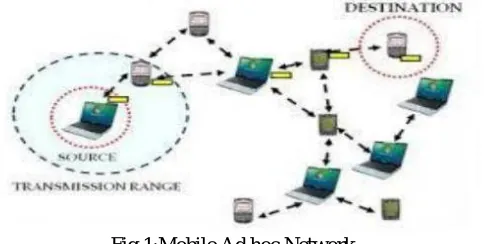
Mobile Ad hoc Network (MANET) is a new promising technology which enables users to communicate without using any fixed or physical infrastructure. In Mobile ad hoc network, different wireless mobile devices are working as a mobile node that build virtual network infrastructure without any centralized server for wireless communication. Each device in a MANET is free to move separately in any direction in any space, and will therefore change its links to other devices regularly. Mobile nodes are equipped with a wireless transmitter and a receiver that communicate directly with each other or forward message through other nodes. MANETs are highly vulnerable to attacks than wired networks due to the open medium and changing topology[1].
Fig 1:Mobile Ad hoc Network
In view of the unique properties of MANET, while analysing about any routing protocol, generally the subsequent properties are expected, though all of these might not be possible to incorporate in a single solution.
In manet, a routing protocol should be distributed in order to increase reliability.
A Routing protocol should be analysed considering issues of security.
A Routing Protocol should be aware of Quality of service(QoS) and many more.
II. CLASSIFICATION OF ROUTING PROTOCOLS
Let’s have a glance at the similar broadcasting techniques that is used in MANETs before classifying different routing protocols:
Uni-casting: A process where the information is sent from the source to a single destination.
Multicasting: A process where the information is sent from a source to asset of destinations.
Geocasting: A process of sending of information from the source to all other nodes inside a geographical region
Broadcasting: A process where the messages are sent from a source to all other nodes in the specified networks.
Routing Protocols in MANETs are broadly classified based on two approaches:
a) Qualitative approach b) Quantitative approach
Qualitative approach fundamentally includes the following metrics [2]:
Proactive behaviour: This type of protocols is used in order to attain low latency and also when bandwidth requirement is not the key issue.
Security: In wireless network technology all the nodes should actively contribute in the routing process thereby, introducing much security vulnerability in the process. Thus these security vulnerabilities should be checked in the routing protocols.
On demand routing behaviour: Routes for a particular path are made on demand by disseminating the flow of control messages for the proper utilization of bandwidth. This type of reactive routing introduces medium to high latency.
Unidirectional link support: Even though nodes in the wireless environment may correspond in a unidirectional link, but the routing protocol should be such that it should maintain both the unidirectional and bidirectional links.
Therefore by analysing Qualitative approach, we come to the conclusion that the MANET protocol should be such that security vulnerability should be accurately maintained and the latency, routing overhead, energy consumption, node participation in the routing process should be considered.
The next approach is the quantitative approach which includes the following metrics:
Delay and End to end data throughput: This kind of approach is useful in order to ensure the effectual working of the routing protocols such that the delays ought to be minimized and also the end to end throughput should be improved.
Out of order delivery: The performance of the routing protocol will be affected if data packets goes out of order. Hence the delivery of the data packets should be in a specific order.
Efficiency: It is required to check the efficiency of the routing protocols such as bandwidth utilization, packet delivery ratio,
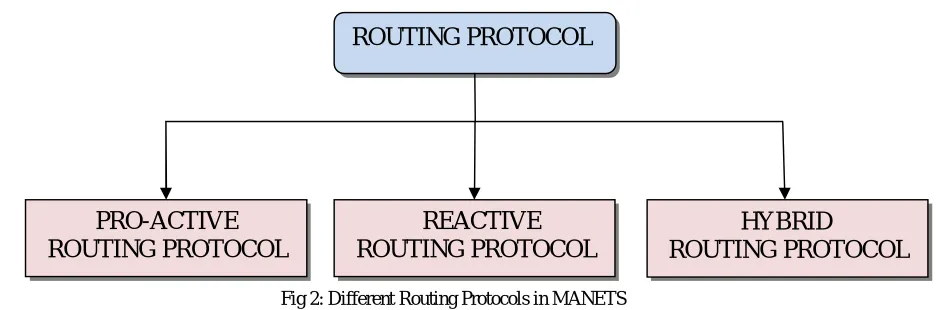
After having a glance on the different broadcast techniques and approaches the routing protocols are broadly classified into three categories as shown below:
Fig 2: Different Routing Protocols in MANETS
All MANET routing protocols could be broadly classified into three major categories [3]
1. Pro-active Routing Protocols, 2. Reactive Routing Protocols, 3. Hybrid Routing Protocols.
1) Pro-active routing protocol: In pro-active routing protocol, every node continuously maintains complete routing information of the network. This information is stored in tables. Each node maintains a routing table which contains the list of destinations and routes.
2) Reactive routing protocol: The reactive routing protocols are based on some class of query-reply dialog. At this point, the nodes do not require intermittent transmission of topological information of the network. When there is a require for a path to a destination, path request messages are swamped periodically with new networks status information. Every node in this routing protocol maintains information of only active paths to the destination nodes.
3) Hybrid Routing Protocols: Frequently pro-active or reactive feature of a particular routing protocol might not be enough. These protocols united the features of both pro-active and reactive routing protocols.
III.SURVEY OF DIFFERENT ROUTING PROTOCOLS
A. PROACTIVE ROUTING PROTOCOLS:
These protocols constantly maintain up-to-date information of routes from each and every other node in the network. These protocols persistently learn the topology of the network by exchanging topological information among the network nodes. Thus, when there is a need for a path to a destination, such path information is accessible immediately.
Different protocols keep track of different routing state information[4]. These protocols need each node to maintain one or more tables to store up to date routing information and to propagate updates throughout the network. As such, these protocols are often referred to as table-driven. Some examples of table driven ad hoc routing protocols include Dynamic Destination Sequenced Distance-Vector Routing Protocol (DSDV) [7],Optimized Link State Routing Protocol (OLSR) [8] and Wireless Routing Protocol (WRP) [6].
1. Dynamic Destination Sequenced Distance-Vector Routing Protocol (DSDV): In this routing protocol, each mobile node in the network keeps a routing table. Each of the routing table contains the list of all
PRO-ACTIVE
ROUTING PROTOCOL
REACTIVE
ROUTING PROTOCOL
HYBRID
available destinations and the number of hops to each. Each table entry is tagged with a sequence number, which is originated by the destination node. Periodic transmissions of updates of the routing tables help maintaining the topology information of the network. If there is any new significant change for the routing information, the updates are transmitted immediately. So the routing information updates might either be periodic or event driven. DSDV protocol requires each mobile node in the network to advertise its own routing table to its current neighbors. The advertisement is done either by broadcasting or by multicasting. By the advertisements, the neighboring nodes can know about any change that has occurred in the network due to the movements of nodes
2. Wireless Routing Protocols (WRP):WRP is table driven or proactive routing protocol [2]. It is advancement of DSDV protocol. Information about different paths stored at the routing tables in proceed. In WRP, Each hop contains shortest path from source to destination. This helps in reduction of about power consumption and loop free routing.WRP uses Distance Table, Routing Table, Link Cost Table and Message Transmission Table while creating paths from source to destination.
3. Optimized Link State Routing Protocol (OLSR):It offer the information regarding cluster and node protection. They used the FDDS (fast distribution connected dominating set) techniques to keep connectivity in the network and also to take care of the routing element. It uses the FDDS-M to maintain the connectivity of the network and FDDS-R to take care the routing part. FDDS is used to handle the initial hierarchical architecture in distributed way. Their job is to elect CHs and connect nodes to CHs. Initially normal node network composed of CHs which is disconnected. It assumes that node knows Stock its ID, residual energy (RE), and traffic load (T). A node can calculate its mobility (M) by measuring its displacement with respect to his own position and its neighbours at different time periods. Scalability of FDDS-R comes from OLSR. OLSR uses MPR, which minimizes the Flooding of control messages in the network. Also OLSR is known to perform well in wide Scale and dense networks.
B.REACTIVE ROUTING PROTOCOLS:
In these protocols, routes are shaped as and when necessary. When a broadcast occurs from source to destination, it invokes the route discovery method. The route remains valid till destination is achieved or until the route is no longer needed. They also referred as On-demand routing protocol. Some of the existing on demand routing protocols are: DSR [4], AODV [5] and ABR[6].
1. Dynamic Source Routing (DSR) protocol: It is a simple and robust routing protocol intended for use in multi-hop wireless ad-hoc networks of mobile nodes. Many of the optimizations proposed in the protocol tend to injure the performance, especially in the case of high node mobility and low traffic load. This matter has been studied extensively, and DSR is shown to perform better with certain optimizations turned off.
2. Ad Hoc On-Demand Distance Vector Routing (AODV):AODV is a disparity of Destination-Sequenced Distance-Vector (DSDV) routing protocol which is jointly based on DSDV and DSR. It aims to minimize the requirement of system-wide broadcasts to its extreme. It does not maintain routes from every node to every other node in the network rather they are discovered as and when needed & are maintained only as long as they are required.
3. Associativity-Based Routing (ABR):ABR protocol defines a latest type of routing metric‚ level of association constancy for mobile ad hoc networks.
C.HYBRID ROUTING PROTOCOLS
Zone Routing Protocol(ZRP):ZRP combines the preeminent properties of both proactive routing and reactive routing. As the name implies, zone routing protocol is based on the concept of zones. Each node has a separate routing zones and the overlapping of zones of neighbouring nodes is there. A node that has a packet to send first checks whether the destination is within its local zone, in this case, the packet can be routed proactively, if the destination is outside the zone, then reactive routing is used [9].
Advantages of Zone routing protocols are as follows. Firstly although using proactive routing, it reduces the control traffic produced by periodic flooding of routing information packets. Next it reduces the consumption of bandwidth and manages overhead compared to reactive routing [9].
The disadvantages of Zone routing protocols is the overlapping of routing zones may be large.
IV.COMPARISON OF DIFFERENT ROUTING PROTOCOLS
A. Comparison of the different types of Routing Protocols:
Parameters Proactive Protocol Reactive Protocol Hybrid Protocol
Routing Scheme Table Driven On-Demand Combination of both
Routing Philosophy Mostly Flat Flat Hierarchical
Scalability Level
Low Not suitable for large networks
Designed for large networks
Routing overhead
High Low Medium
Latency Low due to routing tables High due to flooding Inside zone low outside similar to Reactive
protocols
Availability of routing information
Always available stored in tables
Available when required Combination of both
Storage Capacity High ,due to the routing tables
Low generally Depends upon the number of routes
Depends on the size of Zone, inside the Zone
sometimes high as proactive protocol
Periodic Route Updates Always Required Not Required Used inside each zone
Control Traffic High Low Lower than other two protocols
Scalability 100 More than 100 More than 1000
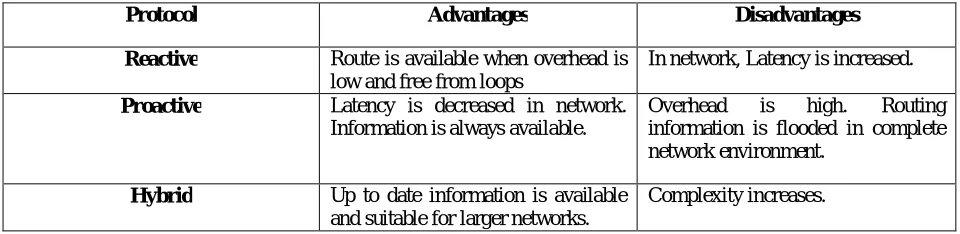
B. Summary of different types of Routing Protocols based on advantages and disadvantages:
Protocol Advantages Disadvantages
Reactive Route is available when overhead is low and free from loops
In network, Latency is increased.
Proactive Latency is decreased in network. Information is always available.
Overhead is high. Routing information is flooded in complete network environment.
Hybrid Up to date information is available and suitable for larger networks.
Complexity increases.
V. CONCLUSION AND FUTURE WORK
In this paper, we have surveyed the different routing protocols in MANETS.This presents a number of routing protocols for MANET, which are roughly categorized as proactive ,reactive and hybrid protocols.Here attempt has been made on the comparative study of Reactive, Proactive and Hybrid routing protocols has been presented in the form of table. There are different shortcomings in various routing protocols and it is quite tricky to choose routing protocol for different situations as there is tradeoff between various protocols. There are assortments of challenges that need to be met, so these networks are going to have pervasive use in the future.Still MANETs have posed a great confront for the researchers due to changing topology and security attacks, and none of the protocols is fully protected and study is going on around the globe.
REFERENCES
[1] Akshatha.Y and Rashmi M Jogdand,”Enhanced Adaptive Acknowledgement Method for De tecting Malicious Nodes in
MANETs”,IOSR Journal of Computer Engineering (IOSR-JCE),Volume 16, Issue 4, Ver. I Jul-Aug. 2014.
[2] PriyankaGoyal, Vinti Parmar2, Rahul Rishi3 MANET: Vulnerabilities, Challenges, Attacks, Application
[3] P. Vidya Shree and G. Sophia Reena, “A survey of various routing protocols in mobile ad-hoc networks (manet)”, International Journal of Computer Science & Engineering Technology (IJCSET), vol. 3, no. 7, July 2012.
[4] M. ArifSiddiqui, Q. Shoeb Ahmad and M. H. Khan, “A study of routing protocols in wireless mesh networks”, Journal of Information, Knowledge and research in computer science and applications, vol. 1, no. 1, October 09 to November 10
[5] A. Hinds, M. Ngulube, S. Zhu and H. Al-Aqrabi, “A Review of Routing Protocols for Mobile Ad-Hoc networks (MANET)”, International Journal of Information and Education Technology, vol. 3, no. 1, February 2013.
[6] L. Abusalah, A. Khokhar and M. Guizani, “A Survey of Secure Mobile Ad Hoc Routing Protocols”, IEEE Communications Surveys & Tutorials, vol. 10 no. 4, 4th Quarter 2008.
[7] Perkins CE, BhagwatP,”Highly Dynamic Destination-Sequenced Distance-Vector Routing (DSDV) for Mobile Computers”, Proceedings of ACM SIGCOMM 1994.
[8] T. H. Clausen et al., “The Optimized Link-State Routing Protocol. Evaluation through Experiments and Simulation”,Proc. IEEE Symp.Wireless Personal Mobile Communications, Sept 2001.