University of Windsor University of Windsor
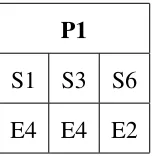
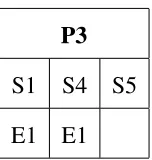
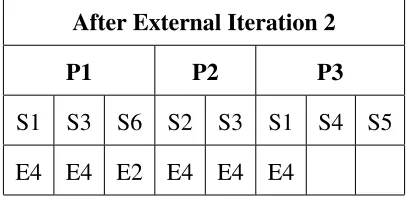
Scholarship at UWindsor
Scholarship at UWindsor
Electronic Theses and Dissertations Theses, Dissertations, and Major Papers
3-10-2019
Productive Cluster Hire
Productive Cluster Hire
Parth Atulkumar Patel
University of Windsor
Follow this and additional works at: https://scholar.uwindsor.ca/etd
Recommended Citation Recommended Citation
Patel, Parth Atulkumar, "Productive Cluster Hire" (2019). Electronic Theses and Dissertations. 7652.
https://scholar.uwindsor.ca/etd/7652
This online database contains the full-text of PhD dissertations and Masters’ theses of University of Windsor students from 1954 forward. These documents are made available for personal study and research purposes only, in accordance with the Canadian Copyright Act and the Creative Commons license—CC BY-NC-ND (Attribution, Non-Commercial, No Derivative Works). Under this license, works must always be attributed to the copyright holder (original author), cannot be used for any commercial purposes, and may not be altered. Any other use would require the permission of the copyright holder. Students may inquire about withdrawing their dissertation and/or thesis from this database. For additional inquiries, please contact the repository administrator via email
Productive Cluster Hire
By
Parth Patel
A Thesis
Submitted to the Faculty of Graduate Studies
through the School of Computer Science
in Partial Fulfillment of the Requirements for the
Degree of Master of Science
at the University of Windsor
Windsor, Ontario, Canada
2019
c
Productive Cluster Hire
By
Parth Patel
APPROVED BY:
M. Hlynka
Department of Mathematics and Statistics
S. Samet
School of Computer Science
M. Kargar, Co-Advisor
School of Computer Science
Z. Kobti, Advisor
School of Computer Science
DECLARATION OF ORIGINALITY
I hereby certify that I am the sole author of this thesis and that no part of this thesis has
been published or submitted for publication.
I certify that, to the best of my knowledge, my thesis does not infringe upon anyones
copyright nor violate any proprietary rights and that any ideas, techniques, quotations, or
any other material from the work of other people included in my thesis, published or
oth-erwise, are fully acknowledged in accordance with the standard referencing practices.
Fur-thermore, to the extent that I have included copyrighted material that surpasses the bounds
of fair dealing within the meaning of the Canada Copyright Act, I certify that I have
ob-tained a written permission from the copyright owner(s) to include such material(s) in my
thesis and have included copies of such copyright clearances to my appendix.
I declare that this is a true copy of my thesis, including any final revisions, as approved
by my thesis committee and the Graduate Studies office, and that this thesis has not been
ABSTRACT
Discovering a group of experts to complete a set of tasks that require various skills is
known as Cluster Hire Problem. Each expert has a set of skills which he/she can offer
and charges a monetary cost to offer their expertise. We are given a set of projects that
need to be completed and on completion of each project, the organization gets a Profit.
For performing a subset of given projects, we are given a predetermined budget. This
budget is spent on hiring experts. We extend this problem by introducing productivity
and capacity of experts. We want to hire experts that are more productive, and this factor
is determined on the basis of their past experience. We also want to make sure that no
expert is overworked as it is not possible for a single expert to provide his/her expertise
for unlimited times. Our goal is to hire as many experts as possible in which the sum of
their hiring costs (i.e., salary) is under the given budget as we are interested to maximize
the profit and also maximize the productivity of the group of experts, our problem is a
bi-objective optimization problem. To achieve this, we propose two different approaches that
DEDICATION
Dedicated to my grandfather Late Shri Arvindbhai Punambhai
Patel, my grandmother Jashodaben Arvindbhai Patel, my
parents Atulkumar Patel and Hema Patel, my uncle Jitendra
Patel, my aunt Kumudben Patel and to my sisters and brothers
ACKNOWLEDGMENT
I would like to express my sincere gratitude to my advisor Dr. Ziad Kobti and Dr. Mehdi
Kargar for their continuous support in my research, for their patience, motivation, and
im-mense knowledge. Their guidance helped me throughout my time of research and writing
of this thesis. I could not have imagined having better mentors for my study.
I would also like to thank my thesis committee members Dr. Saeed Samet and Dr. Myron
Hlynka for their valuable comments and suggestions for the completion of this thesis. I
would like to sincerely thank Dhruvi Patel and Meet Patel, who have been the fundamental
support throughout my work.
Also, I would like to thank my fellow lab mates for the stimulating discussions during
the development of this work. Last but not the least, my deepest gratitude to my family for
TABLE OF CONTENTS
DECLARATION OF ORIGINALITY . . . iii
ABSTRACT . . . iv
DEDICATION . . . v
ACKNOWLEDGMENT . . . vi
LIST OF TABLES . . . ix
LIST OF FIGURES . . . x
1 Introduction . . . 1
1.1 Overview . . . 1
1.2 Motivation . . . 3
1.3 Problem Statement . . . 4
1.3.1 Existing Problem . . . 4
1.3.2 Our Contribution . . . 5
1.4 Hypothesis . . . 7
1.5 Objective . . . 8
1.6 Structure of Thesis . . . 9
2 Background Study . . . 10
2.1 Key Concepts . . . 10
2.1.1 Data Mining . . . 10
2.1.2 Team Formation . . . 11
2.1.3 Cluster Hire . . . 12
2.1.4 Difference between Cluster Hire and Team Formation . . . 13
2.2 Fundamental Concepts . . . 14
2.2.1 Heuristic Function . . . 14
2.2.2 Exact Algorithm . . . 14
2.2.3 Greedy Algorithm . . . 15
2.2.4 Bi - Objective Optimization Function . . . 16
2.3 Literature Review and Related Work . . . 16
3 Proposed Algorithm . . . 25
3.1 Cluster Hire with Expert Pick Strategy . . . 25
3.1.1 Illustration of Expert Pick Strategy using Normalized Values . 30 3.2 Cluster Hire with Project Pick Strategy . . . 34
3.2.1 Illustration of Project Pick Strategy using normalized values . 38 4 Experiments . . . 46
4.1 Synthetic Data . . . 46
4.1.1 Performance Analysis . . . 47
4.2 DBLP Dataset . . . 54
4.2.1 Performance Evaluation . . . 54
4.3 Discussion . . . 58
5 Conclusion and Future Work . . . 62
5.1 Conclusion . . . 62
5.2 Future Work . . . 63
LIST OF TABLES
3.1 List of Project with required Skills and Profit . . . 29
3.2 Profile of Experts . . . 29
3.3 List of Project with required Skills and Profit . . . 30
3.4 Profile of Experts . . . 30
3.5 Iteration 1 Score Calculation . . . 31
3.6 Status after Iteration 1 . . . 32
3.7 Skills Covered after Iteration 1 . . . 32
3.8 Iteration 2 Score Calculation . . . 32
3.9 Status after Iteration 2 . . . 33
3.10 Skills Covered after Iteration 2 . . . 33
3.11 Iteration 3 Score Calculation . . . 33
3.12 Status after Iteration 3 . . . 34
3.13 Skills Covered after Iteration 3 . . . 34
3.14 Expert Score Calculation for Project 1 (Iteration 1) . . . 39
3.15 Skills covered after 1st Iteration . . . 39
3.16 Expert Score Calculation for Project 1 (Iteration 2) . . . 39
3.17 Skills covered after 2nd Iteration . . . 39
3.18 Expert Score Calculation for Project 2 (Iteration 1) . . . 40
3.19 Skills covered after 1st Iteration . . . 40
3.20 Expert Score Calculation for Project 3 (Iteration 1) . . . 40
3.21 Skills covered after 1st Iteration . . . 41
3.22 Expert Score Calculation for Project 3 (Iteration 2) . . . 41
3.23 Skills covered after 2nd Iteration . . . 41
3.24 Project Score after External Iteration 1 . . . 42
3.25 Skills Covered in Iteration 1 . . . 42
3.26 Expert Score Calculation for Project 1 (Iteration 1) . . . 43
3.27 Skills covered after 1st Iteration . . . 43
3.28 Expert Score Calculation for Project 3 (Iteration 1) . . . 43
3.29 Skills Covered after 1st Iteration . . . 43
3.30 Project Score after External Iteration 2 . . . 44
3.31 Skills Covered in Iteration 2 . . . 44
3.32 Iteration 1 Score Calculation . . . 44
3.33 Skills Covered after 1st Iteration . . . 45
LIST OF FIGURES
2.1 Knowledge Discover in Database Process . . . 11
2.2 Difference between Cluster Hire and Team Formation . . . 13
2.3 Solution to coin change problem using greedy algorithm . . . 15
3.1 Min-Max Normalization . . . 30
4.1 Comparison for Total profit vs. a budget of Project Greedy, Expert Greedy with Exact and Random Algorithm . . . 48
4.2 Comparison for Total profit vs. a budget of Project Greedy, Expert Greedy with Random Algorithm . . . 48
4.3 Comparison for Total profit vs. a budget of Project Greedy, Expert Greedy and Random Algorithm . . . 49
4.4 Comparison for Total profit vs. a budget of Project Greedy, Expert Greedy with Random Algorithm . . . 49
4.5 Comparison for the completed project vs. budget of Project Greedy, Expert Greedy with Random Algorithm . . . 50
4.6 Comparison for the completed project vs. budget of Project Greedy, Expert Greedy with Random Algorithm . . . 51
4.7 Comparison for the completed project vs. budget of Project Greedy, Expert Greedy with Random Algorithm . . . 51
4.8 Comparison for the completed project vs. budget of Project Greedy, Expert Greedy with Random Algorithm . . . 52
4.9 The run time of Project Greedy, Expert Greedy, and Random Algorithm when we have various number of projects. . . 53
4.10 Average Productivity of Project Greedy, Expert Greedy, and Random Al-gorithm when we have various number of projects. . . 54
4.11 Comparison of Total Profit vs Budget of Project Greedy, Expert Greedy, and PG KDD’14 . . . 55
4.12 Comparison of Total Profit vs Budget of Project Greedy, Expert Greedy, and PG KDD’14 . . . 56
4.13 Comparison of Number of Completed Projects vs Budget of Project Greedy, Expert Greedy, and PG KDD’14 . . . 56
4.14 Comparison of Number of Completed Projects vs Budget of Project Greedy, Expert Greedy, and PG KDD’14 . . . 57
Chapter 1
Introduction
1.1
Overview
Finding the best combination of experts to complete a given task is of utmost importance
to any company and is considered as an asset. Searching for the right group of experts
involves assigning various skills possessed by experts to complete all projects undertaken
by the company and ensuring that they are completed within the given deadline. Hiring
such individuals will definitely need a budget which can be used to pay the experts in
exchange for the services they provide to the company. Hiring a group of individuals who
work together to complete a set of projects is known as Cluster Hire Problem and was first
introduced by [1]. This problem is growing rapidly and is one of the biggest challenges
faced by online labor markets. Recruiters connect with labor industries to find the best
people for the job.
Team Formation concept has been in the industry for quite a while and it involves finding
the best combination of experts from a pool of experts to complete a task. In other words,
given a set of experts, who possess different skills, we need to select a combination that can
complete the given task within the given deadline. On completion of each task, a company
gets a profit value in dollars. The whole process consists of a set of experts, who possesses a
set of skills and each task requires a set of skills [2]. We select experts who help us to cover
the subset of required skills for completing the task. To hire an expert, the organization
needs to pay a fee to an expert to provide his/her expertise and an organization is always
given a predetermined budget for each task. Recruiters try to minimize this budget which
budget [3].
In addition to this, it is important that we hire experts who are productive as we do not
want to hire someone who cannot complete the task in allocated time. The productivity of
an expert can be decided based on their experience. For instance, we would prefer an expert
who has published more research papers over the one who has published a smaller number
of papers. Hiring productive experts will increase the rate of successful completion of the
project and will ultimately help the company to earn a higher amount of profit as they will
be able to complete more projects.
To make an efficient and productive team, we need to consider the capacity of each
expert. The capacity of an expert is the amount of time an expert can provide his/her
expertise. We know that no one can work for an unlimited time and every human has
a capacity beyond which he/she can not work. We need to consider this aspect while
selecting an expert [4]. It is very important to see that we do not overburden any expert as
this will help the company to get the best results out of them.
Cluster Hire problem is an optimization problem and is slightly related to existing
opti-mization problems. For instance, let’s consider the Job Scheduling Problem. Job
schedul-ing problem has a set of resources that need to be used in order to complete a set of tasks
that are maintained in a priority-based queue. The goal is to allocate these already existing
resources to these tasks using which it can be completed. In our problem, we have a set of
projects which needs to be completed using a set of experts. The difference between the
two problems is that in our problem we have to first generate a subset of experts from a
set of experts based on various constraints like skillset, expert cost, given budget, expert
capacity, profit of the project etc. For example, while selecting an expert we check whether
the expert has the skills required by the project or not, we also check if he is capable enough
to provide his expertise to complete the given set of projects. We also make sure that the
experts. We consider all such factors to form a subset of experts. Moreover, our problem
is a bi-objective optimization problem where we have to maximize the profit and minimize
budget. Hence, our problem can be considered slightly related to Job Scheduling Problem.
Let’s consider Constraint Optimization, it can be considered as a process that optimizes
the given objective based on given variables which are restricted by constraints on them. In
our problem, we have a similar situation where we have to optimize the objective function
by minimizing the Budget and maximizing the Profit and Productivity. Here the constraint
factor is Cost of hiring experts where the cost of hiring experts should never exceed the
given Budget. Considering this part of the whole problem we can say our problem is
slightly related to Constraint Optimization. What makes it stand apart is that the
optimiza-tion objective of our problem is bi-objective.
1.2
Motivation
In the real world, forming a team to complete a task has been a challenging task as it
involves considering so many factors that can affect the final outcome. A lot of researchers
are working in this area to find an optimal solution by stretching it to various dimension.
There are certain works that focus on factors such as communication cost [4], compatibility
amongst the team members [5], the capacity of an expert [4] etc. to find an optimal solution
based on the requirement of the project. Communication cost here means the
communi-cation overhead between the team members, compatibility is the ability to which the team
members can work with each other without any problems, and capacity of an expert means
checking that no expert in the team is overworked.
In today’s era, the start-up company is growing rapidly and the owners need to make
many important decisions. The owners need to hire many employees to run his/her
company. They need to hire a group of experts who can meet the needs of the undertaken
projects. This adds up to a huge motivation to our problem.
Another relevant motivation is the consultancy companies. Nowadays, consultancy
com-panies get a lot of projects with specific skills required for its completion. On completion of
each project consultancy companies get their share of profit. To complete the projects, the
consultancy companies hire a group of experts who can work on more than one project so
that their hiring cost is minimized, and profit is maximized. These companies have grown
rapidly over the past few years and they also add up to be a huge motivation to our problem.
Online labor markets like Guru (www.guru.com) and Freelancer (www.freelancer.com)
were the first ones to help companies hire experts to complete projects. Experts register
on these portals and when a project comes up they try to find the best set of experts who
can work on it and helps the company to complete it.
Team Formation Problem is used for forming a team for a particular task but when it
comes to completing more than one task it becomes inefficient as it forms a new team for
each task. When it comes to the real world, it is not affordable to form one team for each
task and as an improvement [1] introduced Cluster Hire Problem which forms one team
that can complete all tasks by working simultaneously. Let’s see the problem in detail in
the next section.
1.3
Problem Statement
1.3.1 Existing Problem
Cluster Hire Problem was first introduced by [1] and it states that instead of forming one
team for each task it finds one team that can cover all tasks. Let’s understand it in detail.
a set ofmskills. Each experteposses a set of skills, which is denoted as ES(e). Clearly,
∀e∈E,ES(e)⊆S. Each expertedemands a monetary cost (i.e., salary), to participate in
performing different tasks. This is shown byC(e) and is measured by dollar value. We
also have a set of given projects which is denoted byP={p1,p2, . . . ,pk}. Each project is
also composed of a set of required skills that need to be covered by experts in order for the
project to be completed. This set is shown byPS(pj)for project p. Again,∀p∈P,PS(p)⊆
S[1].
Finishing each project brings a profit in dollar value which is shown byPF(p)for project
p. We are interested to choose a set of projects in which the sum of their profit is
maxi-mized.
Given a set of projectsP, the profit of completing these projects is defined as follows:
Pro f it(P) =
∑
p∈P
PF(p)
The authors in [1] introduced the Cluster Hire problem and were able to solve it
suc-cessfully under the given circumstances but it had few drawbacks. It did not consider the
capacity of the experts. In other words, according to their approach, an expert can be
allo-cated to any number of projects which makes it impractical as one expert cannot provide
their expertise for unlimited times. To overcome this problem [4] extended their work by
introducing a constraint on a number of times an expert can provide their expertise. They
assume that each experte is able to offer her expertise at mostCap(e)times [4]. This is
a reasonable assumption since we do not want to overload an expert by assigning her to
many projects. Therefore, each expert has a maximum capacity to participate in a number
of tasks. We take this constraint into consideration when designing the algorithms [4].
1.3.2 Our Contribution
In the previous section we discussed about the significant work done by [1] and [4] to
areas which need to be considered to make it more efficient. While selecting an expert we
need to consider the Productivity of an expert as it is important to see that the experts we
hire are productive as they hold more chances to complete the project as compared to the
experts who are less productive. Let’s discuss it in detail.
Each Experte is assigned a Productivity Score PR(e). This score is determined based
on the past performance of the expert. For example, among a group of researchers, the one
that publishes the most is considered to be more productive. Clearly, we prefer to have
a group of experts that have high productivity. For experts who are new and do not have
any productivity score are assigned with an average value of the productivity amongst the
group of experts who are competing for the work. This gives the expert a fair chance to be
considered to be a part of the final team. The productivity of a group of experts are defined
as follows:
Given a group of expertsE, the productivity of this groupE is defined as follows:
Productivity(E) =
|E|
∑
i=1 PR(ei)
For performing a subset of given projects, we are given a predetermined budget (also
in dollar value) denoted as B. This budget is spent on hiring experts. Our goal is to hire
as many experts as possible in which the sum of their hiring costs (i.e., salary) is under
the given budgetB. Since we are interested to maximize the profit and also maximize the
productivity of the group of experts, our problem is a bi-objective optimization problem.
A common approach to solve a bi-objective optimization problem is to convert it into a
single objective problem. This can be done by introducing a trade-off parameter λ that
varies between 0 and 1 and determines whether we want to put more weight towards profit
or productivity.
Given a set ofnexpertsE, a set ofmskillsS, a set ofkprojectsP, a trade offλ between
of projectsP⊆Sin which the following objective is maximized:
PP(P,E) = (λ).Pro f it(P) + (1−λ)Productivity(E)
Furthermore, the following budget constraint must be satisfied:
∑
e∈E
C(e)≤B
Note that since the dollar values of the projects profit and the productivity of experts will
have different scales, both of these values have been normalized before using the above
objective so that they both fall into the same range(Between 0 and 1).
1.4
Hypothesis
Given a set of projects where each project requires a set of skills to be completed, a set of
experts where each expert possesses a set of skills, capacity, and productivity of experts, a
predetermined budget which can be used to hire a team of experts. We need to find a group
of experts who can cover all the projects such that the cost of hiring experts is less than or
equal to the given budget and we want to maximize the profit. The Profit value for each
project is in dollar value and is known beforehand. Cost of hiring an expert is also in dollar
values and is termed as the fees we need to pay to an expert to provide his/her expertise.
We propose to find a team of experts that can cover all the projects and maximize the profit
by using a greedy approach and want to achieve the solution in polynomial time. We plan
on applying two different algorithms: expert greedy and project greedy algorithm which
we will see in detail in Chapter 3 of the thesis and after applying this we expect to find a
team of experts who can cover all the projects by maximizing the productivity of experts
and profit of the projects. We also make sure that no expert is overworked and we plan to
1.5
Objective
Team Formation problem has become a well-known problem and is being researched
for about almost a decade now. This problem involves finding a set of individuals that
match a given skill set to complete the given task. In our case, we take various factors
like profit, capacity, and productivity into consideration. We are given a set of experts who
possess different skills, we are also given a set of projects that require a certain skill set to
be completed and on completion of which the organization gets a profit value. Our task is
to find a group of experts who possess all the skills required to complete all the projects
within the given budget. While finding a group of experts we take various factors such as
the capacity and productivity of experts.
The capacity of an expert means while assigning an expert to many projects we check if
he/she has the potential to complete all the projects in the given time. In other words, we
make sure that no expert is overworked as no one can provide his/her expertise for unlimited
times. Any individual has a limit up to which he/she can work, and it is important that we
take it into consideration while hiring an expert. For example, we have 10 projects that
need to be completed and we have 15 experts. If we choose an expert who possesses skills
that matches to all the 10 projects and we assign him to all of them. It will be practically
impossible for that expert to give each project equal attention and this will lead to a bad
result for the company and in the worst case, the project will never be completed. To avoid
such circumstances, it is very important to maintain the balance between the team members
and make sure that everyone is given an equal amount of work.
The productivity of an expert is defined in terms of the performance of an expert. When
we hire an expert, we would prefer an expert who is more productive as he/she will stand
more chances of providing successful results. The productivity of an expert in our case is
research papers is more productive than an expert who has published a smaller number of
research papers. It is an important factor in our problem as we need to maximize profit and
productivity of an expert is directly related to profit because if we hire a more productive
expert there are more chances of completing the project and hence company will get more
profit.
Overall, to complete a set of projects we are given a predetermined budget to hire experts.
Our goal is to hire as many as experts possible such that the hiring cost of experts is less
than the given budget and make sure that no expert is overworked. We want to maximize
the profit and minimize the budget and this makes our problem a bi-objective optimization
problem.
1.6
Structure of Thesis
The rest of the thesis is organized in the following way: In chapter 2, we do the
back-ground study of our thesis. We discuss the basic and fundamental concepts. It also includes
a detailed discussion of related work and literature review. In chapter 3, we discuss our
proposed approach in detail with illustration to understand it better. Chapter 4 includes the
experiments done in order to see the performance of our algorithms and validate the results.
Chapter 2
Background Study
2.1
Key Concepts
In this section, we will discuss the key concepts to understand the research work done in
this thesis. We will first discuss the research area of the thesis and then we will describe
what is Team Formation, Cluster Hire and the difference between Team Formation and
Cluster Hire Problem.
2.1.1 Data Mining
Data Mining is a process of finding interesting and meaningful patterns from large data
sets [6]. Data mining is a subfield of Computer Science with a goal to extract meaningful
data from a dataset which can be used in future to take strategic decisions. Each and every
sector of the industry is going paperless and with the increase in the volume of the data
generated it is necessary to have tools that can process this data [6]. Processing data here
means the ability to find valuable information form the whole lot of data present in any
companys database. Data Mining is a part of Knowledge Discovery in Database process.
The KDD process is shown in figure 2.1 it is commonly defined by the following stages [8]:
1. Data Cleaning: It is a process of removing irrelevant and noisy data from the
collection.
2. Data Integration: Combining data from different sources into a single source
Figure 2.1: Knowledge Discover in Database Process [7]
3. Data Selection: It is a process of selecting and retrieving relevant data to
con-duct the analysis from the data warehouse.
4. Data Transformation: It is a process of transforming the data into a form
pro-cessable by the data mining techniques.
5. Data Mining: It is a technique of extracting relevant and important patterns
which can be used by the high-level authorities to make business strategies.
6. Pattern Evaluation: This stage helps us to decide how relevant are the patterns
and tells about the interestingness of the discovered patterns.
7. Knowledge Representation: This stage helps to look at the interesting patterns
that are discovered using data mining techniques. It becomes very easy for the
users to look at the pattern and decide on the possible outcomes and helps in
decision making.
2.1.2 Team Formation
It is a process of finding a set of individuals that can work together to complete a task.
depends on the skillset required to complete the given task and no. of people needed to
complete it. Working in a team is a lot different than working individually as it requires
each member of the team to work together without any problems [9]. We have to find
individuals who can work together to complete any task and at the same time, we have to
make sure they are compatible with each other. For example, if we are looking to form
a soccer team, in particular, the forward players. The required skills will be physicality,
dribbling skills, powerful shot, accuracy, and pace. We need to find 3 players to form the
forward of the team. Lets consider we have 5 candidates who possess all the skills. While
shortlisting them we will need 3 players who run at a similar pace as it becomes easy to play
one to one when you are at a similar pace. It might be possible that the 2 left out candidates
are far better than the selected candidates individually but under the given circumstance
they might fail as a team.
2.1.3 Cluster Hire
Cluster Hire problem means hiring a group of experts who can collectively as a team
complete a set of projects. In other words, we find a team of experts who can work on
more than one project simultaneously to complete them [1]. Here the hiring of experts
depends on the budget, profit value that will be achieved by completing the project, skills
possessed by an expert, the skills required to complete a project, the capacity of the expert,
productivity of expert etc. We have to make sure that we find a cluster of experts who
hold a maximum chance of completing all the projects under the given constraints. For
example, we have 5 projects that require a variety of skills to be completed. The company
gets a profit value on completion of each project. We need a team which can complete all 5
projects. So, from a pool of experts with different skills, we select a team that can complete
2.1.4 Difference between Cluster Hire and Team Formation
Cluster Hire and Team Formation are two different problems. Team formation problem
finds a team for each task independent of other available tasks. Whereas, in Cluster Hire
problem we form a single team that can complete all available tasks.
Figure 2.2: Difference between Cluster Hire and Team Formation
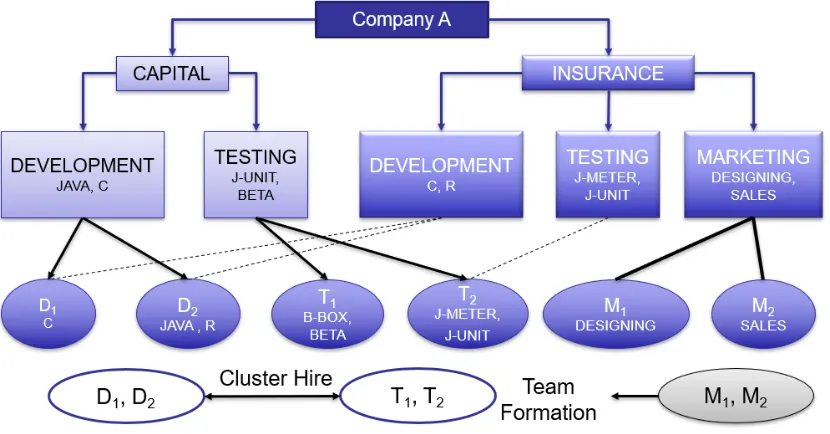
Lets understand this using a simple example. In figure 2.2 we have demonstrated a
sce-nario of a random Company A. The company has two main sub-divisions Capital and
Insurance. These sub-divisions are further divided into different departments. Capital has
the Development and Testing department whereas Insurance has Development, Testing,
and Marketing department. Each department has required skills attached to them that are
needed to complete the projects. For example, in sub-division Capital development
depart-ment needs an expert who possesses Java and C. Further we have experts D1, D2, T1, T2,
M1, and M2. They possess different skills and based on their skills they will be assigned
to different departments. So, hiring D1, D2, T1, and T2 collectively to meet the needs of
M1 and M2 to meet the requirement of Marketing department of sub-division Insurance is
known as Team Formation.
2.2
Fundamental Concepts
In this section, we will discuss the fundamental concepts that are used in this thesis and
will help us to understand it better. We first discuss heuristic function then we know about
the exact algorithm. We then understand the greedy algorithm and the approach used in the
greedy algorithm. Finally, we discuss the bi-objective optimization function.
2.2.1 Heuristic Function
Heuristics are used to provide the solution to the problems that are NP-hard to solve.
When there is no possible solution that can be found in reasonable time, we use heuristics
to find its solution [10]. In other words, heuristic helps to find the solution in a reasonable
amount of time, but it compromises with the optimality of the solution. The main advantage
of using heuristic is that it does not need a lot of computer time and it produces results
quickly. The results produced using heuristic can be optimal or near optimal.
2.2.2 Exact Algorithm
The exact algorithm finds a solution to a problem optimally. The results produced by
the exact algorithm is most optimal [11]. The main drawback of this approach is that it
can not be used when the search space is huge. It takes into consideration all possible
combinations to reach the solution. The solution generated by this algorithm compromises
with the runtime, but it produces an optimal solution. When dealing with huge search space
it fails to produce results is feasible time [11]. Moreover, to calculate the solution of the
2.2.3 Greedy Algorithm
Greedy Algorithm solves the problem using heuristics. It is capable of solving NP-hard
problems in feasible time at an affordable cost. It produces optimal or near to optimal
solutions [12]. It works in a step by step procedure where at each step it chooses a solution
that is optimal at that given point of time. It finds a locally optimal solution and proceeds
further until it reaches its goal. It considers the best choice available at that point and
proceeds further but it never reconsiders the choice it has made, and this is one of the major
drawbacks of this approach. Generally, there are five components that are used to solve a
problem using the greedy algorithm [13]:
1. A candidate set, from which a solution is created
2. A selection function, which chooses the best candidate to be added to the
solu-tion
3. A feasibility function, that is used to determine if a candidate can be used to
contribute to a solution
4. An objective function, which assigns a value to a solution, or a partial solution
5. A solution function, which will indicate when we have discovered a complete
solution
Lets understand it with an example. If we are given 1, 5, 10, 25, and 50 cents coins and
we want to make a change of 41 cents such that we use a minimum number of coins. The
greedy algorithm will try to use most of the 25 cents coins as it is the maximum value coin.
It will then try to use the next highest coin which is 5 cents and so on until it reaches the
solution which is 41. The figure 2.3 shows the optimal solution to the problem which can
be achieved using the greedy approach.
2.2.4 Bi - Objective Optimization Function
Bi-objective optimization means optimizing two objectives at the same time using a
sin-gle function. Such functions are useful when there are more than one deciding factors [15].
In our case, we have two deciding factors which is why we use a bi-objective function. The
function balances both objectives using a balancing factor and the contribution of each
ob-jective to the final score depends on the balancing factor. Lets understand it using a simple
example.
Let SCORE = (BF * (Objective 1)) + ((1 BF) * (Objective 2)) where BF is balancing
factor and its value lies between 0 and 1. Depending on the value of BF the importance
of the Objectives can be balanced. In other words, if the value of BF is higher then the
contribution of Objective 1 in the score value will be higher and if the value of BF is low
then the contribution of Objective 2 will be higher.
2.3
Literature Review and Related Work
In this section, we will discuss the work done by other researchers in the past and how
our work is related to their work. Cluster Hire and Team Formation problem are closely
related to each other but are two different problems. We will discuss the work done in both
We will start with the work done in team formation by various authors and then we will
discuss the work done in cluster hire problem and at the end, we will discuss the paper that
is most closely related to our topic.
The authors in [16] addresses Team Formation problem in a Network of Experts. Team
Formation problem has been researched by many researchers and they have considered
var-ious parameters to find the best possible teams. In this paper, authors [16] have considered
two new factors: Personal Cost and Communication Cost of the experts. Personal cost is
the cost of hiring an expert to provide his/her expertise and Communication Cost is the cost
considered for communicating between the team members. For example, if there are two
experts who are physically present in two different countries then the cost to communicate
with each other is known as communication cost [16]. They have proposed two
approxima-tion algorithms. The first approach presents a budget on one objective and they minimize
the other objective and in the second approach, they present a set of Pareto-optimal
solu-tions in which there is no other team that dominates in both the costs [16]. Given a project
P and a graph G representing a network of experts the task is to find a team for P from G
such that the Communication Cost between the team members and the personal cost of the
experts is minimized. Finding a team of experts while minimizing communication cost is
an NP-hard problem and is proved to be NP-Hard by [17]. This is a bi-criteria
optimiza-tion problem and authors have proposed two variaoptimiza-tions of minimizing communicaoptimiza-tion cost
which we will discuss in detail. The first approach proposes an alpha-beta approximation
function where the first parameter alpha means that in our bi-objective minimization
prob-lem the first objective is at most alpha times the budget and the second parameter is at
most beta times the minimum distance [16]. In this approach the authors use two different
functions: first considers diameter and the second considers the sum of distance for the
communication cost function. The algorithm looks for the expert who possesses the rarest
pool is ready it greedily picks experts one by one such that the bi-objective criteria are
min-imized. The second algorithm finds Pareto optimal teams based on diameter and personnel
cost given to it. It generates many teams that meet the required skills for the project, but
they are distinguished based on their dominance.
Given a set of required skills to build teams of experts has been examined in many
studies. [5] first introduced the discovery of a team of experts from a social network. Then,
the authors of [17] tested a new function called the sum of the distance to find the best
teams. Later, [18] introduced another cost function based on the density of the induced
sub-graph. The contribution by [19], [16] and [2] are significant in order to have variant
research of team formation problems.
In addition to this, the team formation problem was tackled by evolutionary
computa-tions in order to handle the complex expert network. The authors [20] applied Genetic
Algorithms to discover teams of experts and considered the geographical location of each
member of the team while optimizing the approach. Recently, the authors [21]
consid-ered the team formation problem in the health care setting and used Cultural algorithms to
optimize multi-objectives.
The authors of [22] considered a set of experts where each expert is associated with a set
of skills and a collection of projects arriving one at a time in an online form. [1] proposed
Cluster Hire problem for the first time, and followed the similar concept of [22]. But, the
difference was that they didn’t choose projects from online and generated a single team
that can perform many projects. Recently, the authors of [4] extended the work of [1] by
considering the previous collaboration among experts and optimizing the communication
cost among experts. Probably our work is most related to [4]. But the significant difference
is that we didn’t consider the communication cost between team members since we aim to
get more productive experts which seem to be more important than previous collaboration
The authors [22] have addressed the Online Team Formation Problem in Social
Net-works. Team formation as we all know has been studied widely but in this, the author
tackles the team formation problem in social networks where the tasks are received
on-line. Here the problems that need to be solved involves finding a team for each task that
is received such that the members of the team possess the required skills to complete the
task undertaken. We also need to make sure that each member of the team has been given
a similar workload and no member is overburden by the work. In other words, load
bal-ancing for the team should be kept into consideration while selecting the members for the
team. Authors in [22] claims that until this paper they were the first one who has solved the
problem of online team formation by considering all aspects such as workload balance, all
skills required by the task can be covered by the selected members and the communication
overhead is minimum. In past, many authors have tried to solve the team formation
prob-lem but due to the nature of the probprob-lem it has a lot of variations and it is very difficult to
cover all the aspects involved in this area. Authors in [5] have considered communication
cost and they have minimized the communication cost between the experts but the main
challenge that they faced was to tackle the social network when it is not connected. Due
to a large number of experts in the real world, there are very fewer chances that we find
experts who have worked together in the past and to solve this problem they have used a
reference expert who has worked in the past with the other two experts. There are cases
when some expert leaves a team in the middle of the project and there must be a way in
which the expert can be replaced.
The authors in [2] address the Team Formation problem in social networks. Team
for-mation problem has been researched by many researchers and has been studied widely.
Team formation problem is finding a group of experts from the social network who can
cover all the skills required to complete a project. While discovering a team of experts
fac-tors are communication cost, the capacity of experts, personal cost etc. [16]. In this paper,
the author [2] has contributed a new factor Authority of the experts while selecting a team
of experts. The authors [2] have formulated various function that combines
communica-tion cost and authority of experts. Authors in this paper are extending a team formacommunica-tion
problem which involves discovering a team of expert that can cover all the required skills
to complete a project. The selection criteria involve minimizing the communication cost.
Communication cost is the cost spent for all team members to communicate amongst
them-selves. Authors [2] extend this problem by considering the authority of authors. Authority
of an author is determined from a graph where the nodes represent an expert and the node
labels represent their area of expertise. The authors propose a greedy algorithm that
min-imizes the communication cost and considers the authority of the experts while selecting
a team of experts. Authors have proposed a function that takes Communication cost and
connector authority into account. Its optimized value is then given to another function that
takes this optimized value and skill holder authority into account and optimizes it. Using
this function, the author discovers a team to solve this problem.
The authors [23] have addressed Online Search for the overlapping communities. A lot
of research has been conducted in discovering and modeling communities in large
com-plex networks. A community refers to a group of vertices that are densely connected to
each other and sparsely connected to other vertices in the graph. Overlapping Community
Detection (OCD) means finding overlapping community in the entire network whereas
Overlapping Community Search (OCS) means finding an overlapping community where a
specific vertex belongs to [23]. The authors have shown that OCD is a very long and slow
process as compared to OCS which is fast and efficient. Authors have proposed various
algorithms to find the Overlapping Community in the network.
The author [3] have addressed Profit-driven Team Grouping in Social Networks. We are
are experts and the edge between any two nodes indicates that the two experts are socially
connected. The weights on these edges indicate the communication overhead between the
experts [3]. Communication overhead is the cost that needs to be spent in order to make
the two experts work together. We are given a set of tasks where each task needs a set of
skills to be completed. To complete these tasks, we have a set of experts who need to be
assigned to different task such that we are able to complete all tasks and on completion of
each task company gets a profit value. Author solves this problem by proposing an
LP-based approximation algorithm. The author also makes sure that the load balance within
the team members is maintained and no expert is over-worked.
The authors [24] have addressed the Team Formation Problem for Participatory Tasks
that considers Social Connections between experts. The performance of any collaborative
task depends on the contribution made by each team member collectively. To achieve a
participatory task viably and productively, the Team Formation Problem (TFP) outweighs
all other considerations. It is even more complicated when social connections amongst
the experts are taken into consideration. It is a challenging task to find a group of experts
that can complete a task effectively and efficiently as each task has its requirements and
uniqueness [24]. Moreover, factors such as diversity of skills possessed by each
individ-ual and social connection between them also play an important part in the selection of a
candidate. In this paper, the author has proposed two algorithms: Team Formation- Strong
Ties (TFP-ST) and Team Formation-Weak Ties (TFP - WT). Here the strong and weak
ties are the social bonds between any two candidates [24]. Socially strong candidates will
have a Strong-Tie whereas socially weak bond between any two candidates indicates Weak
Tie. To solve this problem author has proposed two algorithms: TFP-ST (Team
Forma-tion Problem Strong-Tie) and TFP-WT (Team FormaForma-tion Problem Weak Tie) to solve
the team formation problem in the social network. The TFP ST problem needs to find
proved to be NP-Hard [24] there does not exist any polynomial approximation solution,
so the authors of this paper provide a solution based on Group Steiner Tree Problem. The
algorithm assumes that to complete a Project P there has to be a set of task T that needs to
be completed [24]. The algorithm adds virtual candidates and virtual edges to the graph.
The weight of the virtual edges should be larger than the sum of weights of all edges in the
graph. This will prevent it to get selected by the shortest path criteria. The first candidate
is chosen based on the shortest path criteria and the selected candidate should meet the
requirement of the task undertaken. This candidate should possess the rarest skill as we do
not want to miss the candidates who have rarest skills. It then chooses the candidates that
meet the requirements of the task and they should have a success ratio greater than the set
value which in the paper is taken as 80 percent. Once all candidates are chosen a clean up
process is initiated to remove those candidates who have redundant skills. This is done to
make sure we do not have more than one candidate doing the same task as it will affect the
efficiency of the task. The time complexity of this algorithm is proved to be cubic in the
paper.
Authors in [1] were the first one to address the Cluster Hire Problem. Given a pool of
Projects P where each project requires a set of skills for its completion, given a pool of
expert E where each expert posses a set of skills and charges a cost C to provide his/her
expertise, a budget B is given to hire a group of experts. Hiring a group of experts who can
work together to complete all projects within the given budget B is known as Cluster Hire
Problem [1]. Authors have presented two algorithms to solve this problem, Expert Greedy
Algorithm and Project Greedy Algorithm. The problem takes a set of projects, set of
ex-perts, a budget to hire experts and profit the organization will achieve after completion of
each project. Each expert posses a set of skills and each project requires a set of skills to be
completed. Authors [1] have a profit function and they are maximizing it in their algorithm.
experts and the least amount of money is spent on hiring a team of experts. This makes it a
bi-objective function where they are minimizing budget and maximizing profit. The
algo-rithm greedily picks one expert at a time and assigns him/her to all those projects where the
required skill set matches with the experts skills. This process is continued until it reaches
a stage where all projects are completed. The second algorithm greedily picks one project
at a time. Here the approach changes, the algorithm chooses one project at a time and then
it looks for the best expert who can work on this project using a score function. Expert with
a high score are considered more effective and are expected to produce better results. This
is done until all projects are covered or the given budget is exhausted.
The Expert Greedy Algorithm [1] starts with an empty team and it selects one expert
at a time according to required skills keeping budget constraint in mind. It selects one
expert and performs various more iteration to have enough experts that can complete the
project in an assigned budget. In cases where budget clashes the algorithm chooses an
expert randomly from the ones that are clashing. The Project Greedy Algorithm [1] starts
with an already formed team in its iteration and this selects project greedily. It then checks
for missing skills in a team to cover the project. According to the missing skills it then
hires few more experts that can work with the existing team keeping the total cost in the
budget. The Clique Greedy Algorithm [1] is an extension of project greedy algorithm which
chooses one project in one iteration. This was designed to overcome limitations of project
greedy algorithm. It forms a group of a number of projects based on the skillsets required.
Project with similar kind of skill set requirement is grouped together. Two projects can be
under one group only if it satisfies the compatibility factor which is aimed to maximize
profit. It then forms a graphical structure where each project is a node and each edge show
that those two projects are compatible. Based on the nodes further decision can be taken.
As we mentioned earlier, Cluster Hire problem was introduced by [1]. Authors in [4]
authors found a subset of projects along with a subset of experts to perform the projects
while maximizing the profit of projects and not violating the given budget constraint. For
performing a subset of given projects, we are given a predetermined budget (also in dollar
value) denoted by B. This budget is spent on hiring experts. Our goal is to hire as many
experts as possible while the sum of the hiring costs (i.e., salary) is under the given budget
B. Since we are interested in maximizing the profit and minimizing the communication
cost, our problem is a bi-objective optimization problem. A common approach to solving a
bi-objective optimization problem is to convert it into a single objective problem. This can
be done by introducing a trade-off parameter that varies between 0 and 1 and determines
whether we want to put more weight towards profit or communication cost. Furthermore,
since one of the objectives is a maximization problem (maximizing the profit) and the other
one is a minimization problem (minimizing the communication cost), they have modified
one of them and made both of them of the same type. Therefore, they maximize the reverse
of the communication cost. Our work can be most related to the work done by [4] but
the significant difference is that we have considered the productivity of the expert over
communication cost as it is more important to have a productive expert as compared to the
Chapter 3
Proposed Algorithm
In this chapter, we propose two different algorithms based on different strategies to find a
group of experts while maximizing the profit and productivity. The first strategy picks an
expert in each iteration and assigns her to some of the projects. The second strategy picks
a project in each iteration and finds the best group of experts to finish that specific project.
3.1
Cluster Hire with Expert Pick Strategy
Since finding the best group of experts to cover a subset of projects while maximizing the
profit and productivity is an NP-hard problem, here we propose the first greedy algorithm
to find a group of experts while covering a subset of projects with high profit. In the
first algorithm and in each iteration, we greedily pick one expert and add her to the pool
of existing experts. We also check to see if adding her will cover any of the remaining
projects. One important challenge is to make sure adding a new expert (with her salary)
does not exceed the given budget B. In each iteration, we assign a score to each pair of
expert/projects and choose the expert with the highest score. The score is designed based
on the following intuitions:
• We want to choose acheap expertso that we do not overspend the budget on a
single expensive expert.
• We want to choose an expert that covers many required skills for a high
prof-itableproject.
Algorithm 1Cluster Hire with Expert Pick Strategy
Input: set ofnexpertsE={e1,e2, . . . ,en}, set ofmskillsS={s1,s2, . . . ,sm}, set ofk projectsP={p1,p2, . . . ,pk}, tradeoff parameterλ, Productivity, Capacity of each expert,
each Project’s Skillset, each Expert’s skillset and budgetB.
Output: subset of projectsP ⊆Pand a group of expertsE ⊆E that maximize PP(P,E)under the given budgetB.
1: E ← /0,P← /0,b←0
2: whileb<BandE/E 6= /0do
3: R ← {e|e∈E ande∈/E andC(e) +b≤B}
4: for alle∈Rdo
5: ifedoes not cover any required skills inP/P then
6: removeefromR
7: ifR= /0then
8: return E andP
9: for all p∈P/P do 10: for alle∈Rdo
11: ifecovers at least one skill in pthen
12: scep←λ.PF(p).min{SkillC(e()e,p),Cap(e)} + (1−λ).PR(e)
13: else
14: scep←0
15: (e,p)←arg maxe∈R,p∈P/P scep
16: addetoE
17: assignskills ofeto pbased on rarest skill strategy 18: updateCap(e)
19: updatePS(p)
20: b←b+C(e)
21: if|PS(p)|=0then
22: add ptoP
23: whileCap(e)>0do
24: p0←arg maxp∈P/P scoreep
25: assignskills ofeto p0based on rarest skill strategy
26: updatePS(p0)according toES(e)
27: updateCap(e)
28: if|PS(p0)|=0then
29: add p0toP
As one might notice, these intuitions are not necessarily compatible. A cheap expert
may not be able to cover many skills from a profitable project or she may not have high
productivity. In order to take into account all these objectives, we design the following
score function for each pair of projects (i.e., p) and experts (i.e.,e).
scep ← λ.PF(p).min{Skill(e,p), Cap(e)}
C(e) + (1 − λ).PR(e) (3.1)
Recall that λ is the tradeoff parameter between profit and productivity (see Problem
Statement). Note thatSkill(e,p)determines the number of skills inpthat could be covered
by experte. Note that after assigning an expert to the pool of existing experts, her capacity
is updated based on the projects she participates in. The first part of the above equation
chooses a pair of the expert/project in which the project phas high profit and the experte
covers as many skills as possible in p. This number is divided by the cost of experte to
ensure we take into account the salary of experte. Between the number of skills that expert
ecan cover inpand the capacity ofe, we choose the minimum value. This is because we do
not want to violate the capacity of experteand overload her with many tasks. For example,
if an expert is able to cover 5 skills in a project, but her capacity is only 3, we use 3 in
the above equation to make sure if she is the selected expert with that project, she is only
assigned to 3 skills and not 5. The next part of this equation maximizes the productivity of
the expert.
Algorithm 1 is our solution to our Problem to find a group of experts while maximizing
the profit of covered projects. This algorithm receives the set ofnexperts, set ofmskills, a
set ofkprojects, the tradeoff parameterλ, and the available budgetBas input. The output
of this algorithm is a subset of projectsP and a group of expertsE that covers all required
skills inP while maximizing the objective of Problem. Furthermore, the sum of the salary
of the experts inE is not more than the given budgetB.
money that we have spent so far inb. We can keep adding experts toE as long asb<B.
Line 2 starts the iteration of the greedy algorithm. As long as we have experts in E that
have not been added toE and we have not overspent the budget, we can consider adding
more experts to E. This is the condition of the while loop in line 2. In line 3, we store
all unassigned experts inE in which their salary is within the remaining budget toR. The
for loop in line 4 checks to see each expert inR satisfy at least one required skill in an
uncovered project. If this is not the case, the expert is removed fromRas these experts are
useless for the remaining projects. In line 7, we check to see ifR is empty or not. If it is
empty, we return the currentE andP and terminate the algorithm. The reason is, ifR is
empty, we have no other experts to add toE. In lines 9 to 14, we assign a score to each pair
of uncovered project p(projects inP/P) and experteinR. Later, we choose the highest
score and add the associated expert toE. Ifedoes not cover any of the required skills in p
(line 11), the score is set to 0 (line 14) as experteis useless for project p. Ifecovers at least
one of the required skills in p, then we calculate the score ofeandpaccording to Equation
3.1. In line 15, we choose pair(e,p)in which their scorescepis maximized among all other
pairs. eis added toE in line 19. Then, the skills ofeare assigned to pin line 17. Note that
if the capacity ofeis smaller than the required number of skills in p, we assign the rarest
skills inefirst. We then update the capacity ofe, the required skills in p(i.e., PS(p)), and
the value ofb. If all of the required skills in pare covered (line 24), pis added toP (line
22).
One advantage of our proposed algorithm is that if an experteis added to the group of
experts, we try to use her maximum capacity as she will get paid the same amount of salary
regardless of the number of skills she covers in different projects. Based on this strategy,
after experteis selected to be added toE in the current iteration, we assign her remaining
capacity to other projects in lines 23 to 29. As long as her capacity is larger than zero (line
(line 24). We then assign the skills of eto p0 and update PS(p0) and the capacity of e. If
all required skills of p0 are covered, it will be added to P. As we are considering a lot
of factors such as Productivity, maximizing profit and minimizing the cost our algorithm’s
worst case running time isO(nmk). In other words, the worst case run time of our algorithm
is cubic.
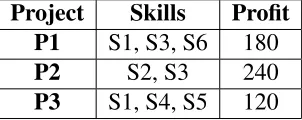
Let’s understand the algorithm using a working example. We are given a set of Projects,
Skills required to complete the project and the profit gained after completing it in Table
3.1. In Table 3.2, we are given the details of experts with their possessed skills, cost they
will charge, expert’s capacity and the productivity of the experts. Our task is to find a team
from Table 3.2 who can cover all the projects in Table 3.1 within the given budget 150.
Project Skills Profit
P1 S1, S3, S6 180
P2 S2, S3 240
P3 S1, S4, S5 120
Table 3.1: List of Project with required Skills and Profit
Expert Cost Skills Capacity Productivity
E1 50 S1, S4 2 4
E2 40 S6, S3 1 3
E3 60 S4, S5 4 4
E4 30 S1, S2, S3 6 3
E5 30 S3, S5 3 2
Table 3.2: Profile of Experts
We can clearly see that Cost, Profit and Productivity are all on a different scale and if
we use these values to calculate score it will not give equal weight to each factor we are
considering. To bring them on the same scale we have used min-max normalization that
will help us to convert Profit, Cost, and Productivity in a range of 0 and 1.
Min-Max normalization is used to re-scale the features to a range between 0 and 1
inclu-sive.The figure 3.1 explains the process of calculating normalized value. In our case, we
only for score calculation and selection process.
Figure 3.1: Min-Max Normalization [25]
3.1.1 Illustration of Expert Pick Strategy using Normalized Values
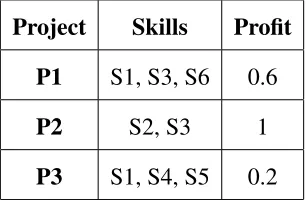
In this section, we will see the working example of our algorithm. The Table 3.3 and
Table 3.4 shows the information of Projects and Experts with Normalized Value. The
values are converted using the information in Table 3.1 and Table 3.2.
Project Skills Profit
P1 S1, S3, S6 0.6
P2 S2, S3 1
P3 S1, S4, S5 0.2
Table 3.3: List of Project with required Skills and Profit
Expert Cost Skills Capacity Productivity
E1 0.75 S1, S4 2 1
E2 0.5 S6, S3 1 0.66
E3 1 S4, S5 4 1
E4 0.25 S1, S2, S3 6 0.66
E5 0.25 S3, S5 3 0.33
Table 3.4: Profile of Experts
Process: We calculate score for each project and expert pair and select the pair that
function that we use to calculate scores:
scep ← λ.PF(p).min{Skill(e,p), Cap(e)}
C(e) + (1 − λ).PR(e)3.1 (3.2)
P1 P2 P3
E1 ((0.5) * (0.6 * min{1,2}) /
0.75 + (0.5 * 1)) = 0.9
0 ((0.5) * (0.2 * min{2,2}) /
0.75 + (0.5 * 1)) = 0.766
E2 ((0.5) * (0.6 * min{2,1}) /
0.5 + (0.5 * 0.66)) = 1.53
((0.5) * (1 * min{1,1}) /
0.5 + (0.5 * 0.66)) = 1.33 0
E3 0 0 ((0.5) * (0.2 * min{2,4}) /
1 + (0.5 * 1)) = 0.7
E4 ((0.5) * (0.6 * min{2,6}) /
0.25 + (0.5 * 0.66)) = 2.73
((0.5) * (1 * min{2,6}) /
0.25 + (0.5 * 0.66)) = 4.33
((0.5) * (0.2 * min{1,6}) /
0.25 + (0.5 * 0.66)) = 0.73
E5 ((0.5) * (0.6 * min{1,3})
/ 0.25 + (0.5 * 0.33)) =
1.365
((0.5) * (1 * min{1,3})
/ 0.25 + (0.5 * 0.33)) =
2.165
((0.5) * (0.2 * min{1,3})
/ 0.25 + (0.5 * 0.33)) =
0.565
Table 3.5: Iteration 1 Score Calculation
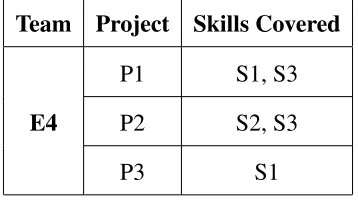
After calculation of the score, we select the expert who has the highest score. In Table
3.5, Expert E4 has the highest score for Project P2. We select Expert E4 and assign to all
the Projects that need to be completed until they reach their maximum capacity. Table 3.6
shows the remaining skills that need to be covered after Iteration 1 and Table 3.7 shows the
Project Remaining Skills
P1 S6
P2 –
P3 S4, S5
Table 3.6: Status after Iteration 1
Team Project Skills Covered
E4
P1 S1, S3
P2 S2, S3
P3 S1
Table 3.7: Skills Covered after Iteration 1
Remaining Budget after Iteration 1= 150 - Cost of Expert E4 = 150 - 30 = 120
In Iteration 2 we follow the same process. Table 3.8 shows the score calculation for
Iteration 2.
P1 P3
E1 0 ((0.5) * (0.2 * min{1,2}) /
0.75 + (0.5 * 1)) = 0.63
E2 ((0.5) * (0.6 * min{1,1}) / 0.5
+ (0.5 * 0.66)) = 0.93
0
E3 0 ((0.5) * (0.2 * min{2,4}) / 1 +
(0.5 * 1)) = 0.7
E5 0 ((0.5) * (0.2 * min{1,3}) /
0.25 + (0.5 * 0.33)) = 0.565
Table 3.8: Iteration 2 Score Calculation
shows skills covered in Iteration 2.
Project Remaining Skills
P1 –
P2 –
P3 S4, S5
Table 3.9: Status after Iteration 2
Team Project Skills Covered
E4
P1 S1, S3
P2 S2, S3
P3 S1
E2 P1 S6
Table 3.10: Skills Covered after Iteration 2
Remaining Budget after Iteration 2= 120 - Cost of Expert E2 = 120 - 40 = 80
In Iteration 3 we again follow the same procedure. Table 3.11 shows the score calculation
in Iteration 3.
P3
E1 ((0.5) * (0.2 * min{1,2}) / 0.75 + (0.5 * 1)) = 0.63
E3 ((0.5) * (0.2 * min{2,4}) / 1 + (0.5 * 1)) = 0.7
E5 ((0.5) * (0.2 * min{1,3}) / 0.25 + (0.5 * 0.33)) = 0.565
Table 3.11: Iteration 3 Score Calculation
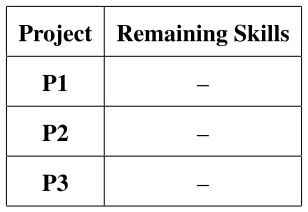
Table 3.12 shows the remaining skills that need to be covered and Table 3.13 shows the
Project Remaining Skills
P1 –
P2 –
P3 –
Table 3.12: Status after Iteration 3
Final Team Project Skills Covered
E4
P1 S1, S3
P2 S2, S3
P3 S1
E2 P1 S6
E3 P3 S4, S5
Table 3.13: Skills Covered after Iteration 3
Remaining Budget after Iteration 3= 80 - Cost of Expert E3 = 80 - 60 = 20
As we can see in Table 3.12 there are no more skills that need to be covered. We now
have the Final Team that can cover all the Projects in Table 3.1. Table 3.13 shows the Final
Team of Experts and the Skills they cover. Total Budget spent on hiring experts is 120.
3.2
Cluster Hire with Project Pick Strategy
The second algorithm to find a group of experts to cover the most profitable set of
projects is designed based on the idea of selecting a project in each iteration. In each
iteration, we assign a score to each uncovered project and choose the one with the highest
score to be added to the pool of projects. The score of each project is designed based on
the following intuitions:
• The set of experts responsible to cover the required skills in the project should
becheap.
• The set of experts that cover the skills of the project should beproductive.
The same as the first strategy, these intuitions are not necessarily compatible. A high
profitable project might need an expensive set of experts and/or non-productive set. We
design the scoring function that takes into account a combination of all these objectives.
In each iteration and for each uncovered project p, we find a set of expertsEpto cover the
required skills of p. In order to do that, we use a modified version of the greedy weighted
set cover algorithm. Recall that in greedy set cover, we are given a collection of sets
(corresponding to the set of skills of each expert) in which each set is associated with a cost
(corresponding to the salary of the expert in our problem). The goal is to choose a subset
of sets to cover a given union set (corresponding to the set of skills required for a given
project in our problem). In the greedy weighted set cover algorithm, in each iteration, a set
that maximizes the number of covered elements divided by the cost of the set is selected.
In other words, the algorithm selects a set, in which the price of covering a single element
is minimized. We also add the productivity to the price per skill when selecting the next
expert to cover a given project. Formally, in each iteration, and for any remaining project,
we find a set of experts that are able to cover that project. To find this set for project p, we
start with an empty setEp. Then, we select an expert to be added toEpthat maximizes the
following equation:
sce ← λ.min{Skill(e,p), Cap(e)}
C(e) + (1 − λ).PR(e) (3.3)
Recall thatλ is the tradeoff parameter. The first part of this equation is taken from the
greedy set cover algorithm with a slight modification that takes the capacity of the expert