Pbuedinss ol Inktutional Anferde On Ctu^ical and BioPwess Ehgineeritg 27r - 2gr Ausust 2OO3 , Univettiti Malatsia Sobah, Kat! KiMMU
Arshad Ahmaill
l\eyworos:
Artificial Neural Netwoiks, Connection Weights, Genetic Alsorithm. Inferential Estimatioi, RobusgLss
Introduction
Over the years, the application of Artificial Neual Networks (ANN) in rhe field oi process industries is growing in acceptance. This is because ANN is capable of capturing i' process inlormation in a black box ftinner. In factigiven sufficient input-outpul data, ANN is able to aPproximate continuous funcdon to arbitrary accuracy This has be€n proved in vadous fields such as pattem recognition, syqtem identification. prediction, signal processing, fiult detection and olhers I1l.
In general, the development of a good ANN model dep€nds ' on several factors [2]. The first factor is regarding the issue
' of process data. The quality of black box model js strongly influen€ed by the quaiity of data Unless a good quality data is used in model fitling, the resulting model will not be adequate. The second factor is network architecture or modei
ISBN:983-2643.15-5
Chen Wah Sit'z
struature. Comrnonly, multilayer peiceptron and its vdriancer are widely used in process estirnation Different netwo* arcbitecture resulis in different estimation perfomalce. The model siz€ and complexity is another important factor. What is required is a pa$imonioBs model. This is because a smatl netrvork may not able to reprcseni Ihe real sioadon due lo its limited capability, while a large network may overfit noise in the tmiring data and fail to have good generalization ability. Finaly, n\e quality of a process model is also strongly. detemined by network lraining. This stage is essentially an identification of model
_ pammeters that fits the given data.
This paper focuses on the last issue. The aim is to improve the dstimation abitiry of ANN regadless of the network architeature. Until oday, maty researchen still prefer use gradient search nelhod - Backpropagation (BP) in lraining ANN. Among all the backpropagation methods, Levenberg -Marquardt (LM) algorithms is the mosl widely used The
advantagas of tlis gradient-based technique are its efficient implementations, good at fine-tuning and faster convergence compared to other methods. Unfortunately, BP is a local search method and when applied to complex nonlinear optimization pmblems, can sometimes result in inconsistent and unFedict?bl€ performances. Modifications Foposed by vadous researchers provided only little improvemenl This could be due to the fact that searching of optimal weights is strongly dependent on initial weighls. If lhese initial weights are located near local minima, the algorithm would be trapped.
Several different attempts have been proposed by various researchers to alleviate this training Foblem. These include imposing consiraints on the search space, rest.rting training at many random points, adjusting aaining parameter and restxuctudng the ANN architecture [3]. I{owever, some apFoaches arc Foblem-specific and not well accepted. So far, different researchen prefer different methodologies. One of the more prqmisiog directions in conjunction widr improving ANN ability is by introducing adaptation of network training using Genetic Algoridms (GA).
Unlike BP, GA is a global search algorithm based on the pdnciple "survival of fittest". GA simultaneously searches
Improving Robustness
-
of Artificial Neural Networks Model Using
Genetic
Alsorithm
I l^zboratory ofProcess ContrcI, Chenicat Engineenn| Departnen!. Fa lry ofChenicat and Naturul Resources EnstueehnS, Unit)eniti Tek oloei Malavsia, 8l3l0 WM Skudai, lohor' Malalsia'
Tel: +60-7-5535610, Fax: +60'7'5581463 E t@il: anhad@fkkk:a.utn nr .
2 tt)borctot] of Pncess ContnL, Chenical Engineeins Department, FacultY of Chemical anJ Natural Resources Engineerins, UiiversitiTeknologi Malalsia,81310 UfM Skudai' lohor' Malavsia'
Tel: +60'7' 5 5 3 5858' E-mail: !!8c9Lp)!2b9q{9!!
for solutions in several regions, thus increasing lhe prooabil;ry ol global convergence. Besides, CA requires no knowledge or gradient information about the search space. Furlhermor€. since rr is impossible to formulate an a priori exact model of the sys@m, a more pmcdcal approach is offline set up a rough model. followed by online update of rhe model using GA.ln this way, ANN-GA that results from ihe merging of CA and ANN will gain adaptability to dynamic environmena. In other words, the ANN-CA model developed should be more robust to dynamic nonlinearity of the process involved.
In this work, an ANN model is used for inferential estimation of product composition in a distillation column. The ain is to address an issue in process industries, i.e.. the lack of on-line measurement of producl quality. The use of on-Une measurements for product quality variables has be€n linrited due to large measurement delay. the need for frequent maintenance as well as high capital and operating costs. In order 10 adapt to changing markel conditions while maximizing profii, the needs for robust and accuraie inferential estimators for controlling the product qualiiy variable becomes paramount [4]. For this reason, this work inrroduces evolution of connection weights in ANN using CA as means of improving robustness of the resulting
Artilicial Neural Networks
ANN is collections of mathemancal modeis lhal emuiate some of the observed propenies of biological nervous systems. ANN mimics human leaming and pedorms mapping from an input space to an output space, In genenl, ANN is made up of individual interconnected simple piocessing elements called neurcns, arranged in a layered stucture io form a neiwork that allows parallel computation. ArchiEcrure of a general ANN is illustrated in Figure I .
Ptuceedirys af lnkmliondt CbnJerence On Chenical and Biopmcess EneiEerihq 2T - 2q Ausu$ 2AB , Universni Malotsia Saboh, Kata Kikatolu
result is then passed through a nonlinear acrivation function or transfer funcrion to oblain rhe outpuL ):
y = I l z w , t t t b l ( l ) )
Transfer
Inpuls Weghls Bias FLrnctio. Output
Figurc I - Architecturc of Aftifcial Neurul Netr',)orkt
An artificial neuron roughly replicates the opentions ard - conneclivity of their blological counterparts thar are highly interconnected. An example of artificial neurcn is illustrated in Figure 2. The neuron input, rr, is multiplied by the corresponding weight factor, vr,, before bejng sent to the neuron. This is followed by performing summation of all input in the neuron body. An intemal bias, , is also inaoduced to enhance perfoffrance of th€ network. The
Figwe 2 -Structure of Neurcn Model
An impoflant feature of this neuron model is a ransfer function, / ) which can peform nonlinear calculalion. Various types of nonlinearity me possible such as log sigmoid, hype$olic tangent sigmoid, hard limit, saturating linear and pure linear function.
ANN can perfom a human-1ike reasoning, ieams ihe attitude and stores the relationship of the Focesses on the basis of a rcpresentative data set that has already exisrs. Therefore, generally speaking, the ANN does no! need much of a detailed description or formulation of rhe underlying process. Depending on the struclure of the network, weighir are adjusied in order to fir a series of inputs and output data. When the weight of a parti€ular neuron is updated it is said that the neuron is leaming or undergo training. Sinc€ the connecting weights are not related to some physical idenlities. the approach is considered as a black-box model. ln sunlrnary. Lra;ning ofan ANN is an oprimjzadoi problem where convergence to global minimum is desired.
In the recent years, ANNS have been extensively studi€d in academia as process models and conrrollers [5, 6, 7, 8]. The applications of ANN are increasing in process industry since it shown the effecriveness in process estimation. Alrhough ANNS have been shown to be effective in solving difficulr problems, specific guidance of design and implementation are still lacking [9]. Among the drawbacks of ANN is the use of gradi€nl descent methods resulted in .problems in the training of the nelwork. This has motivated researchers to come out with idea of merging evolutionary algorirhm (EA) into neural networks [ 10, I l ].
Genetic Algorithms
GA belongs to a €lass of population based stochasdc search algorithms known as Evolutionary Algo.ithms (others include.Evolution Strategies, Evolutionary Programming and Cenetic Programming). These algorithms model some natural phenomena of genetic inhedtance and Darwinian strife for survjval. In general, EAs are applicable ro a wide
l.pur Lar€r Hiddc. L.ye. oulpulLdyer
range of problem in learning and optimizalion. EAs are particularly useful for dealing with large complex problems that generab many local optima,
The evolution process implemented by GA can be interpreed as result of lhe inlerplay between the creation of new genelic information and ils evaloalion and selection. In life, an individual wilhin a population is affected by other individuals as well as the surouoding environment. Normally, th€ belter individuals have hiSher Probability to live longerandto generate offspring. They in turn inherit the parental genelic informadon.
The evolution pmcess involved in g€netic algorithms are canied out by three main genetic operators: reproduction, crossover and mutation. The alterations of thes€ genetic operalors are based on probability defined earlier. The direct relroduction opemtor simply copies a member from the parental population to the next generation. The genetic operation ofcrossover takes two members of the population and combines their genetic information !o create new offspring (cbildren) as shown in Figure 3. The role of lhis operalor is to allow the construction of new individuals from exisling ones, thus enabling new regions of the solution
Fieure 3 - A Typical Single Point Crossowr for GA
The thid operalor is mutation. In this case, random alterations !o the individual genetic coding are made to mainlain population diversity. hence reducing dl€ risk of gemature convergence. This operation can be illustrated in Figure 4.
li
i r
0 1 0 1 0 0 1 1 N 0 1 0 1 0 r 1 ' l 0 I f-" ) I 1 1 0 0 1 ' 1 1 0 v 1 1 0 0 1 r 0 1 1
.Ifc.rinn
0 r i b - i r 0 1 I 0 - 1 0 1 i 1 - i 1 0 1 1 0
- - t
Fieurc 4 - A Ttpical Binary Mutation for GA
Although CA was originally developed for computer science research field, their applicatio:rs have extended to Process modelling and estimation of chemical processes. The application of CA in system identification can bmadly be classified into two distinct arcas: offline design and online optimization [12]. With the ability of global, pamllel and stochastic search method, the idea of applying GA in ANN kaining seems to be advantageous,
ANN'CA model refer to a s['ecial class of ANN in which evolnlion is another fundamental folm of adsptation in addition to leaming. Both models are inspired by nature. but while ANN are concerned with learning of an individual
ISBN:983-2643-15-5
Pneedius oJ Inknotional Conleqce O^ Cheni.ol and Biopd^s Evireaiq 27 - 2q Aus^t 2003 . Uni,eniti Malatlia sabdh, Xota Kiiabolu
(phenotypic leaming): GA deal with leaming of adaptation to a changing environment (genotypic leaming) [f3]. IDtersection of both techniques is believed will imFove the performance of ANN in process estimation.
The evolutioo steps of the ANN-GA are shown in Figure 5. During this €volution, the archit€cturc of an ANN is redefined and fixed.
Figurc 5- A Gelerul Genetic Algorithm Flov'sheet
The first step in dle evolution of ANN involves generation of initial population by decoding each individual in the curent geneftdon into conn€ction weighrs. Each ANN with the decoded connectior weights is trained by a predefined leaming rule. The fihl€ss of ea€h individual is then 'computed. Here fitness r€Fesenis the error due to the training pro€ess result and is represented as a positive real number, the higher the number, the better the individual.
The following step is the selecnon of fitter individuals in a population. This is aimed at producing fitter offspring. Numerous selection processes arc available. There are three major selection schemes for GA: Roulette wheel selection, Rank-based selection and Toumament selection. Some individuals may be selected more than once for genetic operzLtor altention.
Selected populations shal thgn undergo genelic all,e{ation to transfer their good genetic material to next generations. The replacement process comes immediately after the generation of new offsprings. Th€ choice can be made either fiom the set of offspring only of ftom both sets of offspring and parents. In either case, the r€placement procedure can be dete.ministic or stochastic. These evolutions are stopp€d according to gelremtion countea or th€ number of function evalualions,
Process Description and Plant Simulation . ,
In rhb work. an ANN model lrained using LM rANN-LM) and the one trained by CA (ANN-GA) are tested on Fauy Acid Fractionatior Plant of Pan Ced+ry Oleochemicals Company (PCOC). The nain function of,the Fractiomtion
Planais io sepamLe either palm kernel laLty acid iPKFA) or palm stearine hydrogenated fatty acid (PSHFA) into their fatty acid components noted as C14, C16, Cl8 and so on. The Fractionation Plant consists of the five syst€ms connected in series. The separation ofcrude fatty acid into its components is achieved through the five column.syslems. These syslems include:
. PrecutColumn System
. Lights Cui Column System
. Middle Cut Column System
. Stil System
' . Residue Still System
This research focuses only on the lightcutcolumn. Thelight cur colunn is mainly used to separate C-12 from the others. Similar to other disiillation column in this plant,rlight cut column consists of three sections ofstructured packing using
P.ace4ius otthtematiarct conleEhu On Chanicat aad Bioptucess Ensine.nu 2l - 29r Austs 2003 , Uaiveqiti Malaysia Sabah Kda Kitubai
S/j/zer" AX. The rhree section. in the column are fie coodensing. re4lifying. and s!-ipping sec!ions.
The feed from precut column enters between the r.ectificatian and stripping sections and flashes inside the colu4n. LighEr components rise to the top and condense by direct coniact with rhe cooled, down-flowing pump,around .fluid in the.condenqing section. Part of the hot distillate
retums to the colurn qi reflux 0o the rectification seition of . the column. The remaining is cooled by tempered warer in . thq lighb cut product cooler bpfore being sent to stomge. 'ne
heavies collect in the bottom of the colurnn and are circulaLed by a bonom pump *uough rhe
'eboile'. The nel bottoms piodu0t is puinped to.the middl€ cut column for 'lunher lrac!ionarion.
Process flowsheeting and planl simulalion of lhe ftactionarion plant was carried our using HYSYS.Ptanl dynamic simulator based. The flowsheer developed in IrySYS environmenL can be seen in Figure 6. trySYS.Planr does not suppon packed column. and as such, the height equiva,lent thaoretical plare (HETP) calcularion was used. In the sirrylation, UNIQI'AC acriviry model is selected for physical propeny calculations due to the facts that fatty acids (carboxylic acids) are poldr component with non-ideal beh4viour.
For pla[t model validation, comparison with- actual plant dynamic was done using data collecled from lhe planl DCS sysrem. Only selecred majorstream anil somestate condilion for light column such as t€mperature and pressure were compared. Minor discrcpancies are accepted since the overall behaviour is what is importdnt fot this work. Simulation data was monitored to ensure no unrcasonable oualiers due b simulad6h erors. The simulation rnodel developed adequately represents the sele.ted distildtion column since there is no major error.
ANN Model Development
Similar to other system identification approaches, model development for estimators involved several main considerations. First, a sensitivity analysis on the process
i]96
was caftied dut. This was folowed by carcfully planned data genemtion for the model development tasks. Model development stages include specification of network archit€cture, selection ofnetwork topology, as well as model training and validation. Well-design identification effo{s irnproye the validity of the resulting models. The procFdures of developing ANN-GA estirnator were similar to development of ANN-I]4 estimatot. However, for the .former, evolutio! was i!troduced in network training. A1l the developmenl of ANN model endeavours were accornplished using MATLAB toolbox.
Sensitivity Analysis
Sensitivity analyses of light cut column were carried out within HYSYS.Plant envircnment for both openloop and closed-loop systems. Thes€ analyses were caried out !o provide betler understanding on dynamic behaviour of the
process. In this case, step changes were imposed to various process inputs such as flow rate, feed Gmperature and feed composition. Their effects on process outputs such as column lemperature, pressure and product composition weae srudied focussing on the sensitivity ofthe system.
Dal€ Generation and Modification
Sinc€ the producl quality variable cannot be measured on-line, a number of measured variables can be used to inferentially estimate the composition. The choice of suitable measurements were on process insights. In this case the results ofsensitivity analyses become the main deciding
Once lhe suirable variables were specified. data having sufficien! informatjon were generated form th€ HYSYS.Plant flowsheet. In order ro develop sufficienrly excited data for modelling pur?oses. the values of input variables were changed randomly. Ideally, the obse arions should cover the entire tange of operating conditions. The data was then scaled using mean scaling method to Fevent unnecessary domination of certain variabtes due to the difference in order of magnirude of actual process values.
Networks Architecture Specifrcation
Archilecrure of ANN model includes type of networks, number of hjdden layers as well as the number of hidden nodes. ln rhis work, only feedforward nerwork was considered. Only one hidden layer was urilised as ir has come to general knowledge rhat an ANN wiih one hidden layer is sufficient !o perform process mapping a$irrarily well. Another important stage ir ANN modet development is the selection of network ropology. This is essenrially the selectioo of the optimum number of hidden nod€s or neumns. Usualty, this number wilt inqease with the complexiry of system. In ahis study, l-20 neurons were tesred for the optimum nerwork ropology by trial and error approach. Decisions on the optimum topology were based on cross-validarion, i.e., testing rhe trained model using a differenr ser of dara.
Training and Validalion
In general, an ANN model undergoes Lraining by successive presentation of input-outpur pairs aod adjustrnenr of weighrs to minimise the deviation of the nerwork estimarions fiom specified target values. This can be achieved using any suitable optimizarion algorithm. Levenberg-Marquardt (LM) mehod that is one of the backpropagation techniques was aclopted for this work.
Evolution of ConDection Weights
Network training is a minimizarion of an eror function such a s M S E . b y r t e r a l i v e l y a d j u s L i n g c o n n e c d o n $ eights. C A c a n be used effecrively in rhe evoturion ro find a near-oprimat set of-connecrion weights globatty \rirhout compuLing gradienl rnlormaLion. rhus eiiminaring rhe wealness of$adienL based methods. The evolutionary approach ro weighr rtaining in ANN consistt of rwo major phase. The firsl phase is to decide the r€presenration of connection weightr in the form
ISBN:983-2643-15-5
Ptu..pdkb oJ:ll1nd@at cdJ.rc".. on cheni.at tud B@pb..:, t ryiR.raa 27 -2q' Ausutr 2AB. Univ.rsiti Matdr,ia Sabah, KotaK,aabatu
of binary or not. The second phase involves evolutionary pmcess by cA.
Results
and Discussion
Mutti-inpur mulri-ourpur (MISO) model was chosen to for the development of an estimator for the C_12 composition in distillate stream. Eight variables as well as theii one_srep delayed signals were fed as the model inpurs. These input vadables inctude reflux flowrate, recycle flowrate, iop column temperanrre, feed temperature and four tray rempemtures. A totat of 1000 data was generated using these model inputs for modelling puryoses. ihe data was divided mao haining and validation set. In rhe network architecrue specification, rhe oprimum neuron was decided based on the minimum validation mean square er.or (MSE). It was found that the C-12 composiiion €ould be esrimared accuntely using a nerwork with 8 hidden neurons. In this case, th; network is Aained using LM. The rransfer firnctions used in the network are log sigmoid and linefi for hidden layer and oulpul layer respecLjvety. The perfonnance of bolh ANN-LM and ANN-CA modet weri considered in offline and online estimation.
Ofllin€ Estimation
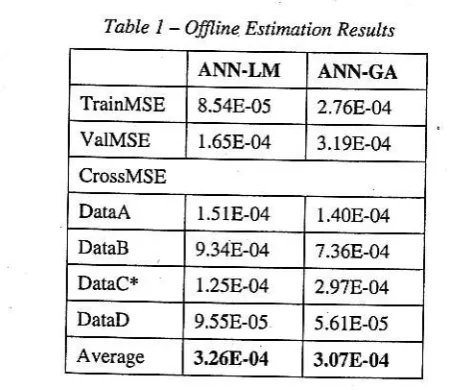
Both ANN-LM and AitN-cA models were tesred on four set of differenr rarge data for model evaluarion. The resutrs are sunmarised in Table I and plotted in Figure 7. Dara C were used as taining and validarion data in model devetopment.
Table 1 - Otline Estimation Resutts
ANN.LM ANN.GA
TrainMSE 8.54E-05 2.168-04
VaIMSE 1.65E44 l . 1 9 E - 0 4 CrossMSE
DarlA 1.51E-04 l 40E-04 DataB 9.34F.-04 7.36E-04
Darac+
r.25E-04
2.97E-04DataD 9.55E-05 5.61E-05
AVenge 3,26E-04 3.ME-04
From the resulb, we can see that MSE for rhe aainins and ralidalion of ANN.LM modei i\ Iolter rhan Lhe ANN_CA model. Similar pedormance can be observed when rhe network was used to estimate the data scatter on Datac since thls s€t was used for tmining and validarion. It is imporlanr ro note here that the topology selection was based on ANN_LM. This^lopology was also imposed on the ANN-CA. Owing ro tbis fact, ANN-LM has some given advantages
The ANN-LM was rmined until conversence. On the contrar'r,, ANN-GA was trained only until iome sperified number of generations (i.e., itemtions). In order ao rcduce
Ptuc..dinp: at t"t.naional CohJ.atu c On Ch.ni.al oid Btoptu'^ E^BineninS 2/ 2E' Aulun 2AB llniet:iti Malartid Sabo\ Kota Kiaabotu
simulation time. lhe number of generaLion for evolulion in -Ca-"""".t
l. Ioo large There is a .nade--off between
"'.i., "i *.**,i"" ;d simulaLion
dme for ANN-cA ."1.i r"
't'i" **l.,rt.
*mber of generation was se( to 150 .'Jil. *"t believed to be able to train the neiwork to
Derformance of ANN-GA is better when evaluated agains ;dier lets of datai This proved ihat ANN trained bv GA can geneialise better in different pattem of data and can better cope with'diffetent operating condition, thus maldng the modet more robust. ANN-LM model is poor in extsapolation This is shown by poor estimation of DataB, which has bigger
Although ANN-LM was wetl trained, the
i98
range than Datac.
5 !.05 3p ; . o !
: 0 3 5
.5 o.o{
x
g o s €
; oi5
,95
Online Estimation
Adaotations of network weights in both ANN-LM and ANN-GA model were introduced The straegy was to acrivale the retmining process using once the estimation enor was exceeding the pr€defined limit. The relraining allowed automatic update of the connection weights (including bias) based on the same network architecture to take into considerations n€w conditions. Here, lhe neiwo.k resfiucturing was not considered and retraining of initial network was assumed lo be able to provide improvements to estimrtion ProPerlies.
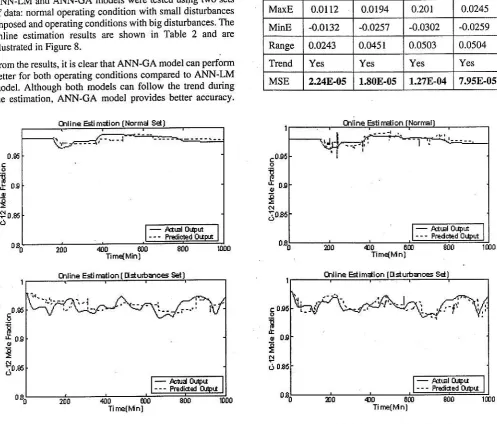
ANN-LM and ANN-GA models were tested using two sets ofdata: normal operating condition with small disturbances imposed and opemting conditions with big disturbances. The online estimation results arc shown in Table 2 and are i l l u s r r a r e d i n F i S u r e 8 .
From the resuhs, it is clear that ANN-GA model can perform better for both opemting conditions compared to ANN_LM model. Although both models can follow the tend during the estimation, ANN-GA model provid€s better accura€y.
|} ine EltinElion lNormd S€l )
- , - - l
200 rro0 n]0 800
nh{MIn}
chlhe E4itralao. I E4urbhcs ci]
T i c t M n l (a) Adaptation Using ANN-LM
Prccee.liagt of Internationo! ConIereice On Cnenical @d Biopnces Enein4titq 27 -2q\ A"EN 2aB , Uaiteniti Malarsia saboh, Kota Kitubalu
Tte poor peformances of ANN-LM model may be due lo the local initial weights leod to lead the solution converge at local minima.
Better resulti were obtained for ANN-GA model. This suggests that by using CA to retrain network, the updated connection weights were able to adapt to new operating conditions. The ANN-GA model was gaining adaptability to dynamic nonlinear environment.
Table 2 - Online Estination Results
Normal Disturbances
ANN.W ANN.GA
MaxB 0.0112 0.0194 0.201 o.0245
MinE -0,0132 -0.425'l -0.0302 -o.0259
Range 0.0243 0.0451 0.0503 0.0504
Trend Yes Yes
MSB 2.248 05 1.808 05 t.278-04 7.95E-05
.9
,P o.o
I
:0.s6
0Eb
5
T
:
;0 06
0Bd
I i E ( M n )
(b) Adaptation UsinS ANN'GA
of ANN Model in Online Adaptation Figute 8 - Pe'fomances
Despite this encouraging observation. there are still questions in implementing ANN-GA model in a real plant. Since the ANN-GA model only concentrales the training algorithm using predefined network architecture, the sele€tion of initial network architeciure is particularly important, Different types of networks such rccunent
ISBN:983-2643-15-5
networks with auto correlation information may also be considered although making training Focedure more complicated.
Another issue is regarding the training data used for model adaptation. Commonly, a good training data should cover a
Ciine Estifrilien lqstu.ba€ Sd
wide range of operating conditions This is difficult to eslablish in pmctic€. One way of overcoming this issue is using initial connection weighis that arc trained under wide range of operating conditions, but adaphtions are added to some tuneable parameters. For an example, new set of weights may act as tuning pammeter and merging them with the initial weights by pre-specified percentage. In addition, large disturbances may also due !o noise and signal errors. Hence, some form of filters may need to remove or to smooth oui process signals. Appropriate filter design often leads to better robustness characteristics and hence makes the estimation scheme more pmcticable,
Conclusiotr
In this paper. we have demonsFated that better network training can be established using Genetic Algorithrns. Inlroducing evolutionary mechanism in network training! ANN-GA perfonned better than ANN-LM either in offline or on-line implementation. ANN-GA was also demonstrated to be able to cope with different range of op€mting condition, rhus improving the model robustness of ANN.
Acknowledgments
This project is funded by the Minislry of Science, Technology and the Environment tkough National Science Foundation Scholarships and IRPA research grant. Our heartiest appreciations are for everybody who has direatly or indirecdy contribute to the success of this project.
References
ill Page, G.F., Gomm, J.B. and Winiams, D. (1993). Application of Newal Networks to Modelline and Control. UK: Chapman &Hall
l2l Basheer , I.A. and Hajmeer M. (2000). Anificial Neural Networks: Fundamentals, Computing, Design, and Arylicatton. Journal of Microbinlngii:al Methods, 431 3 , 3 1
[3] Sexton, R.S., Dorsey, R.E. and Johnson, J.D. (1998). Towards Global Oprimizadon of Neuml Networks: A Comparison of the Genetic Algorithm and Backpropagation. Decision Support Systel/r,s. 221 l 7 l - 185.
Pnceediqs of Intemationol Conf.ftnce Ot Chenical and Biopn.es EnEineeinE 27' - 29" A"EL'| 20AJ , Uaive5iti Malaysia Sobdh, Kata Kinabalu
[4] Tham, M.T., Montague, G.A., Monis, A.J. and Innt, P.A. (1991). Soft-Sensors For hoc€ss Estimation and Inferential Control. ,lounnl of Process Control. l(l): 3-t4.
{51 Ahmad, A., L.Y. Ung and T.S. Wong (2001). Neuml Networks Estirnators for Produet Composition in a Palm Oil FBctionation hocess. In Proceedings of PORIM Intemational Palm Oil Conference 2001.
16l Bhafiiya, S. and Whiteley, J.R. (2001). Development of Inferential Measurements Using Neural Networks. LSA Transac tions. 40: 30'7 -323.
[7] Hunt, K.J., Sbarbaro, D., Zbikowski, R. & Oawthrop, P.J. (1992). Neural Networks for Control Systems - A Survey. Automatica. 28(6): 1083-l ll2.
[8] Ungar L.H., Hanman, E.J., Keeier, J.D. and Mafiin, G.M. (1996), Process Modeling and Con$ol Using Neural Networks. ,4JChE Slnposium Series. 92t 57 -6'7 .
[9] Hintz, K.J. and Spofford, J.J.(1990). Evolving a Neural Networks." In Proceedings of 5th IEEE Inremational Symposiumon Intelligent Conlrol. l: 479-484.
ll0lMontana, D. and Davis, L. (1989). Training Feedforward Neural Networks Using Oenetic Algorithms. Proceedings of Eleventh Intemational Joint Conference on Artifi cial Intelligencet 7 62-7 6'7.
IlllYao, X. (1997). Global Optimizdtion by Evolutionary Algorithrns. In Proceedings of ahe 2* AIZU Inlemational Symposium on Parallel Algorithms / Architecture Synthesis: 282-291.
ll2lFlening, P.J. alld Purshouse, R.C. (2001). Genetic Algorithms in Control System Engineedng. Research Report No. 789, University of Shffield.
[l3]Bian]e, J. (1995). Evolutionary Algorithms for.Neural Network Design and Training. Technical Report No.322, University of Karlsruhe, Institute AIFB.