Review on Comparision of Relational
Database Model and other Database Models
Mamta
Assistant Professor, Department of Computer Science, Saraswati Mahila College at Palwal, Haryana, India
ABSTRACT:.As we know that memory is that palce in computer were we stores the data into the form of blocks same as when we store the data on large amount then we use database systems. A databse system is a software system that stores the data and also manages the data. It is a computer software system that interact with the users and analyse the data.The data model define how data is connected to each other and how they are processed and stored inside the system.In this paper we study about different-2 data models and relationship between these models.
KEYWORDS :Database-Models,Models, Structure,Database Relationship.
I. INTRODUCTION
A model is a representation of reality, ‘real-world’ things and happenings around us. A data-modal represents the organisation itself. It should provide the basic concepts and notations that will allow designers and end users to accurately communicate with the database. Database modelling is the first step in the data base design and object oriented programming.It explicitly determines the structure of data.It is some time reffered as structure.These are sometimes complemented by function model.The main aim of data models is to support the development of information system by providing the definition and format of data.The purpose of a data-model is to make data more representable & understandable.The object based and record based data-models are used to describe data at the conceptual and external level, the physical data-model is used to describe data at the internal level.
.
II. LITERATURE SURVEY
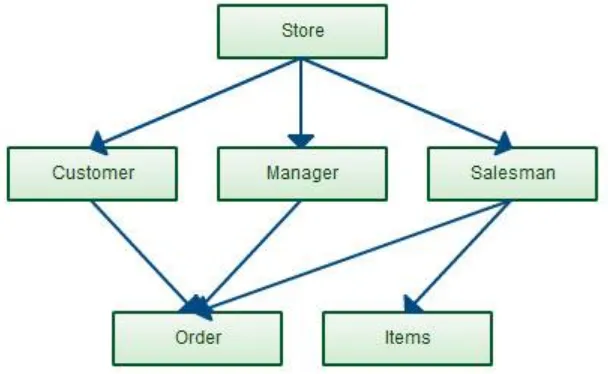
The Network Data-Model represents the “Many-to-many relationship as shown in fig. It consists of nodes and edges. The basic data-modelling construct in the Network- Model is the set construct. A set consist of an owner record. Type, a set name and a number record type. A number record type can have that role in more than one sets, hence the multi-parent concept is created. So this model is based on mathematical set theory.
NETWORK DATABASE MODEL
the Relational database model is based on the relational model developed by E.F.Codd. This model allows the creation of data structure, storage of data and retrieval operations and some integrity rules defines on data. It stored the data in the form of tables. A table is a collection of records and each record in a table consist some fields. Each values in the table are atomic.Each row has unique record.Column values are of the same kind.The sequence of columns is insignificant.Each column has a unique name.Some fields may be designated as key, this means some uniqueness is defined on fields of table. Join operations are also defined on tables that select related records in the two tables by
matching values in those fields. The relational data-model is based on relation-algebra. The purpose of the relational
database contains and what information they want from it, and let the database management system software take care of describing data structures for storing the data and retrieval procedures for answering queries.
Fig1- of Relation model
III. COMPARISION STUDY BETWEEN DIFFERENT DATA MODEL
Characterstics Hierarichal model Network model Relational model
Data structure
One to many or one to one relationships.
It is based on parent child relationship.
It allows many to many relationships.
A record can have many parents as well as many childrens.
It aloows one to one,one to many,many to many relationships.
it is based on relational data structure
Data manipulation
Does not provide an
independent stand alone query based.
Retrieve algorithms are complex.
Use of
CODASYL(conference on data system languages)
Retrieve algorithms are complex
Relational databases are what brings many sources into a common query such as SQL.
Retrieve algorithms are simple and quite
Data integrity
Cannot insert the information of a child who does not have any parents.
Deletion of parents results in deletion of child also
Does not suffer from any insertion anomaly.
Free from update anomalies.
Free from delete anomalies.
Does not suffer from any insertion anomaly.
Free from update anomalies.
Free from delete anomalies.
IV. CONCLUSION
Advancement in computer technology created a need of data storage. Traditional database models fulfilled the requirement of data storage for few decades but global and social networking placed a new challenge in front of
computer experts. This change of trend in technology directed the experts to develop such a system that is not only
REFERENCES
1. Codd, E. F. A relational model for large shared data banks. New York: Association of Computing Machinery. 5. Codd(1970)..
2. Kroenke, DDatabase processing: fundamentals, modeling, applications. Chicago: Science Research Associates, Inc. (1977).
3. Codd, E. F. Relational database: a practical foundation for productivity. New York: Association of Computing Machinery. (2007).
4. Williams, SThe associative data model (Second Edition), Great Britain: Lazy Software . (2002).
5. Simon, A. R. (1997). Data warehousing for dummies®. Hoboken, NJ: Wiley Publishing, Inc.
6. McLeod, R. and Schell, G. (2001). Management information systems (Eighth Edition). Upper Saddle River, NJ: Prentice Hall.
7. Kroenke, D.Database processing: fundamentals, and Implementation (Seventh Edition). Upper Saddle River, NJ: Prentice Hall(2000).
8. Marston, T. (2005). The relational data model. Retrieved March 30, 2009.
9. Chad. A comparison of a graph database and a relational database: a data provenance perspective. Retrieved (2010).
10. Dewson, R .Beginning sql server 2000 programming. Birmingham, UK: Wrox Press Ltd(2001).