Article
Synthesis and Characterization of Te Nanotubes
Decorated with Pt Nanoparticles for fuel cell
anode/cathode working at neutral pH.
Maria Rachele Guascito 1,*, Daniela Chirizzi 2, Emanuela Filippo 3, Francesco Milano 4, Antonio Tepore 3
1 Dipartimento di Scienze e Tecnologie Biologiche e Ambientali, Università del Salento, S.P. Lecce-Monteroni, 73100 Lecce, Italy; [email protected]
2 IZS Puglia e Basilicata, U.O. Putignano. Via Chiancolla 1, C.da. S. Pietro Piturno, 70017 Putignano (BA), Italy; mailto:[email protected]
3 Dipartimento di Beni Culturali, Università del Salento, S.P. Lecce-Monteroni, 73100 Lecce; [email protected] (A. T.), [email protected] (E. F.)
4 Istituto di Scienze delle produzioni Alimentari, Consiglio Nazionale delle Ricerche, S.P. Lecce-Monteroni, 73100 Lecce; [email protected]
* Correspondence: [email protected] (M. R. G.)
Abstract: In fuel-cell technological development, one of the most important objectives is to minimize the amount of Pt, the most employed material as oxygen reduction and methanol oxidation electro-catalyst. In this paper we report the synthesis and characterization of Te nanotubes (TeNTs) decorated with Pt nanoparticles, readily prepared from stirred aqueous solutions of PtCl2 containing a suspension of TeNTs and ethanol acting as a reducing agent, avoiding the use of any hydrophobic surfactants as capping stabilizing substance. The as obtained TeNTs decorated with Pt nanoparticles (TeNTs/PtNPs) have been fully characterized by X-ray diffraction (XRD), transmission electron microscopy (TEM), selected area diffraction patterns (SAD), X-ray photoelectron spectroscopy (XPS) and cyclic voltammetry (CV). We demonstrate that the new material can be successfully employed in fuel cell either as anodic (for methanol oxidation reaction) and cathodic (for oxygen reduction reaction) electrode with high efficiency in terms of related mass activities and on-set improvement. Remarkably, the cell operates in aqueous electrolyte buffered at pH 7.0, thus avoiding acidic or alkaline conditions that may lead e. g. to Pt dissolution (at low pH) and paving the way for the development of biocompatible devices and on chip fuel cells.
Keywords: Te nanotubes decorated with Pt nanoparticles; fuel cell neutral pH; oxygen reduction reaction; methanol oxidation reaction; X-ray photoelectron spectroscopy.
1. Introduction
Nanomaterials have become of paramount importance as advanced systems in numerous fields of research and technological applications mainly thanks to the high opportunity to finely tune the properties of the material by changing their dimensions.[1] In addition, nanomaterials with anisotropic shapes are characterized by higher surface area and several contact points (borders, inner and/or outer surfaces) that can be functionalized in numerous ways [2] if compared to the isotropic counterpart. In this context, carbon nanotubes and nanowires represented a breakthrough in the nano-science research in developing 1D anisotropic nanoparticles since their discovery in 1991.[3]
In electrocatalytic applications, the selection of the optimal electrode materials, to make anodes/cathodes suitable to develop advanced fuel cells and/or electrochemical detectors, is influenced for the most part by their surface chemical composition and physical properties, because the electro-oxidation/reduction rate of the electroactive substances severely depends from these parameters. In the last three decades, to enhance the electrochemical processes in these devices, there was an increasing interest to develop new innovative anisotropic nanomaterials in different shapes
and sizes to make chemically modified electrodes (CMEs), based on metal and/or multi-metallic nanostructures, thanks to their extraordinary electrocatalytic activity decreasing the over-potentials of many substances with respect to common unmodified electrodes [4]. Accordingly, almost since 1980, a variety of techniques and treatments have been developed, useful to modify the surface of the classical electrodes to obtain specific electrocatalytic properties by using either mono- or multi-metallic nanostructures. [5] Multi-multi-metallic structures, either in form of alloy or nano-sized core-shell, show special characteristics like superior optical, catalytic, electronic, and magnetic properties, directly dependent from their chemical composition, as well as their nanometric dimensions typically superior to their pure element counterparts. [6] However, even if most of studies on the synthesis of alloy or core–shell nanostructures have been particularly devoted to develop isotropic spherical structures, methods for making alloy or core–shell structures with different anisotropic shapes, like nanowires, nanotubes etc., have also been reported. [7-9]
In this context platinum material has been extensively investigated and studied for its potentiality in technological applications, including catalysis in many chemical reactions and as electrode material, in fuel cells and/or electrochemical sensors development. On the other hand, massive application of expensive Pt-based catalyst implies a substantial increase in actual costs in fuel cells and/or sensors technologic development, thereby reducing their commercial competitiveness. To reduce the effective device cost by improving the electrocatalytic efficiency of electrode materials with the increment of the active surface, the use of platinum nanostructures in different suitable shapes (i.e. nanowires, nanotubes, nanoparticles) has been studied. [10-15] Besides, the presence of a different metal (e.g., Cu, Sn, Co, Ni, Pd, Au, Ag, Fe, Zn, Ru) to form platinum based hetero-nanostructures or alloy catalysts, can further reduce the Pt amount to be used, since these alloys exhibit better electrocatalytic properties than platinum monometallic counterpart nanomaterials. [16] This strategy is particularly helpful when Pt is used in combination with other inexpensive metals. Accordingly, works have been focused to synthesize and characterize new nanostructured materials based on Pt in different shapes like nanowires and nanoparticles, and, more recently, hollow structured nanomaterials (i.e. nanotubes, nanocages, hollow nanospheres) to make bimetallic and/or multi-metallic nanostructures, [6,17] operating in most cases in acidic or alkaline environment. However, considering that in acidic environment Pt can be dissolved, negatively affecting fuel cell and electrochemical sensor related performance, the use of neutral pH is desirable as it makes this detrimental effect less favorable. [18] In addition, in carbonaceous abiotic membrane-free fuel cells, the employ of electrolytic solution at pH 7.0 (near the buffering point of bicarbonate/CO2) has been recently reported as a valid alternative to alkaline conditions in which the adsorption of CO2, produced by carbonaceous electro-oxidation in the electrolyte, results in a pH decrease that induces instability in the performances of the alkaline direct methanol fuel cell (DMFC). [19,20] Finally, metal alloy materials (i.e. platinum based) used either as anode and cathode in fuel cell systems working at neutral pH can be applied in the development of advanced devices such as (bio-)fuel, micro-fuel and on-chip fuel cells. [20-23]
Pt electrodes modified with Te micro- and nanostructures have been proven to have higher activity than pure Pt bulk for ethanol and glucose electro-oxidation, and H2O2 electro-reduction, making them an important material for the improvement of carbonaceous fuel cells (i.e. direct alcohol fuel cells, DAFCs) [24] and as enzyme-less glucose and H2O2 sensors, [25,26] able to operate with high efficiency also under safe neutral pH environment.
2. Results
The Te nanotubes used in this work were straightforwardly prepared exploiting their natural tendency to form this kind of structure when the Te powder is heated at 400 °C under Ar atmosphere: at this temperature the Te atoms evaporate and condense forming nanotubes.[27] Scanning electron microscope images and X-ray diffraction patterns showed that the as-synthesized Te had a nanotubular single-crystalline morphology with a hexagonal cross-section. Te nanotubes were typically 0.5-6 mm in length and 150-450 nm in external diameter. For the nanotube
decoration with Pt nanoparticles, an ethanolic suspension of these TeNTs was subsequently mixed with an aqueous solution of PtCl2. By heating the solution, the reduction of Pt on behalf of ethanol is promoted and the formed Pt(0) deposits on the TeNT surface as nanoclusters. The relative amounts of TeNT and PtCl2, temperature and reaction time were optimized in order to obtain structures containing equimolar fractions of Pt and Te. The TeNTs/PtNPs nanostructures were used to modify the GC electrode by simply drop casting an ethanolic suspension of decorated nanotubes onto the electrode surface. After solvent evaporation, the nanostructured film was stabilized by various cyclic voltammetry cycles until a steady state current was obtained and activated in H2SO4 0.5 M as usual for Pt electrodes. The modified GC electrodes were finally used for electrocatalytic methanol oxidation and O2 reduction experiments, respectively.
2.1 Morphological and spectroscopic characterization.
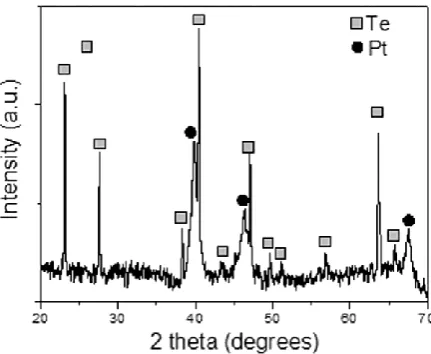
The X-ray diffraction (XRD) pattern of TeNTs/PtNPs composite samples in Figure 1 shows that the stronger and sharpener peaks can be indexed according to the hexagonal crystal structure of tellurium [JCPDS No 36-1452] with lattice constant of a= 0.44579 nm and c= 0.59270 nm. Besides the reflection peaks corresponding to Te, a number of lines were found to coincide with the (111) (200) and (220) planes of the face-centered cubic (fcc) platinum structure, with lattice constant a=0.39231 nm [JCPDS no. 04-0802]. These observations suggested that both Te and Pt were well crystallized nanostructures.
Figure 1. XRD pattern of TeNTs/PtNPs composite nanostructures
concentric rings could be assigned as diffraction from {111}, {200}, {220}, {311} and {222} planes starting from the centermost ring.
Figure 2. Typical TEM image of TeNTs/PtNPs composite nanostructures (b) along with selected area diffraction pattern recorded from the extreme tip of the nanotube (a) and nanoparticles assembly (c).
These results confirmed that the synthesized products were composed of Te nanotubes decorated with Pt nanoparticles.
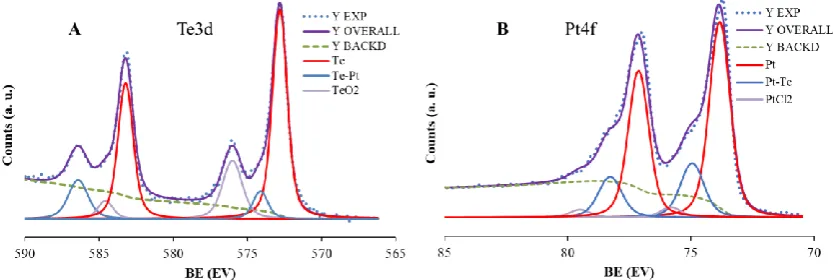
Figure 3. HR Te3d (A) and Pt4f XPS peaks related to TeNT/PtNP composite nanostructures.
In our experiments, outer surface of Te nanotubes served as substrate for the nucleation and growth of Pt nanoparticles. PtCl2 was reduced by ethanol to form Pt nanoparticles, which will attach on the surface of Te nanotubes. It is reasonable to suppose that, likewise what happens in the case of the coating of selenium nanowires with Pt,[30] two distinct reduction reactions pattern occurred: an initial reduction of Pt(II) salt by Te template itself at the interface promoting the Pt nucleation process, in accord with the presence of characteristic Pt-Te interacting species (i.e. XPS experiments) and the reduction of the Pt(II) salt by the alcohol reagent that now promote the growth of the Pt nucleation sites. The galvanic reduction of the Pt(II) by Te template caused the formation of some nucleation sites for Pt nanoparticles formation, randomly distributed along the nanotubes and detected by XPS thanks to its high surface sensibility. As the reaction proceeded, Pt(II) salt reduction by alcohol became dominant, causing a gradual growth of the nanoparticles decorating the nanotubes and, at the same time, the formation of nanoparticles in the solution. The latter ones could attach to the outer surface of the Te nanotubes or to the Pt nanoparticles randomly formed on them.
2.2 Electrochemical characterization of TeNT/PtNP materials onto GC electrodes
Cyclic voltammetric experiments were used to study the main electrochemical properties of bimetallic composite TeNTs/PtNPs materials cast onto GC disk electrodes in phosphate buffer (pH 7.0) (Figure 4). In direct scan (oxidation) two peaks were observed respectively at +285 mV and at +520 mV attributed to Te(0)/Te(IV) and Pt(0)/Pt(II) processes associated also to the O2 monolayer adsorption.[28,31] In reverse scan the peak observed in reduction at +100 mV is ascribed to Te(IV)/Te(0) and Pt(II)/Pt(0) overlapped peaks that involve species formed/adsorbed in oxidation scans. [28] This is in accord with the parallel increase of related currents, in oxidation and reduction, observed in the potential range between -100mV and +800 mV. The peak at -276 mV can be tentatively attributed to reduction processes of Te and Pt sites (i.e. different Te/Pt sites on anisotropic nanotube shapes) requiring higher overpotentials. However, since the overall currents increase with cycling, particularly in the region of Pt/Te reduction zone between -200 mV and +200 mV,[28] the potential scan probably restructures the Pt and Te atoms surface distribution due to the dissolution/re-deposition of different Te and Pt species as function of the voltammetric cycle numbers, accounting for the rising of the peak in reduction at +150 mV, a potential closer to the value of +50 mV already observed on Pt-Te similar bimetallic system and correlated principally to Pt species reduction.[28] The measured PtO2 reduction peak in the same conditions on bare Pt is at +50 mV.[32] Moreover, a steady-state current, corresponding to a stable surface composition, is typically reached after about 30 CV cycles, necessary to obtain suitable TeNTs/PtNPs/GC modified electrodes.
-6.0 -4.0 -2.0 0.0 2.0 4.0 6.0 8.0
-0.7 -0.3 0.1 0.5 0.9
m
A
/c
m
2
Figure 4. Characterization of TeNT/PtNP materials onto GC electrodes by cyclic voltammetry in phosphate buffer, pH 7.0. Scan rate 50 mV s-1. Upward and downward arrows indicate the current change in the subsequent CV scans.
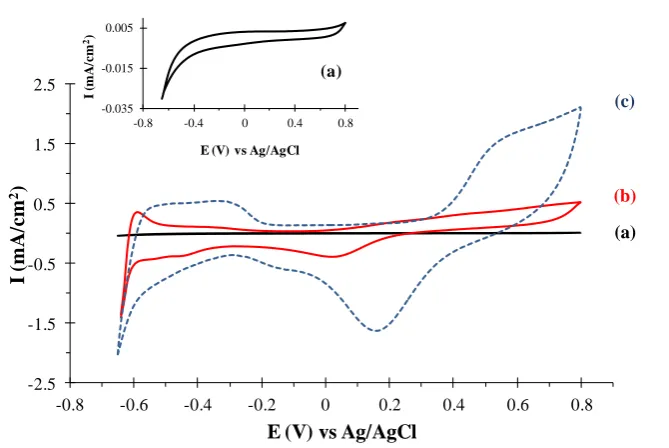
The as prepared TeNTs/PtNPs/GC electrodes were electrochemically activated in H2SO4 0.5 M before using in methanol electro-catalysis in neutral pH experiments, since preliminary tests suggested that a significant increase of the catalytic currents were reached after these pre-treatments. CV results reported in Figure 5 compare typical voltammograms recorded onto clean GC (curve a) and Pt (curve b) conventional electrodes as controls, and onto TeNTs/PtNPs/GC modified electrodes, in a clean phosphate buffer solution. All CV curves were obtained at scan rate of 50 mVs-1 in the potential range between -650 mV and +800 mV. As expected, conventional bare GC electrode do not show any specific electrochemical activity (Figure 5, curve a and related inset). Instead an evident electrochemical activity was recorded both on conventional bare Pt electrode (curve b) and TeNTs/PtNPs/GC modified electrode (curve c). Characteristic peaks due to the atomic hydrogen
adsorption and desorption on platinum active sites were observed in the cathodic “hydrogen region”
in neutral pH electrolytes, between -650 mV and -200 mV vs Ag/AgCl,[33,34] either on bare Pt and TeNTs/PtNPs/GC modified electrodes. So modifying the electrochemically inert GC electrode surface with TeNTs/PtNPs nanostructures, the electrochemical hydrogen adsorption/desorption processes can be activated as typically observed on bare platinum in the potential range between -520 mV and -220 mV at neutral pH, after activating it in H2SO4 0.5 M. In addition, besides the intense
activity in “hydrogen region”, TeNTs/PtNPs/GC modified electrodes showed in oxidation a well
stable peak at Epa = +500 mV with a peak in the reverse scan at Epc = +150 mV attributed to both Pt(0)/Pt(II) and Te(0)/Te(IV) not well resolved red-ox processes related peaks. Otherwise, the shoulder at -140 mV has been attributed principally to Te(IV)/Te(0) reduction process.[26] In detail, charge amount (QH) exchanged during hydrogen desorption on TeNTs/PtNPs/GC, was almost 4 mC cm-2 in actual experimental conditions. Correspondent electrochemically active surface area (ECSA), that can provide important information relatively to the number of Pt sites catalytically active available for an electrochemical reaction,[32] was estimated to be 20 m2/gPt by the following relation:[12]
ECSA = QH/(qH x mPt)
where QH is the charge amount exchanged during hydrogen desorption on Pt nano-particle sites
Figure 5. Characterization of GC (curve a), bare Pt (curve b) and TeNT/PtNP/GC (curve c) electrodes by Cyclic Voltammetry in phosphate buffer, pH 7.0. Scan rate 50 mV s-1.
2.3 Electrochemical characterization of TeNT/PtNP/GC modified electrodes with respect to methanol oxidation.
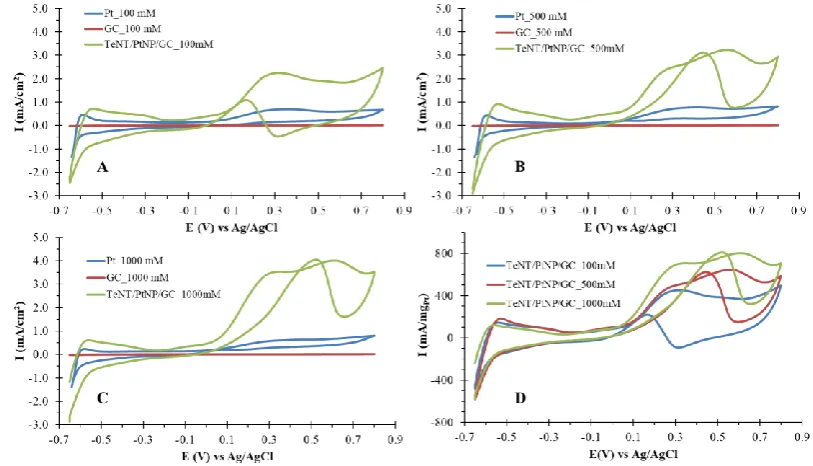
The electrocatalytic activity of the as-obtained modified electrodes for the methanol oxidation reaction (MOR) was studied in phosphate buffer at pH 7.0, a neutral safe medium, by cyclic voltammetry at 100, 500 and 1000 mM methanol, respectively. Related voltammograms are shown in Figure 6 A, B and C (green traces) and compared to bare GC (red traces) and bare Pt (blue traces) electrodes as obtained and in Figure S1 after subtraction of the relative background. Conventional GC electrode, as expected, was totally inactive with respect to methanol oxidation with current densities level ranging between -30 and 10 µAcm-2. Otherwise bare Pt electrodes present peaks in oxidation and reduction related to the electrochemical activity involving the different oxidation states of platinum showing a typical electrocatalytic activity toward methanol oxidation in the potential range between 0.00 mV and +600 mV and a maximum of current density at around +370 mV vs Ag/AgCl, according to the reported values at platinum electrodes in neutral pH vs small molecular weight alcohols.[35-37] However, a rapid poisoning of the electrode at these high concentrations of methanol is observed. As a matter of fact, CV curves obtained at 500 mM (figure 6 B, trace Blue) and 1000 mM (figure 6 C, trace Blue) are almost coincident, with a tendency to decrease with the increase of methanol concentration. A remarkable catalytic oxidation current density, ranging between 0.0 and 4.0 µAcm-2, for methanol on the TeNTs/PtNPs catalyst modified GC is observed in a wider potential range from -200 mV to +800mV. A consistent decrement of the methanol oxidation potential on-set, estimated to be almost of 150 mV if compared to bare Pt, is observed. The onset potential of methanol oxidation is an important factor in electrocatalytic study because it represents the power to break the methanol C-H bonds and the effectiveness in removing off species partially oxidized adsorbed on the electrode surface, improving with onset potential lowering. This observed behaviour, together with the overall current density increment, and the potential range raising in forward scan, with respect to bare Pt, confirms a synergic interaction between Te and Pt electroactive sites that act to enhance methanol electro-oxidation processes.
Accordingly, the specific activities, measured at the corresponding higher peak potential in forward scan at three different methanol contents (100, 500, and 1000 mM) are 2.24 mA cm-2 (at +298 mV), 3.22 mA cm-2 (at +547 mV) and 4.04 mA cm-2 (at +615 mV) respectively. Related mass activities are 448 mA mg(Pt)-1, 644 mA mg(Pt)-1 and 1615 mA mg(Pt)-1, respectively (Figure 6 D). All these values are comparable and/or better than recent previous data reported for methanol electro-oxidation as obtained, for example, on highly dispersed platinum nanoparticles/carbon nitride materials in acid
-2.5 -1.5 -0.5 0.5 1.5 2.5
-0.8 -0.6 -0.4 -0.2 0 0.2 0.4 0.6 0.8
I (m A /c m 2)
E (V) vs Ag/AgCl
(c) (b) (a) -0.035 -0.015 0.005
-0.8 -0.4 0 0.4 0.8
I (m A /c m 2)
media,[38] on branched Pd and Pd-based trimetallic nanocrystals (NCs) with long, thin branches and open structures operating in basic media,[39] as well as on Pt/Te bimetallic nanowires.[40] The oxidation peaks recorded in backward scan (at +160mV, +440mV, and +530 mV) were attributed to the removal of incompletely oxidized carbonaceous species formed in forward scan on Pt, Te and Pt-Te active sites, which appear to be heavily influenced on the three different concentrations of methanol tested. A similar behaviour, where different electrocatalytic sites are activated (see the different peaks involved in CV experiments, Figure 6), not observed on previous reported Pt/Te bimetallic and Pt/Pd/Te trimetallic systems in acid pH [40,41] could be attributed to the coexistence on the top of the surface of Te-Pt ad-atoms directly involved in methanol electrocatalytic oxidation. The observed synergy plays a central role in reducing the on-set, as well as the poisoning effect at potentials greater than +350 mV observed in methanol electro-oxidation on bare Pt. Accordingly, in the potential range between +350mV and +800 mV, peak currents at +547 mV and +615 mV rise with methanol concentration increment. Finally, consistently a high platinum catalytic activity to the TeNT/PtNP/GC electrodes is not only confirmed but further enhanced in the "hydrogen region" in methanol presence. The observed current density that ranges from -2.0 to 0.5 mAcm-2 , in phosphate buffer methanol -free (Figure 5), increases ranging between -3.0 to 1.0 mAcm-2 in methanol 500 mM. A saturation effect has been observed at methanol 1000 mM (Figure 6).
Figure 6. Cyclic voltammetric curves as obtained on bare GC (red traces), bare Pt (blue traces) and TeNT/PtNP/GC (green traces) electrodes, in phosphate buffer pH 7.0, respectively at 100mM (panel A), 500 mM (panel B) and 1000 mM (panel C) methanol solutions. Sweep rate 50 mV s−1. The current
density in panel D for TeNT/PtNP/GC electrodes is normalized in reference to the real Pt surface area per mass.
2.4 Electrochemical characterization of TeNT/PtNP/GC modified electrodes with respect to oxygen reduction.
moderate in comparison to TeNTs/PtNPs/GC modified electrodes. In fact, the higher current increment for oxygen reduction is observed on TeNTs/PtNPs/GC modified electrodes at both O2 tested concentrations with respect to N2-saturated solution (Figure 7 A, B, C green traces). In detail, on Pt electrodes the current density starts to increase at 0.00 mV reaching a quasi-plateau of -0.20 mAcm-2 in atmospheric O2 and at + 50 mV reaching a quasi-plateau of -0.30 mAcm-2 in O2-saturated solutions. Remarkably, TeNTs/PtNPs/GC shows larger density currents and peaks potentials in reduction between +50/+150 mV with on-set at +250 mV. These values are more positive than those measured on bare Pt characterized from a potential peak at -150 mV and on-set at +200 mV and quite similar to the recently reported value on Pt/C catalyst.[42] The more positive potential of the oxygen reduction peak indicates the higher ORR activity of the catalyst [42] demonstrating that the catalytic properties of Pt in TeNTs/PtNPs/GCE electrodes strongly depend on tellurium component. These data indicate that the current density rise observed on TeNTs/PtNPs/GC with O2 concentration increment, and totally absent on GC, should be attributed to electrocatalytic oxygen reduction process on platinum nanoparticles, enhanced in presence of tellurium species. All these collected results point out that these hybrid nanostructures have excellent electrocatalytic activity for oxygen reduction in neutral pH, better than previous data obtained in similar static conditions on ultrathin platinum-coated gold nanoparticle monolayer films [43] as well as on tungsten nitride supported on carbon black [44] at acid pH, in agreement with the observation that Pt catalyst in neutral media promotes a mechanism involving direct 4e- transfer [23]. Furthermore, the nanostructures show an electrocatalytic activity for oxygen reduction almost twice than the response obtained in neutral pH not only on Pt/C catalyst,[42] but also on Pt-free iron/polyindole-based electrocatalysts as recently reported.[42]
Figure 7. Cyclic voltammetric curves as obtained on bare GC (red traces), bare Pt (blue traces) and TeNT/PtNP/GC electrodes (green traces), in phosphate buffer pH 7.0, at N2 saturated solution (panel A), O2 atmospheric solution (panel B) and O2 saturated solutions (panel C), respectively. Sweep rate 50 mV s−1. The current density in panel D for TeNT/PtNP/GC electrodes is normalized in reference to
the real Pt surface area per mass.
3. Materials and Methods
3.1 Chemicals
purification. Deionised ultra-filtered water prepared with a Milli-Q water purification system (Millipore Milli-Q, 18.2 MΩ cm-1) has been used throughout the experiments.
3.2 Apparatus and Methods
All electrochemical experiments were carried out by using a µStat400 DropSens electrochemical potentiostat controlled by computer, in a conventional three-electrode cell by means of a glassy carbon (GC) (A=0.0707 cm2) or Pt (A=0.0314 cm2) disk working electrodes, a Pt wire as counter electrode and an Ag/AgCl, KCl (sat) as reference, in phosphate buffer solutions (pH 7.0, I = 0.2).
X-ray diffraction (XRD), transmission electron microscopy (TEM), selected area diffraction patterns (SAD) and X-ray photoelectron spectroscopy (XPS) were used to characterize the chemical structure and the morphology of the as obtained Te nanotubes decorated with Pt nanoparticles. X-ray diffraction measurements were obtained in the reflection mode on a Mini Flex Rigaku model diffractometer with Cu Kα radiation (λ = 0.154056 nm). The X-ray diffraction data were collected at a scanning rate of 0.02 degrees per second in 2 h ranging from 15° to 80°. The morphology and the crystal structure of the obtained nanostructures have been studied using a transmission electron Hitachi H-7100 microscope operating at an accelerating voltage of 100 kV. In order to prepare the Te nanotubes decorated with Pt nanoparticles samples for TEM observations, the samples were dispersed in ethanol; then, a little amount of this ethanol dispersion was dropped onto copper grids covered by carbon layer and let to dry slowly in air. XPS analysis was done by using the AXIS ULTRA
DLD Kratos Analytical spectrometer. The Al Kα (1486.6 eV) monochromatic radiation source worked
at 15 kV and 15 mA. In the analysis chamber the pressure was typically 3x10⁻⁹ torr. Widescan spectra and high resolution (HR) regions were registered in fixed analyzer transmission (FAT) mode. The pass energy (E0) employed for survey regions acquisition was 160 eV with energy step of 1 eV, while in HR spectra acquisition, the pass energy was of 20 eV and energy step 0.1 eV. The hybrid lens mode
was used for all measurements with analysis area of about 700 μm x 300 μm. During the analysis a
neutralization charge system has been used. Data analysis and peak fitting were done by using the software New Googly [45] which allows background correction as well as curve-fitting of photoelectronic peaks. The peaks attribution, with an uncertainty on Binding Energies of ±0.1 eV, has been done by considering literature data and NIST reference database, [29] and referenced to the aliphatic carbon (C1s peak signal), as an internal standard, set at 285.0 eV [45].
3.3 Synthesis of tellurium nanotubes.
Large scale amounts of tellurium nanotubes were synthesized via a vapor deposition method as reported in a previous work and slightly modified. [27] Powder of tellurium was positioned in a quartz boat at the middle of a tube furnace and directly evaporated onto silicon slides as substrate (0.5x1.0 cm) located 20 cm apart, in a constant gas argon flow (100 sccm, 99.9%). In a typical experiment, the tube was rapidly heated in 20 min from room temperature to 400 °C under Ar flow and kept at this temperature for 40 min during which the Te evaporates and deposits on the silicon substrate spontaneously forming nanotubes. At that time the argon gas flow was stopped and the furnace cooled naturally to the room temperature. All silicon slides used as support for TeNTs deposition experiments were accurately washed by ultrasonication in a water and non-ionic detergent mixture, followed by thorough rinsing with water and ethanol to remove any remnants of nonionic detergent, and dried before use. Scanning electron microscope images and X-ray diffraction patterns showed that the as-synthesized Te had a nanotubular single-crystalline morphology with a hexagonal cross-section. The Te nanotubes were typically 0.5-6 mm in length and 150-450 nm in external diameter.
3.4 Synthesis of Te nanotubes decorated with Pt nanoparticles (TeNTs/PtNPs).
platinum chloride and chloride in excess. The elemental composition of synthesized TeNTs/PtNPs was estimated to be 50 % Pt and 50 % Te (At. %), in the hypothesis that all PtCl2 was reacted.
3.5 Preparation of TeNTs/PtNPs/GC modified electrodes
Routinely, the CG electrode surfaces were polished with alumina, rinsed with deionized water and dried with N2 flow. Modified electrodes were made by casting 5 µL of TeNTs/PtNPs/ethanol (8 mg/1 mL) suspension directly onto GC surfaces, containing about 20 µg of Pt, and left to dry at room temperature. After, TeNTs/PtNPs/GC electrodes were cycled by CV in phosphate buffer (pH 7.0, I = 0.2) starting from measured open circuit potential (OCP), between –400 mV and +800 mV at scan rate of 20 mV s-1, until the current reached the steady-state conditions (typically 30 voltammetric cycles are required). The as obtained modified electrodes were washed after this electrochemical treatment and transferred in H2SO4 0.5 M electrolyte to be activated before their use as anodes and cathodes in phosphate buffer (pH 7.0, I = 0.2) solution for electrocatalytic methanol oxidation and O2 reduction experiments, respectively.
4. Conclusions
The results of this work show the effectiveness of TeNTs/PtNPs nanostructures for methanol electrocatalytic oxidation (MOR) and oxygen reduction (ORR), at neutral conditions suitable for fuel cell applications. The full morphological and spectroscopic characterization of TeNTs/PtNPs synthesized structures was obtained by XRD, TEM, SAD and XPS techniques. Results confirm the formation of bulk structures constituted of Te nanotubes decorated with Pt nanoparticles, with a surface enriched in average with Pt and Te oxidized species compared to platinum and tellurium bulk composition. The presence of a Pt-Te interacting species phase, confirmed by XPS, represents the sites of Pt nucleation and growth directly grafted on Te nanotubes surface. The electrochemical characterization of TeNTs/PtNPs material in aqueous electrolytic solutions at pH 7.0 was tested by cyclic voltammetry experiments. The electrocatalytic activity enhancement of TeNTs/PtNPs structures for methanol oxidation and oxygen reduction, was proved by comparing the results with bare glassy carbon and bare platinum electrodes, as well as with the recent data reported in the literature on systems based on both platinum and platinum-free nanostructured materials. The experiments evidence that TeNT/PtNP, opportunely activated in sulphuric acid 0.5 M solution, is a promising versatile anode/cathode electrocatalyst material for (bio)- fuel cells applications, thus representing a valid alternative to pure platinum and platinum alloys based electrodes, that can operate with particular efficiency in safe neutral pH environment.
Supplementary Materials: The following are available online at www.mdpi.com/xxx/s1, Figure S1: Cyclic voltammetric curves on bare GC, bare Pt and TeNT/PtNP/GC electrodes at different methanol concentrations, after subtraction of the signal in absence of methanol. Figure S2:Cyclic voltammetric curves on bare GC, bare Pt and TeNT/PtNP/GC electrodes at O2 atmosphericsolution and O2 saturated solutions after subtraction of the signal in absence of O2.
Author Contributions: conceptualization, M.R.G. and A.T; methodology, F.M., M.R.G. and D.C.; data curation, E.F.; writing—original draft preparation, F.M. and M.R.G. writing—review and editing, M.R.G and A.T.
Funding: This research received no external funding.
Conflicts of Interest: The authors declare no conflict of interest.
References
1. Rao, C.N.R.; Kulkarni, G.U.; Thomas, P.J.; Edwards, P.P. Size-dependent chemistry: Properties of
nanocrystals. Chemistry – A European Journal 2002, 8, 28-35.
2. Patzke, G.R.; Krumeich, F.; Nesper, R. Oxidic nanotubes and nanorods - anisotropic modules for a future
nanotechnology. Angew Chem Int Edit 2002, 41, 2446-2461.
4. Luo, X.L.; Morrin, A.; Killard, A.J.; Smyth, M.R. Application of nanoparticles in electrochemical sensors and
biosensors. Electroanal 2006, 18, 319-326.
5. Sakamoto, M.; Takamura, K. Catalytic-oxidation of biological components on platinum-electrodes
modified by adsorbed metals - anodic-oxidation of glucose. Bioelectroch Bioener 1982, 9, 571-582.
6. Chen, X.L.; Pan, H.B.; Liu, H.F.; Du, M. Nonenzymatic glucose sensor based on flower-shaped au@pd
core-shell nanoparticles-ionic liquids composite film modified glassy carbon electrodes. Electrochim Acta 2010,
56, 636-643.
7. Toshima, N.; Yonezawa, T. Bimetallic nanoparticles - novel materials for chemical and physical
applications. New J Chem 1998, 22, 1179-1201.
8. Liu, J.H.; Wang, A.Q.; Chi, Y.S.; Lin, H.P.; Mou, C.Y. Synergistic effect in an au-ag alloy nanocatalyst: Co
oxidation. J Phys Chem B 2005, 109, 40-43.
9. Kim, M.J.; Lee, K.Y.; Jeong, G.H.; Jang, J.K.; Han, S.W. Fabrication of au-ag alloy nanoprisms with enhanced
catalytic activity. Chem Lett 2007, 36, 1350-1351.
10. Booth, M.A.; Leveneur, J.; Costa, A.S.; Kennedy, J.; Travas-Sejdic, J. Tailoring the conductivity of
polypyrrole films using low-energy platinum ion implantation. J Phys Chem C 2012, 116, 8236-8242.
11. Jin, G.P.; Li, J.; Peng, X. Preparation of platinum nanoparticles on polyaniline-coat multi-walled carbon
nanotubes for adsorptive stripping voltammetric determination of formaldehyde in aqueous solution. J
Appl Electrochem 2009, 39, 1889-1895.
12. Shi, L.; Liang, R.P.; Qiu, J.D. Controllable deposition of platinum nanoparticles on
polyaniline-functionalized carbon nanotubes. J Mater Chem 2012, 22, 17196-17203.
13. Xia, B.Y.; Wu, H.B.; Wang, X.; Lou, X.W. One-pot synthesis of cubic ptcu3 nanocages with enhanced
electrocatalytic activity for the methanol oxidation reaction. J Am Chem Soc 2012, 134, 13934-13937.
14. Xin, Y.C.; Liu, J.G.; Zhou, Y.; Liu, W.M.; Gao, J.A.; Xie, Y.; Yin, Y.; Zou, Z.G. Preparation and
characterization of pt supported on graphene with enhanced electrocatalytic activity in fuel cell. J Power
Sources 2011, 196, 1012-1018.
15. Singh, R.N.; Awasthi, R.; Sharma, C.S. Review: An overview of recent development of platinum-based
cathode materials for direct methanol fuel cells. Int J Electrochem Sc 2014, 9, 5607-5639.
16. Yang, L.; Ge, J.J.; Liu, C.P.; Wang, G.L.; Xing, W. Approaches to improve the performance of anode
methanol oxidation reaction-a short review. Curr Opin Electrochem 2017, 4, 83-88.
17. Jeon, T.Y.; Lee, K.S.; Yoo, S.J.; Cho, Y.H.; Kang, S.H.; Sung, Y.E. Effect of surface segregation on the
methanol oxidation reaction in carbon-supported pt-ru alloy nanoparticles. Langmuir 2010, 26, 9123-9129.
18. He, C.; Desai, S.; Brown, G.; Bollepalli, S. In Pem fuel cell catalysts: Cost, performance, and durability. , The
Electrochemical Society Interface, Fall 2005; pp 41-44.
19. Yue-Min, D.; Yao-Long, L.I.U.; Gui-Shi, R.A.O.; Guo-Fu, W.; Qi-Ling, Z.; Bin, R.E.N.; Zhong-Qun, T.
Electrooxidation mechanism of methanol at pt-ru catalyst modified gc electrode in electrolytes with
different ph using electrochemical and sers techniques. Chinese J Chem 2007, 25, 1617-1621.
20. Yan, B.; Concannon, N.M.; Milshtein, J.D.; Brushett, F.R.; Surendranath, Y. A membrane-free neutral ph
formate fuel cell enabled by a selective nickel sulfide oxygen reduction catalyst. Angew Chem Int Edit 2017,
56, 7496-7499.
21. Tominaka, S.; Nishizeko, H.; Ohta, S.; Osaka, T. On-chip fuel cells for safe and high-power operation:
Investigation of alcohol fuel solutions. Energ Environ Sci 2009, 2, 849-852.
22. Lehmann, K.; Yurchenko, O.; Urban, G. Carbon nanowalls for oxygen reduction reaction in bio fuel cells. J.
23. Santoro, C.; Arbizzani, C.; Erable, B.; Ieropoulos, I. Microbial fuel cells: From fundamentals to applications.
A review. J Power Sources 2017, 356, 225-244.
24. Huang, M.H.; Wang, F.; Li, L.R.; Guo, Y.L. A novel binary pt3tex/c nanocatalyst for ethanol
electro-oxidation. J Power Sources 2008, 178, 48-52.
25. Guascito, M.R.; Chirizzi, D.; Malitesta, C.; Siciliano, M.; Siciliano, T.; Tepore, A. Amperometric
non-enzymatic bimetallic glucose sensor based on platinum tellurium microtubes modified electrode.
Electrochem Commun 2012, 22, 45-48.
26. Guascito, M.R.; Chirizzi, D.; Malitesta, C.; Siciliano, T.; Tepore, A. Te oxide nanowires as advanced
materials for amperometric nonenzymatic hydrogen peroxide sensing. Talanta 2013, 115, 863-869.
27. Siciliano, T.; Filippo, E.; Genga, A.; Micocci, G.; Siciliano, M.; Tepore, A. Single-crystalline te microtubes:
Synthesis and no(2) gas sensor application. Sensor Actuat B-Chem 2009, 142, 185-190.
28. Guascito, M.R.; Chirizzi, D.; Malitesta, C.; Mazzotta, E.; Siciliano, M.; Siciliano, T.; Tepore, A.; Turco, A.
Low-potential sensitive h2o2 detection based on composite micro tubular te adsorbed on platinum
electrode. Biosens Bioelectron 2011, 26, 3562-3569.
29. Nist x-ray photoelectron spectroscopy database. https://srdata.nist.gov/xps/Default.aspx
30. Mayers, B.; Jiang, X.C.; Sunderland, D.; Cattle, B.; Xia, Y.N. Hollow nanostructures of platinum with
controllable dimensions can be synthesized by templating against selenium nanowires and colloids. J Am
Chem Soc 2003, 125, 13364-13365.
31. Bard, A.J.; Faulkner, L.R. Electrochemical methods: Fundamentals and applications. 2nd edition ed.; Wiley: 2000.
32. Chen, X.M.; Tian, X.T.; Zhao, L.M.; Huang, Z.Y.; Oyama, M. Nonenzymatic sensing of glucose at neutral
ph values using a glassy carbon electrode modified with graphene nanosheets and pt-pd bimetallic
nanocubes. Microchim Acta 2014, 181, 783-789.
33. Ernst, S.; Heitbaum, J.; Hamann, C.H. The electrooxidation of glucose in phosphate buffer solutions: Part i.
Reactivity and kinetics below 350 mv/rhe. J Electroanal Chem Interfacial Electrochem 1979, 100, 173-183.
34. Park, S.; Boo, H.; Chung, T.D. Electrochemical non-enzymatic glucose sensors. Anal Chim Acta 2006, 556,
46-57.
35. Kadirgan, F.; Beden, B.; Leger, J.M.; Lamy, C. Synergistic effect in the electrocatalytic oxidation of methanol
on platinum+palladium alloy electrodes. J Electroanal Chem Interfacial Electrochem 1981, 125, 89-103.
36. Filippo, E.; Baldassarre, F.; Tepore, M.; Guascito, M.R.; Chirizzi, D.; Tepore, A. Characterization of
hierarchical moo3 plates toward resistive heating synthesis: Electrochemical activity of
alpha-moo3/pt modified electrode toward methanol oxidation at neutral ph. Nanotechnology 2017, 28, 215601.
37. Rosenbaum, M.; Schroder, U.; Scholz, F. Investigation of the electrocatalytic oxidation of formate and
ethanol at platinum black under microbial fuel cell conditions. J Solid State Electr 2006, 10, 872-878.
38. Sadhukhan, M.; Kundu, M.K.; Bhowmik, T.; Barman, S. Highly dispersed platinum nanoparticles on
graphitic carbon nitride: A highly active and durable electrocatalyst for oxidation of methanol, formic acid
and formaldehyde. Int J Hydrogen Energ 2017, 42, 9371-9383.
39. Jing, S.C.; Guo, X.L.; Tan, Y.W. Branched pd and pd-based trimetallic nanocrystals with highly open
structures for methanol electrooxidation. J Mater Chem A 2016, 4, 7950-7961.
40. Li, H.H.; Zhao, S.; Gong, M.; Cui, C.H.; He, D.; Liang, H.W.; Wu, L.; Yu, S.H. Ultrathin ptpdte nanowires
as superior catalysts for methanol electrooxidation. Angew Chem Int Edit 2013, 52, 7472-7476.
41. Xu, J.; Wang, Z.H.; Li, H.H.; Liu, J.W.; Yu, S.H. Templating synthesis of ternary ptpdte nanowires with
tunable diameter for methanol electrooxidation. Crystengcomm 2016, 18, 4038-4041.
42. Nguyen, M.T.; Mecheri, B.; Iannaci, A.; D'Epifanio, A.; Licoccia, S. Iron/polyindole-based electrocatalysts
43. Jin, Y.D.; Shen, Y.; Dong, S.J. Electrochemical design of ultrathin platinum-coated gold nanoparticle
monolayer films as a novel nanostructured electrocatalyst for oxygen reduction. J Phys Chem B 2004, 108,
8142-8147.
44. Zhong, H.X.; Zhang, H.M.; Liang, Y.M.; Zhang, J.L.; Wang, M.R.; Wang, X.L. A novel non-noble
electrocatalyst for oxygen reduction in proton exchange membrane fuel cells. J Power Sources 2007, 164,
572-577.
45. Salvi, A.M.; Pucciariello, R.; Guascito, M.R.; Villani, V.; Intermite, L. Characterization of the interface in
rubber/silica composite materials. Surf Interface Anal 2002, 33, 850-861.