ANALYSIS OF FACE RECOGNITION USING
MULTI-ALGORITHMIC CONCEPTS
S. M. Zakariya
1, Aftab Yaseen
21
Electrical Engineering Section, University Polytechnic, AMU Aligarh, (India)
2
Department of Computer Science & Engineering, Integral University, Lucknow, (India)
ABSTRACT
Face recognition is use as a human validation mode for human authorization or authentication. Face recognition is a method of retrieving the faces of similar types from the face databases. It is the problem of finding a face in the target database to find a face that correspond a given face. The aim of face recognition is to find a face in the database, which has highest similarity with a given face. The job of face recognition involves the mining of different traits of the human face from the face picture/image for discriminating it from other people. Many face recognition concepts have been developed for applications such as access control and surveillance. For enhancing the performance and accuracy of face recognition, we use the multi-algorithmic concepts, where in a combination of different face recognition algorithms is used. We implemented four well known face recognition algorithms, they are following: (i) Principal Component Analysis (PCA), (ii) Discrete Cosine Transform (DCT), (iii) Template Matching using Correlation and (iv) Partitioned Iterative Function System (PIFS). We fuse the scores of these algorithms, because fusing the scores of a number of different algorithms applied on the identical data (face image) is a very promising concept to improve the overall performance of the face recognition concepts. We fuse the scores of above face recognition algorithms in a combination of two develop six multi-algorithmic concepts of face recognition. Also, fuse the scores in a combination of three and four develop five multi-algorithmic concepts of face recognition. In this work, we analyze the performance of eleven multi-algorithmic concepts. We present a comparative study of face recognition rate of eleven face recognition concepts at two different precision levels namely at 5 and at top-10. We test with a standard database called ORL face database. Experimentally, we find that the concept based on the combination of four outperforms the concept based on the combination of three. Similarly, the concept based on the combination of three outperforms the concept based on the combination of two.
Keyword: DCT, Face Recognition, face recognition rate, Multi-algorithmic concepts, ORL face
database, PCA, PIFS, and Template matching using Correlation.
I. INTRODUCTION
In the face recognition, a given face is compared with the faces stored in a face database in order to recognize
the individual. The aim is to find a face in the database, which has the highest similarity with the given face.
recognition technology is one of the greatest rising fields. Several studies have been reported in the last 10 to 15
years given in [5, 6, 7 and 9]. Researchers are still going on the development of more accurate and reliable face
recognition concept. With collective efforts from researchers in different fields including computers,
mathematics, psychophysics and neuroscience, different views have developed to resolve the problem of face
recognition [6] and [7]. Among these, the analytical approaches are those based on Principal Component
Analysis (PCA), Discrete Cosine Transform (DCT), Template Matching using correlation, Partitioned Iterated
Function System (PIFS). For enhancing the accuracy and to increase the performance of the face recognition
concept a combination of these algorithms can be used [12] and [13]. In this paper, we discuss the eleven
different face recognition concepts based on in the combination of two, three and four individual face
recognition algorithms (discussed above). The goal is to find the combination of four performs better than the
combination three, and the combination of three performs better than the combination of two in terms of
recognition rate. This paper is organized as follows: In section 2, we discuss in short the earlier studies
performed in the field of face recognition approaches. In section 3, we give an overview of the face database
(ORL) used. In section 4, we present the multi-algorithmic concepts of face recognition in the combination of
two, three and four algorithms. In section 5, we show the steps of implementation of face recognition concepts
with intermediate outcomes. In section 6 we analyze our experimental results at two precision levels. Finally,
we conclude the work and give few future guidelines.
II. RELATED WORK
On the investigation of face recognition concept some of the main studies on face recognition concepts are
discussed below:
PCA also known as Eigen face method, In PCA method the images are projected onto the facial value so called
eigen-space [10] and [12]. The eigenvectors are ordered, each one reporting for a different quantity of the
disparity among the face images. These eigenvectors can be consideration of as a set of traits that together
characterize the disparity between face images. Each image location gives more or less to each eigenvector [1, 2,
3 and 4]. PCA approach reduces the measurement of the data by means of data compression fundamentals [4]
and realizes the most valuable low dimensional arrangement of facial blueprints. This reduction in measurement
removes information that is not useful [5] and precisely crumbles the face structure into unassociated mechanism
known as eigenfaces.
For representing a face using DCT to get the feature vector, its DCT coefficients are resolved and only a sub-set
of the DCT coefficients is preserved. This feature vector has low to mid frequency DCT coefficients, as these are
the ones having highest information [6]. Illumination normalization is recommended by using the correlation of
discrete cosine transform (DCT) low-frequency coefficients to enlightenment [14]. The input image contrast is
stretched using the method of full image histogram equalization. Then, to compensate the illumination variations
the low-frequency DCT coefficients are re-scaled to lower value.
Face recognition based on template matching represents a face in terms of a template consisting of several
values in two images are two variables, template and source image. A face detection method based on half
face-template is discussed in [8].
Recognition technique formulated on Partitioned Iterated Function System (PIFS) makes use of the fact that
human face shows self-similarity region-wise, which is utilized for encoding the face to generate the PIFS code,
by matching the PIFS codes recognition is performed [13], in which a face recognition based on PIFS
representation and matching is carried out in the domain of PIFS code.
The Local feature analysis representations are sparse-distributed and are effectively low-dimensional and
maintain all the advantages of the dark demonstrations of the PCA. But, contrasting the global eigenvector, they
give a method of items in terms of statistically derived local features (e.g. eye, nose etc.) and their positions [2, 3
and 4].
III. ORL FACE DATABASE
The ORL face database was originally published by Cambridge University. ORL database contains a set of face
images taken between April 1992 and April 1994 at the Olivetti Research Laboratory in Cambridge, U.K. [15].
Since 1994, ORL has been used to benchmark many face recognition or classification systems. Same database
we had used in our previous works [1, 2, 3, and 4].
It consists of 400 face images taken from 40 persons, 10 images per person. For each person, it contains face
images under different brightness conditions, facial expressions, and poses.
The images of ORL are in bitmap file format (bmp), grayscale with a resolution of 92x 112 pixels. There are
variations in images of different persons like persons have beard, persons have glasses, persons have moustaches
etc.
IV. MULTI-ALGORITHMIC CONCEPTS OF FACE RECOGNITION
In this section, we have discussed the face recognition using multi-algorithmic concepts. We fused the scores of
face recognition in the combination of two and three algorithms. Total we have been developed ten
multi-algorithmic concepts.
4.1 Face Recognition in the Combination of Two Algorithms
By fusing the scores of two individual face recognition algorithms. First, we have implemented four individual
algorithms of face recognition: (i) PCA, (ii) DCT, (iii) Template Matching (Corr) and (iv) PIFS. We have been
developed the six possible combinations [1] from these four individual algorithms. They are the following:
PCA-DCT, PCA-Corr, PCA-PIFS, DCT-Corr, DCT-PIFS, and Corr-PIFS face recognition concepts.
In this paper, we have discussed only one technique of multi-algorithmic approaches of face recognition in the
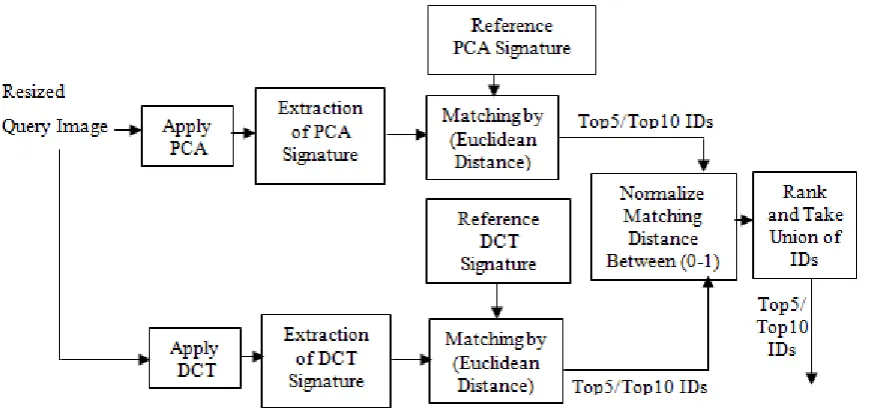
combination of two named PCA-DCT, because of space limitation. Rest is the identical. Figure 1 shows the
block diagram of the PCA-DCT face recognition concept [2] and [4]. Due to space limitation we have shown
only one. Block diagrams of the other five are similar. The least minimum Euclidean distance gives closest
In PCA-DCT concept, first we extract the PCA feature vector and then extract DCT feature vector of the
reference face database images. Reference face image database when subjected to Principal Component
Analysis, PCA reference feature vector database is obtained. Likewise when the reference face image database is
subjected to DCT, Template matching and PIFS, DCT reference feature vector database, Template matching
reference feature vector database and reference PIFS code database is obtained respectively. The Discrete
Cosine Transform (DCT) converts an image from spatial domain to frequency domain. [3].
4.2 Face Recognition in the Combination of Three and Four Algorithms
By fusing the scores of three individual face recognition algorithms. We have been developed the four possible
combinations [1] from the above four individual algorithms. They are the following: DCT-Corr,
PCA-DCT-PIFS, PCA-Corr-PIFS, and DCT-Corr-PIFS face recognition concepts. By fusing the scores of all four
individual algorithms we have been developed one concept named PCA-DCT-Corr-PIFS face recognition
concept.
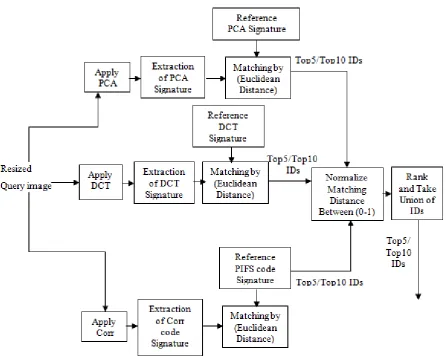
Figure 2 shows the block diagram of the PCA-DCT-Corr face recognition concept [2]. Due to space limitation
we have shown only one. Block diagrams of the other four are similar. The least minimum Euclidean distance
gives closest match with the query face image.
Figure 2: Block diagram of the PCA-DCT-Corr concept
V. IMPLEMENTATION OF FACE RECOGNITION CONCEPT AND INTERMEDIATE
OUTCOME
We follow three steps for implementing the face recognition concept that are: (1) Face Resizing steps, (2)
Feature vector extraction and (3) Recognition step. In first step, resizing of the images are performed because
original images have more values by which eigenface computation becomes complex. ORL face database images
size is 92×112. Hence, after resizing the face image, size is 64×64. In the feature vector extraction step: in case
of PCA, find the eigenvectors with the highest eigenvalue. These eigenvectors can be thought of as a set of
features that together characterize the variation between face images. In case of DCT, its DCT is computed and
only a subset of the obtained coefficients is retained. This feature vector contains low to mid frequency DCT
coefficients, as these are the ones containing highest variance. In Template Matching the templates of eyes, nose
and mouth are created and stored as reference Template database. In recognition steps, Euclidean distance
classifier is used to find the distance between the query face image feature vector and the reference face image
VI. ANALYSIS OF EXPERIMENTAL RESULTS AT TWO PRECISION LEVELS
To distinguish a particular input query face, the system matches the face’s feature vector to the feature vector of
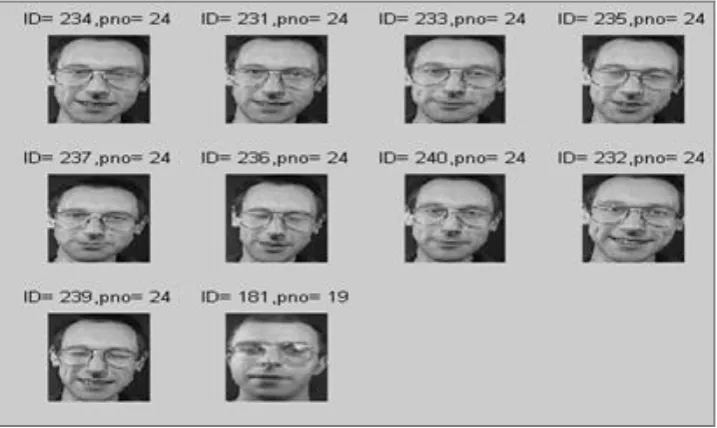
the database faces using Euclidean Distance classifier [7]. Figure 3 shows result of top ten close matches of face
ID= 234 and pose no. 24 using PCA-DCT multi-algorithmic concept of face recognition.
Template matching is the process of positioning the location of a sub image inside a larger image. The larger
image is called the search area and the sub-image is called the template. The template matching process involves
shifting the template over the search area and computing the similarity measure between the template and the
window in the search area over which the template lies. The correlation between two signals (cross correlation)
is a standard approach to feature detection [14] as well as a building block for more suitable recognition
techniques. Figure 4 shows the result of top ten close matches of same face id and pose number as the query of
PCA-DCT-Corr multi-algorithmic concept of face recognition [16].
Figure 3: PCA-DCT: Top ten close matches: the first image is the query image
The experimental results are obtained on Olivetti Research Laboratory (ORL) face image database [15].
A reference face database of 250 images is created. There are 25 persons, 10 poses corresponding to each
person.
Recognition rate results are obtained at two levels,
(i) At top 5-IDs.
(ii) At top 10-IDs.
Each image in the reference face image database is made as query. The top 5-IDs and top 10-IDs are
retrieved corresponding to each query image based on minimum matching distance.
Then the average rate of recognition for system is determined at top 5-IDs and top 10-IDs.
For implementation, we used MATLAB programming and MATLAB image processing tool box [16].
At top 5-IDs
Table 1 shows the average face recognition rate of six multi-algorithmic face recognition concepts in the
combination of two individual algorithms at Top 5 IDs. Table 2 shows the average face recognition rate of four
algorithmic face recognition concepts in the combination of three individual algorithms and one
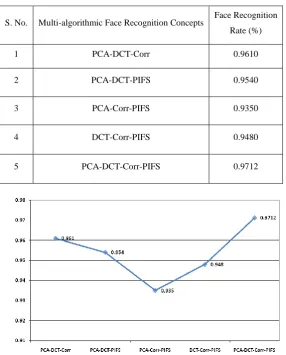
multi-algorithmic concept in the combination of four individual algorithms at Top 5 IDs. We find that the PCA-DCT
based face recognition concept has higher recognition rate as compared to other five face recognition concepts
at this level in the combination of two individual algorithms, and we also find that the PCA-DCT-Corr based
face recognition concept has higher recognition rate as compared to other three face recognition concepts at this
level in the combination of three individual algorithms. Finally, we find that PCA-DCT-Corr-PIFS has the
highest recognition rate at this level, graphically shown in Figure 5 and Figure 6. In the respective figures, the
x-axis shows the face recognition rate and the y-x-axis shows the multi-algorithmic face recognition concept.
Table 1: Face Recognition rate at top 5-IDs of the six multi-algorithmic face recognition
concepts
S. No. Multi-algorithmic Face Recognition
Concepts
Face Recognition
Rate (%)
1 PCA-DCT 0.9424
2 PCA-Corr 0.9260
3 PCA-PIFS 0.9240
4 DCT-Corr 0.9410
5 DCT-PIFS 0.9380
Figure 5: Face Recognition rate at top 5-IDs of the six multi-algorithmic face recognition
concepts
Table 2: Face Recognition rate at top 5-IDs of the five multi-algorithmic face recognition
concepts
Figure 6: Face Recognition rate at top 5-IDs of the five multi-algorithmic face recognition
concepts
S. No. Multi-algorithmic Face Recognition Concepts Face Recognition Rate (%)
1 PCA-DCT-Corr 0.9610
2 PCA-DCT-PIFS 0.9540
3 PCA-Corr-PIFS 0.9350
4 DCT-Corr-PIFS 0.9480
At top 10-IDs
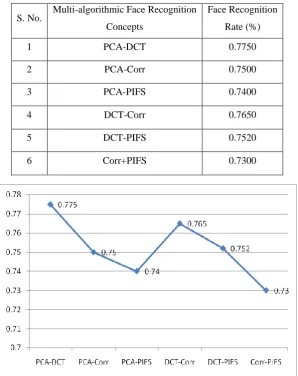
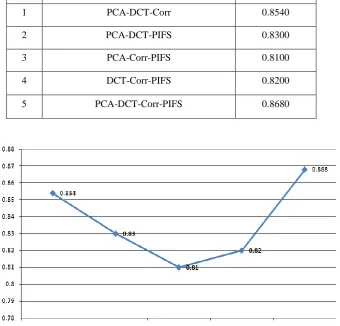
Table 3 shows the average face recognition rate of six multi-algorithmic face recognition concepts in the
combination of two individual algorithms at Top 10 IDs. Table 4 shows the average face recognition rate of four
algorithmic face recognition concepts in the combination of three individual algorithms and one
multi-algorithmic concept in the combination of four individual algorithms at Top 10 IDs. We find that the PCA-DCT
based face recognition concept has higher recognition rate as compared to other five face recognition concepts
at this level in the combination of two individual algorithms, and we also find that the PCA-DCT-Corr based
face recognition concept has higher recognition rate as compared to other three face recognition concepts at this
level in the combination of three individual algorithms. Finally, we find that PCA-DCT-Corr-PIFS has the
highest recognition rate at this level, graphically shown in Figure 7 and Figure 8. In the respective figures, the
x-axis shows the face recognition rate and the y-x-axis shows the multi-algorithmic face recognition concept.
Table 3: Face Recognition rate at top 10-IDs of the six multi-algorithmic face recognition
concepts
Figure 7: Face Recognition rate at top 10-IDs of the six multi-algorithmic face recognition
concepts
S. No. Multi-algorithmic Face Recognition
Concepts
Face Recognition
Rate (%)
1 PCA-DCT 0.7750
2 PCA-Corr 0.7500
3 PCA-PIFS 0.7400
4 DCT-Corr 0.7650
5 DCT-PIFS 0.7520
Table 4: Face Recognition rate at top 10-IDs of the five multi-algorithmic face recognition
concepts
Figure 8: Face Recognition rate at top 10-IDs of the five multi-algorithmic face recognition
concepts
VII. CONCLUSION
In this paper, we have analyzed the face recognition using multi-algorithmic concepts. We reported the
development of eleven face recognition concepts based on the four individual algorithms namely PCA, DCT,
Template Matching using Correlation and PIFS with the combination of two individual algorithms, three
individual algorithms and four individual algorithms. In multi-algorithmic concepts, we combined four
individual algorithms in a group of two, three and four to obtain eleven combinations namely DCT,
PCA-Corr, PCA-PIFS, PCA-Corr, PIFS, Corr-PIFS, PCA-PCA-Corr, PCA-PIFS, PCA-Corr-PIFS,
DCT-Corr-PIFS and PCA-DCT-DCT-Corr-PIFS. We have tested the eleven face recognition concepts with the benchmark
ORL face database, and we computed the average face recognition rates of each concept. Experimentally, we S.
No.
Multi-algorithmic Face Recognition
Concepts
Face
Recognition
Rate (%)
1 PCA-DCT-Corr 0.8540
2 PCA-DCT-PIFS 0.8300
3 PCA-Corr-PIFS 0.8100
4 DCT-Corr-PIFS 0.8200
find that these combinations based concepts (in a group of four) provide better results than the corresponding
combination concepts (in a group of three) and the combinations in a group of three return better results than the
combinations in a group of two. The observable reason for this is that the some IDs are returned by first
algorithm but not by second algorithm in the group and vice-versa. When we combine these two algorithms,
these IDs got combined and the recognition rate in both the cases i.e. for the top5-IDs and for the top10-IDs
increases. Similar things happened in the combination of three and four algorithms. Out of these eleven
multi-algorithmic concepts of face recognition, the PCA-DCT-Corr-PIFS based system has the highest face
recognition rate in both the cases i.e. for the top5-IDs and for the top10-IDs. In future we can implement other
face recognition algorithms other than these four individual algorithms. In future we can combine other
algorithms with our concepts in several different possible combinations.
REFERENCES
[1] S. M. Zakariya, Rashid Ali and Manzoor Ahmad Lone, “Automatic Face Recognition Using
Multi-Algorithmic Approaches,” Proc. of the fourth International Conference on Contemporary Computing
(IC3-2011), Communications in Computer and Information Science Series(CCIS), Springer-Verlag,
ISBN: 978-3-642-22605-2, ISSN: 1865:0929, pp. 501-512, August 2011, Noida, India.
[2] M. A. Lone, S. M. Zakariya and Rashid Ali, “Automatic Face Recognition System by Combining Four
Individual Algorithms”, Proc. of the 2011 International Conference on Computational Intelligence and Communication Systems (CICN-2011), IEEE Computer Society, ISBN: 978-0-7695-4587-5, pp. 222 –
226, October 2011, Gwalior, India.
[3] Manzoor Ahmad Lone, Rashid Ali and S. M. Zakariya, “Combining PCA – DCT based Face
Recognition System with Correlation,” Proc. of the 2011 IEEE International Conference on
Computational Intelligence and Computing Research (2011 IEEE ICCIC), ISBN: 978-1-61284-693-4,
pp. 549 – 552, 16th – 18th December 2011, Kanyakumari, India.
[4] S. M. Zakariya, Manzoor Ahmad Lone, and Rashid Ali, “Effect of Multi-Algorithmic Approaches on
Automatic Face Recognition Systems,” CiiT International Journal of Digital Image Processing, ISSN 0974 – 9691, pp. 1063-1067, October 2011.
[5] P. J. Phillips, H. Moon, S.Rizvi and P. Rauss, “FERET Evaluation Methodology for Face Recognition
Algorithms”, IEEE transaction on pattern analysis and machine intelligence (PAMI 2000), Los Alamitos,
USA, pp.1090-1103, 2000.
[6] Z. M. Hafed and M. D. Levine, “Face Recognition Using the Discrete Cosine Transform”, International
Journal of Computer Vision, vol.(43), no.3, pp.167–188, 2001.
[7] R. Chellapa, C.L. Wilson and S.A. Sirohey, “Human and Machine Recognition of Faces: A survey”,
Proceedings of the IEEE, vol.(83), no. 5, May 1995.
[8] A. Gosthtasby, S.H. Gage, and J.F. Bartholic,“A Two-stage Coss Correlation Approach to Template
Matching”, IEEE Transactions on Pattern Analysis and Machine Intelligence, pp. 374-378, 1984.
[9] Ming-Hsuan Yang, D.J. Kriegman and N. Ahuja, “Detecting Faces in Images: A Survey”, IEEE
[10] L. Wiskott, J. M. Fellous, N. Krueuger, C. von der Malsburg, “Face Recognition by Elastic Bunch Graph
Matching”, IEEE Trans. on Pattern Analysis and Machine Intelligence, Vol. 19, No. 7, pp. 775-779,
1997.
[11] R. Brunelli and T. Poggio, “Face Recognition: Features versus Templates”, IEEE Transactions on
Pattern Analysis and Machine Intelligence, vol. 15, no.10, pp. 1042-1052, Oct 1993.
[12] Kirby, M. and L. Sirovich, “Application of the Karhunen-Loeve Procedure for the Characterization of
Human Faces”, IEEE Transactions on Pattern Analysis and Machine Intelligence, vol. 12, no. 1, pp.
103-108, 1990.
[13] Ce Fan, “Matching Scheme based on PIFS of Compression for Image Retrieval”, Proc. of the IEEE
International Conference on Robotics and Biomimetics, pp.2027-2031, Dec 2007.
[14] R.C. Gonzalar and R.E. Woods, “Digtal Image Processing (third edition)”, Readings MAssachusette:
Addiotion – Wesly, 1992.
[15] The Database of Faces, http://www.cl.cam.ac.uk./research/dtg/attarchive/ Facdatabase.html.
[16] The MathWorks-MATLAB and Simulink for Technical Computing,