COMMUNICATION
Version 18 Oct. 2010 DOI: 10.1002/chem.200((will be filled in by the editorial staff))
Dodeka(ethylene)octamine
Michael Bühl*
[a]Because of their great potential in organic synthesis, design of proton sponges and superbases remains an active area of research.[1,2] Nitrogen bases are very popular for this purpose, and
the most common design principles involve destabilization of the base by enforcing close proximity of nitrogen lone pairs through rigid scaffolds and stabilization of the conjugate acid by intra-molecular hydrogen bonds and extended, polarizable π-systems.
The classic proton sponge, 1,8-bis(dimethylamino)naphthalene (1),[ 3 ] is the paradigmatic prototype that has spawned many
variations.
Scheme 1. Actual and potential nitrogen bases.
The cage compound hexa(ethylene)tetramine (2) is known (in its protonated form)[ 4 ] as the smallest member of a family of
spherical cryptands that contain 4 N atoms with their lone pairs inside the cavity. Because 2 could not be obtained proton-free, it
appears that it might actually be a rather strong base. It is the purpose of the present paper to assess the proton affinity (PA) of 2
computationally and to probe how an increase of the number of "endohedral lone pairs" in such a cage would affect this property. Carrying twice the number of N atoms in a related structural motif, dodeka(ethylene)octamine (3) appeared to be a suitable target for
this purpose. Additional interest in this species stems from the possibility of a cubic ligand field from 8 donor atoms, which might result in favorable coordination properties for f-elements.
At our chosen level of density functional theory (DFT), B3LYP-D3/6-311+G**//B3LYP/6-31G*(*), the computed PA of
1 is 246.2 kcal/mol, very well reproducing the experimental
values ranging between 246.2 kcal/mol[5] and 245.8 kcal/mol.[6]
Protonation of T-symmetric tetramine 2 affords the C3-symmetric
minimum H+@
2. The resulting PA, 255.1 kcal/mol, is noticeably
larger than that of 1. In keeping with the observed difficulty to
prepare it in unprotonated form, 2 with its unusual nitrogen-rich
environment is thus confirmed as a potent base.
In 2, the ethylene moieties bridge the edges of a tetrahedron
spanned by the four N atoms. Applying the same principle to a cube of eight N atoms affords 3. When all ethylene groups in 3
are perfectly eclipsed, a structure with Oh symmetry is obtained. As expected, such a structure is not a minimum, but a higher-order saddle point with as many as 13 imaginary frequencies. When each of the N(CH2)2 fragments at the cube corners are
rotated in the same sense about the threefold axes passing through their centers, the ethylene fragments can adopt a neatly staggered conformation. This rotation removes all symmetry planes and the inversion center, affording the pure rotational point group O. In
this symmetry, 3 turns out to be a true minimum (i.e. with no
[image:1.595.321.544.515.618.2]imaginary frequencies), 254 kcal/mol below the Oh symmetric structure.
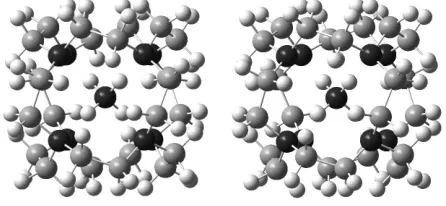
Figure 1. B3LYP optimized structure of NH4+@1 (stereoplot; N black, C gray)..
The point group O is very rarely found in molecules. One of
the very few other examples is a polyhedral vanadyl cluster, (VO)6(tBuPO3)8.[ 7 ] The organic species 3 has a much simpler
topology and is very well suited to illustrate this unusual symmetry class in undergraduate courses on group theory. A three-dimensional plot (with a complexed guest, see below) is shown in Figure 1.
The thermodynamic stability of the title molecule can be assessed by the dimerization reaction 2 + 2→
3. At the
[a] Professor Dr. Michael Bühl
School of Chemistry University of St Andrews
North Haugh, St Andrews, Fife KY16 9ST, United Kindom email: [email protected]
conventional B3LYP level, the driving force is noticeable, ∆E
= -13.6 kcal/mol, and is significantly enhanced by dispersion corrections, to ∆E = -22.3 kcal/mol at B3LYP-D3. This is because
the molecule is large enough to accommodate a sizeable number of formally nonbonded atom pairs at the right distance for attractive van-der-Waals interactions. Even though enthalpic and entropic corrections reduce the driving force for formation of 3, to ∆G = -14.7 kcal/mol, there appears to be no unusual strain that
would render 3 thermodynamically unstable. In fact, judged from
the extent of pyramidalization at the N atoms (nearly planar in 2,
pyramidal in 3), 3 appears to be less strained than 2. The simple
dimerization will certainly be hindered kinetically, so that other routes will have to be sought. A related tricyclic aza crown ether (4) is already known,[8] so that the synthesis of 3 appears to be
within reach.
Scheme 2. Aza crown ether and quinuclidine base related to 3.
In order to probe the potential guest-binding capabilities of 3,
its complexes with selected endohedral ions were optimized, first starting with a proton. The distance between each N atom and the cage center in pristine 3 is 2.70 Å. This is clearly too large for a
proton to be held in the center. Accordingly, H+@3 in O
symmetry is not a minimum, but has 4 imaginary frequencies. A minimum can be located in C3 symmetry where the proton is
attached to a single N atom (NH distance 1.044 Å, pointing to the inside). The resulting predicted proton affinity (PA) of 3, 263.5
kcal/mol, is substantial, larger even that that of 1 or 2. Thus, 3 can
be expected to a very strong base indeed, matching or even surpassing currently known superbases.[1,2] Remarkably, this
strong basicity can be achieved without extended π-systems,
which have been suggested to enhance PAs through π...H+
interactions in the protonated species.[1] In order to facilitate an
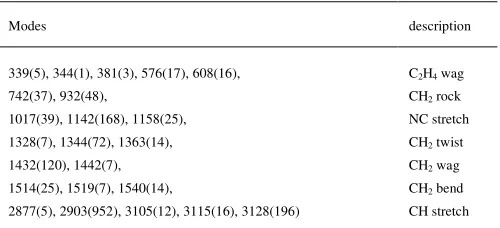
eventual characterization, the B3LYP predicted IR and NMR spectra of 3 and H+@3 are given in Tables 1 and 2, respectively.
The PA of 3 is among the highest measured or computed for
an aliphatic amine so far. A quinuclidine derivative with three pendant arms (5) has been predicted recently to be a very strong
base with a PA of 270 kcal/mol at the PBE0 level of DFT.[2] The
high basicity of this structural motif is rooted in the trifurcated H-bond that is formed upon protonation of the central N. The con-comitant loss of entropy in this arrangement is expected to reduce the free energy of protonation, however. No such entropic penalty is necessary for the proton uptake of 3, which should thus be a
very strong base indeed.
The N-center distance of 2.70 Å in 3 is in a viable range for
N...H-X hydrogen bonding (where X is a first-row element). The cubic arrangement of eight N atoms contains two tetrahedral subsets of four N atoms, which should be well poised to hold a tetrahedral guest. When an ammonium ion is placed in the center of 3 such that each of its H atoms points toward an N atom of the
host, the resulting NH4+@3 is indeed a minimum (Figure 1).
distance within the N-H...N moieties is 2.77 Å (N-H bond lengths 1.03 Å), revealing a slight expansion of the N8 cube upon guest
complexation. This indication for a slight mismatch notwith-standing, the predicted affinity of 3 toward the ammonium ion is
substantial: The complexation enthalpy and free energy for the reaction 3 + NH4+→
NH4+@3 are ∆H = -87.8 kcal/mol and ∆G
= -75.3 kcal/mol, respectively (both containing a sizeable -17.6 kcal/mol dispersion correction). This driving force is comparable in magnitude to the experimental free energy of hydration of NH4+, -81 kcal/mol.[9] As a consequence, the protonated species
H+@
3 discussed above is indicated to have a high affinity for
NH3: For the reaction H+@3 + NH3→ NH
4+@3, ∆H = -26.7
kcal/mol and ∆G = -12.9 kcal/mol are obtained. To put this result
into perspective, the free energy of hydration of NH3 is -4.2
kcal/mol.[10] Barring prohibitively high barriers for inclusion, the
[image:2.595.309.559.289.403.2]protonated title compound could thus be a potent host for ammonia, even in aqueous solution.[11]
Table 1. B3LYP/6-31G* computed vibrational frequencies (in cm−1
) of O-symmetric 3 (in parentheses: intensities in km/mol).
Modes description
339(5), 344(1), 381(3), 576(17), 608(16), 742(37), 932(48),
1017(39), 1142(168), 1158(25), 1328(7), 1344(72), 1363(14), 1432(120), 1442(7), 1514(25), 1519(7), 1540(14),
2877(5), 2903(952), 3105(12), 3115(16), 3128(196)
C2H4 wag
CH2 rock
NC stretch CH2 twist
CH2 wag
CH2 bend
CH stretch
NMR: 1H: δ 1.8 (24H) 3.1 (24H); 13C: δ 54.5 (24C) 15N: δ -363.7 (8N)
Table 2. Selected B3LYP/6-31G*(*) computed vibrational frequencies (in cm−1) of C3-symmetric H+@3 (in parentheses: intensities in km/mol).
Modes description
576(17), 607-610(12),
743(44), 752(18), 925(13), 932(28), 954(26) 1006(13), 1012(32), 1021 (13), 1138(155),
1106(49),
1147(81), 1154(14), 1189(15),
1330(24), 1334-1336(22), 1356(18), 1364(16), 1426(77), 1434(110), 1446(27),
1520(28), 1522(15), 1539(36), 1542(26),
2923-2929(50), 2938-2944(336), 2957-2962(271) 3075(22), 3091-3093(54), 3107-3115(36), 3121-3126(72), 3142(99), 3184(16) 3208(119)
C2H4 wag
CH2 rock
" CC stretch NC stretch CH2 twist
CH2 wag
CH2 bend
CH stretch " NH stretch
NMR: 1H: δ 1.9-3.7 (16x 3H), 7.5 (1H); 13C: δ 50.7 (3C), 52.7-54.7 (6x 3C), 58.4 (3C); 15N: d -348 (1N, NH), -363.5 (1N), -364.2 (3N)-365.4 (3N)
Endohedral inclusion of H+ or NH
4+ in 3 is predicted to
reduce the symmetry from O to C3 or T, respectively. In order to
probe for possible fluxionality of the resulting host-guest complexes, salient transition states were located. For H+@
3,
hopping of the proton from the N atom where it is attached to a neighbouring nitrogen proceeds via a transition state of C2
[image:2.595.309.558.466.633.2]axes; a rotation by 90º would flip the coordination from one tetrahedral set of four N atoms to the other. This can be pictured in Figure 1, which is essentially viewed along such a two-fold axis. The transition state for this process, occurring at a rotation angle of 45º, possesses D2 symmetry. The predicted free-energy
barriers for the two processes, proton jump in H+@ 3 and
ammonium rotation in NH4+@3, are ∆G‡ = 14.7 kcal/mol and 8.3
kcal/mol, respectively, at room temperature. These barriers are well in a range detectable by variable-temperature NMR spectroscopy, and it is well possible that at ambient temperature, H+@
3 and NH4+@3 would actually display apparent O symmetry
on the NMR time scale.
Finally the possibility of f-element complexation by 3 has been explored. Eight-coordination is dominated by dodecahedral or square antiprismatic environments. Based on simple symmetry considerations, a ligand field arising from 8 donors at the corners of a cube would seem favorable only through participation of f-orbitals at the metal center. Indeed, such a coordination environment has been reported for extended actinide fluoride crystals.[12] A cagelike ligand like
3 enforcing such a coordination
sphere might thus be a promising candidate for selective complex-ation of the f-elements. Initial tests with simple lanthanide ions Ln3+ (Ln = La and Lu) were inconclusive, however. While the
resulting endohedral complexes Ln3+@
3 are stable minima in O
symmetry, the driving forces for their formation are difficult to assess. Using acetonitrile as reference, i.e. a monodentate N-donor with high affinity for lanthanides, the energetics for the following reaction can be evaluated:[13]
[Ln(NCMe)8]3+ + 3 →
Ln3+@3 + 8 MeCN
The predicted reaction enthalpies are highly endothermic for both La and Lu (∆H = 30.3 and 21.5 kcal/mol, respectively),
suggesting no special stabilization in the octahedral cage. The chelate effect will favor this encapsulation entropically (cf. the estimated free energies in Table S1 in the Supporting Inform-ation). Whether this effect would be sufficient to make the overall encapsulation exergonic cannot be predicted with confidence at this point.
In summary, dodeka(ethylene)octamine (3) is predicted by
DFT calculations to be a stable minimum in the rare point group
O. It is further predicted to have a large gas-phase proton affinity
(263.5 kcal/mol), larger than that of many common proton sponges and superbases, which should make it an interesting and rewarding synthetic target.
Computational Details
Geometries were optimized at the B3LYP/6-31G*(*) level of theory[14] (i.e. using
6-31G* basis for the host, the Stuttgart-Dresden small-core relativistic effective core potential with its associated (10s8p5d4f3g) valence basis for La and Lu,[15] and
6-31G** for endohedral H and NH4). All stationary points have been characterized by
evaluation of harmonic vibrational frequencies, which were also used to estimate zero-point and thermodynamic corrections to the potential energies. Energies were refined at the B3LYP-D3/6-311+G** level, i.e. including Grimme's three-body dispersion correction term,[16] and converted into enthalpies (viz. negative PAs) or
free energies using the B3LYP/6-31G*(*) thermodynamic corrections at 1 atm and
298.15 K. Unless otherwise noted, results are reported at this level. Chemical shifts
were computed at the GIAO-B3LYP/6-311+G** level for B3LYP/6-31G*(*)
geometries and are reported relative to TMS (1H, 13C) or nitromethane (15N),
computed at the same level. All computations were performed using the Gaussian03 suite of programs.[17]
Acknowledgements
This work was supported by EaStCHEM and the EaStCHEM Research Computing Facility maintained by H. Früchtl.
Keywords: proton sponge • superbase • proton affinities • cubic ligand field • DFT calculations
Received: ((will be filled in by the editorial staff)) Revised: ((will be filled in by the editorial staff)) Published online: ((will be filled in by the editorial staff))
References
[1] See for instance: a) R. Schwesinger, M. Missfeldt, K. Peters, H. G. von Schnering, Angew. Chem., Int. Ed. 1987, 26, 1165–1167; b) B. Kovacevic, Z.
B. Maksic, Chem. Eur. J.2002, 8, 1694-1702; c) V. Raab, E. Gauchenova, A. Merkoulov, K. Harms, J. Sundermeyer, B. Kovacevic, Z. B. Maksic, J. Am. Chem. Soc. 2005, 127, 15738–15743; d) E. Estrada, Y. Simon-Manso,
Angew. Chem., Int. Ed. 2006, 45, 1719–1721; e) I. Despotovic, B. Kovacevic,
Z. B. Maksic, Org. Lett.2007, 9, 1101-1104; f) B. Ganguly, D. Koley, W. Thiel, Tetrahedron2007, 63, 7970-7976; g) M. P. Coles, P. J. Aragon-Saez,
S. H. Oakley, P. B. Hitchcock, M. G. Davidson, Z. B. Maksic, R. Vianello, I. Leito, I. Kaljurand, D. C. Apperley, J. Am. Chem. Soc.2009, 131, 16858–
16868.
[2] See also: S. M. Bachrach, C. C. Wilbanks, J. Org. Chem. 2010, 75, 2651–
2660; and the bibliography cited therein.
[3] R. W. Alder, P. S. Bowman, W. R. S. Steele, D. P. Winterman, Chem. Commun.1968, 723–724.
[4] Y. Miyahara, Y. Tanaka, K. Amimoto, T. Akazawa, T. Sakuragi, H. Kobayashi, K. Kubota, M. Suenaga, K. Koyama, T. Inazu, Angew. Chem. Int. Ed. 1999, 38, 956-959.
[5] Y. K. Lau, P. P. S. Saluja, P. Kebarle, R. W. Alder, J. Am. Chem. Soc. 1978,
100, 7328-7333.
[6] E. P. L. Hunter, S. G. Lias, J. Phys. Chem. Ref. Data1998, 27, 413–656.
[7] D. Wulff-Molder, A. Meisel, Z. Anorg. Allg. Chem.2008, 634, 2966-2972.
[8] P. Groth, Acta Chem. Scand. A1986, 40, 154-156.
[9] J. Florian, A. Warshel, J. Phys. Chem. B 1997, 101, 5583-5595. [10] A. Ben-Naim, Y. Marcus, J. Chem. Phys. 1984, 81, 2016– 2027.
[11] Like 3, the smaller tetramine 2 has four N donors in a tetrahedral
arrangement, too. However, the optimized distance between each of these N atoms and the center is only 1.83 Å. Thus, no analogous affinity toward NH4+
or NH3 is to be expected for 2 or its protonated form.
[12] Na3MF8 (M = Pa, U, Np): D. Brown, J. F. Easey, C. E. F. Rickard, J. Chem. Soc. A1969, 1161-1164. The propensity for a cubic environment may not be very pronounced, however, cf. the square antiprismatic coordination in the related (NO)2UF8: I.-C. Hwang, K. Seppelt, J. Fluorine Chem.2000, 102,
69-72.
[13] D4 symmetry was employed for the acetonitrile complexes (Oh symmetric
structures were higher in energy, see Table S1 in the SI). While eight-coordination is very common for Lu, nine-eight-coordination is often observed for La, but this should not affect the qualitative conclusions.
[14] a) A. D. Becke, J. Chem. Phys.1993, 98, 5648-5642; b) C. Lee, W. Yang, R. G. Parr, Phys. Rev. B1988, 37, 785-789.
[15] X. Cao, M. Dolg, J. Chem. Phys. 2001, 115, 7348-7355.
[16] S. Grimme, J. Antony, S. Ehrlich, H. Krieg, J. Chem. Phys 2010, 132,
154104
[17] M. J. Frisch, J. A. Pople et al, Gaussian 03, Gaussian, Inc., Pittsburgh PA,
Entry for the Table of Contents
(Please choose one layout only)
Layout 1:
Basic Theory −−−−−−−−−−−−−−−−−−−−−−−−−−−−−−−−−−−−−−−−−−−−−−−−−−−−−−−−−−−−
M. Bühl ………...… Page – Page
Dodeka(ethylene)octamine
According to density functional theory predictions, the title compound should be an O-symmetric aliphatic
Supporting Information
for
Dodeka(ethylene)octamine
Michael Bühl
Table S1
: Relative energies (kcal/mol)
Level
2
T
-
2
O
-
1
O
-
1
+ H
+C
3-H
+@
1
T
-
2
+ H
+C
3-H
+@
2
C
3-H
+@
1
C
2-H
+@
1
C
3-H
+@
2
C
2-H
+@
2
∆
E B3LYP/6-31G*(*)
-13.3
-278.2
-268.2
17.2
7.9
∆
H B3LYP/6-31G*(*)
-11.2
-267.3
-258.9
14.2
5.3
∆
G B3LYP/6-31G*(*)
-3.6
-
-
14.4
5.4
∆
E B3LYP/6-311+G**
-13.6
-271.1
-261.7
17.7
5.6
∆
E B3LYP-D3/6-311+G** -22.3
-274.4
-264.4
17.5
5.6
∆
H B3LYP-D3/6-311+G** -20.2
-263.5
-255.1
14.5
3.0
∆
G B3LYP-D3/6-311+G** -14.7
-
-
14.7
3.1
Table S1
(contd.): Relative energies (kcal/mol)
Level
O
-
1
+ NH
4+T
-NH
4+@
1
C
3-H
+@
1
+ NH
3T
-NH
4+@
1
T
-NH
4+@
1
D
2-NH
4+@
1
∆
E B3LYP/6-31G*(*)
-84.5
-24.6
12.1
∆
H B3LYP/6-31G*(*)
-80.8
-22.3
10.5
∆
G B3LYP/6-31G*(*)
-68.3
-8.5
8.7
∆
E B3LYP/6-311+G**
-73.9
-14.8
11.5
∆
E B3LYP-D3/6-311+G** -91.5
-29.0
11.7
∆
H B3LYP-D3/6-311+G** -87.8
-26.7
10.1
∆
G B3LYP-D3/6-311+G** -75.3
-12.9
8.3
Table S1
(contd.): Relative energies (kcal/mol) for Ln = La / Lu (L = MeCN)
Level
D
4-LnL
83+O
h-LnL
83+D
4-LnL
83++
O
-
1
8L +
O
-Ln
3+@
1
∆
E B3LYP/6-31G*
(*
)3.8 / 11.5
40.3 / 30.6
∆
H B3LYP/6-31G*
(*
)4.0 / 10.4
36.6 / 28.3
∆
G B3LYP/6-31G*
(*
)17.7 / 17.7
-14.5 / -28.7
∆
E B3LYP/6-311+G**
4.8 / 11.3
34.5 / 22.2
∆
E B3LYP-D3/6-311+G** 4.5 / 11.8
34.0 / 23.8
∆
H B3LYP-D3/6-311+G** 4.7 / 10.7
30.3 / 21.5
∆
G B3LYP-D3/6-311+G** 18.4 / 18.0
-20.8 / -37.8
Complete reference for Gaussian03
:
Morokuma, G. A. Voth, P. Salvador, J. J. Dannenberg, V. G. Zakrzewski, S. Dapprich, A. D. Daniels,
M. C. Strain, O. Farkas, D. K. Malick, A. D. Rabuck, K. Raghavachari, J. B. Foresman, J. V. Ortiz, Q.
Cui, A. G. Baboul, S. Clifford, J. Cioslowski, B. B. Stefanov, G. Liu, A. Liashenko, P. Piskorz, I.
Komaromi, R. L. Martin, D. J. Fox, T. Keith, M. A. Al-Laham, C. Y. Peng, A. Nanayakkara, M.
Challacombe, P. M. W. Gill, B. Johnson, W. Chen, M. W. Wong, C. Gonzalez, J. A. Pople, Gaussian
03, Gaussian, Inc., Pittsburgh PA,
2003
.
B3LYP/6-31G*
(*
)optimized Cartesian coordinates
of selected minima (in Å, xyz format)
40
2 (T symmetry)
N -1.056162 1.056162 1.056162 N 1.056162 -1.056162 1.056162 N 1.056162 1.056162 -1.056162 N -1.056162 -1.056162 -1.056162 C -0.708758 2.245113 0.319839 C 0.708758 -2.245113 0.319839 C -2.245113 0.319839 0.708758 C 2.245113 0.319839 -0.708758 C 2.245113 -0.319839 0.708758 C -2.245113 -0.319839 -0.708758 C -0.319839 0.708758 2.245113 C -0.319839 -0.708758 -2.245113 C 0.319839 -0.708758 2.245113 C 0.319839 0.708758 -2.245113 C 0.708758 2.245113 -0.319839 C -0.708758 -2.245113 -0.319839 H -1.453075 2.368837 -0.475099 H -0.783381 3.163411 0.935948 H 1.453075 -2.368837 -0.475099 H -2.368837 -0.475099 1.453075 H 2.368837 -0.475099 -1.453075 H 2.368837 0.475099 1.453075 H -2.368837 0.475099 -1.453075 H 0.475099 1.453075 2.368837 H 0.475099 -1.453075 -2.368837 H -0.475099 -1.453075 2.368837 H -0.475099 1.453075 -2.368837 H 1.453075 2.368837 0.475099 H -1.453075 -2.368837 0.475099 H 0.783381 -3.163411 0.935948 H -3.163411 0.935948 0.783381 H 3.163411 0.935948 -0.783381 H 3.163411 -0.935948 0.783381 H -3.163411 -0.935948 -0.783381 H -0.935948 0.783381 3.163411 H -0.935948 -0.783381 -3.163411 H 0.935948 -0.783381 3.163411 H 0.935948 0.783381 -3.163411 H 0.783381 3.163411 -0.935948 H -0.783381 -3.163411 -0.935948
41
H+@2 (C3 symmetry)
N 0.8967426504 0.8967426504 0.8967426504 N -1.0143530641 -1.0058518552 1.0300937931 N 1.0300937931 -1.0143530641 -1.0058518552 N -1.0058518552 1.0300937931 -1.0143530641
C -2.2543631831 -0.6915989024 0.3305671364 C 0.3058277575 2.2586426352 0.683433106 C 0.3305671364 -2.2543631831 -0.6915989024 C -0.3300083454 -2.2552216493 0.716991567 C -0.3532772435 2.291195163 -0.7266378541 C 0.683433106 0.3058277575 2.2586426352 C -0.6915989024 0.3305671364 -2.2543631831 C -0.7266378541 -0.3532772435 2.291195163 C 0.716991567 -0.3300083454 -2.2552216493 C 2.291195163 -0.7266378541 -0.3532772435 C -2.2552216493 0.716991567 -0.3300083454 H 2.4072011575 1.4605128368 -0.447571763 H 3.0271583195 0.8084149166 1.0730512936 H -2.389527443 -1.4516191374 -0.444854369 H -0.447571763 2.4072011575 1.4605128368 H -0.444854369 -2.389527443 -1.4516191374 H 0.4423639612 -2.4110592646 1.4789238732 H 0.4133764981 2.4645737234 -1.4885430225 H 1.4605128368 -0.447571763 2.4072011575 H -1.4516191374 -0.444854369 -2.389527443 H -1.4885430225 0.4133764981 2.4645737234 H 1.4789238732 0.4423639612 -2.4110592646 H 2.4645737234 -1.4885430225 0.4133764981 H -2.4110592646 1.4789238732 0.4423639612 H -3.1367890953 -0.7685119799 0.9848921137 H 1.0730512936 3.0271583195 0.8084149167 H 0.9848921137 -3.1367890953 -0.7685119799 H -0.9980170454 -3.1281515713 0.7861653336 H -1.0298688223 3.1581486253 -0.7638467236 H 0.8084149166 1.0730512935 3.0271583195 H -0.7685119799 0.9848921137 -3.1367890953 H -0.7638467236 -1.0298688223 3.1581486253 H 0.7861653337 -0.9980170454 -3.1281515713 H 3.1581486253 -0.7638467236 -1.0298688223 H -3.1281515713 0.7861653337 -0.9980170454 H 0.2713958134 0.2713958134 0.2713958134
80
3 (O symmetry)
C 2.591405 2.113368 -0.690533 C -0.690533 2.113368 -2.591405 C -2.591405 2.113368 0.690533 C 0.690533 -2.591405 2.113368 C 2.591405 0.690533 2.113368 C -0.690533 2.591405 2.113368 C -2.591405 -0.690533 2.113368 C 0.690533 -2.113368 -2.591405 C 2.591405 -2.113368 0.690533 C -0.690533 -2.113368 2.591405 C -2.591405 -2.113368 -0.690533 C 0.690533 2.591405 -2.113368 C 2.591405 -0.690533 -2.113368 C -0.690533 -2.591405 -2.113368 C -2.591405 0.690533 -2.113368 C -2.113368 0.690533 2.591405 C -2.113368 2.591405 -0.690533 C -2.113368 -0.690533 -2.591405 C -2.113368 -2.591405 0.690533 C 2.113368 2.591405 0.690533 H 2.970700 3.111963 1.170597 H 1.349507 3.360942 0.551463 H 2.970700 -1.170597 3.111963 H 2.970700 -3.111963 -1.170597 H 2.970700 1.170597 -3.111963 H 1.170597 2.970700 3.111963 H 3.111963 2.970700 -1.170597 H -1.170597 2.970700 -3.111963 H -3.111963 2.970700 1.170597 H 1.170597 -3.111963 2.970700 H 3.111963 1.170597 2.970700 H -1.170597 3.111963 2.970700 H -3.111963 -1.170597 2.970700 H 1.170597 -2.970700 -3.111963 H 3.111963 -2.970700 1.170597 H -1.170597 -2.970700 3.111963 H -3.111963 -2.970700 -1.170597 H 1.170597 3.111963 -2.970700 H 3.111963 -1.170597 -2.970700 H -1.170597 -3.111963 -2.970700 H -3.111963 1.170597 -2.970700 H -2.970700 1.170597 3.111963 H -2.970700 3.111963 -1.170597 H -2.970700 -1.170597 -3.111963 H -2.970700 -3.111963 1.170597 H 1.349507 -0.551463 3.360942 H 1.349507 -3.360942 -0.551463 H 1.349507 0.551463 -3.360942 H 0.551463 1.349507 3.360942 H 3.360942 1.349507 -0.551463 H -0.551463 1.349507 -3.360942 H -3.360942 1.349507 0.551463 H 0.551463 -3.360942 1.349507 H 3.360942 0.551463 1.349507 H -0.551463 3.360942 1.349507 H -3.360942 -0.551463 1.349507 H 0.551463 -1.349507 -3.360942 H 3.360942 -1.349507 0.551463 H -0.551463 -1.349507 3.360942 H -3.360942 -1.349507 -0.551463 H 0.551463 3.360942 -1.349507 H 3.360942 -0.551463 -1.349507
H -0.551463 -3.360942 -1.349507 H -3.360942 0.551463 -1.349507 H -1.349507 0.551463 3.360942 H -1.349507 3.360942 -0.551463 H -1.349507 -0.551463 -3.360942 H -1.349507 -3.360942 0.551463
81 H+@3 (
C3 symmetry)
H 1.1884653807 3.0644668155 -3.0309769757 H 3.1321001533 -1.1810449069 -2.9305399977 H -1.1619509414 -3.0841819233 -2.9844389465 H -3.1045754981 1.1885678018 -2.9384911055 H -0.5913385628 3.4050271821 1.443431967 H -3.3686797874 -0.557004426 1.3353639167 H 0.5360550095 -3.3536842958 1.3732939586 H 1.2680346721 3.3408083835 0.517385663 H 1.443431967 -0.5913385628 3.4050271821 H 1.3353639167 -3.3686797874 -0.557004426 H 1.3732939586 0.5360550095 -3.3536842958 H -3.3536842958 1.3732939586 0.5360550095 H 0.517385663 1.2680346721 3.3408083835 H 3.4050271821 1.443431967 -0.5913385628 H -0.557004426 1.3353639167 -3.3686797874 H -1.3233602101 -3.3427949726 0.555847478 H -1.431386736 0.5678736741 3.4049532568 H -1.3169880274 3.3743563166 -0.5487738394 H -1.3685624784 -0.5537229341 -3.3673913619 H 3.4049532568 -1.431386736 0.5678736741 H -0.5487738394 -1.3169880274 3.3743563166 H -3.3673913619 -1.3685624784 -0.5537229341 H 0.555847478 -1.3233602101 -3.3427949726 H 0.5678736741 3.4049532568 -1.431386736 H 3.3743563166 -0.5487738394 -1.3169880274 H -0.5537229341 -3.3673913619 -1.3685624784 H -3.3427949726 0.555847478 -1.3233602101 H 0.8811794053 0.8811794053 0.8811794053
85
NH4+@3 (T symmetry)
N 1.5981238244 1.5981238244 1.5981238244 N -1.582788553 1.582788553 1.582788553 N -1.5981238244 -1.5981238244 1.5981238244 N 1.582788553 -1.582788553 1.582788553 N 1.5981238244 -1.5981238244 -1.5981238244 N 1.582788553 1.582788553 -1.582788553 N -1.5981238244 1.5981238244 -1.5981238244 N -1.582788553 -1.582788553 -1.582788553 C -0.6986340407 2.6204460555 2.1371401626 C -2.6226314375 -0.6974585465 2.1620046803 C 0.6986340407 -2.6204460555 2.1371401626 C 2.1620046803 2.6226314375 0.6974585465 C 2.1371401626 -0.6986340407 2.6204460555 C 2.1620046803 -2.6226314375 -0.6974585465 C 2.1371401626 0.6986340407 -2.6204460555 C -2.6204460555 2.1371401626 0.6986340407 C 0.6974585465 2.1620046803 2.6226314375 C 2.6204460555 2.1371401626 -0.6986340407 C -0.6974585465 2.1620046803 -2.6226314375 C -2.1620046803 -2.6226314375 0.6974585465 C -2.1371401626 0.6986340407 2.6204460555 C -2.1620046803 2.6226314375 -0.6974585465 C -2.1371401626 -0.6986340407 -2.6204460555 C 2.6204460555 -2.1371401626 0.6986340407 C -0.6974585465 -2.1620046803 2.6226314375 C -2.6204460555 -2.1371401626 -0.6986340407 C 0.6974585465 -2.1620046803 -2.6226314375 C 0.6986340407 2.6204460555 -2.1371401626 C 2.6226314375 -0.6974585465 -2.1620046803 C -0.6986340407 -2.6204460555 -2.1371401626
C 2.6226314375 0.6974585465 2.1620046803 H 3.1206387509 1.1632614344 3.0313325147 H 3.4036065351 0.5747387556 1.4067259772 H -1.1719038984 3.1382469683 2.9936553864 H -3.1206387509 -1.1632614344 3.0313325147 H 1.1719038984 -3.1382469683 2.9936553864 H 3.0313325147 3.1206387509 1.1632614344 H 2.9936553864 -1.1719038984 3.1382469683 H 3.0313325147 -3.1206387509 -1.1632614344 H 2.9936553864 1.1719038984 -3.1382469683 H -3.1382469683 2.9936553864 1.1719038984 H 1.1632614344 3.0313325147 3.1206387509 H 3.1382469683 2.9936553864 -1.1719038984 H -1.1632614344 3.0313325147 -3.1206387509 H -3.0313325147 -3.1206387509 1.1632614344 H -2.9936553864 1.1719038984 3.1382469683 H -3.0313325147 3.1206387509 -1.1632614344 H -2.9936553864 -1.1719038984 -3.1382469683 H 3.1382469683 -2.9936553864 1.1719038984 H -1.1632614344 -3.0313325147 3.1206387509 H -3.1382469683 -2.9936553864 -1.1719038984 H 1.1632614344 -3.0313325147 -3.1206387509 H 1.1719038984 3.1382469683 -2.9936553864 H 3.1206387509 -1.1632614344 -3.0313325147 H -1.1719038984 -3.1382469683 -2.9936553864 H -3.1206387509 1.1632614344 -3.0313325147 H -0.568630708 3.3887236244 1.3696440478 H -3.4036065351 -0.5747387556 1.4067259772 H 0.568630708 -3.3887236244 1.3696440478 H 1.4067259772 3.4036065351 0.5747387556 H 1.3696440478 -0.568630708 3.3887236244 H 1.4067259772 -3.4036065351 -0.5747387556 H 1.3696440478 0.568630708 -3.3887236244 H -3.3887236244 1.3696440478 0.568630708 H 0.5747387556 1.4067259772 3.4036065351 H 3.3887236244 1.3696440478 -0.568630708 H -0.5747387556 1.4067259772 -3.4036065351 H -1.4067259772 -3.4036065351 0.5747387556 H -1.3696440478 0.568630708 3.3887236244 H -1.4067259772 3.4036065351 -0.5747387556 H -1.3696440478 -0.568630708 -3.3887236244 H 3.3887236244 -1.3696440478 0.568630708 H -0.5747387556 -1.4067259772 3.4036065351 H -3.3887236244 -1.3696440478 -0.568630708 H 0.5747387556 -1.4067259772 -3.4036065351 H 0.568630708 3.3887236244 -1.3696440478 H 3.4036065351 -0.5747387556 -1.4067259772 H -0.568630708 -3.3887236244 -1.3696440478 H -3.4036065351 0.5747387556 -1.4067259772 N 0. 0. 0.