10 | P a g e
ENHANCED LEVY-FLIGHTCUCKOO SEARCH
ALGORITHM (ELCSA) FOR CLUSTER MEMBER
SELECTION AND MEMBER REPLACEMENT
D. Gopinath
1, Dr.K. K. Savitha
21
Research Scholar, Bharathiar University, Coimbatore, Tamilnadu, (India)
2Assistant Professor, Department of Computer Application,
Bharathiar University PG Extension Centre, Erode, Tamilnadu, (India)
ABSTRACT
Mobile Ad Hoc Network (MANET) is an upcoming research area due to the improvements in Wireless network technology and its wide usage. It is a decentralized autonomous system consists of free nodes that can move arbitrarily. Routing in MANET is a paramount significance and the limited battery power of nodes in MANET is a crucial factor while establishing routes. In cluster based MANET, the Cluster Head selection and Cluster Member selection should be considered as important aspects. The Cluster Head manages nodes of their own region and Cluster Member plays an important role in transferring information to particular destination during data transmission. In this paper, the Cluster Member Selection is carried to form effective clusters for providingreliable data transmission. In this work, Enhanced Levy-Flight Cuckoo Search Algorithm (ELCSA) is proposed for effective Cluster Member Selection and Member Replacement in a cluster. Member replacement is based on node failure and current status of the particular node.
Keywords:Ad-hoc networks, Clusters, ELCSA, Metaheuristic Algorithms.
I INTRODUCTION
1.1 Wireless communications
Wireless communications have become very pervasive. The number of mobile phones and wireless Internet users
has increased significantly in recent year.A wireless ad-hoc network (WANET) [1,2] is a self-configuring,
decentralized type of wireless network. With every node that participates in routing, the main characteristic of
11 | P a g e
1.2 MANET
MANET (Mobile Ad Hoc Network) has an infrastructure less environment .There is no fixed infrastructure or
topology for MANET. These are collection of several mobile nodes and based on mobility of the nodes the topology
chances occur. These nodes are interconnected by wireless link.Because of the change of transmission power, noise,
interference the link retention may vary. Here nodes are act has a router to transfer information and there is no
separate routers are connected. Science nodes have finite transmission range, a part of nodes cannot communicate
with each other, so routing path in MANET contain multiple hops and each of the node in MANET act as a router
[3].
But Node mobility causes successive topology changes and system partition. As a result of the variable and
eccentriclimit of wireless link and packet losses may happen frequently. Broadcast nature of wireless medium
presents hiddenterminal and exposed terminal problems. The malwares can easily analysis and attack the rout or
data due to this nature. Furthermore, mobile nodes have confined energy, processing and bandwidthassets and
require powerful routing plan. Moreover, these mobile nodes are depends on constrained battery power. The power
reduction cases node failer. In an individually organized network many metrics needs to be considered like
maximum feasible bandwidth path, most balanced and reliable path etc.[4] Because of the changing characteristics
of nodes routing in MANET is veryaccosting. Routing protocol in MANET can be of three types like topology
based routing protocol, location basedrouting protocol, and destination based routing protocol [3].
1.3 Metaheuristic Algorithms
More and more modern metaheuristic algorithms inspired by nature are emerging and they become increasingly
popular. For example, particles swarmoptimization (PSO) was inspired by fish and birdswarm intelligence, while the
Firefly Algorithm wasinspired by the flashing pattern of tropical firefly’s [5, 6, 7, 8, 9]. These nature-inspired
metaheuristicalgorithms have been used in a wide range of optimization problems, including NP-hard problems
suchas the travelling salesman problem [ 5, 6, 7, 8, 9, 10, 11].
The power of almost all modern metaheuristicscomes from the fact that they imitate the best feature in nature,
especially biological systems evolvedfrom natural selection over millions of years.
Two important characteristics are selection of the fittest andadaptation to the environment. Numerically speaking,
these can be translated into two crucial characteristics of the modern metaheuristics: intensification and
diversification [6]. Intensification intends tosearch around the current best solutions and selectthe best candidates or
12 | P a g e
This paper aims to formulate a new enhanced algorithm,called Enhanced Levy-Flight Cuckoo Search Algorithm(ELCSA)the algorithm is constructed based on the interesting breeding behavior such as brood parasitism of certain
species of cuckoos. The algorithm is inspired based on Cuckoo Search Algorithm.
Thebreeding behavior of cuckoos and the characteristics of Levy flights of some birds and fruit flies, andthen
formulate the new ELCACS, followed by its implementation. Finally, the algorithm of ELCAA is used to find
nearest best node amount group of for data transfer. The main aim to find the optimal solution for node selection in
ADHOC network.
II BACKGROUND AND RELATED RESEARCH
2.1 Clustered mobile ad-hoc networks
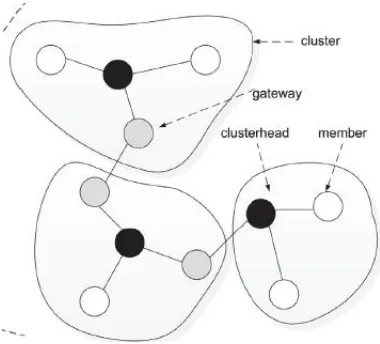
A cluster is a subset of nodes in a network contains a collection of nodes. A cluster consists of aspecial node called
cluster-head and some other nodes called cluster-members. The cluster-head is responsible to relay packets forits
cluster-members and packets from other cluster-heads. Theinformation needed when selecting cluster-heads is
gathered fromperiodical hello packets. Different criterions are used when selectingcluster-heads, such as node ID
[12–14], node degree [15, 16], linkstability [17], battery power, speed, or combinations of them[18, 19]. After
cluster construction process has finished, some othernodes are selected by cluster-heads to act as gateways,
whichshould rebroadcast every packet it received. Gateways can be selectedimmediately after the cluster
construction process has finished,such as source independent connected dominating set(SICDS) in [20, 21], or
selected on the fly while performing a broadcastsession, such as source dependent connected dominating
set(SDCDS) in [20, 21].
2.2 Cuckoo search
Cuckoo search is a relatively recent nature-inspired metaheuristic algorithm, developed by Xin-She Yang and Suash
Deb in 2009. CS was inspired by the brood parasitism of some cuckoo bird species, in combination with the Levy
flights [22–24] random walks. Cuckoos are catching scientists’ interest because of their aggressive reproduction
strategy. Some species lay their eggs in communal nests of other host birds (often other species), and may remove
others' eggs to increase the hatching probability of their own eggs.
CS idealized rules can be summarized as:
1. Each cuckoo lays one egg at a time, and dumps its egg in a randomly chosen nest.
13 | P a g e
3. The number of available host nests is fixed, and the egg laid by a cuckoo is discovered by the host bird with aprobability pa ε [0,1] , where the host bird can either throw the egg away, or abandon the nest and build a
completely new nest.
While exploring new solutions, it is necessary to control the Levy flights random walks, to avoid large moves,
causing the solutions to jump outside of the search space. A step size factor that is defined according to the scale of
the problem of interest should be used for this purpose. This might be an interesting subject for more research,
studying the optimal utilization of the Levy flight in optimization; for simplicity, a typical step size factor of 0.01, as
suggested by the authors, is being used in this study [25, 26, 27].
III PROPOSED SYSTEM MODEL:
ELCSA ALGORITHM
The cluster based network is formed in the proposed work. The Cluster Head selection should be our upcoming
work. In this work, Cluster Member selection for data transfer should be considered as main aspect, because the
information transfer should be in trusted and manageable node.The ELCSA is a based onnature inspired
metaheuristic algorithm. The main aim is to find better node for communication.
Basic terminology:
Cluster: Collection of nodes (Grouped)
Cluster Head (CH): Cluster head is a responsible node for communicate group of nodes.
Cluster Gateway (CG): Common/Intermediate member of more than one cluster.
Cluster Member Node (CMN): Member of a cluster and control of Cluster Head.
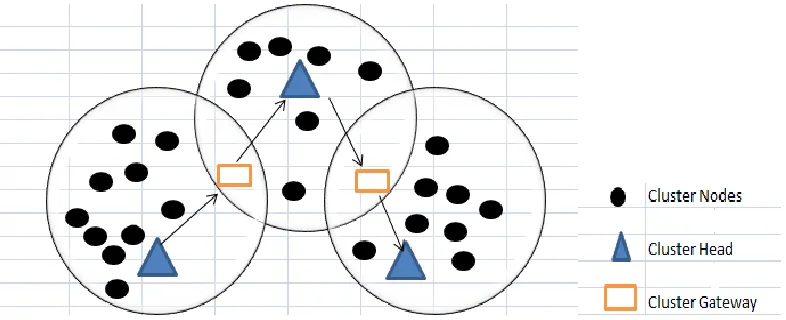
Fig. 1.The states of the Nodes in a clustered MANET with Head and Gateway node.
Black circles indicate the cluster nodes inside the region (before select the cluster member). Brown marks indicate
14 | P a g e
3.1 Proposed Model: ELCSA Algorithm
InELSA (Enhanced Levy-Flight Cuckoo Search Algorithm) the Selection of Cluster Member (CM) for particular
Cluster Head is planned. Node collection means collection of multiple nodes in a region.
In this, region should be splits based on boundary (my next paper Next Paper – Regarding boundary).At initial entire
nodes in the region should be viewed by firefly. The entire nest/ nearby nodes are verified to check fitness for find
the Better Nodes on the Region/nest. Based on Fitness the new nest will formed. Then Rankingwill be performed for
Nodes on the Region. Based on the Rank Place the Nodes will be maintained. After Sometime the comparison
should be made between the newly Arrived Nodes with Previous nodes to get better node on current. AgainRanking
is performed to Replacement Current best Node. At the time of updating failure node also replayed.
Main steps of the ELCSA algorithm
Step 1: Cycle= 1
Step 2:Initialize thepopulation of n host / nests (in a region)
Step 3: Find the new nest using Levy flight (nest contains Secured and Active node)
Check the entire nest in all dimensions
Set new one (new nest contain – currently selected best node)
Collect normal and levy Samples to select best one
Step 4: Evaluate the new nest to calculate fitness
Rank the nests and keep current best nests
Check the entire nest
Compare new nest with previous
Replace the old nest based on fitness
Step 5: Replacement of nest
Check Newly Arrive based on random permutation
Again check the entire nest for ranking
Set new nest
Start from Step 1
Step 6: Evaluate the new nest
Step 7: Rank and keep the current best
Step 8: Store the best solution achieved so far
Step 9: cycle = cycle +1.
15 | P a g e
Fig. 2: Cycle of Node Updating
The proposed ELCSA algorithm uses the cluster topology where each node selection should be based on some
aspects.
The following aspects should be calculated to find the fitness of the node
1. Environmental distance
2. Clustering stability enhancement
3. Load balancing clustering scheme
4. Energy consumption
5. Remaining battery energy
6. Combined Weight
16 | P a g e
Fig. 3: Formed Final Cluster
3.2 Framework of Clustered ELCSA Based Node Selection
Performing Ranking
Cluster Head (CH) Selection
Selection of Cluster Member (CM)
Collection Nodes in a Region
Fitness Calculation
Cluster Based Network Formation
Final Cluster Member Selection
17 | P a g e
Cluster Based Network Formation:The cluster count should be based on the number of nodes on the network. Maximum number of nodes in
the cluster should be based on the trusted level of nodes.
Cluster Head (CH) Selection:
The Cluster Head (CH) Selection is based on some criteria that should be my future work.
Selection of Cluster Member (CM):Based on fitness the cluster member should be selected.
Collection Nodes in a Region:
In a cluster there are number of nodes should be collected together in a region.
Fitness Calculation:
Calculationof fitness is based on Environmental distance, Clustering stability enhancement, Load balancing
clustering scheme, Energy consumption, Remaining battery energy and Combined Weight.
Performing Ranking:
The Ranking should be based on fitness level.
Final Cluster Member Selection:
Basedon raking the number of nodes should be participated for data transfer.
Node Replacement Based on Newly Arrived Nodes:
Failed node was found at the time of updating and Re-Ranking is initialized.
IV CONCLUSION
In this work, Enhanced Levy-Flight Cuckoo Search Algorithm (ELCSA) is proposed for effective Cluster Member
Selection and Member Replacement in a cluster. Member replacement is based on node failure and current status of
the particular node.The above framework can be enhanced and implemented for the real time environment.
REFERENCES
[1] T. Dutta, Medical data compression and transmission in wireless ad hoc net- works, IEEE Sensors J. 15 (2)
(2015) 118–173, doi: 10.1109/JSEN.2014.2354394 .
[2] T. Shu, M. Krunz, Privacy-preserving and truthful detection of packet dropping attacks in wireless ad hoc
18 | P a g e
[3] S. K. Sarkar, T. G. Basavaraju and C. Puttamadappa, Ad Hoc Mobile Wireless Networks: Principles, Protocolsand Applications, CRC Press (2007).
[4] PiyaliKar, MrinalKanti Deb Barma, Sudipta Roy and S. K, Sen, Energy Efficient Weight Based Clustering in
MANET, 2nd International Conference on Data Engineering and Communication System (ICDECS),
ISSN-0973-4562, vol. 10, pp. 82–86, december 28–29 (2015).
[5] Bonabeau E., Dorigo M., Theraulaz G., Swarm Intelligence: From Natural to Artificial Systems. Oxford
University Press, (1999)
[6] Blum C. and Roli A., Metaheuristics in combinatorial optimization: Overview and concepturalcomparision,
ACM Comput. Surv., 35, 268-308 (2003).
[7] Deb. K., Optimisation for Engineering Design, Prentice-Hall, New Delhi, (1995).
[8] Yang X. S., Nature-Inspired Metaheuristic Algorithms, Luniver Press, (2008).
[9] Yang X. S., Biology-derived algorithms in engineering optimizaton (Chapter 32), in Handbook of Bioinspired
Algorithms and Applications (edsOlarius&Zomaya), Chapman & Hall / CRC (2005).
[10] Goldberg D. E., Genetic Algorithms in Search, Optimisation and Machine Learning, Reading, Mass.: Addison
Wesley (1989).
[11] Kennedy J., Eberhart R., Shi Y.: Swarm intelligence, Academic Press, (2001).
[12] X. Niu, Z. Tao, G. Wu, C. Huang, L. Cui, Hybrid cluster routing: An efficientrouting protocol for mobile ad
hoc networks, in: Communications, 2006. ICC ’06. IEEE International Conference on, vol. 8, 2006, pp. 3554– 3559.
[13] Y. Ge, L. Lamont, L. Villasenor, Hierarchical olsr – a scalable proactive routing protocol for heterogeneous ad
hoc networks, in: Wireless And Mobile Computing, Networking And Communications, 2005. (WiMob’2005),
IEEE International Conference on, vol. 3, 2005, pp. 17–23.
[14] L. Villasenor-Gonzalez, Y. Ge, L. Lament, Holsr: a hierarchical proactive routing mechanism for mobile ad hoc
networks, IEEE Communications Magazine 43 (2005) 118–125.
[15] T. Rasheed, K.A. Agha, U. Javaid, L. Reynaud, Cluster-quality based hybrid routing for large scale mobile
multi-hop networks, in: Wireless Communications and Networking Conference, 2007.WCNC 2007. IEEE,
2007, pp. 3052–3057.
[16] K. Xu, X. Hong, M. Gerla, An ad hoc network with mobile backbones, in: Communications, 2002. ICC 2002.
IEEE International Conference on, vol. 5, 2002, pp. 3138–3143.
[17] K. Xu, M. Gerla, A heterogeneous routing protocol based on a new stable clustering scheme, in: MILCOM
19 | P a g e
[18] A. Iwata, C.-C.Chiang, G. Pei, M. Gerla, T.-W.Chen, Scalable routing strategies for ad hoc wireless networks,IEEE Journal on Selected Areas in Communications 17 (1999) 1369–1379.
[19] C. Lin, M. Gerla, Adaptive clustering for mobile wireless networks, IEEE Journal on Selected Areas in
Communications 15 (1997) 1265–1275.
[20] M. Gerla, J. Tsai, Multicluster, mobile, multimedia radio network, in: Wireless Netw 1, 1995. Highest
Connectivity Clustering.
[21] C. Chiang, H. Wu, W. Liu, Routing in clustered multi-hop, mobile wireless networks with fading channel, in:
Proceedings of IEEE SICON, 1997. Least Cluster Change (LCC).
[22] Pavlyukevich, I. 2007. “Lévy flights, non-local search and simulated annealing.” Journal of Computational
Physics. 226, 2 (2007), 1830–1844.
[23] Yang, X.-S. 2010. Nature-Inspired Metaheuristic Algorithms: Second Edition. Luniver Press.
[24] Yang, X.S. and Deb, S. 2010. “Engineering optimisation by cuckoo search.”International Journal of
Mathematical Modelling and Numerical Optimisation. 1, 4 (2010), 330–343.
[25] Barthelemy, P. et al. 2008. “A Lévy flight for light.”Nature. 453, 7194 (2008), 495–498.
[26] Gutowski, M. 2001. “Lévy flights as an underlying mechanism for global optimization algorithms.” arXiv
preprint math-ph/0106003. (2001).
[27] Gutowski, M. 2001. “Lévy flights as an underlying mechanism for global optimization algorithms.” arXiv
preprint math-ph/0106003. (2001).
Biography
Mr.D.Gopinath received his B.Sc, M.Sc and M.Phil degree in Computer Science from the
Bharathiar University. He is currently working as a Assistant Professor in Kongu Arts and Science
College. He has presented papers at various National and international conferences. His area of
interest includes Wireless sensor Network Security, Network Security, Ad Hoc Network,
especially design and implementation of security metrics.
Dr.K.K.Savitha is currently working as an Assistant Professor at the Department of Computer
Applications, Bharthiar University PG Extension Centre, Erode and also holds B.Sc, MCA and
M.Phil degrees. She completed her PhD from Anna University, Chennai in2013. Her research
interest includes mobile computing, Cloud Computing and Soft Computing. She is a Life member