A Novel And Efficient User Access Control Scheme For Wban
Syed Ibraheem ; Mrs. M Shirisha ; Prof V. Janaki Garu
1. P.G Scholar, Department of CSE, Vaagdevi College of engineering, Bollikunta, Warangal, Telangana
2. Associate Professor, Department of CSE, Vaagdevi College of engineering, Bollikunta, Warangal, Telangana
3. Professor .HOD, Department of CSE, Vaagdevi College of engineering, Bollikunta, Warangal, Telangana
Mail id:[email protected] ; Mail id:[email protected]
ABSTRACT :
Wireless body area networks (WBANs) are
expected to act as an important role in
monitoring the health information and creating a
highly reliable ubiquitous healthcare system.
Since the data collected by the WBANs are used
to diagnose and treat, only authorized users can
access these data. Therefore, it is important to
design an access control scheme that can
authorize, authenticate, and revoke a user to
access the WBANs. In this paper, we first give an
efficient certificate less signcryption scheme and
then design an access control scheme for the
WBANs using the given signcryption .Our
scheme achieves Confidentiality, integrity,
authentication, non-repudiation, public
verifiability, and cipher text authenticity.
Compared withexisting three access control
schemes using signcryption, our scheme has the
least computational cost and energy
consumption for the controller. In addition, our
scheme
Has neither key escrow nor public key
certificates, since it is based on certificate less
cryptography.
Wireless body area networks, security, access
control, signcryption, certificate less
cryptography.
INTRODUCTION
With the rapid progress in wireless
communication and medical sensors, wireless
body area networks (WBANs) are under rapid
research and
Development. A typical WBAN is composed of
a number of implantable or wearable sensor
nodes and a controller. The sensor nodes are
responsible for monitoring a patient’s vital signs
(e.g. electrocardiogram, heart rate, breathing rate
and blood pressure) and environmental
parameter (e.g. temperature, humidity and light).
The sensor nodes communicate with the
controller and the controller acts as a gateway
that sends the collected health data to the
healthcare staffs and network servers. The
hospital frequently. The clinical diagnosis and
some emergency medical response can also be
realized by the WBANs. Therefore, the WBANs
act as an important role in creating a highly
reliable ubiquitous healthcare system. A good
survey about the current state-of-art of WBANs
is given by Movassaghi et al.
Since collected data by the WBANs act as a vital
role in the medical diagnosis and treatment, only
authorized users can access these data.
Therefore, it is important to design an efficient
access control scheme that is capable of
authorizing, authenticating and revoking a user
to access
the WBANs. Without this access control, the
health data may be abused, which may result in
a catastrophic consequence. However, it is not an
easy thing to design an efficient access control
scheme for the WBANs because the resource of
the sensor nodes is very limited. We give a
CLSC scheme with public verifiability and
cipher text authenticity. We design an access
control scheme for the WBANs using the CLSC
with public verifiability and cipher text
authenticity. Our scheme achieves
confidentiality, integrity, authentication,
non-repudiation, and public verifiability and cipher
text authenticity. In addition, the proposed
scheme has neither key escrow problem nor
public key certificates. The controller can verify
the validity of a cipher text without decryption.
Compared with existing three access control
schemes using signcryption, our scheme has the
least computational cost and energy
consumption for the controller.
2. LITERATURE SURVEY
1) Low-SAR path discovery by particle swarm
optimization algorithm in wireless body area
networks
AUTHORS: T. Y. Wu and C. H. Lin
Sensor nodes in wireless body area networks are
placed on the surface of the human skin or
embedded inside the human body. When a
transmitter sends packets, signals reach the
receiver through the human body or skin.
However, electric and magnetic field (EMF)
radiation generated during packet transmission
can lead to a negative influence on human health.
The specific absorption rate (SAR) is defined as
a measure of the amount of radio frequency
energy absorbed by human tissue in units of
mass. The higher the human body absorbs the
value of the specific absorption rate, the more
EMF radiation. Also, the degree of harm to
human health is greater. This paper uses the
particle swarm optimization algorithm to
discover the optimal position of the relay node
so that sensor nodes can send packets to the hub
SAR and the success rate of packet transmission
thus can be improved.
2) Energy efficient transmission approach for
WBAN based on threshold distance
AUTHORS: C. Yi, L. Wang, and Y. Li
Energy efficiency is a key concern for wireless
sensor nodes, especially for wireless body area
network (WBAN) in which sensors operate in
close vicinity to, on or even inside a human
body. In this paper, we first present a
system-level energy consumption model associated with
transmission distance d and transmission data
rate over on-body wireless communication link.
Then, based on the analysis of tradeoff between
circuit energy and transmission energy on
distance, a threshold distance dth which is
responsible for the proportion of transmission
energy and circuit energy is derived for energy
saving in WBAN. With the case of d ≤ dth , since
circuit energy is comparable with transmission
energy consumption, the total energy
consumption can be saved by optimizing the
transmission data rate R. Simulation results
show that a 59.77% or even more energy saving
is achievable using the optimized scheme,
compared with baseline scheme. With d > dth ,
since the total energy consumption is
monotonically decreasing with respect to time t,
an offline algorithm is applied to energy saving
by prolonging transmission time within the
deadline time. In addition, on the basis of the
offline algorithm, a battery-aware transmission
approach is presented for WBAN using battery
electrochemical property. Experimental results
show that, using the presented battery-aware
approach, 71.05% and 60.81% energy saving
can be obtained, in comparison with the baseline
and offline schemes, respectively.
3) A cyber physical test-bed for virtualization of
RF access environment for body sensor network
AUTHORS: J. He, Y. Geng, Y. Wan, S. Li,
and K. Pahlavan
Performance evaluation of wireless access and
localization is important for body sensor
networks, as any defects in the design not only
cause wastage of resources, but also threaten an
individual's health and safety. The typical cyber
methods, however, such as software simulation,
often fail to accurately simulate the influence of
hardware implementation. The traditional
physical methods, however, such as field testing,
are not capable of creating repeatable and
controllable channel conditions. To combine
cyber and physical factors as well as to address
the issue, we present a cyber physical test-bed
for environment virtualization to facilitate the
performance evaluation of wireless access and
test-bed creates a virtualized environment by
emulating the wireless channel in a cybernetic
way using a real time channel emulator. The
original devices or systems under testing can be
physically connected to a channel emulator to
evaluate the performance in the virtualization
environment. Furthermore, the cyber physical
test-bed supports various scenarios from in-body
data transmission to time of arrival based indoor
localization. To validate the cyber physical
approach, emulated outputs are compared with
the empirical data obtained from actual
measurements. To overcome the bandwidth
limitation of traditional digital channel
emulators, we have designed an analog channel
emulator for UWB technologies. The
preliminary verification of this analog emulator
is introduced at the end of this paper.
4) WBANs-Spa: An energy efficient relay
algorithm for wireless capsule endoscopy
AUTHORS: D. Liu, Y. Geng, G. Liu, M.
Zhou, and K. Pahlavan
Wireless Body Area Networks (WBANs) are
specific purpose sensor networks designed to
operate autonomously to connect various
medical sensors, located inside and outside of a
human body. WCE quickly becomes one of the
most popular WBANs applications. Due to finite
energy budget of sensor nodes, transmission
power should be as low as possible in order to
increase the life time of WBANs. To this end, we
addressed a relay network model from in body
Wireless Capsule Endoscopy (WCE), to
on-body relay nodes, and finally to external Access
Point (AP) for the energy-efficient of WBANs in
heterogeneous environment for realistic medical
applications. Also, we proposed
WBANs-Shortest Path Algorithm (WBANs-Spa) of relay
network to reduce total network power
consumption using empirical path loss model,
which could find the optimal multi-hop path
based on the network model. Simulation results
showed our design was effective for minimizing
total network energy consumption in relay
network for WBANs, and the effect of on-body
relay nodes and external AP deployment was
provided.
5) A novel and lightweight system to secure
wireless medical sensor networks
AUTHORS: D. He, S. Chan, and S. Tang
Wireless medical sensor networks (MSNs) are a
key enabling technology in e-healthcare that
allows the data of a patient's vital body
parameters to be collected by the wearable or
implantable biosensors. However, the security
and privacy protection of the collected data is a
major unsolved issue, with challenges coming
devices, and the high demand for both
security/privacy and practicality. In this paper,
we propose a lightweight and secure system for
MSNs. The system employs hash-chain based
key updating mechanism and proxy-protected
signature technique to achieve efficient secure
transmission and fine-grained data access
control. Furthermore, we extend the system to
provide backward secrecy and privacy
preservation. Our system only requires
symmetric-key encryption/decryption and hash
operations and is thus suitable for the low-power
sensor nodes. This paper also reports the
experimental results of the proposed system in a
network of resource-limited motes and laptop
PCs, which show its efficiency in practice. To
the best of our knowledge, this is the first secure
data transmission and access control system for
MSNs until now.
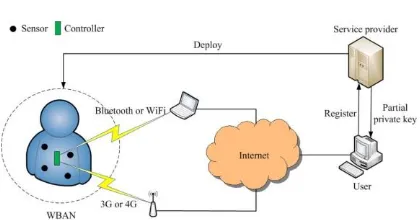
3. a) SYSTEM MODEL
Fig. 1 shows the overview of the network model
that mainly consists of three entities, the WBAN
of a patient, a service provider (SP) and a user
(e.g., a nurse, a doctor, a government agency or
an insurance company). The WBAN consists of
some sensor nodes and a controller. The sensor
nodes can communicate with the controller and
the controller can communicates with not only
the sensor nodes but also the Internet. The SP
deploys the WBAN that monitors a patient’s
vital signs and environmental parameter. If a
user hopes to access the WBAN, it must be
authorized by the SP. The SP is responsible for
the registration for both the user and the WBAN
and producing a partial private key for the user
and the private keys for the WBAN. That is, the
SP plays the KGC in the CLC. We suppose that
the SP is honest and curious (the SP follows the
protocol but hopes to know the transmitted
messages). That is, we do not need to fully trust
the SP since it only knows the partial private key
of the user. This is an important advantage of the
CLC than the IBC. When a user hopes to access
the monitoring data of the WBAN, it first sends
a query message to the WBAN. Then controller
checks if the user has been authorized to access
the WBAN. If yes, the controller sends collected
data to the user in a secure way. Otherwise, the
controller refuses the query request.
B. Security Requirements
The communication between the user and the
controller should satisfy at least four security
properties, i.e. confidentiality, authentication,
integrity and non-repudiation. Confidentiality
keeps query messages secret from the others
except the user and the controller.
user can access the WBAN. Integrity ensures
that a query message from the user has not been
altered by some unauthorized entities.
Non-repudiation prevents the denial of previous
queries submitted by the user. That is, if the user
has submitted a query message to the WBAN, it
cannot deny its action. In addition, we also hope
that this communication satisfies public
verifiability and cipher text authenticity. The
public verifiability means that a third party can
verify the validity of a cipher text without
knowing the controller’s private key. The cipher
text authenticity means that a third party can
verify the validity of a cipher text without
decrypting it.
B. Motivation and Contribution
The previous access control schemes using
signcryption have the following weaknesses: (1)
they either require the public key certificates or
have key escrow problem. (2) They do not have
cipher text authenticity. The controller must first
decrypt a cipher text and then verify its validity.
If the cipher text is not valid, the decryption
work will be wasted. The motivation of this
paper is to find a new methodology for design of
an access control scheme for the WBANs
without the above weaknesses. Only authorized
users can access the WBANs and the query
messages are protected. It is important to protect
the query messages for preserving the privacy of
the users [21]. Our methodology uses certificate
less signcryption (CLSC) [22] with public
verifiability and cipher text authenticity. The
contributions of this paper are summarized as
follows
1) We give a CLSC scheme with public
verifiability and cipher text authenticity.
2) We design an access control scheme for
the WBANs using the CLSC with public
verifiability and cipher text authenticity.
Our scheme achieves
confidentiality,integrity, authentication,
on-repudiation, public verifiability and
,cipher text authenticity. In addition, the
proposed scheme has neither key escrow
problem nor public key certificates. The
controller can verify the validity of a cipher
text without decryption. Compared with
existing three access control schemes using
signcryption, our scheme has the least
computational cost and energy
consumption for the controller.
4. CONCLUSION
In this paper, we proposed a modified certificate
less signcryption scheme that satisfies public
verifiability and cipher text authenticity. We also
gave a certificate less access control scheme for
the WBANs using the modified signcryption.
Compared with existing four access control
schemes using signcryption, our scheme has the
least computational time and energy
consumption. In addition, our scheme is based
on the CLC that has neither key escrow problem
5. REFERENCES
[1] T. Y. Wu and C. H. Lin, “Low-SAR path discovery by particle swarm optimization algorithm in wireless body area networks,” IEEE Sensors J., vol. 15, no. 2, pp. 928–936, Feb. 2015.
[2] C. Yi, L. Wang, and Y. Li, “Energy efficient transmission approach for WBAN based on threshold distance,” IEEE Sensors J., vol. 15, no. 9, pp. 5133– 5141, Sep. 2015.
[3] J. He, Y. Geng, Y. Wan, S. Li, and K. Pahlavan, “A cyber physical test-bed for virtualization of RF access environment for body sensor network,” IEEE Sensors J., vol. 13, no. 10, pp. 3826–3836, Oct. 2013. [4] D. Liu, Y. Geng, G. Liu, M. Zhou, and K. Pahlavan, “WBANs-Spa: An energy efficient relay algorithm for wireless capsule endoscopy,” in Proc. IEEE 82nd Veh. Technol. Conf. (VTC-Fall), Boston, MA, USA, Sep. 2015, pp. 1–5.
[5] D. He, S. Chan, and S. Tang, “A novel and lightweight system to secure wireless medical sensor networks,” IEEE J. Biomed. Health Inform., vol. 18, no. 1, pp. 316–326, Jan. 2014.
[6] S. Movassaghi, M. Abolhasan, J. Lipman, D. Smith, and A. Jamalipour, “Wireless body area networks: A survey,” IEEE Commun. Surveys Tuts., vol. 16, no. 3, pp. 1658–1686, Jan. 2014.
[7] M. Li, W. Lou, and K. Ren, “Data security and privacy in wireless body area networks,” IEEE Wireless Commun., vol. 17, no. 1, pp. 51–58, Feb. 2010.
[8] C. Hu, F. Zhang, X. Cheng, X. Liao, and D. Chen, “Securing communications between external users and wireless body area networks,” in Proc. 2nd ACM Workshop Hot Topics Wireless Netw. Secur. Privacy (HotWiSec), Budapest, Hungary, 2013, pp. 31–35. [9] J. Lai, R. H. Deng, C. Guan, and J. Weng, “Attribute-based encryption with verifiable outsourced decryption,” IEEE Trans. Inf. Forensics Security, vol. 8, no. 8, pp. 1343–1354, Aug. 2013. [10] R. Lu, X. Lin, and X. Shen, “SPOC: A secure and privacy-preserving opportunistic computing framework for mobile-healthcare emergency,” IEEE Trans. Parallel Distrib. Syst., vol. 24, no. 3, pp. 614– 624, Mar. 2013.
[11] H. Zhao, J. Qin, and J. Hu, “An energy efficient key management scheme for body sensor networks,” IEEE Trans. Parallel Distrib. Syst., vol. 24, no. 11, pp. 2202–2210, Nov. 2013.
[12] D. He, S. Chan, Y. Zhang, and H. Yang, “Lightweight and confidential data discovery and dissemination for wireless body area networks,” IEEE J. Biomed. Health Inform., vol. 18, no. 2, pp. 440–448, Mar. 2014.
body sensor networks,” IEEE Trans. Inf. Technol. Biomed., vol. 13, no. 6, pp. 926–932, Nov. 2009. [14] D. Boneh and M. Franklin, “Identity-based encryption from the Weil pairing,” SIAM J. Comput., vol. 32, no. 3, pp. 586–615, 2003.
[15] J. Liu, Z. Zhang, X. Chen, and K. S. Kwak, “Certificateless remote anonymous authentication schemes for wireless body area networks,” IEEE Trans. Parallel Distrib. Syst., vol. 25, no. 2, pp. 332– 342, Feb. 2014.
[16] S. S. Al-Riyami and K. G. Paterson, “Certificateless public key cryptography,” in Advances in Cryptology (Lecture Notes in Computer Science), vol. 2894. New York, NY, USA: Springer-Verlag, 2003, pp. 452–474.
[17] G. Cagalaban and S. Kim, “Towards a secure patient information access control in ubiquitous healthcare systems using identity-based signcryption,” in Proc. 13th Int. Conf. Adv. Commun. Technol. (ICACT), Seoul, Korea, Feb. 2011, pp. 863–867.
[18] L. Chen and J. Malone-Lee, “Improved identity-based signcryption,” in Public Key Cryptography (Lecture Notes in Computer Science), vol. 3386. New York, NY, USA: Springer-Verlag, 2005, pp. 362–379.
[19] Y. Zheng, “Digital signcryption or how to achieve cost(signature & encryption) cost(signature) + cost(encryption),” in Advances in Cryptology
(Lecture Notes in Computer Science), vol. 1294. New York, NY, USA: Springer-Verlag, 1997, pp. 165–179.
[20] C. Hu, N. Zhang, H. Li, X. Cheng, and X. Liao, “Body area network security: A fuzzy attribute-based signcryption scheme,” IEEE J. Sel. Areas Commun., vol. 31, no. 9, pp. 37–46, Sep. 2013.
[21] C. Ma, K. Xue, and P. Hong, “Distributed access control with adaptive privacy preserving property for wireless sensor networks,” Secur. Commun. Netw., vol. 7, no. 4, pp. 759–773, Apr. 2014.
[22] P. S. L. M. Barreto, A. M. Deusajute, E. de Souza Cruz, G. C. F. Pereira, and R. R. da Silva, “Toward efficient certificateless signcryption from (and without) bilinear pairings,” in Proc. Brazilian Symp. Inf. Comput. Syst. Secur., 2008, pp. 115–125. [23] P. S. L. M. Barreto, B. Libert, N. McCullagh, and J.-J. Quisquater, “Efficient and provably-secure identity-based signatures and signcryption from bilinear maps,” in Advances in Cryptology (Lecture Notes in Computer Science), vol. 3788. New York, NY, USA: Springer-Verlag, 2005, pp. 515–532. [24] C. P. Schnorr, “Efficient signature generation by smart cards,” J. Cryptol., vol. 4, no. 3, pp. 161–174, 1991.
Security and Cryptology (Lecture Notes in Computer Science), vol. 2971. New York, NY, USA: Springer-Verlag, 2004, pp. 352–369.
[26] C. Gamage, J. Leiwo, and Y. Zheng, “Encrypted message authentication by firewalls,” in Public Key Cryptography (Lecture Notes in Computer Science), vol. 1560. New York, NY, USA: Springer-Verlag, 1999, pp. 69–81.
[27] J. Daemen and V. Rijmen, The Design of Rijndael: AES—The Advanced Encryption Standard. Springer, 2002.
[28] D. Johnson, A. Menezes, and S. Vanstone, “The elliptic curve digital signature algorithm (ECDSA),” Int. J. Inf. Secur., vol. 1, no. 1, pp. 36–63, Aug. 2001. [29] N. Gura, A. Patel, A. Wander, H. Eberle, and S. C. Shantz, “Comparing elliptic curve cryptography and RSA on 8-bit CPUs,” in Cryptographic Hardware and Embedded Systems (Lecture Notes in Computer Science), vol. 3156. New York, NY, USA: Springer-Verlag, 2004, pp. 119–132.
[30] K.-A. Shim, Y.-R. Lee, and C.-M. Park, “EIBAS: An efficient identitybased
broadcast authentication scheme in wireless sensor networks,” Ad Hoc Netw., vol. 11, no. 1, pp. 182– 189, Jan. 2013.
[31] X. Cao, W. Kou, L. Dang, and B. Zhao, “IMBAS: Identity-based multiuser broadcast authentication in wireless sensor networks,” Comput. Commun., vol. 31, no. 4, pp. 659–667, Mar. 2008.
[32] F. Li, Z. Zheng, and C. Jin, “Secure and efficient data transmission in the Internet of Things,” Telecommun. Syst., vol. 62, no. 1, pp. 111–122, 2016.
[33] K. A. Shim, “S2DRP: Secure implementations of distributed reprogramming protocol for wireless sensor networks,” Ad Hoc Netw., vol. 19, pp. 1–8, Aug. 2014.