368 | P a g e
IMPLEMENTATION OF THE CONTRAST
ENHANCEMENT AND WEIGHTED GUIDED IMAGE
FILTERING ALGORITHM FOR EDGE PRESERVATION
FOR BETTER PERCEPTION
Chiruvella Suresh
Assistant professor, Department of Electronics & Communication Engineering,
SRTIST, Nalgonda, Telanga, (India)
ABSTRACT
Digital image processing has revolutionized the content perception from physical photo appearance to digital image appearance by implementing the digitalization. Digital image processing helps to achieve good process in various research fields but still enhancing the degraded content to normal content is concerned area. Image enhancement attains attention due to its high application applicability. A novel framework is proposed in this paper by combine the edge based weighting scheme with guided image filtering to get proposed weighted guide image filtering (WGIF). WGIF scheme yields low complexity as GIF and preserve the sharp gradient information. WGIF has ability to provide the local and global smoothing filters advantages and successful to avoid the halo artifacts. In practical WGIF is for single image feature enhancement. Experimental results provide low complexity and high performance over traditional state of art methods.
Keywords: Guided Image Filter, Halo Artifacts, Low Complexity, Image Enhancement
I INTRODUCTION
Digital image is defined as ―An image is not an image without any object in it‖. Human visual system has ability to
perceive the objects in digital image using edges in efficient manner. Halo artifacts introduces blur in digital image
which makes perception of content difficult. Various filtering techniques have designed in literature to preserve the
global and local statistics but none can meet the desired requirements and various algorithms yields high complexity
which fails them to achieve practical reliability.
Digital image processing domain has different research fields and all these research fields have applications ranging
from low level to high level. Edge preservation in all these research fields attains attention and implementation of
smoothing filters has ability to filter noise content by preserving the edge information. Smoothing algorithms can be
classified into two types namely global filters such as bilateral filter , tri-lateral filters , and finally guided image
369 | P a g e
considered as alternative to global filters which are simple and cost effective but fail to conserve the sharp edgesinformation like global filters.
When local filters are forcefully adopts to smooth edges it results halo artifacts. Halo artifacts produced by bi-lateral
filter and guided image filter are fixed in equipped way using similarity parameter in terms of range and spatial.
Bi-lateral filtering mechanism is considered as adaptive filter and this adaptive mechanism helps to handle the halo
artifacts and on negative side it destroys the 3D convolutional form . An interesting algorithm named weighted
guided image filtering scheme is proposed in this paper by combining the edge-based weighting scheme along with
guided image filtering. Calculation of edge based weighting scheme is calculated by using 3 3 local variance in a
guidance image. This local variance scheme of one individual pixel is normalized by all pixels local variance in
guidance image. The acquired normalized weights of all pixels are then adaptively adapted to WGIF. WGIF helps
to avoid halo artifacts in accurate manner for excellent visual quality. The intricacy of WGIF is same as GIF. The
proposed weighted guide image filtering (WGIF) is applied for multiple purposes as single image mist removal,
single image detail enhancement and different exposed images fusion.
II RELATED WORK
Pierre Charbonnier, Laure Blanc-Feraud, Gilles Aubert, and Michel Barlaud [1] proposed an algorithm, called
ARTUR, to avoid problems that are ill posed and must be regularized. Usually, a roughness penalty is imposed on
the solution. The difficulty is to avoid the smoothing of edges, which are very important attributes of the image. In
this paper, they first give conditions for the design of such an edge-preserving regularization in which under the few
conditions it is possible to introduce an auxiliary variable whose role is twofold. First, it marks the discontinuities
and ensures their preservation from smoothing. Second, it makes the criterion half-quadratic. The optimization is
then easier, as well as a deterministic strategy, based on alternate minimizations on the image and the auxiliary
variable, and can be applied in a large number of applications in image processing.
Z. Farbman, R. Fattal, D. Lischinski, and R. Szeliski [2] pavedthe new way to construct edge-preserving multi-scale
image decomposition in order to control the spatial scale of the extracted details, and it is often desirable to
manipulate details at multiple scales, while avoiding visual artifacts. It current base detail decomposition techniques,
based on the bilateral filter, are limited in their ability to extract detail at arbitrary scales. Thus they advocate the use
of an alternative edge-preserving smoothing operator, based on the weighted least squares optimization framework,
which is particularly well suited for progressive coarsening of images and for multi-scale detail extraction and
effectiveness of edge-preserving decompositions in the context of LDR and HDR tone mapping, detail
enhancement, and other applications.
J. Chen, S. Paris, and F. Durand [3]presented a new data structure—the bilateral grid, that enables fast edge-aware
image processing. By working in the bilateral grid, algorithms such as bilateral filtering, edge-aware painting, and
local histogram equalization become simple manipulations that are both local and independent.It parallelize
370 | P a g e
method on a variety of applications such as image editing, transfer of photographic look, and contrast enhancementof medical images.
K. He, J. Sun, and X. Tang [4]represented a novel explicit image filter called guided filter which is derived from a
local linear model, the guided filter computes the filtering output by considering the content of a guidance image,
which can be the input image itself or another different image. The guided filter can be used as an edge-preserving
smoothing operator like the popular bilateral filter, but it has better behaviors near edges. The guided filter is also a
more generic concept beyond smoothing: It can transfer the structures of the guidance image to the filtering output,
enabling new filtering applications like dehazing and guided feathering. Moreover, the guided filter naturally has a
fast and no approximate linear time algorithm, regardless of the kernel size and the intensity range. Currently, it is
one of the fastest edge-preserving filters. Experimental result shows that the guided filter is both effective and
efficient in a great variety of computer vision and computer graphics applications, including edge-aware smoothing,
detail enhancement, HDR compression, image matting/feathering, dehazing, joint upsampling, etc.
III METHODLOGY
Digital image composed of three contents namely color, shape and texture. Assessing the image information based
on edges (gradient) has ability to perform the enhancement tasks and fusion in reliable way in the field of digital
image processing. Acquiring the digital content of images with good visual quality in computational photography
and other applications with complexity is still concerned area because many global filters yields high complexity
which show adverse impact on enhancement process.. In this paper, a strategy is implemented to enhance the image
contents based on edge information by incorporating the guided image filter (GIF) with novel edge based weighting
scheme to form weighted guided image filter with minimal complexity and better visual quality.
The edge information plays an important role in implementing weighted guide image filtering algorithm for various
applications. The key element of proposed algorithm is to ensure a confined linear model between a guidance image
(G) and filtering output ( ). The confined linear model ensures filtering output ( ) has an edge only if the respective
guidance image (G) has an edge. Consider G as guidance image and the respective variance is denoted by . The
edge based weighting scheme is well defined by local variance of 3 3 local variance windows of all pixels
as follows
(1)
Where
denotes a small constant selected for input image dynamic range ―L‖ and its value is . All
guidance image pixels are used in the computation of . The pixel importance is measured by weighting
mechanism with respect to whole guidance image. The value of weighting mechanism is larger than 1 if is at an
edge and value is small if is in a flat area. The feasible blocking artifacts appearance can be efficiently prevented
371 | P a g e
filtering scheme is incorporated with cost function and finally the minimization of differences between image to befiltered and filtered output as follows
(2)
The computation of and are as follows
(3)
(4)
Where is represented as two matrices element by element product and along with matrices mean values are also
taken into consideration in order to yield final value as
(5)
To make the analysis easy both X and G are assumed to be same for perfection and when we consider a pixel with a
edge has value larger than 1 and in WGIF it is close to 1 is better than GIF value. The above analysis show better
edge information is obtained by WGIF than GIF
IV RESULTS
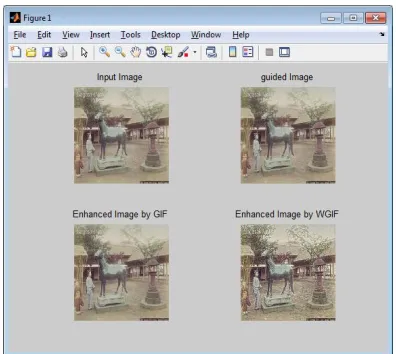
Figure 1: (a) Input image (b) Guided image (c) Enhanced image
372 | P a g e
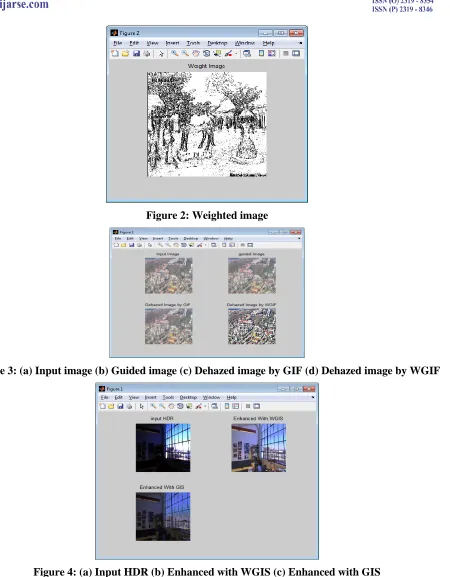
Figure 2: Weighted image
Figure 3: (a) Input image (b) Guided image (c) Dehazed image by GIF (d) Dehazed image by WGIF
Figure 4: (a) Input HDR (b) Enhanced with WGIS (c) Enhanced with GIS
V CONCLUSION
An optimized framework is proposed in this work by incorporating the edge based weighting scheme with guided
373 | P a g e
GIF and preserve the sharp gradient information. WGIF has ability to provide the local and global smoothing filtersadvantages and successful to avoid the halo artifacts. In practical WGIF is for single image feature enhancement.
REFERENCES
[1] P. Charbonnier, L. Blanc-Feraud, G. Aubert, and M. Barlaud, ―Deterministic edge-preserving regularization in
computed imaging,‖ IEEE Trans. Image Process., vol. 6, no. 2, pp. 298–311, Feb. 1997.
[2] Z. Farbman, R. Fattal, D. Lischinski, and R. Szeliski, ―Edge-preserving decompositions for multi-scale tone and detail manipulation,‖ ACM Trans. Graph., vol. 27, no. 3, pp. 249–256, Aug. 2008.
[3] J. Chen, S. Paris, and F. Durand, ―Real-time edge-aware image processing with the bilateral grid,‖ ACM Trans. Graph., vol. 26, no. 3, pp. 103–111, Aug. 2007.
[4] K. He, J. Sun, and X. Tang, ―Guided image filtering,‖ IEEE Trans. Pattern Anal. Mach. Intell., vol. 35, no. 6,
pp. 1397–1409, Jun. 2013.
[5] L. I. Rudin, S. Osher, and E. Fatemi, ―Nonlinear total variation based noise removal algorithms,‖ Phys. D,
Nonlinear Phenomena, vol. 60, nos. 1–4, pp. 259–268, Nov. 1992.
[6] Z. G. Li, J. H. Zheng, and S. Rahardja, ―Detail-enhanced exposure fusion,‖ IEEE Trans. Image Process., vol. 21,
no. 11, pp. 4672–4676, Nov. 2012.
[7] Z. Farbman, R. Fattal, D. Lischinski, and R. Szeliski, ―Edge-preserving decompositions for multi-scale tone and
detail manipulation,‖ ACM Trans. Graph., vol. 27, no. 3, pp. 249–256, Aug. 2008.
[8] R. Fattal, M. Agrawala, and S. Rusinkiewicz, ―Multiscale shape and detail enhancement from multi-light image
collections,‖ ACM Trans. Graph., vol. 26, no. 3, pp. 51:1–51:10, Aug. 2007.
[9] P. Pérez, M. Gangnet, and A. Blake, ―Poisson image editing,‖ ACM Trans. Graph., vol. 22, no. 3, pp. 313–318,
Aug. 2003.
[10] K. He, J. Sun, and X. Tang, ―Single image haze removal using dark channel prior,‖ IEEE Trans. Pattern Anal.
Mach. Intell., vol. 33, no. 12, pp. 2341–2353, Dec. 2011.
[11] L. Xu, C. W. Lu, Y. Xu, and J. Jia, ―Image smoothing via L0 gradient minimization,‖ ACM Trans. Graph., vol.
30, no. 6, Dec. 2011, Art. ID 174.
[12] C. Tomasi and R. Manduchi, ―Bilateral filtering for gray and color images,‖ in Proc. IEEE Int. Conf. Comput.
Vis., Jan. 1998, pp. 836–846.
[13] Z. Li, J. Zheng, Z. Zhu, S. Wu, and S. Rahardja, ―A bilateral filter in gradient domain,‖ in Proc. Int. Conf.
Acoust., Speech Signal Process., Mar. 2012, pp. 1113–1116.
[14] P. Choudhury and J. Tumblin, ―The trilateral filter for high contrast images and meshes,‖ in Proc. Eurograph.
Symp. Rendering, pp. 186–196, 2003.
[15] F. Durand and J. Dorsey, ―Fast bilateral filtering for the display of highdynamic-range images,‖ ACM Trans.