Determination of the nuclear level densities and radiative
strength function for 43 nuclei in the mass interval 28
≤
A
≤
200
DavidKnezevic1,5, Nikola Jovancevic1,, Anatoly M.Sukhovoj2, Ludmila V.Mitsyna2, Miodrag
Krmar1, Vu D. Cong2, Franz-Josef Hambsch4, Stephan Oberstedt4, Zsolt Revay3, Christian
Stieghorst3, andAleksandarDragic5
1University of Novi Sad, Faculty of Science, Department of Physics, Trg Dositeja Obradovica 3, 21000 Novi Sad, Serbia
2Joint Institute for Nuclear Research, 141980 Moscow region, Dubna, Russia
3Technische Universität München, Forschungsneutronenquelle Heinz Maier-Leibnitz (FRM II), Lichtenbergstr. 1, 85747 Garching, Germany
4European Commission, Joint Research Centre, Directorate G – Nuclear Safety and Security, Unit G.2, Retieseweg 111, 2440 Geel, Belgium
5Institute of Physics Belgrade, Pregrevica 118, 11080 Zemun, Serbia
Abstract.The determination of nuclear level densities and radiative strength functions
is one of the most important tasks in low-energy nuclear physics. Accurate experimen-tal values of these parameters are critical for the study of the fundamenexperimen-tal properties of nuclear structure. The step-like structure in the dependence of the level densitiesρon
the excitation energy of nuclei Eexis observed in the two-step gamma cascade
measure-ments for nuclei in the 28≤A≤200 mass region. This characteristic structure can be explained only if a co-existence of quasi-particles and phonons, as well as their interac-tion in a nucleus, are taken into account in the process of gamma-decay. Here we present a new improvement to the Dubna practical model for the determination of nuclear level densities and radiative strength functions. The new practical model guarantees a good description of the available intensities of the two step gamma cascades, comparable to the experimental data accuracy.
1 Introduction
The development of theoretical models of nuclear structures requires a set of experimental information of the excited levels density,ρ, (with given quantum numbers) and of the values of the partial width (radiative strength function),Γ, of all possible decay channels. Correct interpretation of the
dynam-ics of the nuclear transitions, in a broad variety from the simple low-lying levels (e.g., quasi-particle or phonon structure) to the very complex compound-states is possible by the theoretical calculations if those experimental data are available. One of the most suitable techniques for determination of required nuclear mater parameters (ρandΓ) is the two-step gamma cascades methods based on
mea-surement of gamma coincidences following neutron capture [1].
Based on the experimental data collected by two-step gamma cascades experiment a model for description the gamma-decay of neutron resonance was developed at JINR, Dubna [2, 3]. In this model the level densityρof quasi-particles in any nucleus is defined using the known model of n-quasi-particle levels. Here we presented the improved version of this model taking into account shell inhomogeneities of the single-particle level spectra and their influence on the functions:ρ=ϕ(Eex) and Γ=ψ(E1), where Eexis the excitation energy and E1 is primary transition energy. The experimental results of two step gamma cascades intensity for 43 nuclei in the 28≤A≤200 mass region were fitting by this model. This provide us possibility to extract parameters of nuclear structure such as breaking thresholds of the second and the third Cooper pairs, ratio of the collective level density to the total one or level parity.
2 Dubna two-step gamma cascades method
The two-step gamma-cascades method for obtaining information about the nuclear structure param-eters following the thermal neutron captures was developed at FLNP, JINR, DUBNA [2, 3]. From amount of gamma-gamma coincidences the method allows to choose registration events of full energy of two-gamma transition cascade with a sufficiently low background. And the experimental intensity
distributions of cascades to the final levels of compound-nucleus with excited energy below∼500– 800 keV are obtained from these coincidences. Using the nuclear spectroscopy procedures allows decomposing the initial spectrum on primary and secondary transmission components of cascades with an acceptable uncertainty [2, 3].
The basic idea of this method comes from specific dependence of the two-step gamma- cascade intensity on the partial radiative widthΓand the density of excited levels:
Iγγ=
λ,f
i
Γλi
Γλ Γi f
Γi =
λ,f
Γλi Γλimλinλi
Γi f
Γi fmi f
(1)
whereΓλiandΓi f are the partial radiative widths corresponding to the primary and to the secondary transitions; nλi = ρ∆Ei is the number of the excited intermediate levels in a certain interval of the excitation energy∆Ei; Γλi andΓi f are the average values of the corresponding intervals of the nucleus excitation energy widths;mλiandmi f are the number of levels in the same intervals. When this method was developed for the first time it was based on an interactive calculation. Using iterative process with “randomly” chosen functionsρandΓ, it is possible to obtain the most probable values
of level density and radiative width (or radiative strength function).
3 Model of the gamma-decay of neutron resonance
Here we present improved version of the model for the gamma-decay of neutron resonance [2] which can explain the experimental data based on combination of phenomenological and theoretical repre-sentations.
The level density, described by an expression for densityρlof Fermi levels, was taken from the model of densityΩnofn-quasi-particle states [4]:
ρl=
(2J+1) exp−(J+1/2)2/2σ2
2√2πσ3 ·Ωn(Eex),Ωn(Eex)=
gn(Eex−Ul)n−1
((n/2)!)2(n−1)! (2)
Based on the experimental data collected by two-step gamma cascades experiment a model for description the gamma-decay of neutron resonance was developed at JINR, Dubna [2, 3]. In this model the level densityρof quasi-particles in any nucleus is defined using the known model of n-quasi-particle levels. Here we presented the improved version of this model taking into account shell inhomogeneities of the single-particle level spectra and their influence on the functions:ρ=ϕ(Eex) and Γ=ψ(E1), where Eexis the excitation energy and E1 is primary transition energy. The experimental results of two step gamma cascades intensity for 43 nuclei in the 28≤A≤200 mass region were fitting by this model. This provide us possibility to extract parameters of nuclear structure such as breaking thresholds of the second and the third Cooper pairs, ratio of the collective level density to the total one or level parity.
2 Dubna two-step gamma cascades method
The two-step gamma-cascades method for obtaining information about the nuclear structure param-eters following the thermal neutron captures was developed at FLNP, JINR, DUBNA [2, 3]. From amount of gamma-gamma coincidences the method allows to choose registration events of full energy of two-gamma transition cascade with a sufficiently low background. And the experimental intensity
distributions of cascades to the final levels of compound-nucleus with excited energy below∼500– 800 keV are obtained from these coincidences. Using the nuclear spectroscopy procedures allows decomposing the initial spectrum on primary and secondary transmission components of cascades with an acceptable uncertainty [2, 3].
The basic idea of this method comes from specific dependence of the two-step gamma- cascade intensity on the partial radiative widthΓand the density of excited levels:
Iγγ=
λ,f
i
Γλi
Γλ Γi f
Γi =
λ,f
Γλi Γλimλinλi
Γi f
Γi fmi f
(1)
whereΓλiandΓi f are the partial radiative widths corresponding to the primary and to the secondary transitions; nλi = ρ∆Ei is the number of the excited intermediate levels in a certain interval of the excitation energy∆Ei; Γλi andΓi f are the average values of the corresponding intervals of the nucleus excitation energy widths;mλiandmi f are the number of levels in the same intervals. When this method was developed for the first time it was based on an interactive calculation. Using iterative process with “randomly” chosen functionsρandΓ, it is possible to obtain the most probable values
of level density and radiative width (or radiative strength function).
3 Model of the gamma-decay of neutron resonance
Here we present improved version of the model for the gamma-decay of neutron resonance [2] which can explain the experimental data based on combination of phenomenological and theoretical repre-sentations.
The level density, described by an expression for densityρlof Fermi levels, was taken from the model of densityΩnofn-quasi-particle states [4]:
ρl=
(2J+1) exp−(J+1/2)2/2σ2
2√2πσ3 ·Ωn(Eex),Ωn(Eex)=
gn(Eex−Ul)n−1
((n/2)!)2(n−1)! (2)
Here J is the spin quantum number, g=6a/π2is the density of the single-particle states near Fermi-surface,σis the cut-offfactor (a andσvalues were taken from the back-shifted Fermi-gas model
[5]), andUl, is the energy of thel-th Cooper pair breaking threshold. The effect of the collective enhancement was also included in this model by the coefficientCcolof the collective enhancement of
the vibrational level density (or both vibrational and rotational ones for deformed nuclei). For a given excitation energy, Eex, the phenomenological coefficient is determined by a theoretical description that can be found in Ref. [3]:
Ccoll=Alexp((Eex−Ul)/Eν−(Eex−Ul)/Eµ)+β (3)
whereAlare parameters of density for the vibrational levels above the breaking point for eachl-th Cooper pair, Eµ andEνdetermine the change in the nuclear entropy and the change of the quasi-particles excitation energies, respectively. CoefficientsAlfor different pairs are fitted independently,
as it was done in Ref. [2]. Coefficientβis used for a description of the rotation level density. Radiative strength functions forE1- andM1-transitions are determined in this model by Ref. [6]:
k(E1,Eγ)+k(M1,Eγ)=w 1 3π22c2A2/3
σGΓG2(E2γ+κ4π2T2) (E2
γ−E2G)2+Eγ2Γ2γ +
+Pδ−exp(αp(Eγ−Ep))+Pδ+exp(βp(Ep−Eγ)) (4)
with fitting normalization parameterwand coefficientκ; thermodynamic temperatureT; the location
of the center of the giant dipole resonanceEG, with widthΓGand cross sectionσGin the maximum for each nucleus. For description of experimental data of Ref. [3] it is necessary to add one or several narrow peaks to the strength function is based on the data of Ref. [3]. The second summand of Eq. (5) corresponds to the left slope of the peak (energies below the maximum), and the third summand is the right slope (energies above the maximum). PositionEpin the energy scale, amplitudesPδ+andPδ− and slope parametersαp andβp are fitted for each peak independently. AtE1 ≈Bn the fitted ratios
ΓM1/ΓE1ofE1- andM1-strength functions are normalized to known experimental values, and their sumΓλis normalized to the total radiation width of the resonance.
The influence of the shell correctionδEon the density of the quasi-particle levels were tested in this work. It was done by using thea(A) value, which depends on the excitation energy, included linearly in the parameter of the single-particle densityg(see Eq. (2)). For a nucleus with massAand excitation energyEex,a(A) is expressed, as [3]:
a(A)=a˜(1+((1−exp(γEex))δE/Eex)) (5) where asymptotic value is ˜a=0.114·A+0.162·A2/3andγ=0.054. TheδEvalues slightly varied relative to their evaluations [3] in order to keep an average spacing between neutron resonances (see [2]).
In our model the set of common parameters for fitting (see Eqs. (2, 3)) were: 1) the break up thresholds energiesUlup tol=4,
2) theEµandEνparameters, which are common for all Cooper pairs
3) the mutually independent parametersAlof the density of vibrational levels above the break up thresholdUl
4) the coefficientsw,κandβ
5) the ratiorof negative parity and the total level density.
Figure 1. Histogram - experimental cascade intensity and its uncertainties for156Gd as function of primary
cascade quantaE1. Points - the best fit of the presented practical model; triangles - a calculation ofIγγusing
models of Ref. [5, 6]. Recorded threshold for cascade gammas isEγ=520 keV.
a) b)
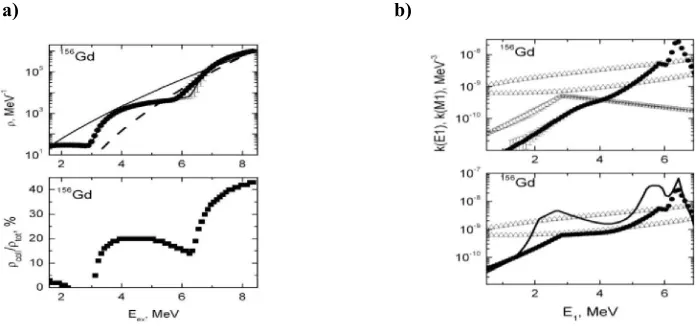
Figure 2. a)Level density of156Gd. Top: points are the best fit of level density (uncertainties – scatter of fits
for different sets of initial parameters); dashed and solid lines are the level density calculated using the model of
Ref. [5], with taking into account the shell correctionδE(6) and withoutδE, correspondingly. Bottom: fitted ratio of density of collective levels to the total level density. b)Strength function for156Gd. Top: solid points
are the best fit of the strength function ofE1-transitions; open points are the best fit of the strength function of
M1-transitions.Bottom:solid points are a sum ofE1- andM1- strength functions; dash line is the sum of strength functions multiplied byρmod/ρexpratio (Ref. [7]). Calculations using the model of Ref. [6] (lower triangles) and
using the model of Ref. [8] (upper triangles) were fulfilled withk(M1)=const.
4 Results and discussion
A solution of the system of Eq. (1) is performed by the Monte-Carlo method. The nonlinearity of the strongly correlated equations of the system (1) produces an uncertainty of extracting theρandΓ
parameters fromIγγintensities.
Figure 1. Histogram - experimental cascade intensity and its uncertainties for156Gd as function of primary
cascade quantaE1. Points - the best fit of the presented practical model; triangles - a calculation ofIγγ using
models of Ref. [5, 6]. Recorded threshold for cascade gammas isEγ=520 keV.
a) b)
Figure 2. a)Level density of156Gd. Top: points are the best fit of level density (uncertainties – scatter of fits
for different sets of initial parameters); dashed and solid lines are the level density calculated using the model of
Ref. [5], with taking into account the shell correctionδE(6) and withoutδE, correspondingly. Bottom: fitted ratio of density of collective levels to the total level density. b)Strength function for156Gd. Top: solid points
are the best fit of the strength function ofE1-transitions; open points are the best fit of the strength function of
M1-transitions.Bottom:solid points are a sum ofE1- andM1- strength functions; dash line is the sum of strength functions multiplied byρmod/ρexpratio (Ref. [7]). Calculations using the model of Ref. [6] (lower triangles) and
using the model of Ref. [8] (upper triangles) were fulfilled withk(M1)=const.
4 Results and discussion
A solution of the system of Eq. (1) is performed by the Monte-Carlo method. The nonlinearity of the strongly correlated equations of the system (1) produces an uncertainty of extracting theρandΓ
parameters fromIγγintensities.
Experimental data onIγγ(E1) are usually obtained with a small total uncertainty and averaged over 500 keV energy intervals. The results for156Gd are shown, in more detail, in Figs. 1–2. The best fits toIγγ(E1), as well as the fitted level densities and strength functions, are compared to corresponding values calculated using the statistical model. The results and corresponding calculations of level density and radiative strength function for the rest of the investigated nuclei will not be shown in
a) b)
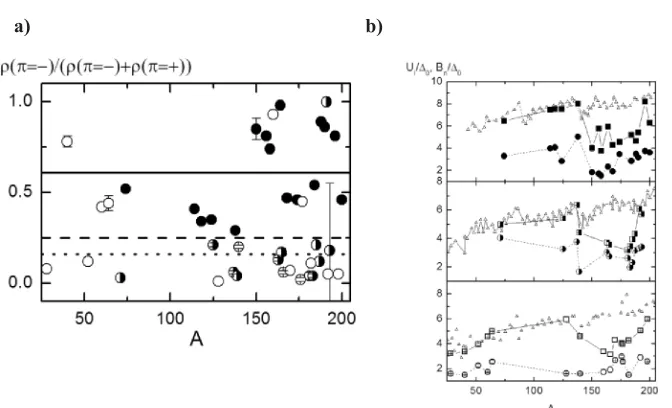
Figure 3. a)A-dependence of the ratios Ul/∆0, for the second (points) and the third (squares) Cooper pairs. Full
points – even-even, half-open points are even-odd and open points are odd-odd compound nuclei. Triangles – the mass dependence ofBn/∆0ratio.B)Mass dependence of the ratio of the level density with negative parity to
the total level density at the upper energy border of theEdand their averages for even-even nuclei (solid lines),
even-odd (dashed lines) and odd-odd nuclei (dotted lines). Full points – even-even, half-open points – even-odd and open points – odd-odd compound nuclei.
this publication. However, we are presented here obtained results for some of parameters of nuclear structure.
One important parameter is the breaking thresholds for Cooper pairs. In the present analysis was confirmed the previous results about the connection between the shape of the investigated nucleus and the breaking thresholds. That was established for the first time in our prior analysis [3]. As the breaking thresholds differ for nuclei with various nucleon parities and depend on the average pairing
energy (∆0) of the last nucleon, the mass dependencies for the ratios of the break up thresholds of the second and the third Cooper pairs to∆0, as well as the mass dependence of the binding energy to∆0, are presented in Fig. 3. As it can be seen in Fig. 3, there is a noticeable difference inU2/∆0andU3/∆0 ratios for spherical and deformed nuclei in contrast toBn/∆0.
In this work it was also obtained information about levels parity. For determination of the part
r=ρ(π−)/(ρ(π−)+ρ(π+)) of levelsρ(π−) with negative parity, a linear extrapolation forrvalue was
applied in theEd ≤ Eex ≤ Bn energy interval. At that, in theBn point we use generally accepted assumption, thatρ(π−)=0.5(ρ(π−)+ρ(π+)), andρ(π−) value in this energy point was fixed, and at
theEdenergy theρ(π−) value varied.
5 Conclusion
In this work we presented new variant of model for gamma decay of neutron resonance, taking into account shell inhomogeneities of the single-particle level spectra. We used this model for fitting the experimental intensity of two-step gamma cascades and to obtain information about parameters of nuclear structure.
The data on Cooper pair break-up energies, obtained with a high accuracy, are sufficient to
con-clude that the dynamics of interaction between superfluid and normal phases of a nucleus depends on its’ shape. Our model allows for a separate determination of the density of vibrational levels between the breaking thresholds of the Cooper pairs.
Unfortunately, an existence of the sources of uncertainties of the soughtρandΓfunctions is a
fundamental problem, and it is inevitable for any nuclear model used for experimental data analysis and for predictions of the spectra and cross sections. There are also fluctuations of the intensities of gamma-transitions in different nuclei, which has a contribution to the systematical error. Nevertheless,
the practical model showed one possibility to describe the data of the two-step experiments with the accuracy that exceeds the statistical one.
For future development of reliable model of cascade gamma decay new experimental data are necessary. Because of that,108Ag,110Ag,104Rh and56Mn nuclei will be investigated by two step gamma cascade method.
References
[1] V.G. Soloviev, Nuclear Physics A586(2), 265 (1995) [2] A.M. Sukhovoj, Phys. Atom. Nucl.78, 230 (2015)
[3] A.M. Sukhovoj, L.V. Mitsyna, N. Jovancevic, Phys. Atom. Nucl.79, 313 (2016)
[4] V.M. Strutinsky, in Proceedings of the International Congress on Nuclear Physics, Paris, France, p. 617 (1958)
[5] W. Dilg, W. Schantl, H. Vonach, and M. Uhl, Nucl. Phys. A217, 269 (1973)
[6] S.G. Kadmenskij, V.P. Markushev and W.I. Furman, Sov. J. Nucl. Phys.37, 165 (1983)