ISSN (Print) : 2320 – 3765 ISSN (Online): 2278 – 8875
I
nternational
J
ournal of
A
dvanced
R
esearch in
E
lectrical,
E
lectronics and
I
nstrumentation
E
ngineering
(An ISO 3297: 2007 Certified Organization) Website: www.ijareeie.com
Vol. 6, Issue 3, March 2017
Forest Fire Detection Using Wireless Sensor
Networks
Shainy Peter
1,Neenu Paul
2, Sreelakshmi.K.K
3,Thenu Elizabeth Sleeba
4Assistant professor, Dept. of ECE, Mar Baselios Institute of Technology and Science, Nelliamattom, Kerala,India1 UG student, Dept. of ECE, Mar Baselios Institute of Technology and Science, Nelliamattom, Kerala,India2 UG student, Dept. of ECE, Mar Baselios Institute of Technology and Science, Nelliamattom, Kerala,India3 UG student, Dept. of ECE, Mar Baselios Institute of Technology and Science, Nelliamattom, Kerala,India4
ABSTRACT: Wireless Sensor Networks (WSNs) are used for various applications such as habitat monitoring, automation, agriculture, and security. Since numerous sensors are usually deployed on remote and inaccessible places, the deployment and maintenance should be easy and scalable. Wireless sensor network consists of large number of small nodes. The nodes then sense environmental changes and report them to other nodes over flexible network architecture. Sensor nodes are great for deployment in hostile environments or over large geographical areas. This article presents the design of a system for detection of temperature and humidity and smoke for the prevention of forest fires using wireless sensor networks to prevent a disaster (forest fire) that could lead to loss of a significant number of natural resources. In this project, several tests had been conducted in order to prove the viability of the system. Test results indicated that the reliability of the system in propagating information directly to the base station could be gained excellently in various conditions.
KEY WORDS: Hub, Node, ZIGBEE, Sensing Parameters
I. INTRODUCTION
ISSN (Print) : 2320 – 3765 ISSN (Online): 2278 – 8875
I
nternational
J
ournal of
A
dvanced
R
esearch in
E
lectrical,
E
lectronics and
I
nstrumentation
E
ngineering
(An ISO 3297: 2007 Certified Organization) Website: www.ijareeie.com
Vol. 6, Issue 3, March 2017
II. METHODOLOGY
Selection of Deployment Area
In case of selection of deployment area, we mainly consider the fire prone area i.e., area is select based on the vulnerability to fire. Accordingly to the details available from the forest fire department, the areas are classified into high fire prone area, moderate fire prone area and low fire prone area. It will help to concentrate where the sensors need to be deployed.
Deployment of Sensors
The sensors are placed manually.
Checking Connectivity and Cluster Formation
Connectivity checking is essential to understand that each component in the network working as per our needs. For that handshaking mechanism can be used. The cluster formation has greater impact on connectivity checking. Because cluster head present in each cluster stores the details of each sensor nodes and also it helps in effective data transmission.
Sensing Parameters
In forest fire scenario, sensors are used to sense the parameters which are fueling the fire like temperatures, wind speed, smoke etc. In forest fire scenario, temperature is the important factor fueling the forest fire. If the temperature increases then the intensity of fire also increases where the wind can also affect the fire in terms of increases the intensity and may change the direction of fire.
Data Collection and Aggregation
Another important designing factor is that data collection and data aggregation. Data coming from multiple sensor nodes are aggregated if they are about the same attribute of the phenomenon when they reach the same routing node on the way back to the sink. It may cause problems like overlap problem, congestion and collision of data. It can be avoid by using handshaking mechanism like RTS, CTS.
III. ARCHITECTURE
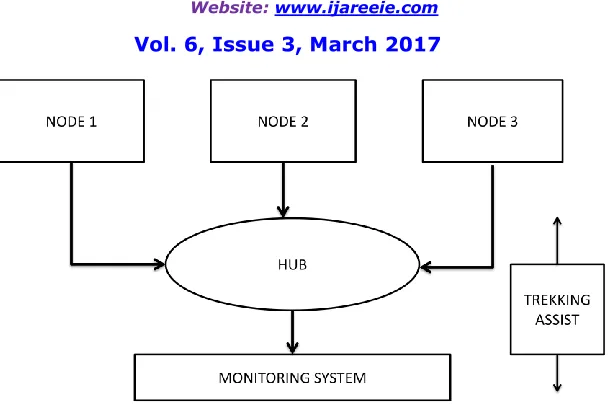
Based on the findings from traditional and existing method, here proposed a system architecture for the real monitoring of forest fire given below:
ISSN (Print) : 2320 – 3765 ISSN (Online): 2278 – 8875
I
nternational
J
ournal of
A
dvanced
R
esearch in
E
lectrical,
E
lectronics and
I
nstrumentation
E
ngineering
(An ISO 3297: 2007 Certified Organization) Website: www.ijareeie.com
Vol. 6, Issue 3, March 2017
Fig. 1: Proposed Architecture
The forest fire monitoring system designed in this paper can real-time monitor smoke concentration, temperature, humidity and other environmental parameter, and it can automatically send warning signals to control room and completes corresponding control. Data processing flow of the system is as follows: At first, sensor nodes widely distributed in forest can real-time collect signals such as wind speed, temperature, humidity, etc. Data collected by sensor nodes is sent to central node in multi-hop routing manner through large numbers of routing nodes placed in the forest, and then it is packaged by the central node to be sent to monitoring center.
III. BLOCK DIAGRAM
ISSN (Print) : 2320 – 3765 ISSN (Online): 2278 – 8875
I
nternational
J
ournal of
A
dvanced
R
esearch in
E
lectrical,
E
lectronics and
I
nstrumentation
E
ngineering
(An ISO 3297: 2007 Certified Organization) Website: www.ijareeie.com
Vol. 6, Issue 3, March 2017
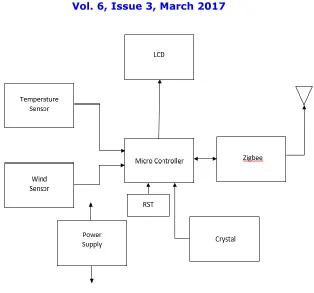
Fig. 2: Sensor Node (Cluster Head)
ISSN (Print) : 2320 – 3765 ISSN (Online): 2278 – 8875
I
nternational
J
ournal of
A
dvanced
R
esearch in
E
lectrical,
E
lectronics and
I
nstrumentation
E
ngineering
(An ISO 3297: 2007 Certified Organization) Website: www.ijareeie.com
Vol. 6, Issue 3, March 2017
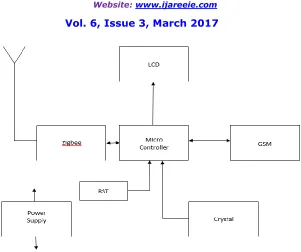
Fig. 3: Base Station (Transceiver)
IV. FUTURE SCOPES
Trespasser’s identification along with image processing .
Transmitting signals and image of the trekker
V. CONCLUSION
Wireless sensor network has great impact on industry and our daily life, and this paper designs a monitoring system for forest fires based on wireless sensor network and GPS network. Our system is able to fairly accurately distinguish different forest fire scenarios and accurately determine the direction of growth of fire. This system with the advantages of real-time, low power, high reliability, remote control and so on, has a broad application prospect in forest fire monitoring.
REFERENCES