
MESON2016 – Concluding Remarks
Avraham Gal1,
1Racah Institute of Physics, The Hebrew University, Jerusalem 91904, Israel
Abstract.Several topics presented and discussed at MESON2016 are highlighted, including pentaquarks, dibaryons and meson-nuclear bound states.
1 Introduction
The scope of topics presented and discussed in MESON2016 is too broad to be covered in one con-cluding talk. I therefore selected a few central topics discussed in MESON2016 where my personal involvement helped making some meaningful remarks. These topics are Pentaquarks, Dibaryons, and Meson-Nuclear Bound States. I apologize to the many speakers whose presentations were not mentioned in this concluding talk.
2 Exotics: remarks on Pentaquarks
Regardingpentaquarks, it is appropriate perhaps to note that theS=−1Λ(1405) resonance, defying a three-quark classification, was predicted in 1959 by Dalitz and Tuan as a ¯KNquasibound state [1] five yearsbeforethe term ‘quark’ was transformed by Gell-Mann from Fiction to Physics. A recent LQCD calculation confirms its ¯KN hadronic structure [2] as opposed to a tightly bound genuine pentaquark. Indeed, theΛ(1405) emerges naturally below theK−p threshold in chiral EFT hadronic approaches [3], although as shown in Cieplý’s talk [4] thesubthresholdKN¯ scattering amplitudes exhibit appreciable model dependence, with consequences forK−ppquasibound-state searches.
AS = +1Θ+(1530) pentaquark was claimed more than 10 years ago. Recent dedicated exper-imental searches have failed to confirm it, placing instead upper limits on its coupling to theKN channel [5]. It was argued that theΘ+ might be formed copiously in nuclei by absorption ontwo nucleons, e.g.K+d→Θ+p[6, 7] thereby resolving a long-standing puzzle, discussed in Friedman’s talk [8], regarding the size andAdependence ofK+nuclear cross sections at low energies.
The recent LHCb discovery of hidden-charm structures [9] has led to several serious attempts to interpret these in terms of pentaquark(s). As argued in Karliner’s talk the relatively small width of order 40 MeV forPc(4550) supports aΣcD¯∗hadronic molecule structure of two quark clusters, rather than a tightly bound pentaquark; see Fig. 1 on next page. ThisΣcD¯∗hadronic molecule is apparently the lightest of several other predicted doubly-heavy hadronic molecules [10]. It was emphasized that this calls for a new rich meson-meson, meson-baryon and baryon-baryon heavy-flavor QCD spec-troscopy. Other speakers too discussed various aspects of heavy-flavor Exotics, demonstrating that no clear consensus has yet been reached on this topic.
Figure 1.Left: two alternative visual descriptions of the LHCb hidden-charm pentaquarkPc(4550) as a tightly bound ¯ccuudpentaquark or as aΣcD¯∗hadronic molecule. Right:Pc(4550)→J/ψ+pdecay channel which for
a ¯ccuudpentaquark implies a considerably larger width than reported. Figure adapted from Karliner’s talk.
3 Exotics: remarks on Dibaryons
3.1 Nonstrange dibaryons
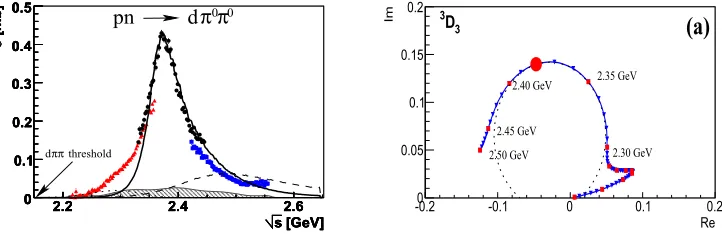
The only dibaryon for which good experimental evidence exists to date is the nonstrangeI = 0 JP =3+D
03(2380), peaking≈85 MeV below theΔΔthreshold. The WASA-at-COSY experiments
that established it, see Fig. 2, were ranked in Wilkin’s obituary of COSY at MESON2016 a top no. 2 in COSY’s impact list. The small width ofD03(2380),Γ≈70 MeV, less than even a singleΔwidth,
was shown (on p. 479 in Ref. [14]) to follow from phase-space and quantum-statistics arguments.
[GeV] s
2.2 2.4 2.6
[mb]
σ
0 0.1 0.2 0.3 0.4 0.5
[GeV] s
2.2 2.4 2.6
[mb]
σ
0 0.1 0.2 0.3 0.4 0.5
[GeV] s
2.2 2.4 2.6
[mb]
σ
0 0.1 0.2 0.3 0.4 0.5
[GeV] s
2.2 2.4 2.6
[mb]
σ
0 0.1 0.2 0.3 0.4 0.5
ππ
d threshold
pn dπ π0 0
Re
-0.2 -0.1 0 0.1 0.2
Im
0 0.05 0.1 0.15 0.2
3
D
3
2.50 GeV 2.45 GeV
2.40 GeV 2.35 GeV
2.30 GeV
(a)
Figure 2. Evidence for theD03(2380) dibaryon from WASA-at-COSY. Left: fromp+d→ dπ0π0+ps [11].
Right: from the Argand diagram of the3D
3 partial wave innpscattering [12], with full account of the recent
measurement of thenpanalyzing power [13].
The large binding energy ofD03(2380) with respect toΔΔ, exceeding by far the scale of nucleon
separation energies in nuclei, does not mean it is a deeply bound dibaryon if one recalls the existence of a lower two-body channel,πD12(2150), relative to whichD03(2380) resonates. Here,D12(2150)
stands for a near-thresholdNΔI =1 JP = 2+πNN quasibound state. BothD
with theirI ↔S twinsD21andD30, were proposed by Dyson and Xuong [15] based on symmetry
arguments, and have been considered subsequently in numerous quark-based works; and recently also in terms of ‘meson assisted dibaryons’ [14] in the hadronic basis [16, 17].
Figure 3.Left:D12(2150)NΔdibaryon signal in the Dalitz plot ofMd2π+vs. Md2π−from a preliminary report on
γd→dπ+π−measurements in the g13 experiment (CLAS Collaboration) at JLab [18]. Right: Thepn→dπ0π0
WASA-at-COSYMdπdistribution [11] and, in solid lines, as calculated [19] for two input parametrizations of D12(2150). The dot-dashed line gives theπD12(2150) contribution to the two-body decay ofD03(2380), and the
dashed line gives a scalar-isoscalarσ-meson emission contribution.
The relevance of theD12(2150) NΔdibaryon to the physics of theD03(2380)ΔΔ dibaryon is
demonstrated in Fig. 3 by showing, on the left panel, adπ±invariant-mass correlation near theNΔ threshold as deduced from preliminary CLAS data on theγd→dπ+π−reaction [18] and, on the right panel, adπinvariant-mass distribution peaking near theNΔthreshold as deduced from the WASA-at-COSY pn → dπ0π0 reaction by which theD
03(2380) was discovered [11]. These preliminary
CLAS data forγd → dπ+π−suggest a subthresholdD12(2150) dibaryon with mass 2115±10 MeV
and width 125±25 MeV [18], consistently with past deductions. The peaking of thedπinvariant-mass distribution in thepn→dπ0π0reaction essentially at thisD
12(2150) mass value suggests that the
two-body decay modes ofD03(2380) are almost saturated by theπD12(2150) decay mode, as reflected in
the calculation [19] depicted in the right panel.
The success ofhadronicmodel calculations [16, 17] to reproduce suchDIS dibaryon signals is consistent with the failure of recent quark-based calculations [20] to find tightly boundhexaquarks by using realistic color-spin hyperfine and color confinement quark-quark interactions. An hexaquark with quantum numbers identical to those ofD03 lies at least 150 MeV above theΔΔthreshold, and
this gap gets larger for other hexaquark candidates; a similar conclusion also holds for Jaffe’sS=−2 I(JP) = 0(0+) H hexaquark [21]. This means that the proper degrees of freedom in the case of nonstrange dibaryons are nucleons, pions andΔbaryons, and that physical thresholds and p-wave pions must be realistically incorporated in future considerations of such dibaryons.
3.2 Strange dibaryons
Following recent searches for a ¯KNN I(JP)=1
2(0−) quasibound state (loosely termedK−pp) in Frascati
from J-PARC Experiments E27 [27, 28] and E15 [29, 30], with binding energies given by
deep : BK−pp(E27)≈95 MeV, shallow : BK−pp(E15)≈15 MeV, (1)
relative to the K−pp threshold at 2370 MeV. To understand the possible origin of such radically different S = −1 dibaryon candidates, it is instructive to look at the E27d(π+,K+)X small-angle missing-mass spectrum, Fig. 4(left), which indicates≈22 MeV attractive shift of theY∗(1385+1405) unresolved quasi-free peak, consistently with the attraction calculated in theI(JP)=1
2(0−)Λ(1405)N
s-wave channel that overlaps substantially with K−pp[31]. Chirally motivatedK−ppcalculations also suggest binding of order 20 MeV, as reviewed in Ref. [32], in rough agreement with the E15
3He(K−,n)Xnear-threshold signal but not with the E27 deeply-bound signal shown in Fig. 4(right).
The relatively shallowK−ppbinding persists in three-body calculations upon including theπΛNand
πΣNlower-mass channels [33] which play only a secondary role in binding ¯Kmesons.
] 2 c [GeV/ d MM
2.1 2.2 2.3 2.4 2.5
)] 2 c b/sr/(MeV/ μ [ (Lab) o -16 o 2 dM / Ω d / 2 σ d 0 1 2 3 4 5 6 data simulation
Λ
Σ
Y*
(a)
] 2 c [GeV/ d MM2 2.1 2.2 2.3 2.4 2.5 2.6
)] 2 c b/sr/(15MeV/ μ [ (Lab) o -14 o2 dM / Ω d / 2 σ d 0 0.05 0.1 0.15 0.2 0.25 0.3 0.35 0.4
Figure 4.J-PARC E27d(π+,K+)Xmissing-mass spectra atpπ+ =1.69 GeV/c. Left: small-angleK+inclusive quasi-free spectrum [27]. Right:Σ0pdecay branch of appcoincidence spectrum [28].
TheπΛN–πΣN system, however, may benefit from sizable meson-baryon p-wave interactions, in terms ofΔ(1232) → πN andΣ(1385) → πΛ–πΣstrong-decay form factors, by aligning isospin and angular momentum to totalI(JP)=3
2(2+). Such a pion assisted dibaryon was studied in Ref. [34]
by solvingπY N coupled-channel Faddeev equations, thereby predicting a new S = −1 dibaryon resonanceY3
22+ slightly below the πΣN threshold ( √
sth ≈ 2270 MeV). Adding a ¯KNN channel
hardly matters, since its leading3S1NNcomponent is Pauli forbidden. The E27 deeply bound broad
signal at √s∼2275 MeV shown in Fig. 4(right) may then correspond to the production of suchY+3 22+ inπ++d → Y++K+, followed by its decay toΣ0+p[35]. We note that theS=−1Y3
22+(2275) dibaryon may have good overlap with5S
2,I = 32 Σ(1385)NandΔ(1232)Y dibaryon configurations,
the lowest threshold of which, that ofΣ(1385)N, is only∼50 MeV above theπΣNthreshold.
Other possible search reactions that are isospin selective as far as the finalY → ΣN decay is concerned are
π±+d→ Y++/−+K0/+, p+p→ Y+++K0, (2)
in which the produced dibaryonYdecays to aΣN final charge state which is uniquelyI = 3 2, viz.
Y++/− → Σ±+p(n). The ppreaction has been reported by the HADES Collaboration at GSI [36],
3.3 Charmed dibaryons
Charmed,C= +1 dibaryons have also been predicted: (i) aI(JP)=1
2(0−) dynamically generatedDNN
quasibound state at 3.5 GeV [37] reminiscent of theS = −1 K−pp; and (ii) a I(JP)=3
2(2+)πΛcN
quasibound state below 3.4 GeV [38], analogous to theS = −1 pion assisted dibaryonY3 22+. The prediction of this charmed pion assisted dibaryonC3
22+(3370) is robust, since it depends little on the unknown3S
1 ΛcN interaction. TheC3
22+(3370) is likely to be thelowest lying charmed dibaryon. It could be searched with proton beams at GSI, and with pion beams in the high-momentum hadron beam line extension approved at J-PARC, viz.
(p+p) or (π++d) → C++++D−, C+++→Σ++c (2455)+p. (3)
4 Meson-nuclear bound states
No meson-nuclear bound states have been firmly established so far. ForK− mesons, extrapolating from kaonic atoms [39] it is widely accepted that broad quasibound states exist [40]. K+ mesons, in contrast, experience repulson in dense (nuclear) matter. This is naively explained by a mean-field treatment ofK− ≡ s¯uandK+ ≡ su¯ mesons, arguing that a nonstrange antiquark/quark induces attraction/repulsion in dense matter. In the charmed sector, one would then expectattraction for D+ ≡ cd¯and repulsion for D− ≡ cd¯ mesons. This is not borne out in a recent QCD sum-rule calculation, showing in Fig. 5(left) arepulsivemass shift in dense matter, as a function of the assumed value of theπNσterm, forboth D±mesons [41]. Fig. 5(right) shows that an attractiveD+mass shift is possible in principle, but only for unrealistically high values of the heavy-quark massmh. This result has also been explained in Ref. [42] using a constituent quark picture.
0 10 20 30 40 50 60 70 80 90 100 110 120
30 40 50 60 70 80 90
Mass shift [MeV]
σπN [MeV]
D+ (at ρ0)
D− (at ρ0)
-10 0 10 20 30 40 50 60 70 80 90
2 2.5 3 3.5 4 4.5 5 (a)
Mass shift [MeV]
Heavy quark mass mh [GeV]
D+ (at ρ0)
D− (at ρ0)
Figure 5.Dmeson mass shift in nuclear matter [41] vs.σπN(left) and vs. the heavy quark mass mh(right).
threshold, where COSY-11 data on near-threshold meson production inppcollisions indicate a rather strongηpattraction that is likely to supportη-mesic nuclear states and a much weakerη pinteraction [45], for the real part of which only a limit consistent with zero can be placed [46]. Citing from Wilkin’s talk: “I would not put any money on boundη in nuclei!". Within a QCD-inspiredη−η mixing model [47],η-nuclear attraction of roughly−40 MeV at saturation density as derived in the ELSA experiment [44] implies about−90 MeV forηattraction in nuclear matter, commensurate with the attraction expected in theηN interaction model GW considered below. For these and for other reasons specified below, the following discussion is limited toη-nuclear quasibound states.
(MeV)
1/2
s
1400 1450 1500 1550 1600
(fm)
N
η
Re F
-0.5 0.0 0.5 1.0
(MeV)
1/2
s
1400 1450 1500 1550 1600
(fm)
N
η
Im F
0.0 0.2 0.4 0.6 0.8
Figure 6.Real (left) and imaginary (right) parts of theηN s-wave cm scattering amplitudeFηN(
√
s), compiled in Ref. [48] from severalN∗(1535) resonance coupled-channel models, in decreasing order of ReaηN: GW [49],
CS [50], MBM [51] and IOV [52]. TheηNthreshold is marked by a thin vertical line.
The ηN near-threshold dynamics is governed by the N∗(1535) resonance, introducing thereby appreciable model dependence in coupled-channel calculations of the s-wave scattering amplitude FηN(√s), as seen in Fig. 6. Owing to the nearbyN∗(1535), both ReFηN and ImFηNdecrease in all models steadily below threshold, which is where bound states are calculated. This decrease persists also in in-medium extensionsFηN(
√
s, ρ) of the ηN scattering amplitude, suggesting thatη-nuclear states are narrow. I know of no similar mechanism that would suggest as narrowη-nuclear states.
0 0.2 0.4 0.6 0.8 1
ρ/ρ0
-70 -50 -30 -10
E - E
th
(MeV)
CS, Pauli+SE CS, Pauli GW, Pauli
0 10 20 30 40
A2/3 5
10 15 20 25 30
Bη
(MeV)
C Mg
Ca Zr
1s Pb
1p
1d 2s
Figure 7. Left: Subthreshold energies probed in the 1sη-40Ca bound state as a function of nuclear density,
The subthreshold energy √sand the nuclear densityρ, both serving in bound state calculations as arguments of the in-medium meson-nucleon scattering amplitudeFmN(√s, ρ), are tightly correlated as demonstrated in Fig. 7(left) within a particularη-nucleus calculation. This correlation imposes a self-consistent procedure in bound state calulations [48], as discussed here by Mareš.
A chart of η-nuclear bound states calculated self-consistently in the CS model is shown in Fig. 7(right). Since ImFηN(√s) is particularly small in model CS below threshold, see Fig. 6(right), the resultingη-nuclear widths are just a few MeV, and only somewhat larger in model GW. Bound states should definitely exist in12C and beyond, and beginning in6Li in model GW which according to Fig. 6(left) provides the strongestηNattraction among the four models exhibited, Few-body calcu-lations have also been reported recently using theηNinteraction models GW and CS. No bound state was found forηdand forη3He [55]. Calculations are underway forη4He.
5 Summary and outlook
Several topics discussed in MESON2016 were picked up selectively in these Concluding Remarks, the common grounds of which is the rich spectroscopic variety that remains largely to be uncovered in hadronic systems. The impression gained at this Conference is that no consensus has been reached on the hidden-charm structures observed recently for mesons and for baryons in the energy range 2–5 GeV. In the absence of compelling arguments, or calculations classifying these in terms of gen-uine tetraquarks and pentaquarks, the only logical conclusion is that of hadronic-molecule underlying structure. For dibaryons too, highlighting recent experimental results from COSY (nonstrange) and J-PARC (strange), the evidence points to hadronic structure. Finally, we focused attention to the pos-sible existence of observableη-nuclear quasibound states, which could be explored at GSI using (p,d) and in J-PARC using the (π+,p) reaction on nuclear targets.
I would like to thank the Organizers of MESON2016 for trusting me in this unthankful job.
References
[1] R. H. Dalitz, S. F. Tuan, Phys. Rev. Lett.2, 425 (1959)
[2] J. M. M. Hall, W. Kamleh, D. B. Leinweber, B. J. Menadue, B. J. Owen, A. W. Thomas, R. D. Young, Phys. Rev. Lett.114, 132002 (2015)
[3] T. Hyodo, Nucl. Phys. A914, 260 (2013)
[4] A. Cieplý, M. Mai, U.-G. Meißner, J. Smejkal, Nucl. Phys. A954, 17 (2016) [5] M. Moritsu et al. (J-PARC E19 Collaboration), Phys. Rev. C90, 035205 (2014) [6] A. Gal, E. Friedman, Phys. Rev. Lett.94, 072301 (2005)
[7] A. Gal, E. Friedman, Phys. Rev. C73, 015208 (2006) [8] E. Friedman, Nucl. Phys. A954, 114 (2016)
[9] R. Aaij et al. (LHCb Collaboration), Phys. Rev. Lett.115, 072001 (2015) [10] M. Karliner, J. L. Rosner, Phys. Rev. Lett.115, 122001 (2015)
[11] P. Adlarson et al. (WASA-at-COSY Collaboration), Phys. Rev. Lett.106, 242302 (2011) [12] P. Adlarson et al. (WASA-at-COSY Collaboration, SAID Data Analysis Center), Phys. Rev. C
90, 035204 (2014); see also R. L. Workman, W. J. Briscoe, I. I. Strakovsky, Phys. Rev. C93, 045201 (2016)
[13] P. Adlarson et al. (WASA-at-COSY Collaboration, SAID Data Analysis Center), Phys. Rev. Lett.
[14] A. Gal, Acta Phys. Pol. B47, 471 (2016)
[15] F. J. Dyson, N.-H. Xuong, Phys. Rev. Lett.13, 815 (1964) [16] A. Gal, H. Garcilazo, Phys. Rev. Lett.111, 172301 (2013) [17] A. Gal, H. Garcilazo, Nucl. Phys. A928, 73 (2014)
[18] R. Schumacher (JLab CLAS Collaboration), private communication (APS 04/2015 meeting) [19] M. N. Platonova, V. I. Kukulin, Nucl. Phys. A946, 117 (2016)
[20] W. Park, A. Park, S. H. Lee, Phys. Rev. D92, 014037 (2015) [21] W. Park, A. Park, S. H. Lee, Phys. Rev. D93, 074007 (2016)
[22] M. Agnello et al. (FINUDA Collaboration), Nucl. Phys. A914, 310 (2013)
[23] O. Vázquez Doce et al. (data from KLOE Collaboration), Phys. Lett. B758, 134 (2016) [24] A. O. Tokiyasu et al. (LEPS Collaboration), Phys. Lett. B728, 616 (2014)
[25] G. Agakishiev et al. (HADES Collaboration), Phys. Lett. B742, 242 (2015) [26] E. Epple, L. Fabbietti, Phys. Rev. C92, 044002 (2015)
[27] Y. Ichikawa et al. (J-PARC E27 Experiment), Prog. Theor. Exp. Phys.2014, 101D03 (2014) [28] Y. Ichikawa et al. (J-PARC E27 Experiment), Prog. Theor. Exp. Phys.2015, 021D01 (2015) [29] T. Hashimoto et al. (J-PARC E15 Experiment), Prog. Theor. Exp. Phys.2015, 061D01 (2015) [30] Y. Sada et al. (J-PARC E15 Experiment), Prog. Theor. Exp. Phys.2016, 051D01 (2016) [31] T. Uchino, T. Hyodo, M. Oka, Nucl. Phys. A868-869, 53 (2011)
[32] A. Gal, Nucl. Phys. A914, 270 (2013)
[33] J. Révai, N. V. Shevchenko, Phys. Rev. C90, 034004 (2014) [34] H. Garcilazo, A. Gal, Nucl. Phys. A897, 167 (2013) [35] T. Nagae, Nucl. Phys. A954, 94 (2016)
[36] J. C. Berger-Chen, L. Fabbietti, doi:10.3204/DESY-PROC-2014-04/101 (arXiv:1410.8004) [37] M. Bayar, C. W. Xiao, T. Hyodo, A. Doté, M. Oka, E. Oset, Phys. Rev. C86, 044004 (2012) [38] A. Gal, H. Garcilazo, A. Valcarce, T. Fernández-Caramés, Phys. Rev. D90, 014019 (2014) [39] E. Friedman, A. Gal, Nucl. Phys. A881, 150 (2012), ibid.899, 60 (2013)
[40] D. Gazda, J. Mareš, Nucl. Phys. A881, 159 (2012)
[41] K. Suzuki, P. Gubler, M. Oka, Phys. Rev. C93, 045209 (2016)
[42] A. Park, P. Gubler, M. Harada, S. H. Lee, C. Nonaka, W. Park, Phys. Rev. D93, 054035 (2016) [43] S. Friedrich et al. (CBELSA/TAPS Collaboration), Eur. Phys. J. A52, 297 (2016)
[44] M. Nanova et al. (CBELSA/TAPS Collaboration), Phys. Rev. C94, 025205 (2016) [45] P. Moskal et al., Phys. Lett. B482, 356 (2000), Phys. Rev. C69, 025203 (2004) [46] E. Czerwi´nski et al., Phys. Rev. Lett.113, 062004 (2014)
[47] S. D. Bass, A. W. Thomas, Phys. Lett. B634, 368 (2006), Acta Phys. Pol. B45, 627 (2014) [48] A. Gal, E. Friedman, N. Barnea, A. Cieplý, J. Mareš, D. Gazda, Acta Phys. Pol. B45, 673 (2014) [49] A. M. Green, S. Wycech, Phys. Rev. C71, 014001 (2005)
[50] A. Cieplý, J. Smejkal, Nucl. Phys. A919, 46 (2013)
[51] M. Mai, P. C. Bruns, U.-G. Meißner, Phys. Rev. D86, 094033 (2013) [52] T. Inoue, E. Oset, M. J. Vicente Vacas, Phys. Rev. C65, 035204 (2002) [53] E. Friedman, A. Gal, J. Mareš, Phys. Lett. B725, 334 (2013)
![Figure 3. M12γmeasurements in the g13 experiment (CLAS Collaboration) at JLab [18]. Right: TheWASA-at-COSYπΔ00d → dπ+ Left: M−(2150) dibaryon signal in the Dalitz plot of vs](https://thumb-us.123doks.com/thumbv2/123dok_us/8152030.1359507/3.482.56.435.137.280/figure-gmeasurements-experiment-collaboration-thewasa-cosypd-dibaryon-dalitz.webp)
![Figure 5. D meson mass shift in nuclear matter [41] vs. σ (left) and vs. the heavy quark mass mπNh (right).](https://thumb-us.123doks.com/thumbv2/123dok_us/8152030.1359507/5.482.47.427.383.509/figure-meson-shift-nuclear-matter-quark-mpnh-right.webp)
![Figure 7.-nuclear spectra [54] calculated self-consistently using the in-medium CS model NLO30sηRight: η Left: Subthreshold energies probed in the 1 η scattering amplitudes in models GW and CS used in Ref](https://thumb-us.123doks.com/thumbv2/123dok_us/8152030.1359507/6.482.72.411.471.597/figure-calculated-consistently-shright-subthreshold-energies-scattering-amplitudes.webp)
