An Enhanced Energy Efficient Context-Aware
Medium Access Control Protocol for
Wireless Body Area Networks
Aparna A R
M.Tech Scholar, Dept. of ECE., Sree Narayana Gurukulam College of Engineering, Kadayirippu, Kerala, India
ABSTRACT: Rapid growth in biomedical sensors, low power circuits and wireless communications has enabled a new generation of Wireless Sensor Networks, the Body Area Networks (BANs) to serve a variety of applications, mainly dedicated for health care monitoring applications by providing freedom of movement for patients. The existing design challenges in wireless BAN includes energy efficiency, since it is inconvenient to recharge/replace batteries; heterogeneous and dynamic traffic, which may lead to intolerant latency; fading and packet loss due to body movements and environment. MAC protocols ensure proper channel access control for reliable link level communication and are responsible for coordinating the access from active nodes. An Energy Efficient MAC protocol design is crucially needed to ensure reliable transmission. Recent developments include hybrid MAC protocols, which give consideration to WBAN contexts traffic nature and channel status. A Context Aware MAC (CAMAC) protocol can overcome challenges in WBAN. Our objective is to develop an Enhanced Congestion Aware MAC protocol that takes into consideration the energy that is remaining in the nodes. The existing works make use of OMNET++, TinyOS and NS2 software for analysis. Simulation studies are done using ns2 installed on Fedora. The effectiveness of this suggested MAC is studied by comparing with the existing 802.11 MAC. The new protocol outperforms traditional MAC and strike a desired trade-off between efficiency and reliability. The performance metrics used for analysis are Packet Delivery Ratio, Throughput, Overhead, Jitter, Delay and Average Energy Consumption.
KEYWORDS: Wireless Sensor Networks, Wireless Body Area Networks, Medium Access Control
I. INTRODUCTION
Wireless networking is an exciting area and it has completely invaded our homes and environment during the last decade due to cheap equipment and easily implementable standards. Sensor networks with small energy-efficient nodes have become reality and a whole new world of applications has emerged. Wireless Sensor Networks that operates close to the human body can be called as Wireless Body Area Networks (WBAN). Wireless body area networks (WBAN) was first presented by T. G. Zimmerman in an article from 1996 [2] but he gave these body networks the name wireless personal are network (WPAN) from the beginning. Later on PAN was redefined and the name WBAN evolved instead. [3] This term was first coined by Van Dam et al. in 2001 [4] and received the interest of several researchers.
A Wireless Body Area Network consists of small, intelligent devices attached on or implanted in the body which are capable of establishing a wireless communication link. These devices (nodes) provide continuous health monitoring and real-time feedback to the user or medical personnel. Furthermore, the measurements can be recorded over a longer period of time, improving quality of the measured data. It is clear from figure 1.1, that WBAN is basically a short range wireless network for an individual. It consists of wearable or implanted electronic devices that transmit ID or sensor data to a gateway device. This gateway is then connected to an external Access Point which is not more than several meters distance.[11], [23]. These sensor nodes can have different topologies (eg: star, tree, mesh). Actually the most common one used is the star topology. Here the nodes are connected to a central gateway or coordinator in a star manner.
to the shared wireless medium. The MAC is the core of communication protocol stack which provides the basis for achieving Quality of Service (QoS) in any wireless networks. A versatile MAC should support diverse applications and different types of data such as continuous, periodic, burst and non-periodic data along with high level QoS. MAC plays a major determining factor in improving overall network performance. Channel access control mechanisms provided by MAC sub-layer can be called as MAC protocol.
Need for a MAC protocol: [31]
Wireless channel is a shared medium and BW is a scarce resource
To avoid packet collisions
To maximize probability of successful packet transmissions
To avoid problems due to hidden and exposed nodes
To maintain fairness among all users
Mac protocol design has been an active area of research
Figure 1.1: WBAN [28]
An important requirement in WBANs is the energy efficiency of the system. A MAC layer is the most suitable level to address the energy efficiency. In WBAN, different data sources generate time-varying traffic. Large traffic volume may result in intolerant latency and thus it is extremely important that the most significant data can always be delivered in a real-time fashion. Besides, data transmission may suffer from deep fading and packets loss due to the dynamic on-body channel induced by movements and surrounding environment.
this work. Also, a brief survey of Energy-Efficient MAC protocols is presented. The design and analysis of this Enhanced MAC Protocol completed in ns-2 (network simulator version 2).
The IEEE 802.11 standard is the most widely deployed Wireless Local Area Network (WLAN) standard today. IEEE 802.11 is a set of media access control and physical layer specifications for implementing WLAN computer communication in the 2.4, 3.6, 5 and 60 GHz frequency bands. They are created and maintained by the IEEE LAN/MAN Standards Committee (IEEE 802). The base version of the standard was released in 1997 and has had subsequent amendments. The standard and amendments provide the basis for wireless network products using the Wi-Fi brand. Its MAC layer includes a set of protocols which are responsible for maintaining order in the use of a shared medium. Wireless channel is defined, with AODV routing protocol. For MAC protocol we use Mac/802_11.
II. RELATED WORK
Studies about IEEE 802.15.4 MAC protocol and its effectiveness in WBANs can be seen in [1], [3], [4]. More facts about IEEE 802.15.4 can be obtained from [16], [17], [18]. The low power performance of three modes of the IEEE 802.15.4 standard were evaluated, in relation to a body area network of implanted medical sensors by Timmons et.al in [17]. The modes evaluated were beacon, beacon plus guaranteed timeslots and non-beacon, all at 2.4 GHz. Analysis of performance of IEEE 802.15.6 carried out by several researchers, as IEEE 802.15.6 is very important and inevitable standard for WBANs. Details are available in [6], [7], [8], [9], [10]. The throughput and delay analysis of IEEE 802.15.6 based CSMA/CA protocol carried out by S. Ullah et.al in [12]. From [2], the packets received remain the same for IEEE 802.15.6, regardless of the state of GTS but a significant improvement is seen when GTS is turned on while implementing IEEE 802.15.4 and shows that IEEE 802.15.4 is better than IEEE 802.15.6.
III.PROPOSEDENHANCEDIEEE802.15.4MAC
The IEEE 802.15.4 MAC is implemented here by incorporating congestion awareness and some extra features. The IEEE 802.15.4 standard can be also called as Low Rate Wireless Personal Area Networks (LR-WPAN). This standard defines the physical and MAC layers of the LR-WPANs. It is easy to install and provides reliable data transfer. As it is using unlicensed ISM, these are said to be extremely low cost, flexible and extendable networks. The LR-WPAN is used for short range of operations while maintaining integrated intelligence for network setup as well as routing. IEEE 802.15.4 maintains a simple and flexible protocol stack which helps LR-WPAN in achieving a reasonable battery life. Our discussion is giving emphasis to the MAC sub-layer.
802.15.4 can support star topology, peer-to-peer topology. Commonly used topology for WBANs is star topology. Advantage is that an external coordinator can be used with access to rechargeable power supply. [26]. The enhanced MAC protocol is context aware. Context is based on channel condition and congestion. We are implementing future work described in [1], that is the remaining energy of the nodes are calculated, and if it is less than the threshold, route will be changed, which will enhance the paper results.
Algorithm:
Check the remaining energy of the node
If energy is less than threshold, then change the path
If energy is greater than threshold, continue with same path
If high packet loss happens to occur due to congestion and high interference, then reduce the congestion parameters including the packet size and number of packets sent per second.
No congestion detected, then continue with same parameters
NS-2 is primarily Unix based, is used for analysis. It uses TCL as its scripting language. Overall, NS-2 is a standard experiment environment in research community. The visualisation tool is termed NAM (Network Animator).
IV.RESULTSANDDISCUSSIONS
Packet Delivery Ratio
Figure 4.1: Packet Delivery Ratio
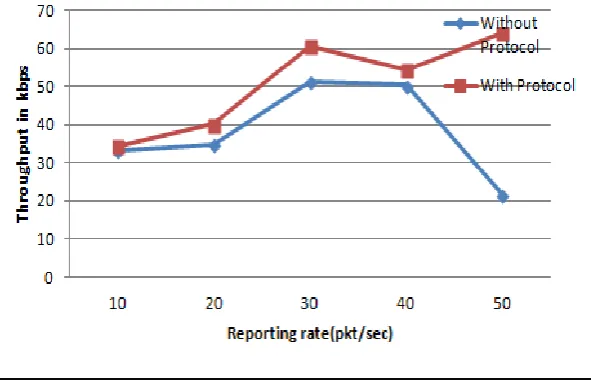
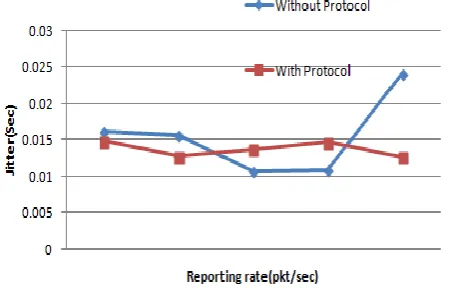
In all comparison graphs, „with protocol‟ refers to the proposed protocol performance and „without protocol‟ is the 802.11 MAC. Thus the Packet Delivery Ratio is analysed for both 802.11 MAC and the proposed MAC. The proposed Enhanced Context-Aware MAC outperforms traditional 802.11 MAC in terms of the Packet Delivery Ratio. The succeeding figures show comparison of both in terms of throughput, control overhead, normalized routing overhead, jitter and average energy consumption respectively.
Throughput
Control Overhead
Figure 4.3: Control Overhead
Normalized Routing Overhead
Figure 4.4: Normalized Routing Overhead
Jitter
Average Energy Consumption
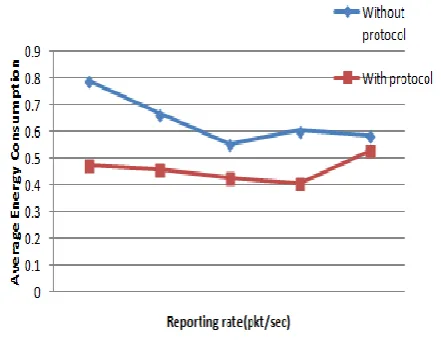
Figure 4.6: Average Energy Consumption
From the above comparison graphs, figure 4.1 to 4.6, it is evident that the enhanced MAC outperforms traditional MAC protocol in terms of significant performance parameters. The greater the value of PDR means better performance. So the greater value of PDR for „with protocol‟ means its better. Similarly throughput is the most important parameter to analyze the performance of the network. It is evident that the throughput values of proposed protocol are greater than 802.11 MAC. Also control overhead, normalized routing overhead, jitter values, average energy consumption of both are compared.
V. CONCLUSION
Through this project work, a new variant of Context-Aware MAC protocol is proposed, which suits for WBANs. The proposed MAC is congestion-aware. If congestion and packet loss is detected, the packet size and report rate will get reduced to overcome the situation. The proposed enhanced version of MAC protocol tends to increase the throughput by efficient selection of route. The route will be replaced when the energy of participant nodes fall below certain threshold. This work also gives a brief discussion on Energy-Efficient MAC protocols for WBANs. The provision of calculation of remaining energy of nodes and the ability to perform accordingly makes it an enhancement over traditional MAC.
The MAC protocol is implemented using Network Simulator version 2 analysing tool. Comparison is done with IEEE 802.11 MAC protocol, by considering several significant performance parameters including the throughput. Also, the simulation is performed in five different instances by varying packet rates, separately for both protocols. The results show that the proposed work is having less overhead, jitter, and delay. Also, Enhanced Context Aware MAC outperforms IEEE 802.11 MAC, in terms of packet delivery ratio, throughput.
Suggestions for future work:
Implementation of Enhanced MAC protocol with error-correction mechanisms.
Next improvement can be possible by considering sink mobility and to ensure successful delivery of data.
The future work can include some more contextual parameters like inter WBAN interference rejection while receiving the data
REFERENCES
[1] Bin Liu and Zhisheng Yan, “MAC Protocol in Wireless Body Area Networks for E- Health: Challenges and a Context-Aware Design” IEEE Wireless Communications, August 2013, pages 64-72
[4] K. Van Dam, S. Pitchers, and M. Barnard, “Body area networks: Towards a wearable future,” in Proceedings of WWRF kick o_ meeting, Munich, Germany, 6-7 March 2001
[5] S. Ullah, Henry Higgins, Bart Braem, Benoit Latre, Chris Blondia, Ingrid Moerman, Shahnaz Saleem, Ziaur Rahman, Kyung Sup Kwak, “A
Comprehensive Survey of WirelessBody Area Networks: On PHY, MAC, and Network LayersSolutions,” J.Medical Systems, vol. 36, no. 3, pp.
1065–1094, 2012.
[6] A. Astrin et al., “TG6 draft,” IEEE P802.15-10-0245-06-0006, Oct. 2010
[7] Bin Zhen, Huan-Bang Li and Ryuji Kohno “Networking issues in medical implant communications,” International Journal of Multimedia and Ubiquitous Engineering. Vol. 4, No. 1, January, 2009.
[8] “IEEE standard for local and metropolitan area networks: Part 15.6: Wireless body area networks,” IEEE submission, Feb. 2012.
[9] B. Latr´e, B. Braem, I. Moerman, C. Blondia, and P. Demeester, “A survey on wireless body area networks,” Wireless Network, vol. 17, pp. 1– 18, Jan. 2011
[10] Samaneh Movassaghi, J Lipman, M Abolhasan, D Smith, A Jamalipour., “Wireless Body Area Networks: A Survey” IEEE Communications Surveys & Tutorials, Vol. 16, No. 3, Third Quarter 2014
[11] S. Drude, “Requirements and application scenarios for body area networks,” in Proc. Mobile Wireless Commun. Summit, 2007, 16th IST, Jul. 1–5, pp. 1–5.
[12]Wei Ye, John Heidemann, Deborah Estrin “An Energy-Efficient MAC Protocol for Wireless Sensor Networks,” 21st Conference of the IEEE
Computer and Communications Societies (INFOCOM), volume 3, Pages 1567-1576 June 2002
[13]T. Van Dam and K. Langendoen, “An adaptive energy-efficient MAC protocol for wireless sensor networks”, In ACM Conference on Embedded Networked Sensor Systems (Sensys), Los Angeles, USA, Page 171-180, November 2003.
[14]F. Timmons, W. Scanlon, “Analysis of the Performance of IEEE 802.15.4 for Medical Sensor Body Area Networking,” 1st Annual IEEE Communications Society Conference on Sensor and Ad Hoc Communications and Networks, Santa Clara, US, October 2004, 16-24
[15]A. El-Hoiydi, J.-D. Decotignie, C. Enz and E. Le Roux ,“ WiseMAC, An Ultra Low Power MAC Protocol for multihop Wireless Sensor Networks”. 4th
ACM Conference on Embedded Networked Sensor Systems (SenSys), 2006
[16]Okundu Omeni, A.C.W Wong, A.J Burdett, C. Toumazou,“Energy Efficient Medium Access Protocol for Wireless Medical Body Area Sensor Networks,” IEEE Transactions on Biomedical Circuits and Systems, volume 2, number 4, December 2008, Page 251–259.
[17]N. F. Timmons and W. G. Scanlon, “An Adaptive Energy Efficient MAC Protocol for the Medical Body Area Network,” Wireless VITAE 2009 [18]Fang, G. and Dutkiewicz, E., “BodyMAC: Energy efficient TDMA based MAC protocol for Wireless Body Area Networks”, ISCIT, 2009. [19]H. Li and J. Tan, “Heartbeat-Driven Medium-Access Control for Body Sensor Networks,” IEEE Transactions on Information Technology in Biomedicine, volume 14, number 1, January 2010.
[20]M. Ameen, J Liu, S Ullah, KS Kwak, “A Power Efficient MAC Protocol for Implant Device Communication in Wireless Body Area Networks,”
8th Annual IEEE Consumer Communications And Networking Conference-Smart Spaces and Personal Area Networks (CCNC), January 2011, Pages
1155–1160
[21]S. J. Marinkovi, E. M Popovici, C Spagnol, S Faul, W.P Marnane “Energy-Efficient Low Duty Cycle Body Area Networks,” IEEE Transactions on Information Technology in Biomedicine, volume 13, number 6, November 2009, Pages 915–925.
[22]T. O‟Donovan, John O‟ Donoghue, C Sreenan, D Sammon, P O‟ Reilly, Kieran A.O‟ Connor “A Context Aware Wireless Body Area Network (BAN),” 3rd International Conference in Pervasive Computing Technologies for Healthcare, April 2009
[23] R Bults, K Wac, A V Halteren, D. Konstantas, V Jones, Ing Widya., “Body Area Networks for Ambulant Patient Monitoring Over Next Generation Public Wireless Networks”. In:14th IST Mobile and Wireless Communications Summit, 2004
[24]W. Ye, F. Silva and J. Heidemann. “Ultra-Low Duty Cycle MAC with Scheduled Channel Polling,” 4th
ACM Conference on Embedded Networked Sensor Systems (SenSys), 2006
[25]L. van Hoesel and P. Havinga, “A Lightweight Medium Access Protocol (LMAC) for Wireless Sensor Networks: Reducing Preamble Transmissions and Transceiver State Switches,” 1st Int. Workshop Network Sensor Systems (INSS 2004),Tokyo, Japan, 2004.
[26] IEEE 802.15.4, Wireless Medium Access Control (MAC) and Physical Layer (PHY) Specifications for Low-Rate Wireless Personal Area Networks (LR-WPANs), IEEE, Sept. 2006
[27]P Honeine, F Mourad, M Kallas, H Snoussi, H Amoud, C Francis, “Wireless Sensor Networks in Bio-Medical: Body Area Networks,” 7th
International Workshop on Systems,Signal Processing and their Applications (WOSSPA) 2011.
[28] Google Images. https://www.google.co.in/imghp
[29] IEEE 802.15.6, Technical requirements document, 2008.
[30] A. Boulis and Y. Tselishchev, “Contention vs. Polling: A Study in Body Area Networks MAC Design,” Proc. 5th Int‟l. Conf. Body Area
Networks , Sept. 2010
[31] Drs. Baruch Awerbuch & Amitabh Mishra, “Medium Access Control (MAC) Protocols for Ad hoc Wireless Networks – I,” Department of Computer Science Johns Hopkins University, 2008
[32] S. Hayat, N. Javaid, Z. A. Khan, A. Shareef, A. Mahmood, S. H. Bouk “Energy Efficient MAC Protocols” http://arxiv.org/abs/1207.2567v1 ; 11
July 2012
[33] Anand Gopalan, S. and Park, J.T., “Energy-efficient MAC protocols for wireless body area networks: Survey”, ICUMT, 2010.
[34] Pei Huang, Li Xiao, Soroor Soltani, Matt W. Mutka, And Ning Xi,“The Evolution Of MAC Protocols In WirelessSensor Networks: A Survey,”
IEEE Communications Surveys & Tutorials, Vol. 15, No. 1, First Quarter 2013 101
[35] A. Rahim, N. Javaid, M. Aslam, Z. Rahman, U. Qasim, Z. A. Khan, “A Comprehensive Survey of MAC Protocols for Wireless Body Area Networks,” arXiv:1208.2351v1[cs. NI] 11 July 2012.
[36] M. M. Sandhu, N. Javaid, M. Akbar, F. Najeeb, U. Qasim, Z. A. Khan, “FEEL: Forwarding Data Energy Efficiently with Load Balancing in Wireless Body Area Networks,” 2014 IEEE 28th International Conference on Advanced Information Networking and Applications.
BIOGRAPHY
Aparna A.R received her B.Tech degree in Electronics and Communication Engineering from Government Engineering College, Idukki, Kerala (Mahatma Gandnhi University), in 2012. She is currently pursuing her M.Tech Degree in Communication Engineering from Sree Narayana Gurukulam College of Engineering, Kadayiruppu. Her research interest includes Wireless Sensor Networks, including Body Area Networks.