Motion Gesture Sensor System Based On
Security
C.P.Darani
[1]
, M.Joshi Diana Preethi
[2]
Teaching Faculty, Department of CSE/IT, University College of Engineering, Trichy, India1 PG Student, Department of CSE, University College of Engineering, Trichy, India 2
ABSTRACT: In recent trends, several human-machine interfaces (HMIs) that flawlessly combine multiple sensors such as a touch screen, a gyroscope, an accelerometer, a digital compass, a camera, and a proximity sensor. Motion gesture sensor (MGS) is an emerging research topic for use as intuitive and natural interfaces for portable handheld applications, which require these sensors to be small and inexpensive while consuming low power.Motion gesture is one of the applications of image processing techniques which is applied to motion detection and extract the knowledge. In this paper, we describe some real-world application like proximity-based contactless MGS. Now days, there is variety of different approaches and algorithms of motion sensory analysis and motion gesture system. This Paper proposes a proximity-based contactless MGS that embeds photodiodes and a motion detection algorithm into a single package. The MGS is composed into five different types, 1) touch-based 2) motion-based 3) controller-based 4) vision –based 5) proximity-based systems. The area and height of the proposed optical structure including photodiodes and an optical block are reduced by 96.2% and 71.7%, respectively, compared with the most recently developed MGS. In addition, specifically we propose sensor achieves a recognition rate of over 99.5% on average at various speeds of hand movements. Finally, the prototype system is implemented and tested for validation. In addition, specifically we propose that the trustworthiness of user and user satisfaction must be an important consideration.
KEYWORDS: Motion gesture Recognition; Contactless interface; Proximity; Motion Sensors; Visual sensing; Optical block methods
I. INTRODUCTION
In recent days, Mobile phones or sensible phones are speedily changing into the central pc and communication device in people‘s lives. Application deliverance channels like the Apple AppStore are reworking mobile phones into skilled, App Phones of downloading a myriad of applications in a second significantly, today‘s sensible phones are programmable and are available with a growing set of low-cost powerful embed sensors, like digital compass, GPS, microphone, accelerometer, gyroscope, and camera, that are sanction native the emergence of private, group, and community scale sensing applications. We have a tendency to believe that sensor equipped phones can revolutionize several sectors of our economy, together with business, healthcare, social networks, environmental observance, and transportation. Recent developments in smart phones and tablets have been applied towards various applications, including healthcare environmental and user status monitoring, and motion recognition. Motion-based systems support single-handed interaction by holding a device and moving it. Gyroscopes or accelerometers can be used to measure inertial movement at the expense of a heavy computational burden.
platform and acquired richer conditions, these advancements frequently have been paired with the introduction of new sensors. For example, accelerometers have become common after being initially introduced to enhance the user link between and utilize the camera. They are used to automatically determine the orientation in which the user is holding the phone and use that information to automatically re-orient the display between a landscape and portrait view or properly orient captured photos through screening on the mobile phone.
Mainly computers are restricted by their two dimension representation of scenes, a gesture detection scheme has to concern various cues to attain more correct results and more valuable information. While the possibilities incorporate whole -body tracking and other techniques that merge multiple cues, it is complicated than done to sense scenes using only two dimensional representation that do not include known gesture detection of eyeball they detect the motion which come from the human eye.
In order to deploy a motion sensor, there are many ways. They are Consider a scenario, i n a store where a light beam crossing the room near the door, and a photo sensor that resides on the next side of the room. Whenever a customer crosses the beam, the in-built photo sensor captures the amount of change of light and starts ringing the bell. Most of the grocery stores have door openers that operate automatically and use a very simple form of radar in order to detect the movements near the door. There is a box above the door which sends a burst of microwave radio energy and waits till the reflected energy to bounces back.
Personal Environmental Impact Report, PEIR is a participatory sensing application that uses location data sampled from everyday mobile phones to calculate personalized estimates of environmental impact and exposure.
Participatory sensing refers to the vision of distributed data collection and analysis at the personal, urban, and global scale, in which participants make key decisions about what, where, and when to sense [1]. The infrastructure formed by an installed base of well over two billion mobile phones, when combined with a cloud of supporting web services, make such adaptive, mobile, human-in-the-loop sensing systems possible. However, the existence of these capabilities does not make them immediately usable or scalable. To reveal relevant, previously unobservable implications of human activity requires the development of new types of integrative platforms.
Here, we present PEIR, the Personal Environmental Impact Report (Figure 1), an example of this new class of system: It uses mobile handsets to collect and automatically upload data to server-side models that generate web-based output for each participant.The main purpose of the system is Gesture recognition is the most emergent technology in which human‘s gestures are used to control the devices. Even though the hand gestures are used, in controlling the devices without any physical contact, t here may exits noise which degrades the performance of the recognition process. The extended analysis of literatures portraits tha t gesture recognition with eye ball movement minimizes the effect of noise intervention in the system. Thus, increasing the rat e of recognition thereby maximizing the overall system performance. Security threats can be prevented to some extend with this proposed eye ball movement gesture recognition. Mainly the system focuses on proposed eye ball movement based recognition system, the iris plays a vital role to control the devices. The log records here maintains the information about the various possible directions in which the iris can be rotated and relevant triggered actions to be performed to control the device. Motion detecti on algorithm is employed to carry out these measures.
II. RELATED WORK
A. Motion Gesture Sensor System
finger movement without touching any device or surface of an object. The results portraits that the middling completion moment through the touch less mouse is longer than a conventional mouse. The survey from the participants shows that the touch less mouse could be present a useful substitute in unusual situations in which a conventional mouse can‘t be utilized. [5]. Y.S. Kim and K.-H. Baek et al (2009) propounded the shows a power-efficient and a small-sized motion gesture sensor (MGS) based on an infrared (IR) proximity sensor which is active. While the conventional proximity-based MGSs require two and a photodiode, the proposed MGS considers the
elimination of one of the LEDs at the cost of an extra photodiode as a unique channel. [6]. J. Wang, S. Zhai, and J. Canny et al broached to perform active music performance can mean the composition and their interpretation of the composed music or improvisation.[7]. M. Mun, S. Reddy, K. Shilton et al suggested to PEIR, the individual Environmental Impact statement, could be a democratic sensing application that uses position information sampled from day by day mobile phones to calculate tailored estimates of ecological impact and exposure. [8].
III.PROPOSED WORK
.We provide more effective Gesture recognition that is the most emergent technology in which human‘s gestures are used to control the devices. Even though the hand gestures are used, in controlling the devices without any physical contact, there may exits noise which degrades the performance of the recognition process. The extended analysis of literatures portraits that gesture recognition with eye ball movement minimizes the effect of noise intervention in the system. Thus, increasing the rate of recognition thereby maximizing the overall system performance. Security threats can be prevented to some extend with this proposed eye ball movement gesture recognition.
In the existing hand gesture movement recognition system, camera with inbuilt gesture sensor senses the hand movement by matching the captured shadow of the motion with the items in the past log records maintained within the system. The log records store the possible hand movements based on the past experience and the correspondingly necessary actions to be carried
out.
For proposed eye ball movement based recognition system, the iris plays a vital role to control the devices. The log records here maintains the information about the various possible directions in which the iris can be rotated and relevant triggered actions to be performed to control the device. Motion detection algorithm is employed to carry out these measures
.
IV.PROPOSED SYSTEM ARCHITECHTURE
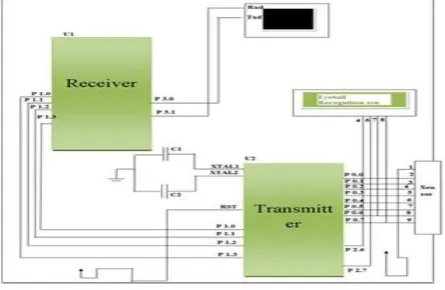
―Fig. 2,‖ shows that the simulation tool which includes sensor, microcontroller and GestIc. In addition, one end act as a receiver and another end act as a transmitter
The simulation tool which includes sensor, microcontroller and GestIc .
Simulation Tool:Proteus
Proteus is created as a multiplatform such as DOS, Windows, Unix to manipulate the text and binary files. The
language was focused on Windows, with specialized functions for: network and serial communication, interrogation with the database, system service creation, console applications, emulation. These additional functions are only
present in the Windows flavour of the interpreter, although a Linux version is available. Proteus was designed to
be simple to use, capable, absolute, consistent and readable. The special features are,
Powerful string management;
Clarity of Proteus scripts;
Advanceddata structures: arrays, queues, stacks, bit maps, sets, AVL trees are available. The languages can be
extended by adding the user functions written in Proteus.
Sensor:
A sensor device detects events or changes in quantities and hence provides a corresponding output that may be as an electrical or optical signal. The sensitivity of the sensor indicates how much the output of the sensor changes when the input quantity bei ng measured changes. If the mercury in a thermometer moves 1 cm when the temperature changes by 1 °C, the sensitivity will be
1 cm/°C. In most of the cases, a micro sensor reaches a significantly higher speed and sensitivity in comparison with the macroscopic approaches.
Proximity Sensor:
The proximity sensor is a sensor which is able to detect the presence of nearby objects without any physical contact. A proximity sensor is capable of emitting an electromagnetic field or a beam of electromagnetic radiation and looks for changes in their turn signal. The object which is sensed is referred to as the target of the proximity sensor. The maximum distance that this sensor can detect is defined "nominal range". Proximity sensors can be used smart phones to detect the taps in the touch screen. Microcontroller:
A microcontroller is a complete computer system that is manufactured on a single chip. The feature of a microcontroller
resembles that of a microprocessor as that of ALU, registers, program counter, stack pointer,flags, etc. In addition to these common features, a microcontroller adds some features which includes a clock circuit, internal RAM, ROM, serial and parallel I/O counter.
The usage of a microcontroller gives a great advantage that a program is stored in ROM that has a vital role in management of the system's operations and functions. Because the program written into ROM is fixed that is, it cannot be altered or changed; as a result the operation of the system remains constant (unchanged) in spite of the instructions given to it. Therefore, a microcontroller can be assumed of a device consists of on-chip program memory. It can be otherwise called as microcontroller
STEP 1
V.RESULTS
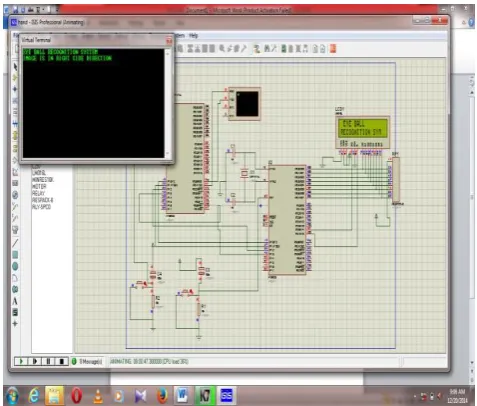
Simulating should be acting that the time given framework of the simulator produces the terminal window. The human type ‗A‘ in the
terminal window as shown in figure 4.1 it capture the hand gestures given by the user.
Figure 4.1 Gesture Recognition
STEP 2
STEP 3
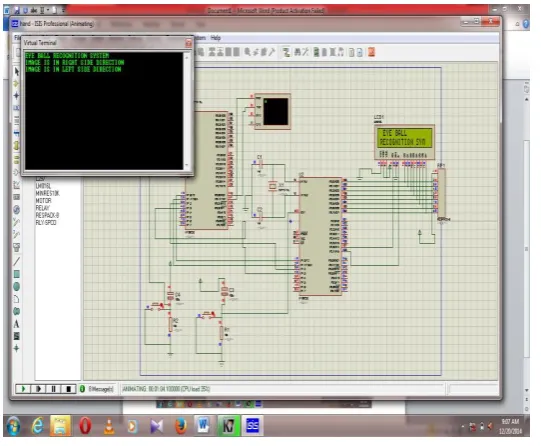
Figure 4.2 The image moving to right by eyeball detection
The human type ‗B‘ in the terminal window as shown in figure 4.3 Left the image is moving to ‗left‘ direction.
Figure 4.3 The image is moving to left by eyeball movement
STEP 4
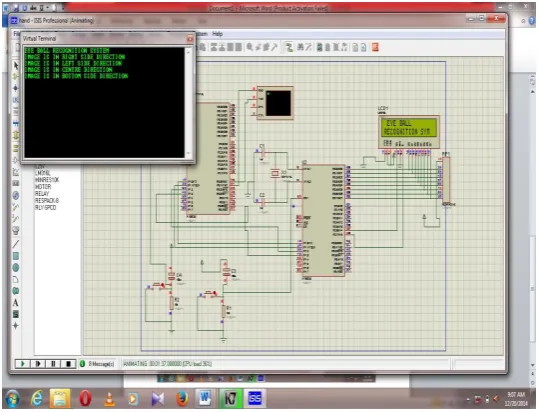
The human type ‗C‘ in the terminal window as shown in figure 4.4 the image is moving to ‗center‘ direction, and it displays
STEP 5
Figure 4.4 The image is moving to center direction by eyeball movement
The human type ‗D‘ in the terminal window as shown in figure 4.5 the image is moving to ‗bottom‘ direction, and it displays ‗image is in bottom direction‘
Figure 4.5The image is moving to bottom direction by eyeball movement
VI.CONCLUSION & FUTURE WORK
The proposed thesis deals with the simulation for various eyeball detection is successfully achieved and the recognition rate was achieved at 99.5%.The eyeball detection was recognized easily by using microcontroller and sensor devices. Thus the microcontroller size is very small; it is widely applicable to portable handheld devices. A single-package motion gesture sensor which includes two photodiodes. The IR LED along with the sensor can be embedded into a single package for handheld applications which can be portable. The rate of recognition is improved to eliminate the design constraints and also to reduce the device size.
In future the Authentication security threads can be avoided by authenticating the given human eyeball. The area and height of the optical structure will be reduced by modifying the optical structure of the package and adding additional channels.
REFERENCES
[1] J. Wang, S. Zhai, and J. Canny, ―Camera phone based motion sensing: interaction techniques, applications and performance study,‖ in Proc.
19th annual ACM symposium on User interface software and technology, pp.101–110, Oct. 2006.
[2] D. Um and W.N.P. Hung, ―Novel Infrared Proximity Array Sensor for 3D Visual Sensing: Modeling a nd Applications,‖ inProc. IEEE Conference on Robotics, Automation and sMechatronics, pp. 1–6, Jun. 2006.
[3] J.-H. Kim, N.D. Thang, and T.-S. Kim, ―3-D hand motion tracking and gesture recognition using a data glove,‖ in Proc. IEEE International Symposium on Industrial Electronics, pp. 1013–1018, Jul. 2009.
[4] M. Mun, S. Reddy, K. Shilton, N. Yau, J. Burke, D. Estrin, M. Hansen, E.Howard, R. West, and P. Boda, ―PEIR, the personal environmental impact report, as a platform for participatory sensing systems research,‖ in Proc.7th international conference on Mobile systems, applications, and services,pp. 55–68, Jun. 2009,
[5] D. Ryu, D. Um, P. Tanofsky, D.H. Koh, Y.S. Ryu, and S. Kang, ―T-less: A novel touchless human-machine interface based on infrared proximity sensing,‖ in Proc. IEEE/RSJ International Conference on Intelligent Robots and Systems, pp. 18–22. Oct.
2010.
[7] A. Tar and G. Cserey, ―Object outline and surface-trace detection using infrared proximity array,‖ IEEE Sensors Journal, vol.11, no. 10, pp. 2486–2493, Oct. 2011.
[8] P. Wojtczuk, A. Armitage, T.D. Binnie, and T. Chamberlain, ― PIR sensor array for hand motion recognition,‖ in Proc. 2ndInternational Conference on Sensor Device Technologies and Applications, pp. 99–102. Aug. 2011.
[9] I. Yang and O. Kwon, ―A touch controller using differential sensing method for on-cell capacitive touch screen panelsystems,‖ IEEE Trans. Consumer Electronics, vol. 57, no. 3, pp. 1027–1032, Aug. 2011.
[10] O.I. Franko and T.F. Tirrell, ―Smartphone App use Among medical providers in ACGME training programs,‖ Journal of medical systems, vol.36, no. 5, pp. 3135–3139, 2012.
[11] H. Lee and J. Park, ―Touch play pool: touch gesture interaction for mobile multifunction devices,‖ in Proc. IEEE International Conference on Consumer Electronics, pp. 291–292. Jan. 2012.
[12] R. Xu, S. Zhou, and W.J. Li, ―MEMS Accelerometer Based Nonspecific-User Hand Gesture Recognition,‖ IEEE Sensors Journal, vol. 12, no. 5, pp.1166–1173, May 2012.
[13] M.K. Dobrzynski, R. Pericet-Camara, and D. Floreano, ―Vision Tape—A Flexible Compound Vision Sensor for Motion Detection and Proximity Estimation,‖ IEEE Sensors Journal, vol. 12, no. 5, pp. 1131–1139, May 2012.
[14] N.D. Lane, E. Miluzzo, H. Lu, D. Peebles, T. Choudhury, and A.T.Campbell, ―A survey of mobile phone sensi ng,‖ IEEE Communications Magazine, vol. 48, no. 9, pp. 140–150, Sep. 2010.