Color Image Enhancement by Linear Transformations
Solving out of Gamut Problem
Ghanapriya Singh
Netaji Subhas Institute Of Technology University Of Delhi
New Delhi
Tarun Kumar Rawat,
PhD. Netaji Subhas Institute Of TechnologyUniversity Of Delhi New Delhi
ABSTRACT
In various other color image enhancement algorithms there was need to convert image from RGB color space to other color space which often resulted in values going out of gamut. The proposed method avoids the same without using any complex algorithm. It is a generalized setup in which grey scale techniques are applied to color images without changing hue of pixels. Results are analyzed both in subjective and objective sense and thus proving its efficiency.
Keywords
Image enhancement, gray scale to color image, hue, out of gamut problem.
1.
INTRODUCTION
The objective of image enhancement is that resultant image is more suitable than original image for specific application it could be for visual perception of human beings or easier analysis for a machine etc. Various techniques used for image enhancement is generally problem oriented. For grey scale images several algorithms are available which changes grey values of pixels depending on the criteria of enhancement. But if the same algorithm is tried to be applied on color images it changes the hue.For the purpose of color image enhancement, it is to be seen that hue should not change for any pixel. If hue is changed then the color gets cooled or warmed, and sometimes even alter the object appearance. One needs to improve the visual quality of an image without distorting its color.
The RGB color space is generally used for display but human visual perception are hue, saturation and intensity. Generally, for enhancement in color images, for keeping the hue unaltered the image is transformed from RGB space to other color spaces such as LHS, HSI, YIQ, HSV, etc [1]. For example, a common approach is to extract the luminance information from a YIQ color representation, enhance the luminance component alone, and combine the results with the unmodified chromatic information. Forward and backward transformations are used to switch between color coordinate systems. The out of gamut problem emerges when the color coordinate systems’ gamut is different [2].The backward transformation to RGB color space need not necessarily bring values within range. The term “color gamut” stands for the span of all possible colors of a given image or device. For an image, the color gamut is simply the set of all the colors found in it. For output devices, such as printers or screens, the color gamut is the set of colors the given device can render. One of the fundamental motivations for solving out of gamut problem is the need to preserve the edge between two out-of-gamut colors, which would otherwise map individually to the same in-gamut color.
2.
PREVIOUS WORK
A lot of emphasis has been laid on solving gamut problem in reproducing exact hue in printers, digital camera, mobile
display and other output devices[3,4,5,6] and various algorithms[3,4,5,6,7] have been proposed so that images in device are produced within gamut. These algorithms could be broadly classified into global gamut mapping and spatial gamut mapping based on color mapping depending on image to device gamut mapping or on the spatial neighborhood of a pixel [8]. But very limited algorithms have been proposed to tackle the gamut problem involved in image enhancement which usually involves changing the color image from RGB space to other mentioned spaces. A straightforward color space conversion causes color distortion due to gamut difference between the two color spaces. Gamut clipping [2, 13] and gamut compression [14] are two common approaches used with gamut mapping algorithms.
.Yoonsung bae et al. proposed two gamut adaptive correction schemes [12]. The commonly used solutions, including hard clipping or linear scaling, results in either detail loss or global contrast reduction [11]. Wenxian Yang et al [9] proposed optimization of energy-minimization for gamut fitting while Joachim Giesen et al used image dependent optimization [10]. Weeks et al [14] proposed a hue preserving color image enhancement technique which modifies the saturation and intensity components in color difference (C-Y) color space. When R, G, and B value exceeds the bounds, Weeks et al. suggested normalization of each component to bring it back within range. The normalization although preserves details but a darker image is obtained thus reduction in achieved intensity. For the processing of luminance and saturation components Yang et al [13] used two hue preserving techniques i.e scaling and shifting. They used Clipping technique for values falling outside RGB range. The disadvantage of clipping out of bounds RGB values is that it creates undue shift in hue and image details are lost.
The transformations to color space are, generally, computationally costly [13] and again the inverse coordinate transformation has to be implemented for displaying the images. The proposed method does not convert to any other color space thus eventually reducing calculations. Two operations, scaling and shifting, which were introduced in [13], [14] for luminance and saturation processing were proved to be hue preserving. The scaling and shifting is applied to RGB color space in [15].
3.
INTRODUCTION TO ALGORITHM
3.1
HUE PRESERVING
TRANSFORMATIONS:
SCALING & SHIFTING
Hue preservation is necessary for color image enhancement. Distortion may occur in image if hue is not preserved. The hue of a pixel in the image before the transformation and hue of the same pixel after the transformation are to be same for a hue preserving transformation.
Scaling and Shifting Operations
These operations are assumed to be hue preserving, and this section is dedicated to realizing why this is so:
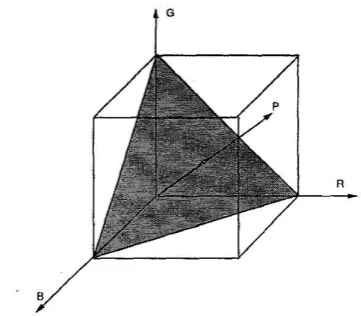
(a)The RGB cube with the Maxwell Triangle
[image:2.595.59.240.254.412.2](b) The Hue and Saturation
Figure 1: The Definition of Hue and Saturation
Let P be a generic color in the RGB cube as shown in 1(a). The dark triangle made with the face diagonals is known as the Maxwell's triangle. The frontal view of this triangle is drawn in 1(b). The point P' is the point where the OP intersects the Maxwell's plane. C is the projection of the
With reference to the figure 1(b), the hue and saturation can be defined as the angle between CPi and CR as the Hue of the color and the ratio of magnitude of CPi to CQ as saturation.
Now consider the two operations separately:
Scaling: If all the colors are scaled by the same value, then clearly, neither the saturation, nor the hue value of the color changes. Because the color vector OP only grows further away from the origin at exactly the same angle, it will keep intersecting the Maxwell plane at exactly the same point thus preserving hue.
Shifting: If the same value is added to all the three components, then the resultant vector will always lies in the same plane as OPi and OC. This is also easy to see if we agree to the fact that upon additions on two vectors, the resultant always lies on the plane made by the two vectors. Here, one of the two vectors is parallel to OPi and the vector being added is parallel to OC, since all its components have the same value. Hence, again the value of hue will not change after this operation.
So the general form of transforms that would take one image to another image while still preserving Hue will be of the form with α as scaling constant and β as shifting constant: Ŷ = α . y + β
Thus, Scaling and shifting are hue preserving operations. Let us denote the normalized values for R, G, and B components of a pixel of an image I by a vector ŷ, where ŷ=(y1,y2,y3),
y1,y2,y3 correspond to the normalized red, green and blue
pixel values respectively. That is 0 ≤ yk ≤ 1, k=1,2, 3. A
transformation which is a combination of scaling and shifting can be written as
ŷ’=(αy1+β, αy2+β,αy3+β) (1)
A general transformation in which ŷ’ is linear in yk for all k,
and α and β are dependent upon ŷ and vary with each but same k for all 1, 2, 3, is defined as
y’k = α(ŷ)yk + β(ŷ) (2)
3.2
LINEAR TRANSFORMATIONS
Linear transformations are common for grey scale image enhancement. If α(ŷ) and β(ŷ) are taken as constant functions in (2), it will reduce to a linear transformation as follows: y’k = αyk + β (3)
Where, yk is the grey value of the kth component of the pixel,
y’k is the modified grey value of the k th
component of the pixel. This linear transformation can be easily applied to RGB images directly with just keeping α and β constant range such that it does not go out of gamut.
3.3
NON-LINEAR TRANSFORMATIONS
The above listed transformations are one dimensional but a pixel in a color image has a color vector with three components R, G, and B. The procedure followed for generalizing grey scale contrast intensification to color images is discussed below. To simplify the mappings the shifting function β is put zero. After taking β(ŷ) to be zero in the eq(2), the transformation would become
y’k = α(ŷ) yk (5)
In the above equation, α is a function of ŷ i.e., it modifies the three components of the color vector by three different scales. This leads to changes in hue of the color vector, which is against our aim. A way of making this transformation hue preserving is to have the same scale for each of the three components of the vector.
In particular α, can be taken as a function of lk, where
lk=y1+y2+y3 as intensity is I = R + G + B. Thus lk is function
of k = 1,2,3. Then the transformation will be of the form y’k = α(lk) yk (6)
Initially, it was defined α(lk)= f(lk)/lk, where is a f(lk)
nonlinear transformation used in contrast enhancement for grey scale images for example Power Law Transformation. As is a ratio α(lk) value can be greater than 1. In such a case
y’k value of may exceed 1 and thus resulting in gamut
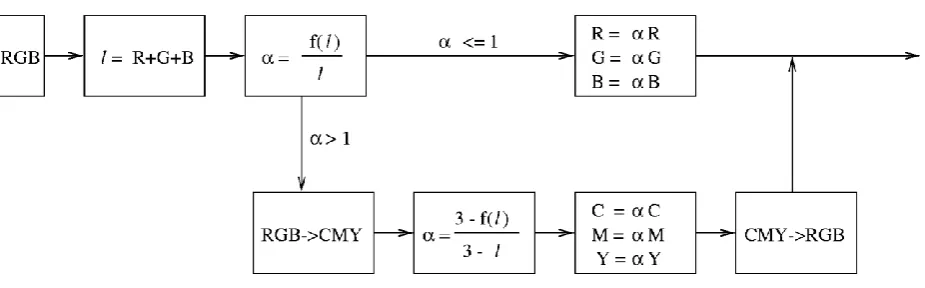
problem. A possible solution to this is to transform the color vector to CMY space and process it there. The CMY color space is subtractive model. Therefore, white is at (0.0, 0.0, 0.0) and black is at (1.0, 1.0, 1.0). The algorithm is as follows:
CASE 1 :
Which is simple scaling thus hue preserving, thus when α(lx) ≤ 1 , then x’k = α(x¯). xk
CASE 2 :
When α(lx) > 1 then following steps are followed:
1. Transform the RGB color vector to CMY color space
yk =1 – xk
2. Perform the transform in the CMY space. Find ly =
y1 + y2 +y3 = 3- f(lx ).
3. g(ly) = 3- f(lx ).
4. α(lx)= g(ly)/ ly.
5. y’k = α(ly ¯
). Yk
6. Revert back to the RGB space xk =1 – yk
3.4
Proving algorithm by various grey
scale techniques:
The above principle gives a generalized setup for using grey level techniques for color image transformation. To prove the generality of principle many gray scale enhancement techniques are used.
Power Law Transformation has f(lk) = c . r ^ γ with r being
lk as it is grey pixel on which transformation is applied on
grey image contrast enhancement and c and γ being constants which depend on image. Logarithmic Transformations has f(lk) = c * log (1 + r) with r being f(lk). Intensity adjusting
transformation linearly enhances intensity without changing hue. S Type Enhancement has
[image:3.595.62.525.468.612.2]
with x as f(lk) and other m and n as constants.
4.
RESULTS & ANALYSIS
(a)
(b)
(c) (d)
(e) (f)
(g)
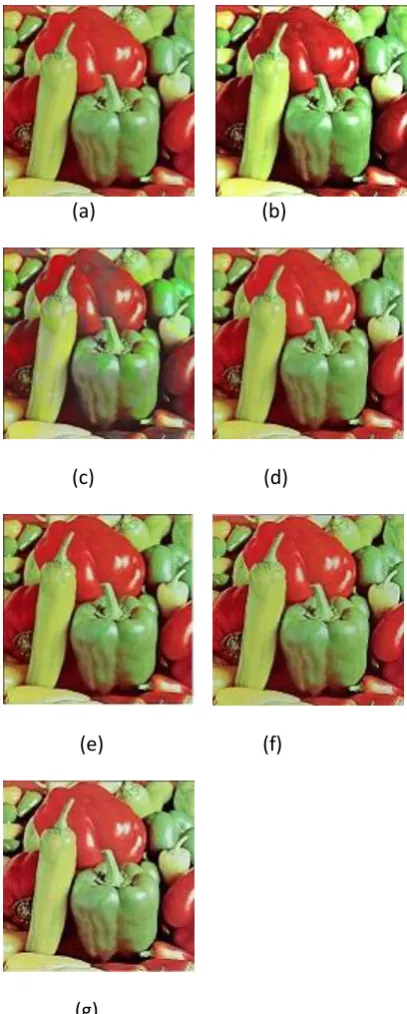
Figure 2 : (a) Original Pepper image (b) Yang Method (c) Weeks Method (d) Proposed Adjusting Intensity Method
(e)Proposed Power Law Method (f)Proposed Log Transform Method (g) Proposed S Type Method
Individual care should be taken for each image at the time of choosing the constants involved in the transformations while implementing different enhancement functions. Figure 2(b) is obtained by Yang Method and 2(c) is obtained my Weeks Method. The results of proposed method by various techniques are shown. Figure 2(d) is by adjusting intensity
constant γ is taken 0.99. Figure 2(f) is result obtained by Log Transform taking constant c = 1.25. Figure 2(g) is result obtained by S Type enhancement constant
=
0.25 and 2= 3.4.1 SUBJECTIVE ANALYSIS:
The Proposed method is compared to other methods which are avoiding out of gamut problem by either clipping or normalizing the values. The effect of clipping in Yang’s method is not very noticeable but still it darkens the image. The effect of normalizing is clearly seen in Weeks method which is not acceptable as it distorts the image.
The Proposed method is generalized method which is effectively shown by using four methods and is visual analysis clearly indicates its superiority over other methods. It gives enhanced images by correctly selecting the constants.
[image:4.595.54.258.101.609.2]4.2 OBJECTIVE ANALYSIS
:Table 1: Quality assessment of various methods of Pepper image
Methods PSNR MSE MSSIM
FSIM
FSIMc
Original infinite 0 1
1
1
Yang method
20.5098 578.22 0.8090 0.8638 0.8580
Weeks method
21.8300 426.65 0.8370 0.8810 0.8771
Proposed Adjusting Intensity
61.9720 0.0413 1 0.9536 0.9527
Proposed Power law
61.9700 0.0413 1 0.8923 0.8887
Proposed Log Transform
34.5769 22.6669 1 0.9278 0.9266
Proposed S Type
26.1278 158.59 0.9999 0.9211 0.9186
[image:4.595.308.550.342.692.2]fidelity of its representation. Because signals have a very wide dynamic range, PSNR is usually expressed in terms of the logarithmic decibel scale. PSNR and MSE though not ideal but are commonly used for quality analysis.
The structural similarity (SSIM) index is a method for measuring the similarity between two images.SSIM considers image degradation as perceived change in structural information and hence is taken as a factor for assessing quality of image [16]. In MSSIM the scale is between 0 to 1 in which 1 indicates perfect similarity. SSIM gives a much better indication of image quality. SSIM measures how "similar" various metrics of the images are, while PSNR is essentially a measurement of "error" between the two images. Higher PSNR is better. The feature-similarity index (FSIM) uses phase congruency and contrast including information of image gradient magnitude (GM) as primary features.
5.
CONCLUSION
The proposed method gives a generalized set up to use grey scale enhancement method for color image enhancement. The transformation is said to be general in the sense that the function ’ ’ can be any contrast enhancement function used for grey scale images and the resulting enhanced color image is gamut problem free irrespective of the nature of the function ’ ’. The proposed method is also computationally efficient as it requires simple calculations while Yang et al & Weeks methods require rigorous calculations. The proposed method is also hue preserving. The proposed method gives better result than clipping out of gamut values of Yang's method and normalization values of Weeks method both in subjective and quantitative analysis.
6.
REFERENCES
[1] R. Gonzalez and R. Woods, Digital Image Processing, 3rd ed. Prentice Hall, Jan. 2009.
[2] Christopher C. Yang and S. H. Kwok “Gamut Clipping in Color Image Processing” IEEE Conference 2000.
[3] Chang-Jing Yang et al. “Hybrid Gamut Mapping and Dithering Algorithm for Image Reproduction” 12th International Conference on ITS Telecommunications IEEE 2012.
[4] LI Xiao-zhou, DONG Cui-hua “Researches on Original Image Gamut in Digital Printing” 2012 9th International Conference on Fuzzy Systems and Knowledge Discovery (FSKD 2012) IEEE.
[5] CA. Poynton “ Wide Gamut Device-Independent Colour Image Interchange” International Broadcasting Convention, Conference Publication No. 397, IEE, 1994
[6] Chih-Chang Lai et al. “ Color Gamut and Contrast Enhancement for Mobile Phone Displays” 33rd
annual conference Nov. 2007.
[7] Yoshifumi Shimodaira et al. “New Imaging and Display System for Wide Gamut Color Reproduction” IEEE conference 2007.
[8] Peter Zolliker, et al “Retaining Local Image Information in Gamut Mapping Algorithms” IEEE TRANSACTIONS ON IMAGE PROCESSING, VOL. 16, NO. 3, MARCH 2007.
[9] Wenxian Yang et al “GAMUT FITTING FOR IMAGE COMPOSITION APPLICATIONS” IEEE conference 2009.
[10]Joachim Giesen et al. “Image-Dependent Gamut Mapping as Optimization Problem” IEEE TRANSACTIONS ON IMAGE PROCESSING, VOL. 16, NO. 10, OCTOBER 2007.
[11]Wenxian Yang, Jianfei Cai and Jianmin Zheng “SOLVING THE OUT-OF-GAMUT PROBLEM IN IMAGE COMPOSITION” IEEE 17th International Conference on Image Processing September, 2010.
[12]Yoonsung bae et al. “GAMUT-ADAPTIVE CORRECTION IN COLOR IMAGE PROCESSING” IEEE 17th International Conference on Image Processing September, 2010.
[13]C. C. Yang and J. J. Rodriguez, “Efficient luminance and saturation processing techniques for bypassing color coordinate transformations,” in Proc. IEEE Int. Conf. on Systems, Man, and Cybernetics, vol. 1, 1995, pp. 667– 672
[14]Weeks “Saturation clipping in the LHS and YIQ color spaces,” in Proc. IS&T/SPIE Int. Symp. Electronic Imaging: Science & Technology –Color Imaging: Device-Independent Color, Color Hard Copy, and Graphic Arts, San Jose, CA, 1996.
[15] S. Naik and C. Murthy, “Hue-preserving color image enhancement without gamut problem” IEEE Tran. On Image Processing, vol. 12, no. 12, pp. 1591–1598, Dec. 2003.
[16] Z. Wang, A. C. Bovik, H. R. Sheikh, and E. P. Simoncelli, "Image quality assessment: From error measurement to structural similarity" IEEE Transactions on Image Processing, vol. 13, no. 1, Jan. 2004.