Security Analysis of Reverse Encryption
Algorithm for Databases
Ayman Mousa
Department of Computer Science, Workers University,Egypt.
Osama
S.
Faragallah and
S.
EL-Rabaie
Department of Computer science and Engineering,Faculty of Electronic Engineering,Menoufia
University, Egypt.
E. M. Nigm
Department of Mathematics,Faculty of Science, Zagazig University, Egypt.
ABSTRACT
Encryption provides strong security for databases. To develop a database encryption strategy, many factors must be taken into consideration. Organizations must balance between the requirement for security and the desire for excellent performance. In this paper a novel encryption algorithm is proposed “Reverse Encryption Algorithm (REA)”. The proposed algorithm REA is simple and yet leads to a cipher. It has achieved security and is fast enough for most applications. REA algorithm is limiting the added time cost for encryption and decryption to not degrade the performance of a database system. Moreover, designing REA algorithm has enhanced security in data encryption. Besides, the secure and performance of the proposed encryption algorithm REA is evaluated and compare with the most common encryption algorithms. Experimental results show that the proposed encryption algorithm REA outperforms other encryption algorithms at performance and security in databases. Overall, the proposed encryption algorithm REA achieves balance between the security and the efficiency.
General Terms
Database, security, algorithms, encryption.
Keywords
Database security, cryptographic algorithms and database encryption.
1.
INTRODUCTION
Database encryption is a well established technology for protecting sensitive data. Unfortunately, the integration of existing encryption techniques with database systems causes undesirable performance degradation. It is a crucial technique in the security mechanisms of database. Database encryption solution is a specialized and complex and if internal resources don’t have the cryptography expertise with regard to database environment, outside expertise should be used to ensure superior performance and strong security [2].
A novel innovative encryption algorithm REA is proposed. It is efficient and secure. It has accomplished security and it is fast enough for most widely used software. The proposed algorithm REA limits the added time cost for encryption and decryption and at the same time does not degrade the performance of a database system. So, analyze security and performance factors that are used as the secure and efficient criteria. Such as the key space, the key sensitivity, the security of data against attacks, the computational speed, the information entropy, and the correlation coefficient.
This paper observes a method for evaluating the security and efficiency of the proposed encryption algorithm REA and compares with the most common encryption algorithms namely: DES, 3DES, RC2, AES and Blowfish. A comparison will be presented for those encryption algorithms for encryption and decryption times. Also, another comparison will be presented for the secure value (it is used to measure the information entropy). Furthermore, another measure of security is the correlation coefficient of encrypted fields with the proposed encryption algorithm REA.
The results of the experimental shows that the encryption and decryption time of the proposed encryption algorithm REA has a very good performance compared to other encryption algorithms. The security measure (information entropy) results indicate that the proposed encryption algorithm REA and AES are more secure than DES, 3DES, RC2, and Blowfish. Also, the correlation coefficient measure results depict that the proposed encryption algorithm REA provides more security.
The remainder of this paper is organized as follows. Section 2 discusses related work about the performance and security of the encryption algorithms. Section 3 describes the proposed encryption algorithm (REA). The performance and security factors are analyzed in section 4. Section 5 shows the experimental results for the secure and efficient evaluation of the proposed encryption algorithm REA and compares it with the most common encryption algorithms. Finally section 6 presents conclusion and future work.
2.
RELATED WORK
To give more prospective about the performance of the compared algorithms, this section discusses the results obtained from other resources. It was concluded in [7] that AES is faster and more efficient than other encryption algorithms. When the transmission of data is considered there is an insignificant difference in the performance of different symmetric key schemes (most of the resources are consumed for data transmission rather than computation). Even under the scenario of data transfer it would be advisable to use AES scheme in case the encrypted data is stored at the other end and decrypted multiple times.
of cryptographic schemes. It evaluates the most commonly used cryptographic algorithms. Also it is shown that Blowfish and AES have the best performance among others. And both of them are known to have better encryption (i.e. stronger against data attacks) than the other two.
A study in [15] is conducted for different popular secret key algorithms such as DES, 3DES, AES, and Blowfish. They were implemented, and their performance was compared by encrypting input files of varying contents and sizes. The algorithms were tested on two different hardware platforms, to compare their performance. They had conducted it on two different machines: PII 266 MHz and P4 2.4 GHz. The results showed that Blowfish had a very good performance compared to other algorithms. Also it showed that AES had a better performance than 3DES and DES. It also shows that 3DES has almost 1/3 throughput of DES, or in other words it needs 3 times than DES to process the same amount of data.
3.
PROPOSED ALGORITHM REA
A novel encryption algorithm REA is recommended, because of its simplicity, efficiency, and security. It can outperform competing algorithms. In this section provides a comprehensive yet concise algorithm. Also, gives a general analysis of the functioning of these structures.
The proposed algorithm REA is a symmetric stream cipher that can be effectively used for encryption and safeguarding of data. It takes a variable-length key, making it ideal for securing data. The REA algorithm encipherment and decipherment consists of the same operations, only the two operations are different: (1) added the keys to the text in the encipherment and removed the keys from the text in the decipherment. (2) Executed divide operation on the text by 4 in the encipherment and executed multiple operation on the text by 4 in the decipherment. Divide operation by 4 on the text to narrow the range domain of the ASCII code table at converting the text. The details and working of the proposed algorithm REA are given below.
Encryption Algorithm of the REA
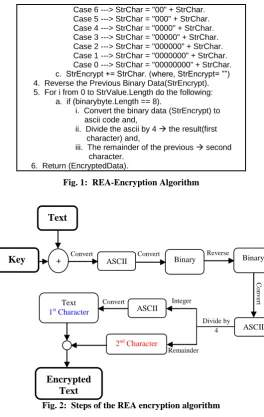
The steps of the encryption algorithm REA (Figure 1) are presented in the following steps (Figure 2):Step1: Input the text and the key. Step2: Add the key to the text.
Step3: Convert the previous text to ascii code. Step4: Convert the previous ascii code to binary data. Step5: Reverse the previous binary data.
Step6: Gather each 8 bits from the previous binary data and obtain the ascii code from it.
Step7: Divide the previous ascii code by 4. Step8: Obtain the ascii code of the previous result divide and put it as one character.
Step9: Obtain the remainder of the previous divide and put it as a second character.
Step10: Return encrypted text.
INPUT: Plaintext (StrValue), Key (StrKey).
OUTPUT: Ciphertext (EncryptedData).
1. Add the key to Text (StrKey + StrValue)---> full string (StrFullVlaue).
2. Convert the Previous Text(StrFullVlaue) to ascii code (hexdata).
3. Foreach (byte b in hexdata).
a. Convert the Previous ascii code (hexdata) to binary data (StrChar).
b. Switch (StrChar.Length).
Case 7 ---> StrChar = "0" + StrChar.
Case 6 ---> StrChar = "00" + StrChar. Case 5 ---> StrChar = "000" + StrChar. Case 4 ---> StrChar = "0000" + StrChar. Case 3 ---> StrChar = "00000" + StrChar. Case 2 ---> StrChar = "000000" + StrChar. Case 1 ---> StrChar = "0000000" + StrChar. Case 0 ---> StrChar = "00000000" + StrChar. c. StrEncrypt += StrChar. (where, StrEncrypt= ””) 4. Reverse the Previous Binary Data(StrEncrypt). 5. For i from 0 to StrValue.Length do the following: a. if (binarybyte.Length == 8).
i. Convert the binary data (StrEncrypt) to ascii code and,
ii. Divide the ascii by 4 the result(first character) and,
iii. The remainder of the previous second character.
[image:2.595.297.562.68.486.2]6. Return (EncryptedData).
Fig. 1: REA-Encryption Algorithm
Fig. 2: Steps of the REA encryption algorithm
3.2 Decryption Algorithm of the REA
The steps of the decryption algorithm REA (Figure 3) are presented in the following steps (Figure 4):Step1: Input the encrypted text and the key. Step2: Loop on the encrypted text to obtain ascii code of characters and add the next character. Step3: Multiply ascii code of the first character by 4. Step4: Add the next digit (remainder) to the result multiplying operation.
Step5: Convert the previous ascii code to binary data. Step6: Reverse the previous binary data.
Step7: Gather each 8 bits from the previous binary data and obtain the ascii code from it.
Step8: Convert the previous ascii code to text. Step9: Remove the key from the text. Step10: Return decrypted data.
INPUT: Ciphertext (EncryptedData), the Key (StrKey).
OUTPUT: Plaintext (DecryptedData),
1. For (i = 0; i < EncryptedData.Length; i += 2) a. Get the ascii code of the encrypted text b. newascii = (EncryptedData[i] * 4) + the next digit(remainder)[i+1].
2. Foreach (byte b in newascii).
a. Convert the Previous ascii code (newascii) to binary data (StrChar).
b. Switch (StrChar.Length).
Case 7 ---> StrChar = "0" + StrChar. Integer
Binary
C
onve
rt
Divide by 4 Text
1st Character
Encrypted Text
ASCII Binary
ASCII
Text
Key Convert Convert Reverse
ASCII
2nd Character
Case 6 ---> StrChar = "00" + StrChar. Case 5 ---> StrChar = "000" + StrChar. Case 4 ---> StrChar = "0000" + StrChar. Case 3 ---> StrChar = "00000" + StrChar. Case 2 ---> StrChar = "000000" + StrChar. Case 1 ---> StrChar = "0000000" + StrChar. Case 0 ---> StrChar = "00000000" + StrChar. c. StrDecrypt += StrChar.
3. Reverse the Previous Binary Data(StrDecrypt). 4. For i from 0 to StrDecrypt.Length do the following: a. if (binarybyte.Length == 8).
i. Convert the binary data (StrChar) to ascii code (hexdata) and,
ii. Convert the previous ascii code (hexdata) to the text (StrFullVlaue).
5. Remove the key from the text (StrFullVlaue - StrKey) (StrValue).
[image:3.595.50.281.72.240.2]6. Return (DecryptedData).
Fig. 3: REA-Decryption Algorithm
Fig. 4: Steps of the REA decryption algorithm
4.
SECURITY AND PERFORMANCE
FACTORS ANALYSIS
The following factors are used as the secure and efficient criteria [13] such as the key space, the key sensitivity, the security of data against attacks, the computational speed, the information entropy, and the correlation coefficient. Each of these factors is described in the following subsections.
Key Space Analysis
Key space is the total number of different keys that can be used in the cryptographic system. The security (strength) of the algorithm is a function of the length of the key. The longer the key, the more resistant the algorithm is to a successful brute-force attack. Key length is universally expressed as a number of bits[13]. A key length of N-bits has the key space 2N possibilities. From the cryptography point of view, the size of the key space should not be smaller than 2100 to provide a high level of security [20]. The secret key of the proposed encryption algorithm REA is 256-bits long, can be increased, the key space is about 2256 (1.16x1077) different combinations of the secret key. A long key space is sufficient for reliable practical usage.
Key Sensitivity Analysis
A good encryption should be sensitive to a small change in the secret keys [21]. The proposed encryption algorithm REA is sensitive to a tiny change in the secret keys. If change a little in the secret key then the decrypted data is not performing.
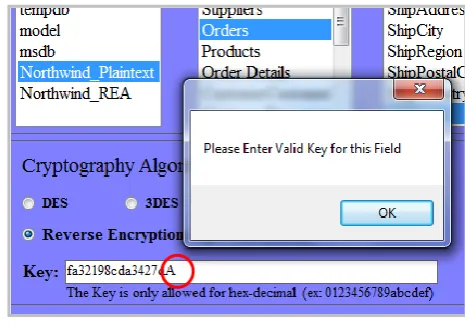
[image:3.595.26.301.274.464.2]For example, If the plaintext is encrypted using the proposed algorithm REA with the secret key "fa32198cda3427da" as shown in Figure 10. Then, it decrypted with the correct secret keys, the plaintext obtained after decryption as shown in Figure 11. It is noted that the decrypted is exactly the same of the plaintext. Hence, say that the proposed algorithm REA can successfully encrypt and decrypt without any loss of data. From experiments, the secret key "fa32198cda3427dA" changed one character from small to capital as shown in Figure 5. Hence, say that the proposed encryption algorithm REA is highly sensitive to a small change in the secret keys.
Fig. 5: Change one character in the secret key
Attack Analysis:
There are well known methods of attack, such as
brute-force
, which determines the number of
steps
and
time
required for a successful attack [4].
Attack Steps
Attack steps are defined as the number of steps required to perform the best known attack. The number of steps helps to determine the time that might be required for a successful attack using a particular processor, without having to actually run the attack on the algorithm. The proposed encryption algorithm REA using the key length 256-bits, can be increased, then the attack steps is about 2256 (1.16x1077).
Attack Time
Attack time is defined as the time required performing the fastest known attack on a specified processor. For example, the machine that operates at 2000 (Mtops) times 60 (seconds/minute) times 60 (minutes/hour) times 24 (hours/day) 365 (days/year) equals 6.3072x10¹⁶ operations/year. The attack time in years were derived by dividing the attack steps by the pilot Mtops per year (6.3072x10¹⁶ operations per year). Since proposed algorithm REA using 256-bits, then the attack time is about 1.839x1060 years.
Speed Analysis
It is an important tool to evaluate the efficiency of encryption algorithms is measuring the amount of time required to encrypt and decrypt process [9]. The encryption and
-
Get 1st Character
Reverse
Get 2st Character Next Digital
Multiple by
4
C
onve
rt
Decrypted Text Remove the key from the text
Binary
Encrypted Text
ASCII
Binary
Text
Key
Convert ASCII
ASCII +
[image:3.595.319.552.276.439.2]
n i i x n x 1 1 ) (
n i i y n y 1 1 ) (
N i i x x x 1 2 )) ( ( ) (
N i i y y y 1 2 )) ( ( ) (
) 2 . 4 ( ) ( ) ( )) ( ))( ( ( ) , ( 1 y x y y x x y x CorrCoef n i i i
decryption times of the proposed encryption algorithm REA are given in the experimental results, it is fast enough.
Information Entropy Analysis
In the study of statistical analysis such as Information Entropy factor, it is used to measure the secure value of a cipher. The entropy of a message m of the size n, denoted H(m), is the amount of information in the message [20-21].
The entropy of a given message m is defined by the weighted average:
H(m) = - Σ{0≤i≤n-1} p(mi) log2 p(mi) (4.1)
Where P(mi) represents probability of mi. If every symbol has
an equal probability, i.e., m={m0,m1,m2,…m255}, then the
result entropy is H(m)=8 which corresponds to an ideal value of entropy for message source m. Practically, the information entropies of encrypted data are less compared to the ideal case. To design a good data encryption scheme, the entropy of encrypted data close to the ideal case is expected.
A secure cryptosystem should be performing a condition on the information entropy that is the ciphertext should not provide any information about the plaintext. From the results, the entropy (secure) value of the proposed encryption algorithm REA is about 7.469.
4.6 Correlation Coefficient Analysis
Statistical analysis such as correlation coefficient factor is used to measure the relationship between two variables; the plaintext and its encryption. This factor demonstrates to what extent the proposed encryption algorithm strongly resists statistical attacks. Therefore, ciphertext must be completely different from the plaintext [21]. The correlation coefficient is measured by the following equation[13]:
where (x) and (y) are the respective means of x and y:
, and (4.3)
x and y are variables of the plaintext and ciphertext. and the terms in the denominators (It is called the standard deviations of x and y) are:
, and
(4.4)
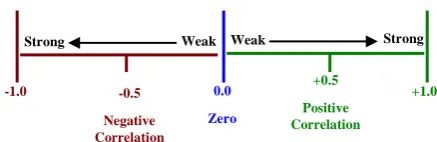
[image:4.595.319.538.78.149.2]If the correlation coefficient equals one, that means the plaintext and its encryption is identical. If the correlation coefficient equals zero, that means the ciphertext is completely different from the plaintext (i.e. good encryption). If the correlation coefficient equals minus one that means the ciphertext is the negative of the plaintext (Figure 6). So, success of the encryption process means smaller values of the correlation coefficient. The experimental results, the correlation coefficient value of the proposed encryption algorithm REA is about 0.0872.
Fig. 6: Correlation coefficient shows strength and direction of correlation
5.
EXPERIMENTAL RESULTS
A typical case study is studied in this section, to give the security and efficiency evaluation of a proposed encryption algorithm REA and to compare it with the most common encryption algorithms namely: DES, 3DES, RC2, AES and Blowfish. The comparisons have been conducted for those encryption algorithms at computational speed (encryption and decryption time) and secure analysis such as information entropy and correlation coefficient. To make the encryption and decryption time is low as possible, cryptosystem should be optimized. Practically, the information entropies of encrypted data are less compared to the ideal case. Also, if the correlation coefficient equals zero, that means the ciphertext is completely different from the original.
All experiments were done on laptop IV 2.0 GHz Intel processor with 1 MB cache memory, 1 GB of memory, and one Disk drive 120 GB. The Operating System which was used is Microsoft Windows 7 professional. The results were executed based on the database Microsoft SQL Server 2005 is "Northwind ", which contains eight tables. The programming tasks were built by Microsoft Visual C# 2008. In the experiments, using two databases from the database “Northwind” are:
1.
Northwind_Plaintext has not any encrypted fields. But it's used to encrypt and decrypt some fields (Table 1) by using the most common encryption algorithms namely: DES, 3DES, RC2, AES, Blowfish and the proposed algorithm REA.2.
Northwind_REAhas the encrypted fields (Table 1) with using the proposed encryption algorithm REA (Figure 10).Table1. Encrypted fields names Field Name Table Name F1 ContactName Suppliers
F2 UnitPrice Products
F3 ShipAddress Orders
F4 Freight Orders
F5 UnitPrice Order Details
F6 Quantity Order Details
F7 Description Categories
F8 Notes Employees
F9 ContactName Customers
F10 ContactTitle Customers
The keys used in the encryption data, kept secrecy in the encrypted table with the proposed encryption algorithm REA. This table contain five fields StrTable(is encrypted table name), StrField(is encrypted field name), StrKey(is encrypted key, it's used in encryption process), StrAlgo(is encryption algorithm name), and StrFieldType(is encrypted field type),
Strong Weak Weak Strong
+0.5 Positive Correlation 0.0 Zero -0.5 Negative Correlation
[image:4.595.342.515.570.694.2]where the first three fields encrypted with proposed algorithm REA (Figure 7). Only the administrator will get these keys by using the password (Figure 8). After the administrator enters the password and selects the required database see the table of the encrypted keys in the database "Northwind_REA" (Figure 9).
[image:5.595.53.281.144.235.2]Fig. 7: Encrypted keys table with the proposed algorithm REA in the database "Northwind_REA"
Fig. 8: Login of the administrator to get the keys
Fig. 9: Decrypted keys table with the proposed algorithm REA in the database "Northwind_REA"
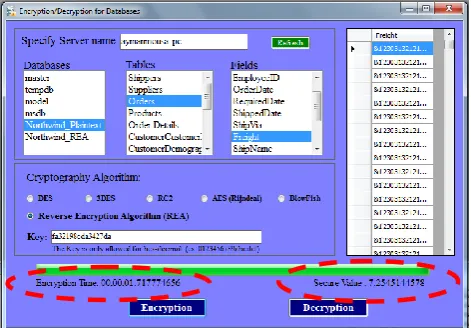
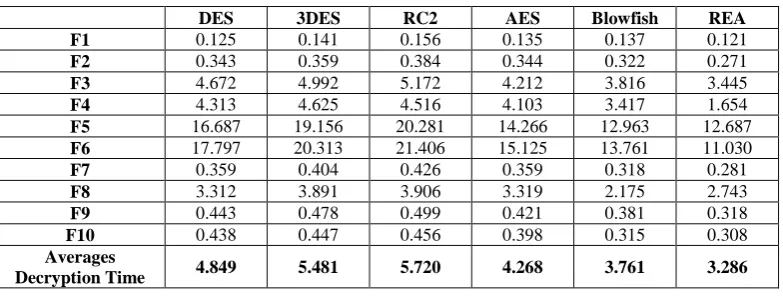
[image:5.595.80.248.281.385.2]The encryption and decryption time, the experiments were encrypted and decrypted ten different fields (shown in Table 1) with the proposed encryption algorithm REA and calculated execution time for each one. Then, calculated the average of the execution times for every encryption and decryption processes. Repeat these steps by other encryption algorithms namely: DES, 3DES, RC2, AES and Blowfish (shown in Table 2 and 3). Figures 10 and 11 have shown once step from ten steps of using proposed encryption algorithm REA.
Fig. 10: Encrypted field with the proposed encryption algorithm REA
Fig. 11: Decrypted field with the proposed decryption algorithm REA
[image:5.595.313.550.289.460.2]4.242
4.671 4.732
4.007
3.243 3.121
0.000 0.500 1.000 1.500 2.000 2.500 3.000 3.500 4.000 4.500 5.000
E
n
c
r
y
p
ti
o
n
T
im
e
..
DES 3DES RC2 AES Blow fish REA
[image:6.595.156.437.269.456.2]Cryptographic Algorithms
[image:6.595.104.496.526.674.2]Table 2. Comparative of encryption times (milliseconds) for encryption algorithms
Fig. 12: Average of encryption times for encryption algorithms
Table 3. Comparative of decryption times (milliseconds) for decryption algorithms
DES 3DES RC2 AES Blowfish REA
F1 0.125 0.141 0.156 0.135 0.137 0.121
F2 0.343 0.359 0.384 0.344 0.322 0.271
F3 4.672 4.992 5.172 4.212 3.816 3.445
F4 4.313 4.625 4.516 4.103 3.417 1.654
F5 16.687 19.156 20.281 14.266 12.963 12.687
F6 17.797 20.313 21.406 15.125 13.761 11.030
F7 0.359 0.404 0.426 0.359 0.318 0.281
F8 3.312 3.891 3.906 3.319 2.175 2.743
F9 0.443 0.478 0.499 0.421 0.381 0.318
F10 0.438 0.447 0.456 0.398 0.315 0.308
Averages
Decryption Time 4.849 5.481 5.720 4.268 3.761 3.286
DES 3DES RC2 AES Blowfish REA
F1 0.141 0.263 0.342 0.109 0.116 0.104
F2 0.359 0.419 0.395 0.329 0.296 0.266
F3 3.609 4.484 4.594 3.047 2.671 2.521
F4 4.063 4.469 4.513 3.297 2.544 1.718
F5 14.194 14.968 15.234 14.000 11.304 11.297
F6 15.906 17.547 17.328 15.484 12.452 12.360
F7 0.344 0.453 0.449 0.331 0.274 0.265
F8 2.960 3.203 3.531 2.688 2.051 2.005
F9 0.422 0.463 0.487 0.403 0.376 0.335
F10 0.421 0.438 0.442 0.386 0.346 0.334
Average
4.849
5.481 5.720
4.268
3.761
3.286
0.000 1.000 2.000 3.000 4.000 5.000 6.000
D
ec
ry
p
ti
o
n
T
im
e.
DES 3DES RC2 AES Blow fish REA
Cryptographic Algorithms
5.259 6.342
6.777 7.603
4.017 7.469
0.000 1.000 2.000 3.000 4.000 5.000 6.000 7.000 8.000
S
ec
u
re
V
a
lu
e
(E
n
tr
o
p
y
)
DES 3DES RC2 AES Blowfish REA
[image:7.595.157.439.69.253.2]Cryptographic Algorithms
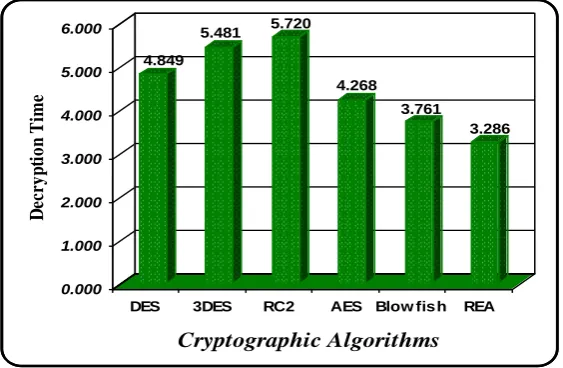
Fig. 13: Average of decryption times for decryption algorithms
Overall, the results showed that the proposed encryption algorithm REA has a very good performance compared to other encryption algorithms. Also, it showed that Blowfish and AES have a better performance than DES, 3DES, and RC2.
For the information entropy factor (Security Analysis), a secure encryption algorithm should be performing a condition on the information entropy that is the ciphertext should not provide any
[image:7.595.129.470.379.755.2]information about the plaintext. The experiments results, the secure (entropy) values of encrypted fields with the proposed encryption algorithm REA (Figure 10) and comparing with the most common encryption algorithms namely: DES, 3DES, RC2, AES and Blowfish. The results for this comparison are shown on Table 4, Figure 14 and Figure 15 at the secure (entropy) values.
Table 4. Comparative of secure (entropy) values for encryption algorithms
DES 3DES RC2 AES BF REA
F1 5.577 6.678 6.948 7.504 3.861 7.817
F2 4.765 5.872 6.354 7.415 3.801 7.181
F3 5.805 6.878 7.165 7.845 4.405 7.604
F4 4.748 5.847 6.451 7.423 3.791 7.255
F5 4.751 5.846 6.234 7.423 3.783 7.053
F6 4.769 5.841 6.587 7.656 3.799 7.154
F7 5.666 6.754 7.078 7.772 4.212 7.631
F8 5.258 6.339 6.975 7.583 4.163 7.735
F9 5.632 6.702 7.025 7.608 3.998 7.577
F10 5.623 6.667 6.952 7.801 4.358 7.684
Average Secure
Value 5.259 6.342 6.777 7.603 4.017 7.469
0 1 2 3 4 5 6 7 8 9
F1 F2 F3 F4 F5 F6 F7 F8 F9 F10
Encrypted Fields
Se
c
u
re
Va
lu
e
(En
tr
o
p
y
)
DES
3DES
RC2
AES
BF
[image:8.595.149.445.72.268.2]REA
Fig. 15: Secure values of encrypted fields for encryption algorithms
The secure (entropy) of encrypted data by proposed encryption algorithm REA (is about 7.469) is a less compared to the ideal case. So, design REA is a security in data encryption.
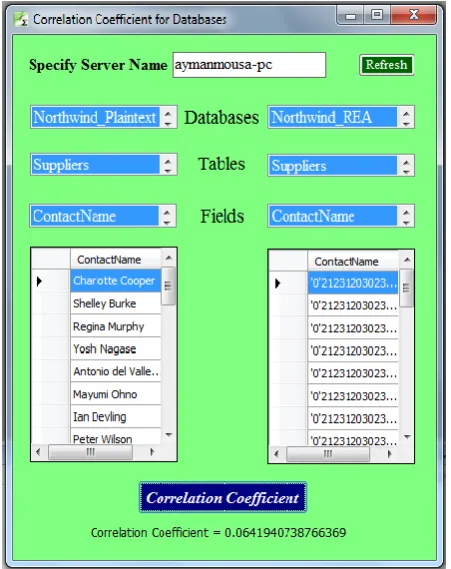
The correlation coefficient factor (Security Analysis), it is used to measure the relationship between two variables; the plaintext and its encryption. Therefore, ciphertext must be completely different from the plaintext. Therefore, using two databases "Northwint_Plaintext" and "Northwind_REA" see figure 16. So, success of the encryption process means smaller values of the correlation coefficient. The results, the correlation coefficient values of encrypted fields by the proposed encryption algorithm REA are shown in table 5.
[image:8.595.331.512.311.478.2]Fig. 16: Correlation coefficient value of encrypted field with proposed encryption algorithms REA
Table 5. Correlation coefficient values of encrypted fields with proposed encryption algorithms REA
Correlation Coefficient Values
F1 0.0642
F2 0.1843
F3 0.0168
F4 0.0545
F5 0.2526
F6 0.0821
F7 0.0000
F8 0.0826
F9 0.0000
F10 0.1352
Average 0.0872
The correlation coefficient of encrypted data with the proposed algorithm REA (is about 0.0872) is a small value to compare zero value. So, the proposed algorithm REA is a good or secure encrypted data.
Finally, the encryption and decryption time results showed that the proposed encryption algorithm REA has a very good performance compared to other encryption algorithms. The security (information entropy) results show that the proposed encryption algorithm REA and AES have a better secure than DES, 3DES, RC2, and Blowfish. Also, the correlation coefficient results show that the proposed encryption algorithm REA has a strong security. Overall, the proposed encryption algorithm REA achieved balance between the security and efficiency in databases.
6.
CONCLUSION AND FUTURE WORK
Encrypting sensitive data in the database becomes more and more crucial for protecting from being misused by intruders who bypass conventional access control mechanisms and have direct access to the database. Must be studied the performance and security of a new scheme in a systematic way. For this purpose, the proposed in this paper to address these issues and contributed in the following:
[image:8.595.57.283.441.726.2]cost for encryption and decryption so as not to degrade the performance of a database system.
2. Evaluating the efficiency of the proposed encryption algorithm REA and compares it with the most common encryption algorithms namely: DES, 3DES, RC2, AES and Blowfish. It indicates the speed of encryption and decryption process. The results show the superiority of REA algorithm over other algorithms in terms of the encryption and decryption time.
3. Analyze the security of the proposed encryption algorithm REA and compares it with the most common encryption algorithms namely: DES, 3DES, RC2, AES and Blowfish. A comparison has been presented for the security (it is used to measure the information entropy). The results show, the secure (entropy) of encrypted data by proposed encryption algorithm REA (is about 7.469) is a less compared to the ideal case. So, designing REA algorithm is a strong security in databases encryption.
4. The correlation coefficient reflects the security measure as well. So, success of the encryption process means smaller values of the correlation coefficient. The results show, the correlation coefficient values of encrypted fields by proposed encryption algorithm REA (is about 0.0872).
In future work, interests in extending a novel encryption algorithm REA to support query processing performance on encrypted databases. In addition, we would like to extend and apply the proposed encryption algorithm REA in other kind of databases such as distributed DBMSs and object oriented DBMSs.
7.
REFERENCES
[1] Bouganim L. , and Pucheral P., "Chip-secured data access: Confidential data on untrusted servers", Proceedings of the 28th International Conference on Very Large Data Bases, Hong Kong, China, pp.131-142, 2002.
[2] Castano S., Fugini M., Martella G., and Samarati P., "Database Security", Addison-Wesley, 1995.
[3] Chen G., Chen K., and Dong J., "A Database Encryption Scheme for Enhanced Security and Easy Sharing", Proceedings of the 10th International Conference on Computer Supported Cooperative Work in Design, 2006. [4] Coppersmith D., "The Data Encryption Standard (DES)
and Its Strength against Attacks", IBM Journal of Research and Development, pp.243-250, May 1994.
[5] Daemen, J., and Rijmen, V. "Rijndael: The Advanced Encryption Standard (AES)", Dr. Dobb's Journal, PP.137-139, March 2001.
[6] Damiani E., Vimercati S., and Foresti S., "Key Management for Multi-User Encrypted Databases", Proceedings of ACM Storage SS’05, pp.74–83, 2005.
[7] El-Fishawy N., "Quality of Encryption Measurement of Bitmap Images with RC6, MRC6, and Rijndael Block Cipher Algorithms", Proceedings International Journal of Network Security, PP.241–251, Nov. 2007.
[8] Ferraiolo D., and Kuhn R., "Role-based Access Controls", Proceedings of NIST-NCSC’92, pp.554–563, 2002.
[9] Idrus S., and Aljunid A., "Performance analysis of encryption algorithms text length size on web browsers," IJCSNS International Journal of Computer Science and Network Security, vol.8 no.1, pp. 20-25, Jan. 2008. [10] Jingmin H., and Wang M., "Cryptography and
Relational Database Management Systems", Proceedings IEEE Symposium on the International Database Engineering & Applications, Washington, USA, 2001.
[11] KIM Y., and Hong E., "A Study of UniSQL Encryption System: Case Study of Developing SAMS", proceedings of ICACT 2007, Volume III, pp. 577-582, Seoul, Korea, 2007.
[12] Mattsson U., "A Database Encryption Solution That Is Protecting against External and Internal Threats, and Meeting Regulatory Requirements: A practical implementation of field level privacy", 2005.
[13] Musheer A. and Shamsher M. "A New Algorithm of Encryption and Decryption of Images Using Chaotic Mapping ", International Journal on Computer Science and Engineering, Vol.2, No.1, pp.46-50, 2009.
[14] Results of Comparing Tens of Encryption Algorithms Using Different Settings-Crypto++ Benchmark, Retrieved Oct. 1, 2008. (http://www.eskimo.com/ weidai/benchmarks.html)
[15] Salama D., Abdual Kader H., and Hadhoud M., “Studying the Effects of Most Common Encryption Algorithms”, International Arab Journal of e-Technology, Vol. 2, No. 1, pp.1-10 January 2011. [16] Salama D., Abdual Kader H., and Hadhoud M.,
“Wireless Network Security Still Has no Clothes”, International Arab Journal of e-Technology, Vol. 2, No. 2, pp.112-123, June 2011.
[17] Schneier B., "Applied Cryptography Second Edition: protocols, algorithms, and source", Beijing: China Machine Press, 2000.
[18] Schneier B., "The Blowfish Encryption Algorithm", Retrieved, 2008.
[19] Stallings W., “Cryptography and Network Security Principles and Practice” 4th
Ed. Prentice-Hill Inc. 2005.
[20] Weerasinghe T., "Secrecy and Performance Analysis of Symmetric Key Encryption Algorithms ", International Journal of Information & Network Security (IJINS), Vol.1, No.2, pp. 77-87, June 2012.