Munich Personal RePEc Archive
Monetary exchange rate model:
supportive evidence from nonlinear
testing procedures
Liew, Venus Khim-Sen and Baharumshah, Ahmad Zubaidi
and Habibullah, Muzafar Shah and Midi, Habshah
Labuan School of International Business and Finance, Universiti
Malaysia Sabah, Department of Economics, Faculty of Economics
and Management, Universiti Putra Malaysia
2008
Online at
https://mpra.ub.uni-muenchen.de/7293/
Monetary Exchange Rate Model: Supportive Evidence from Nonlinear Testing
Procedures
Venus Khim-Sen Liewa, Ahmad Zubaidi Baharumshahb, Muzafar Shah Habibullahb,
Habshah Midic
a
Labuan School of International Business and Finance, Universiti Malaysia Sabah, Jalan
Sungai Pagar, 87000 Labuan F.T., Malaysia.
b
Department of Economics, Faculty of Economics and Management, Universiti Putra
Malaysia, 43400 Serdang, Malaysia.
c
Department of Mathematics, Faculty if Science and Environmental Science Studies,
Universiti Putra Malaysia, 43400 Serdang, Malaysia.
11-2-2008
Summary
Using nonlinear testing procedures relevant to the recent literature, this study provides
evidence of nonlinear adjustment of nominal exchange rate towards monetary
fundamentals in the context of ASEAN-5 countries. While it supports earlier findings
supportive of monetary exchange rate model in this region using the linear testing
procedures, this study provides insightful information in explaining why persistent
misalignments between nominal exchange rate and monetary fundamentals are often
Monetary Exchange Rate Model: Supportive Evidence from Nonlinear Testing
Procedures
Introduction
The debate on whether or not nominal exchange rates exhibit long-run relationship with
the monetary fundamentals has occupied much of international finance researchers’ time
ever since the break down of the Bretton-Woods system in the mid-1973. To this end,
empirical evidence is not as supportive of the monetary model as the theory suggests (see
among others, Meese and Rogoff, 1983; Lyons, 2002; Cheung et al. 2005). Recently,
there is a growing consensus among researchers that the lack of supportive evidence may
largely be associated to the negligence of the nonlinear adjustment of exchange rate
towards the equilibrium level suggested by the corresponding monetary fundamentals
(Taylor and Taylor, 2004). Nonlinearity in exchange rate adjustment is often attributed
to the existence of trading frictions such as transaction costs (Dumas, 1992) and menu
costs (Chinn, 2001). These trade frictions resulted in a band of inaction whereby
exchange rate misalignments which are not large enough to cover arbitrage profit are left
uncorrected within the band. Market players take arbitrage advantage only when the
misalignments are outside the band. Eventually, misalignments disappear and exchange
rate reverts to its mean position suggested by monetary fundamentals. By this principle,
deviations of exchange rate from the monetary fundamentals may apparently behave like
Numerous recent studies based on nonlinear consideration have been able to provide
evidence supportive of nonlinear adjustment of nominal exchange rate towards its
fundamentals. In this regards, using testing procedures in the Smooth Transition
Autoregressive (STAR) framework (Luukkonen et al. 1988; Granger and Terasvirta,
1993), many studies have documented the nonlinear relationship between nominal
exchange rate and fundamentals in the context of developed countries (Micheal et al.,
1997; Baum et al., 2001; Taylor et al., 2001), the Middle East (Sarno, 2000), Asian (Liew
et al.,2003; 2004; 2005), African (Anoruo et al., 2005; Bahmani-Oskooee and Gelan,
2006) and Caribbean and Latin American economies (Francis and Iyare, 2006)
respectively.
Nonetheless, it should be noted that all the above-mentioned nonlinear studies in
exchange rate have insofar been applied to the key building block of monetary model,
that is, the purchasing power parity (PPP) model only. Remarkably, STAR framework
allows for smooth transition of a time series variable from one regime to another
corresponds to the smooth regime changes due to the heterogeneous behavior of
exchange rate market players who do not act simultaneously and thus it is a widely
accepted framework in exchange rate study related to PPP, in particular. Surprisingly,
while this framework is insightful in discovering the nonlinear dynamic between nominal
exchange rate and domestic and foreign prices, its application in validating the monetary
Based on the above consideration, the current study thus attempts to fill up the literature
gap by examining the long-run relationship between nominal exchange rate and monetary
fundamentals using nonlinear approaches in the context of ASEAN-5 economies1. Earlier
on, Liew et al. (2003) have documented the inadequacy of STAR model in characterizing
the nonlinear relationship between nominal exchange rate and related price levels in
among others, the ASEAN-5 countries. In a follow-up study, Liew et al. (2004) provide
evidence of STAR-type nonlinear mean-reverting behaviour of ASEAN-5 exchange rates
towards the PPP equilibrium levels. In a separate endeavor, Baharumshah and Liew
(2005) demonstrate the usefulness of STAR model in predicting the future movement of
ASEAN-5 exchange rates based on national price levels. Given the overwhelming
evidence of STAR-type nonlinearity in the building block of the monetary exchange rate
model, it is natural for one to hypothesize the presence of the same nature of nonlinear
relationship among exchange rate and extended set of monetary variables that include
domestic and foreign money supplies and aggregate outputs in this region. Thus, this
empirical study is under taken to reveal the presence or absence of STAR-type nonlinear
relationship among ASEAN-5 exchange rates and the above-mentioned monetary
variables.
Empirical Monetary Exchange Rate Model
The following monetary exchange rate model is employed in this study2.
1
ASEAN is the acronym of Association of South East Asian Nations, which was formed among the five founding member countries of Indonesia, the Philippines, Malaysia, Singapore and Thailand on 8 August 1967.
t
e =β0+β1mt +β2mt*+β3gt+β4gt*+εt, (1)
where et mt and gt denote nominal exchange rate, domestic money supply and aggregate
output respectively; while foreign variables are marked with asterisks. β’s are
parameters to be estimated with the expected sign of β1,β4> 0, whereas β2,β3 < 0.
Equation (1) is the less restrictive version of the following typical long-run equilibrium
exchange rate model resulting from the modern theories of exchange rate determination
(Mark and Sul, 2001):
t
e = β0+ β1( *) t t m
m − + ( *)
2 gt−gt
β + εt (2)
where (mt−mt*) and (gt−gt*) are known as money and output differential respectively.
β’s are parameters to be estimated. It is expected that β1=1 (neutrality of money)
andβ2< 0.
Equation (1) relaxes the assumptions of identical income elasticity for foreign and
domestic countries and the neutrality of money inherent in Equation (2), which is also
known as forward-looking monetary exchange rate model. Accordingly, Equation (1) is
known as the unrestrictive form forward-looking monetary exchange rate model.
It is noteworthy that prior to the adoption of any monetary model, it is required that the
order, that is one (Rapach and Wohar, 2002). In the present study, it is found from Ng
and Perron (2001) unit root tests that the condition is fulfilled for Equation (2) in the case
of Malaysia only. As for the remaining four countries, exchange rate and the money and
output differentials are integrated of mixed orders and hence, in the vein of Rapach and
Wohar (2002), there is no basis for the validation of forward-looking monetary exchange
rate model3. In contrast, this study finds that nominal exchange rate, money supplies and
aggregate outputs are all integrated of order one for each country under study. As such,
there is a possibility that the nominal exchange rate may be cointegrated with the
corresponding monetary fundamentals. In the light of this preliminary finding, this study
chooses to examine the validity of the more realistic unrestrictive form forward-looking
monetary exchange rate model as specified in Equation (1).
Remarkably, the stationarity of the residuals series of Equation (1), εt, which represents
the deviations (misalignments) of nominal exchange rate from the monetary
fundamentals implied by this model, is of interest in this study. In this respect, if the
residuals series of this model is stationary, then it can be interpreted as evidence of
cointegration relationship between exchange rate and the corresponding monetary
fundamentals, henceforth validating this forward-looking monetary exchange rate model.
Otherwise, the model is invalid. This method of identifying cointegration relationship in
the univariate framework is in the spirit of Engle and Granger (1987) residual-based test
for cointegration whereby the conventional Dickey-Fuller types of stationary tests are
popularly applied.
3
However, it has been pointed out in Liew et al. (2003) that the applications of those
conventional testing procedures which are built on the basis of the linear framework may
be inappropriate in the study of exchange rates behaviour in this region. Therefore, prior
to the examination of stationarity, another time series property of the residuals, that is,
linearity needs to be predetermined. Conventional testing procedures produce valid
inferences only when the deviations series is linear in nature. Otherwise, nonlinear testing
procedures are in order.
Testing for Nonlinearity
For the reasons discussed above, this study employs the following linearity test
formulated by Luukkonen et al. (1988) (LST) to determine whether the deviations of
ASEAN-5 exchange rates from the corresponding monetary fundamentals are linear or
nonlinear in nature in the sample period under study:
t
y = a0 +
3 1
k
i t i i t i t d t d i
a y− b y y− − cy−
=
+ +
∑
+ξt (3)where yt is the residuals of the cointegration equation of exchange rate and
fundamentals and is essentially the OLS residuals from the regression of et on a
constant, mt, gt, mt* and gt*, as specified in Equation (1). k and d are the
autoregressive and lag order and delay parameter respectively. ξt is white noise
Under the null hypothesis (H0: b1= =... bk = =c 0), nonlinearity is absence and the
series under study can be adequately characterized by autoregressive process. On the
other hand, the alternative hypothesis (HA: c or/and at least one b is non-zero)
postulates the existence of a type of nonlinearity in the series, which can be
represented by Smooth Transition Autoregressive (STAR) process. The F test of
restriction may be employed to test the null hypothesis against the alternative
hypothesis; see Luukkonen et al. (1988) and Teräsvirta (1994) for more details.
Note that the true lag length, k and the delay parameter, d are unknown and their
optimal values have to be predetermined based on certain considerations. This study
employs a computer grid search program that determines the optimal k and d that
maximizes the F statistic, for k, d∈{1, ..,12}.
Testing for Cointegration
It is known from the principle of Engle and Granger (1987) residual-based test for
cointegration that if the exchange rate deviation series is stationary, it implies that
exchange rate is cointegrated with its underlying fundamentals. However, if a series
contains STAR-type nonlinearity, conventional stationarity tests are no more applicable.
As such, a nonlinear unit root test developed by Kapetanois et al. (2003) (KSS) enables us
to detect the presence of non-stationarity against nonlinear but globally stationary STAR
3 1
t t t
y ρy− µ
∆ =% % + (3)
or
3 1
1
k
t t i t i t i
y ρy− α y− ν
=
∆ =% % +
∑
∆% + (4)where ∆ is the first difference operator; y%t may be the demeanded or demeaned and
de-trended or the original yt series, depending on situation; whereas µt and υt are
stochastic error terms each with zero mean and constant variance assumption.
Specifications (3) and (4) correspond to the conventional Dickey-Fuller (DF) and
augmented Dickey-Fuller (ADF) stationary tests with no intercept and trend terms in the
nonlinear framework. Results of simulation study show that these nonlinear stationary
tests produce robust results if the data generating process of the series under study is in
fact nonlinear in nature (Kapetanois et al., 2003).
The null hypothesis of H : 00 ρ = against the alternative of H : 1 ρ < 0 can be tested
using the t-statistics. Under the null hypothesis, the exchange rate deviation series is
nonlinear and nonstationary, implying the absence of cointegration relationship between
exchange rate and its underlying fundamentals. In contrast, the exchange rate deviation
series is a stationary STAR process, indicating evidence of nonlinear cointegration
relationship between exchange rate and its underlying fundamentals. For the brevity of
NADF
t respectively in this study. Kapetanois et al. (2003) prove that the asymptotically
distribution of ρ is non-normal, so the authors simulated and provided the critical values
of the statistics involved in the same paper for our convenience. In this paper, Equation
(4) is estimated for k ranging from 1 to 12 inclusively. The optimal k is predetermined
based on Akaike Information Criterion (AIC).
Data
The monthly data of ASEAN-5 countries plus Japan, their major trading partners in this
region, as an anchor country for exchange rate are employed in this study. The variables
involved are nominal Japanese Yen based exchange rates, aggregate price levels, interest
rates, money demands and aggregate output levels. The sample period begins from
January 1977 (1977M1) and end at March 2006 (2006M3). In this study Consumer Price
Index (CPI), M2 and Gross Domestic Product (GDP) will accordingly serve as measures
of aggregate price level, money demand and aggregate output level for all countries.
However, as monthly data for GDP is not available for all countries, it has to be
interpolated from annually data in the spirit of Bahmani-Oskooee (2002)4. As for interest
rates, money market rates will be used in all case except Philippines, where there is no
report of this data at all. In such case, we follow Alba and Papell (1998) in using the
three-month treasury bill rate. The nominal Yen-based exchange rate for each country is
the cross-rate of the country’s spot U.S. Dollar based exchange rate and the spot
Yen/U.S. Dollar exchange rate. The resulting nominal spot exchange rates are the known
4
as Rupiah/Yen, Peso/Yen, Ringgit/Yen, Dollar/Yen and Baht/Yen for Indonesia, the
Philippines, Malaysia, Singapore and Thailand accordingly. As their names imply, these
nominal spot exchange rates are actually the domestic prices of Yen. These data are
collected from various monthly and quarterly issues of International Financial Statistics
(IFS) published by the International Monetary Fund (IMF). All variables will be
employed in their logarithmic form. The deviations series are constructed based on the
unrestrictive form forward-looking exchange rate monetary model. The resulting
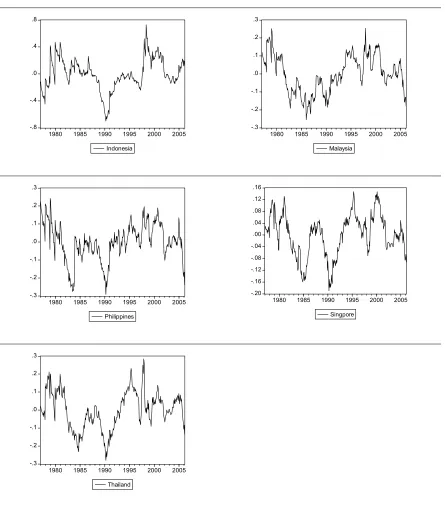
deviations for all countries are plotted in Figure 1. Apparently, while the series fluctuate
around the zero-mean with no obvious long-term trend in the graphs, coupled with the
persistent drift of the deviations from the equilibrium rendering over- or under-valued up
to two to three years in many cases, it is quite likely that these series are following
nonlinear mean-reverting behaviour. Nonetheless, linearity test and stationarity test are
needed to formally analyze whether or not the series are nonlinear as well as
Figure 1: Deviations of exchange rates from monetary fundamentals -.8 -.4 .0 .4 .8
1980 1985 1990 1995 2000 2005
Indonesia -.3 -.2 -.1 .0 .1 .2 .3
1980 1985 1990 1995 2000 2005
Malaysia -.3 -.2 -.1 .0 .1 .2 .3
1980 1985 1990 1995 2000 2005
Philippines -.20 -.16 -.12 -.08 -.04 .00 .04 .08 .12 .16
1980 1985 1990 1995 2000 2005
Singpore -.3 -.2 -.1 .0 .1 .2 .3
1980 1985 1990 1995 2000 2005
Results and Discussion
The formal linearity test results are summarized in Table 1. It clearly shows that the null
hypothesis of linear process has been rejected by the F statistics for each deviations
series, at conventional significant levels, in favor of nonlinear process that can be
characterized by the STAR model. This means that the adjustment of ASEAN-5 nominal
exchange rate towards the monetary fundamentals is nonlinear in manner, and therefore
to certain extend, this finding of nonlinear exchange rate adjustment is supportive of the
novel finding of Baharumshah et al. (2002), Lee and Azali (2005) and Lee et al. (2008),
in which evidence of valid monetary models are obtained from linear estimation
frameworks. In addition, this fresh evidence also expands the existing literature from the
documentation of the nonlinear adjustment between ASEAN-5 nominal exchange rate
and relative prices to a broader sense that includes domestic and foreign money supplies
and aggregate outputs (Liew et al., 2003; 2004).
Table 1: Results of Testing for Nonlinearity.
Country k d F msv
Indonesia 4 3 2.2304* 0.0868
Malaysia 1 1 6.9645** 0.0352
Philippines 10 12 4.0375*** 0.0034
Singapore 11 8 1.9152** 0.0172
Thailand 3 4 5.5924*** 0.0014
Having revealed the nonlinear property of the deviations series, it is interested to know
whether these nonlinear series are stationary or not. The corresponding KSS stationary
tests are estimated and the results are reported in Table 2. From the tNDF, it is obvious
that the null hypothesis of nonstionary may be rejected at 1% significant level in all
cases. Moreover, it has been shown that more negative t statistics are provided by the
NADF
t , whereby lagged values of the first differenced deviation series are included in the
test to eliminate possible serial correlation problem. All-in-all, the KSS tests results are
favouring the monetary exchange rate model under study since stationarity of deviations
series implies evidence of long-run relationship between exchange rate and the implied
monetary fundamentals. This validation of monetary model provides more insight on the
exchange rate adjustment dynamic as compared with previous studies in the same region
using the linear frameworks (Baharumshah et al., 2002; Lee and Azali, 2005; Lee et al.,
2008). Remarkably, the deviations series is mean-reverting in the STAR framework,
which means that nominal exchange rate follows the nonlinear path as represented by the
STAR process in its adjustment towards the equilibrium position determined by the
monetary fundamentals. Based on the discussion earlier, this finding can be interpreted as
small deviations remains uncorrected and hence may be persistent in the short-run.
However, as time past, deviations which eventually grow into large enough magnitude
will be harvested by market players to obtain arbitrage profits. With that, exchange rate
will revert to the mean position given by the monetary fundamentals. Such evidence of
nonlinear mean-reverting behaviour of exchange rate remains the first in the literature in
evidence of nonlinear mean-reverting behaviour of exchange rate towards the PPP
[image:16.612.84.527.183.271.2]equilibrium (Chortareas and Kaprenios 2003;Liew et al., 2004).
Table 2: Results of Testing for Stationarity
Country tNDF msv tNADF msv k
Indonesia -2.6521*** 0.0084 -2.7917*** 0.0002 12 Malaysia -4.1038*** 0.0002 -5.0690*** 0.0004 12 Philippines -2.9516*** 0.0034 -3.8749*** 0.0002 12 Singapore -2.8140*** 0.0052 -3.3430*** 0.0002 12 Thilnd -3.7320*** 0.0002 -4.0980*** 0.0004 3 Notes: Notes: tNDF and tNADF correspond to Equations (2) and (3) respectively, which are estimated on the
original deviation series, as there is no significant intercept and trend terms in each series. msv denotes on the marginal significance value (msv) of the implied t statistic, which is computed from 4999 simulated series based on empirical distribution function. *** indicates significant at 1% level.
Conclusion
This study employs nonlinear testing procedures to validate the forward-looking
monetary exchange rate model, in the context of ASEAN-5 countries. In particular,
linearity property of the deviations of yen-based ASEAN-5 exchange rates from the
corresponding equilibrium position as determined by the monetary fundamentals is first
determined. This is followed by the examination of the stationary property of the
above-mentioned deviations series. The testing procedures employed to accomplish these tasks
include the linearity test due to Luukkonen et al. (1988) and thestationarity test recently
developed by (Kapetanois et al. 2003). Both testing procedures, which are formulated
based on the STAR framework, are adopted in this study based on previous findings of
STAR-type nonlinear mean-reverting dynamic in the nominal exchange rate towards
It is found that the exchange rate misalignments exhibit nonlinear behaviour in
mean-reverting dynamics. Consistent with the theory of band of inaction postulated by Dumas
(1992), trading frictions such as transaction costs induced a band of inaction for
ASEAN-5 exchange rates, within which exchange rate misalignments are left to drift freely and
causing exhibition of persistent misalignments in the short-run. However, misalignments
are unsustainable when they surge out of the band, whereby market corrections take place
due arbitrage profit reaping activities. Besides, we put forward that it is also plausible that
government intervention may occur outside the inaction band whereby the marginal
profits (political, economics) exceeds the marginal costs of intervening.
Besides, this study finds that the unrestricted form forward-looking monetary model is
suitable for the countries under study. This means that domestic money supply, domestic
aggregate output, Japan money supply, Japan aggregate output are the main driving
forces the current exchange rate dynamic. As such, in monitoring the movement of
exchange rates in these countries, government policy makers could focus on the
above-mentioned set of monetary variables, which has been shown well-coordinated with the
dynamic of exchange rates in this study.
Acknowledgement
References
Anoruo, Emmanuel, Venus Khim-Sen Liew and Uchenna Elike (2006) “Nonlinear Real Exchange Rate Behavior: Are the African Currencies Exceptional,” International Research Journal of Finance Economics 1, 97 – 110.
Baharumshah, Ahmad Zubaidi, Abdul Mansur M. Masih and M. Azali (2002) “The Stock Market and Ringgit Exchange Rate: A Note,” Japan and the World Economy
458, 1 – 16.
Baharumshah, Ahmad Zubaidi and Venus Khim-Sen Liew (2005) “Forecasting Performance of Exponential Smooth Transition Autoregressive Exchange Rate Models,” Open Economies Review, 17, 261 – 277.
Bahmani-Oskooee, Mohsen (2002) “Does Black Market Exchange Rate Volatility Deter the Trade Flows? Iranian Experience,” Applied Economics 34, 2249 – 2255.
Bahmani-Oskooee, Mohsen and Abera Gelan (2006) "Testing the PPP in the Non-linear STAR Framework: Evidence from Africa." Economics Bulletin, 6(17), 1 – 15.
Baum, Christopher F., John T. Barkoulas and Mustafa Caglayan (2001) “Non-linear Adjustment to Purcahsing Power Parity in the Post-Bretton Woods Era,” Journal of International Money and Finance 20, 379 – 399.
Caner, Mehmet and Bruce E. Hansen (2001) “Threshold Autoregression with a Unit Root,” Econometrica 69, 1555 – 1596.
Cheung, Yin-Wong, Menzie David Chinn and Antonio Garcia Pascual (2005) “Empirical Exchange Rate Models of the Nineties: Are They Fit to Survive?” Journal of International Money and Finance 24, 1150 – 1175.
Chinn, Menzie David (2001) "Menu Costs and Nonlinear Reversion to Purchasing Power Parity among Developed Countries," UCSC Dept. of Economics Working Paper No. 498.
Chortareas, G. and George Kapetanios (2003) “The yen-real exchange Rates may be stationary after all: Evidence from Nonlinear Unit Root Test,” Working Paper No. 484, Department of Economics, Queen Mary, University of London.
Dumas, Bernard (1992) “Dynamic Equilibrium and the Real Exchange Rate in a Spatially Seperated World,” Review of Financial Studies 5, 153–180.
Francis, Brian and Sunday Iyare (2006) "Do Exchange rates in Caribbean and Latin American Countries Exhibit Nonlinearities?" Economics Bulletin, 6 (14), 1 – 20.
Granger, Clive W. J. and Timo Teräsvirta (1993) Modelling Non-linear Economic Relationships. London: Oxford University Press.
Kapetanios, George, Yongcheol Shin and Andy Snell (2003a) “Testing Unit Root in the Nonlinear STAR Framework,” Journal of Econometrics 112, 359 – 379.
Kapetanios, George, Yongcheol Shin and Andy Snell (2003b) “Testing for Cointegration in Nonlinear STAR Error Correction Models,” Working Paper, Queen Mary, University of London.
Lee, Chin and M. Azali (2005) “Exchange Rate Misalignments in ASEAN-5 Countries,”
Labuan Bulletin of International Business and Finance 3, 11 – 28.
Lee, Chin, M. Azali, Zulkornain B. Yusop and Mohammed B. Yusoff (2008) “Is Malaysia Exchange Rate Misaligned Before The 1997 Crisis?” Labuan Bulletin of International Business and Finance, forthcoming.
Liew, Venus Khim-Sen, Chong T. Tai-Leung and Lim Kian-Ping (2003) “Inadequacy of Linear Autoregressive Model for Real Exchange Rates: Empirical Evidence from Asian Economies,” Applied Economics 35, 1387 – 1392.
Liew, Venus Khim-Sen., Ahmad Zubaidi Baharumshah and Chong T. Tai-Leung (2004) “Are Asian real exchange rate stationary?” Economics Letters 83, 313 – 316.
Luukkonen, Ritva, Pentti Saikkonen and Timo Teräsvirta (1988) “Testing Linearity against Smooth Transition Autoregressive Models,” Biometrika 75, 491 – 499.
Lyons, Richard K. (2002) "Foreign Exchange: Macro Puzzles, micro Tools," Economic Review, Federal Reserve Bank of San Francisco, 51 – 69.
Mark, Nelson C and Donggyu Sul (2001) “Nominal Exchange Rates and Monetary Funamentals: Evidence from a Small Post-Bretton Woods Panel,” Journal of International Economics 53, 29 – 52.
Michael, Panos, A. Robert Nobay and David A. Peel (1997) “Transactions Costs and Nonlinear Adjustment in Real Exchange Rates: An Empirical Investigation,” Journal of Political Economy 105(4), 933-948.
Rapach, David E. and Mark E. Wohar (2002) “Testing the Monetary Model of Exchange Rate Determination: New Evidence from a Century Data,” Journal of International Economics, 58, 359 – 385.
Sarno, Lucio (2000) “Real Exchange Rate Behaviour in the Middle East: A Re-examination,” Economics Letters 66, 127–136.
Taylor, Alan M. and Mark P. Taylor (2004) “The Purchasing Power Parity Debate,”
Journal of Economic Perspectives 18, 135 – 158.
Taylor, Mark P. David A. Peel (2000) “Non-linear Adjustment, Long-run Equilibrium and Exchange Rate Fundamentals,” Journal of International Money and Finance 19, 33 – 53.
Taylor, Mark P., David A. Peel and Lucio Sarno (2001) “Nonlinear Mean-reversion in Real Exchange Rates: Toward a Solution to the Purchasing Power Parity Puzzles,”
International Economic Review 42, 1015 – 1042.
Teräsvirta, Timo (1994) “Specification, Estimation, and Evaluation of Smooth Transition Autoregressive Models,” Journal of American Statistics Association