http://dx.doi.org/10.4236/jsea.2014.71006
Multidimensional Design Paradigms for Data Warehouses:
A Systematic Mapping Study
Ania Cravero, Samuel Sepúlveda
System Engineering Department, La Frontera University, Temuco, Chile. Email: [email protected], [email protected]
Received November 29th, 2013; revised December 25th, 2013; accepted January 2nd, 2014
Copyright © 2014 Ania Cravero, Samuel Sepúlveda. This is an open access article distributed under the Creative Commons Attribu-tion License, which permits unrestricted use, distribuAttribu-tion, and reproducAttribu-tion in any medium, provided the original work is properly cited. In accordance of the Creative Commons Attribution License all Copyrights © 2014 are reserved for SCIRP and the owner of the intellectual property Ania Cravero, Samuel Sepúlveda. All Copyright © 2014 are guarded by law and by SCIRP as a guardian.
ABSTRACT
Data warehouses (DW) must integrate information from the different areas and sources of an organization in order to extract knowledge relevant to decision-making. The DW development is not an easy task, which is why various design approaches have been put forward. These approaches can be classified in three different para- digms according to the origin of the information requirements: supply-driven, demand-driven, and hybrids of these. This article compares the methodologies for the multidimensional design of DW through a systematic map- ping as research methodology. The study is presented for each paradigm, the main characteristics of the metho- dologies, their notations and problem areas exhibited in each one of them. The results indicate that there is no follow-up to the complete process of implementing a DW in either an academic or industrial environment; how- ever, there is also no evidence that the attempt is made to address the design and development of a DW by ap- plying and comparing different methodologies existing in the field.
KEYWORDS
Multidimensional Design; Paradigms; Data Warehouses; Systematic Mapping
1. Introduction
Data warehouses (DW) are a collection of an organiza- tion’s historical data of any kind. The historical data are analyzed by the decision-makers by converting the data into strategic information in order to support the decision- making process [1]. These DWs integrate a huge amount of data coming from heterogeneous data sources into a multidimensional design (MD). This model enables the users to access the data in a more natural way, by means of its structure, composed of facts (analysis measures) and dimensions (context of the factual analysis) [2]. The information stored in the facts usually represents mea- surements for business processes (for example, how many products are sold? How many patients are treated? How long does a given process take? etc.), and the dimensions represent the framework for analyzing these measure- ments (for example, time, customer or product).
The development of a DW is not an easy task, raising some difficulties such as misalignment with the business
strategy and therefore failure upon implementation [3,4]. As a result, a lot of effort has been made to develop me- thodologies and approaches that enable the correct crea- tion of a MD of a DW [5].
According to Winter and Strauch [6], the methodolo- gies or approaches of the MD can be classified according to the way in which the DW requirements are obtained. These are the approaches demand-driven, supply-driven, and the hybrid approaches that seek to combine the first two.
results indicate that there is no follow-up to the complete process of implementing a DW in either an academic or industrial environment; however, there is also no evi- dence that the attempt is made to address the design and development of a DW by applying and comparing dif- ferent methodologies existing in the field. Finally, it is noted that the proposals that contribute with tools do so only at the prototype level.
The systematic mapping of studies is a methodology used frequently in medical research, which has been ada- pted for use in the IT area [7].
This work is organized as follows: Section 2 presents the problem of definition. Section 3 presents the basic con- cepts and a brief description of the paradigms for the MD of a DW. Section 4 describes the process of systematic mapping. Section 5 describes the results. Section 6 in- cludes work related. Finally, Section 6 presents the con- clusions.
2. Problem Definition
Although there are a variety of methodologies and ap- proaches for the design of DW, the researchers believe that this research area is very poor. In this sense Rizzi and others authors indicate that “A very few comprehen- sive design methods that have been devised so far [5,8]. Overall, believe that some specific issues in design, has not been properly investigated yet. Besides, more gener- ally, mechanisms should appear to coordinate all DW de- sign phases allowing the analysis, control, and traceabil- ity of data and metadata along the project life-cycle” [9]. As yet there is no common strategy for the development of data warehouses [10].
On the other hand, the proposed methodologies are not always coupled with an appropriate technique for re- quirement analysis to form a methodological approach ensuring that the resulting database will be well-docu- mented and will fully satisfy the user requirements [11]. In this sense, the DW is acknowledged as one of the most complex information system modules and its design and maintenance is characterized by several complexity fac- tors that determined, in the early stages of this discipline, a high percentage of real project failures [12,13].
The awareness of the critical nature of the problems and the experience accumulated by practitioners deter-
mined the development of different design methodolo- gies and the adoption of proper life-cycles that can in- crease the probability of completing the project and fulfil the user requirements [11]. For these reasons, it is sug- gested a survey of methodologies for DW design in order to help the reader make crucial choices more consciously.
3. Basic Concepts
3.1. Data Warehouse
The classic definition of DW was proposed by Inmon [14] as a subject-oriented, non-volatile, integrated, and time variant collection of data in support of management’s de- cisions.
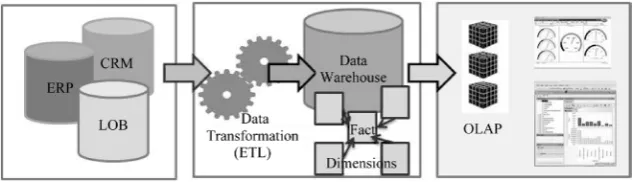
From the functional point of view, the implementation of a DW is comprised of 3 stages: (1) data extraction from different sources, (2) consistent data transformation and loading into the DW, (3) and efficient and flexible access to the integrated data using tools for end users [14].
From the development point of view, the stages consist of: (1) requirements analysis, (2) the conceptual design of the DW, (3) the logical design, (4) the physical design, (5) and the implementation via data ETL (Extraction, Transformation and Loading) [2].
The main contribution of a DW is its ability to convert data into strategic intelligence, supporting decision-mak- ing at the highest levels of an organization. This ability is supported by the OLAP tool [15], which provides end us- ers with configurable views of data from different angles and at different aggregation levels [16].
In order to achieve OLAP consultations quickly and flexibly, the data are organized multidimensionally (known as a star schema), where the information is classified ac- cording to the facts and dimensions [2]. The facts are the numeric data or the data that represent a specific indus- trial activity to be analyzed. The dimensions are the indi- vidual perspectives of the data that determine the granu- larity (data at the detail level) adopted for the representa- tion of a fact. The units of the facts and their values are called measurements [2]. Figure 1 illustrates the com- plete process.
[image:2.595.140.457.630.721.2]The methodologies for the MD analyzed establish ac- tivities for the conceptual and logical design, which are
classified on the basis of three paradigms that are detail- ed next [6].
• Supply-driven paradigm: The supply-driven appro- aches (also known as data-driven) initiate the DW modeling process from a detailed analysis of the data sources to determine which elements (such as facts, dimensions) are most relevant to the decision-making process.
• Demand-driven paradigm: These approaches, also known as requirement-driven or targeted, begin by determining the user’s needs, then a MD of the DW is created according to the selected goals.
• Hybrid paradigm: These approaches seek to combine both paradigms in order to design the DW from the data sources, but also taking end users’ needs into ac- count. The main characteristic and difference com- pared to the two previous approaches is that this type can intersperse the supply- and demand-driven ap- proaches in order to apply them at each stage of the DW development, benefitting from the information col- lected throughout the process.
3.2. Systematic Mapping
Systematic mapping is a reporting process and structure that can categorize the results published to date in a cer-tain area.
The aim of systematic mapping is classification, and it is therefore directed towards the thematic analysis and identification of the main publication forums [17]. The same article indicates that it enables responses to generic questions like: What has been done to date in field X? As a limitation, this type of study does not consider the qua- lity of the studies included.
The systematic mapping process consists of the fol- lowing stages: (1) definition of the research questions, (2) scope of review, (3) execution of the search, (4) selection of the studies, (5) filtering of the studies, (6) classifica- tion scheme, (7) extraction of data and mapping process- es, (8) and systematic map [17].
4. Systematic Mapping of MD Design
Paradigms for DW
The primary aim of the systematic mapping of studies is to obtain an overall view of the research into the para- digms for the MD in DW. This not only entails identify- ing the main approaches in this area, but also their strengths and weaknesses and, of course, the future work that may take place to demonstrate possible weaknesses.
Next we describe the stages carried out.
4.1. Definition of the Research Questions
The following research questions (RQ) were defined ac- cording to the technique indicated in [18], fulfilling the
proposed aims:
• (RQ1) Which paradigm do the investigations selected use most and how has the trend changed over time? This allows us to ascertain which trend this field presents, which approaches are effective and which are not.
• (RQ2) Which environment, academia or industry, is the most common when applying the research? This can help to explain the preferred environment for de- signing a DW.
• (RQ3) What is the contribution of the research works to the field? This can identify the contribution of the works, whether these are methodologies or approach- es, and if they include tools.
• (RQ4) Which stage of the design of a DW is investi- gated? This can explain which stage has been re- searched the most: the conceptual, logical or physical design.
4.2. Scope of the Review
According to [18], the scope is defined on the basis of the following parameters.
• Population: Group of articles that describes the stu- dies into the MD of a DW in academia and industry.
• Intervention: Any study that contains methods, ap- proaches or tools; based on the paradigms for DW.
• Study design: Experiments, case studies, accounts of experience, research-action.
• Results: Amount and type of evidence regarding the MD ofDW.
4.3. Execution of the Search
The search string consisted of Boolean expressions form- ed by the following key words: “data warehouse”, “data warehousing”, “multidimensional design”, “approach”, “methodology”. Some of the terms were broken into bo- olean expressions using the OR and AND connectors, creating the following search string: (“data warehouse” OR data warehousing) AND “multidimensional design” AND (approach OR methodology).
In terms of time lapse, the search is concentrated be- tween 1998 and 2013. This choice was made because as of 1998 several researchers began delving into this sub- ject, using the works of Bill Immon and Ralph Kimball (considered as the “fathers” of DW), as the basis of their investigations.
The sources where the search was applied were: IEEE Digital Library, ACM Digital Library, ScienceDirect and SpringerLink.
4.4. Selection and Filtering of the Studies
that make significant contributions regarding the para- digms for the MD of DW. Second, we used the exclusion criterion, where we concentrated mainly on the summary, introduction and conclusions, analyzing those works a little more where it was needed to ensure that they were relevant for the field of study.
• Inclusion criteria: books, documents, articles, theses, research works, journal and conference publications that describe the MD of a DW and that contain ap- proaches, methodologies and/or tools in any of the fol- lowing stages: conceptual, logical and physical multi- dimensional design.
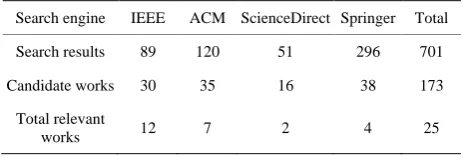
• Exclusion criteria: (1) Works that deal with DW, but are not related to their MD. (e.g. Experiences of using a DW in the industry or in academia, data analysis with DW, business intelligence, data mining, OLAP, etc.) (2) Works that concentrate on the design of a DW, but that do not express a methodology for it. Table 1 presents the number of articles according to the search string and the filter.
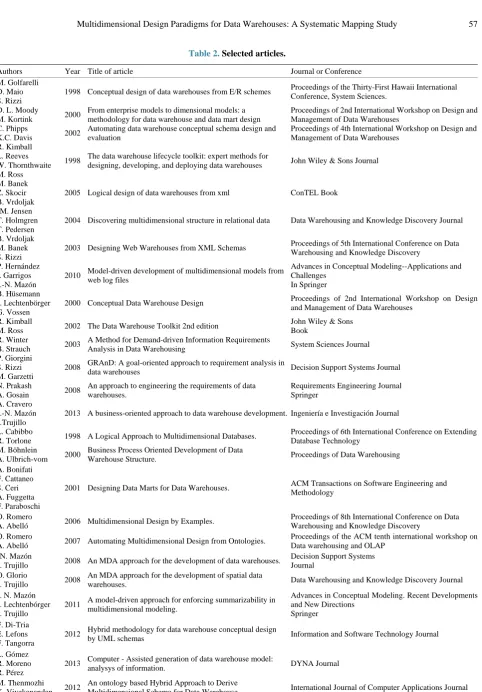
The selection process consists of three iterations per- formed by four reviewers. In the first iteration, each re- viewer applied the inclusion and exclusion criteria to the title, abstract and key words for 10 works selected at random. A reliability of 79% was obtained according to Fleiss' kappa proposed by [19], which is very good. In the following iteration, each reviewer applied the same criteria to a set of articles that was assigned to him, now including the introduction and conclusion. In the third iteration the works where questions arose were analyzed thoroughly. This way a total of 25 relevant works were obtained for the mapping. Table 2 presents the authors, title, year and publication source for each of these ar- ticles.
4.5. Definition of the Classification Scheme
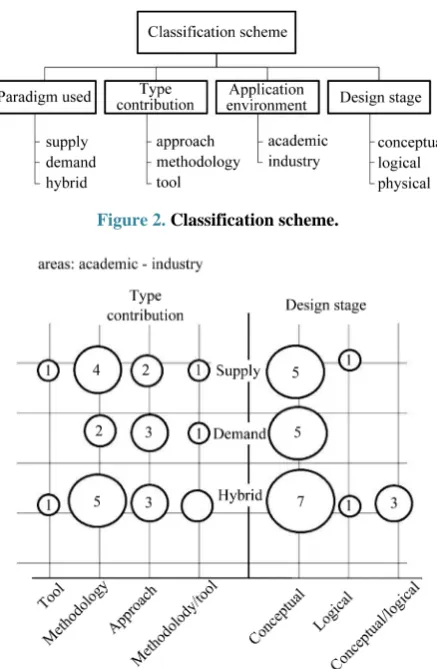
Once the relevant articles had been selected, four types of classifications were defined based of the study objec- tives (see Figure 2):
• Paradigm developed: Model on which the articles are based, i.e., supply-driven approach, demand-driven approach, and hybrid approach.
• Type of contribution: The contribution that investiga- tion makes to the field, i.e., if it is an approach, or a methodology, and if it contains a tool, or if it is me-
Table 1. Results of the search and filter.
Search engine IEEE ACM ScienceDirect Springer Total
Search results 89 120 51 296 701
Candidate works 30 35 16 38 173
Total relevant
works 12 7 2 4 25
thodology-tool. Approach for those publications that offer new ideas or methodologies different from those already established. Methodology includes descrip-tions and procedures to follow and be able to carry out the MD of a DW. Tool refers to any kind of tool that helps in the process of designing a DW. Finally, methodology-tool to classify those publications that contribute with tools to apply the methodology pre- sented.
• Application environment: The area where the inves- tigation is developed, or where the authors aim to ap- ply their research. In this case we classified them in two categories: academic and industry. Academic: this category is for those publications that direct their efforts to conducting new research and/or developing new ideas. Industry: this classification corresponds to those works that apply their research in some organi- zation (for-profit or not-for-profit).
• Design stage: Development stage of a DW in which the authors concentrate on developing their research, i.e., conceptual design, logical design and the physi- cal.
4.6. Data Extraction and Systematic Mapping
After defining the classification system, the last step of systematic mapping consists of data extraction and the process of mapping the different dimensions. The com- plete result of this activity is in the following section. The synthesized result of our study can be seen in the bubble diagram in Figure 3.
Figure 3 basically illustrates two scatter plots with bubbles at the category intersections, which encompass several categories at once and give a quick, overall view of a field of study, providing a visual map. In this visua- lization of the results, the size of a bubble is proportional to the number of articles that are in the pair of categories that correspond to the bubble of the coordinates.
So, for example, we found 4 articles that describe a DW design methodology on the basis of the supply para- digm. Thus also, we found 7 articles that describe a me- thodology for the design of a DW based on the hybrid paradigm and which includes only the conceptual mod- eling of the DW.
We observe in the same figure there were no articles describing a methodology to develop a DW that included the stage of physical design, but there were articles that included the two first, conceptual and logical design.
Figure 4 illustrates the distribution of the works se- lected using a timeline. For all the publications included in the mapping (25), 11 are articles from conferences, 9 from journals, 4 are books and 1 is a thesis.
[image:4.595.56.288.659.738.2]Table 2. Selected articles.
Authors Year Title of article Journal or Conference
M. Golfarelli D. Maio S. Rizzi
1998 Conceptual design of data warehouses from E/R schemes Proceedings of the Thirty-First Hawaii International Conference, System Sciences.
D. L. Moody
M. Kortink 2000
From enterprise models to dimensional models: a methodology for data warehouse and data mart design
Proceedings of 2nd International Workshop on Design and Management of Data Warehouses
C. Phipps
K.C. Davis 2002
Automating data warehouse conceptual schema design and evaluation
Proceedings of 4th International Workshop on Design and Management of Data Warehouses
R. Kimball L. Reeves W. Thornthwaite M. Ross
1998 The data warehouse lifecycle toolkit: expert methods for
designing, developing, and deploying data warehouses John Wiley & Sons Journal
M. Banek Z. Skocir B. Vrdoljak
2005 Logical design of data warehouses from xml ConTEL Book
JM. Jensen T. Holmgren T. Pedersen
2004 Discovering multidimensional structure in relational data Data Warehousing and Knowledge Discovery Journal
B. Vrdoljak M. Banek S. Rizzi
2003 Designing Web Warehouses from XML Schemas Proceedings of 5th International Conference on Data Warehousing and Knowledge Discovery
P. Hernández I. Garrigos J.-N. Mazón
2010 Model-driven development of multidimensional models from web log files
Advances in Conceptual Modeling--Applications and Challenges
In Springer B. Hüsemann
J. Lechtenbörger G. Vossen
2000 Conceptual Data Warehouse Design Proceedings of 2nd International Workshop on Design
and Management of Data Warehouses
R. Kimball
M. Ross 2002 The Data Warehouse Toolkit 2nd edition
John Wiley & Sons Book
R. Winter
B. Strauch 2003
A Method for Demand-driven Information Requirements
Analysis in Data Warehousing System Sciences Journal
P. Giorgini S. Rizzi M. Garzetti
2008 GRAnD: A goal-oriented approach to requirement analysis in
data warehouses Decision Support Systems Journal
N. Prakash
A. Gosain 2008
An approach to engineering the requirements of data warehouses.
Requirements Engineering Journal Springer
A. Cravero J.-N. Mazón J.Trujillo
2013 A business-oriented approach to data warehouse development. Ingeniería e Investigación Journal
L. Cabibbo
R. Torlone 1998 A Logical Approach to Multidimensional Databases.
Proceedings of 6th International Conference on Extending Database Technology
M. Böhnlein
A. Ulbrich-vom 2000
Business Process Oriented Development of Data
Warehouse Structure. Proceedings of Data Warehousing
A. Bonifati F. Cattaneo S. Ceri A. Fuggetta F. Paraboschi
2001 Designing Data Marts for Data Warehouses. ACM Transactions on Software Engineering and Methodology
O. Romero
A. Abelló 2006 Multidimensional Design by Examples.
Proceedings of 8th International Conference on Data Warehousing and Knowledge Discovery
O. Romero
A. Abelló 2007 Automating Multidimensional Design from Ontologies.
Proceedings of the ACM tenth international workshop on Data warehousing and OLAP
JN. Mazón
J. Trujillo 2008 An MDA approach for the development of data warehouses.
Decision Support Systems Journal
O. Glorio
J. Trujillo 2008
An MDA approach for the development of spatial data
warehouses. Data Warehousing and Knowledge Discovery Journal
J. N. Mazón J. Lechtenbórger J. Trujillo
2011 A model-driven approach for enforcing summarizability in multidimensional modeling.
Advances in Conceptual Modeling. Recent Developments and New Directions
Springer F. Di-Tria
E. Lefons F. Tangorra
2012 Hybrid methodology for data warehouse conceptual design
by UML schemas Information and Software Technology Journal
L. Gómez R. Moreno R. Pérez
2013 Computer - Assisted generation of data warehouse model:
analysys of information. DYNA Journal
M. Thenmozhi
K. Vivekanandan 2012
An ontology based Hybrid Approach to Derive
Figure 2. Classification scheme.
Figure 3. Bubble diagram. Systematic mapping visualiza-tion.
trend in the design of DW will be using hybrid ap- proaches that consider the model of the strategy, the use of objective models, transformations between conceptual, logical and physical models, to achieve automation.
5. Comparative Analysis and Discussion
Next, from the results we answer the research questions formulated in Section 3.
• (RQ1): There are 8 articles selected according to the supply-based paradigm, 6 according to the demand- driven paradigm and 11 from the hybrid. The results indicate that most of the current research has been aimed at the hybrid approach with 11 publications cor- responding to 44% of the total. One possible justifica-tion is that the authors preferred to use methodologies that reduce the failure of the DW, since this: (1) must be aligned to the organizational strategy, and (2) must have existing data fed into its data bases [4,5,13], a si- tuation that can be addressed with this type of paradi- gm. The second paradigm with the greatest presence is the supply-driven approach with a total of 8 works (32%). An important point to mention is that the sup- ply-driven approach has been neglected since 2004
due to the number of failed projects (close to 80% [13]); nevertheless, in 2010 it was taken up again, but focusing on data sources different from the organiza-tional ones. Some examples are: data from the Web and XML schemas [20]. The paradigm with the low-est presence is the demand-driven approach with 6 ar-ticles (24%). It should be emphasized that in both pa- radigms, demand-driven and hybrid, there is a variety of articles in which goal models are used to represent users’ needs according to the business strategy, for example i* [21,22], KAOS [23], GQM [24] and oth-ers; but only one article incorporates a process to vali- date the alignment between the DW and the organiza-tional strategy [25], which is done using the standard BMM (Business Motivation Model) of the Object Ma- nagement Group (OMG) [26].
• (RQ2): In terms of the environment where most of the contributions are applied (academia or industry), the numbers indicate that the authors prefer to apply their research in the industrial environment, with 15 publi- cations selected. By contrast, we found 10 publications in the academic environment. It is worthy of note that there were no articles related to any experiment with methodologies applied to real cases, they only present a set of stages and guidelines to carry out them.
• (RQ3): In terms of the contribution of the research works (methodology, approach, tool), we can see that the methodologies were the predominant contribution in the current investigations with a total of 11 works. Second were the approaches with a total of 8 publica- tions, and third was a combination of methodology and tool with a total of 4 publications. This type of combined contribution results from the authors pre- senting methodologies in their works, the application of which must be done through a tool that they them- selves created or modified according to their needs. This is the case of [27], who automates the method for identifying multidimensional concepts in operational sources for the MD. Mazón and Trujillo, in conjunc- tion with Glorio [28], automatically derive standard conceptual models that are constructed with the di- mension hierarchies that do not violate summarizabil- ity. [29] manage to derive the conceptual and logical model automatically from the data sources and the business requirements. In addition, in different publi- cations we can see the use of transformations among models using standards such as QVT [30].
Figure 4. Timeline of the selected works.
create the physical design of the DW.
6. Limitations of the Study
The main threats to the validity of this systematic map- ping are related to bias in the selection of the studies that must be included and, in some cases, to the possible in- accuracies in the data extraction, as we are aware that it can happen that some existing documents have not been included, although the broad review that was undertaken and the knowledge of this subject have led us to conclude that if there are any, there are probably not many.
We tried to minimize this problem by performing the following activities before selecting studies: (1) explain what a DW design methodology to persons selected pa- pers, (2) validate that everyone understood the same, through exhibitions, (3) using the kappa index as a vali- dator of the selection process. The second limitation is the quality of the studies incorporated. This limitation could have been avoided by doing a systematic review of these works. However, the low number of truly pertinent publications (25) leads us to believe that it is still soon for this type of quality assessment. Another possible li- mitation of this type of study is the possibility of being mistaken in the classification due to the ambiguous use that the authors make of it such as, in our case, approach or methodology.
7. Related Work
There several studies comparing different methods and approaches to the design of DW.
List and others authors [10], analyze various DW de- velopment methodologies, using criteria such as: end us- er involvement, duration of development and completion, skill level of data warehouse designer, complexity of data model, amount of source systems and longevity of data model. The target was to establish a link between the me-
thodology and the requirement domain.
On the other hand, Romero and Abelló [5], compared 17 selected methodologies based on 3 criteria: papers with a high number of citations, papers presenting a nov- el contribution, and in case of papers created by the same authors, have included the latest version. To make the comparison created a common framework describing dif- ferent features of the DW. They used a methodology for the selection of articles and posterios discucion.
Jindal and Tajena [31], conducted a comparative study small based on the following criteria: Proposal, Frame- work/Architecture, Approach or technique proposed, sche- ma used, whether the design can be extended to logical and physical design also, case study and tool used. The aim was to propose a generalized object oriented concep- tual design framework based on UML that meets all typ- es of user needs.
Finally, Cravero and Sepúlveda [32], perform a chro- nological study of various methodologies, but there is not a comparative study. They used a systematic methodol- ogy for the selection of papers.
All these works present a study on methodologies for DW design, but do not use a methodology recognized by the software engineering community, such as the syste-matic mapping.
8. Conclusions
In this article, we have presented a systematic mapping of studies of the paradigms for the MD of DW, having pro- vided a framework of current work, helping open the field to new researchers.
proximately, which is why there are no articles that deal with the complete implementation process of a DW ei- ther in an academic or industrial environment. Another deficiency that we identified is the lack of experiments in this line of research: there are no publications that ad- dress the design and development of a DW by applying and comparing different existing methodologies in the area. The lack of tools is another point that we must em- phasize; in most of the publications that contribute with tools, we found only prototypes. There is no instrument finalized and validated by the investigators in the re- search field and this deficiency is important considering that most of the publications focus on industry, a market that determines the evolution of the area. There is also no finalized tool to realize the conceptual design totally au- tomatically, which is the objective that most of the au- thors wish to achieve.
Acknowledgements
This work was financed by the Universidad de La Fron- tera.
We also wish to thank the following undergraduate stu- dents for their participation: Pablo Espinoza, Jenifer In-ostroza and Jennifer Matamala.
REFERENCES
[1] P. Giorgini, S. Rizzi and M. Garzetti, “Goal Oriented Re- quirement Analysis for Data Warehouse Design,” DO-LAP’05, Proceedings of the 8th ACM International Work- shop on Data Warehousing and OLAP,Bremen,Vol. 45, 2005, pp. 47-56.
[2] R. Kimball and M. Ross, “The Data Warehouse Toolkit,” 2nd Edition, John Wiley & Sons, Chichester, 2002. [3] M. Frolick and K. Winter, “Critical Factors for Data Ware-
house Failure,” Business Intelligence Journal,Vol. 8, No. 1, 2003, pp. 61-71.
http://www.tdwi.org/research/display.aspx?ID=6592 [4] A. Cravero, S. Sepúlveda, J.-N. Mazón and J. Trujillo,
“Alineamiento de Objetivos de la Organización: Una Ne- cesidad para el Análisis de Requisitos en Almacenes de Datos,” CIBSE2010, 2010.
[5] O. Romero and A. Abello, “A Survey of Multidimension- al Modeling Methodologies,” International Journal of Data Warehousing & Mining (IJDWM), Vol. 5, No. 2, 2009, pp. 1-23.
http://dx.doi.org/10.4018/jdwm.2009040101
[6] R. Winter and B. Strauch, “A Method for Demand Driven Information Requirements Analysis in Data Warehousing Projects,” Proceedings of the 36th Annual Hawaii Inter- national Conference onSystem Sciences, 2003, pp. 9-14. [7] B. Kitcheham, T. Dyba and M. Jorgensen, “Evidence-Ba-
sed Software Engineering,” Proceeding of the 26th Inter- national Conference on Software Engineering (ICSE, 2006), IEEE Computer Society, 2006, pp. 373-378.
[8] N. Prakash and A. Gosain, “An Approach to Engineering the Requirements of Data Warehouses,” Requirements En- gineering, Vol. 13, No. 1, 2008, pp. 49-72.
http://dx.doi.org/10.1007/s00766-007-0057-x
[9] S. Rizzi, A. Abelló, J. Lechtenbörger and J. Trujillo, “Re- search in Data Warehouse Modeling and Design: Dead or Alive?” Proceedings of the 9th ACM International Work- shop on Data Warehousing and OLAP, Arlington, 2006, pp. 3-10.
[10] B. List, R. M. Bruckner, K. Machaczek and J. Schiefer, “A Comparison of Data Warehouse Development Metho- dologies Case Study of the Process Warehouse,” In A. Hameurlain, R. Cicchetti and R. Traunmüller, Eds., Pro- ceedings of 13th International Conference on Database and Expert Systems Applications, Lecture Notes in Com- puter Science, Aix-en-Provence, Vol. 2453, 2002, pp. 203-215.
[11] M. Golfarelli, “From User Requirements to Conceptual De- sign in Data Warehouse Design,” Data Warehousing De- sign and Advanced Engineering Applications: Methods for Complex Construction, 2010, p. 1.
[12] P. Giorgini, S. Rizzi and M. Garzetti, “GRAnD: A Goal- Oriented Approach to Requirement Analysis in Data Ware- houses,” Decision Support Systems, Vol. 45, No. 1, 2008, pp. 4-21. http://dx.doi.org/10.1016/j.dss.2006.12.001 [13] R. Weir, T. Peng and J. Kerridge, “Best Practice for Im-
plementing a Data Warehouse: A Review for Strategic Alignment,” School of Computing, Napier University, Edinburgh, 2003.
[14] W. Inmon, “Building the Data Warehouse,” 2nd Edition, 1996.
[15] E. Codd, S. Codd and C. Salley, “Providing OLAP to Us- er-Analysts: An IT Mandate, E. F. Codd and Associates,” 1993.
[16] F. Silva-Paim and J. F. B.-Castro, “DWARF: AN Appro- ach for Requirements Definition and Management of Da- ta Warehouse Systems,” Proceedings of the Requirements Engineering Conference, RE’03, 11th IEEE International, 2003, pp. 75-84.
[17] K. Petersen, R. Feldt, S. Mujtaba and M. Mattsson, “Sys- tematic Mapping Studies in Software Engineering,”
EASE’08 Proceedings of the 12th International Conference on Evaluation and Assessment in Software Engineering. British Computer Society Swinton, 2008, pp. 68-77. [18] B. Kitchenham and S. Charters, “Guidelines for Perform-
ing Systematic Literature Reviews in Software Engineer- ing,” Technical Report EBSE’07, 2007.
[19] K. Gwet, “Inter-Rater Reliability: Dependency on Trait Pre- valence and Marginal Homogeneity,” Statistical Methods for Inter-Rater Reliability Assessment Series, Vol. 2, 2002, pp. 1-9.
[20] P. Hernández, I. Garrigos and J.-N. Mazón, “Model-Dri- ven Development of Multidimensional Models from Web Log Files,” Advances in Conceptual Modeling—Applica- tions and Challenges, 2010, pp. 170-179.
4, 2012, pp. 360-379.
http://dx.doi.org/10.1016/j.infsof.2011.11.004
[22] J. N. Mazón, J. Pardillo and J. Trujillo, “A Model Driven Goal Oriented Requirement Engineering Approach for Data Warehouses,” ER Workshops (RIGiM), 2007. [23] P. Giorgini, S. Rizzi and M. Garzetti, “Goal Oriented Re-
quirement Analysis for Data Warehouse Design,” DO-LAP’05, Bremen, Vol. 45, 2005, pp. 47-56.
[24] A. Bonifati, F. Cattaneo, S. Ceri, A. Fuggetta and F. Para- boschi, “Designing Data Marts for Data Warehouses,”
ACM Transactions on Software Engineering and Metho- dology, Vol. 10, No. 4, 2001, pp. 452-483.
http://dx.doi.org/10.1145/384189.384190
[25] A. Cravero, J.-N. Mazón and J. Trujillo, “A Business-Ori- ented Approach to Data Warehouse Development,” Inge- niería e Investigación, Vol. 33, No. 1, 2013, pp. 59-65. [26] OMG, “Business Motivation Model. Version 1.1,” OMG
Document Number: Formal/2010-05-01, 2008.
[27] O. Romero and A. Abelló, “Multidimensional Design Me- thods for Data Warehousing,” Integrations of Data Ware-
housing, Data Mining and Database Technologies: Inno- vative Approaches, 2011, p. 78.
[28] O. Glorio, J. Pardillo, J.-N. Mazón and J. Trujillo, “Da- WaRA: An Eclipse Plugin for Usingi* on Data Warehouse Requirement Analysis,” RE’08, 2008, pp. 317-318. [29] M. Thenmozhi and K. Vivekanandan, “An Ontology Bas-
ed Hybrid Approach to Derive Multidimensional Schema for Data Warehouse,” International Journal of Computer Applications, Vol. 54, No. 8, 2012, pp. 36-42.
[30] J.-N. Mazón and J. Trujillo, “An MDA Approach for the Development of Data Warehouses,” JISBD’09, 2009, p. 208.
[31] R. Jindal and S. Taneja, “Comparative Study of Data Ware- house Design Approaches: A Survey,” International Jour- nal of Database Management Systems, Vol. 4, No. 1, 2012, pp. 33-45.