Munich Personal RePEc Archive
A systematic analysis of the preference
change in co-branding
Lee, Chia-Lin and Decker, Reinhold
Bielefeld Graduate School of Economics and Management
(BiGSEM), Germany, Department of Business Administration and
Economics, Bielefeld University, Germany
17 December 2008
Online at
https://mpra.ub.uni-muenchen.de/12249/
A Systematic Analysis of the Preference Change
in Co-branding
Chia-Lin Lee1 and Reinhold Decker2
1
Bielefeld Graduate School of Economics and Management (BiGSEM)
2
Department of Business Administration and Economics
Bielefeld University – Germany
December 2008
Address correspondence to:
Chia-Lin Lee, M.B.A.
Bielefeld University,
Graduate School of Economics and Management (BiGSEM)
PO Box 10 01 31, D-33501 Bielefeld, Germany
Phone: +49(0)521-106-4862
A Systematic Analysis of the Preference Change in Co-branding
Chia-Lin Lee and Reinhold Decker
Abstract
This paper presents current theoretical and empirical findings on consumers’ preference change in
co-branding. We develop a conceptual model to illustrate consumers’ attitudinal changes in
co-branding based on the findings of Park et al. (1996) and Simonin and Ruth (1998), among others.
We argue that the attitude change is influenced by three important effects, namely the extension effect,
the mutual effect, and the reciprocal effect. It is shown how the interaction of these effects can be used
to systematically explain the rationale behind preference change in co-branding. So, our study takes an
initial step toward the understanding of the connection between consumer evaluation and the success
of alliance formation for adapting the Venkatesh et al. (2000) model. Finally, we provide suggestions
for marketing managers and motivate the need for further research in the field of strategic marketing.
Keywords: Co-branding, attitude change, preference change, consumer behavior
1. Introduction
Most firms nearly always search for potential growth opportunities in the market they serve.
One effective way is co-branding. Co-branding can avoid the possible failures derived from
over-leveraging the equities of existing brands (Swaminathan et al., 2001; James et al., 2006)
and can reduce the introduction cost of new products (Kotler and Keller, 2006). Examples of
co-branding include the Oral-B Rembrandt whitening pen, the Sony-Ericsson mobile phone,
and the NutraSweet sweetener in Diet-Coke. In the optimal case, co-branding strategies make
use of the salient attributes of the allying1 brands and offer opportunities for both players to reach a new market. However, the existence of a co-branding alliance can also cause an
en-dogenous competition on consumer preferences (i.e., some consumers may change their
pref-erences from one of the partnering brands to the other).
Venkatesh et al. (2000) argue that the occurrence of preference change is crucial because it
influences the success of forming a co-branding alliance. However, their analysis totally
ig-nores an important issue behind preference change, namely the consumers’ evaluation of
co-branding, which is a major topic in co-branding research (see Park et al., 1996 and
Si-monin and Ruth, 1998). Therefore, the aim of this paper is to analyze preference change by
relating it to the overall evaluation process (i.e., to perceptions and attitudes). To our
knowl-edge, this study is the first one to provide a systematic analysis of preference change in the
context of co-branding.
The remainder of this paper is organized as follows. Section 2 provides some definitions
and a brief review of the co-branding literature. Section 3 summarizes previous findings on
analysis of consumers’ preference change and applies the results in a three-brand scenario.
Section 5 concludes the paper with some discussions and a short outlook on future research
directions.
2. Definitions and Literature
The most common definition of “co-branding” (or “composite brand extension”, “brand
al-liance”) refers to the combination of two brand names to launch a single and unique product
for a short to long term cooperation (Park et al., 1996; Boo and Mattila, 2002; Kumar, 2005).
In particular, we exclude the terms “product bundling” and “joint sales promotion” because
they involve creating two or more products with the same or different brands (Leuthesser et
al., 2003; Hadjicharalambous, 2006).
There are mainly two types of co-branding. Joint venture co-branding refers to two
compa-nies financially cooperating to offer a co-branded product (Kotler and Keller, 2006). The
re-spective products are often from the same product category such as Sony-Ericsson mobile
phones. Ingredient co-branding refers to the fact that a branded ingredient is part of a product
introduced or promoted by another brand (Norris, 1992). Maybe the most famous example is
the personal computers featuring “Intel-inside”. The present study focuses on co-branded
consumer durables such as co-branded mobile phones.
Successful co-branding may appeal to the consumers because it reinforces the attribute
pro-files of the product (Park et al., 1996) and differentiates the product by offering quality
assur-ance to the consumers (Rao and Ruekert, 1994). However, there are at least three possible
problems when a firm wants to initiate a co-branding alliance. First, co-branding may give
one of the allying brands the opportunity to penetrate the other’s market (Leuthesser et al.,
2003). Secondly, the composite brand name may also dilute the brand equities of the
partner-ing brands (Leuthesser et al., 2003). Finally, a free-rider problem in sharpartner-ing the profit may
exist when two brands have asymmetric contributions to the partnership (Simonin and Ruth,
1998).
Co-branding is regarded as one type of brand extension (Park et al., 1996;
Hadjicharalam-bous, 2006) and it is also considered as one type of new product strategy (Park et al., 1996;
Bouten, 2006; Hadjicharalambous, 2006). Therefore, marketing managers are not only
in-volved in the introduction process of the new co-branded product but are also interested in the
diffusion patterns. Figure 1 depicts the co-branding’s nature as mentioned above. If there
ex-ists a co-branding alliance formed by two specific brands, say A and B, the co-branded
prod-uct AB is therefore regarded as a new and extended product launched by these two brands.
3. A Conceptual Model of Consumers’ Attitude Change in Co-branding
Consumer evaluation of co-branding is an essential topic in marketing and the
four statements for introducing three main effects that influence the attitude change.3
Figure 1: The nature of co-branding
3.1 The Mutual Effect
The influence resulting from the “product fit” and the “brand fit” is called the “mutual
ef-fect” in this paper. The product fit (Simonin and Ruth, 1998; Bouten, 2006) between the
part-nering brands has a direct impact on consumers’ attitudes toward the co-brand. Previous
re-search results show that if there exists a high product fit (e.g., because of complementing
product attributes (Park et al., 1996) or a high relatedness between the product categories of
the partnering brands (Simonin and Ruth, 1998)), consumers will have a favorable attitude
toward the co-brand. Many studies have used the product fit to construct a theoretical model
or to conduct an empirical analysis in the field of co-branding (Boo and Mattila, 2002; Bouten,
2006).
Another important factor is the brand fit. A high fit of brand image (e.g., Mercedes Benz
with Louis Vuitton) is proved to positively influence consumers’ attitudes toward the co-brand
(Simonin and Ruth, 1998; Bouten, 2006). That is, if the consumers perceive a distinct
consis-tency between the images of the allying brands, they will have a favorable attitude toward the
co-brand. This consistency can be reflected in the positioning strategy (e.g., both brands
pro-duce luxury products) and the overall performance (e.g., both brands are compatible in terms
of market shares or sales volumes in their respective markets). Based on the findings of
pre-vious studies, we can formulate the following statement(s) about the mutual effect:
S1: A good (poor) product and brand fit results in a positive (negative) mutual effect and
yields a favorable (unfavorable) attitude toward the co-brand.
3.2 The Extension Effect
The prior attitude toward the parent brand is associated with the attitude toward the
ex-tended product in the brand extension context (Aaker and Keller, 1990). It can be measured in
terms of the perceived quality (Aaker and Keller, 1990; Zeithaml, 1998) and the prior
pur-chase experience (Swaminathan, 2003). A high perceived qualityor significant prior purchase
experience regarding the parent brands implies a favorable attitude toward them (Aaker and
Keller, 1990; Swaminathan, 2003). Hence, “high perceived quality” and “significant prior
purchase experience” can be utilized as indicators representing favorable prior attitudes
to-Brand A Brand B
Co-brand (AB)
(Introduction of a new co-branded product) Brand
Extension
Brand Extension
Brand A Brand B
Co-brand (AB)
(Introduction of a new co-branded product) Brand
Extension
ward a brand. In addition, a significant prior experience can be used as a measure to represent
a higher level of brand loyalty (Swaminathan et al., 2001).
Several scholars have also argued that the prior attitude plays an important role in the
eval-uation process of co-branding (Simonin and Ruth, 1998; Boo and Mattila, 2002; Lafferty et al.,
2004).4 Among these studies, Simonin and Ruth (1998) claim that the prior attitude toward one of the partnering brands is positively related to the consumer’s attitude toward the
co-brand and the post-exposure attitude toward that brand. Since co-branding is one type of
brand extension, we term the influence resulting from the prior attitude the “extension effect”.
Thus, the following two statements can be written down:
S2: A favorable (unfavorable) prior attitude toward one of the partnering brands results in a
positive (negative) extension effect and yields a relatively favorable (unfavorable)
post-exposure attitude toward that brand.
S3: A favorable (unfavorable) prior attitude toward one of the partnering brands results in a
positive (negative) extension effect and yields a relatively favorable (unfavorable) attitude
toward the co-brand.
3.3 The Reciprocal Effect
The reciprocal effect first appeared in the brand extension context (Aaker and Keller, 1990;
Lane and Jacobson, 1997; Swaminathan, 2003) but has been applied to co-branding as well
(Park et al., 1996; Swaminathan, 1999). Different studies use different names to term this
ef-fect, such as the feedback effect (Park et al., 1996), the spillover effect (Simonin and Ruth,
1998), and the post-effect (Leuthesser et al., 2003). In this paper, the reciprocal effect is
de-fined as an influence resulting from the attitudes toward the co-brand on each of the allying
brands. According to Simonin and Ruth (1998)’s study, the reciprocal effect yields a relatively
favorable (unfavorable) post-exposure attitude toward each of the partners. Therefore, we
conclude the following statement:
S4: A favorable (unfavorable) attitude toward the co-brand results in a positive (negative)
re-ciprocal effect and yields a relatively favorable (unfavorable) post-exposure attitude
to-ward each of the partnering brands.
In conclusion, the process of attitude change can be described as follows: The extension
effect and the mutual effect have direct impacts on consumers’ attitudes toward the co-brand
(cf. S1 and S3). The post-exposure attitude toward each of the allying brands will be affected
by both the extension effect and reciprocal effect (cf. S2 and S4). Therefore, the possibility that
a consumer will change her/his brand attitudes toward each of the partnering brands after the
alliance will depend on the strength of the interactions of the considered effects. Figure 2
Figure 2: A conceptual model of attitude change in co-branding
4. Analysis of Preference Change in Co-branding
Preferences are formed by the rank order of attitudes (Bass and Talarzyk, 1972). Hence, the
attitude change can also trigger a preference change. To further discuss the latter topic, we
assume that several brands (termed A, B and Y, Z in the following) exist in the market of
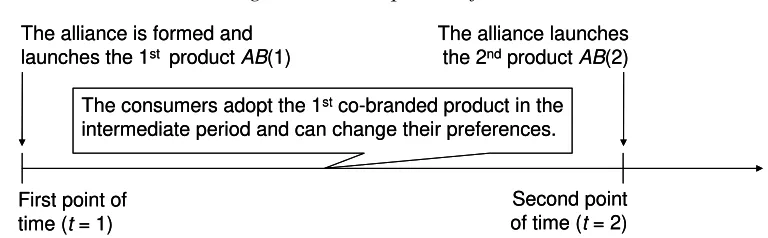
in-terest. Moreover, we consider two points of time as well as the intermediate period between
both. At the first point of time (t = 1), the alliance is formed by brand A and B and releases the
first co-branded product AB(1). Brand A and B are assumed to stop introducing their own
products after having started the partnership. At the second point of time (t = 2), the alliance
releases the second co-branded product AB(2). We further assume that a preference change
will only occur after having purchased the first co-branded product (Simonin and Ruth, 1998)
in the intermediate period, and the consumer preferences at time t = 1 are not affected by
co-branding. The sequence of events is summarized in Figure 3.
Figure 3: The sequence of events
Besides, the considered market is assumed to comprise several market segments. The
con-sumers belonging to one segment prefer one specific brand. At the first point of time, we
ca-tegorize the segments into two groups: One group is composed of those segments preferring
the partnering brands (segment A and B) and the other includes the segments preferring the
competing brands (segment Y and Z). Since the rationale of preference change is identical for
each of the segments in the same group, we only focus on the process of preference change in
Brand A Brand B
Brand A Brand B
Brand A Brand B
S2 S3 S3 S2
Prior attitude
Post-exposure attitude
Attitude toward the co-brand AB
S4 S4
Prior attitude
Post-exposure attitude S1
Brand A Brand B
Brand A Brand B
Brand A Brand B
S2 S3 S3 S2
Prior attitude
Post-exposure attitude
Attitude toward the co-brand AB
S4 S4
Prior attitude
Post-exposure attitude S1
First point of time (t = 1)
Second point of time (t = 2) The alliance is formed and
launches the 1st product AB(1)
The alliance launches the 2ndproduct AB(2)
The consumers adopt the 1stco-branded product in the
intermediate period and can change their preferences.
First point of time (t = 1)
Second point of time (t = 2) The alliance is formed and
launches the 1st product AB(1)
The alliance launches the 2ndproduct AB(2)
The consumers adopt the 1stco-branded product in the
[image:7.595.104.488.524.643.2]segment A and Z in the next sections.
4.1 The Preference Change in Segment A
At time t = 1 all consumers belonging to segment A have a favorable prior attitude toward
brand A and therefore prefer this brand. The preference change in segment A can be explained
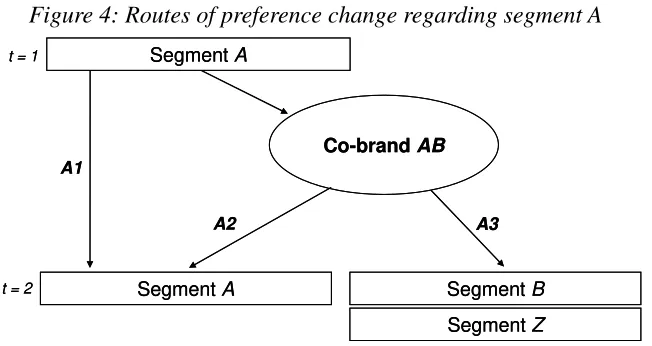
[image:8.595.140.466.187.360.2]by three routes (see Figure 4).
Figure 4: Routes of preference change regarding segment A
4.1.1 Route A1
We argue that a certain fraction of the consumers in segment A have a stable preference at
time t = 2. This stable preference results from their extremely favorable prior attitude toward
brand A. In other words, a significant positive extension effect (according to S2) dominates the
evaluation process. Two supporting arguments are provided below.
The first argument is related to brand familiarity, which can be defined as “the number of
product-related experiences (product usage) that have been accumulated by consumers” (Alba
and Hutchinson, 1987). Based on this definition, those consumers with an extremely favorable
prior attitude toward brand A also have a significant prior purchase experience regarding this
brand.5 Since brand familiarity can positively moderate the impact of prior attitude on post-exposure attitude (Simonin and Ruth, 1998), a high level of brand familiarity will lead to
stable preferences.
The second argument is related to brand loyalty. A favorable prior attitude implies brand
loyalty (Dyson et al., 1996). Those consumers who have an extremely favorable prior attitude
toward brand A can be assumed to be completely loyal to this brand. It is commonly
recog-nized that brand loyalty is highly resistant to change (Blackwell et al., 2005). Therefore, the
respective consumers are the most unlikely to change their brand attitudes after experiencing
the co-branded product AB, because they will ignore the potential inconsistent information
and defend their well-established attitudes (Smith and Mackie, 2007). Therefore, an extremely
favorable prior attitude toward brand A results in a stable preference.
4.1.2 Route A2 and A3
Segment A
Segment A
t = 1
t = 2
Co-brand AB
A3
Segment B
Segment Z
A1
A2 Segment A
Segment A
t = 1
t = 2
Co-brand AB
A3
Segment B
Segment Z
A1
Although the remaining consumers of segment A also have a favorable prior attitude toward
brand A, their attitudes are more amenable to change compared to those of the completely
loyal consumers (Swaminathan et al., 2001). Hence, at time t = 2, their preferences may stay
with brand A or switch to another brand depending on the different levels of perceived
prod-uct and brand fits.
If the respective consumers perceive a better fit from the alliance, a positive mutual effect
will exist and, subsequently, the consumers will have a favorable attitude toward the co-brand
AB (S1) as well as a positive reciprocal effect toward brand A (S4). The resulting favorable
post-exposure attitude implicates that the consumers still prefer brand A (route A2).
However, if the consumers perceive a poorer fit, their post-exposure attitudes toward brand
A will be unclear. The negative mutual effect (originated from a poorer fit), together with the
positive extension effect (S3), will influence their attitude toward co-brand AB (S1). The
inter-play may generate a favorable or an unfavorable attitude toward the co-brand and yield a
pos-itive or negative reciprocal effect (S4) on brand A.
Hence, consumers may still prefer brand A (route A2) because the rank order of their
atti-tudes at time 2 is the same as that at time 1. On the other hand, it is also possible that their
at-titude toward brand A is adversely affected and thus the rank order of their attitudes changes.6 In this case, the preference is likely to shift to any other competing brand (say, brand Z) or to
stay with brand B (route A3). The latter is called the “shift-in preference” (Venkatesh et al.,
2000) which means that some consumers shift their preferences from one brand to its partner.
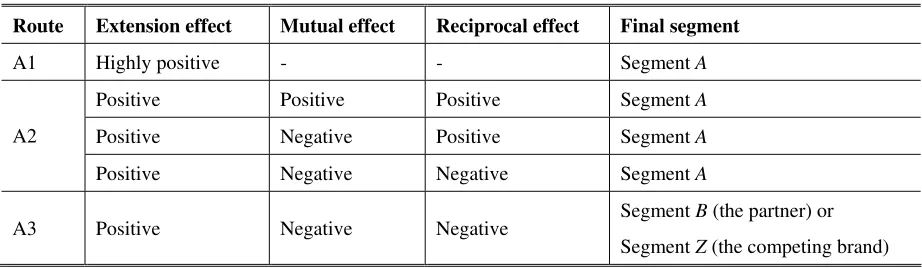
Table 1 summarizes the interaction of the three effects and the preference change in segment
[image:9.595.67.528.489.623.2]A.
Table 1: Preference change in segment A
Route Extension effect Mutual effect Reciprocal effect Final segment
A1 Highly positive - - Segment A
Positive Positive Positive Segment A
Positive Negative Positive Segment A
A2
Positive Negative Negative Segment A
A3 Positive Negative Negative Segment B (the partner) or
Segment Z (the competing brand)
4.2 The Preference Change in Segment Z
At time t = 1, all consumers belonging to segment Z have a favorable prior attitude toward
brand Z and therefore prefer this brand. Their preferences may also change at time t = 2.
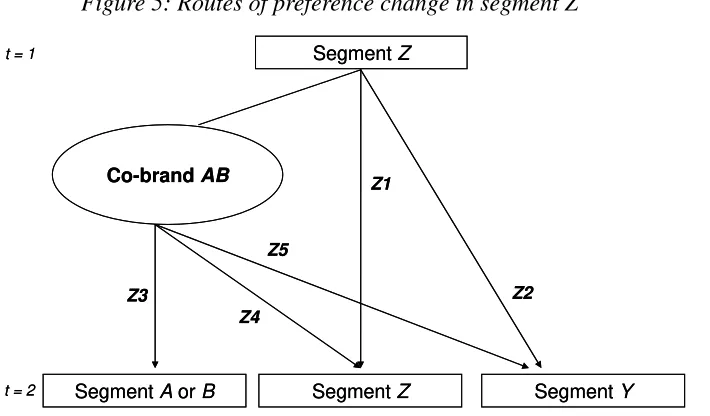
Ac-cording to Figure 5, we can use five routes to explain the phenomenon of preference change.
4.2.1 Route Z1 and Z2
well-established attitude toward brand Z. Hence, these consumers’ preferences are stable
(route Z1). Besides, some members of segment Z are not aware of co-brand AB and may shift
their preferences to one of the remaining (but not explicitly considered) brands named Y in
[image:10.595.133.488.157.365.2]our example due to variety seeking (route Z2).
Figure 5: Routes of preference change in segment Z
4.2.2 Route Z3, Z4 and Z5
The rest of the consumers in segment Z are assumed to purchase the first co-branded
prod-uct AB(1) in the intermediate period. In this case, the possibility of staying with brand Z
depends on the interaction of the strength of the three main effects. If these consumers have a
favorable attitude toward co-brand AB, a positive reciprocal effect on one of the allying
brands A or B will exist (S4). Besides, if these consumers have a favorable prior attitude
to-ward brand A, they will have a favorable post-exposure attitude toward this brand (S2).
Accordingly, their attitude toward brand A will be enhanced and the rank order of the brand
attitudes may change. Their preference is likely to stay with brand A (route Z3).
On the contrary, if the consumers have an unfavorable attitude toward co-brand AB, a
nega-tive reciprocal effect will exist and dilute their attitude toward brand A and B. Thus, their
pre-ferences will not stay with brand A or B at time t = 2.7 Depending on the rank order of their attitudes, the preferences may stay with brand Z (route Z4) or shift to a different competing
brand Y (routeZ5).
4.3 An Application: Preference Change in a Three-brand Scenario
Let us now assume that the market of interest consists of exactly three brands: A, B, and Z.
Brand A and B are supposed to form a co-branding partnership while brand Z is the competing
brand. Each brand is assumed to be preferred by one segment (e.g., segment A prefers brand
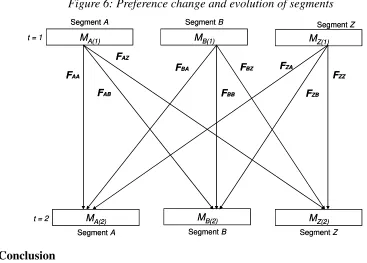
A), and each consumer prefers only one brand at a certain point of time. Besides, MA(1), MB(1)
and MZ(1) denote the sizes of segment A, B and Z at time t = 1; MA(2), MB(2) and MZ(2) represent
the counterparts at time t = 2.
Segment Z
Segment Aor B
t = 1
t = 2
Co-brand AB
Z2 Z3
Z1
Segment Z Segment Y
Z4 Z5
Segment Z
Segment Aor B
t = 1
t = 2
Co-brand AB
Z2 Z3
Z1
Segment Z Segment Y
The relationship between preference change and segment size can then be explained as
fol-lows: Co-brand AB is formed at time t = 1 and the consumers belonging to the three segments
may change their preferences at time t = 2. If so, segment size MA(2) of brand A will be
com-posed of three parts, namely FAA, FBA, and FZA. Here, FAA refers to the proportion of
con-sumers who stay with segment A, whereas FBA and FZA denote the proportions of
consum-ers who shift their preferences from brand B or Z to A. The same explanations can be applied
to the notations of segment B and Z. Figure 6 concludes this evolution and provides a
simpli-fied basis for deepening behavioral studies in co-branding (e.g., in a quantitative respect as
[image:11.595.97.464.245.508.2]suggested by Venkatesh et al. (2000)).
Figure 6: Preference change and evolution of segments
5. Conclusion
5.1 Discussions
The incentive for a company to form a co-branding alliance is to gain an “added value”
from the partnership. This “added value”, among others, can consist of the opportunity for one
of the partnering brands to build up its brand awareness at the other’s customer base
(Kippenberger, 2000; Leuthesser et al., 2003). For instance, the co-branded credit card
Citibusiness / AAdvantage not only enables American Airlines (AA) to build up its brand
awareness in Citibank’s customer base but also provides an opportunity for Citibank to gain
more transactions from flight tickets purchased by AA’s customers who want to save the extra
miles. However, if the above example is presented in the same product category, Venkatesh et al.
(2000) argue that the added value could cause consumers’ preference change (shift-in
prefer-ence) and the subsequent endogenous competition on consumer preferences. Finally, the
alli-ance may end up because of one brand’s loss in preference share. Hence, the preference
change plays an essential role in analyzing the success of alliance formation. This analysis
provides the grounds of preference change and takes an initial step toward the understanding
of the connection between consumer evaluation and alliance success (e.g., for adapting the
t = 1
t = 2
MA(1) MB(1)
FAA
MA(2) MB(2) MZ(2)
MZ(1)
FAZ
FAB
FBA
FBB
FBZ FZA
FZB
FZZ
Segment A Segment B Segment Z
Segment A Segment B Segment Z
t = 1
t = 2
MA(1) MB(1)
FAA
MA(2) MB(2) MZ(2)
MZ(1)
FAZ
FAB
FBA
FBB
FBZ FZA
FZB
FZZ
Segment A Segment B Segment Z
Venkatesh et al. (2000) model).
5.2 Future Research Directions
Several questions are left for future research. First, we did not include the influence of a
brand’s positions into our analysis (e.g., Sony-Ericsson or Ericsson-Sony), although the order
of the brand names can be assumed to influence consumers’ attitudes toward the co-brand and
the allocation of the reciprocal effect (Park et al., 1996). Future research could address this
issue. Secondly, we did not discuss the role that brand familiarity plays in consumers’
evalua-tion of co-branding. Simonin and Ruth (1998) conclude that brands with different levels of
familiarity have unequal contributions to the formation of the composite concept which
in-volves an asymmetric reciprocal effect. One can then use the level of brand familiarity as a
weight to moderate the contributions to the alliance and the reciprocal effects on each partner.
Thirdly, we did not fully address the fit between the current and the co-branded products
be-cause we simply assumed that a better fit exists within our definition of co-branding. Finally,
when adapting the Venkatesh et al. (2000) model, one can utilize our analysis and add
attrib-utes for each brand to explore the relationship between consumers’ evaluation and alliance
success.
Endnotes
1. We use allying brands and partnering brands interchangeably.
2. Information integration (Anderson, 1981), attitude accessibility (Fazio, 1989), and context
ef-fect (Lynch et al., 1991) provide a meaningful foundation to illustrate consumers’ attitude
change in co-branding.
3. Here, the term “attitude change” refers to the changes of existing attitudes toward the parent
(partnering) brands.
4. Lafferty et al. (2004) examine the prior attitude in a cause-brand alliance.
5. As already mentioned, the prior attitude can be measured by prior purchase experience (see
Swaminathan, 2003).
6. This implies that the degree of favorability of brand A is lower than other brands and thus the
rank order is changing.
7. This result is a logical consequence of the preceding reasoning. Since the consumers’ initial
preference is brand Z and their attitude toward brand A (B) is diluted at time t = 2, they will
definitely not stay with brand A (B).
References
Aaker, D. A. and K. L. Keller (1990), “Consumer Evaluations of Brand Extensions,” Journal
of Marketing, 54 (1), 27-41.
Alba, J. W. and W. J. Hutchinson (1987), “Dimensions of Consumer Expertise,” Journal of
Anderson, N. H. (1981), Foundation of Information Integration Theory. New York: Academic
Press.
Bass, F. M. and W. W. Talarzyk (1972), “An Attitude Model for the Study of Brand
Prefer-ences,” Journal of Marketing Research,9(1), 93-96.
Blackwell, R. D., P. W. Miniard and J. F. Engel (2005), Consumer Behavior (10th ed.). Mason, Ohio:Thomson South-Western.
Boo, H. C. and A. Mattila (2002), “A Hotel–restaurant Brand Alliance Model: Antecedents
and Consequences,” Journal of Foodservice Business Research, 5(2), 5-24.
Bouten, L. (2006), “Co-branding in New Product Development,” 19th EMAC Doctoral
Col-loquium, University of Economics and Business, Athens.
Dyson, P., A. Farr and N. Hollis (1996), “Understanding, Measuring, and Using Brand
Eq-uity,” Journal of Advertising Research, 36(6), 9-21.
Fazio, R., M. Powell and C. Willams (1989), “The Role of Attitude Accessibility in the
Atti-tude-to-Behavior Process,” Journal of Consumer Research, 16, 280-288.
Hadjicharalambous, C. (2006), “A Typology of Brand Extensions: Positioning Cobranding As
a Sub-Case of Brand Extensions,” Journal of American Academy of Business, 10(1),
372-377.
James, D. O., M. Lyman and S. Foreman (2006), “Does the Tail Wag the Dog? Brand
Person-ality in Brand Alliance's Evaluation,” Journal of Product and Brand Management, 15 (3),
173-183.
Kippenberger, T. (2000), “Co-branding as A New Competitive Weapon,” The Antidote, 5(6),
12-15.
Kotler, P. and K. L. Keller (2006), Marketing Management (12th ed.). Upper Saddle River: Prentice Hall.
Kumar, P. (2005), “The Impact of Cobranding on Customer Evaluation of Brand
Counterex-tensions,” Journal of Marketing, 69(3), 1-18.
Lafferty, B. A., R. E. Goldsmith and G. T. M. Hult (2004), “The Impact of the Alliance on the
Partners: A Look at Cause-brand Alliances,” Psychology and Marketing, 21, 509-531.
Lane, V. R. and R. Jacobson (1997), “The Reciprocal Impact of Brand Leveraging: Feedback
Effects from Brand Extension Evaluations to Brand Evaluation,” Marketing Letters, 8 (3),
261-271.
Leuthesser, L., C. Kohli and R. Suri (2003), “2+2=5? A Framework for Using Co-branding to
Leverage a Brand,” Brand Management, 11(1), 35–47.
Changes in Mental Representations or in the Anchoring of Rating Scales?,” Journal of
Consumer Research, 18(3), 284-297.
Norris, D. G. (1992), “Ingredient Branding: A Strategy Option with Multiple Beneficiaries,”
Journal of Consumer Marketing, 9(3), 19-31.
Park, C. W., S. Y. Jun and A. D. Shocker (1996), “Composite Branding Alliances: An
Investi-gation of Extension and Feedback Effects,” Journal of Marketing Research, 33(4),
453-466.
Rao, A. R. and R. W. Ruekert (1994), “Brand Alliances as Signals of Product Quality,” Sloan
Management Review, 36(1), 87-97.
Simonin, B. L. and J. A. Ruth (1998), “Is A Company Known by the Company It Keeps?
As-sessing the Spillover Effects of Brand Alliances on Consumer Brand Attitudes,” Journal
of Marketing Research, 35(1), 30-42.
Smith, E. R. and D. M. Mackie (2007), Social Psychology. New York: Psychology Press.
Swaminatham, V. (1999), “Do Co-branding Strategies Influence Brand Choice? An Empirical
Analysis,” American Marketing Association – Conference Proceedings. Chicago:
ABI/INFORM Global.
Swaminathan, V. (2003), “Sequential Brand Extensions and Brand Choice Behavior,” Journal
of Business Research, 56, 431-442.
Swaminathan, V., J. F. Richard and S. K. Reddy (2001), “The Impact of Brand Extension
In-troduction on Choice,” Journal of Marketing, 65(4), 1-15.
Venkatesh, R., V. Mahajan and E. Muller (2000), “Dynamic Co-Marketing Alliances: When
and Why Do They Succeed or Fail?,” International Journal of Research in Marketing, 17,
3-31.
Zeithaml, V. A. (1988), “Consumer Perceptions of Price, Quality and Value: A Means-end