
International Journal of Emerging Technology and Advanced Engineering
Website: www.ijetae.com (ISSN 2250-2459, Volume 2, Issue 11, November 2012)560
Enhancing Data Delivery with Path Predictable Mobile
Observer in Wireless Sensor Networks
Queen.R
1, Renganayagi.G
2, Anne Persial.P
3 1,2,3Assistant Professor, Einstein College of Engineering, Tamilnadu
Abstract—The recent advances in processor, memory, and
radio technology have enabled the development of distributed networks of small, inexpensive nodes that are capable of sensing, computation, and wireless communication. Sensor networks of the future are envisioned to revolutionize the paradigm of collecting and processing information in diverse environments. However, the severe energy constraints and limited computing resources of the sensors, present major challenges for such a vision to become a reality. Here present a novel data collection scheme called Greatest Amount Shortest Path (GASP), that optimizes the data collection path to minimize the energy consumption, under the condition, that the total amount of data collected by the mobile observer is maximized. In order to reduce the computational complexity, all nodes are partitioned into several groups with respect to their locations. Then, within a single group, the GASP scheme generates to get the optimal assignment of sensors. In addition this paper proposes an optimal partition scheme of the overlapping time of nodes. Due to the spatial correlation between sensor nodes subject to observed events, it may not be necessary for every sensor node to transmit its data. So it proposes a scheme to exploit the spatial correlation of data in a wireless sensor network, in a way so as to reduce the number of transmissions in the network and then significantly improve energy efficiency.
Keywords— Constrained path, data delivery ratio, energy
consumption, mobile observer, wireless sensor networks.
I. INTRODUCTION
Wireless sensor networks (WSNs) have received a lot of attention in recent years due to their potential applications in various areas such as environment monitoring or tracking. In order to get useful and up-to-date information from the environment, the network is composed of a large number of low-capacity (processor, memories, battery) sensors. As the number of sensors increases, the amount of data in the network also increases. The data generated by the sensors has, then, to be sent to a central entity, called sink, for storage and processing. Thanks to the wireless communication capabilities and the protocols developed in the literature, multi-hop transmissions can be used to route data from a sensor to the sink if no direct connection is available.
However, the mobile observer picks up the data from the sensors when in close range to the gateways these communication paradigms rapidly consumes the energy of intermediate sensors and reduce the amount of transiting data in the network. Therefore, data collection becomes a key issue in wireless sensor networks.
Based on these, this paper focuses on high dense WSNs with path-constrained mobile observer that may exist in real world applications, such as ecological environment monitoring and health monitoring of large buildings. In this paper, multiple mobile elements are used for the purpose of data collection. Here consider a scenario where nodes periodically transfer data through multi-hop routes towards the sink, while the sink intermittently changes its position according to certain predefined traces. It proposes a routing protocol, GASP, dedicated to support sink mobility.
All nodes in the monitored region can be divided into two classes, sub-sinks and members. The former consists of nodes closer to the path of mobile observer which can transmit data to the mobile observer directly. For members, the data must be relayed to specific sub-sinks which buffer data and complete the final data transmission to the mobile observer. Each member needs to choose one and only one sub-sink as its destination. Then all data is sent or forwarded along the routing trees to the roots that consist of the sub-sinks. We assume that the speed of the mobile observer is much slower than the data travels within sensor networks. The data transmission time between the sub-sinks and the mobile observer is negligible. We also assume that mobile observer is aware of the physical locations of all nodes. Simulation experiments under Network simulator 2 is conducted to validate effectiveness of the presented formulations and algorithms by calculating the energy consumption and data delivery ratio.
International Journal of Emerging Technology and Advanced Engineering
Website: www.ijetae.com (ISSN 2250-2459, Volume 2, Issue 11, November 2012)561 To describe the sink mobility and bring significant potential advantages for energy efficiency, several algorithms and protocols have been proposed. In [4], a theoretical framework is developed to model Sensor Networks with Mobile Sinks (MSSNs). Based on this sink mobility can improve the performance of WSNs. In [6], [15], mobile sinks are mounted on some people or animals moving randomly to collect information of interest sensed by the sensor nodes where the sink trajectories are random. In the scenarios where the trajectories of the mobile sinks are constrained or predetermined as in [8], [9], efficient data collection problems are often concerned to improve the network performance. In [4], [7], path constrained sink mobility is used to improve the energy efficiency of single hop sensor networks which may be infeasible due to the limits of the path location and communication power. In [9], [13], the authors propose multi hop sensor networks with a path-constrained mobile sink where the Shortest Path Tree (SPT) method is used to choose the cluster heads and route data that may result in low energy efficiency for data collection.
To facilitate the efficient data collection and expand deployment in large scale, it can be envisioned that sensor networks will consist of multiple sink nodes. For these reasons, here concentrate our attention on spatially correlated data collection in multi-sink scenario. As shown before, most of related work in this field focuses on the data collection with one sink, and only few works is multi-sink supported. Different from prior work, we exploit spatial correlation in multi-sink scenario by selecting a sub sink according to the coverage region between nearby nodes.
II. PROJECT WORK
A. Assignment of sensors
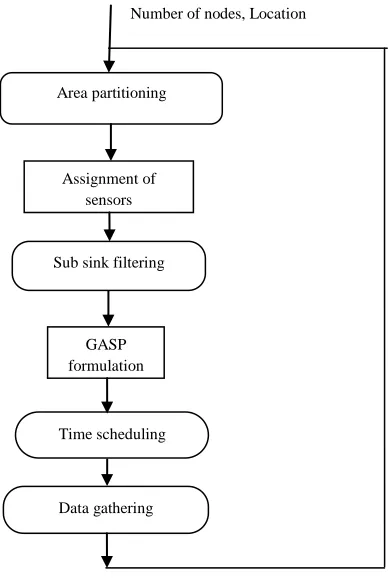
[image:2.612.352.547.137.426.2]Main aim of the movement of mobile observer include find the routing information and the data collection. To complete this, mobile observer is moved in two directions. In forward path the mobile observer transmits broadcast messages continuously. All nodes receiving the broadcast messages from the mobile observers are automatically selected as sub sinks. AODV routing protocol is used to select the one hop member. Then the sub sinks start building the shortest path trees (SPTs) rooted from them to entire network.
Fig. I Methodology of communication model
As a result each node keeps shortest hop information from them to entire network and then sends the related hop information to the corresponding sub sink. Sub sink will transmit the hop information to the mobile observer. Mobile observer needs to record the time when each node enters and leaves its communication range. For the mobile observer, the data collection process in the forward direction and reverse direction are symmetrical. So only the time records in the forward direction are needed. Then sub sinks send the shortest hop information collected to the mobile observer it passes by. Due to high density of sensor nodes, there is often more than one node simultaneously located within the direct communication area of the mobile observer which is called overlapping. Different overlapping time scheduling methods may indirectly affect the energy consumption of entire network. The mobile observer calculates the length of the communication time allocated to each sub sink according to the optimal sharing overlapping.
Assignment of sensors
Time scheduling
SCHEDULING
Area partitioning
Sub sink filtering
GASP formulation
Data gathering
GATHERING
International Journal of Emerging Technology and Advanced Engineering
Website: www.ijetae.com (ISSN 2250-2459, Volume 2, Issue 11, November 2012)562 Here we get the shortest hop matrix and the Minimum or maximum requirement of member information that is necessary for the GASP calculation. Finally, we get the optimized assignment between all members and sub sinks. Mobile observer broadcast the results of member assignment to the monitored area.
In reverse path, all nodes start collecting data from the monitored area. The members send the sensed data to the destination sub sinks according to the routing table. Sub sinks preaches all data from their members and they before the mobile enter into the communication range. During the actual data collection, we adopt a handoff method to partition the overlapping time which is one consistent with the one used in forward path.
B.Node optimization
Energy conservation is of dominant importance in sensor networks. The main sources of energy wastage are produced by more sinks are located in the same coverage region. Mostly, they collect the same information from the monitored area. In this paper, for this purpose, we go to the Node Optimization (NO). In First centre point of coverage region of sub-sinks are found. Let us assume that, distance between two centre points is d. If the value of d is less than or equal to 150m, Consider these two are placed in same coverage area. Then coverage ratio is more than 80%, we choose any one sink as optimal sink having more number of members.
C.Area partitioning
In this section, the network is divided into several regions. Each node only knows the node connectivity within its region and the region connectivity of the whole network. The regional level topological information is distributed to all nodes. So it proposes an algorithm to build shortest path trees based on area partitioning. Through area partitioning, we can divide the whole monitored area into several regions.
The mobile observer transmits type 1 broadcast message to start the sub sink selection and area partitioning. If nodes receive the type 1 broadcast message, can be selected as a sub sink. All nodes transmit or forward type 2 broadcast messages to build the Shortest Path Trees (SPTs) rooted from the sub sinks to the members in each zone. And the SPTs in different regions do not cross each other.
If nodes receive the type 2 broadcast messages, if the routing table is empty, add a new entry to the routing table with source address, number of shortest hops and region id.
In case no corresponding route entry adds a new entry to the routing table with source address, number of shortest hops and region id. Compare the present hop number with past. Then update the route entry with minimum hop number. Ignore others.
Each node keeps two global variables, Local region and Min Hop. Local region indicates the ID of the area that current node belongs to. And Min Hop is the shortest hop from current node to all sub sinks. At the beginning, the mobile observer sends type 1 broadcast messages continuously, in which region ID is changed according to the movement time and the number of regions. In order to avoid the loss of some routing information and keep the SPTs accurate, the routing information from all area is buffered during the region partitioning, which brings more cost and needs more buffer to cache route entries. After executing Algorithm, each node will delete the route entries whose region is different from Local region, because the members only need to communicate with its neighbours within the same region.
D.Time scheduling
In high density sensor networks, sometimes more than one node comes under the direct communication area of the mobile observer. This is called as overlapping. To reduce the overlapping, we plan to implement the time scheduling method. When the node receives the signal from the mobile observer, it enters into the communication range i.e. starting time. When the node out off the signal from the mobile observer, it leaves the communication range i.e. end time. The vectors of the start time and the end time between the sub sinks and the mobile observer are sorted in the ascending order.
The communication time between the mobile observer and all sub sinks can be divided into time intervals by the elements. The length of the time allocated to each sub sink in each time interval of the vector is arranged into matrix form. The matrix is the objective variable of our overlapping time scheduling problem.
International Journal of Emerging Technology and Advanced Engineering
Website: www.ijetae.com (ISSN 2250-2459, Volume 2, Issue 11, November 2012)563 That is, it needs to find an optimal partition matrix of overlapping time, which may help to improve the data equilibrium and reduce the energy consumption.
E.Gasp formulation
Main aim of optimization is to maximize the total amount of data collected by the mobile observer. Actually, the calculation of total amount of data is related to the node density of the whole network. For example, if there are too many nodes in the monitored area, it is impossible for the mobile observer to collect all data sensed by the nodes due to the limit of total length of the communication time. Considering that the network density and members assigned to the sub sink is greater than or equal to the requirement on the number of members associated with sub sink for high density network. Members assigned to the sub sink is less than or equal to the requirement on the number of members associated with sub sink for low density network.
Finally each member node knows the shortest hop information from itself to all sub sinks and the number of members required by each sub sinks. Then GASP algorithm is executed by each member to choose a sub sink. Weight value is to calculate the priority of each sub sink, which reflects the probability of being selected as the final destination. Small value of weight vector denotes that the hop information has a higher priority than minimum requirement of member in choosing the sub sink.
F.Data gathering
Data gathering is an operation to collect the set of raw data items from all sensor nodes to the sink node. Mobile observer starts its round and stores the routing table information in an array. After the completion of the forward path by the mobile observer, then return back. Sub sinks preaches all data from their members and themselves before the mobile observer enters into the communication range. During the mobile observer enter into the time allotted period; nodes in the corresponding area deliver the data to the mobile observer.
III. RESULTS
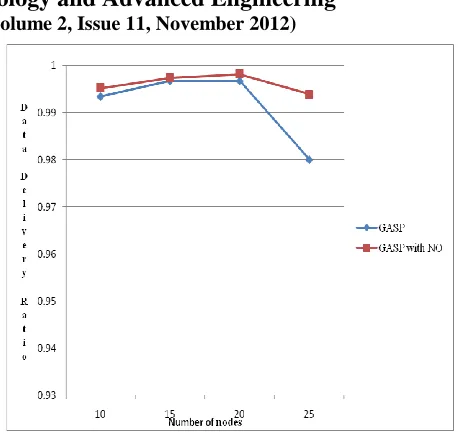
[image:4.612.329.558.113.332.2]This section presents the evaluation of the GASP scheme implemented in NS2. In the simulation experiments, 25 sensor nodes are placed in a monitored rectangular area randomly and uniformly. Metrics of energy consumption of all nodes and data delivery ratio are observed to evaluate the performance of the GASP scheme.
Fig. II Data Delivery Ratio for different number of nodes
Data delivery ratio (DDR) is defined as the ratio of the total amount of data transferred to the access-points to the total amount of data generated. . Ideally, DDR will be one. Data may be lost because of errors in radio communication, failure of mobile observer or buffer overflows. It evaluates the performance under the new scenarios with multiple mobile observers.
The figure III shows that energy consumption is decreased when it has using Node optimization method. The increasing amount of sinks can shorten the distance between the sensor nodes and the sinks.
[image:4.612.330.560.482.663.2]International Journal of Emerging Technology and Advanced Engineering
Website: www.ijetae.com (ISSN 2250-2459, Volume 2, Issue 11, November 2012)564 Here the number of mobile observers is changed from 1 to 2. Due to multiple observers, the average hops for each member to its sub sink is decreased and the total energy consumption of the sensor network is reduced significantly.
IV. CONCLUSION
We proposed an enhanced data delivery scheme called GASP in wireless sensor networks with path-constrained mobile observer. In GASP, the optimization of correlating sensor nodes with sub sinks is used to maximize the amount of data delivered to mobile observer and reduces
the energy consumption. Also the computational
complexity is reduced by area partitioning and time scheduling scheme. By implementing these techniques produce more redundant data transmission in wireless sensor networks and this factor can be defeated with the effect of Node Optimization. By the assistance of Node Optimization spatial correlation is achieved and only a small subset of sensor nodes is selected to upload their data to the observer. This can improve the energy efficiency drastically with the available battery power.
REFERENCES
[1] Shuai Gao, Hongke Zhang, and Sajal K.Das, Senior Member, IEEE , ―Efficient Data Collection in wireless Sensor Networks with Path-Constraint Mobile Sinks,‖ IEEE Transactions on Mobile computing, vol. 10, No.5. 2011. .
[2] X. Xu, J. Luo, and Q. Zhang, ―Delay tolerant event collection in sensor networks with mobile sink,‖ in INFOCOM, San Diego, CA, USA, 2010.
[3] S. Pattem, B. Krishnamachari, and R. Govindan, ―The impact of spatial correlation on routing with compression in wireless sensor networks,‖ ACM Trans. Sensor Networks(TOSN), vol. 4, no. 8, pp. 24–33, 2008.
[4] L. Song and D. Hatzinakos, ―Architecture of Wireless Sensor Networks with Mobile Sinks: Sparsely Deployed Sensors,‖ IEEE Trans. Vehicular Technology, vol. 56, no. 4, pp. 1826-1836, July 2007.
[5] C. Liu, K.Wu, and J. Pei, ―An energy-efficient data collection framework for wireless sensor networks by exploiting spatiotemporal correlation,‖IEEE Trans. Parallel Distrib. Syst., vol. 18, no. 7, pp. 1011–1023, 2007.
[6] S. Jain, R.C. Shah, W. Brunette, G. Borriello, and S. Roy, ―Exploiting Mobility for Energy Efficient Data Collection in Sensor Networks,‖ Mobile Networks and Applications, vol. 11, no. 3, pp. 327-339, 2006.
[7] A. Chakrabarti, A. Sabharwal, and B. Aazhang, ―Communication power Optimization in a Sensor Network with a Path-Constrained Mobile Observer,‖ ACM Trans. Sensor Networks, vol. 2, no. 3, pp. 297-324, Aug. 2006.
[8] J. Luo, J. Panchard, M. Piorkowski, M. Grossglauser, and J. Hubaux, ―MobiRoute: Routing towards a Mobile Sink for Improving Lifetime in Sensor Networks,‖ Proc. Second IEEE/ ACM Int’l Conf. Distributed Computing in Sensor Systems (DCOSS), pp. 480-497, 2006.
[9] A. Somasundara, A. Kansal, D. Jea, D. Estrin, and M. Srivastava, ―Controllably Mobile Infrastructure for Low Energy Embedded Networks,‖ IEEE Trans. Mobile Computing, vol. 5, no. 8, pp. 958-973, Aug. 2006.
[10] Y.Gu, D. Bozdag, R. Brewer, and E. Ekici, ―Data Harvesting with Mobile Elements in Wireless Sensor Networks,‖ Computer Networks, vol. 50, no. 17, pp. 3449-3465, 2006.
[11] R.Cristescu, B. Beferull-Lozano, M. Vetterli, and R. Wattenhofer, ―Network correlated data gathering with explicit communication: Npcompleteness and algorithms,‖ IEEE/ACM Trans. Netw., vol. 14, no. 1, pp. 41–54, 2006.
[12] H. Gupta, V. Navda, S. Das, and V.Chowdhary, ―Efficient gathering of correlated data in sensor networks,‖ in MobiHoc, Urbana-Champaign, Illinois, USA, May 2005.
[13] A.Kansal, A. Somasundara, D. Jea, M. Srivastava, and D. Estrin, ―Intelligent Fluid Infrastructure for Embedded Networks,‖ Proc. ACM MobiSys, pp. 111-124, 2004.
[14] M. Vuran, O. Akan, and I. Akyildiz, ―Spatio-temporal correlation: theory and applications for wireless sensor networks,‖ Computer Networks, vol. 45, pp. 245–259, 2004.
[15] R.C. Shah, S. Roy, S. Jain, and W. Brunette, ―Data MULEs: Modeling a Three-Tier Architecture for Sparse Sensor Networks,‖ Proc. First IEEE Int’l Workshop Sensor Network Protocols and Applications, pp. 30-41, 2003.
![[(1R) 3 Benzoyl 1,7,7 trimethylbicyclo[2 2 1]heptan 2 onato κ2O,O′]chlorido(η6 p cymene)ruthenium(II)](data:image/gif;base64,R0lGODlhAQABAIAAAP///wAAACH5BAEAAAAALAAAAAABAAEAAAICRAEAOw==)