A Comparative Study on Clay and Red Soil Based
Geopolymer Mortar
M.N. Uddin
1,*, V. Saraswathy
21M.Tech, Centre for Green Energy Technology, Pondicherry University, India
2Corrosion & Materials Protection Division, CSIR-Central Electrochemical Research Institute, India
Copyright©2018 by authors, all rights reserved. Authors agree that this article remains permanently open access under the terms of the Creative Commons Attribution License 4.0 International License
Abstract
Geopolymer mortar is cement less which is gaining popularity globally towards the sustainable development. It can be produced from mineral admixtures such as fly ash, clay, red soil with user-friendly alkaline-reagents. Production of Ordinary Portland Cement (OPC) requires large amount of energy as well as carbon footprint. It is shown that OPC emits approximately 5% of global CO2 emissions annually, which works out to nearly more than ½ ton of CO2 emission for every one ton production of OPC. So it is badly needed to reduce the global CO2 which has encouraged the researchers to search alternative sustainable building materials those are available in locality with lower embodied energy and carbon dioxide emissions. Clay and red soil are the best selection for that and both are usable as an eco-friendly building materials also available in locality. So an attempt has been made to explore the possibility of using clay and red soil based mortar in construction industry. The composition and microstructure were characterized by x-ray fluorescence (XRF), scanning electron microscopy (SEM) &particle size analyzer. Studies were carried out for both materials with respect to compressive strength, ultrasonic pulse velocity, effective porosity and co-efficient of absorption. The results indicated that geopolymer mortar with clay and red soil can be used as an alternate construction material in the construction industry.Keywords
Geopolymer Mortar, Clay, Red Soil,Characterization, Performance, Sustainability & Application
1. Introduction
Geopolymer term was first applied by the Davidovits[1], which is alkali aluminosilicate binders formed by the alkali silicate activation of aluminosilicate materials. Geopolymer and Alkali-activated cements are often confused, which were originally developed by
Glukhovskyin the Ukraine during the 1950s [1]. Recently research is shifting from the chemistry to engineering and commercial application of geopolymer for sustainable development. It has been shown that geopolymer concrete has good engineering properties [2]. This is a cementitious material which is better alternate to cement and it possesses the advantages of rapid strength gain, elimination of water curing, good mechanical and durability properties. Moreover it is a binder material which is produced from an alumino-silicate activated in a high alkali solution [3].
Construction is the 2nd largest industry in this world. Embodied energy, carbon emission, economy, utility, durability and comfort are the main concerns of current classical building design. Cement mortar is one of the integral parts of a building and it is one of the primary binders for classical building design to produce the mortar as well as concrete. So for, the development of infrastructure facilitates the demand of OPC is increasing day by day. Thus the use of OPC to create modern infrastructure has come at the cost of significant quantities of CO2 released to the atmosphere [4].
Chemically, OPC is a mixture of tri- and dicalcium silicate (Ca3SiO5 and Ca2SiO4, respectively; sometimes written 3CaO·SiO2 and 2CaO·SiO2 or as C3S and C2S in cement chemist’s notation) [5]. OPC production relies on the calcination of limestone (CaCO3) and silica (SiO2) at high temperatures. The production of 1 ton of cement emits roughly ½ ton of CO2 as a direct result of this chemical reaction (Hardjito, Wallah, Sumajouw, &Rangan, 2004):
5CaCO3 +2SiO2−→1450◦C Ca3SiO5+Ca2SiO4+ 5CO2 When the tri- and di-calcium silicates are hydrated, producing calcium silicate hydrates (C–S–H, in cement chemist’s notation) that are the strength-bearing phase of OPC and Ca (OH) 2:
natural resources and energy.
In the fast growing construction world it is essential to find alternatives to cement mortar and concrete for making environment friendly structure. One of the alternatives to produce more eco-friendly mortar is by-product materials such as fly ash, red soil, meta-kaolin or clay.
There are two main constituents of geopolymer mortar, source materials and the alkaline liquids. The source materials based on alumina-silicate should be rich in silicon (Si) and aluminium (Al). These are natural minerals such as kaolinite, clays, etc. or by-product materials such as red soil, fly ash, silica fume, slag, rice-husk ash [5]. The choice of the source materials mainly depends on factors such as availability, cost, and type of application and specific demand of the end users. The alkaline liquids are from soluble alkali metals that are usually sodium or potassium based. The most common alkaline liquid used in geopolymerisation is a combination of sodium hydroxide (NaOH) or potassium hydroxide (KOH) and sodium silicate or potassium silicate. [6].
This paper describes clay and red soil based geopolymer mortar. However no specific publications are available concerning the performance of red soil and clay based mortar for eco-friendly construction. So this paper is devoted to explore the possible application of red soil and clay based geopolymer mortar for sustainable construction in future practice.
2. Experimental Work
2.1. Materials Used
Clay and Red soil: Collected from Karaikudi, Tamil
Nadu was used for casting the specimen.
Fine Aggregate: Locally available River sand (local)
passing through 4.75mm mm sieve was used.
Binder: Combinations of sodium hydroxide (NaOH)
and Sodium Silicate (Na2SiO3) are employed to achieve the activation of the geopolymer mortar. The chemical composition of Sodium Silicate is: Na2O-14.922%, SiO2-43.247% and H2O -41.83% [7]. 14M concentration
binder was used with a fixed binder to soil ratio 0.4. Water: Portable water is used with pH 7 to 8.5; Cl- = 40 ppm, Hardness = 240 ppm and distilled water was used for making binder [7].
Calcium Oxide (LR grade): (1% sample weight) was
used for rapid setting of mortar.
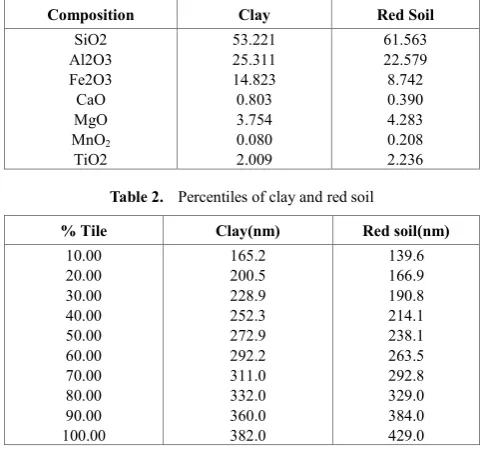
2.2. Elemental and Morphological Characterization Elemental composition of red soil and clay were determined by X-Ray Fluorescence (XRF) analysis, are given in Table 1.
Table 1. Composition of red soil and clay as determined by XRF (% Mass)
Composition Clay Red Soil
SiO2 Al2O3 Fe2O3 CaO MgO MnO2
TiO2
53.221 25.311 14.823 0.803 3.754 0.080 2.009
[image:2.595.300.543.254.481.2]61.563 22.579 8.742 0.390 4.283 0.208 2.236
Table 2. Percentiles of clay and red soil
% Tile Clay(nm) Red soil(nm)
10.00 20.00 30.00 40.00 50.00 60.00 70.00 80.00 90.00 100.00
165.2 200.5 228.9 252.3 272.9 292.2 311.0 332.0 360.0 382.0
139.6 166.9 190.8 214.1 238.1 263.5 292.8 329.0 384.0 429.0
[image:2.595.65.537.590.731.2]From Table 1 it has been observed that both clay and red soil are having more than 70% of aluminosilicate materials and can be used for making geopolymer concrete. Percentiles of clay and red soil were determined by particle size analyzer are given in Table 2. Particle size distribution for clay and Red Soil are showing in Fig.1
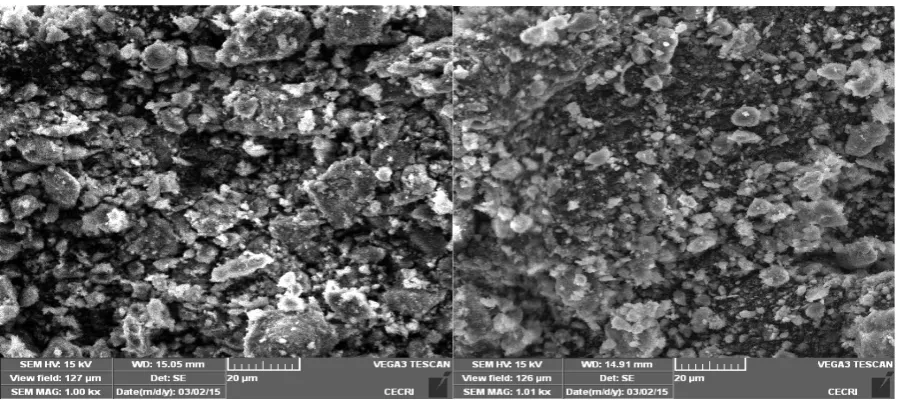
Figure 2. SEM Image of Clay (Left) and Red Soil (Right)
From Fig.1 it is observed that the particle size ranges from 165.2nm to 382nm, 139.6nm to 429nm for clay & red soil respectively. Fig.2 shows the scanning electron micrographs of red soil and clay respectively. Both particles are spongy in shape and have a wide range of particle size or diameter as depicted from particle size analyzer.
2.3. Mixing and Preparation of Specimen for Making Geopolymer Mortar
Red soil and clay with a mixture of alkaline activators namely sodium silicate and sodium hydroxide (NaOH) solution at a fixed Alkaline activator/soil ratio 0.4 were used to prepare a clay and red soil based geopolymer at constant (NaOH) concentration of 14M. Clay or red soil to fine aggregates ratio was maintained at 1:3.Total additional water for clay and red soil are approximately 12% and 6 % of total sample weight
Addition of calcium oxide was approximately 1% of sample weight. A ratio of sodium silicate solution-to-sodium hydroxide solution, by mass, of 2.5 was used [8]. The sodium silicate solution and the sodium hydroxide solution were mixed together at least 24 hours prior to casting of the specimens.
The fresh geopolymer mortar was used to cast cubes of size 50mm x 50mm x 50mm to determine its compressive strength, ultrasonic pulse velocity, water absorption as well as co-efficient of water absorption. Each cube specimen was cast in three layers by manual compaction as well as by using vibrating table. Each layer received 25-30 strokes of compaction by rod followed by further compaction on the vibrating table.
2.4. Curing and Exposure Conditions
After casting, the specimens were allowed to set for 24hrs in moulds. Then, the specimens were removed from the molds and heat cured in oven at 60-700 C for 24 hours.
After that, the specimens were cured in room temperature until they reached the 7th, 14th and 28th days of age.
3. Tests Carried Out
3.1. Ultrasonic Pulse Velocity (UPV)
UPV is a recognized non-destructive evaluation test to qualitatively asses the homogeneity and integrity of concrete and mortar. This test essentially consists of measuring travel time, T of ultrasonic pulse of 50 to 54 kHz, produced by an electro-acoustical transducer, held in contact with one surface of the concrete member under test and receiving the same by a similar transducer in contact with the surface at the other end. With the path length L, (i.e. the distance between the two probes) and time of travel T, the pulse velocity (V=L/T) is calculated [9].The cube samples were subjected to UPV test prior to compression test and the values were recorded.
3.2. Compressive Strength
The compressive strength test of concrete is one of the most important and useful properties of concrete. In most of the structural applications concrete is employed primarily to resist the compressive stresses. The compressive strength is frequently used as a measure of these properties. Mortarcube specimens of 50mmx 50mm x50mm were cast for both clay and red soil with a fixed percentage and concentration of binder. After a specified period, specimens are subjected to compression test by using universal testing machine of 100T capacity at a loading rate of 140kN/min.
3.3. Test for Water Absorption, Specific Gravity and Permeable Voids (ASTM C642-90)
50mmx50mmx50mm cube was cast. After 48hours of de-molding, the specimens were kept in air and thermal curing. At the end of curing periods, the specimens were kept in open atmosphere for surface drying. Then the specimens were dried in an oven at a temperature of 100+5°C for 48hours and allowed to an accuracy of 1 gm using a standard weighing balance.
Record the weight of dried specimens as Wd[8]. Immerse the specimens in water at room temperature (28°C) for minimum 48 hours. Then the surface moisture was removed with a towel or cotton and weighed. This weight is designated as Ws. After that the specimens were immersed in tap water in a container and boiled for 5 hr at 60 0 C. Allowed to cool for natural loss of heat for 14 hours and then surface moisture was removed and reweighed. This is designated as Wb. The suspended weight of the specimens kept in water is taken as Wi. Then the following parameters were calculated as follows:
% Water Absorption= (Ws-Wd)/Wd Bulk Sp.Gravity(Dry)=Wd/(Wb-Wi) Apparent Sp.Gravity=Wd/ (Wd-Wi) Permeable voids (%) = (Wb-Wd)/(Wb-Wi)
3.4. Co-efficient of Water Absorption
The Coefficient of water absorption test was conducted as per ASTM C642-97. This is measured by the rate of uptake water or capillary absorption of water by dry concrete over a period of 48 hours. The four sides of the cubes (50mm X50mm X 50mm) specimens were sealed with epoxy except top and bottom sides, so that the water absorption is through unidirectional & capillary action takes place from the bottom sides only. Initially the weight of the dry specimen was taken and then placed in a plastic tray filled with water up to 1/3rd height of the specimen. Then the absorption of water was measured at different time intervals [8].
This is calculated from the formula:
Coefficient of absorption Ka = (Q/A) 2 x (1/t) Where Q = Quantity of water absorbed by the oven dried specimen in time
t = 48 hours (172800 second).
A = Total surface area of concrete specimen through which water penetrates.
A lower value of Ka indicates a higher degree of imperviousness of concrete for water penetration.
4. Result & Discussion
4.1. Ultrasonic Pulse Velocity (UPV)
Bar chart showing the comparison of ultrasonic pulse
[image:4.595.304.542.136.306.2]velocity for red soil and clay based geopolymer mortar which is given in the Fig.3. It is observed that red soil based mortar has shown higher UPV value than clay based mortar.
Figure 3. Ultrasonic Pulse Velocity for red soil and clay geopolymer mortar
4.2. Compressive Strength
[image:4.595.303.541.465.515.2]The result of compressive strength 7, 14 and 14 days are obtained for clay and red soil mortar cubes are reported in Table 3. From the table, it is found that the compressive strength increase with increasing the curing period. Red soil specimen has shown higher compressive strength than clay specimen.
Table 3. Compressive strength value for red soil and clay mortar
Specimen Type
Average compressive strength (Mpa)
7 days 14 days 28 days
RGPM
CGPM 3.03 2.44 6.38 4.08 7.73 4.55
N: B:-RGPM: Red Soil Geopolymer Mortar, CGPM: Clay Geopolymer Mortar
4.3. Test for Water Absorption, Specific Gravity and Permeable Voids (ASTM C642-90)
[image:4.595.304.540.654.711.2]The results for Water absorption, Specific gravity and Permeable voids are tabulated in Table 4. From this result it is shown that red soil based mortar absorb less water as well as less voids compare to clay based mortar.
Table 4. Water absorption, Specific gravity and Permeable voids
Name of the Test Red soil Clay
Absorption of water (%) Bulk sp. Gravity (dry)
Apparent sp. Gravity Permeable voids (%)
8.0 2.02 2.57 21.4
11.13 1.95 2.78 29.85
4.4. Test for Co-efficient of Absorption
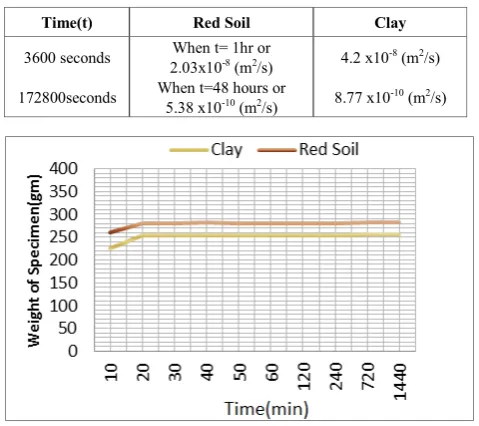
clay and red soil are presented in Table 5. From the table it is observed that, the coefficient of water absorption for red soil cube is found to be less when compared to clay. Also from Fig.4 it has shown that clay based mortar has shown higher weight gain compared to red soil mortar with a specific time interval.
Table 5. Co-efficient of absorption for red soil and clay
Time(t) Red Soil Clay
3600 seconds
172800seconds
When t= 1hr or 2.03x10⁻⁸ (m2/s)
When t=48 hours or 5.38 x10⁻¹⁰ (m2/s)
4.2 x10⁻⁸ (m2/s)
8.77 x10⁻¹⁰ (m2/s)
Figure 4. Weight of the specimens with respect to time
5. Potential Applications and
Sustainability
For sustainable engineering propose it is possible to develop various masonry blocks by using locally available clay and red soil materials without the use of conventional cement and thermal input. Fast and simple method can be adopted for making bricks, pavements (low traffic), lightweight aggregates, roofing tiles and glass-ceramics and clay liners in geotechnical applications [10].
Previous studies have shown that embodied energy required for making soil based bricks are 5 to 15 times less than that of fired bricks. And the pollution emission will also be 2.4 to 7.8 times less than fired bricks [11].Some properties of conventional bricks are shown in Table 6. Furthermore compared to conventional bricks geopolymer brick has less breakage, better shape, use of local material, saving of fuel and also helps in improving the environment. The strength of the geopolymer bricks is as high as 5-8 MPa. Water absorption is less than 12%.
Table 6. Properties of conventional bricks [12]
Particulars Conventional bricks
Strength Shape & size Water absorption Average Density
2-4 MPa Non uniform & irregular
18-25% m3
6. Conclusions
The following conclusions were drawn from the above investigation:
Compared to ordinary Portland cement mortar red soil and clay based mortar have shown lower performance but in future these are potential material for replacing the use of OPC in infrastructure development[14, 15].
By changing or modifying the various parameters it is possible to improve the performance of these materials which plays an important role for eco-friendly construction. Moreover between two materials, the red soil-based geopolymer mortar has shown better performance than clay based mortar. So this is one of the potential green materials for sustainable construction in future. Also as an energy efficient materials these
geopolymer mortar do not have any Portland cement, so they can be considered as less energy intensive, since Portland cement is highly intensive energy material next only to Steel and Aluminum [17, 18]. Moreover these geopolymer mortars utilize the locally available materials for producing the binding material in mortar, so it can be considered as a sustainable material for eco-friendly construction. This report could be useful as guidance and as a reference to the related organization and future research on clay and red soil based mortar
Acknowledgements
The first author would like to acknowledge the South Asia Foundation (http://www.southasiafoundation.org/) for post-graduation fellowship on M.Tech in Green Energy Technology at Pondicherry University in 2013-2015.
The authors also gratefully acknowledge the financial support of the corrosion and materials protection department of Central Electrochemical Research Institute, Karaikudi.
REFERENCES
[1] Peter Duxson, John L. Provis, Grant C. Lukey , Seth W. Mallicoat , Waltraud M. Kriven , Jannie S.J. van Deventer “Understanding the relationship between geopolymer composition, microstructure and mechanical properties”, Colloids and Surfaces A: Physicochem. Eng. Aspects 269 (2005) 47–58
[3] C.D. Budh and N.R. Warhade “Effect of Molarity on Compressive Strength of Geopolymer Mortar” ISSN 2278-3652 Volume 5, Number 1 (2014), pp. 83-86
[4] S.K. Gupta, Mustakeem R. Khan, Nishant Nathani and Pragnya Prakash “Pedagogy for Green Building: India” ISSN 2249-3131 Volume 4, Number 1 (2014), pp. 27-32, http://www.ripublication.com/ijerd.htm
[5] Aaron Richard Sakulich, “Reinforced geopolymer composites for enhanced material greenness and durability” [6] N A Lloyd and B V Rangan “Geopolymer Concrete with Fly Ash” ISBN 978-1-4507-1490-7 http://www.claisse.info/Pro ceedings.htm
[7] Tamil vanan.K: Modified Geopolymer mortar, May 2012. [8] S. Steefna shiny: Durability of Geopolymer concrete, May
2005.
[9] HarekrushnaSutar, Subash Chandra Mishra, Santosh Kumar Sahoo, Ananta Prasad chakraverty and Himanshu Sekhar Maharana “Progress of Red Mud Utilization: An Overview” American Chemical Science Journal 4(3): 255-279, 2014 [10]J. A. PETER, M. NEELAMEGAM, J.K. DATTATREYA,
N.P.RAJAMANE and S. GOPALAKRISHNAN, “Utilisation of flyash as cement replacement material to produce high performance concrete” 1999, NML, Jatnshedperr, pp. 38-49
[11]http://www.earth-auroville.com/ access on 25th March,
2015.
[12]http://www.ampri.res.in/ access on 13th April 2015.
[13]Radhakrishna, A Shashishankar and B C Udayashankar, “Phenomenological Model To Re-Proportion Geopolymer Compressed Blocks” 33rdConference on Our World in Concrete & Structures: 25 - 27 August 2008, Article Online Id: 100033036.
[14]Kolli Ramujee, “Development of Low Calcium Flyash Based Geopolymer Concrete” IACSIT International Journal of Engineering and Technology, Vol. 6, No. 1, February 2014
[15]A. Mohd Mustafa Al- Bakari, Omar. A.K.A.Abdul Kareem and San Myint “Optimization of Alkaline Activator/Fly Ash Ratio on the Compressive Strength of Fly Ash-Based Geopolymer”
[16]D.V. Reddy, J-B Edouard, K. Sobhan, A. Tipnis “Experimental Evaluation of the Durability of Fly Ash-Based Geopolymer Concrete in the Marine Environment” LACCEI’2011
[17]NIRAGI DAVE and VAISHALI SAHU “Experimental Evaluation of Low Calcium Fly Ash Based Geopolymer Concrete” ISSN: 0975-5462, Vol. 4 No.12 December 2012@IJEST
[18]http://theconstructor.org/buildings/ access on 14th March,