© 2016, IRJET | Impact Factor value: 4.45 | ISO 9001:2008 Certified Journal | Page 391
NEURAL NETWORK BASED INDIVIDUAL CLASSIFICATION SYSTEM
Dr. S.Maheswari
System Programmer, Alagappa University,Karaikudi
---Abstract:
Neural Networks one of therejuvenating concepts in the modern computer world has come across many applications concerned with recognition. Recently it been extended to the concept Classification. This paper aims at designing and developing a Neural Network model for individual classification performance. It deals with the development of an algorithm that provides a way to measure the personality of an individual. The algorithm used to train the network based on the unsupervised and supervised training of the sample data set and multi-layer perceptions. The conventional Back Propagation Network Algorithm used in the proposed classification system. The Neural net architecture includes multilayers of neurons that trained and set with 200 training set. An accuracy rate of 99.82% been obtained.
Keywords:
Neural Network, Back Propagation Network, Classification, Supervised training, Unsupervised Training.1. INTRODUCTION
Neural Networks, one of the restoring in many applications. This paper aims at designing and developing a individual classification performance. In order to accomplish this task of measuring personality performance, an algorithm has been developed which holds te following modules.
Getting input from student or person through a questionnaire, which is used as the source data.
Training and Recognition, which effects major part of implementation part in acquiring the desired result.
There are 147 questions with 3 possible responses like given in the questionnaire. Each candidate is asked to indicate their response to each statement. On the basis of the total scores of the individual is categorized into three
different categories. Based on the twenty dimensions it is classified as the individuals performance are classified into three groups. They are High Personality, Middle Personality, and Low Personality. When the person are chosen for the job or training puposes the one who comes under High Personality category can be readily selected, then in the classification who is in the Middle personality with some constant observation, and the person falling in the Low Personality
2. Related Works
© 2016, IRJET | Impact Factor value: 4.45 | ISO 9001:2008 Certified Journal | Page 392 the network one at a time. Each tome, the
weights are adjusted to provide the desired output with the given inputs. Back-propagation, radial-basis, and delta rule training algorithms are among the most popular and versatile.
Back propagation is one of the first training algorithms developed. It is widely used for its simplicity, however it is far from being the best. The problems encountered by it are universal to most training algorithms. To train a back-propagation network, every weight in the network must to be initialized to a small random number. The numbers have to be random so that each neuron will adapt a different set of weights. The entire set of training data is input into the network one-by-one [2]. For every training sample the desired output is compared to the actual output, and the weights of each neuron are altered based on the amount of error it contributed. After many iterations, the weights reach values that offer minimal error. This seemingly simple process can take a tremendous amount of time. Teaching the XOR classification to a simple network consisting of 2 input, 2 hidden and 1 output neuron using back – propagation can take over 500,000teachers to reach an acceptable 1% error level. Identified two likely culprits: the size step problem, and the moving target problem [5].
The back-propagation algorithm makes adjustments by computing the derivative, or slope of the network error with respect to each neuron’s output. It attempts to minimize the overall error by descending this slope to the minimum value for every weight. If the network takes steps that are too large, it may pass the global minimum. If it takes steps that are small, it may settle on local minima, or take an in ordinate amount of time to arrive at the global minimum. The ideal step size for a given problem requires detailed, high order derivative analysis, a task not performed by the algorithm. The moving target problem appears because the weights of each neuron are adjusted independently. An advantage of a large network is that each neuron becomes a specialized feature detector; its weights become
tuned to identify a specific characteristic of its inputs. As the weights are altered, each neuron’s role becomes increasingly defined.
However, back-propagation does not
coordinate this development; several neurons may identify a particular feature (ex. feature A), and ignore another (Feature B). When feature A’s error signal is eliminated, feature B remains. The neurons may then abandon feature A and begin focusing on feature B. Throughout numerous epochs the neurons dance between feature A and feature B are identified of at the same time.
Back Propagation is a form of supervised learning for multi-layer nets,[1] also known as the generalized delta rule. Error data at the output layer is “backpropagated” to earlier ones, allowing incoming weights to these layers to be updated. It is most often used as training algorithm in current neural network applications. The back propagation algorithm was developed in “Artificial Neural Network” [3]. Since its rediscovery, the back propagation algorithm has been widely used as a learning algorithm in feed forward multilayer neural network [4].
The multi-layer Perceptions is calculating the weights of the hidden layers in an efficient way that result in the least (or zero) output error; the more hidden layer there are the more difficult it becomes. To update the weights one must calculate on error. At the output layer this error s easily measured; this is the difference between the actual and desired target outputs. At the hidden layers, however, there is no direct observation of the error; hence, some other technique must be used. To calculate an error at the hidden layers that will cause minimization of the output error, as this is the ultimate goal.
© 2016, IRJET | Impact Factor value: 4.45 | ISO 9001:2008 Certified Journal | Page 393 signal depends on the values of the weights of
the neurons each layer. This error is minimized and during this process new values for the weights are obtained. The speed and accuracy of the learning process that is the process of updating the weights also depends on a factor, known as the learning rate.
Before starting the back propagation learning process, we need the following:
The set of training patterns, inputs and target
A value for the learning rate
A criterion that terminates the algorithm G A methodology for updating weights
The nonlinearity function (ususally the sigmoid)
Initial weight values (typically small random values)
3. PROBLEM DEFINITION AND ANALYSIS The classification of individual is done by two means one by asking him directly or by making himself write about him. But in both ways the result may not be satisfactory. The questions are used to classify their performance. These measures are not directly testing their knowledge but it collects details related to their interests and habits, which acts as a base for their performance. The answers for the questionnaire would be in multiple optional types.
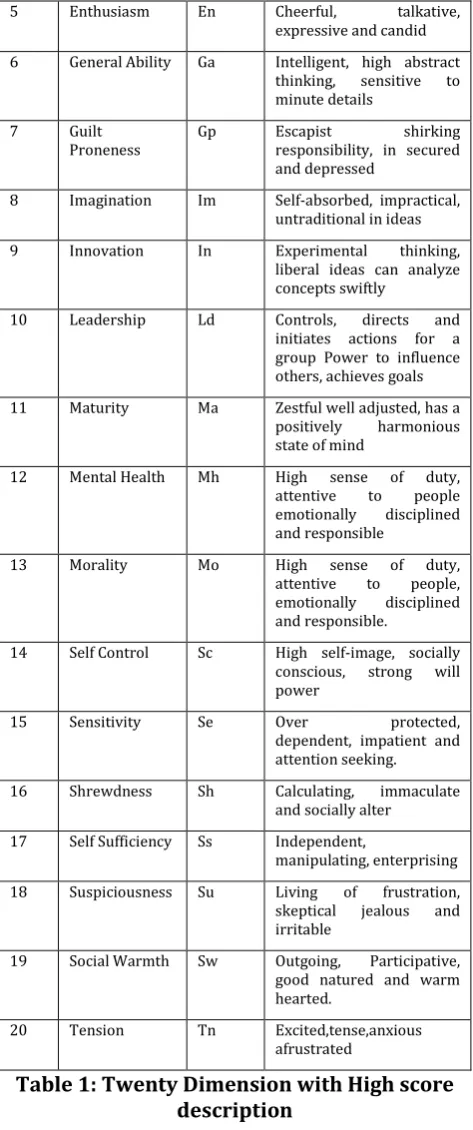
There are twenty dimensions for classifying individual’s performance. Each dimensions has 7 questions. The twenty dimensions that are being considered as to go into the performance of a student
Sl.No Dimensions Symbol High Score Description
1 Adaptability Ad Accommodation, accepts
and adjusts to situations easily
2 Achievement
Motivation Am Ambitious, interested in career and overtly realistic involvement in life
3 Boldness Bo Socially bold, adventurous,
responsible and friendly
4 Competition Co Independent minded,
stern and assertive
5 Enthusiasm En Cheerful, talkative,
expressive and candid
6 General Ability Ga Intelligent, high abstract
thinking, sensitive to
minute details
7 Guilt
Proneness Gp Escapist responsibility, in secured shirking and depressed
8 Imagination Im Self-absorbed, impractical,
untraditional in ideas
9 Innovation In Experimental thinking,
liberal ideas can analyze concepts swiftly
10 Leadership Ld Controls, directs and
initiates actions for a group Power to influence others, achieves goals
11 Maturity Ma Zestful well adjusted, has a
positively harmonious
state of mind
12 Mental Health Mh High sense of duty,
attentive to people
emotionally disciplined
and responsible
13 Morality Mo High sense of duty,
attentive to people,
emotionally disciplined
and responsible.
14 Self Control Sc High self-image, socially
conscious, strong will
power
15 Sensitivity Se Over protected,
dependent, impatient and attention seeking.
16 Shrewdness Sh Calculating, immaculate
and socially alter
17 Self Sufficiency Ss Independent,
manipulating, enterprising
18 Suspiciousness Su Living of frustration,
skeptical jealous and
irritable
19 Social Warmth Sw Outgoing, Participative,
good natured and warm hearted.
20 Tension Tn Excited,tense,anxious
[image:3.595.329.566.108.674.2]afrustrated
Table 1: Twenty Dimension with High score description
© 2016, IRJET | Impact Factor value: 4.45 | ISO 9001:2008 Certified Journal | Page 394 into three groups. They are High personality,
Middle Personality and Low Personality. When the person is chosen for the job or training purposes the one who comes under High Personality category can be readily selected, then the person who is in the Middle Personality with some constant observation, and the person falling in the low personality should not preferred.
After framing the questionnaire consisting of 147 questions it was given to a psychologist, for his opinion about the working ability of the questionnaire. The psychologist made certain minor corrections and expressed complete satisfaction about the nature and working condition of the questionnaire. Also psychologist help to frame the twenty dimensions which is the base for the questionnaire.
The inputs (Patterns) and output (Opinion of psychologists) were given to Neural Network. The back Propagation gives idea to classify the person’s performance by means of three categories. This is implemented using Oracle as a backend and Java as Front end.
In order to accomplish this task of measuring Personality performance and algorithm has been developed which holds the Following modules
Getting input from customer through a questionnaire which is used as the source data for the project.
Training and Recognition, which effects major part of the implementation part in acquiring the desired result.
4. NETWORK LAYERS
The commonest type of artificial neural network consists of three groups or layers of units layer of “input” units is connected to a layer of hidden units which is connected to a layer of “output units” The activity of the input units represent
the raw information that is fed into the network
The activity of each hidden unit is determined by the activities of the input units and the weights on the connections between the input and the hidden units.
The behavior of the output units depends on the activity of the hidden units and the weights between the hidden output units
The simple type of network is interesting because the hidden units are free to construct their own representations of the input. The weights between the input and hidden units determine when each hidden unit is active and so by modifying these weights a hidden unit.
In multi-layer networks units are often numbered by layer, instead of following global numbering.
5. IMPLEMENTATION OF BACK PROPAGATION NETWORK
In this dissertation, the data consist of 170 samples out of which 130 samples are taken for training and remaining 43 samples are taken for testing. The network is by giving the testing sample against the trained network 5.1 Training
Training set use to update the weights. Patterns in this set are repeatedly presented in random order. The weight update equations are applied after a certain number of patterns.
Neural Networks are trained using data referred to as a training set.
The process is one of computing outputs, compare outputs with desired answers, adjust weights and repeat. The information of a Neural Network is
in its structure, activation functions, weights
These weights are used to express the relative strength of an input value of from a connecting unit. It is by adjusting these weights that a neural network learns.
© 2016, IRJET | Impact Factor value: 4.45 | ISO 9001:2008 Certified Journal | Page 395 5.2 Supervised Learning:
This is usually performed with feed-forward nets where training patterns are composed of two parts an input vector and output vector associated with the input and output nodes respectively. A training cycle consists of the following steps. An input vector is presented at the inputs together with a set of desired responses, one for each node, at the output layer. A forward pass is done and the errors or discrepancies between desired and actual response for each node in the output layer, are found. These are then used to determine weight changes in the net according to the prevailing learning rule. The best known examples of this technique occur in the back – propagation algorithm, the delta rule and perceptron rule.
5.3 Backprobagation Algorithm:
Pattern table created in Oracle is given below
Qno A1 A2 A3 A4 …
… …
A14
7 Target Random
1 1 3 3 2 …
… …
[image:5.595.346.525.337.401.2]3 W 13
Table 2: Patterns for training the networks
[image:5.595.39.272.420.499.2]Since we are having 3 Neurons in the output layer, the target data for all the 3 classifications are as follows:
Table 3: Target data for 3 Classification
Network Design:
In this paper the back-propagation algorithm for training the network is used. For analyzing the back- propagation, the network architecture has been splited into two types. 1. Network with one hidden layers
In this layer 300 neurons in hidden layer 147 300 3
Input Hidden Output
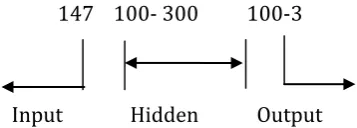
2. Network with more than one hidden layers. In this layer split hidden layers into three in which first hidden layer had 100 neurons, second hidden layer had 300 neurons, third had 100 neurons.
147 100- 300 100-3
Input Hidden Output The following is the sample network with one hidden layer and 300 neurons. The serial number Extracted patterns, Class (target) and Random numbers are stored in a Oracle table for later use(training)
Qno A1 ……… A147 Target Random
1 2 ……… 3 HP 126
Table 4: Pattern VI. Result and Discussion
In this classification system, the network model is trained with 200 training set, using supervised learning algorithm. The steps in network training as follows:
Patterns are randomly picked from the pattern table in Oracle database with the help of ‘random’ field present in table to train the networks.
Since, the training requires target data for learning, they are extracted with the help of ‘target’ field in the pattern table. Output
Layer Neurons
High
Personality Middle Personality Low Personality
1 1 0 0
2 0 1 0
[image:5.595.341.556.494.572.2]© 2016, IRJET | Impact Factor value: 4.45 | ISO 9001:2008 Certified Journal | Page 396 The network is trained with the help of
back propagation algorithm.
The networks are trained until the error value gets saturated.
No of neuron
s in
Hidden Layer
Trai ning Set
Activatio n Function
η –
value (learni ng rate)
No of iteratio ns
Accuran cy (percent age)
300 130 Sigmoid
[image:6.595.332.569.110.260.2]Function 0.001 20,000 99.82
Table Training specification
There is a reason to keep η value as 0.001. Regarding to the application, the error value reduces so smoothly when η is 0.001 rather than any other value.
If η value is between 1 and 0.1, the error value does not decrease smoothly. It accelerates up and down, increase the learning time. So it is always advisable to keep η value as small as possible.
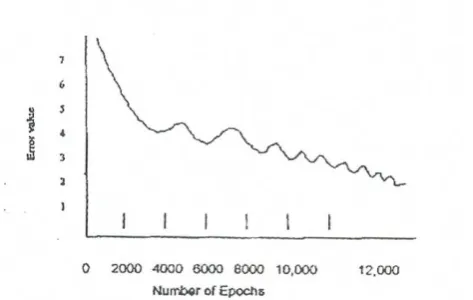
The following graphs helps to understand, how error value accelerates.
In fig (A) the decrease in error value with η =0.001, with the architecture of one hidden layer with 100 neurons.
Fig : (A) (when η =0.001)
(when η =0.001)
Fig(B) : Training Error
In fig (B) the decrease in error value with η = 0.5 with the architecture of one hidden layer with 100 neurons. Where the error value accelerates very much and takes king time to learn.
Before Training:
1) Weights between input and hidden layer: SNU
R DNUR1 DNUR2 DNUR3 DNUR4 DNUR5
1 .065 .333 .105 .073 .15
2) Weights between hidden and output layer
SNUR DNUR1 DNUR2 DNUR3
1 .13 .062 .118
After Training:
1) Weights between input and hidden layer:
SNUR DNUR1 DNUR2 DNUR3 DNUR4 DNUR5
1 .065066 .332632 .105019 .0743 .15064
2) Weights between hidden and output layer
SNUR DNUR1 DNUR2 DNUR3
1 .188329 -.232969 -.497274
[image:6.595.65.286.141.284.2]© 2016, IRJET | Impact Factor value: 4.45 | ISO 9001:2008 Certified Journal | Page 397 N=Total number of Test samples=40
Ec=Number of samples exactly classified. N=Total Number of test samples taken for each case=10 [10*4=40 which is N]
S.N
o Classificati on
Clas sifie d Exac tly
Clas sifie d Wro ngly
Not Clas sifie d
Accurac
y –
(Ec/n)* 100(%)
Ove rall Acc urac y (%)
1 High
Perso nality
10 10 0 0
97.6
2 Midd
le Perso nality
20 19 1 0
3 Low
Perso nality
13 13 0 0
43 42 1 0
Classification and overall accuracy By considering all the three tables overall accuracy of our project is in (Neural Networks approach for interest =97.6%
CONCLUSION
Neural Network is a flexible and powerful in the computer world. There is no need to understand the internal mechanisms of that task. It is also suitable for real time systems
because for the fast response and
computational times which are due to their parallel architecture. User can interact and any number of clients can connect to the server. Finally in future the neural network will be integrated with the fuzzylogic and related subjects.
References
1. Philp D.Wasserman, “Neural Computing:” Theory and Practice”, VNR 1989
2. C.Gershenson “Artificial Neural Network” 2003
3. Robert Schalkoff “Artificial Neural Network” 2011
4. Paulraj Sivanandam “Introduction to Artificial Neural Network” 2003
5.Teuvo Kohenen “Neural
Network”Springerpress
6. M.Jabri and B.Flower, “ Weight perturbation: An optimal architecture and learning technique for analog VLSI feedforward and recurrent multilayer networks,”IEEE Trans. Neural Network Vol.3. Jan 1922.
7. Y.K Choi and SY.Lee “Subthreshold MOS implementation of Neural Network with on – chip error back propagation learning, ” in Proc.Int. Joint. Conf. Neural Network, July 1993 pp 849 -852.