5941
IMPACT OF DEFAULT OPTION ON FINAL PRICE IN
ONLINE COMMERCE
1 JUN SIK KWAK
1Associate Professor, Dongseo University, Division of Business Administration, Korea
E-mail: 1[email protected]
ABSTRACT
As online purchases become more frequent, the e-commerce and m-commerce market is growing rapidly. Under such circumstances, understanding the preferences of online consumers is very important. Status quo bias and implicit self-theory of people can give important implications for online purchase. People do not want to change the current state. So, people prefer to maintain their current state rather than change. This person's tendency is called the status quo bias. A typical strategy that utilizes the tendency of people who do not like change is the default option strategy. Default option means an option that is selected automatically unless an alternative is specified. Online commerce experiment was conducted to study default option effect in final purchase price. There are two types of default option. One is the additive default option that people add their desired items with basic item. The other is subtractive default option that people delete items they don’t want with full items. The results show that the final purchase price is higher in subtractive default option than in additive default option. The final purchase price is different from sex. The final purchase price of male group is not different from between additive default option and subtractive default option. But the final purchase price of female group is higher in subtractive default option than in additive default option. This result shows that female feels more losses than male. Implicit self-theory influence on the final purchase price in default option. Especially, in the subtractive default option, the final price of incremental theorist is higher than that of entity theorist. Therefore, E-commerce and M-commerce companies will have to establisheffective online sales strategies that take into account default options and implicit self-theory.
Keywords: Online Purchase Psychology, Status Quo Bias, Default Option, Implicit Self-Theory, Final
Price
1. INTRODUCTION
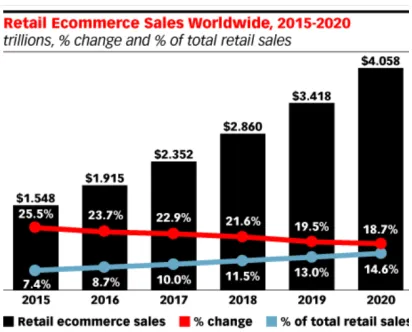
According to data from the e-Commerce Foundation, the global B2C e-commerce market grew by 17.5 per cent year-on-year in 2016, reaching $ 2.671 trillion. Unlike in the past, E-commerce companies such as Amazon are dominating offline businesses like Wal-Mart. In recent years, e-commerce Amazon, which is known as a distribution monster in the US, is expanding its business by acquiring, merging, expanding, and overseas entry into the offline distribution business. In addition, m-commerce is growing rapidly due to popularization of smart phones. According to App Annie, the annual spend on mobile will increase from $ 379 in 2016 to $ 1008 in 2021. In addition, global mobile commerce is expected to grow at a CAGR of 38% by 2021. According to eMarketer report, retail ecommerce sales worldwide will exceed $2 trillion in 2017. As you can see from
figure 1, retail ecommerce sales are predicted to increase by 14.6% by 2020.
[image:1.612.314.520.516.682.2]5942 In order to survive in the fast-growing e-commerce and m-e-commerce markets, it is important to understand consumers' purchase psychology.
Do you think that people like change? There are two different theories. One is sunk cost effect. Sunk cost is irreversible cost after making a decision. But people are more likely to continue prior decision after they invest money, time, and efforts even though the situation is changed [1]. This is sunk cost effect. Sunk cost effect is very robust and has been demonstrated in a various decision settings even though it is one’s irrational behavior. For example, A CEO who makes a decision whether or not he have to invest money to complete a prior project with a pessimistic situation is more likely to invest money if he have already invested money into the project than if he has not [2]. Likewise, there are two men. One man purchased a basketball ticket. The other man obtained it for free. They have to make a decision whether or not they would go to a basketball game under a bad weather and road condition. Who goes to a basketball game? A man who purchased ticket is more willing to go than one who obtained it for free [3]. The other is Status quo bias. Samuelson and Zeckhauser say that people want to do nothing or maintain one’s current or previous decision [4]. This was called as “Status Quo Bias”. Status quo bias affects human decision making. Status quo bias is relevant with endowment effect, loss aversion and prospect theory [5]. In this study, we tried to investigate default option strategy using "status quo bias" and the impact of gender and implicit self–theory on status quo bias.
2. THEORETICAL BACKGROUND
2.1 Status Quo Bias
People continue to keep their current or previous decisions when they make new decisions. This tendency is called a status quo effect [4]. In other words, people feel action regret(a regret that you feel when you do something and cause a negative result) bigger than inaction regrets(a regret that you feel when you don’t something and cause a negative result), even if they have the same negative result [6]. Kahneman and Miller (1986) explained the reason of status quo bias through norm theory [7]. According to normative theory, changing it rather than maintaining it will cause more regrets. They argue that changing to the other causes a lot of regret because it is considered more normative to maintain the present state. For example, one group
was asked to search for the item they were looking for from the beginning. Other group was asked to search for the item they were looking for from the last. As a result, the regret of the group who searched for the desired words and found the word from the end was higher [8]. This is a default option or status quo option which to search from the beginning. They felt a bigger regret because they search from this standard. For this reason, negative outcomes will make you feel more regretful about buying new brand than buying an existing one. Luce(1998) asked the subjects to choose one of five cars [9]. The subjects were asked to imagine that they had already had that car. When a new car arrives, they were asked which car to choose. They decided to keep the car they chose. Luce reported that choosing the status quo relates to a lower level of negative emotions. The status quo bias arises from the psychological commitment to the present situation because the status quo bias is related to the increased level of regret. Inman and Zeelenberg (2002) tested the results of repeated purchase (maintaining the status quo) and the results of the switching purchase in terms of prior consumption experience and brand history [10]. In this study, they found that there is a situation where repeated purchases are more regretful than switching purchases. This effect was based on whether there is a justification for decision making or not. In a series of four experiments, if there is good reason to switch, they felt less regret when faced with negative performance as a result of the switching purchase than the result of the repeated purchase. In other words, if consumers think their decision is appropriate in that situation, the feeling of regret is reduced.
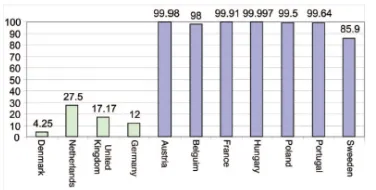
5943 have presumed consent (opt-out) and require check for those who do not want to be donors. Figure 2 shows that the average percentage of organ donors is below 30% when default option is opt-out and the average of percentage of organ donors is more than 85% when default option is opt-in [12].
Figure 2: Effect consent rates by country. The four leftmost bars are explicit consent (opt-in), The seven rightmost bars are presumed consent (opt-out). * Source:
E. J. Johnson and D. G. Goldstein, “Defaults and Donation Decisions,” Transplantation, vol. 78, No. 12,
1715.
2. 2 Implicit Self Theory
The implicit theory means the tendency or perception that people have implicitly about self or other’s intelligence or ability, not explicitly. This is a subjective objective measure that recognizes an individual's intelligence or ability, rather than an objective measure of intelligence or ability, such as IQ. The implicit theory of intelligence is one of the most actively performed studies on implicit theory. This can be divided into fixed theory that intelligence or ability is fixed, and incremental theory that intelligence or ability can develop [13]. So, implicit self-theory proposes two theorists. One is entity theorist who believes that intelligence and ability is fixed and cannot change. The other is incremental theorist who believes that intelligence and ability can be changed by effort Dweck (1999) reported that according to the implicit self-theory, entity theory and incremental theory, people showed different behavior patterns in the same situation as shown in Table 1 [14].
TABLE 1: DIFFERENCE ACCORDING TO IMPLICIT SELF
-THEORY
Entity
theorist Incremental theorist
Learning Objectives
To Show me
smarter To grow
Attribution to failure
Lack of competence,
(internal attribution)
Lack of self-effort (external attribution)
Self-esteem level generally low generally high
Achievement goal orientation
Performance goal orientation
Mastery goal orientation
2.2.1 Entity Theory
Dweck (1999) regards person with entity theory who they believe intelligence as a fixed characteristic and who believes that it cannot be changed. They would try to show that they are better than other students by doing something easily without effort. Students with entity theory tend to think that failure is due to their lack of ability, and they feel disappointment and shame, and give up in challenging situations. Students with entity theory are easily depressed when confronted with a negative situation, which leads to helpless patterns. In this way, students with entity theory are shown to be performance goal-oriented and their purpose of learning is to look smart. We want to get positive evaluations through learning, avoid negative evaluations, and choose a safe way to achieve learning objectives and avoid mistakes. On the average, students with entity theory had lower self-esteem than students with incremental theory and this difference increased as the grade increased. After suffering frustration, he degrades his ability. The problem of not trying because intelligence is fixed is seen in social situations. Students with entity theory viewed social rejection such as a break with a friend or a failure to socialize as their own incompetence. In other words, he did not think that he had the qualities to make friends and to maintain relationships, but he did not show his efforts to improve it. One characteristic of this entity theory is that they do not make much effort to achieve any achievement. The reason is that they think more effort than others is showing that they have low ability. Although the present achievement is low, they have the belief that they can have high achievement whenever they try. Behaviors resulting from these beliefs are called self-handicapping strategy because they show low task performance. It is not necessarily bad for people to have entity theory. It is natural and necessary to show effort toward recognition of achievement and achievement-oriented appearance. However, if people forget the purpose of learning and learn it only for accomplishment, problems can arise.
2.2.2 Incremental Theory
[image:3.612.104.292.168.263.2]5944 appear to be accomplished in a continuing effort, even if they feel immature in certain areas. People with entity theory show helpless responses when they experience failure, but those with incremental theory do not shame their own intelligence and do not react helplessly because they see that their strategies or techniques are wrong[15]. Frustration is, of course, something that can happen in the course of long-term learning. It's just a signal that we have to make effort and build a new strategy again. People will have a very challenging task someday. It is important to note incremental theory because people with entity theory will behave in a way that they doubt and abandon their abilities rather than overcome them. For example, Aronson and Fried (1998) showed a group of college students (incremental group) how to improve their intelligence with a short film, and then wrote a letter to elementary students informing them about the possibilities of intelligence enhancement. Other group (control group) did not have such an action. As a result, it was found that GPA at the end of the semester was significantly higher in the incremental group than in the control group. In addition, it was found that people in the incremental group enjoy university life and perceive themselves as more academic people more than college students in the control group.
2.3 Hypothesis
The purpose of this study is to investigate the effect of gender and implicit self - theory on the default option effect. Default option can influence the final purchase price. But there are some boundary conditions [16]. The theory of change beliefs takes the form of conflicting beliefs with entity theory and incremental theory. Entity theory implies a belief that intelligence is fixed and does not change easily regardless of individual effort. On the other hand, incremental theory implies a belief that intelligence is fluid, developable, and controllable. Entity theorists and incremental theorists have different interests in the task situation. The entity theorists maintain and extend self-esteem through the results of intelligence showing the adequacy of their abilities in the context of achievement. Because the incremental theorists believe that ability is not fixed, the pursuit of challenging task that continuously develops their intelligence enhances self-esteem. There is an empirical study that entity theorists experience self-esteem through comparison with peers, while incremental theorists experience self-esteem in challenging situations.
Meanwhile, there are two ways to present prices: additive default option and subtractive default option. The additive default option is a way to purchase additional products of your choice in the base product. The subtractive default option is a way to remove unwanted products from a full-option product. According to the prospect theory, a person feels more sadness due to loss rather than joy in the same profits. So people try to avoid losses. Therefore the final purchase price of subtractive default option is higher than that of additive default option. But, this result is different from sex because there is a difference between men and women who feel about loss. These results will also depend on the implicit self-theory of the individual. The hypothesis of this study is as follows.
H1. The impact of the default option on the final purchase price in online purchase will vary by gender.
H1. The impact of the default option on the final purchase price in online purchase will vary by implicit self-theory.
3. EXPERIMENT
The purpose of this experiment is to examine the effect of the default option strategy on the final purchase price by gender and implicit self-theory when people buy product in online.
3.1 Participants and Design
A total of three hundred twenty people took part in experiment. They were randomly assigned to the two default option conditions (additive vs. subtractive default option).
3.2 Procedure
5945 Table 2: additive and subtractive default option scenarios
Type Description
Common
You visited oriental medical clinic because you felt bad.
There were three good products for your health
Additive default option
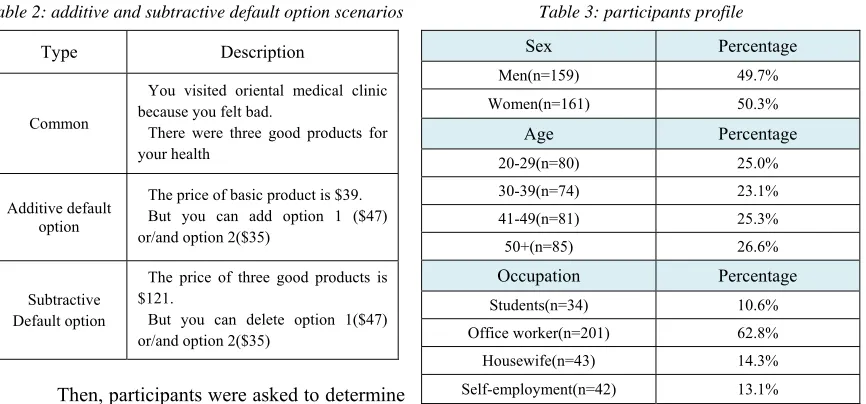
The price of basic product is $39. But you can add option 1 ($47) or/and option 2($35)
Subtractive Default option
The price of three good products is $121.
But you can delete option 1($47) or/and option 2($35)
Then, participants were asked to determine how many product they purchased in the given situation. After this, participants reported implicit self-score (7 items), age, sex, and occupation. The implicit self-theory items used in this study are as follows: (1) My intelligence is innate and can no longer be improved. (2) No matter how I try to improve my intelligence, my intelligence will not change in the future. (3) Humans can learn new things, but they cannot change innate intelligence. (4) Even if I have to change my personality, my personality will not change. (5) The personality of the person can be changed for a while, but the nature of the person cannot be changed. (6) A person's personality is a part of the person and can hardly be changed (7) if a friend dislikes me I am a friend of mine rather than trying to fix what I hate.
4. RESULTS AND DISCUSSION
4.1 Participants Profile
A total of three hundred twenty people took part in experiment. Table 3 shows the demographic profile of participants.
Table 3: participants profile
Sex Percentage
Men(n=159) 49.7%
Women(n=161) 50.3%
Age Percentage
20-29(n=80) 25.0%
30-39(n=74) 23.1%
41-49(n=81) 25.3%
50+(n=85) 26.6%
Occupation Percentage
Students(n=34) 10.6%
Office worker(n=201) 62.8%
Housewife(n=43) 14.3%
Self-employment(n=42) 13.1%
As you see the table 3, 49.7% of male and 50.3% of female participated in the study. 25% of 20s, 23.1% of 30s, 25.3% of 40s, and 26.6% of over 50s participated. Among the respondents, 62.8% of the respondents were engaged in the workplace.
4.2 Final Purchase Price by Gender
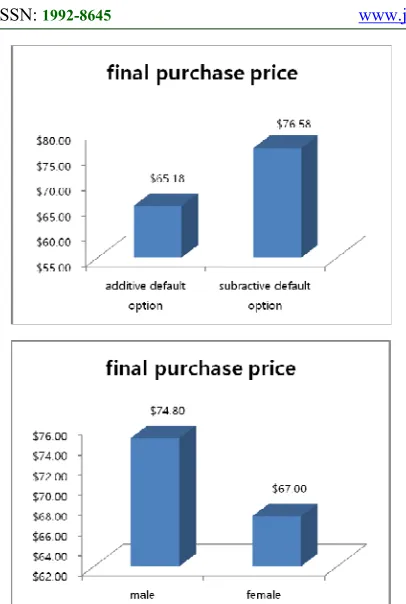
5946 Figure 2: Final purchase price of default option and sex
[image:6.612.94.518.59.372.2]The interaction of sex and default option is significant (F (1,316) =5.469, p=0.02). As shown in Figure 3, in male group, the final price difference between subtractive option (M=$77.04) and additive option (M=$72.47) is not significant. But, in female group, final price in subtractive option ($76.09) is higher than final price in additive option ($58.24).
Figure 3: Final purchase price according to sex and default option
This result seems to show that there is no difference in the final purchase price in subtractive default option because there is not a large difference between men and women perception of loss. However, it can be understood that men are more susceptible to health promotion (gain) because they have more options than women.
4.3 Final Purchase Price by Implicit
Self-Memory
Final purchase price was analyzed by a ANOVA with implicit self-score (ISS) and default option conditions (additive and subtractive method) as an independent (see table 5).
As consistent with H2, the main effect of default option is significant (F (1,316) =8.494, p=.004). As shown in Figure 4, the final price (M=$76.58) in subtractive default option is higher than the final price (M=$65.20) additive default option. The main effect of ISS is significant (F (1,316) =4.739, p=.030). As shown in Fig. 3,
Table 4: ANOVA Table by sex and default option
source Sum of Squares df Mean Square F sig
Corrected Model .695 3 .232 8.300 .000
Intercept 7426.802 1 7426.802 266229.973 .000
Gender .274 1 .274 9.812 .002
Default Option .256 1 .256 9.168 .003
Gender * Default Option .153 1 .153 5.469 .020
Error 8.815 316 .028
Sum 7437.388 320
Corrected Total 9.510 319
Table 5: ANOVA Table by IST and default option source Sum of Squares df Mean Square F sig
Corrected Model .419 3 .140 4.854 .003
Intercept 7302.436 1 7302.436 253833.482 .000
Implicit Self-Theory(IST) .136 1 .136 4.739 .030
Default Option .244 1 .244 8.494 .004
IST * Default Option .014 1 .014 .502 .479
Error 9.091 316 .029
Sum 7437.388 320
[image:6.612.94.297.71.373.2] [image:6.612.101.517.581.744.2]5947 Incremental theorist (M=$73.88) paid more final purchase price than entity theorist (M=$67.02).
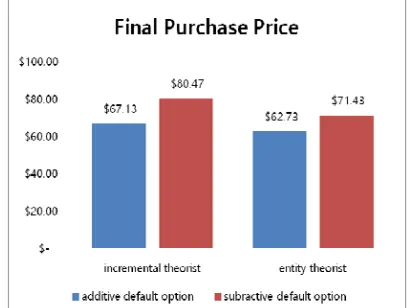
Figure 4: Final Purchase Price Of Default Option And IST
[image:7.612.91.296.450.604.2]The interaction of IST by default option is not significant (F (1,319) =.502, p=.479). As shown in Figure 5, the final price of incremental theorist (M=$62.73) and entity theorist (M=$67.13) is not different in additive default option. But, in subtractive default option, the final price of incremental theorist (M=$80.47) is higher than the final price of entity theorist (M=$71.43) and this difference is marginally significant (F (1,158) =3.647, p=.058).
Figure 5: Final Purchase Price According To ISS And Default Option
5. DISCUSSION AND CONCLUSIONS
This study was conducted to investigate the effects of consumer psychology, especially the default option and implicit self-theory, on the final purchase price in e-commerce and m-commerce.
Many researchers say that status quo bias
influences on human decision. This is the default option strategy, which is a representative strategy that utilizes people's status quo bias. This study is to examine how default option affect final purchase price according to gender or implicit self-theory score (ISS). To do this, we conducted experiment using health related products.
Frist, The result shows that participants in subtractive default option paid more final purchase price than those in additive default option. The effect of default option is different from gender. In particular, the final purchase price of men was higher than the final purchase price of women. Looking more closely, the effect of default option is not different in male condition. But final purchase price in subtractive default option is higher than that in additive default option in female condition.
Second, the result shows that incremental theorist paid more final purchase price than entity theorist. Especially, this difference is not significant in additive default option. But in the subtractive default option, incremental theorist paid more final purchase price than entity theorist. This result seems to be due to the fact that incremental theories have a greater sense of loss than the entity theorist when removing options from the full option. Therefore, E-commerce and M-commerce companies will have to establish effective online sales strategies that take into account default options and implicit self-theory.
There are some limitation and the direction of future research. First, this study focuses on oriental medical product. Health-related products will vary in preference by age and gender. It is a very interesting result that the final purchase price of men is higher than that of women, considering that women feel more loss than men. Perhaps this is because the product used in this experiment is a health-related product. If it were a cosmetics-related product, other results might have appeared. Therefore, in future research, it will be necessary to experiment on beauty related products, not health related products. So, a caution needs to be taken not to over-generalize this conclusion because oriental medical product is credence goods. This research had better expand to the other product such as functional goods and experience goods in the future.
5948 incremental theorist pursue goals: gain, non-gain, loss, and non-loss. However, it is different that entity theorist and incremental theorist think whether gain or loss is more important. Therefore, future studies should be conducted based on this point.
Third, the study was conducted online. However, respondents are not as well controlled as experimental labs. When conducting on-line research, it is necessary to consider how to check whether a response has been made faithfully, which can enhance the reliability of the study. In the future, when researching online, more accurate research data should be obtained by using a method that can find out the unfaithful respondents.
ACKNOWLEDGEMTS:
This work was supported by Dongseo University, "Dongseo Frontier Project" Research Fund of 2016
REFRENCES:
[1] H. R. Arkes, and C. Blumer, “The psychology of sunk costs”, Organizational Behavior and
Human Decision Processes, Vol. 35, 1985, pp.
124-140.
[2] J. S. Kwak, and J. W. Park, ‘Effects of a regulatory match in sunk-cost effects: A mediating role of anticipated regret”, Marketing Letter, Vol.23, 2012, pp. 209-222. [3] R. H. Thaler, “Mental accounting matters”,
Journal of Behavioral Decision Making,
Vol.12, 1999, pp. 183-206.
[4] W. Samuelsson and R. Zeckhauser, “Status Bias in Decision Making”, Journal of Risk and Uncertainty, Vol.1, 1998, pp. 7-59.
[5] D. Kahneman, J. L. Knetsch, and R. H. Thaler, “Anomalies: The Endowment Effect, Loss Aversion, and Status Quo Bias”, Journal of
Economic Perspectives, Vol.5, 1991, pp.
193-206.
[6] T. Gilovich, and V. H. Medvec, “The Temporal Pattern to the Experience of Regret”, Journal of personality and social psychology. Vol.67, No.3, 1994, pp. 357-365.
[7] D. Kahneman and D. Miller, “Norm Theory: Comparing Reality to Its Alternatives”, Psychological Review, Vol. 93, 1986, pp. 136-153
[8] I. Simonson, “The Influence of Anticipation Regret and Responsibility on Purchase Decision”, Journal of Consumer Research, Vol. 19, No. 2, 1992, pp.105-118.
[9] M. Luce, “Choosing to Avoid: Coping with Negatively Emotion - Laden Consumer
Decisions”, Journal of Consumer Research, Vol. 24, 1998, pp. 409-432.
[10] J. J. Inman and M. Zeelenberg (2002), “Regret in Repeat Purchase versus Switching Decisions: The Attenuating Role of Decision Justifiability” Journal of Consumer Research, Vol. 29, No. 2, 2002, pp. 116-128
[11] E. J. Johnson, and D. G. Goldstein, “Defaults and Donation Decisions”, Transplantation, Vol. 78, 2004, pp. 1713-1716.
[12] E. J. Johnson and D. G. Goldstein, “Do defaults save lives?”, Science, Vol. 302, 2003, pp. 1338-1339.
[13] C. S. Dweck, “Motivational processes affecting learning”, American Psychologist, Vol. 41, No.10, 1986. pp. 1040-1048.
[14] C. S. Dweck, “Self-theories: their role in motivation, personality, and development, 1999, Philadelphia : Psychology Press. [15] L.S. Blackwell, K.H. Trzensniewski, and C. S.
Dweck, “Implicit Theories of Intelligence Predict Achievement Across and Adolescent Transition: A Longitudinal Study and an Intervention”, Child Development, Vol. 78, No.1, 2007, pp. 246-263