ISSN: 1992-8645 www.jatit.org E-ISSN: 1817-3195
5654
USING AN ANT COLONY OPTIMIZATION ALGORITHM
FOR IMAGE EDGE DETECTION AS A THRESHOLD
SEGMENTATION FOR OCR SYSTEM
1MARYAM ASGARI, 2FARSHID PIRAHANSIAH, 3MOHAMMAD SHAHVERDY, 2MEHDI FARTASH
1,3 Department of Computer Engineering, Prof. Hessabi Branch, Islamic Azad University, Tafresh, Iran 2 Young Researchers and Elite Club, Prof. Hessabi Branch, Islamic Azad University, Tafresh, Iran
4 Department of computer engineering, Arak Branch, Islamic Azad University, Arak, Iran
E-mail: 1[email protected], 2 [email protected]
,
3[email protected], 4[email protected]ABSTRACT
Binarization or thresholding is one problem that have to solve in pattern recognition methods and applications. Moreover, it has a very important influence on the sequent steps in computer vision applications such as, Optical Character Recognition (OCR), image segmentation, and tracking objects. Ant colony optimization (ACO) is a population-based metaheuristic which use to solve optimizations problems in diverse fields, such as traffic congestion and control, structural optimization, manufacturing, and genomics are presented. In this work, a combination of ant colony, edge detection, and thresholding methods are combine in order to use in OCR system. The algorithm which is used the DIBCO 2009 in printed and a handwritten image was tested. This method has a compare with Kittler and Illingworth's Minimum Error Thresholding, potential difference, max entropy, Pirahansiah’s method and Otsu.
Keywords: Ant colony optimization (ACO), Peak Signal-to-Noise Ratio (PSNR), single thresholding, image processing, image segmentation, optical character recognition, computer vision, Deep Learning.
1. INTRODUCTION
Thresholding, edge detection, and ant colony are the methods which used in many computer vision applications such as video stabilization [1], camera calibration [2], segmentation [3], binarization [4], Simultaneous Localization and Mapping (SLAM) [5], feature extraction [6], stereo vision [7], License plate recognition system [8-12].
One of the essential stages of pre-processing in any applications of computer vision is thresholding [3, 4, 8-12]. Thresholding can be used as a method to separate the foreground from the background of an image or in OCR systems [13] can be used as a separate character from images. This paper compares several thresholding methods: Otsu [14], Kittler and Illingworth [15], potential difference[16], max entropy[17], multilevel threshold[18], Pirahansiah’s method [3, 4] and the unprecedented method aimed in this paper which
used ant colony on edge detection for thresholding is a compare with 6 before proposed method. In [13] a nonparametric and unsupervised method of automatic threshold selection for picture segmentation is presented. An optimal threshold is selected by the discriminant criterion, namely, so as to maximize the separability of the resultant classes in gray levels. The procedure is very simple, utilizing only the zeroth- and the first-order cumulative moments of the gray-level histogram. In [14] a computationally efficient solution to the problem of minimum error thresholding is derived under the assumption of object and pixel grey level values being normally distributed. The method is applicable in multithreshold selection.
The ant colony optimization (ACO) for edge detection proposed by Jing et al. [19] and the source code of their method is based on MATLAB which is available free.
5655 Result and discussion are presented in Section 4. Finally, Section 5 concludes this paper
.
2. STATE OF THE ART
Thresholding is a type of image segmentation, where change the pixels of an image to make the image simpler to recognize. There are many applications, which use thresholding in computer vision algorithms as a first step. For example, in camera calibration algorithms first step is to use threshold for the calibration pattern in order to find corner points to perform calibration [2]. In robot localization, SLAM methods require threshold value to find interesting point and landmark properly [5]. In addition, threshold use for image segmentation [13]. in the object and character recognition system [6].
Using ant colony optimization for find proper value of threshold have been studied [20-24] however; lack of using ACO based thresholding for OCR system.
2.1 THRESHOLDING
The thresholding methods can be divided into three main categories which are single, multilevel and multi thresholding [3, 4]. Kittler and Illingworth’s Minimum Entropy Threshold (MET) [14], potential difference [15] and Pirahansiah’s method [3, 4] are examples of single thresholding methods. Multilevel threshold methods, such as that of [17], separate object based on gray values. Multi-threshold [11] techniques choose a selection of threshold values based on certain behaviors such as number objects inside the image after threshold. We discuss some state-of-the-art methods in the following subsections.
2.1.1 Single Threshold Method
The usage of the single thresholding means one threshold value, t, change the image to black and white. The thresholding process is a very important step through the segmentation phase. It is also a very significant part of image processing and pattern recognition. Thresholding is carried out for distinctive reasons, for example to increase the computational fast or to reduce the storage space. The segmentation accuracy can be maximized by an appropriately chosen threshold value. The single threshold condition is given as:
(5)
Different approaches are used to automatically determine the threshold value. Methods such as local entropy, Kittler and Illingworth’s MET [14], and potential difference [15] often use a gray level co-occurrence matrix as the population set to determine the appropriate threshold value.
2.1.2 Pirahansiah’s Single Threshold Method
One of the latest threshold algorithm which is based on single threshold method is proposed by Pirahansiah [3, 4]. The pseudo code of the algorithm is presented below as Algorithm 1.
Algorithm 1. Pirahansiah’s Threshold Algorithm.
Input: column gray scale images, img. Output: The selected threshold values, t.
1 For (0<t<256) where (t = t +5) then find PSNRt of imgt
by compare with the original image
2 If ( (mean value/k1< PSNRt< mean value/k2))
3 then threshold=t
4 end for
2.1.3 Multilevel Threshold
In multilevel thresholding, more than one threshold value is used to change the image to a gray-scale image. Arora et al. [17] proposed a multilevel threshold method that identifies threshold values globally based on a gray scale distribution. A recursive algorithm is applied to determine a sequence of threshold values based on the mean and standard deviation at each step. The multilevel algorithm is described in Algorithm 2.
Algorithm 2. The Multilevel Thresholding Algorithm[17]
1: While increasing PSNR>0.1 is true do 2 : r = [a, b]. (in the first step a = 0 and b = 255)
3 : Find the mean and standard deviation for all of the pixels in the image range r
4 : t1 = mean–k1* standard deviation; (k1 is a random number)
5 : t2 = mean+k2* standard deviation; (k2 is a random number)
6 : The mean value of range (a, t1] is set as the threshold value of the partial range.
7 : The mean value of range [t2, b) is set as the threshold value of the partial range.
8 : a = t1+1 9 : b = t2-1 10 : end while 11 : t1 = mean 12 : t2 = mean+1 13 : repeat step 6
14 : Obtain new image with multilevel thresholding
2.1.4 Multi-Threshold
ISSN: 1992-8645 www.jatit.org E-ISSN: 1817-3195
5656 in an image for each threshold. The peak threshold values are those with the highest total number of blobs as compared to their threshold neighbors. The Heuristic threshold algorithm is described in Algorithm 3.
Algorithm 3. The Multi Threshold Algorithm [11]
1: Start.
2: Obtain the histogram distribution.
3: Calculate the total number of gray-scale pixels according to three levels.
4: For (0<t<256) step 10 is true do
5: Obtain the total number of objects, numt, in the source image when the threshold value t is used.
6: end for
7: Search for and select the peak values from num (1 … 255).
8: Choose the selected threshold values if the number of objects is maximum.
9: Execute the character segmentation module.
2.2. ANT COLONY OPTIMIZATION (ACO)
Ant Colony Optimization Initially proposed by Marco Dorigo in 1992 in his PhD thesis. Ant colony optimization algorithms have been applied to many combinatorial optimization problems. Jing et al. [19] proposed the ant colony optimization (ACO) for edge detection and the source code of their method is based on MATLAB which is available free. In this research we use this approach. pseudo-code of ACO can be written as:
procedure ACO_MetaHeuristic while(not_termination) generateSolutions() daemonActions() pheromoneUpdate() end while end procedure
The steps of ACO based on the paper [19] consisted of several steps as follows:
1) Randomly initialall ant position and pheromone matrix.
2) For moving ant use the Equation 1
(1)
Where q (0<q<1) is a random number and q0 is a number between 0 and 1. For the moving and choosing next move base on probability distribution can use Equation 2.
(2)
Where the notations of are control parameters determined the relative influence of the pheromone and the visibility respectively.
3) For the update of movement use Equation 3 and 4 as below.
(3)
(4)
Where denotes the pheromone
evaluation ratio. Q is constant, m ant number, length of tour by ant k.
4) Make decision
3. PROPOSED METHOD
In the same spirit as Otsu [14], Kittler and Illingworth [15], potential difference [16], max entropy [17], multilevel threshold [18], Pirahansiah’s method [3, 4], the algorithm which is used the DIBCO 2009 in printed and a handwritten image was tested. This method has a compare with Kittler and Illingworth's Minimum Error Thresholding, potential difference, max entropy, Pirahansiah’s method and Otsu. The proposed method use ACO based threshold method to enhance performing thresholding on images which is sutiable for OCR systems.
3.1 RESULTS AND DISCUSSION
The comparison was done by using DIBCO benchmark. The DIBCO dataset contains several images which are divided into two main categories “handwritten” and “printed”. The Otsu [14], Kittler and Illingworth [15], potential difference[16], max entropy[17], Pirahansiah’s method [10] and the unprecedented method aimed in this paper which used ant colony on edge detection for thresholding are using for comparison. The comparison is done by using PSNR which explained in [3, 4].
3.2 Experiment Results
The Figure 1 shows proposed method results of the printed images from DIBCO benchmark dataset.
5657
(b) P01. Ground truth image from DIBCO
(c) P01. Proposed method 1
(d) P01. Proposed method 2
(e) P01. Proposed method
3
(f) P01. Proposed method 4
(a) P02. Original image from DIBCO
(b) P02. Ground truth image from DIBCO
(c) P02. Proposed method 1
(d) P02. Proposed method 2
(e) P02. Proposed method 3
(f) P02. Proposed method 4
(a) P03. Original image from DIBCO
(b) P03. Ground truth image from DIBCO
(c) P03. Proposed method 1
(d) P03. Proposed method 2
(e) P03. Proposed method 3
(f) P03. Proposed method 4
(a) P04. Original image from DIBCO
ISSN: 1992-8645 www.jatit.org E-ISSN: 1817-3195
5658
(c) P04. Proposed method 1
(d) P04. Proposed method 2
(e) P04. Proposed method 3
(f) P04. Proposed method 4
(a) P05. Original image from DIBCO
(b) P05. Ground truth image from DIBCO
(c) P05. Proposed method 1
(d) P05. Proposed method 2
(e) P05. Proposed method 3
(f) P05. Proposed method 4
Figure 1: The printed dataset of DIBCO benchmark. (a) is original images, (b) ground truth, (c) to (f) proposed
[image:5.612.93.532.61.668.2]method.
Table 1 shows the result of each proposed method based on PSNR.
Table 1. The result of each proposed method based on
PSNR
PSNR
Methods 1 2 3 4
Images
P01 6.6701 6.6135 6.4767 6.3915
P02 5.4008 5.6267 5.5604 5.5133
P03 7.0038 6.5976 6.89 6.6289
P04 7.6099 7.6533 7.6781 7.5529
P05 5.7077 5.4939 5.7731 5.6181
Average 6.47846 6.397 6.47566 6.34094
Figure 2 shows proposed method results of the handwritten images from DIBCO benchmark dataset.
(a) H01. Original image from DIBCO
(b) H01. Ground truth image from DIBCO
(c) H01. Proposed method 1
(d) H01. Proposed method 2
(e) H01. Proposed method 3
(f) H01. Proposed method 4
[image:5.612.250.520.156.717.2]5659
(b) H02. Ground truth image from DIBCO
(c) H02. Proposed method 1
(d) H02. Proposed method 2
(e) H02. Proposed method 3
(f) H02. Proposed method 4
ISSN: 1992-8645 www.jatit.org E-ISSN: 1817-3195
5660
(b) H03. Ground truth image from DIBCO
(c) H03. Proposed method 1
(d) H03. Proposed method 2
(e) H03. Proposed method 3
(f) H03. Proposed method 4
5661
(c) H04. Proposed method 1
(d) H04. Proposed method 2
(e) H04. Proposed method 3
(f) H04. Proposed method 4
(a) H05. Original image from DIBCO
(b) H05. Ground truth image from DIBCO
(c) H05. Proposed method 1
(d) H05. Proposed method 2
ISSN: 1992-8645 www.jatit.org E-ISSN: 1817-3195
5662
(f) H05. Proposed method 4
Table 2 shows the result of each proposed method based on PSNR for the handwritten images.
TABLE 2. The result of each proposed method based on
PSNR
PSNR
Methods A B C D
Images
H01 9.5516 9.5508 9.7037 9.4849
H02 15.1372 15.4791 15.0854 15.5681
H03 9.3283 9.3051 9.3528 9.2715
H04 9.9124 9.8011 9.6884 9.7458
H05 12.0292 12.0834 12.0076 12.0858
Average 11.1917 11.2439 11.1676 11.2312
3.3 Comparison Results
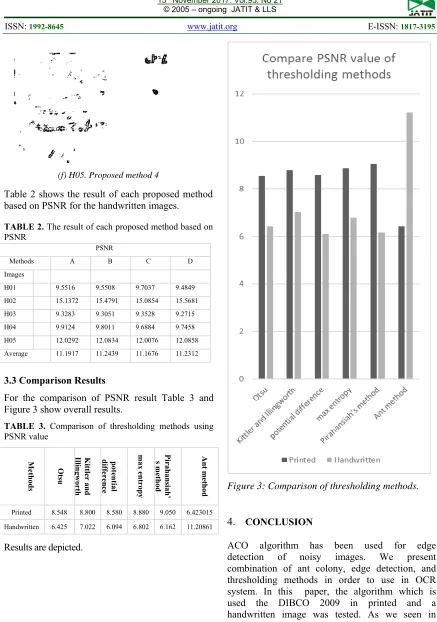
For the comparison of PSNR result Table 3 and Figure 3 show overall results.
TABLE 3. Comparison of thresholding methods using
PSNR value
Met
h
ods
Ots
u
Kit
tler and
Illin
gworth
potential
differ
ence
max
ent
ropy
Pirahansiah’
s method Ant me
tho
d
Printed 8.548 8.800 8.580 8.880 9.050 6.423015
Handwritten 6.425 7.022 6.094 6.802 6.162 11.20861
[image:9.612.86.523.52.674.2]Results are depicted.
Figure 3: Comparison of thresholding methods.
4. CONCLUSION
5663 5. ACKNOWLEDGEMENT
We thank to “anonymous” reviewers for their so-called insights. We are also immensely grateful to for their comments on an earlier version of the manuscript.
REFRENCES:
[1] F. PirahanSiah, S. N. H. S. Abdullah, and S. Sahran, "Augmented optical flow methods for video stabilization," in 4th Artificial Intelligence Technology Postgraduate Seminar (CAITPS 2015), Faculty of Information Science and Technology (FTSM) - UKM on 22 and 23 December 2015, 2015, pp. 47-52.
[2] F. PirahanSiah, S. N. H. S. Abdullah, and S. Sahran, "Camera calibration for multi-modal robot vision based on image quality assessment," in Control Conference (ASCC), 2015 10th Asian, 2015, pp. 1-6.
[3] F. PirahanSiah, S. N. H. S. Abdullah, and S. Sahran, "Adaptive Image Thresholding Based On the Peak Signal-To-Noise Ratio," Research Journal of Applied Sciences, Engineering and Technology, 2014.
[4] F. PirahanSiah, S. N. H. S. Abdullah, and S. Sahran, "Peak Signal-To-Noise Ratio Based on Threshold Method for Image Segmentation," Journal of Theoretical and Applied Information Technology, vol. 57, 2013.
[5] F. PirahanSiah, S. N. H. S. Abdullah, and S. Sahran, "Simultaneous Localization and Mapping Trends and Humanoid Robot Linkages," Asia-Pacific Journal of Information Technology and Multimedia, vol. 2, p. 12, December 2013 2013.
[6] M. Naeimizaghiani, F. PirahanSiah, S. N. H. S. Abdullah, and B. Bataineh, "Character and object recognition based on global feature extraction," Journal of Theoretical and Applied Information Technology, vol. 54, pp. 109-120, // 2013.
[7] F. PirahanSiah, S. N. H. S. Abdullah, and S. Sahran, "2D versus 3D Map for Environment Movement Object," presented at the 2nd National Doctoral Seminar on Artificial Intelligence Technology, Residence Hotel, UNITEN, Malaysia, 2012.
[8] F. PirahanSiah, S. N. H. S. Abdullah, and S. Sahran, "Comparison single thresholding method for handwritten images segmentation," in Pattern Analysis and Intelligent Robotics
(ICPAIR), 2011 International Conference on, 2011, pp. 92-96.
[9] N. H. Z. Abidin, S. N. H. S. Abdullah, S. Sahran, and F. PirahanSiah, "License plate recognition with multi-threshold based on entropy," in Electrical Engineering and Informatics (ICEEI), 2011 International Conference on, 2011, pp. 1-6.
[10] F. PirahanSiah, S. N. H. S. Abdullah, and S. Sahran, "Adaptive image segmentation based on peak signal-to-noise ratio for a license plate recognition system," in Computer Applications and Industrial Electronics (ICCAIE), 2010 International Conference on, 2010, pp. 468-472. [11] S. N. H. S. Abdullah, F. PirahanSiah, N. H. Zainal Abidin, and S. Sahran, "Multi-threshold approach for license plate recognition system," in International Conference on Signal and Image Processing WASET Singapore August 25-27, 2010 ICSIP, 2010, pp. 1046-1050. [12] S. N. H. S. Abdullah, F. PirahanSiah, M.
Khalid, and K. Omar, "An evaluation of classification techniques using enhanced Geometrical Topological Feature Analysis," presented at the 2nd Malaysian Joint Conference on Artificial Intelligence (MJCAI 2010), Malaysia, 2010.
[13] M. S. Farshid PirahanSiah, "GSFT-PSNR: Global Single Fuzzy Threshold Based on PSNR for OCR Systems " International Journal of Computer Science and Network Solutions, vol. 4, pp. 1-19, 2016.
[14] N. Otsu, "A Threshold Selection Method from Gray-Level Histograms," Systems, Man and Cybernetics, IEEE Transactions on, vol. 9, pp. 62-66, 1979.
[15] J. Kittler and J. Illingworth, "Minimum error thresholding," Pattern Recognition, vol. 19, pp. 41-47, 1986.
[16] J. Acharya and G. Sreechakra, "Potential Difference Based on Electrostatic Binarization Method," 1999.
[17] T. Pun, "A new method for grey-level picture thresholding using the entropy of the histogram," Signal Processing, vol. 2, pp. 223-237, 1980.
[18] S. Arora, J. Acharya, A. Verma, and P. K. Panigrahi, "Multilevel thresholding for image segmentation through a fast statistical recursive algorithm," Pattern Recognition Letters, vol. 29, pp. 119-125, 2008.
ISSN: 1992-8645 www.jatit.org E-ISSN: 1817-3195
5664 detection," in Evolutionary Computation, 2008. CEC 2008. (IEEE World Congress on Computational Intelligence). IEEE Congress on, 2008, pp. 751-756.
[20] A. R. Malisia and H. R. Tizhoosh, "Image thresholding using ant colony optimization," in Computer and Robot Vision, 2006. The 3rd Canadian Conference on, 2006, pp. 26-26. [21] J. Zhang, K. He, X. Zheng, and J. Zhou, "An ant
colony optimization algorithm for image edge detection," in Artificial Intelligence and Computational Intelligence (AICI), 2010 International Conference on, 2010, pp. 215-219. [22] D. Rao and S. Rai, "Ant Colony Optimization Algorithm for Improving Efficiency of Canny Edge Detection Technique for Images," 2016. [23] Y.-C. Liang, A. H.-L. Chen, and C.-C. Chyu,
"Application of a hybrid ant colony optimization for the multilevel thresholding in image processing," in International Conference on Neural Information Processing, 2006, pp. 1183-1192.