© 2018, IRJET | Impact Factor value: 6.171 | ISO 9001:2008 Certified Journal | Page 521
day and for this population requires low cost houses this houses consume more concrete and in the production of that concrete plenty amount of CO2 will produces. This CO2
production is covers 40% of total production of CO2 on this planet. If we reduce the few amount in that then we save our environment or reduction in the ozone layer.
Our lower income group population wants the houses which can be built with low cost so to build the low cost house we have to reduce the uses of concrete from the structure because it is the most expansive material used in the building.
To overcome from above mentioned problems the slab should be lighter and economical for that a slab of dimension 1000 X 1000 X 150 mm is modeled and use the recycled plastic cavity in the shape of sphere, egg and elliptical which is placed in the middle of the cross section of the slab and the cavity is fixed at the joint of the reinforcement. The pressure of 15000 Pa is applied on the top face of the slab and keep the all four side faces fixed to get the edge condition. Analysis of this slab was carried out by using ANSYS WORKBENCH 14.0.
Key Words: Solid Slab, Cavity Slab, modelling, Ansys 14.0
1. INTRODUCTION
Concrete is the most important material for the building construction and it is second most usable material after water. We cannot assume a structure without concrete. In the manufacturing of the concrete huge amount of carbon die oxide and other gases and by product come into the atmosphere and this amount of carbon and other by product disturbed the cycle of the atmosphere and by the result of which our environment is getting warm day by day and the carbon die oxide is the biggest reason behind the decaying of the ozone layer of earth which reduces the radiation comes on the earth surface.
If we prepare 1 tons of concrete than total emission of CO2 is
410 kg/m3. The production of cement which is the primary
material for the concrete is increasing with rate of 2.5% per year so the emission of carbon is also increases to reduce that many work done in this field and they get batter result.
In order to reduce the uses of carbon construction company uses the cavity in the slab or in other structural parts of building this uses of cavity reduces the use of concrete by which the emission of carbon is reduces.
solid slab, sphere cavity slab, egg cavity slab and elliptical cavity slab
1.1 Types of Cavity1
Cobiax:-
[image:1.595.332.535.425.567.2]Cobiax is the elliptical plastic boll which is made from recycled plastic. Cobiax founded in Switzerland and after some year it is manufactured in Cobiax components are currently manufactured in many factories distributed over worldwide. In early, Switzerland is considered as headquarter for the start of manufacturing, marketing and exporting of Cobiax to other countries. Recently, these countries have held the partnership with Switzerland and have manufactured the void formers with steel cages for its cities that use this system. Among these countries are Germany, Singapore, France, Greece, Iran, Turkey, Middle East and many other countries around the world.
Figure. 1 Cobiax Cavity
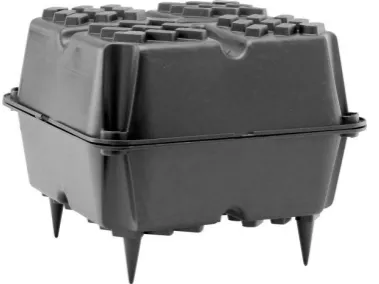
U-Boot:-
© 2018, IRJET | Impact Factor value: 6.171 | ISO 9001:2008 Certified Journal | Page 522 Figure. 2: U-Boot
Bubble Deck:-
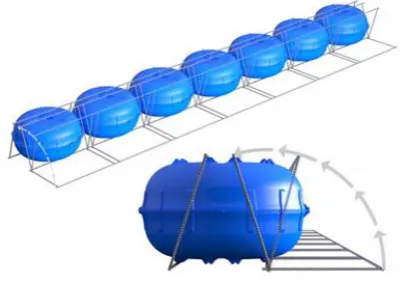
[image:2.595.69.259.79.221.2]In the 90s Bubble deck system was invented by jorgan Breuning for reducing weight of the slab with more than 30% and also it has longer span between supports and this slab is known as bubble deck slab. The name of this slab is due to the shape of the cavity fix in the slab. The manufacturer of this type of cavity take the patent for that. It generally used in between the upper and the bottom layer of the reinforcement which gives almost same property as given by the solid slab used material is HDPE.
Figure. 3: Bubble Deck
1.2 DETAIL OF CAVITY USED
Sphere cavity:
Diameter
Internal = 74.00 mm
External = 80.00 mm
Thickness = 6.0 mm
Volume = EXT. – INT
= 2.68 X 10⁻⁴ - 2.122 X 10-4
= 5.58 X 10⁻⁵ m2
Weight = 62 Gram
Figure. 4: Sphere Cavity
Elliptical Cavity
Diameter Dx EXT. = 80.00 mm
INT. = 74.00 mm
Dy EXT. = 40.00 mm
INT. = 34.00 mm
Dz EXT. = 80.00 mm
INT. = 74.00 mm
Thickness = 6.0 mm
Volume = 2.90 X 10-04 m3
Weight = 300 Gram
Figure.5: Elliptical Cavity
Egg Cavity
Diameter Dx EXT. = 61.00 mm
INT. = 55.00 mm
Dy EXT. = 80.00 mm
INT. = 74.00 mm
Dz EXT. = 61.00 mm
INT. = 55.00 mm
Thickness = 6.0 mm
Volume = 6.2 X 10-05
Weight = 60 Gram
[image:2.595.62.263.393.547.2]© 2018, IRJET | Impact Factor value: 6.171 | ISO 9001:2008 Certified Journal | Page 523 imported in Ansys 14.0 static analysis and then it is meshed
with the course relevance and default size of element after meshing of slab load is applied on slab and fixed it’s all four side faces and analyse it for total deformation, Von-misses stress, Von-misses strain, strain energy, principle stress, principle strain, Shear strain, Shear stress Etc.
[image:3.595.310.563.73.429.2]In that process four type of slab is modeled which is solid slab, Sphere cavity slab, Egg cavity slab, Elliptical cavity slab the general arrangement of slab is shown in figure given below.
Figure.7: Arrangement of Cavity in Slab
Table -1: Material Used
Material Used
Material Density
Kg/m3 Poisson ratio
Young’s Modulus (mPa)
Concrete 2400 0.18 27386
Reinforce
ment 7850 0.3 2.0 X 10⁵
Recycled
Plastic 1100 0.35 4000
3. RESULTS & DISCUSSION
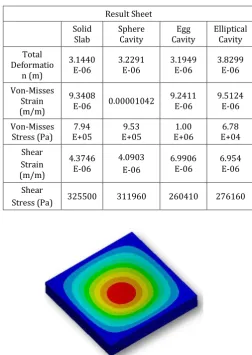
The result is based on the 4 properties which is total deformation, Von-misses stress, Von-misses strain, Shear strain, Shear stress.
Von-Misses
Stress (Pa) E+05 7.94 E+05 9.53 E+06 1.00 E+04 6.78 Shear
Strain (m/m)
4.3746 E-06
4.0903 E-06
6.9906
E-06 6.954 E-06
Shear
[image:3.595.41.285.337.500.2]Stress (Pa) 325500 311960 260410 276160
Figure.8: Demonstration of Total Deformation Result
[image:3.595.310.557.474.639.2]© 2018, IRJET | Impact Factor value: 6.171 | ISO 9001:2008 Certified Journal | Page 524 Figure.9: Demonstration of Von-Misses Strain Result
[image:4.595.36.551.248.596.2]Chart -2: Von-Misses Strain
Figure.10: Demonstration of Shear Strain Result
Chart -3: Shear Strain
Figure.11: Demonstration of Von-Misses Strain Result
Chart -4: Von-Misses Stress
Figure.12: Demonstration of Shear Strain Result
[image:4.595.39.559.588.735.2]© 2018, IRJET | Impact Factor value: 6.171 | ISO 9001:2008 Certified Journal | Page 525 4. The behavior of sphere cavity slab is better than all other
slabs in case of shear stress.
5. The behavior of sphere cavity slab is better than all other slabs in case of Von-Misses Stress.
6. The behavior of Elliptical cavity slab is better than all other slabs in case of shear stress.
7. If we talk of the economy, then sphere cavity slab saves 6% concrete, Egg cavity saves 4% concrete and Elliptical cavity saves 15% concrete.
5. Future Scope
1.It is also felt that study of seismic performance on the basis of experimental investigation in Indian environment is required. For analysis and design of precast concrete structure in the country, seismic performance of structure must be investigated experimentally.
2.Study of seismic performance of emulative precast structure can be performed on ANSYS workbench.
3.Study of thermal performance of the slab structure can be performed on ANSYS Workbench.
REFERENCES
[1] Shetkar, A., & Hanche, N. (2015). “An experimental study
on Bubble Deck slab system with elliptical balls”. Proceeding of NCRIET-2015 and Indian J. Sci, Volume 12, Issue 1, Page 021-027.
[2] Churakov, A. (2014). “Biaxial hollow slab with
innovative types of voids”. Saint-Petersburg University. Volume 6, Issue 21, Page 70.
[3] A. K. Dwivedi, Prof. H. J Joshi, R. Raj, et. All (2016).
“Voided Slab Design: Review” 3rd International Conference on Multidisciplinary Research & Practice, Volume 4, Issue 1, Page 220-226
[4] Jamal, J., & Jolly, J. (2017). “A study on structural
behavior of bubble deck slab using spherical and elliptical balls”. International Research Journal of Engineering and Technology, Volume-4, Issue-5, Page 2090-2095.
and their application to lightweight bridge decks” (Doctoral Dissertation, Massachusetts Institute of Technology).
[8] Calin, S., Asavoaie, C., & Florea, N. (2010). “Issues for
achieving an experimental model concerning bubble deck concrete slab with spherical gaps”. Buletinul university of polytechnic for construction and architecture, volume 56 Issue 2, Page 19.
[9] Prakash, A. N. (2011). “The revolutionary concept in
voided slabs”. Dimensions-A Journal of AN Prakash CPMC Pvt. Ltd., Issue, (10).
[10] Teja, P. P., Kumar, P. V., Anusha, S., Mounika, C. H., &
Saha, P. (2012, March). “Structural behavior of bubble deck slab”. In Advances in Engineering, Science and Management (ICAESM), 2012 International Conference on (pp. 383-388). IEEE.
[11] Ibrahim, A. M., Ali, N. K., & Salman, W. D. (2013).
“Flexural capacities of reinforced concrete two-way bubble deck slabs of plastic spherical voids”. Diyala Journal of Engineering Sciences, volume 6, Issue 2, Page 9-20.
[12] Hai, L. V., Hung, V. D., Thi, T. M., Nguyen-Thoi, T., &
Phuoc, N. T. (2013, September). “The experimental analysis of bubble deck slab using modified elliptical balls”. In Proceedings of the Thirteenth East Asia-Pacific Conference on Structural Engineering and Construction (EASEC-13) (pp. G-6). The Thirteenth East Asia-Pacific Conference on Structural Engineering and Construction (EASEC-13).
[13] Bindea, M., Zagon, R., & Kiss, Z. (2013). “Flat slabs with
spherical voids. Part II: Experimental tests concerning shear strength”. Acta Technica Napocensis: Civil Engineering and Architecture, Volume 56, Issue 1, Page 74-81.
[14] Ibrahim, A. M., Ali, N. K., & Salman, W. D. (2013).