© 2016, IRJET | Impact Factor value: 4.45 | ISO 9001:2008 Certified Journal | Page 1357
Design and Evaluation of Electrical Resistance Unit(Ohmic Heating) for
Food Processing
V. Perasiriyan
1, S. Priya
2, A. Mangala Gowri
3*, D. Ramasamy
2, T. Sivakumar
41Department of Food Engineering,College ofFood and Dairy Technology, Tamil Nadu Veterinary and Animal Sciences University, Chennai
2Department of Food Science and Technology,College of Food and Dairy Technology, Tamil Nadu Veterinary and Animal Sciences University, Chennai
3Centre for Stem Cell Research and Regenerative Medicine, Madras Veterinary College, Tamil Nadu Veterinary and Animal Sciences University, Chennai
4Faculty of Food Sciences, College of College of Food and Dairy Technology, Tamil Nadu Veterinary and Animal Sciences University, Chennai
---***---Abstract -With growing concerns on the safety of food for consumption by animals and humans, an efficient processing technique that is more easily controlled and as effective as current techniques could revolutionize the food industry in the coming years. Present day energy conservation strategies focus mainly on novel low energy high efficient methods of food processing suitable for long storage with minimal nutrient loss.In ohmic heating, the electrical energy provided to the heating cell is ideally used only for heat generation; and electrochemical reactions at electrode and solution interface is considered undesirable.The present study involves on the development and functional analysis of ohmic processing unit based on the principle of electrical resistance induced in the food usinga lab test model OHP unit with stainless steel and titanium electrode.
Key Words: Electrical Resistance, Food, Ohmic Processing,
stainless steel, titanium electrode
1.INTRODUCTION
Development of new technologies in thermal food treatments are showing promise for industrial and scientific processing of foods with minimum nutrient loss. Ohmic heating is one of the newest alternative processing techniques to emerge in the last 15 years. Ohmic heating (also referred as Joule heating, electrical resistance heating, direct electrical resistance heating, electroheating, and electroconductive heating) is defined as a process wherein (primarily alternating) electric currents are passed through foods or other materials with the primary purpose of heating them. Using electric current, food can be pasteurized, fermented, or sterilized in a manner that is equally comparable, if not, better than the current methods of processing.
With growing concerns on the safety of food for consumption by animals and humans, an efficient processing technique that is more easily controlled and as effective as current techniques could revolutionize the food industry in the coming years. Present day energy conservation strategies focus mainly on novel low energy high efficient methods of food processing suitable for long storage with minimal nutrient loss. Under preservation by low temperature microbial growth and enzyme reactions are retarded in stored foods. This advanced thermal processing is based on the principle of Ohms’ law wherein the food material itself serves as an electrical resistor which is heated by passing current through it and heats the entire mass of the food product. Food quality preservation through this technology is useful for the treatment of protein rich perishable foods like fruits which tends to denature and coagulate when thermally processed.Ohmic heating presents huge applications including its use in blanching, evaporation, dehydration, fermentation, sterilization of foods and heating of foods applied in military field and long term space missions [12]. Ohmic heating of food products involves the passage of alternating current through them, thus generating internal heat as a result of electrical resistance [11].
In ohmic heating, the electrical energy provided to the heating cell is ideally used only for heat generation; and electrochemical reactions at electrode and solution interface is considered undesirable. Electrodes in ohmic heating can be regarded as a junction between a solid-state conductor (i.e. current feeder) and a liquid-state conductor (i.e. heating medium). They play a vital role by conveying the current uniformly into the heating medium. Various materials, were used as electrodes in different ohmic heating studies and applications which included, carbon (graphite) [5,9], aluminum [8, 16], dimensionally stable anode (DSA)-type, glassy carbon [1], platinum [15], platinized-titanium [13,15], rhodium plated stainless steel [10], titanium and stainless steel [1, 2, 18].
© 2016, IRJET | Impact Factor value: 4.45 | ISO 9001:2008 Certified Journal | Page 1358 corrosion during ohmic heating of a model system. Stainless
steel 304 electrodes were energized in a 2% salt solution at room temperature of 24±1C for 10 min. The effects of Alternating Current (AC) electrical frequency and current density were examined in a frequency range of 55 to 5000 Hz and current density range of 1200 to 3500 A/m2. The ratio of
colorimeter values of lightness (L)/yellowness (b) was used to quantify the degree of visual corrosion. Corrosion was most serious at low AC electrical frequencies of 55, 100, 200 Hz and at high current density of 3500 A/m2. At AC electrical
frequency values above 5000Hz, corrosion reduced dramatically even as current density was increased to 3500 A/m2 and heating time extended to 1–1/2 h [20].
Using the alternating frequency of 60 Hz,Chaminda and his colleguesdemonstrated that the electro chemical behavior of an electrode material was unique to the material itself. Although, in general, a large microscopic surface area can suppress electrochemical processes, the type and extent of electrochemical reactions are determined by the chemical nature of the electrode surface, as well as the pH of the heating medium. All the electrode materials exhibited intense electrode corrosion at pH 3.5 compared to that of the other pH values. Although the titanium electrodes showed a relatively high corrosion resistance, apparent electrolysis was seen at all the pH values during ohmic heating. Stainless steel was found to be the most electrochemically active electrode material during ohmic heating at all the pH values. It was proven that the intense corrosion of graphite electrodes was due to the migration of surface functional groups and oxides as organic compounds during ohmic heating; and the pH of the heating medium seemed to facilitate such migrations. Because of the relatively inert electrochemical behavior, titanium and platinized-titanium would be the electrode material of choice for ohmic heating at all the pH values. The potential use of platinized-titanium electrodes for ohmic heating operations was further demonstrated on a pilot scale at 39.8 kW and the concentrations of migrated Pt and Ti were reported to be far below the published dietary exposure limits [3].Titanium and its alloys possess tensile strengths from 30,000 psi to 200,000 psi (210-1380 MPa), which are equivalent to those strengths found in most of alloy steels. The density of titanium is only 56 percent of steel, and its corrosion resistance compares well with that of platinum. Of all the elements in the earth’s crust, titanium is the ninth most plentiful. Titanium has a high melting point of 3135°F (1725°C). This melting point is approximately 400°F above the melting point of steel and approximately 2000°F above that of aluminium.
Ohmic heating has immense potential for achieving rapid and uniform heating in foods, providing microbiologically safe and high quality foods. Properly processed and packed fruit preparations are potential readymade energy sources for immediate consumption.The success of ohmic heating depends on the rate of heat generation in the system, basic design of the system, the electrical conductivity of the food, electrical field strength, residence time and the method by
which the food flows through the system [14]. Hence, it is proposed to establish pilot electrical resistance chamber for food processing based on the principle of resistance heating and characterize the effect of selective fruit based solid-liquid foods and liquid foods as models on this method to achieve the beneficial effect of ohmic heating method of food processing. The proposed objectives in this study is to design and developa lab test model OHP unit with stainless steel and titanium electrode for food preservation
MATERIALS AND METHODS
The present study involves on the development and functional analysis of ohmic processing unit based on the principle of electrical resistance induced in the food usinga lab test model OHP unit with stainless steel and titanium electrode.A model ohmic processing unit was designed and installed at College of Food and Dairy technology, Koduvalli.A lab test model OHP unit with stainless steel and titanium electrode was assembled and tested with lemon- watermelon blend (sugar and salt added to lemon juice and stabilized the pHto 3.5) at various voltage of 0, 10, 20, 30, 40, 50, 60 v/cm for changes in pH. Based on the results and due to the reports of the present test model and previous research reviews titanium electrode was used in the fabricated and installed unit.
2.1 Electrical Resistance Induction Chamber
© 2016, IRJET | Impact Factor value: 4.45 | ISO 9001:2008 Certified Journal | Page 1359 for manual operation and auto cycles in the control panel
were given in the Fig 4 A.
2.2. Electrode
The electrode should be smooth, less porous, less corrosive, easily cleanable, do not absorb any material or flavours, hard and capable to withstand high temperature, do not react with food substances and exhibit very low electro chemical reaction. Previous studies indicated that at lower frequencies the stain less steel electrode have high electro chemical reactions. But titanium (Ti) is light in weight, strong, corrosion resistant and abundant in nature and has been reported to have negligible electrochemical reaction and the concentrations of migrated Ti were far below the published dietary exposure limits [14].
Titanium hasa low coefficient of linear expansion which is equal to5.0x10-6 inch per inch /°F, whereas that of stainless
steel is 7.8x10⁻⁶, copper 16.5x10⁻⁶, and aluminum 12.9x10⁻⁶.
Titanium is not a good conductor of electricity as that of copper. But titanium has almost same conductivity as that of stainless steel.Since titanium is reported to have negligible electro chemical reaction titanium parallel plate electrodes of size (95x30x1.5mm) were used in the system. Electrodes were connected to the power supply, and it needs physical contact with the food material in order to pass the electric current through them. The distance between the electrodes in the system or electrode gap can decide the electric field strength. This tends to fluctuate depending on the size of the system and hence by changing this distance, the electric field strength, expressed in volts per centimeter [V/cm], can be varied. In an in-line field system, the material upstream experiences higher field strength than the material downstream due to the dropin voltage throughout the system. In a cross-field system, the electric field strength is constant throughout (FDA-CFSAN 2000). A device for measuring temperature in the system, an electrically isolated thermocouple is inserted. As per the earlier reports it was observed that the ohmic heating chamber of 3 cm to 5 cm electrode spacing gave a minimum difference between the observed and reference value of the electrical conductivity. Hence the designed OHP unit chamber was designed with the electrode of variable spacing of 3 cm to 5 cm [4].
3. RESULT AND DISCUSSION
3.1. Designed and Developed Electrical Resistance Chamber Fabricated OHP Unit
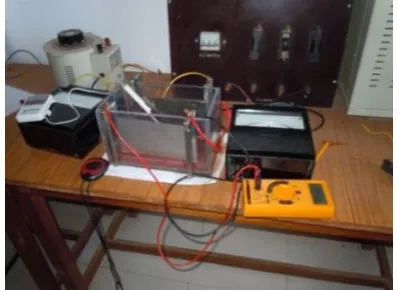
Preliminary experiments were carried out on a test model - lab scale Ohmic heating system. The lab test model OHP unit with stainless steel (SS) and titanium (Ti) electrode (Fig 1 & 2) was assembled and tested with lemon pH (2.2-2.8) watermelon (5.2-5.6) blend (stabilized the pH to 3.5) at various voltage of 0, 10, 20, 30, 40, 50 and 60 V/cm for
[image:3.595.334.533.183.328.2]changes in pH showed that there was a characteristic change in the pH in using the stainless steel electrode than the titanium electrode (Fig 3). Based on the results and due to the reports of the present test model and previous research reviews titanium electrode was used in the fabricated and installed unit.
[image:3.595.339.524.375.548.2]Fig 1 .Test model- OHP with Stainless steel electrode using lemon-water melon juice.
Fig. 2.Test model-OHP with Titanium electrode using lemon-water melon juice.
[image:3.595.307.550.587.747.2]© 2016, IRJET | Impact Factor value: 4.45 | ISO 9001:2008 Certified Journal | Page 1360 The experimental results showed a characteristic change in
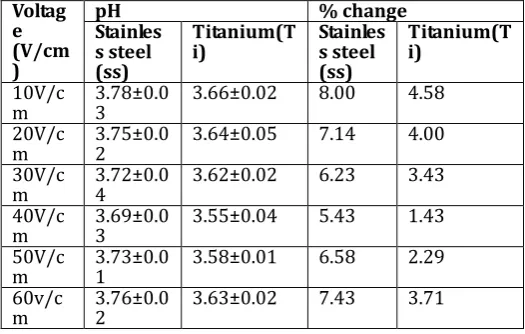
the pH of the lemon-watermelon blend stabilized for a pH 3.5 based on the applied voltage gradient while using two different types of electrodes. The voltage gradient had significant effect on the pH change in fruit juice when stainless steel electrodes were used than using titanium electrodes during Ohmic treatments (p<0.05, Table 1). The range of the fruit blende pH after Ohmic treatments using stainless steel electrodes was 3.69 to 3.78 whereas the pH range was 3.55 to 3.66 in using titanium electrodes. The effect of ohmic heating on the pH was limited due to less corrosive titanium electrodes compared to SS electrodes, since the maximum percentage change was 4.58 % and 8% in titanium and SS electrodes respectively during the treatments range between 30-60 V/cm.The model outline is shown in the Fig. 4
Table – 1 pH changes during different voltage gradient in lemon-water melon juice blend.
Voltag e (V/cm )
pH % change
Stainles s steel (ss)
Titanium(T
i) Stainless steel (ss)
Titanium(T i)
10V/c
m 3.78±0.03 3.66±0.02 8.00 4.58
20V/c
m 3.75±0.02 3.64±0.05 7.14 4.00
30V/c
m 3.72±0.04 3.62±0.02 6.23 3.43
40V/c
m 3.69±0.03 3.55±0.04 5.43 1.43
50V/c
m 3.73±0.01 3.58±0.01 6.58 2.29
60v/c
[image:4.595.30.293.350.517.2]m 3.76±0.02 3.63±0.02 7.43 3.71
Fig. 4 Designed model OHP unit outline
The advantages of ohmic processing are rapid uniform
heating even with distinctive two phase systems [19], a good retention of nutrients such as vitamins and colour [17] and energy efficiency [6]. This technology is attractive for treating particulate food where spores can reside and the solid particles are heated as rapid as the liquid in which they bathe. The Ohmic heating process allows for particulate foods to be treated, using the principle of (HTST) sterilization. Though the ohmic process of heating is thermal but non thermal effects operate due to electric currents generated within the food and the electric conductivity of the food determines the rate of ohmic heating and this alters as the process progresses [7]. Thus the efficiency of the technique lies in the electrodes used and the electrical resistance offered by the test food. Also the ohmic heater cleaning requirements are comparatively less than those of traditional heat exchangers due to reduced product fouling on the food contact surface. This can be used for heating not only liquid foods but that containing large particulate such as semi solid foods. It is a highly attractive technique for continuous food processing. This technique can serve as a continuous in-line heater for cooking and sterilization of viscous and liquid food products such as fruit juices and pulps which inactivate enzymes without affecting the flavour.
4. CONCLUSION
Novel low energy or energy efficient methods of food processing are important aspects of present day need towards energy conservation strategies. Development of new technologies in thermal food treatments are showing promise for industrial and scientific processing of foods with minimum nutrient loss. Inducing resistance in food by passing electric current generates thermal changes which volumetrically heats the entire subjected food substance. Ohmic heating (OH) is an advanced thermal processing based on the principle of Ohms’ law wherein the food material itself serves as an electrical resistor which is heated by passing current through it and heats the entire mass of the food product.
REFERENCES
[1] Amatore, C., M. Berthou., S. Herbert. (1998). Fundamental principles of electrochemical ohmic heating of solutions. J of Electroanal Chem. 457: 191-203.
[2] Assiry, A., S.K.Sastry., and C. Smaranayake. (2003).Degradation kinetics of ascorbic acid during ohmicheatingwith stainless steel electrodes.Journal of Applied Electrochemistry.33(2):187-196.
[3] Chaminda, P., S. Sudhir., and K. Sastry. (2005). Electrode and pH effects on electro chemical reactions during ohmic heating. Journal of Electro analytical Chemistry.57(7): 125–135.
© 2016, IRJET | Impact Factor value: 4.45 | ISO 9001:2008 Certified Journal | Page 1361 (Agricultural processing) thesis submitted to TNAU.
Coimbatore- 3.
[5] Getchell, V.E. (1935). Electric pasteurization of Milk. Agricul. Eng.16(10): 408-410.
[6] Ghnimi. S., N. Flach-Malaspina., M. Dresh.,G. Delaplace., J.F. Maingonnat. (2008). Design and performance evaluation of an ohmic heating unit for thermal processing of highly viscous liquids. Chem Eng. Res. Des. 89: 627-632.
[7] Halden, K., A. A. P de-Alwis., P. J. Fryer. (1990).Changes in the electrical conductivity of foods during ohmic heating. InterJ of Food Sci and Technol. 25:9-25.
[8] Mizhrahi, S., I.J. Kopelman and J. Perlman. (1975). Blanching by electro-conductive heating. Journal of Food Technology. 10:281-288.
[9] Moses, D.B.,(1938). Electrical pasteurization of milk. Agricultural Engineering.19:525-526.
[10] Palaniappan, S., S. K. Sastry. (1991) Electrical conductivity of selected juices: influences of temperature, solids content, applied voltage and particle size. J. Food Process. Eng. 14: 247-260.
[11] Reznick, D.(1996). Ohmic heating of fluid foods. Food Technol. 50 (5):250-251.
[12] Sarang,S., S. K. Sastry., L. Knipe.(2008). Electrical conductivity of fruits and meats during ohmic heating. J. Food Eng.87: 351-356.
[13] Stirling, R., (1987). Ohmic heating-a new process for the food industry, Power Engineering J. 6: 365-371.
[14] Timsit, R.S. and A. Luttgen.(2016). Temperature distribution in an ohmic-heated electrical contact at high signal frequencies. Applied physics letters. 108, 121603. doi: 10.1063/1.4944535
[15] Tzedakis, T., R. Basseguy., M. Comtat. Platinized titanium electrodes (1999) J. Appl. Electrochem. 29: 821.
[16] Uemura, K., A. Noguchi., S.J. Park., D.U. Kim. (1994) in: Proceedings of the 6th International Congress on Engineering and Food, Blackie Academic & Professional Press, London, pp. 310–312.
[17] Vikram, V.B., M.N. Ramesh., S.G. Prapulla. (2005). Thermal degradation kinetics of nutrients in orange juice heated by electromagnetic and conventional methods. Journal of Food Engineering.69:31-40.
[18] Wu, H., E. Kolbe., B. Klugstad., J.W. Park and J. Yongsawatdigul. (1998). Electrical properties of fish mince during multi-frequency ohmic heating. Journal of Food Science.63(6): 1028-1032.
[19] Zareifard, M.R., H.S. Ramaswamy., M. Trigui., M. Marcotte., (2003). Ohmic heating behaviour and electrical conductivity of two-phase food systems.Innovative Food sci. Emerg. Technol.4: 45-55.