© 2018, IRJET | Impact Factor value: 6.171 | ISO 9001:2008 Certified Journal | Page 3587
REMOTE CONTROLLED ARECANUT PLUCKING MACHINE
Fasil TK
1, Jishnu K Das
2, Shabeeh AP
3, Xavier Saji
4, Prof. Jacob Kuriakose
5,
Prof. Vinod Yeldho Baby
61,2,3,4
B-Tech Degree student, Mechanical Engineering, Mar Athanasius College of Engineering,
Kothamangalam, Kerala, India
5,6
Assistant Professor, Dept. of Mechanical Engineering, Mar Athanasius College of Engineering,
Kothamangalam, Kerala, India
---***---Abstract -
The people in rural areas of Karnataka andKerala mainly depends on agriculture for their livelihood. Skilled areca nut tree climbers have become scarce and farmers are finding it difficult to harvest the nuts. Here we are designing and fabricating remote controlled areca nut plucking machine. The tree climber has two rings, two pulleys, rollers, rope, spring, cutter, collector and the main frame. The power from the motor is transmitted by rope pulley mechanism. The machine is placed around the tree and clamped to it by using two rings. Rotation of the motor allows rope to wind and rewind on to the drum. Cutting will happen along the movement of the machine. There is no separate mechanism for cutting to make the system simple. Control over the motor is done by a Bluetooth connected via mobile.
Key Words: Areca Nut Tree, Rope, Pulley, Cutter, Spring,
Roller, Collector, Main frame, Ring, Drum, Bluetooth, Mobile
1. INTRODUCTION
There are much equipment machines in the market to help farmers. Sourcing skilled labours for agriculture sector has become a tedious job in today’s time. Especially in the field of areca nut agriculture. It requires skill to climb areca nut tree. So, there is need of mechanization in the farming process to cope up with lack of manpower and to eliminate the risk to human life.
This project is a mechanized system which would eliminate the need of manual climbing for harvesting areca nut. This system is so simple that can be controlled by anyone. The currently available systems are complicated in design and working. we decide to develop a simple automated system which uses ROPE PULLEY mechanism. This machine can be operated wirelessly over Bluetooth using a mobile application. This machine is simple and a person with little technical knowledge can be easily assemble and operate the machine. It is very easy to move from one place to another. This is the most suitable machine for harvesting areca nut tree easily. A wiper motor is providing power for the climbing and cutting of areca nut bunch. Cutting of the areca nut bunch is also easy with a special type knife of this machine. A battery is also attached to the machine for driving the motor. Rotation of the motor allows rope to wind and rewind on to the drum, which is attached to the motor shaft.
This is a unique model which will be the machine- front of the areca nut industry and in turn will serve as a great help to the farmers. For the simplification of design and energy saving we use rope to bring the machine down. we can bring the machine down by pulling rope from ground and this rope also can be used to align the cutting knife to any position manually. So, there is no power required for climb down. In this study, considering all the parameters, a safe, reliable, efficient, automated and cost effective climbing machine is designed and fabricated of the paper.
2. LITERATURE REVIEW
J Sharana Basavaraja [1] Tree climber is mainly focused on two units RH and LH. The RH unit create the downward movement of the pedal, through which steel wire rope is stretched and locks the areca nut tree. Now the LH unit is lifted up by pulling the handle attached to it to climb and the same process is repeated to reach the required height. To descend the tree the pedal of RH unit is pushed down and the handle of the LH unit is also pulled down alternatively till the bottom of the tree.
Manoj Kumar [3]. The base frame is one which supports all the components to be built upon. The also has a movable arm on top. The whole set is controlled by remote
S R Pavan Kumar [4]. The main locomotion of the robot is caused due to the two motors which facilitates simultaneous motion of two consecutive links. This robot grasps the tree with the help of grippers acted by a spring
Nallusamy V [5]. It is composed of a pair of omni directional tree grippers for holding the robot on a tree surface and a novel 3 DOF continuum manipulator for the manicuring.
© 2018, IRJET | Impact Factor value: 6.171 | ISO 9001:2008 Certified Journal | Page 3588
[image:2.595.308.548.83.208.2]3. DESCRIPTION OF COMPONENTS
Table -1: Components List
COMPONENTS MATERIAL/ SPECIFICATION
MAIN FRAME GI
STEEL ROD MS
SPRING Cold Drawn Steel Wire, Grade 2
CUTTER MS
PULLEY MS
MOTOR 12V, 130W, 50rpm Wiper Motor
BATTERY 12V, 7.2Ah
4. PROBLEM FORMULATION
In the current condition, there is a scarcity in the availability of skilled labors for harvesting Areca nut and for other activities like pesticide application. This has created a negative energy in the Areca nut farming. The wages for skilled laborers are also high which is also an important factor. This project concentrates on design and fabrication of a Remote-Controlled Areca nut Plucking Machine which will eliminate the need of a skilled laborer for harvesting areca nut.
To design and fabricate a remote-controlled areca nut plucking machine with higher efficiency and a simpler mechanism which could be easily understood by farmers without any complex confusions arising in them. The simpler mechanism also helps in easy repairing and recovery from damages without taking them to service.
To eliminate risk of human life
To reduce damage on the tree from the machine To produce an efficient system
To produce a cost-effective product to the market.
5. DESIGN AND FABRICATION
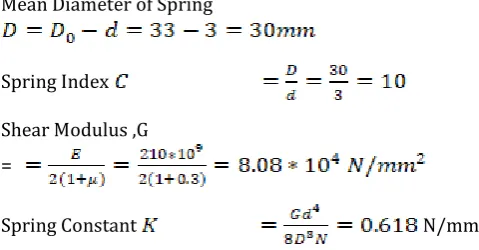
A. CALCULATION FOR SPRING CONSTANT Spring Outer Diameter
Wire Diameter
No. of coils in the spring
No. of active coils N = 51-2 = 49
Free length mm
Young’s Modulus of Steel
Poisson's Ratio
Mean Diameter of Spring
Spring Index
Shear Modulus ,G =
Spring Constant N/mm
By this calculation, we have chosen cold drawn grade 2 spring of spring constant 0.618 N/mm.
B. MOTOR TORQUE CALCULATION
Spring constant
Total mass of the machine
,
© 2018, IRJET | Impact Factor value: 6.171 | ISO 9001:2008 Certified Journal | Page 3589 C. CAD DRAWING
Fig Isometric View
D. ANALYSIS
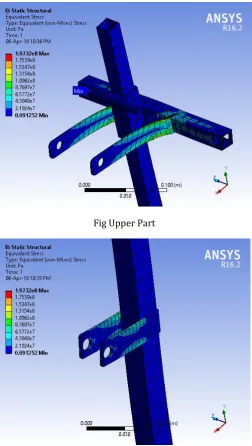
The analysis was carried out using ANSYS 16.2. Static structural analysis were performed on the main structure in order to determine whether the frame along with the pulley holder can withstand the force due to weight and reactive force due to contraction of spring. The two ring holding positions were taken as fixed supports to hold the frame in positions during analysis. The total force was divided into two and they were applied on each holes on the string holding the pulley shaft. The forces acting on the top pulley were taken in downward direction and similarly the force acting on the lower pulley were taken in upward direction according free body diagram of rope and pulley mechanism.
[image:3.595.308.562.80.291.2]The total force acting on a single pulley were considered as 450N. The total machine weight was derived as 9 kg from the CAD design. Thus, 90N force due to the weight acting on the pulley. And the total length of the spring is 63cm where it is considered to contracted to 3cm (ie 60cm contraction). The spring constant is 600N/m and thus exerting a force of 360N due to contraction. This total force 450 N is divided into two since two straps holds the pulley in place.
Fig Upper Part
Fig Lower Part
E. ELECTRONICS
Initially, 12V is supplied to the Arduino from which 5V is given to the VCC of Bluetooth module. Both the grounds of Bluetooth module and Arduino are shorted. The signal received by the Bluetooth is transmitted to the Arduino. TDX and RDX are the two pins used for transmission and receiving the signals. Ground and VCC of relay are shorted with that of the Arduino. N1 and N2 are the two pins through which the signals are given which are connected to 6 and 7th
[image:3.595.37.289.98.466.2]© 2018, IRJET | Impact Factor value: 6.171 | ISO 9001:2008 Certified Journal | Page 3590 is 1, motor will rotate in the opposite direction for a time
period of 2900 milliseconds. When both N1 and N2 sends the same signal, then motor will stop rotating.
6. WORKING PRINCIPLE
The experimental setup consists of a main frame on which the main components of the machine are mounted. The motor is mounted onto the main frame with an extra member. The motor shaft is welded to the drum which winds the steel rope. Thus, when the motor rotates, the drum rotates and the string is wound over the drum. The string is welded in to the main frame and follows through two pulleys to form a rope and pulley mechanism. During the drum winding, the spring gets contracted and spring force acts along the direction opposite to the applied force. This opposite force generates an upward motion during unwinding process done by the motor.
The upper and lower rings are used to mount the machine onto the areca nut tree. These two rings are fixed to the main frame with the help of pins with areca nut tree in the ring. The ring is provided with number of holes so that they can be mounted for different diameters of areca nut trees. During the winding operation done by the motor, the upper ring will be locked to the tree and lower ring will be free to move. Thus creating an upward movement of the lower ring. After the winding operation, the lower pulley gets locked and upper pulley becomes free. During the unwinding operation the upper pulley displaces and creates a displacement.
The cutting operation is carried out by the cutting tool during the unwinding operation carried out by the motor. This operation gives enough power for the cutting tool to produce a cutting action. The collector present along with the cutting tool collects the areca nut and prevent it from falling to the ground and thus helps in reducing the overall time by eliminating the time required to collect the areca nut from ground. The climbing down mechanism is much simpler. It consists a rope tied on to the both upper and lower rings. While pulling the rope from the ground, both rings get detached from the tree by aligning perpendicular to the linear length of the tree. The sudden loose in the rope again tightens the ring to the tree and prevents fall of from the tree and produces a step wise climbing down technique.
8. CONCLUSIONS
Our main aim is to represent our innovative concept, we have taken some useful data from our conceptual model. The observations which were made are:
At the present condition, the machine can be used to cut the areca nut from the areca nut tree.
On further modifications, the machine can also be used for spraying operation. For this purpose, a special attachment will replace the cutter.
A camera can be included in the system at the top of the machine in order to have exact vision of the areca nut from the ground.
To overcome problems in conventional machines such as low efficiency, difficult to operate, the proposed model of remote controlled areca nut plucking machine is helpful and complete all the expectations needed in plucking the areca nut.
Based on the project done and the further discussions, the conclusions are:
The machine will overcome the limitations of existing machines by introducing the simplest mechanism.
Compact and simple in geometry.
© 2018, IRJET | Impact Factor value: 6.171 | ISO 9001:2008 Certified Journal | Page 3591 Works on minimizing effort on the tree which
in turn will not damage the tree.
Descending of the machine can be done manually.
The safety and health of humans can be ensured by this machine, since the entire operation is controlled from the ground via Bluetooth.
9. REFERENCES
[1] J Sharana Basa Varaja,Nagaraja, Somashekar H Hedge-
Design and development of Areca Tree Climber in international journal of Research in Mechanical Mechatronics and Automobile Engineering.
[2] Rahul V, Sebin Babu- Semi Automated Coconut Tree
Climber in International Journal of Research in Engineering and Technology.
[3] Nallusamy V- Tree Climbing Robot in JSET of
Engineering and Research.
[4] N S Kannur- Design and Fabrication of Coconut Tree
Climbing Equipment- International journal of innovative research in science engineering and technology.
[5] Veerabadhra- Development of Automated Coconut
Harvester Prototype- International journal of innovative research in science, engineering and technology.
BIOGRAPHIES
FASIL TK,
B-Tech Degree student, Mechanical Engineering, Mar Athanasius College of Engineering, Kerala, India
JISHNU K DAS,
B-Tech Degree student, Mechanical Engineering, Mar Athanasius College of Engineering, Kerala, India
SHABEEH AP,
B-Tech Degree student, Mechanical Engineering, Mar Athanasius College of Engineering, Kerala, India
XAVIER SAJI,
B-Tech Degree student, Mechanical Engineering, Mar Athanasius College of Engineering, Kerala, India