© 2017, IRJET | Impact Factor value: 5.181 | ISO 9001:2008 Certified Journal | Page 5612
Survey Paper on Eye Gaze Tracking Methods and Techniques
Puja sorate
1, Prof. Mrs. G. J. Chhajed
21
Student of Computer Engineering, Pune University
VPKBIET, Baramati, India
2
Assistance
Professor of Computer Engineering, Pune University
VPKBIET, Baramati, India
---***---Abstract
-
Eye movement tracking is a technique use for checking the usability problems in the context of Human Computer Interaction (HCI). Initially they are present tracking technology and key elements. Eye movement tracking technique based on the behavior of the user when they are looking. It can use for different kinds of techniques i.e.“electro-oculography(EOG), Sceleral Search Coils, infrared
oculography(IOG), video oculography (VOG), different models, probable approaches i.e. “shape based approach, appearance based methods, 2D and 3D models based approach and different software algorithms for pupil detection Eye tracking and Gaze estimation are the most challenging areas in computer vision. The eye tracking applications likes human computer interaction, brain computer interaction, assistive technology, e-learning, psychology investigation, pilot training assistance, virtual and augmented reality and so on.
Key Words: Electro-occulography, Video occulography, appearance based method, HCI, Eye tracking, Gaze estimation.
1.
INTRODUCTION
Face is the key of mind and eyes are the window to the person. Eye movements provide rich information to a person. The study of eye movement helps to determine people where they are looking. Eye tracking is the measure of eye movement and gaze tracking is the analysis of eye tracking info and head movement info. The gaze tracking applications like in robotics, psychological studies, cognitive science. In psychological studies, they are used to measure the
behavioural responses. [1] In computer vision as an input
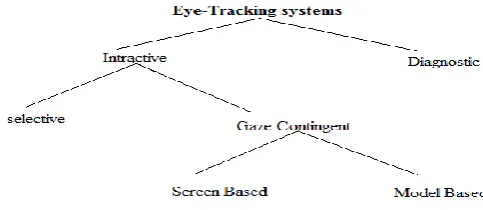
device and in making as a tool to obtain optimum location to place an advertisement. The main application of neuroscience is Eye tracking and is well-organized time and effectual cost, as well as low problem and compare with other neurological methods. Eye tracking helps the neuroscience Eye movements, such as saccades, fixation and smooth pursuit, Visual processing, interaction between eye movements, vision, and performance tasks Object-by-object search mechanisms in attention studies, Eye movement patterns in visual neglect, Neurological functions involved in perceptual decision making. Attention and brain imaging have been investigated neuroscience.In Fig. [1] Hierarchy of eye tracking applications likes Interactive and diagnostic. The interactive applications are
divided into two types selective and Gaze contingent. Selective systems use the point of gaze as to a pointing device such as the mouse. The selective system can be use in handicapped users. Gaze-contingent systems exploit knowledge of the user’s gaze to facilitate the rapid rendering of complex displays.
2.
METHOD OF EYE TRACKING
The recording of the eye position and eye movement is called occulography. The different types of methods are used in eye tracking. [2]
[image:1.595.324.566.301.406.2]2.1 EOG (Electro-occulography):
© 2017, IRJET | Impact Factor value: 5.181 | ISO 9001:2008 Certified Journal | Page 5613 EOG is a feasible and low-cost method for human-computer
interaction. The EOG sensors are attached at the skin around the eyes and to measure an electric field exists when eyes rotate. By recording small differences between skins potential around the eye and the position of the eye can be estimated. The horizontal and vertical eye movements are recorded separately by placing electrodes. This technique is not compatible daily use, since it is used by clinicians. However, it is a cheap, easy and invasive method of recording large eye movements. [3]
Ali Bulent and Serkan Gurkan [3] in this paper presents the design and application of EOG method. EOG method is based on microcontroller. Nearest neighbourhood algorithm is use in EOG method. These algorithms are classifying the signals. It can reject the high frequency noise and low performance. Also, different processing signals are used such as analysis of variance, principal component analysis and classification techniques such as KNN.
Y Kuno, T Yagi and Y Uchikawa [4] in this paper present the design an EOG based HCI system. The feasibility of eye movement related EEG signal to be used in HCI system. EOG has provided the light adaptation is constant, pitch, yaw eye movements are measured in 0.5-1 degree. The accuracy is never inferior to the eye movement detection methods such as VOG.
Zhao Lv, Xiaopei Wu, Mi Li and Chao Zhang [5] In this paper presents the designed an EOG based human computer interface system. It has three parts of EOG: EOG acquisition and amplification, EOG pattern recognition, and control command output. In this method also declare the amplitude of the pulse isincreased with the increment of rolling angle and the width of the positive or negative pulse is proportional to the duration of eye ball rolling movement. Blink detection and eye movement’s detection algorithm are used.
Advantages:
1. It is Easy to use.
2. EOG are linearly proportional to eye displacement. 3. EOG signals are measured with respect to the head.
Disadvantages:
1. Large eye movement are not produced bioelectric amplitude that is proportional to eye position.
2. EOG signals are deterministic for similar person in different situation
2.2 Sceleral Search Coils:
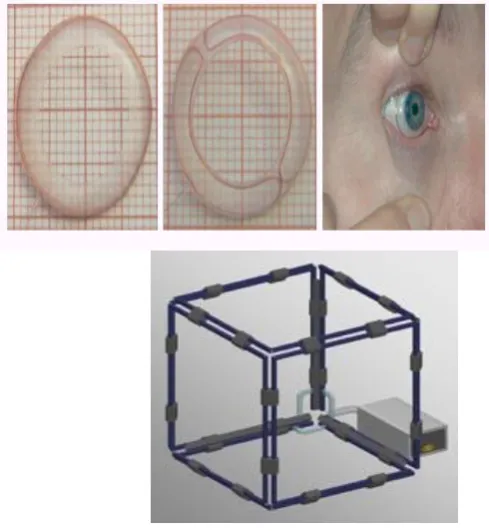
In this method, a coil of wire moves in magnetic field this field are induces a voltage in a coil. This coil is attached to the eye, and then the signal is produced to the eye position. By using modified contact lens, it is possible to measure
human eye movements, by embedded small coils of wire. With the help of anesthetics, it is inserted into the eye. To measure the horizontal movement of eye, two field wires generates magnetic field which is placed at either side of head. To measure vertical movements second set of coils placed perpendicular to first set. It is possible to disentangled two signals from both vertical & horizontal movement by using appropriate electronics. Also, torsion movements can be measured but eye of coil must be of appropriate design.
Fig. 3Sceleral Search Coils
Advantages:
1. High Accuracy.
2. Unlimited resolution impact.
Disadvantage:
1. Sceleral Search Coils method is invasive.
2. Implementation is complicated.
2.3
Infrared oculography:
[image:2.595.309.554.230.496.2]
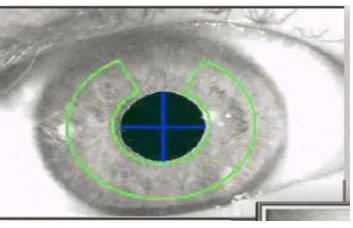
© 2017, IRJET | Impact Factor value: 5.181 | ISO 9001:2008 Certified Journal | Page 5614 invisible to eyes it will not create any distraction. This
[image:3.595.110.231.135.259.2]system mostly used during MRI examination.
Fig. 4 Infrared oculography
Advantage:
1. It can measure eye movement in darkness also.
2. It can use in Gaze interaction by using Image Processing. 3. Movement before between blinking can be measured.
Disadvantage:
1. For Horizontal movement it can measure upto 35degrees only.
2. For Vertical Movement it can measure upto 20 degrees only. Not possible to measure torsional movement.
2.4
Video-based oculography:
Video-based oculography is a non-invasive or invasive method. Each two methods are split into the other categories are depending on light used: visible light and infrared light. Invasive system also known as head mounted system. Head mounted system is used for one or more cameras.non – invasive system is also known as remote eye tracking system. Video based eye tracking method is used for commercial eye tracker. Video based eye tracker is very complex and expensive task [7].
There are two types of camera. I) Single camera II) multiple camera.
Fig. 5 video oculography
a.
Single camera eye tracker:
[image:3.595.329.546.300.469.2]The single camera systems can capture limited field images that are fixed at a point in high resolution. The video-based eye tracker is work by illuminating the eye with an infrared light source. This light produces a glint on the cornea of the eye this is called as corneal reflection. The glint has been used for the reference point of gaze estimation. The pupil-glint difference vector remains constant the eye and the head moves. The glint is clearly change location when the head moves, but it is less obvious that the glint shifts position when changing gaze direction. a single camera and a collection of mirrors in a single illumination source to produce the desired effect. The several commercial systems base their technology on one camera and one infrared light.[10]
Fig.6 Single camera eye tracker
b.
Multiple camera eye trackers:
[image:3.595.74.251.631.745.2]© 2017, IRJET | Impact Factor value: 5.181 | ISO 9001:2008 Certified Journal | Page 5615 Fig.7 Remote eye tracker
Advantages:
1. Clinical observation of eye movement disorders. 2. Video recording system is easily handled.
3. It can allow head free movement and fully remote recording.
Disadvantages:
1. Video recording system is expensive.
2. Limited spatial resolution.
3. Recording with closed eyes is not possible and cannot measures eye torsion.
3.
M
ETHODS OF GAZE TRACKINGTo obtain direction of gaze it uses information which is obtained from eye region & head position, from image data we detect eye location. The three most important Part of human eye is
1. Pupil: Aperture that lets light into eye. 2. Iris: - Colored Muscle group that controls
diameter of Pupil.
3. Scelera: White Protective issue that covers remainder of the eye.
Illumination, viewing angle, occlusion of the eye, head pose etc are some issues due to which Eye detection & tracking becomes challenging task Visible & Infrared Spectrum Imaging are two types of Imaging Processes which used in Video Based eye tracking. Infrared eye tracking uses two of bright pupil or dark pupil technique. Eye gaze tracking methods are analysis of image data.
This method classified into Feature based & Appearance based gaze estimation.
3.1 Feature Based Gaze Estimation
:
The characteristics of human eye to identify different feature of eyes like eye corner, pupil detection, and cornea reflections are common features used in gaze estimation.
The feature based method is identifying the local feature of eye that is less sensitive to variation in illumination and viewpoint. The system performance issues in outdoor and strong ambient light. The gaze estimation accuracy is decrease when the pupil and iris features are not correcting available.
There are two types of feature based models: [14] [15] 1. Model-based approaches
2. Interpolation-based approaches
A.
Model-based approaches:
Model based methodologies utilize an express geometric model of the eye to gauge 3D look bearing vector. Most 3D show based (or geometric) approaches depend on metric data and along these lines require camera alignment and a worldwide geometric model (outer to the eye) of light sources, camera and screen position and introduction. Most of the model-based technique takes after a typical system: first the optical pivot of the eye is recreated in 3D: the visual pivot is remade next: at long last the purpose of look is evaluated by converging the visual hub with the scene geometry. Remaking of the optical hub is finished by estimation of the cornea and understudy focus. By characterizing the look course vector and incorporating it with data about the articles in the scene, the purpose of look is evaluated for 3D demonstrate based methodologies; look headings are assessed as a vector from the eyeball focus to the iris focus.
1.
B. Interpolation based approaches
:These strategies accept the mapping from picture elements to look co-ordinates (2D or 3D) have a specific parametric frame, for example, a polynomial or a nonparametric shape as in neural systems. Since the utilization of a basic direct mapping capacity in the main video-based eye tracker, polynomial expressions have turned out to be a standout amongst the most prominent mapping procedures.
Interjection based techniques stay away from unequivocally displaying the geometry and physiology of the human eye however rather depict the looked point as a nonspecific
© 2017, IRJET | Impact Factor value: 5.181 | ISO 9001:2008 Certified Journal | Page 5616
3.2 Appearance based method:
Appearance based method detect and track on the photometric appearance. The appearance based techniques are used in image content. The image content to estimate the gaze direction by mapping image data to the screen co-ordinates. The Appearance based methods are morph able model, gray scale unit, manifold, Gaussian interpolation and cross ratio.[16] Appearance based methods are not require calibration of camera and geometry data.
Advantages:
1. Easy to implement.
2. More robust than feature based gaze estimation.
4. CONCLUSION
VOG techniques have been used to wide field of scientific research related to visual development and cognitive science as well as to pathologies of the eyes and of the visual system. The main aim of this method is to find out latest growth in non-contacting video based gaze tracking.
R
EFERENCES[1] Picot A, Char bonnier S. and Calliper A. (2010) “Drowsiness detection based on visual signs: blinking analysis based on high frame rate video” , IEEE Intl. Instrumentation and Measurement Technology Conference, Austin, USA.
[2] COGAIN: “D2.1 Survey of De-Facto Standards in Eye Tracking” by the European Commission within the Sixth Framework Programme, 2005.
[3] Ali Bulent Usakli and Serkan Gurkan, “Design of a Novel Efficient Human-Computer Interface: An Electrooculogram Based Virtual Keyboard” IEEE Transaction on Instrumentation and Measurement, Vol. 59, N0.8, August 2010, pp 2099-2108
[4] Yoshiaki Kuno, Tohru Yagi, and Yoshiki Uchikawa, “Biological Interaction between Man and Machine”, IEEE/RSJ International Conference on Intelligent Robots and Systems (IROS’97), September 1997, pp 318-323.
[5] Zhao Lv, Xiaopei Wu, Mi Li and Chao Zhang, “Implementation of the EOG based Human Computer Interface System”, The 2nd International Conference on Bioinformatics and Biomedical Engineering (ICBBE), pp 2188-2191, 2008.
[6] Mazo L, Barea M., Boquete R. and Lopez E. (2002) System for assisted mobility using eye movements based on electrooculography. IEEE Trans.on Neural Sys. and Rehab. Eng., 10(4):209-218.
[7] Morimoto C. and Mimica M. (2005) Eye gaze tracking techniques for interactive applications, Computer Vision and Image Understanding, 98(1): pp. 4-24.
[8] Černy, M. (2011) Gaze Tracking Systems for Human-Computer Interface Perner´s Contacts, 6(5): 43-50.
[9] Merchant J, Morrissette R, and Porterfield J. L, (1974) “Remote measurement of eye direction allowing subject motion over one cubic
foot of space,” IEEE Transactions on Biomedical Engineering, 21 ( 4): 309-317.
[10] Sugano Y, Matsushita Y., Sato Y. and Koike H. (2008) An Incremental Learning Method for Unconstrained Gaze Estimation. ECCV: pp. 656-667
[11] Christian Nietzsche, Atsushi Nakazawa and Haruo Takemura, (2011) Display-camera calibration using eye reflections and geometry
Constraints, Computer Vision and Image Understanding, pp. 835–853.
[12] Zhu, Z., Ji, Q. and Bennett, K.P. (2006) nonlinear eye gaze mapping function estimation via support vector regression. In: Proceedings of the 18th International Conference on Pattern Recognition (ICPR 2006). Vol. 1. 1132–1135.
[13] Yoo D.H. and Chung, M.J. (2005) A Novel Non-Intrusive Eye Gaze Estimation Using Cross-Ratio under Large Head Motion, Computer Vision and Image Understanding, 98(1): 25-51.
[14] Iannizzotto L. and La Rosa F., (2011) Competitive combination of Multiple Eye detection and Tracking Techniques, IEEE Transactions on Industrial Electronics, 58(8): 3151-3159.
[15] Hansen D. W., Agustin J. S. and Villanueva A, (2010) Homography Normalization for Robust Gaze Estimation in Uncalibrated setups Proc. of the Symposium on Eye Tracking Research and Applications, pp. 13-20.