http://dx.doi.org/10.4236/msa.2015.62021
Formation of Supersaturated Solid Solutions
Bi-Ag and Bi-Zn by Rapid Solidification
Using Melt Spinning Technique
Tarek El-Ashram1,21Physics Department, Faculty of Science, Port Said University, Port Said, Egypt 2Physics Department, Preparatory Year Deanship, Jazan University, Jazan, KSA
Email: [email protected]
Received 18 January 2015; accepted 9 February 2015; published 12 February 2015
Copyright © 2015 by author and Scientific Research Publishing Inc.
This work is licensed under the Creative Commons Attribution International License (CC BY).
http://creativecommons.org/licenses/by/4.0/
Abstract
Two eutectic alloys Bi-Ag and Bi-Zn were rapidly solidified using melt-spinning technique. X-ray diffraction analysis (XRD), differential scanning calorimetry (DSC), and temperature dependence of resistivity (TDR) were performed. The solid solubility of both Ag and Zn was extended to the eutectic concentration due to rapid solidification by melt spinning technique and both alloys are single-phase solid solutions. The addition of Ag extended the unit cell in both a and c directions keeping the axial ratio c/a without change, and in case of Zn addition, the unit cell was increased in a direction and decreased in c direction leading to the decrease in the axial ratio c/a. The Bi-Ag eutectic alloy exhibited a semiconducting behavior with energy gap of 280 meV, while Bi-Zn eutec-tic alloy exhibited metallic behavior.
Keywords
Rapid Solidification (RS), Crystal Structure, X-Ray Diffraction Analysis (XRD), Solid Solubility, Semiconducting Behavior, Bi-Ag, Bi-Zn
1. Introduction
ef-fect of alloying on the electronic and the electrical properties of Bi; they found that the addition of antimony changes the electrical behavior from semimetal to semiconductor at a certain range of concentration of Sb [7]-[9]. A series of rapidly solidified Bi-based semiconductor alloys are produced using melt spinning technique [10] [11]. They found that the semiconducting behavior depends on the type of the solute atoms added to Bi. The alloys contain solute atoms with odd valencies: for instance, Ag (+1), Al (+3) and Sb (+5) have semicon-ducting behavior by contrast; all alloys contain solute atoms with even valencies: for instance Zn (+2) and Sn (+4) have metallic behavior. According to the equilibrium Bi-Ag phase diagram, there is no solubility of Ag in Bi [12]. By rapid solidification using melt spinning technique, the solubility of Ag in Bi is extended to 2 at% [10]. There are significant discrepancies concerning the solubility limit of Zn in Bi prepared by conventional casting. Recent investigations indicate that the solubility of Zn in Bi is 0.3 wt% at 200˚C [13] [14]. In contrast some au-thors found that the solubility of Zn in Bi is 2 wt% [15]. Therefore, the aim of the present work is to study the effect of increasing Ag and Zn concentrations on the structure and electrical properties of Bi. Rapid solidifica-tion has been used in the present work to prevent rejecsolidifica-tion of extra solute atoms and thus prevent precipitasolidifica-tion, from a solid solution.
2. Experimental Procedures
The materials used in the present work are Bi, Ag and Zn fragments the starting purity was better than 99.99%. Two alloys Bi-4.3 at% Ag (eutectic) and Bi-8.1 at% Zn (eutectic) were produced by a single copper roller (200 mm in diameter) melt-spinning technique. The process parameters such as the ejection temperature, and the li-near speed of the wheel were fixed at 873 K and 30.4 ms−1 respectively. X-ray diffraction analysis (XRD) was carried out with a XPERT-PRO X-ray diffractometer, using Cu-Kα radiation (λ = 1.5406 Å). Differential Scan-ning Calorimetry (DSC) was carried out in a Shimadzu (DSC-50) with heating rate 10 K·min−1. The temperature dependence of resistivity (TDR) was measured by four probe method using micro ohmmeter of type BS407. The BS407 uses a four terminal measurement system via high quality Kelvin Clip leads with sensitivity is 1 µΩ. The heating range starts from room temperature up to 530 K with heating rate about 5 K·min−1.
3. Results and Discussion
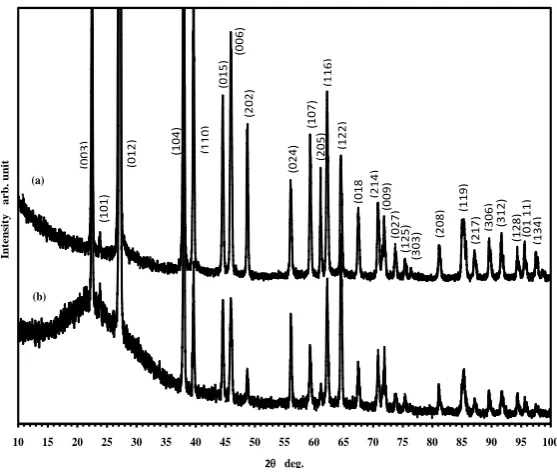
3.1. Structure [image:2.595.174.453.460.697.2]Figure 1(a) shows the X-ray diffraction pattern for as-quenched melt-spun Bi-4.7 at% Ag eutectic alloy. All the
Figure 1. X-ray diffraction pattern for as-quenched melt-spun: (a) Bi-4.7 at%
Ag eutectic alloy; (b) Bi-8.1 at% Zn eutectic alloy.
10 15 20 25 30 35 40 45 50 55 60 65 70 75 80 85 90 95 100
Int e ns it y a r b. uni t
2θ deg.
(003)
(101)
(012) (104) (110)
(015) (006) (202) (024) (107) (205) (116) (122)
(018 (214) (009)
(027)
(125) (303) (208)
(119)
(217) (306) (
312)
(128) (01 11) (134) (a)
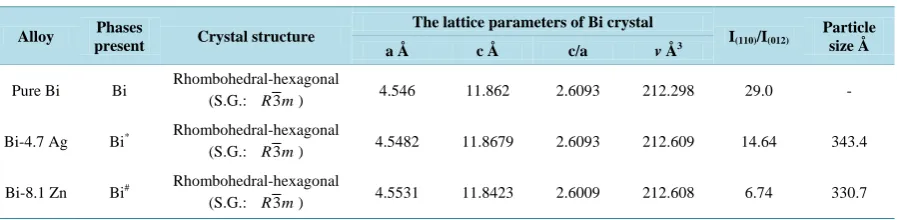
peaks were identified for Bi rhombohedral structure. No precipitation of Ag was observed and the structure is a single phase Bi rich solid solution of Ag in Bi. According to the equilibrium phase diagram there no solubility of Ag in Bi. Therefore rapid solidification by melt spinning technique extended the solubility of Ag in Bi up to the eutectic composition. The structure of Bi is rhombohedral-hexagonal (S.G.: R m3 ) with lattice parameters [16] a = 4.745 Å, α = 57.23˚. Alternatively, the lattice parameters can be specified as the corresponding hexagonal vectors, with lengths a = 4.546 Å and c = 11.862 Å.
By addition of Ag to Bi, the lattice parameters of Bi were increased (see Table 1). However the axial ratio c/a did not change. Also the volume of unit cell was increased. The intensity ratio from (110) to (012) planes was decreased from 29% to 14.64%. The particle size of Bi was calculated using Debye-Scherrer formula [17] to be 343.4 Å.
Figure 1(b) shows the X-ray diffraction pattern for as-quenched melt-spun Bi-8.1 at% Zn eutectic alloy. All
the peaks were identified for Bi rhombohedral structure. No precipitation of Zn was observed and the structure is a single phase Bi rich solid solution of Zn in Bi. Therefore rapid solidification by melt spinning technique ex-tended the solubility of Zn in Bi up to the eutectic composition. The lattice parameter a is increased and c is de-creased and this led to the decrease in the axial ratio c/a (see Table 1). The volume of the unit cell v is increased from 212.298 to 212.608 Å3. The intensity ratio from (110) plane to (012) plane was decreased from 29% to 6.74%. The particle size was calculated to be 330.7 Å. The detail of XRD is shown in Table 1.
[image:3.595.90.539.396.506.2]3.2. Thermal Analysis
Figure 2 shows the DSC curves for as-quenched melt-spun Bi-4.7 at% Ag and Bi-8.1 at% Zn alloys.
For Bi-4.7 at% Ag (Figure 2(a)) no phase transformation was observed before melting. The melting endo-therm is a single sharp peak which characterizes the eutectic reaction. The melting temperature Tm was found to
be 534.37 K. The enthalpy of fusion ∆Hm was calculated to be 57.67 kJ∙kg−1. The same behavior was observed
for Bi-8.1 at% Zn (Figure 2(b)).
Table 1. The detail of XRD results of rapidly solidified Bi- based alloys.
Alloy Phases
present Crystal structure
The lattice parameters of Bi crystal
I(110)/I(012)
Particle size Å
a Å c Å c/a v Å3
Pure Bi Bi Rhombohedral-hexagonal
(S.G.: R m3 ) 4.546 11.862 2.6093 212.298 29.0 -
Bi-4.7 Ag Bi* Rhombohedral-hexagonal
(S.G.: R m3 ) 4.5482 11.8679 2.6093 212.609 14.64 343.4
Bi-8.1 Zn Bi# Rhombohedral-hexagonal
(S.G.: R m3 ) 4.5531 11.8423 2.6009 212.608 6.74 330.7
[image:3.595.203.422.526.703.2]Bi*: Solid solution of Ag in Bi; Bi#: Solid solution of Zn in Bi.
Figure 2. DSC curves for as-quenched melt-spun: (a) Bi-4.7 at% Ag eutectic alloy; (b) Bi-8.1 at% Zn eutectic alloy. 300 320 340 360 380 400 420 440 460 480 500 520 540 560 580 600
H
eat
f
low
ar
b
.
u
n
it
Temperature K (a)
No phase transformation was observed before melting and the melting endotherm is a single sharp peak which characterizes the eutectic reaction. The melting temperature Tm was found to be 527.45 K and the enthalpy of
fusion ∆Hm was found to be 61.26 kJ∙kg−1. The detail of DSC is shown in Table 2.
3.3. Electrical Properties
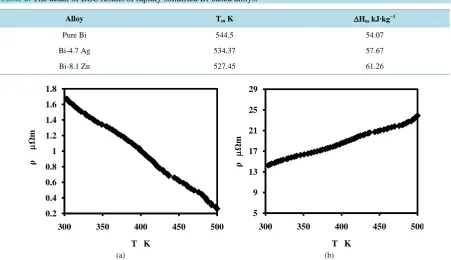
Figure 3(a) shows the TDR curves obtained for as-quenched melt-spun Bi-4.7 at% Ag alloy. The resistivity de-
creases by increasing temperature i.e. it has a semiconducting behavior.
The resistivity at room temperature of pure Bi is 1.17 µΩm and TCR is 4.6 × 10⁻³ K−1 [18]. Pure Bi was ra-pidly solidified by melt spinning technique and its resistivity was measured to be 2.09 µΩm and TCR was found to be 3.05 × 10⁻³ K−1 [19]. Therefore rapid solidification increases the resistivity of Bi and decreases the TCR. The energy gap was calculated and was found to be 280 meV. The increase in Ag concentration increases the energy gap of as quenched melt spun semiconducting Bi-Ag alloy from 225 meV for Bi-1 at% Ag [10] to 280 meV for Bi-Ag eutectic alloy. The explanation of the semiconducting behavior of Bi alloys is given elsewhere [20].
Figure 3(b) shows the TDR curves obtained for as-quenched melt-spun Bi-8.1 at% Zn alloy. The resistivity
[image:4.595.87.539.325.585.2]increases by increasing temperature i.e. it has a metallic behavior. The resistivity at room temperature was found to be 14.25 µΩm and TCR was found to be 3.38 × 10⁻³ K−1. Both ρ and TCR were increased due to the addition of Zn (see Table 3).
Table 2. The detail of DSC results of rapidly solidified Bi-based alloys.
Alloy Tm K ∆Hm kJ∙kg−1
Pure Bi 544.5 54.07
Bi-4.7 Ag 534.37 57.67
Bi-8.1 Zn 527.45 61.26
(a) (b)
[image:4.595.89.539.625.708.2]Figure 3. TDR curves obtained for as-quenched melt-spun: (a) Bi-4.7 at% Ag eutectic alloy; (b) Bi-8.1 at% Zn eutectic alloy.
Table 3. The detail of TDR results of rapidly solidified Bi-based alloys.
Alloy ρµΩm at room temp. Behavior TCR 10−3 K−1 Eg (meV)
Pure Bi (CC) 1.17 Metallic 4.60 -
Pure Bi (RS) 2.09 Metallic 3.05 -
Bi-4.7 Ag (RS) 1.67 Semiconducting - 280
Bi-8.1 Zn (RS) 14.25 Metallic 3.38 -
CC: conventional casting; RS: rapid solidification. 0.2 0.4 0.6 0.8 1 1.2 1.4 1.6 1.8
300 350 400 450 500
ρ
µ
Ω
m
T K
5 9 13 17 21 25 29
300 350 400 450 500
ρ
µ
Ω
m
4. Conclusions
From this work, the following conclusions may be obtained:
1) Rapid solidification using melt-spinning technique can produce semiconductor alloys, which cannot be normally obtained by conventional casting. The rapidly solidified Bi-Ag eutectic alloy was found to be a narrow gap semiconductor. Also by increasing Ag concentration, the energy gap increased from 225 meV for Bi-1 at% Ag [10] to 280 meV for Bi-Ag eutectic alloy.
2) From the XRD it is evident that the solid solubility of both Ag and Zn was extended to the eutectic concen-tration due to rapid solidification by melt spinning technique. Also the addition of both Ag and Zn to Bi in-creases the volume of the unit cell. However Ag extends the unit cell in both a and c directions keeping the axial ratio c/a without change, and in case of Zn the unit cell is increased in a direction and decreased in c direction leading to the decrease in the axial ratio c/a.
3) The increase in the Zn concentration in Bi did not lead to any semiconducting behavior. This indicates that the odd valency dopants are responsible on converting Bi into semiconductor as suggested by [11].
4) The melting endotherm of the supersaturated solid solutions was a single sharp peak, i.e. the same as the eutectic melting.
References
[1] Horio, Y., Yamashita, H. and Hayashi, T. (2004) Microstructure and Thermoelectric Properties of Hot-Pressed p-Type Bi0.5Sb1.5Te3 Alloys Prepared by Rapid Solidification Technique. Materials Transactions, 45, 3309-3313.
http://dx.doi.org/10.2320/matertrans.45.3309
[2] Shepelevich, V.G. and Prokoshin, V.I. (2014) Electrical Properties of Rapidly Solidified of Heavily Doped Alloys (Bi91-Sb9)100−xSnx. 8th International Conference on Microelectronics and Computer Science, Chisinau, October 2014,
22-25.
[3] Shepelevich, V.G. (1986) Homogenizing Influence on the Kinetic Properties of Alloys of Bi-Sb. Inorganic Materials, 22, 378-380.
[4] Koukharenko, E., Frety, N., Shepelevich, V.G. and Tedenac, J.C. (2001) Microstructural Characterization of Ultrarapid Quenched Bismuth and Antimony Tellurides Alloys. Journal of Crystal Growth, 222, 773-778.
http://dx.doi.org/10.1016/S0022-0248(00)00996-9
[5] Koukharenko, E., Frety, N., Shepelevich, V.G. and Tedenac, J.C. (2000) Thermoelectric Properties of Bi2Te3 Material
Obtained by the Ultarapid Quenching Process Route. Journal of Alloys and Compounds, 299, 254-257.
http://dx.doi.org/10.1016/S0925-8388(99)00688-X
[6] Koukharenko, E., Frety, N., Shepelevich, V.G. and Tedenac, J.C. (2001) Electrical Properties Bi2−xSbxTe3 Materials
Obtained by Ultrarapid Quenching. Journal of Alloys and Compounds, 327, 1-4.
http://dx.doi.org/10.1016/S0925-8388(01)00945-8
[7] Dutta, S., Shubha, V., Ramesh, T.G. and D’Sa, F. (2009) Thermal and Electronic Properties of Bi1−xSbx Alloys.
Jour-nal of Alloys and Compounds, 467, 305. http://dx.doi.org/10.1016/j.jallcom.2007.11.146
[8] Lenoira, B., Dauscher, A., Cassartb, M., Ravichc, Y.I. and Scherrer, H. (1998) Effect of Antimony Content on the Thermoelectric Figure of Merit of Bi1−xSbx Alloys.Journal of Physics and Chemistry of Solids, 59, 129.
http://dx.doi.org/10.1016/S0022-3697(97)00187-X
[9] Lenoira, B., Cassartb, M., Michenaud, J.P., Scherrer, H. and Scherrer, S. (1996) Transport Properties of Bi-RICH Bi-Sb Alloys.Journal of Physics and Chemistry of Solids, 57,89-99. http://dx.doi.org/10.1016/0022-3697(95)00148-4
[10] Raouf, A., Kamal, M., El Ashram, T. and Mosaad, S. (2010) Rapidly Solidified Semiconducting Bi-Ag Alloys Pro-duced Using Melt-Spinning Technique. Journal of Ovonic Research, 6, 297-302.
[11] El-Ashram, T., Kamal, M., Raouf, M.A. and Mosaad, S. (2012)Odd Valency Dopants Convert Bismuth into Semi- conductor. Journal of Ovonic Research, 8, 97-104.
[12] Hansen, M. and Anderko, K. (1958) Constitution of Binary Alloys. 2nd Edition, McGraw-Hill, Inc., New York, 10-11.
[13] Malakhov, D.V. (2000)Thermodynamic Assessment of the Bi-Zn System. Calphad, 24, 1-14.
http://dx.doi.org/10.1016/S0364-5916(00)00011-0
[14] Braga, M.H., Vizdal, J., Kroupa, A., Ferreira, J., Soares, D. and Malheiros, L.F. (2007) The Experimental Study of the Bi-Sn, Bi-Zn and Bi-Sn-Zn Systems. CALPHAD, 31, 468-478.
[15] Massalski, T.B. (1990) Binary Alloy Phase Diagrams. ASM International, Ohio.
Cards. JCPDS, International Center for Diffraction Data, Swarthmore.
[17] Cullity, B.D. (1959) Elements of X-Ray Diffraction. 2nd Edition, Addison-Wesley Publishing Company, Reading, 262, 317.
[18] Smithells, C.J. and Brandes, E.A. (1976) Metals Reference Book. 5th Edition, Butterworth and Co. Ltd., UK, 940.
[19] Kamal, M. and El-Ashram, T. (2008)Zero and Negative Temperature Coefficients of Resistivity of Rapidly Solidified Bi-Sn Alloys Using Melt-Spinning Technique.Journal of Materials Science: Materials in Electronics, 19, 91-96.
http://dx.doi.org/10.1007/s10854-007-9315-4