Acoustic Event Detection from Weakly
Labeled Data Using Auditory Salience
Podwinska, Z, Sobieraj, I, Fazenda, BM, Davies, WJ and Plumbley, MD
http://dx.doi.org/10.1109/ICASSP.2019.8683586
Title
Acoustic Event Detection from Weakly Labeled Data Using Auditory
Salience
Authors
Podwinska, Z, Sobieraj, I, Fazenda, BM, Davies, WJ and Plumbley, MD
Type
Conference or Workshop Item
URL
This version is available at: http://usir.salford.ac.uk/id/eprint/51244/
Published Date
2019
USIR is a digital collection of the research output of the University of Salford. Where copyright
permits, full text material held in the repository is made freely available online and can be read,
downloaded and copied for noncommercial private study or research purposes. Please check the
manuscript for any further copyright restrictions.
ACOUSTIC EVENT DETECTION FROM WEAKLY LABELED DATA
USING AUDITORY SALIENCE
Zuzanna Podwinska
?Iwona Sobieraj
†Bruno M Fazenda
?William J Davies
?Mark D. Plumbley
†?
Acoustics Research Centre,
University of Salford, Salford, United Kingdom
†
Centre for Vision Speech and Signal Processing,
University of Surrey, Guildford, United Kingdom
ABSTRACT
Acoustic Event Detection (AED) is an important task of machine listening which, in recent years, has been addressed using common machine learning methods like Non-negative Matrix Factorization (NMF) or deep learning. However, most of these approaches do not take into consideration the way that human auditory system detects salient sounds. In this work, we propose a method for AED using weakly labeled data that combines a Non-negative Matrix Factoriza-tion model with a salience model based on predictive coding in the form of Kalman filters. We show that models of auditory perception, particularly auditory salience, can be successfully incorporated into existing AED methods and improve their performance on rare event detection. We evaluate the method on the Task2 of DCASE2017 Challenge.
Index Terms— AED, NMF, auditory salience, Kalman filter
1. INTRODUCTION
Acoustic Event Detection (AED) is an important task of machine listening, which aims to automatically recognise, label, and estimate the position in time of sound events in a continuous audio signal. In recent years it has seen a rise in interest in the research commu-nity, due to the number of real-world applications for AED such as home-care [1], surveillance [2], multimedia retrieval [3] or urban traffic control [4], to name just a few. A successful series of De-tection and Classification of Acoustic Scenes and Events (DCASE) challenges [5, 6] have provided the community with datasets and baselines for a number of tasks related to AED, accelerating re-search in this field. Early approaches for AED were strongly in-spired by speech recognition systems, using mel frequency cepstral coefficients (MFCCs) with Gaussian Mixture Models (GMMs) com-bined with Hidden Markov Models (HMM) [7, 8]. Later, methods based on dictionary learning, mainly Non-negative Matrix Factoriza-tion were most prominent soluFactoriza-tions for the AED task [9, 10, 11]. In recent years a number of deep learning methods have been proposed, that achieve state of the art results [12, 13]. However, most of the models used for AED nowadays have been primarily developed for image or text processing, while, to our knowledge, the importance of human sound perception in developing methods for AED has not received enough attention. In fact, in many applications of AED it
The research leading to these results has received funding from the Eu-ropean Union’s H2020 Framework Programme (H2020-MSCA-ITN-2014) under grant agreement n 642685 MacSeNet. This work is also partly sup-ported by EPSRC grant EP/N014111/1.
may be desirable to only detect events which human listeners would detect. Therefore, in this paper, we want to pave the way towards perceptually motivated AED, showing how AED models can benefit from the combination with auditory attention and salience models.
Salience is a property of sound which makes it stand out in an auditory scene, and grab listener’s attention in a bottom-up manner. There have been a few different approaches to modelling auditory salience, such as calculating salience features from spectrogram im-ages [14], Bayesian surprise [15] and predictive coding [16] (for a review of auditory attention models, see [17]). All of these methods can be interpreted as novelty detection, which makes them natural candidates for an AED task. In fact, [18] has shown that an audi-tory salience model can be used for AED with promising results. However, these methods have concentrated on detection of every prominent sound, whereas a more realistic scenario might require the detection of a a-priori specified event only, which is the case in-vestigated in this paper.
In this work we propose to combine the best of two worlds and show how they can compliment each other: a Non-negative Ma-trix Factorization model with an auditory salience model based on Kalman filters. What is more, we show that the resulting method is applicable for AED onweakly labeleddata, that is, data in which we do not have exact information of when the interesting sound occurs, but just a tag of which sounds are present in a given audio excerpt.
2. AUDITORY SALIENCE MODEL
The auditory salience model used here was developed by [16], and is based on predictive coding, which has been proposed as the working principle of the auditory cortex [19]. The model uses a Kalman filter which: 1) predicts present input based on past input and an internal model, 2) updates the model according to prediction error and 3) weights the model versus data depending on variance of the input. Because salience is related to surprise, understood here as violation of expectation [20], a salient event is detected when the incoming input varies significantly from the prediction.
Each feature extracted from the signal is tracked by one or mul-tiple Kalman filters simultaneously. The stateXof a filter is coded as a vector containing a feature valueznand the difference between
the last two consecutive feature values:
Xn=
zn
zn−zn−1
. (1)
ˆ
X-n=AXˆn−1
P-n=APn−1AT+Q
Kn=P-nB T
(BP-nB T
+R)−1 ˆ
Xn= ˆX
-n+Kn(zn−BXˆ
-n)
Pn= (I−KnB)P-n
(2)
whereXˆ-andXˆ are the a priori and a posteriori predictions ofX, respectively.
Taken together with the system matrixAand the measurement matrixBshown below, this means that at any point in time, the fea-ture vector is expected to continue changing in the same manner it has most recently changed:
A=
1 1 0 1
,Bn=1 0. (3)
The measurement and system noise covariance matrices are as follows:
Q=
σ2w 0
0 σ2b
,R=σv2 (4)
whereσw,σbandσvare empirically chosen for each feature.
To determine the number of filters to be initialised at the begin-ning of each file, Gaussian Mixture Model clustering is performed on the first 500 ms of each feature stream and a Kalman filter is ini-tialised for each of the clusters. The filters are iniini-tialised with the sameXn−1andPn−1values as in [16].
As long as a filter predicts feature values reasonably well, it up-dates its future predictions based on the input. Feature values are assumed to be predicted well by a filter as long as the following con-dition is satisfied:
|zn−BXˆ
-n| ≤2
q
P[1]+σ2
v (5)
whereP[1]is the first element of matrixP. When a new feature value is not predicted by any of the currently running filters, a salience spike is produced, with amplitude equal to the difference between prediction and measured value (the system innovation). Addition-ally, a new filter is initialised based on this new value. If a filter has not correctly predicted any feature values for 1 s, it is closed.
This process produces vectors of salience spikessi (one from
each feature). The resulting salience score for framenis obtained by applying feature-specific and between-feature weights and summing the resulting vectors, as follows:
s(n) = X i∈[1,N]
si(n)
wi+
X
j∈[1,N],j6=i
wij max
k∈[−1,1]sj(n+k)
.
(6)
3. ORTHOGONALITY-REGULARIZED NMF
For the AED model we use a model from our previous work, where we adapted a standard NMF approach to learning on weakly labeled data [21].
3.1. Non-negative Matrix Factorization
The goal of NMF is to approximate a non-negative data matrix, typi-cally a time-frequency representation of a given sound,V∈R+F×T
as a product of a dictionaryW∈R+F×K and its activation matrix H∈R+K×T, such that:
V≈Vˆ=WH. (7)
W and H are estimated to minimize some divergence metric D(V|WH). For any two matrices X and Y, we defineD(X|Y) =
P
m,nD(xmn, ymn). In this work, we choose the generalized
Kullback-Leibler (KL) as the divergence metric, defined as
DKL(V|WH) =
X
k,l
Vk,llog
Vk,l
(WH)k,l
−Vk,l+ (WH)k,l
(8) which is a common choice for audio applications.
3.2. NMF on weakly labeled data
Let us consider the task of detection of rare sound events. Lety∈ {0,1}be a weak label denoting absence or presence of the target sound,V0 =V01,· · ·,V0M0 is a set ofM0training examples with
absence of the target sound andV1 =V1
1,· · ·,V1M1 is a set ofM1
training examples with the presence of the target sound. As the data is weakly labeled, examples containing the target sound most prob-ably also contain noise and other sounds. Therefore, we assume that to reconstruct well the target sound training examples (V1) we also need elements from dictionaries extracted from background sounds examples (V0). At the same time, we do not expect elements of the dictionary atoms of target sounds to be used for reconstructingV0
. We impose this constraint in the training phase by applying a binary mask to the activation matrix as follows:
V= [V0,V1]≈[W0,W1]
1 1 0 1 H00 H01 H10 H11
= [W0,W1]
H00 H01 0 H11
=[W0H00,W0H01+W1H11]
(9)
whereW0 ∈ R +F×K
0
,W1 ∈ R +F×K
1
are “sound” and “back-ground” dictionaries respectively,K0andK1are their correspond-ing ranks. 0is a matrix of zeros withK1rows and the number of columns corresponding to the total size ofM0background training
data, while1denotes matrices of appropriate dimensions with all el-ements equal to 1.H00
,H01
,H10
andH11
are parts of the activation matrix of suitable dimensions. We then further improve the sepa-ration of the dictionaries by adding an additional orthogonality reg-ularizer, which minimizes the coherence between the dictionaries. Combining the constraint on the activation matrix and the orthogo-nality regularizer results in the following cost function to minimize:
min
W0,W1,H≥0
DKL(V|WH) +λkW1W0k2
=DKL(V0|W0H00) +DKL(V1|(W0H01+W1H11))
+λkW1W0k 2
.
(10)
AskW1W0k2
is convex inW0andW1, we can minimize the cost function using the gradient descent. Then, following the derivations of Lee and Sung [22], we obtain the corresponding multiplicative update rules forW0andW1:
W0←W0
V0H00 W0H00 +
V1H01 W0H01+W1H11 1·H00+1·H01+λW1W1W0
W1←W1
V1H11 W0H01+W1H11 1·H11+λW0W0W1.
As the regularizer does not influence the activation matrixH, the update rule forHremains the same as in the original NMF problem formulation:
H←HW T V
WH
WT1 . (12)
Final dictionariesW0andW1are then concatenated to form a dictio-naryWused for audio event detection, whereas the activation matrix
His discarded.
4. PROPOSED METHOD
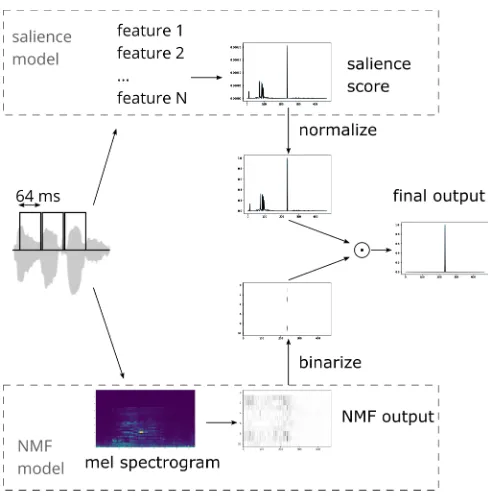
For the final task of AED we combine the outputs of the two models. In principle, the salience model will detect onsets of any interesting events, regardless of whether they are the target in the task. There-fore, its output is combined with the NMF output, which can dif-ferentiate between target and non-target events. The full combined model is shown in Figure 1.
Fig. 1. General architecture of the proposed method. Frames of audio signal are analysed in parallel by two models. The salience model calculates salience score from N different features, while the NMF model uses mel spectrograms to produce an output matrix, which is binarized before being combined with the salience score to form the final output.
Firstly, we use the NMF method to extract dictionariesW0and
W1. In the event detection phase, a test sample is decomposed using the trained dictionaries as follows:
Vtest=
W0,W1
H0 H1
. (13)
Finally,H1is binarized using a threshold equal to 50% of the maxi-mum value of the entire activation matrix (H0andH1).
In parallel, salience scores(n)per frame is computed for each test sample, forming a vectors, which is then normalised. In the final stage the salience score vectorsis multiplied element-wise with the
binary output ofH1. The columns of the resulting matrixOthat have at least one entry greater than 0 indicate the presence of an event.
O=sH1. (14)
We post-process the annotation matrices by discarding events shorter than 100 ms and removing gaps shorter than 100 ms between the events. The shortest event in the training dataset was 240 ms long.
5. EXPERIMENTAL SETUP
5.1. Dataset
The proposed method is evaluated on rare event detection using only weakly labeled data from the audio recordings of the TUT Rare Sound Events 2017, which were provided for Task 2 of the DCASE2017 challenge [6]. Although the DCASE2018 Challenge also provided a weakly labeled dataset for AED, we choose the DCASE2017 dataset because it addresses a simple scenario - de-tecting one sound at a time - which is suitable for the current proof-of-concept study. The dataset consists of around 100 isolated sound examples for three target classes: gunshot, baby crying and glass breaking, together with background audio which is part of the TUT Acoustic Scenes 2016 dataset [23]. For training the NMF model we use weakly labeled 4 second mixtures. It is important to reiterate, that we do not know the timestamp of the event in the mix, just a binary label determining weather the mix contains the sound of interest. For testing, we use 500 mixes of -6dB, 0dB and 6dB SNR of the sounds and backgrounds not used in the training set. The testing mixtures were provided for the DCASE2017 challenge. Each testing mixture is 30 second long.
5.2. Parameters of the salience model
Six features are extracted using the pyAudioAnalysis library [24], with a 64 ms window: energy, energy entropy, spectral centroid, spectral rolloff, spectral entropy and zero-crossing rate. The weights wiiandwijused in Eq. 6 were trained with a constrained logistic
regression, where the binary output variable was presence of event in a file, predictor values were the meansifor each feature, and the
weights were constrained to be positive. Recordings of 30 seconds are used for training.
5.3. Parameters of the NMF model
To build the NMF model, we resample the data to 16000 Hz. We extract mel-spectrograms with 40 components, using a window size and hop size of 64 ms. In order to model temporal dynamics we group 4 consecutive frames into 2D patches, a value that was cho-sen empirically. We train the system on audio chunks of 4 seconds and evaluate on recordings of 30 seconds. We set the number of positive and negative atoms asK0 = 20,K1 = 10, values chosen
empirically.
5.4. Evaluation metrics
[image:4.612.53.297.270.518.2]6. RESULTS AND DISCUSSION
Table 1 presents the results of the evaluation on the test set. For comparison, alongside the proposed method, we show the results for each of the NMF and salience models separately. In the salience model, an event was detected for every framenin whichs(n) >
[image:5.612.315.558.177.370.2]0.5∗max(s).
Table 1. Evaluation results on gunshot, babycry and glassbreak de-tection. Error Rate (ER) and F-score (F1) are reported for the pro-posed method, NMF only and Salience model only. Lowest ER and highest accuracy for each target sound are shown in bold.
Event type Proposed NMF Salience
ER F1 ER F1 ER F1
Gunshot 0.76 65% 0.80 64 % 1.45 36% Glass breaking 1.07 46% 1.23 41% 1.12 54%
Baby crying 1.04 36% 1.07 37% 1.71 32%
Adding the auditory salience model to the NMF detector im-proves its performance for gunshot and glass breaking events. For the baby crying event, it decreases the error rate, but does not im-prove the F-score, suggesting a low hit rate. The reason for this difference in performance for different event classes may be that the first two - gunshot and glass breaking - usually have sudden on-sets, while the last one - baby crying - can start rather slowly. The salience model is designed to detect sudden changes in features, but will adapt to changes that are too slow. While this property makes it useful in some types of backgrounds (see below), it also means that it might not be suited for events which develop slowly, or might need a larger frame window for them.
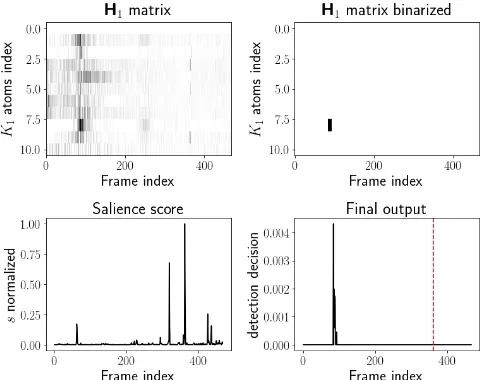
Fig. 2. Results for a gunshot event over a residential area back-ground, with a loud car passing in the first half of the file. Top row:
H1matrix from the NMF model. Bottom left: salience model out-puts. Bottom right: final output of the model, from which an event is detected for any value larger than 0. Red dashed line shows the position of the target event. Even though it was correctly recognised by the salience model, the combined models do not detect it.
There were a number of cases where the salience model was able to detect an event when the NMF was not. This is also evident from
the fact that the salience model outperforms both the NMF and the proposed method for the glass breaking event. One situation where the salience model presents an advantage is when the background noise significantly but slowly increases in level - e.g. a train passing (see Figure 2). Because a Kalman filter-based model is not sensitive to sudden feature changes, it is able to adapt to this background, and only flag a detection when changes in feature values correspond to new, ’surprising’ events. It also seems to perform well in loud cafeteria-type backgrounds (see Figure 3).
Fig. 3. Results for a gunshot event over a cafe/restaurant back-ground. Top row:H1matrix from the NMF model, before and after binarization. Bottom left: salience model outputs, after normaliza-tion. Bottom right: final output of the model, from which an event is detected for any value larger than 0. Red dashed line shows the position of the target event, which was correctly recognised by the salience model, but not the NMF model.
For the combined model, however, binarization in the NMF out-put, followed by multiplication of outputs, does not allow for detec-tion of any events not detected by NMF. With the method used to combine the two models, the main advantage of the salience model was in removing false positives. A different method, not based on a binary mask, might preserve more events detected by Kalman filters and increase hit rate.
7. CONCLUSIONS
[image:5.612.55.298.411.601.2]8. REFERENCES
[1] P. V. Hengel and J. Anem¨uller, “Audio event detection for in-home care,”Proc. of International Conference on Acoustics (NAG-DAGA), pp. 618–620, 2009.
[2] J. Kotus, K. Lopatka, and A. Czyzewski, “Detection and local-ization of selected acoustic events in acoustic field for smart surveillance applications,”Multimedia Tools and Applications, vol. 68, no. 1, pp. 5–21, 2014.
[3] M. Bugalho, J. Portˆelo, I. Trancoso, T. Pellegrini, and A. Abad, “Detecting audio events for semantic video search,” inProc. of the 10th International Conference of the International Speech Communication Association (Interspeech 2009), 2009, pp. 1151–1154.
[4] F. Meucci, L. Pierucci, E. Del Re, L. Lastrucci, and P. Desii, “A real-time siren detector to improve safety of guide in traffic environment,”Proc. of the 16th European Signal Processing Conference (EUSIPCO 2008), 2008.
[5] A. Mesaros, T. Heittola, E. Benetos, P. Foster, M. Lagrange, T. Virtanen, and M. D. Plumbley, “Detection and classification of acoustic scenes and events: Outcome of the DCASE 2016 challenge,”IEEE/ACM Trans. Audio, Speech and Lang. Proc., vol. 26, no. 2, pp. 379–393, 2018.
[6] A. Mesaros, T. Heittola, A. Diment, B. Elizalde, A. Shah, E. Vincent, B. Raj, and T. Virtanen, “DCASE 2017 challenge setup: Tasks, datasets and baseline system,” inProc. of the De-tection and Classification of Acoustic Scenes and Events 2017 Workshop (DCASE2017), 2017, pp. 85–92.
[7] T. Heittola, A. Mesaros, A. Eronen, and T. Virtanen, “Context-dependent sound event detection,”EURASIP Journal on Audio, Speech, and Music Processing, vol. 2013, no. 1, 2013. [8] A. Diment, T. Heittola, and T. Virtanen, “Sound event detection
for office live and office synthetic AASP challenge,” inIEEE AASP Challenge on Detection and Classification of Acoustic Scenes and Events (DCASE 2013), 2013, extended abstract. [9] C. V. Cotton and D. P. W. Ellis, “Spectral vs. spectro-temporal
features for acoustic event detection,”Proc. of the IEEE Work-shop on Applications of Signal Processing to Audio and Acous-tics, pp. 69–72, 2011.
[10] T. Komatsu, T. Toizumi, R. Kondo, and Y. Senda, “Acous-tic event detection method using semi-supervised non-negative matrix factorization with mixtures of local dictionaries,” in
Proc. of the Detection and Classification of Acoustic Scenes and Events 2016 Workshop (DCASE2016), September 2016, pp. 45–49.
[11] O. Dikmen and A. Mesaros, “Sound event detection using non-negative dictionaries learned from annotated overlapping events,” inProc. of the IEEE Workshop on Applications of Sig-nal Processing to Audio and Acoustics (WASPAA 2013), 2013, pp. 5–8.
[12] G. Parascandolo, H. Huttunen, and T. Virtanen, “Recurrent neural networks for polyphonic sound event detection,” in
Proc. of the IEEE International Conference on Acoustics, Speech and Signal Processing (ICASSP 2016), 2016, pp. 6440– 6444.
[13] Y. Xu, Q. Kong, W. Wang, and M. D. Plumbley, “Large-scale weakly supervised audio classification using gated convolu-tional neural network,” inProc. of the IEEE International Con-ference on Acoustics, Speech and Signal Processing (ICASSP 2016), 2018, pp. 121–125.
[14] C. Kayser, C. I. Petkov, M. Lippert, and N. K. Logothetis, “Mechanisms for allocating auditory attention: An auditory saliency map,” Current Biology, vol. 15, no. 21, pp. 1943– 1947, 2005.
[15] B. Schauerte, B. K¨uhn, K. Kroschel, and R. Stiefelhagen, “Multimodal saliency-based attention for object-based scene analysis,” inProc. of the IEEE/RSJ International Conference on Intelligent Robots and Systems (IROS 2011), 2011, pp. 1173–1179.
[16] E. M. Kaya and M. Elhilali, “Investigating bottom-up auditory attention,” Frontiers in Human Neuroscience, vol. 8, p. 327, 2014.
[17] ——, “Modelling auditory attention,”Philosophical Transac-tions of the Royal Society B: Biological Sciences, vol. 372, no. 1714, 2017.
[18] B. Schauerte and R. Stiefelhagen, “’Wow!’ Bayesian surprise for salient acoustic event detection,” inProc. of the IEEE In-ternational Conference on Acoustics, Speech and Signal Pro-cessing (ICASSP2013), 2013, pp. 6402–6406.
[19] M. Heilbron and M. Chait, “Great expectations: Is there evi-dence for predictive coding in auditory cortex?”Neuroscience, vol. 389, pp. 54–73, 2018.
[20] L. Itti and P. Baldi, “Bayesian surprise attracts human atten-tion,”Vision Research, vol. 49, no. 10, pp. 1295–1306, 2009. [21] I. Sobieraj, L. Rencker, and M. D. Plumbley,
“Orthogonality-regularized masked NMF for learning on weakly labeled audio data,” inProc. of the IEEE International Conference on Acous-tics, Speech and Signal Processing (ICASSP 2016), 2018, pp. 2436–2440.
[22] D. D. Lee and H. S. Seung, “Learning the parts of objects by non-negative matrix factorization.”Nature, vol. 401, no. 6755, pp. 788–91, 1999.
[23] A. Mesaros, T. Heittola, and T. Virtanen, “TUT database for acoustic scene classification and sound event detection,” in
Proc. of the 24th European Signal Processing Conference 2016 (EUSIPCO 2016), 2016.
[24] T. Giannakopoulos, “pyAudioAnalysis: An open-source Python library for audio signal analysis,”PLOS ONE, vol. 10, no. 12, p. e0144610, 2015.